
Fermented milk products are produced as a result of the action of specially selected microbial cultures, which lead to a decrease in the pH of the milk with or without its coagulation (Codex Alimentarius, 2003). In addition to lactic acid, which increases the acidity of milk, other metabolites are formed that shape the flavour and aroma characteristics (e.g., diacetyl, acetaldehyde, ethanol, and others) as well as the texture (e.g., exopolysaccharides). Depending on the type of starter cultures employed, this group of products includes various types of fermented milk, such as yoghurt (thermophilic lactic fermentation), acidophilus milk, cultured milk (mesophilic lactic fermentation), and kefir (mesophilic yeast-lactic fermentation), among others (Diagram 1). Some of these products also contain adjunct cultures, such as probiotics to produce therapeutic fermented milks (Robinson and Tamime, 2006).
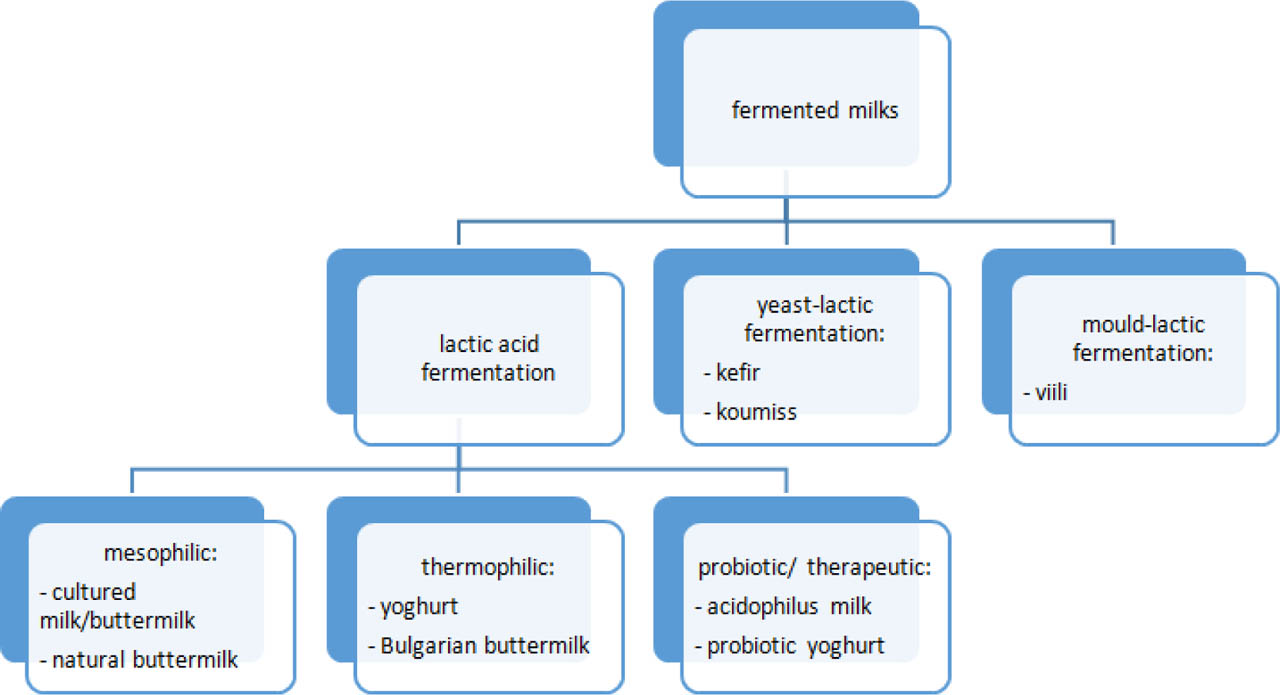
Diagram 1.
Fermented milk types with the most popular examples (Tamime et al., 2007).
The use of different cultures results in variations in the type of fermentation (lactic, yeast-lactic, mouldlactic), rate of milk acidification, differences in the profile of metabolites including aromatic volatiles and exopolysaccharides (EPS), and variations in the physicochemical properties of the acid coagulum (Li et al., 2020; Nguyen et al., 2023). Among the components of milk, protein (mainly casein) plays the most significant role in shaping the structure and consistency of yoghurt gel, as it forms the three-dimensional network of the viscoelastic gel in which other ingredients, such as serum and fat globules, are entrapped (Iličić et al., 2015; Tamime et al., 2007). Therefore, any differences in protein content and quality are reflected in the physicochemical properties of the acid milk coagulum. This also applies to differences resulting from milk protein polymorphism, which can affect milk coagulation properties in many ways, including alteration of milk components, such as proteins, fat, lactose and minerals or affecting casein micelle size (Kelly et al., 2025).
Bovine milk contains an average of 3.5% protein, of which about 80% are caseins (CNs), composed of four fractions: αs1-CN, αs2-CN, β-CN, and κ-CN (Fox et al., 2015). Moreover, milk proteins, including casein fractions, undergo genetic polymorphism. Recently, much attention has been paid to the β-CN genetic variants. Among the 13 genetic variants of β-CN, the A1 and A2 types are the most common (Jeong et al., 2024). The difference between A1 and A2 β-CN is due to a single nucleotide polymorphism at codon 67 of the β-CN gene (CSN2), leading to a substitution of histidine in A1 for proline in A2 within the polypeptide chain (Radkowska, 2020). A2 milk, containing solely the A2 variant of β-CN is believed to offer more health benefits compared to its A1 counterpart or conventional milk, which contains a mixture of A1 and A2 β-CNs. Digestion of A1 milk β-casein (β-CN), unlike the A2 variant, produces the peptide β-casomorphin-7 (β-CM-7), which has been linked to potential risk for cardiovascular, metabolic, and neurological disorders, although evidence remains inconclusive and insufficient (Cieślińska et al., 2022; Gonzales-Malca et al., 2023). In contrast, clinical studies indicate that A2 milk may improve digestive comfort and alleviate lactose intolerance symptoms, but no additional health benefits have been clearly demonstrated (Choi et al., 2024; González-Rodríguez et al., 2025; Milan et al., 2020). Nonetheless, alongside research into its health effects, there is a growing need for studies on the functional and technological properties of A2 milk, which are essential for its effective processing and industrial application.
Previous studies indicate that the β-CN genetic variant may significantly impact the coagulation process of milk and the properties of the coagulum formed through either acid or enzymatic coagulation. While most experimental results suggest that milk containing the A2 β-CN variant coagulates more slowly under the influence of rennet, producing a looser and more delicate curd (Bisutti et al., 2022; Faggion et al., 2025; Vigolo et al., 2023; Fernández-Rico et al., 2022), findings regarding acid coagulation are not as conclusive (Daniloski et al., 2022, 2024; Juan Godoy et al., 2024; Hallén et al., 2009; Juan and Trujillo, 2022; Radkowska et al., 2025, Wang et al., 2022). It is important to note that the mechanisms of these two types of coagulation differ, which may explain the differences in the properties of milk coagulated enzymatically vs. acid-coagulated milk.
Additionally, researchers have used milk from different sources (varying chemical compositions, cattle breeds, feeding methods, and genetic profiles of proteins), processed in different ways (pasteurized, UHT), and acidified using various agents (glucono-δ-lactone, different starter cultures). Our previous research demonstrated that yoghurts made from the milk of Simmental cows with the A2A2 β-CN genetic variant, compared to yoghurts made from milk with the A1A1 β-CN variant, exhibited a firmer structure and a more compact coagulum (Radkowska et al., 2025).
As outlined above, various types and combinations of starter microbial cultures characteristic of specific fermented milk products, influence not only the rate and extent of milk acidification but also contribute to the development of the desired texture, consistency, and other sensory attributes of the final products. The available literature addressing the effect of milk protein polymorphism on the quality of acid-induced milk gels either omits the consideration of starter culture application (using glucono-δ-lactone as an acidifying agent) (Daniloski et al., 2022; Hallén et al., 2009) or focuses exclusively on a single product type, most commonly yoghurt (Daniloski et al., 2024; Juan Godoy et al., 2024; Juan and Trujillo, 2022; Radkowska et al., 2025).
Given the growing body of evidence supporting the health benefits associated with the consumption of A2 milk, alongside consistent reports indicating its reduced suitability for cheese production – primarily due to its impact on both product characteristics and, more critically, manufacturing yield (Fernández-Rico et al., 2022) – it appears warranted to investigate the potential of A2 milk in the production of various types of fermented dairy milk. For this category of dairy products, where the mass of the raw material remains largely unchanged during processing, the type of milk has minimal influence on yield. Furthermore, the health-promoting properties of A2 milk, particularly its potential to mitigate symptoms of lactose intolerance, may be further enhanced through synergistic interactions with the bioactive components of starter and probiotic cultures commonly used in fermented dairy products. Therefore, the present study was undertaken with the objective of evaluating the effect of the genetic variant of β-CN on selected quality characteristics of fermented milk, while simultaneously accounting for the use of different starter culture systems, including mesophilic lactic acid bacteria (LAB) in cultured milk, a combination of mesophilic LAB and yeasts in kefir, as well as probiotic cultures and Streptococcus thermophilus in ABT-yoghurt. Such an approach enabled a comprehensive assessment of the effect of the β-CN genetic variant in milk not only on the acid gel quality but also on the growth and viability of specific groups of commonly used dairy starter cultures, as well as the sensory characteristics of various types of fermented milk products produced within the dairy industry.
Material and methods
Material
The fresh raw milk used for the production of various types of fermented milk was sourced from the Experimental Station of the National Research Institute of Animal Production in Odrzechowa, the largest facility for breeding Simmental cows in Poland. In the initial stage of the study, dairy cows were identified based on the β-CN variant, with a total of 560 cows examined. Genetic identification was conducted using the allelic discrimination assay (ADA) method with fluorescently labelled TaqMan MGB probes (Applied Biosystems) and real-time polymerase chain reaction (real-time PCR) in the Molecular Genetics Laboratory of the National Research Institute of Animal Production in Balice.
In the next phase of the study, cows carrying the A1A1 and A2A2 β-CN genotypes were selected. These cows were in their first or second lactation and at a similar stage of lactation (50–150 days). They were housed in a free-stall barn and fed uniformly according to the total mixed ration (TMR) feeding system based on nutritional standards. The animals were provided with identical care, management, and optimal welfare conditions. Milk samples from Simmental cows with A1A1 (hereafter referred to as A1 milk) and A2A2 (hereafter referred to as A2 milk) β-CN genotypes (20 individuals in each group) were collected twice a year from the same animals during milkings in June and September. These samples were then used to produce fermented milks under laboratory conditions at the Department of Animal Products Processing of the University of Agriculture in Krakow (Kraków, Poland) and subsequently analysed.
Freeze-dried lactic culture for Direct Vat Set (DVS) ABT-1-Probio-Tec™, composed of Lactobacillus acidophilus LA-5, Bifidobacterium animalis subsp. lactis BB-12 and Streptococcus thermophilus purchased from Chr. Hansen (Hoersholm, Denmark) was used for probiotic ABT-yoghurt production. Cultured milk and kefir were produced with the use of mesophilic FL-DAN culture (composition: Lactococcus lactis, Leuconostoc mesenteroides subsp. cremoris, Lactococcus lactis subsp. diacetylactis; Chr. Hansen, Denmark) or Choozit™ kefir DA LYO (composition: kefir grain microbiota, kefir yeasts, lactic acid bacteria: Lactococcus lactis, Leuconostoc spp., Lactobacillus spp., Streptococcus thermophilus; Danisco, Poznań, Poland) DVS starter cultures, respectively.
Buffered peptone water, MRS agar, M-17 agar, VRBL agar, and chloramphenicol agar were supplied from BioMaxima (Lublin, Poland). Trolox ((±)-6-hydroxy-2,5,7,8-tetramethylchromane-2-carboxylic acid) was obtained from Fluka (Buchs, Switzerland), while 2,2-diphenyl-1-picrylhydrazyl (DPPH) and 2,4,6-tris(2-pyridyl)-s-triazine (TPTZ) were purchased from Sigma-Aldrich (Steinheim, Germany and Buchs, Switzerland). All other chemicals used were of analytical reagent grade.
Production of fermented milks
Fresh raw milk (A1A1 and A2A2 separately) was first heated to 40–45°C and then centrifuged using a milk separator (LWG24E – Spomasz, Gniezno, Poland) to obtain a fat content of 2%. The milk was subsequently homogenized twice at 65°C and 6 MPa using an Armfield FT9 milk homogenizer (Ringwood, England) and then pasteurized at 85°C for 15 minutes in kettles.
After pasteurization, each milk type (A1A1 and A2A2 β-CN milk) was divided into three portions for the production of probiotic yoghurt (ABT-yoghurt), kefir, and cultured milk. The milk intended for ABT-yoghurt production was cooled to 43°C, while the portions for kefir and cultured milk were cooled to 23°C. Each portion was then inoculated with the appropriate starter culture (ABT-yoghurt: 0.068 g/L; kefir: 0.005 g/L; cultured milk: 0.038 g/L milk) and transferred into sterile 200 mL glass jars with screw caps. The production process for each type of fermented milk is illustrated in Diagram 2.
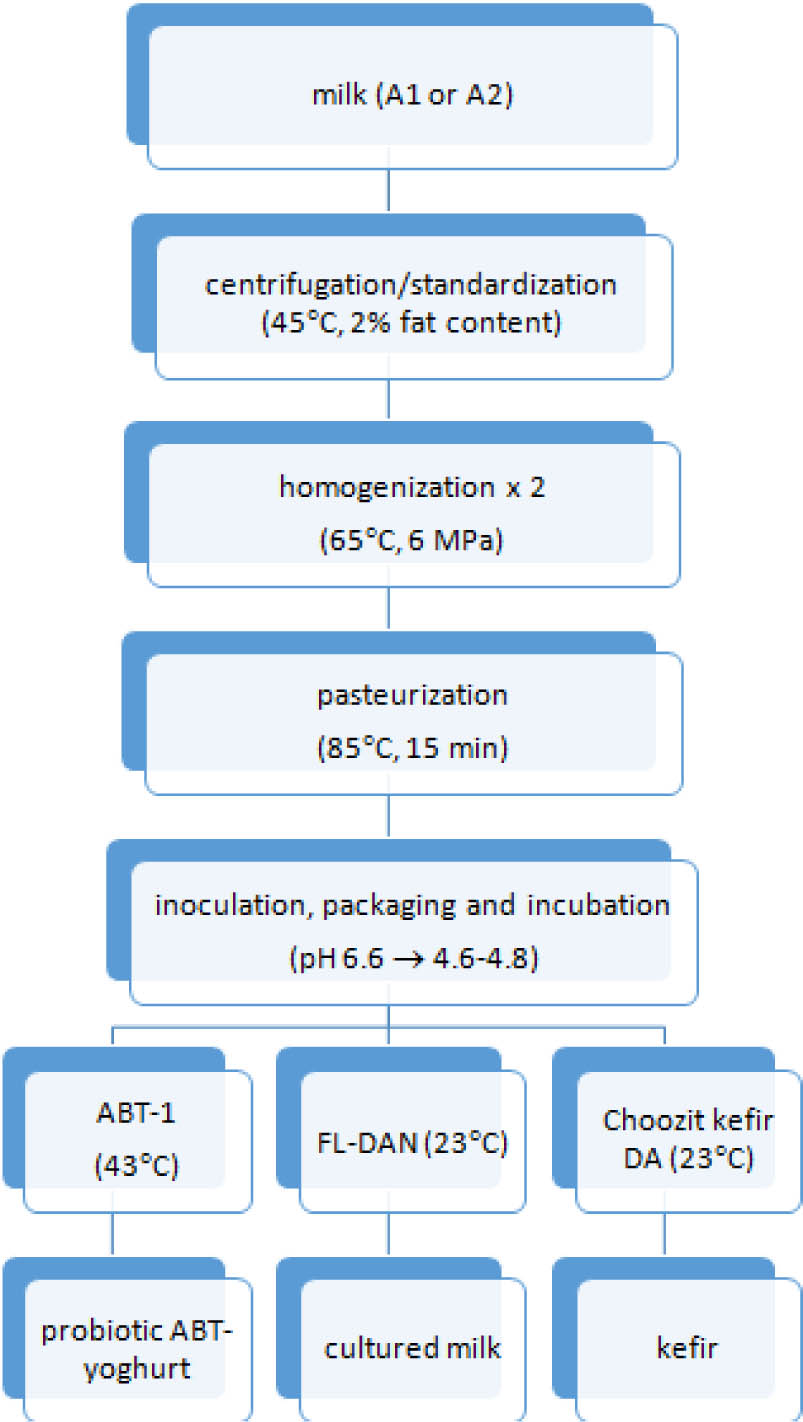
Diagram 2.
Production of fermented milks.
The incubation was carried out until pH values within the range of 4.6 to 4.8 (approximately 5 h for probiotic yoghurt and 21 h for mesophilic fermented milks) were reached. The fermented milks were then cooled and stored in the refrigerator at 4°C prior to analysis. Analyses were performed on fresh samples of fermented milks (0w) and after three-week cold storage (3w).
Analytical methods
Chemical composition
The analysis of key chemical components in fermented milks was conducted exclusively on fresh samples. This included the determination of total solids (TS), fat (F), protein (P), and ash (A) concentrations (PN-75/A 86130). The content of carbohydrates was calculated using the formula:
Titratable acidity and pH
The active acidity (pH) of the fermented milk samples was determined using an Elmetron CP-411 pH-meter (Zabrze, Poland). Titratable acidity was assessed following the Polish Standard (PN-A-86061:2002/Az1, 2006) and expressed as a percentage of lactic acid.
Antioxidant capacity
The antioxidant capacity of the obtained fermented milks was assessed using two methods: ferric reducing antioxidant power (FRAP), and scavenging activity against DPPH radicals, expressed as anti-radical power (ARP). The evaluation followed the procedure described in detail by Najgebauer-Lejko et al. (2011). FRAP results were expressed in mM Fe2+/kg, while ARP was reported as the mM Trolox equivalent (TE)/kg of the sample.
Texture – double compression test
The texture properties of the fermented milk samples were evaluated using a TA-XTPlus texture analyser (Stable Micro Systems, Haslemere, Surrey, UK). Prior to analysis, the samples were kept undisturbed in their original glass jar packaging (inner diameters: 45–55 mm; sample height: 50 mm) and stored at 4°C.
Texture analysis was performed using a plastic cylindrical probe (diameter: 50 mm, height: 5 mm), which penetrated the sample to a depth of 15 mm at a speed of 1 mm/s. The compression was applied twice. Based on the force-time data, the following texture parameters were calculated using dedicated software:
– Hardness: the maximum force recorded during the first compression cycle (N),
– Adhesiveness: the work required to withdraw the probe from the sample during the first compression cycle (|N∙s|),
– Cohesiveness: the ratio of the positive force area during the second compression cycle to that of the first cycle (dimensionless value),
– Gumminess: the product of hardness and cohesiveness (N).
Rheological studies
The rheological properties of the fermented milks were measured using a HAAKE iQ rotational rheometer (Thermo Scientific, Karlsruhe, Germany). A concentric cylinder measuring system CC 25DIN was employed, with a ring gap (distance between the inner and outer cylinder) set at 1.06 mm. Measurements were conducted using the control rate (CR) method within a shear rate range of 10–200 s−1 (kefir, cultured milk) or 10–300 s−1 (ABT-yoghurt).
The sample application procedure involved mixing the fermented milk sample with a teaspoon by stirring 10 times clockwise and 10 times counterclockwise. A sample volume of 16 mL was used. Before measurement, the sample was allowed to relax within the measuring geometry for 600 s at 10°C. Subsequently, the samples were subjected to a variable shear rate treatment in the following sequence: 1. Increasing the shear rate from 10 to 200 (kefir, cultured milk) or 300 s−1 (ABT-yoghurt) over 90 s (momentum curve); 2. Maintaining a constant shear rate of 200/300 s−1 for 10 s (structure destruction phase); 3. Decreasing the shear rate from 200/300 s−1 to 10 s−1 over 90 s (return curve).
Based on the measured shear stress τ values (Pa) and the applied shear rate γ values (s−1), flow curves were plotted. The rheological parameters of the analysed fermented milk samples were determined using the Herschel-Bulkley model, described by the following equation:
where: τ is the shear stress (Pa), τ0 is the yield stress (Pa), k is the consistency coefficient (Pa·sn), γ is the shear rate (s−1), and n is the flow behaviour index (−).The area of the hysteresis loop and the apparent viscosity (η) for each sample were also calculated at the different shear rates. Viscosity curves were plotted as a function of the calculated apparent viscosity (η) and the applied shear rate γ· (s−1). The initial apparent viscosity was determined at a shear rate of 10 s−1, while the final viscosity was recorded at 200 s−1 (kefir, cultured milk) or 300 s−1 (ABT-yoghurt). The yield point was determined empirically as the intersection of two tangents drawn to the flow curve in a double logarithmic coordinate system of shear stress (τ) vs. shear rate (γ·).
Instrumental colour measurement
Colour reflectance measurement was conducted using a Konica Minolta CM-3500d spectrophotometer (Konica Minolta Sensing Inc., Osaka, Japan) with a standard illuminant and D65/10° settings. Before measurement, each sample was warmed to 20°C and thoroughly mixed with a spatula. The following coordinates were measured using CIE L*a*b* colour system: L* (lightness), ranging from 0 (black) to 100 (white), a* coordinate, where negative values indicate green and positive values indicate red, and b* coordinate, where negative values indicate blue and positive values indicate yellow. Moreover, hue angle (h) and chroma (C) were determined. Additionally, the total colour difference values (ΔE) between A1 and A2 fermented milks and between fresh and stored samples were calculated (Eq. 3).
where ΔL*, Δa*, and Δb* were the differences between the values of the respective colour characteristics of compared products.Sensory quality
The sensory quality of the obtained fermented milks was assessed in accordance with PN-ISO 6658 (1998) using a 5-point scale (ranging from 1 – very bad to 5 – excellent). A trained panel of seven judges, consisting of academic staff and students, carried out the evaluation. The sensory attributes assessed in the fermented milks included colour, appearance, consistency, odour, and taste. The overall preference, referred to as the total score, was calculated by applying specific weighting factor to each quality feature (0.10 for colour, 0.15 for appearance, 0.25 for consistency, 0.15 for odour, and 0.35 for taste).
Microbiological quality
Decimal dilutions of ABT-yoghurt, kefir, and cultured samples were prepared in buffered peptone water. The enumeration of Streptococcus thermophilus colonies in probiotic yoghurt was performed using the pour-plate technique on M17 agar under aerobic conditions (ISO 7889/IDF 117, 2003). Lactobacillus acidophilus colonies were enumerated aerobically using MRS agar (pH 6.4) (IDF Standard 149A, 1997). Bifidobacteria were cultured anaerobically in CO2 incubators on NNLP-MRS agar, which is MRS supplemented with 5% NNLP (nalidixic acid, neomycin sulphate, lithium chloride, and paromomycin sulphate) (Dave and Shah, 1996). All cultures were incubated at 37°C for 48 h (streptococci) or 72 h (lactobacilli and bifidobacteria). Lactococcus spp. in kefir and cultured milk were enumerated using M17 agar (pH 7.15) and incubated aerobically at 30°C for 72 h, following IDF Standard 149A (1997). The number of Lactobacillus spp. colonies in kefir was assessed using MRS agar (pH 6.2) under anaerobic conditions at 37°C for 72 h. Yeast and moulds were grown aerobically on chloramphenicol agar at 25°C for five days (IDF 94:2004, 2004). In kefir samples, yeast colonies were distinguished from moulds macroscopically and microscopically.
To verify that the tested products did not contain contaminating microorganisms such as coliform bacteria, a pour plate method was performed using VRBL agar, followed by incubation at 30°C for 24 hours, in accordance with ISO 4832:2006 (2006).
Experimental design and statistical analysis
The analyses were conducted in four replicates (2 batches and 2 repetitions), and the results were expressed as average values ± SD. The basic chemical composition and sensory quality of the specific fermented milks were evaluated using fresh samples and subjected to statistical analysis using the t-test. Storage tests − including acidity determination, microbiological study, antioxidant properties, textural and rheological analysis, and colour assessment − were performed on the fresh samples and after three weeks of storage at 4°C. These data were statistically analysed using a two-way ANOVA, taking the type of milk used for fermentation (A1 or A2) and storage time as variability factors. When applicable, differences between average values were assessed using Duncan's post-hoc test, with statistical significance set at P≤0.05. Statistical analyses were conducted using Statistica 13.3 software (TIBCO Software Inc., Palo Alto, CA, USA).
Results
Chemical composition
The basic chemical composition of A1 and A2 fermented milks is presented in Table 1. The table presents a single value for each characteristic of milk with a given β-casein (β-CN) genetic variant, regardless of the type of fermented milk (ABT-yoghurt, kefir, cultured milk), as they were all prepared from the same batch of milk and subjected to the same treatment up to the point of inoculation. There were no statistically significant differences observed in total solids (TS), milk solids non-fat (MSNF), or the concentration of any analysed chemical component based on the β-CN genetic variant in the milk.
Acidity and antioxidant capacity
The analysed A1 and A2 fermented milks, regardless of their type, did not differ significantly in acidity level and pH (Table 2). Likewise, no changes in acidity were observed in either type of mesophilic fermented milk three weeks after production. In contrast, ABT-yoghurts showed a significant increase in acidity accompanied by a decrease in pH after storage.
Table 2.
Acidity and antioxidant characteristics of the fresh (0w) and stored (3w) A1 and A2 fermented milks (x ±SD, n=4)
| Characteristic | ABT-yoghurt | Kefir | Cultured milk | ||||
|---|---|---|---|---|---|---|---|
| 0w | 3w | 0w | 3w | 0w | 3w | ||
| pH | A1 | 4.75 b±0.15 | 4.41 a±0.09 | 4.58 a±0.03 | 4.54 a±0.03 | 4.49 a±0.01 | 4.47 a±0.04 |
| A2 | 4.72b±0.08 | 4.40 a±0.08 | 4.58 a±0.03 | 4.54 a±0.04 | 4.50 a±0.02 | 4.45 a±0.03 | |
| Acidity (% lactic acid) | A1 | 0.70 a±0.06 | 0.83 b±0.03 | 0.92 a±0.03 | 0.89 a±0.02 | 0.98 a±0.03 | 0.95 a±0.03 |
| A2 | 0.70 a±0.03 | 0.81 b±0.05 | 0.90 a±0.02 | 0.90 a±0.01 | 0.94 a±0.03 | 0.96 a±0.02 | |
| FRAP (mMFe2+/kg) | A1 | 0.97 a±0.36 | 0.83 a±0.11 | 0.72 a±0.01 | 0.74 a±0.03 | 0.92 a±0.10 | 0.88 a±0.22 |
| A2 | 0.96 a±0.28 | 0.76 a±0.05 | 0.67 a±0.09 | 0.66 a±0.08 | 0.87 a±0.12 | 0.81 a±0.10 | |
| ARP (mMTE/kg) | A1 | 0.32 a±0.27 | 0.25 a±0.09 | 0.23 a±0.19 | 0.26 a±0.13 | 0.29 a±0.25 | 0.29 a±0.14 |
| A2 | 0.29 a±0.16 | 0.30 a±0.15 | 0.23 a±0.16 | 0.27 a±0.11 | 0.31 a±0.26 | 0.31 a±0.17 | |
The β-CN genetic variant in milk had no significant effect on either the anti-radical power (ARP) against the 2,2-diphenyl-1-picrylhydrazyl (DPPH) radical or the ferric reducing antioxidant power (FRAP). Furthermore, neither of the antioxidant measures showed any significant changes in the fermented milks after three weeks of refrigerated storage (Table 2). When comparing the results for different types of fermented milk, kefir exhibited slightly lower antioxidant activity than either probiotic yoghurt or cultured milk.
Texture and rheological properties
Table 3 presents the results of the instrumental texture test and rheological analysis in the flow behaviour range of the analysed fermented milk products. Among all tested samples, probiotic ABT-yoghurts exhibited approximately twice the values of hardness, adhesiveness, and gumminess compared to kefirs and cultured milks, which showed similar textural characteristics.
Table 3.
Textural and rheological characteristics of the analysed fresh (0w) and stored (3w) fermented milks (x ±SD, n=4)
| Attribute | ABT-yoghurt | Kefir | Cultured milk | ||||
|---|---|---|---|---|---|---|---|
| 0w | 3w | 0w | 3w | 0w | 3w | ||
| Hardness (N) | A1 | 0.85 a±0.09 | 1.13 b±0.16 | 0.39 a±0.01 | 0.49 bc±0.04 | 0.45 a±0.02 | 0.50 a, b±0.01 |
| A2 | 0.97 a±0.07 | 1.28 b±0.04 | 0.46 b±0.04 | 0.54 c±0.07 | 0.51 b±0.02 | 0.59 c±0.06 | |
| Adhesiveness (|N·s|) | A1 | 1.52 a±0.19 | 2.41 a±0.37 | 0.63 a±0.05 | 0.89 a±0.17 | 0.74 a±0.14 | 1.08 b±0.09 |
| A2 | 2.25 a±0.62 | 1.63 a±0.93 | 0.92 a±0.29 | 1.39 b±0.38 | 1.12 b±0.24 | 1.21 b±0.31 | |
| Cohesiveness (−) | A1 | 0.44 c±0.01 | 0.38 a±0.01 | 0.48 a±0.01 | 0.46 a±0.04 | 0.50 a±0.00 | 0.48 a±0.01 |
| A2 | 0.41 b±0.01 | 0.37 a±0.03 | 0.50 a±0.02 | 0.47 a±0.02 | 0.43 a±0.12 | 0.51 a±0.01 | |
| Gumminess (N) | A1 | 0.37 a±0.04 | 0.43 a, b±0.05 | 0.19 a±0.00 | 0.22 a, b±0.01 | 0.22 a, b±0.01 | 0.22 a±0.01 |
| A2 | 0.40 a±0.03 | 0.47 b±0.02 | 0.23 b±0.01 | 0.26 c±0.04 | 0.26 b±0.02 | 0.29 c±0.02 | |
| Hysteresis loop area (kPa · s−1) | A1 | 4.63 a±0.25 | 4.73 a±0.31 | 1.46 a±0.10 | 1.50 a±0.09 | 1.70 a±0.07 | 1.71 a±0.06 |
| A2 | 8.54 b±0.09 | 8.61 b±0.35 | 1.93 b±0.09 | 1.78 b±0.16 | 1.91 b±0.04 | 2.10 c±0.17 | |
| k (Pa sn) | A1 | 2.89 a±0.26 | 4.17 b±0.40 | 1.55 a±0.40 | 5.19 b±0.74 | 6.73 a±0.24 | 6.58 a±0.35 |
| A2 | 7.90 c±0.65 | 12.23 d±0.90 | 4.42 b±0.35 | 4.92 b±0.73 | 7.29 a±0.71 | 7.27 a±0.67 | |
| n | A1 | 0.40 c±0.01 | 0.24 b±0.01 | 0.37 c±0.02 | 0.29 b±0.05 | 0.25 a±0.01 | 0.27 a±0.01 |
| A2 | 0.26 b±0.03 | 0.16 a±0.02 | 0.23 a±0.01 | 0.32 b±0.01 | 0.24 a±0.03 | 0.26 a±0.04 | |
| Initial η (Pas) | A1 | 4.90 a±0.28 | 4.79 a±0.06 | 1.71 a±0.11 | 2.32 b±0.38 | 2.48 a±0.11 | 2.71 a±0.22 |
| A2 | 6.07 b±0.21 | 6.88 c±0.46 | 2.17 a, b±0.18 | 2.57 b±0.25 | 2.82 a±0.14 | 2.87 a±0.26 | |
| Final η (Pas) | A1 | 0.21 b±0.01 | 0.15 a±0.00 | 0.14 a±0.01 | 0.16 a±0.03 | 0.16 a±0.00 | 0.19 b±0.01 |
| A2 | 0.24 c±0.02 | 0.18 a, b±0.01 | 0.16 a±0.01 | 0.17 a±0.01 | 0.18 b±0.01 | 0.21 c±0.00 | |
| τ0 (Pa) | A1 | 23.13 a±1.11 | 25.74 b±1.00 | 12.68 a±1.31 | 12.81 a±1.55 | 11.26 a±1.75 | 13.29 a±0.97 |
| A2 | 29.67 c±1.16 | 29.28 c±1.01 | 10.96 a±1.30 | 11.92 a±0.99 | 18.03 b±1.03 | 17.11 b±0.59 | |
When comparing the evaluated mesophilic fermented milks in terms of the β-CN genetic variant, it was observed that the A2 type, in comparison to A1, demonstrated slightly higher values of hardness (in fresh kefirs and both fresh and stored cultured milks, P≤0.05), adhesiveness (in stored kefirs and fresh cultured milks, P≤0.05), and gumminess (in kefirs and stored cultured milks, P≤0.05). The cohesiveness of kefirs and fermented milks did not significantly differ between the A1 and A2 milk types. In contrast, although the trends in probiotic ABT-yoghurts were generally similar to those observed in mesophilic products, the differences in hardness and adhesiveness between A1 and A2 variants were not statistically significant. However, fresh A2 yoghurts exhibited reduced cohesiveness compared to their A1 counterparts. Regardless of the variant of β-CN, refrigerated storage led to an increase in hardness of almost all treatments, whereas cohesiveness either remained unchanged in mesophilic fermented milks or even slightly decreased in thermophilic milk products. More pronounced changes after storage were noticed in A2 variants of fermented milks, including a significant increase in the hardness and gumminess of all types of fermented milks and a rise in the adhesiveness in kefirs.
In the rheological analysis within the flow region, all examined types of fermented milk products produced from A2 milk exhibited significantly higher hysteresis loop area values compared to their A1 counterparts (Table 3). The most pronounced differences were observed in probiotic ABT-yoghurts, where the A2 variant demonstrated nearly double the hysteresis loop area, indicating markedly lower structural resistance to deformation. Compared to A1 ABT-yoghurt, the one made from A2 milk also exhibited substantially higher consistency coefficient (k) values, further increased substantially following three weeks of refrigerated storage. Moreover, these samples deviated more notably from Newtonian fluid behaviour, as evidenced by lower flow behaviour index (n) values. Additionally, they presented considerably higher apparent viscosity at a shear rate of 10 s−1, as well as increased final viscosity (η) and yield stress (τ0). In contrast, fermented milk products produced using mesophilic cultures, such as kefir and cultured milk, showed considerably smaller differences between the genetic variants of β-CN in milk. Although larger hysteresis loop areas were consistently observed in the A2 variants of all the analysed products, significantly higher k values and lower n values were recorded only in fresh kefir samples, while higher final viscosity and yield stress were observed solely in the A2 variant of cultured milk.
The rheological behaviour of all analysed fermented milk samples was well described by the Herschel-Bulk-ley model, with coefficients of determination (R2) ranging from 0.98 to 0.99 (data not shown).
Colour characteristics
Figure 1 presents the results of colour measures (L*, a*, b*, h, C) for probiotic ABT-yoghurts, kefirs, and fermented milks, depending on the genetic variant of β-CN in the milk and the storage time under refrigeration. No significant differences were observed in any determined colour characteristics for probiotic yoghurts, either due to storage time or the genetic type of β-CN in the milk. Similarly, no significant differences were found in the lightness (L*), green-red colour coordinate (a*), and blue-yellow coordinate (b*) values for kefirs and cultured milks. However, some minor but statistically significant (P≤0.05) fluctuations were noted in these products, specifically related to colour saturation and hue angle. Fresh A2 kefir exhibited a colour saturation approximately 1.5 units higher than A1 kefir after storage. For A2 kefir, a significant increase in hue angle was observed after three weeks of storage (Δh 0w-3w = 1.37°). Slightly larger differences in C and h values were found in cultured milks. Fresh A1 cultured milk showed significantly lower colour saturation (106.6 vs. 107.8) compared to its A2 counterpart. However, after three weeks, the C value for A2 cultured milk decreased to a level comparable to A1 cultured milk (106.3 vs. 106.5). In contrast, the hue angle of A1 cultured milk increased by 1.5° after three weeks of storage. Generally, probiotic ABT-yoghurt slightly differed from both mesophilic fermented milks, showing a darker, more yellow and more vivid colour. The difference for colour and lightness between two specimens (∆E) took the values of 0.26, 0.11, and 0.15 respectively for ABT-yoghurt, cultured milks and kefirs when A1 and A2 variants were compared (data not shown). The average colour difference (∆E) between fresh and stored fermented milk samples calculated for ABT-yoghurts was equal to 0.18 and for mesophilic milks 0.35 (kefir) and 0.40 (cultured milk). Such small values (below 1.0) indicate that there were no differences between A1 and A2 fermented milks, nor between fresh and stored samples, which could be distinguished by the human eye.
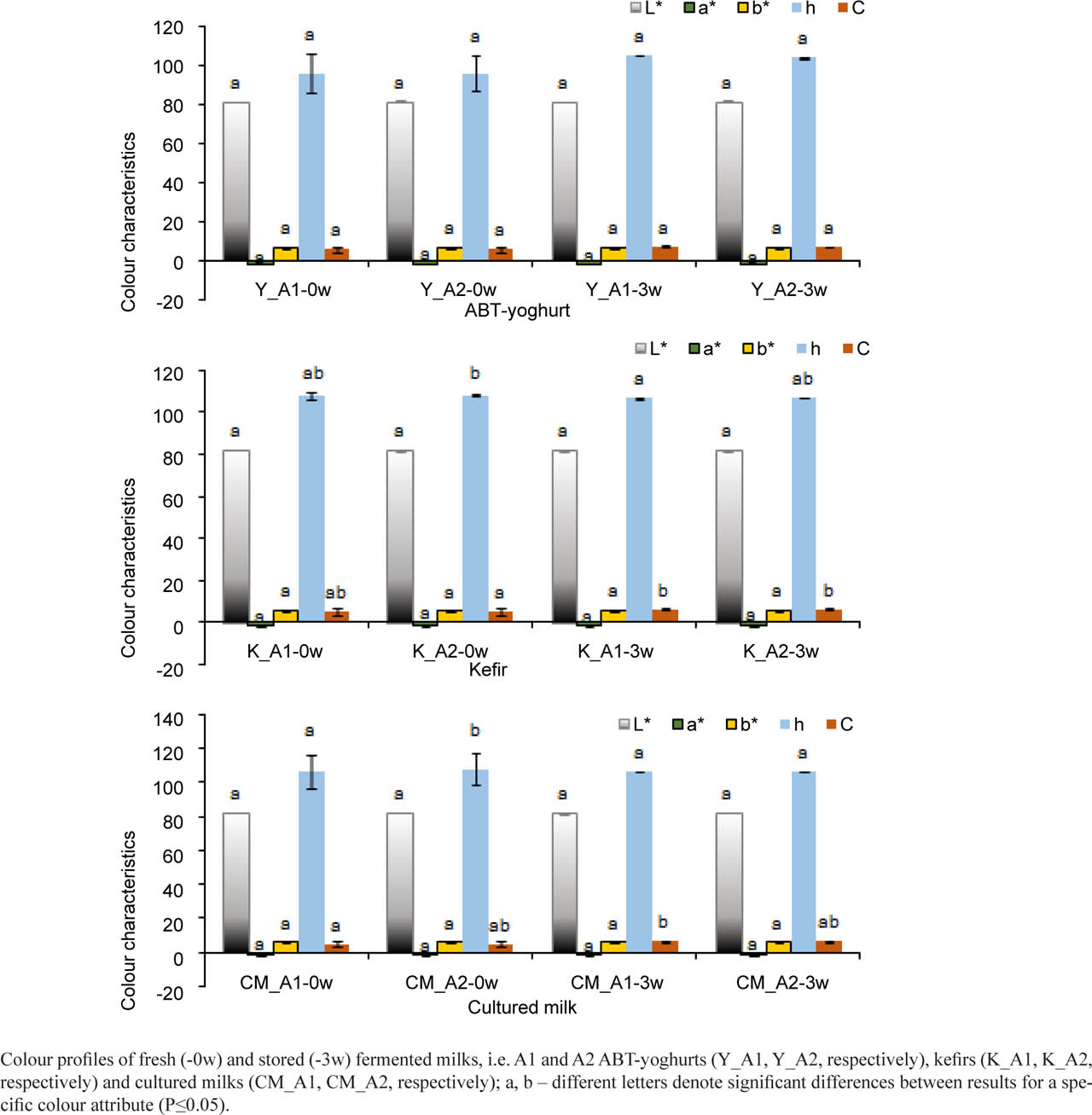
Figure 1.
Colour profiles of fresh and stored fermented milk products produced from A1 and A2 milk.
Sensory quality
Across all types of fermented milk tested, no statistically significant differences were found in the colour, odour or taste depending on the polymorphic variant of β-CN in the milk (Table 4). The total score values, calculated based on the panellists' ratings for all sensory quality attributes and taking into account the appropriate weighting coefficient, suggest that all products, regardless of type and variant, exhibited good sensory quality (scores above 4). No tested sensory attributes of probiotic ABT-yoghurt were influenced by the β-CN genetic variant. In the case of cultured milk, the A2 variant was rated higher in terms of appearance and consistency, receiving a better overall sensory quality score compared to the A1 variant. In contrast, for kefir, although there were no differences in overall evaluation based on the type of β-casein, the A2 kefir was rated lower in terms of consistency.
Table 4.
Sensory properties of A1 and A2 fermented milks (x ±SD, n=14)
| Sensory characteristic | ABT-yoghurt | Kefir | Cultured milk | |||
|---|---|---|---|---|---|---|
| A1 | A2 | A1 | A2 | A1 | A2 | |
| Colour | 4.82 a±0.37 | 4.82 a±0.54 | 4.93 a±0.27 | 4.93 a±0.27 | 4.86 a±0.36 | 5.00 a±0.00 |
| Appearance | 3.64 a±0.66 | 3.29 a±0.75 | 4.32 a±0.42 | 4.29 a±0.80 | 4.00 a±0.55 | 4.61 b±0.59 |
| Consistency | 4.43 a±0.58 | 4.29 a±0.67 | 4.89 b±0.29 | 4.39 a±0.71 | 4.32 a±0.64 | 4.86 b±0.53 |
| Odour | 4.57 a±0.42 | 4.54 a±0.37 | 4.89 a±0.29 | 4.61 a±0.49 | 4.54 a±0.66 | 4.57 a±0.51 |
| Taste | 4.46 a±0.57 | 4.29 a±0.58 | 4.50 a±0.48 | 4.64 a±0.57 | 4.50 a±0.73 | 4.71 a±0.38 |
| Total score | 4.38 a±0.35 | 4.23 a±0.41 | 4.67 a±0.26 | 4.55 a±0.43 | 4.42 a±0.50 | 4.74 b±0.21 |
Microbiological quality
The count of the starter microorganisms in fresh (0w) and stored (3w) fermented milks, produced from milk containing either A1 or A2 β-CN, is presented in Table 5.
Table 5.
Microbiological characteristics of the analysed fermented milks (x ±SD, n=4)
| A1A1 | A2A2 | ||
|---|---|---|---|
| ABT-yoghurt | |||
| Lb. acidophilus LA-5 | 0 | 8.47 a±0.04 | 8.39 a±0.07 |
| 3 | 8.20 a±0.01 | 8.42 a±0.15 | |
| Bifidobacterium BB-12 | 0 | 6.42 a±0.66 | 6.65 a±0.95 |
| 3 | 5.48 a±0.54 | 5.45 a±0.85 | |
| Str. thermophilus | 0 | 9.16 a±0.74 | 9.13 a±0.81 |
| 3 | 8.51 a±0.14 | 8.52 a±0.02 | |
| Kefir | |||
| Lactobacillus spp. | 0 | 9.16 a±0.69 | 8.93 a±0.88 |
| 3 | 6.76 b±0.31 | 6.73 b±1.03 | |
| Lactococcus spp. | 0 | 9.16 a±0.04 | 9.19 a±0.05 |
| 3 | 8.20 b±0.40 | 8.01 b±0.30 | |
| Yeasts | 0 | 2.99 a±0.65 | 3.13 a±0.57 |
| 3 | 4.33 a±0.22 | 3.59 a±1.28 | |
| Cultured milk | |||
| Lactococcus spp. | 0 | 8.98 a±0.37 | 8.92 a±0.19 |
| 3 | 7.45 b±0.05 | 7.44 b±0.16 | |
Contaminating microbes, i.e., coliform bacteria and mould, were not detected in 0.1 g of any of the analysed fermented milks. In any case, the type of β-CN in the raw milk used for fermentation had no significant impact on the number of specific starter microorganisms in the analysed fermented milks. Moreover, in thermophilic ABT-yoghurt the level of all starter bacteria did not change substantially during storage. Conversely, in mesophilic fermented milks the number of lactic acid bacteria (LAB) significantly decreased after three weeks of refrigerated storage. The count of lactococci in kefir and cultured milk decreased by about one log cycle, whereas reduction of lactobacilli count in kefir reached above two log cycles throughout the three weeks of the experiment. On the contrary, the number of yeast cells in kefir slightly increased, however the change was not statistically significant (P>0.05).
Discussion
All tested fermented milk types were produced from the same tank milk batches standardized to 2 ± 0.1% fat content. Consequently, none of the obtained fermented milk types (kefir, ABT-yoghurt and cultured milk) within the same A1 or A2 genetic variant of β-casein (β-CN) differed in basic chemical composition (Table 1). Moreover, there were no significant compositional differences between A1 and A2 fermented milks. The milk used for the production exhibited a typical chemical profile consistent with literature data for Simmental cow milk (Litwińczuk et al., 2016). These findings are in agreement with previous research reporting no significant differences in the basic chemical compositions of milk with various β-CN phenotypes, i.e. A1/A1, A1/A2 and A2/A2 (de Vitte et al., 2022; Gai et al., 2023) as well as between homozygous A1/A1 and A2/A2 milk (Nguyen et al., 2018 a).
No significant impact of the β-CN genetic variant was found on coagulation time, final pH or titratable acidity of fresh and stored ABT-yoghurts, kefirs and cultured milks. The final pH of the specific fermented milk type was reached at the same time for A1 and A2 milk. Thus, our results do not confirm findings of Daniloski et al. (2022, 2024), who reported that A2/A2 β-CN milk requires more time to coagulate under acidic conditions. Gai et al. (2023) found that acid coagulation induced by glucono-δ-lactone (GDL), measured using a rheometer, took slightly longer in A2/A2 milk compared to A1/A1 and A1/A2 milk; but the differences were not statistically significant. It is important to note that acidification with GDL, used in the studies by Daniloski et al. (2022) and Gai et al. (2023), proceeds more rapidly than fermentation by starter cultures. Moreover, bacterial gels differ in their physical and rheological properties from those formed using GDL (Lucey and Singh, 1997). In contrast, Nguyen et al. (2018 a) found no significant difference in the fermentation time needed to reach the final pH of 4.6, between A1/A1 and A2/A2 variants of milk incubated with yoghurt cultures at 43°C. However, according to the authors, A2 milk formed a softer gel and needed more time to achieve the gelation point (G'=1 Pa). Similarly, Juan and Trujillo (2022) reported no differences in coagulation time and acidification rate between A2/A2 β-CN and control milk (containing both A1 and A2 β-CN) when fermented with yoghurt starter bacteria. Likewise, Ketto et al. (2017) and Hallén et al. (2009) found no significant effect of β-CN polymorphism in milk on acid coagulation properties, but emphasized other influential factors such as protein and lactose content, salt distribution, κ-CN and composite αs1-β-κ-CN genotypes and β-LG genetic variant. This phenomenon is advantageous from a technological perspective, as it suggests that A2 milk does not require extended coagulation time during the manufacture of various fermented dairy products.
Beyond coagulation time, other key quality determinants of fermented milks include gel body and texture, consistency and other sensory attributes (Lucey, 2004). The fermented milk products produced in this study were set-type products, as the inoculated pure milk base was allowed to coagulate in the containers, and the final gel was neither broken nor blended with any additives. Therefore, a firm, gel-like structure was expected (Tamime et al., 2007). However, many compositional and processing factors can affect the physical properties of acidified milk gels, including raw milk quality and composition (e.g., total solids, protein, fat, fatty acids), fortification levels and materials, stabilizers, heat treatment, homogenization, type and dose of starter culture, incubation temperature, final pH, cooling conditions and post-manufacturing handling (Béal and Helinck, 2014; Lucey, 2004; Lucey and Singh, 1997). Thus, textural analyses were conducted to determine whether the genetic polymorphism of milk β-CN could influence the hardness, adhesiveness, cohesiveness and gumminess of various, specific fermented milk types. In the present study, slightly higher hardness values were observed for the A2 fermented milk samples, aligning with previous findings on A2 and A1 traditional yoghurts (Radkowska et al., 2025). Conversely, Nguyen et al. (2018 a) reported lower firmness in A2/A2 yoghurts, which was supported by confocal laser scanning microscopy (CLSM) and cryogenic scanning electron microscopy (cryo-SEM) images, which revealed a less compact and more porous gel microstructure, composed of thinner protein strands, compared to the corresponding A1/A1 yoghurts. Lower gel strength, cohesiveness and resistance to deformation in A2/A2 yoghurts compared to both A1/A1 and A1/A2 variants, as measured via small deformation rheological and back extrusion tests, was also reported by Daniloski et al. (2024). The authors also observed conformational differences in the protein matrix, with A2/A2 gels exhibiting a more open and porous microstructure. In contrast, Juan and Trujillo (2022), using the Optigraph® system to monitor acid coagulation properties, found higher gel density in A2 milk when compared to the control, conventional milk (a mixture of A1 and A2 β-CN), which is in line with our findings. Further research by Juan Godoy et al. (2024), aimed at comparing selected qualitative characteristics of yoghurts obtained from A2 milk with conventional yoghurts (containing both A1 and A2 β-CN), demonstrated greater firmness in A2 yoghurts, confirmed in both instrumental and sensory evaluations. Cendron et al. (2021) reported that the negative impact of A2/A2 β-CN on milk coagulation can be mitigated through the selection of cows with specific composites. For instance, milk from Italian Holstein cattle with the A2A2-AB-BB variant of β-CN-β-LG-κ-CN composite genotype exhibited good coagulation properties (Cendron et al., 2021).
More information on the physicochemical features of the fermented milk, particularly the consistency of the intact product and its structural response to applied deformation (e.g. during transport or mixing), can be obtained from rheological studies. Shear flow measurements of yoghurts performed in our study confirmed previous findings indicating that fermented milks exhibit pseudoplastic behaviour, with apparent viscosity decreasing as shear rate increases (Lee and Lucey, 2010). Generally, samples made from milk containing the A2 variant of β-CN were more viscous, as reflected by higher consistency coefficients and apparent viscosity values, and exhibited greater resistance of the protein network to flow, indicated by higher yield stress. However, under mechanical stress, these gels underwent more extensive and less reversible structural breakdown, as evidenced by larger hysteresis loop areas and lower flow behaviour index (n) values, suggesting increased susceptibility to shear-induced thinning. Notably, the influence of the β-CN phenotype on rheological behaviour varied among fermented milk types, with the most pronounced effects observed in probiotic yoghurts, and the least in cultured milk. From a practical perspective, these findings suggest that A2 milk-based fermented milk products, particularly probiotic yoghurts, may exhibit reduced mechanical stability during the processing following fermentation, or post-manufacturing handling. This aspect should be especially taken into account during the production of mixed fermented milk beverages processed by the tank method. The effect of protein single and composite polymorphism on the physical properties of cultured milk was also studied by Ketto et al. (2018). However, the authors focused on milk with different αs1-CN, κ-CN, and β-LG phenotypes, all containing exclusively the A2 β-CN variant. They observed a combined effect of protein content and β-LG phenotype on the yield stress of the cultured milk gels. The findings of Ketto et al. (2018, 2019) and Cendron et al. (2021) support the hypothesis that the polymorphism of a single milk protein may be insufficient to fully and conclusively explain differences in the physicochemical properties (e.g. texture, viscosity) of acid gels obtained from A1 and A2 β-CN milk. This was also confirmed by Kelly et al. (2025), who discussed the challenges in interpreting the diverse and often contradictory literature reports on the effects of milk protein polymorphism on milk coagulation characteristics, both rennet- or acid-induced. The authors emphasized that such inconsistency arises from the inherent complexity of milk, making it extremely difficult, if not impossible, to isolate the impact of a single component, such as the β-CN variant, without interference from other interacting factors.
The superior texture and rheological properties of probiotic yoghurt samples compared to mesophilic fermented milks, can be attributed to the formation of a more compact protein matrix, resulting from higher fermentation temperatures and more rapid acidification associated with thermophilic starter cultures (Lucey, 2004). Moreover, enhanced production of exopolysaccharides (EPS), especially by Streptococcus thermophilus and Bifidobacterium spp., significantly contributes to yoghurt viscosity and gel strength (Iličić et al., 2015; Lucey, 2004). In contrast, although kefiran (an EPS present in kefir) positively affects texture development (Hamet et al., 2015), the structural integrity of the gel may be undermined by carbon dioxide generated through fermentative yeast activity (Farnworth and Mainville, 2003).
The fermented milk samples in this study were relatively bright, exhibiting greenish-yellow tones. The characteristic white colour of plain milk arises from light scattering by fat globules, calcium caseinate, and phosphate. Green and yellow hues result from water- and fat-soluble pigments, such as riboflavin and carotenoids (Chudy et al., 2020). The primary factors influencing the colour of plain dairy products include compositional and processing factors (e.g., homogenization, heat treatment), as well as storage conditions. According to Rój and Przybyłowski (2012), the colour profile of plain yoghurt is significantly influenced by fat content, with higher fat levels producing a lighter, more yellow appearance. Compared to our findings, they reported higher L* values (~91), higher b* values (7.3–8.5), and lower a* values (−3.6 to −4.4) for yoghurts containing 1.5–2% fat. Similarly, Chudy et al. (2020) observed greater lightness and more pronounced yellow and green hues in yoghurts with 2% fat. In our study, the lightness and other colour characteristics of the fermented milks were not influenced by the β-CN variant, likely due to similar chemical compositions and identical processing conditions prior to fermentation of both milk variants. In a study by de Vitte et al. (2022) comparing milk composition and sensory properties among crossbred Simmental × Holstein cows from one herd with different β-CN phenotypes, the authors reported a significant influence of β-CN polymorphism on colour profile. The A1/A2 milk differed the most from A1/A1 and A2/A2 milks, with A2/A2 being the closest to the gold standard for colour. In the cited study, A2/A2 was greener than A1/A1 variant, while no significant differences were observed in L* and a* values. Despite minor differences in the individual colour attributes observed in our study, the calculated colour differences (∆E) were sufficiently small (below 1.0) that these differences were not perceptible to the human eye, as confirmed by the results of the sensory analysis.
In terms of sensory characteristics, Juan Godoy et al. (2024) reported that both consumers and expert panellists rated A2 yoghurts higher than conventional ones. Ladyka et al. (2024) observed no sensory defects in taste, smell or texture in A2 milk-based fermented products. Taken together with microbiological and physicochemical results, the authors concluded that the production of fermented milk from A2 milk does not require adjustments to standard production protocols. Our findings regarding sensory quality of different types of fermented milk are consistent with these observations. Moreover, the findings from the sensory analysis corroborate the results of instrumental rheological measurements, texture analysis, and colour assessment. Panellists identified differences in the appearance and consistency of the tested products, while no significant differences in colour were observed, aligning with the outcomes of the instrumental evaluations.
The lack of significant influence of the β-CN pheno-type in milk on the growth and viability of specific starter cultures across all tested types of fermented milk is supported by the findings of Ladyka et al. (2024), who observed no differences in lactococci counts among A1/A1, A2/A2, and A1/A2 mesophilic fermented milks. Likewise, Juan Godoy et al. (2024) observed no differences in starter culture growth between A2 and conventional yoghurts (containing both A1 and A2 β-CN). In probiotic ABT-yoghurt, although a decrease in viable Bifidobacterium animalis subsp. lactis (strain BB-12) colonies was observed during storage, this reduction was not statistically significant. However, by week 3, the bifidobacteria count fell below the therapeutic minimum of 1 million CFU per gram of fermented milk (Rutella et al., 2016). In contrast, viable probiotic Lactobacillus acidophillus LA-5 cells remained above this threshold throughout storage. The viability of probiotic bacteria in fermented milk may be affected by several factors, such as oxygen exposure, packaging permeability, or by metabolites produced by lactic acid bacteria (LAB) including lactic acid and hydrogen peroxide. Bifidobacteria are generally less acid-tolerant than Lb. acidophilus, and may be inhibited at a pH below 5.0 (Shah, 2000). Thus, the observed reduction in the Bifidobacterium population in the present study may be caused by the substantial drop in pH (from 4.7 to 4.4) during storage, similarly in both A1 and A2 probiotic yoghurts.
Our study demonstrated that the phenotype of β-CN in milk does not significantly affect the in vitro antioxidant properties of various types of fermented milk. This aligns with previous research showing no significant difference in antioxidant capacity between traditional yoghurts produced from A1 and A2 milk (Radkowska et al., 2025). To the best of our knowledge, no studies have been published to date specifically investigating the influence of β-CN polymorphism on the antioxidant activity in fermented milks. Limited available data, including research assessing ABTS radical scavenging activity in A2A2 vs. A1/A2 or A1/A1 milk, suggest that the antiradical activity of milk containing the A1 β-CN variant is comparable to, or even higher than, that of A2 milk (Petrat-Melin et al., 2015; da Silva Ribeiro et al, 2021). However, caseins and their derivatives (peptides, amino acids) represent only one group of anti-oxidant contributors in milk and plain dairy products. Others include carotenoids, vitamins C and E, trace minerals (zinc, selenium), enzymatic systems (superoxide dismutase, catalase, glutathione peroxidase), milk oligosaccharides, and starter microorganisms in fermented dairy products (Cichosz et al., 2017; Khan et al., 2019; Najgebauer-Lejko and Sady, 2015). Moreover, the antioxidant potential measured in vitro in the final retail product (i.e., fermented milk) may be further altered during digestion in the human gastrointestinal tract. Deth et al. (2016) reported that β-casomorphin-7 (BCM-7), a peptide released during the digestion of milk containing the A1 β-CN variant, may impair cysteine uptake, thereby reducing plasma glutathione (GSH) levels and potentially diminishing antioxidant capacity in the human organism compared to A2 milk. Conversely, Nguyen et al. (2018 b) showed that starter cultures used in yoghurt production can degrade BCM-7 during fermentation and storage.
Conclusion
In summary, the obtained results indicate that fermented milk produced from raw materials containing exclusively β-CN A1 or A2 did not differ significantly in terms of basic chemical composition, antioxidant activity, microbiological quality, or sensory characteristics. However, the type of milk was found to influence the rheological properties and, to a lesser extent, the texture of the fermented milk samples. This suggests differences in the physicochemical properties of acid gels, likely at the microstructural level, which become apparent under more substantial and prolonged deformation. This effect was particularly pronounced in thermophilic ABT-yoghurt gels, indicating a possible influence of starter cultures and incubation conditions – namely, higher temperatures and significantly shorter coagulation times – compared to mesophilic gels in kefir or cultured milk, where the differences between β-CN variants were less pronounced. From a scientific perspective, further research using more sensitive methods appears warranted to investigate the impact of milk protein polymorphism on the microstructure of fermented milk gels produced with various starter cultures. Another aspect worthy of future study is the behaviour of acid gels during the production of stirred fermented milks, where the gel is broken post-fermentation, as opposed to set-style fermentation (thermostatic method) without mechanical break-down of the gel, as applied in the present study. From a practical standpoint, the results indicate that A2 milk is suitable for the production of various types of fermented milk products without compromising microbiological quality, including viability of probiotic bacteria, or significantly affecting sensory properties. On the other hand, the present findings suggest that although such products exhibit good consistency and texture in the package, they may require gentler handling during mixing and transportation, as their structure appears to be more susceptible to deformation under mechanical stress.