
Table 1.
Studies of fish meal fully and partially replaced by plant protein in fish diets
| Species | Plant protein ingredients | Fish meal (FM) replacement level | Main effects on growth and feed utilization | References |
|---|---|---|---|---|
| 1 | 2 | 3 | 4 | 5 |
| Larval cobia (Rachycentron canadum) | Mixed plant proteins and oils in larval diets | Plant proteins and oils as major protein and lipid sources | Larval cobia showed good growth on diets containing a wide range of plant proteins and oils, supporting the feasibility of early plant-based feeding. | Craig et al. (2006) |
| Juvenile Siberian sturgeon (Acipenser baerii) | Extracted soybean meal (partially replacing animal-origin proteins: fish meal and meat-and-bone meal) plus crystalline amino acids (L-lysine, DL-methionine) in some treatments | Partial replacement of animal protein by extracted soybean meal; tested with and without AA supplementation | Partial replacement of fish meal and meatandbone meal with extracted soybean meal reduced growth; however, supplementing L-lysine and DL-methionine improved growth and FCR, highlighting the importance of amino acid balancing in high soybean diets. | Mazurkiewicz et al. (2009) |
| Juvenile Japanese flounder (Paralichthys olivaceus) | Soybean meal, corn gluten meal, and soybean phospholipid | Diets with graded soybean meal; 24% dietary SBM identified as safe level | SBM inclusion above 24% adversely affected growth and protein and lipid metabolism, whereas 24% SBM supported normal growth and feed utilization. | Deng et al. (2006) |
| Cobia (Rachycentron canadum) | Rapeseed meal and other plant-based ingredients (in diets comparing FM replacement by rapeseed meal) | Graded inclusion of rapeseed meal | Growth and body composition were maintained up to moderate rapeseed meal levels; excessive inclusion reduced growth, indicating a species-specific tolerance threshold. | Luo et al. (2012) |
| Hybrid sturgeon (Acipenser baerii × A. schrenckii) | Corn gluten meal as the major plant protein | Up to 55% corn gluten meal replacing part of FM | Corn gluten meal up to 55% did not affect growth or FCR and reduced feed cost by about 30% compared with fish meal-based diets. | Sicuro et al. (2012) |
| Siberian sturgeon (Acipenser baerii) | Mixture of soybean meal and wheat gluten meal, fortified with crystalline EAAs and monocalcium phosphate | 100% of dietary protein from the soy–wheat gluten mixture (fish meal free) | Complete fish meal replacement with soybean meal and wheat gluten, when supplemented with crystalline amino acids and mineral phosphorus, produced no adverse effects on growth or protein utilization. | Yun et al. (2014) |
| Rainbow trout (Oncorhynchus mykiss) | Plant protein concentrates (mainly soy, pea and wheat fractions) plus multiple EAA supplementations, krill meal and krill soluble as attractants | 100% FM substitution by plant concentrates | Total fish meal replacement with adequately supplemented plant protein concentrates showed no reduction in feed intake or growth, demonstrating feasibility of completely plantbased protein in salmonids when attractants and EAAs are used. | Lee et al. (2015) |
| Juvenile Amur sturgeon (Acipenser schrenckii) | Soy protein isolate (SPI) as principal plant protein | Replacement series up to 100% FM with SPI | Inclusion of SPI at high levels depressed growth and feed utilization; brokenline analysis recommended a maximum of about 57.6% fish meal replacement by SPI to avoid significant growth and FCR deterioration. | Jiang et al. (2018) |
| Atlantic salmon (Salmo salar) | High-level mixed plant proteins (soy protein concentrate, wheat gluten, pea protein and other plant concentrates) plus partly hydrolyzed and soluble fish proteins | Diets with 80% of protein from plant sources; fish protein hydrolysate/soluble fractions at 10% | Reducing fish meal from 35% to 15% with high plant protein decreased growth but adding 10% partly hydrolyzed or soluble fish protein to the 80% plant-protein diet restored growth to the level of fish meal-rich controls and increased circulating branched-chain amino acids. | Egerton et al. (2020) |
| Multiple species (metaanalysis) | Fermented soybean meal, fermented rapeseed meal, and other fermented plant proteins | Wide range; many trials up to full FM replacement in experimental diets | Systematic review found that replacing FM with fermented plant proteins can maintain or even improve growth, FCR and health markers compared with conventional plant meals, thanks to higher digestibility and lower antinutrient content. | Mugwanya et al. (2023) |
| Yellow catfish (Pelteobagrus fulvidraco) | Mixed plant protein: cottonseed protein concentrates and rapeseed protein concentrates (2:3 ratio) | Up to 60% FM replacement by the cottonseed–rapeseed mixture | At 20–40% replacement, growth and liver protein content were maintained, but 60% replacement triggered oxidative stress, inflammatory responses and reduced growth, defining a practical upper limit for this mixture. | Han et al. (2022) |
| Juvenile ballan wrasse (Labrus bergylta) | Soy protein concentrate, pea protein concentrates and other plant proteins in commercialstyle diets | High but partial replacement (majority of dietary protein from plant ingredients) | Plantbased protein ingredients successfully replaced much of the fish meal without negative effects on growth, feed intake or survival when diets were balanced for amino acids and energy. | Cavrois-Rogacki et al. (2022) |
| Multiple carnivorous fish (metaanalysis) | Various plant proteins: soybean meal, soy protein concentrate, pea protein, rapeseed/canola meal, sunflower meal, corn gluten, wheat gluten, etc. | Typically, 30–60% FM replacement across trials | Systematic metaanalysis showed that, across carnivores, moderate fish meal replacement (up to about 50%) by processed plant proteins usually maintains growth and FCR, whereas very high replacement, especially with minimally processed SBM, tends to reduce growth. | Qian et al. (2024) |
Table 2.
Step-by-step summary of cholesterol metabolism enzyme activity and related gene expression
| No. | Step | Key genes/enzymes | Action | Outcome |
|---|---|---|---|---|
| 1 | Activation of sterol regulatory element-binding proteins (SREBPs) | SREBP-2 | Responds to low cholesterol, enhances transcription of biosynthetic genes | Initiates cholesterol production pathways |
| SREBP-1 | Enhances the transcription of genes involved in lipid synthesis. | Drives fatty acid metabolism in response to low intracellular levels. | ||
| 2 | Cholesterol biosynthesis | HMG-CoA reductase (HMGCR) | Converts HMG-CoA to mevalonate, the rate-limiting step in cholesterol synthesis. | Produces cholesterol for cellular membranes and steroid synthesis. |
| Squalene synthase (SQS) | Converts farnesyl pyrophosphate to squalene. | |||
| Lanosterol synthase (LSS) | Converts squalene into lanosterol, a precursor for cholesterol. | |||
| 3 | LDL cholesterol uptake | Low-density lipoprotein receptor (LDLR) | LDLR binds and internalizes LDL particles from the bloodstream, transporting cholesterol into cells. | Supplements intracellular cholesterol levels, especially in low dietary cholesterol scenarios. |
| 4 | Cholesterol regulation | Liver X receptor (LXR) | Activated by high intracellular cholesterol. LXR enhances the transcription of ABCA1 and ABCG5/ABCG8. | Promotes cholesterol efflux and prevents cellular cholesterol overload. |
| 5 | Cholesterol efflux | ATP-binding cassette (ABC) transporters: ABCA1, ABCG5, and ABCG8 | ABCA1: Effluxes cholesterol to form HDL (high-density lipoproteins). | Removes excess intracellular cholesterol and maintains lipid balance. |
| ABCG5/ABCG8: Excretes cholesterol into bile. | ||||
| 6 | Cholesterol storage | Acyl-CoA: cholesterol acyltransferase (ACAT) | Converts free cholesterol into cholesterol esters for storage in lipid droplets. | Prevents excess free cholesterol accumulation in cellular membranes. |
| 7 | Cholesterol catabolism | Cholesterol 7-alpha-hydroxylase (CYP7A1) | Converts cholesterol into bile acids, the first and rate-limiting step of bile acid synthesis. | Facilitates cholesterol excretion and digestion, reducing intracellular cholesterol levels. |
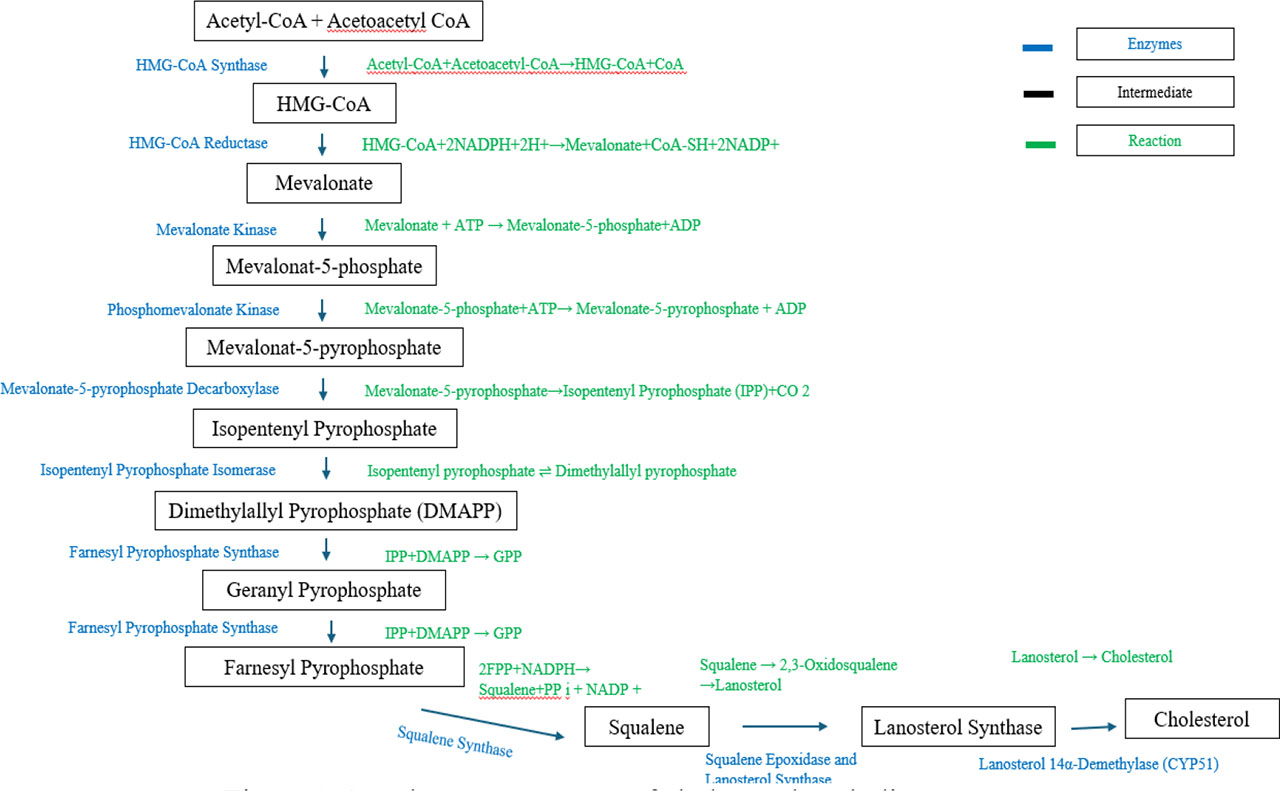
Figure 1.
Step-by-step summary of cholesterol anabolism
Table 3.
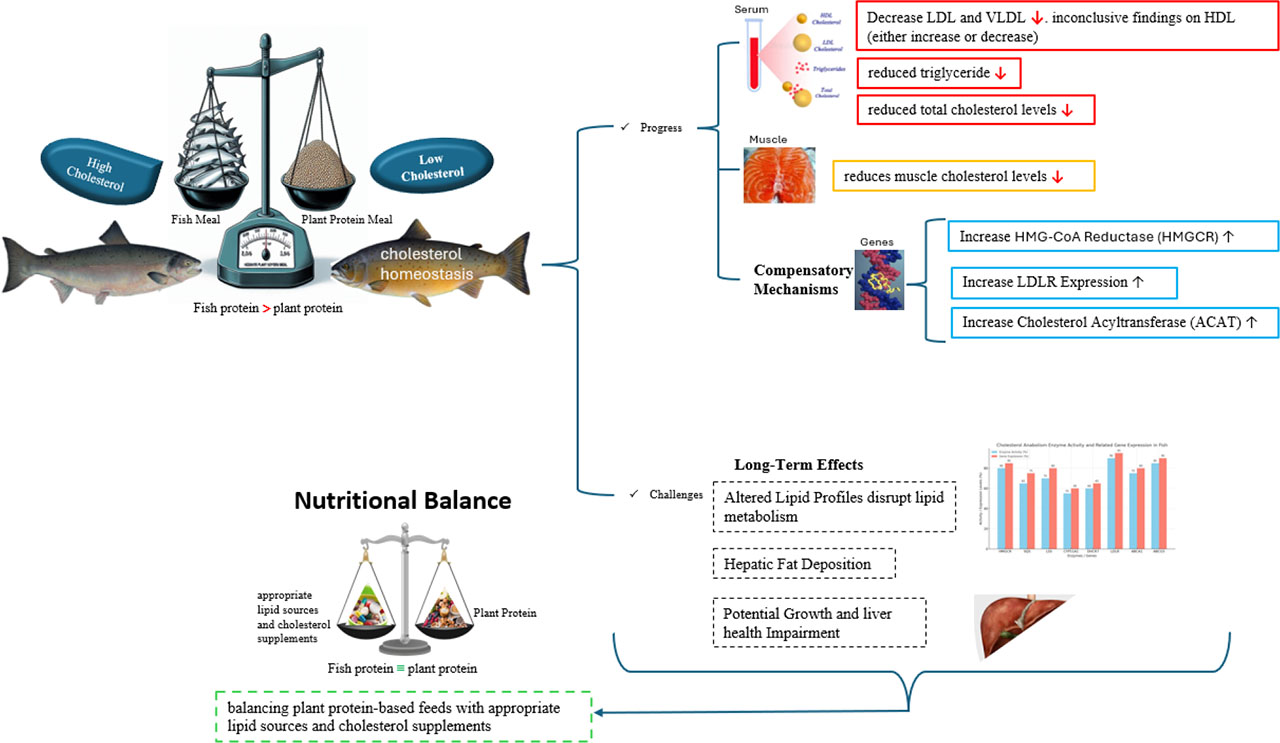
Effect of replacing fish meal with plant protein on serum total cholesterol (T-CHO)
| Species studied | Plant ingredients used | Remarks on total cholesterol | References |
|---|---|---|---|
| Atlantic cod | Plant protein blend | Reduced total cholesterol | Hansen et al. (2007) |
| Great sturgeon | Sesame oil cake | Decreased total cholesterol | Jahanbakhshi and Hedayati (2013) |
| Nile tilapia (Oreochromis niloticus) | Soy protein concentrate | No significant impact on total cholesterol | Mahmoud et al. (2014) |
| Silvery-black porgy (Sparidentex hasta) | Significantly increased total cholesterol, triglyceride and very low density lipoprotein | Yaghoubi et al. (2016) | |
| Tilapia (Oreochromis niloticus × O. aureus) | Rubber seed meal | Reduced total cholesterol with no adverse growth effects | Deng et al. (2017) |
| Turbot (Scophthalmus maximus) | High level of plant protein | T-CHO in plasma significantly reduced | Gu et al. (2017) |
| Largemouth bass (Micropterus salmoides) | Soybean protein concentrate | Significant reduction in T-CHO | Ren et al. (2018) |
| European sea bass | Soybean meal | Decreased total cholesterol | Bonvini et al. (2018) |
| Red sea bream (Pagrus major) | Rapeseed meal | Significant decrease in total cholesterol | Dossou et al. (2018) |
| Common carp | Sunflower meal | Significant increase in total cholesterol | Rahmdel et al. (2018) |
| Black sea bream | Plant protein with taurine supplement | T-CHO lower with all-plant protein diets | Tong et al. (2020) |
| Rainbow trout | Corn gluten meal | Reduced total cholesterol | Staessen et al. (2020) |
| Juvenile golden pompano (Trachinotus ovatus) | Cottonseed protein concentrate | Lowered total cholesterol | Shen et al. (2020) |
| Juvenile redlip mullet | Soybean meal | No adverse impact on serum cholesterol | Liu et al. (2021) |
| Rainbow trout (Oncorhynchus mykiss) | Dephenolized cottonseed protein | Moderately lowered total cholesterol | Zhao et al. (2021 b) |
| Grouper (Epinephelus coioides) | Extruded soybean meal | Reduced total cholesterol | Zhao et al. (2021 a) |
| Rockfish (Sebastes schlegeli) | Various plant protein sources | No significant effect on T-CHO | Kim et al. (2021) |
| Tilapia (Oreochromis niloticus) | Canola meal | Increased total cholesterol | Iqbal et al. (2022 b) |
| Tilapia (Oreochromis niloticus) | Sunflower meal | Reduced cholesterol | Iqbal et al. (2022 a) |
| Gibel carp (Carassius auratus gibelio) | Soybean meal | Decreased total cholesterol | Uyisenga et al. (2023) |
| Juvenile olive flounder (Paralichthys olivaceus) | Plant proteins and meat meal | T-CHO varied from 156.8 to 157.9 mg/dl | Sim et al. (2023) |
| Nile tilapia (Oreochromis niloticus) | Plant protein and animal protein meal | Significant effect on T-CHO | Li et al. (2023) |
| Nile tilapia (Oreochromis niloticus) | Cholesterol and bile acid supplements in plant-based diets | T-CHO lowest in the control group | Jiang et al. (2024 b) |
| Rockfish (Sebastes schlegeli) | Plant proteins with jack mackerel meal | No significant effects on T-CHO | Kim and Cho (2024) |
| Largemouth bass (Micropterus salmoides) | Plant protein sources and mixed animal | T-CHO increased with mixed protein | Chen et al. (2024) |
Table 4.
Effect of replacing fish meal with plant protein on serum LDL and VLDL
| Species studied | Plant ingredients used | Effects on LDL | Effects on VLDL | Remarks | References |
|---|---|---|---|---|---|
| Atlantic cod (Gadus morhua L.) | Plant protein mix | Lower LDL levels | – | Stable plasma lipid concentrations | Hansen et al. (2007) |
| Juvenile sturgeon (Huso huso) | Sesame oil cake, corn gluten | Lowered LDL levels | Significant reduction in VLDL | Improved growth performance | Jahanbakhshi and Hedayati (2013) |
| Nile tilapia (Oreochromis niloticus) | Soybean meal | Significant reduction in LDL | – | No significant change in HDL | Mahmoud et al. (2014) |
| Totoaba juveniles (Totoaba macdonaldi) Nile tilapia (Oreochromis niloticus) | Soybean meal | – | VLDL slightly decreased but not statistically significant | – | López et al. (2015) |
| Juvenile gibel carp (Carassius auratus gibelio) | Corn gluten meal | Decreased LDL | – | Reduced plasma cholesterol | Ren et al. (2017) |
| Rainbow trout (Oncorhynchus mykiss) | Plant protein | Reduced LDL levels | Reduced VLDL levels | Reduced serum cholesterol | Lazzarotto et al. (2018) |
| Common carp | Sunflower meal | A moderate reduction in LDL levels | VLDL slightly decreased | Higher replacement levels increased total cholesterol | Rahmdel et al. (2018) |
| Juvenile European sea bass | Soybean meal | Significant decrease in LDL | No significant changes in VLDL | Improved immune response | Bonvini et al. (2018) |
| Red sea bream (Pagrus major) | Rapeseed meal | Moderate reduction in LDL | Significant reduction in VLDL levels | Slight increase in HDL levels | Dossou et al. (2018) |
| Rice field eel (Monopterus albus) | Soy protein concentrate | Reduced LDL levels | Slight decrease in VLDL | Enhanced lipid metabolism | Zhang et al. (2019 a) |
| Hybrid grouper (Epinephelus lanceolatus♂× Epinephelus fuscoguttatus♀) | Plant protein sources | Reduced LDL levels | – | No impact on HDL or growth | Ye et al. (2019) |
| Juvenile golden pompano (Trachinotus ovatus) | Cottonseed protein concentrate | Decreased LDL | – | No negative impact on liver function | Shen et al. (2020) |
| Zebrafish | Chlorella sp. meal | Lower LDL levels | Decreased VLDL | Decreased total cholesterol and triglycerides | Carneiro et al. (2020) |
| Black sea bream (Acanthopagrus schlegelii) | Soybean meal, corn gluten meal | LDL moderately decreased | VLDL moderately reduced | Decreased total cholesterol | Tong et al. (2020) |
| Grass carp (Ctenopharyngodon idellus) | Soy protein concentrate, corn gluten | – | VLDL levels decreased moderately | – | Peng et al. (2020) |
| Juvenile redlip mullet | Soybean meal | Significant decrease in LDL | VLDL levels unchanged | No adverse effects on growth or health | Liu et al. (2021) |
| Rainbow trout | Dephenolization cottonseed protein concentrate | Decreased LDL | Moderate reduction in VLDL | Positive effects on blood lipid profile | Zhao et al. (2021 b) |
| Tilapia (Oreochromis niloticus) | Canola meal | Significant increase in LDL | Moderate increase VLDL levels | Improved feed efficiency | Iqbal et al. (2022 b) |
| Tilapia (Oreochromis niloticus) | Sunflower meal | Moderate decrease in LDL | VLDL levels remained unchanged | Iqbal et al. (2022 a) |
Table 5.
Effect of replacing fish meal with plant protein on serum HDL and TG
| Species studied | Plant ingredients used | Effects on HDL | Effects on triglycerides (TG) | References |
|---|---|---|---|---|
| Great sturgeon | Sesame oil cake | Significant increase in HDL | Significant reduction in TG | Jahanbakhshi and Hedayati (2013) |
| Nile tilapia (Oreochromis niloticus) | Soybean meal | HDL levels increased slightly | Triglyceride levels decreased | López et al. (2015) |
| Rainbow trout (Oncorhynchus mykiss) | Corn gluten, soybean meal, wheat gluten and soy protein concentrate | HDL levels increased | TG levels reduced | Lazzarotto et al. (2018) |
| Red sea bream | Rapeseed meal | Significant increase in HDL | Significant reduction in TG | Dossou et al. (2018) |
| Common carp | Sunflower meal | HDL levels unchanged | TG levels slightly reduced | Rahmdel et al. (2018) |
| European sea bass | Soybean meal | Slight improvement in HDL levels | No significant changes in TG | Bonvini et al. (2018) |
| Hybrid grouper | Plant protein sources | Moderate increase in HDL | Ye et al. (2019) | |
| Rice field eel | Soy protein concentrate | HDL levels stable | TG levels moderately decreased | Zhang et al. (2019 a) |
| Hybrid tilapia | Soy protein concentrate, corn gluten | Significant improvement in HDL | TG levels decreased moderately | Peng et al. (2020) |
| Juvenile golden pompano (Trachinotus ovatus) | Cottonseed protein concentrate | HDL levels increased | TG levels decreased | Shen et al. (2020) |
| Black sea bream (Acanthopagrus schlegelii) | Supplementing taurine in plants | HDL levels moderately increased | TG levels decreased moderately | Tong et al. (2020) |
| Juvenile redlip mullet | Soybean meal | No significant change in HDL levels | No significant changes in TG | Liu et al. (2021) |
| Rainbow trout (Oncorhynchus mykiss) | Dephenolized cottonseed protein | Slight increase in HDL | TG levels moderately reduced | Zhao et al. (2021 b) |
| Tilapia (Oreochromis niloticus) | Canola meal | Increased HDL | Increased TG | Iqbal et al. (2022 b) |
| Tilapia (Oreochromis niloticus) | Sunflower meal | Reduced HDL | Reduced TG | Iqbal et al. (2022 a) |
| Tilapia (Oreochromis niloticus) | Corn gluten meal, soybean meal, cottonseed meal and rapeseed meal | Increased TG | Jiang et al. (2024 b) |
Table 6.
Effect of replacing fish meal with plant protein on squalene synthase and lanosterol synthase
| Species studied | Plant ingredients used | Effects on squalene synthase (SQS) | Effects on lanosterol synthase (LSS) | References |
|---|---|---|---|---|
| Rainbow trout (Oncorhynchus mykiss) | Soybean meal | Upregulation of SQS genes and increased enzyme activity | Increased LSS expression and enzyme activity | Turchini and Francis (2009) |
| Atlantic salmon (Salmo salar L.) | Vegetable proteins | Increased SQS gene expression and enzyme activity | Increased LSS gene expression and enzyme activity | Bendiksen et al. (2011) |
| European sea bass (Dicentrarchus labrax) | Rapeseed and sunflower meal | Increased SQS gene expression and activity | Upregulated LSS expression to compensate for low dietary cholesterol | Guerreiro et al. (2015) |
| Atlantic salmon (Salmo salar) | Soy protein concentrate | Increased SQS expression | Increased LSS expression and enzyme activity | Ytrestøyl et al. (2015) |
| Rainbow trout (Oncorhynchus mykiss) | Plant protein sources | Upregulated SQS activity in response to low cholesterol | Enhanced LSS expression due to reduced dietary cholesterol | Zhu et al. (2018) |
| Atlantic salmon (Salmo salar) | Pea, soy and wheat | Increased SQS gene expression and enzyme activity | increased enzyme activity | Dhanasiri et al. (2020) |
| Nile tilapia (Oreochromis niloticus) | Soybean meal and pea protein | Increased SQS expression | Increased LSS expression | El-Sayed et al. (2021) |
| Rainbow trout (Oncorhynchus mykiss) | Cottonseed protein concentrate | Increased SQS expression | Enhanced LSS expression | Liu et al. (2022) |
| Common carp (Cyprinus carpio) | Cottonseed protein concentrate | Increased SQS expression due to low dietary cholesterol | Enhanced LSS expression | Fan et al. (2024) |
Table 7.
Effect of replacing fish meal with plant protein on HMG-CoA reductase
| Species studied | Plant ingredients used | HMGCR remarks | References |
|---|---|---|---|
| Yellowtail (Seriola quinqueradiata) | Soy protein concentrate | Elevated HMGCR expression as an adaptive response to plant-based protein diets | Maita et al. (2006) |
| European sea bass (Dicentrarchus labrax) | Soybean meal, wheat gluten and white sweet lupin | High stimulation of HMGCR genes due to cholesterol biosynthesis | Geay et al. (2011) |
| Atlantic salmon (Salmo salar) | Pea protein, soy protein | Increased expression of HMGCR due to reduced dietary cholesterol | Kortner et al. (2013) |
| Atlantic salmon (Salmo salar L.) | Lupin meal and wheat gluten | Capacity for cholesterol synthesis was up-regulated simultaneously with the mRNA expression of HMGCR | Gu et al. (2014) |
| Turbot (Scophthalmus maximus) | Soybean meal and wheat gluten | Peaked mRNA expression of HMGCR in the intestine | Gu et al. (2017) |
| Atlantic salmon (Salmo salar) | Soy protein concentrate | Significant increase in HMGCR expression as a compensatory mechanism due to low dietary cholesterol | Bou et al. (2017) |
| Rainbow trout (Oncorhynchus mykiss) | Corn gluten, soybean meal, wheat gluten and white lupin, peas and rapeseed meal | Increased hepatic mRNA expression of HMGCR in both juveniles and ongrowing fish. | Lazzarotto et al. (2018) |
| Atlantic salmon (Salmo salar) | Rapeseed meal, soy protein | Higher HMGCR expression was observed as cholesterol synthesis compensation mechanism. | Caballero-Solares et al. (2018) |
| Japanese seabass (Lateolabrax japonicus) | Soy protein concentrate | HMGCR expression was significantly elevated with plant protein diets replacing fish meal, indicating increased cholesterol synthesis. | Zhang et al. (2019 b) |
| Rainbow trout (Oncorhynchus mykiss) | Corn gluten, wheat gluten, soybean meal, soybean protein concentrates light white lupin, and dehulled pea | Hepatic mRNA expression of HMGCR increased, suggesting a promotion of the synthesis of cholesterol regulated by SREBP-2 | Zhu et al. (2020) |
| Common carp (Cyprinus carpio L.) | Soybean meal and cottonseed protein concentrate | Peaked the liver mRNA expression of HMGCR | Yao et al. (2021) |
| Largemouth bass (Micropterus salmoides) | Partial inclusion of soybean protein concentrate | Enhanced the mRNA levels of HMGCR | Chen et al. (2024) |
| Red seabream (Pagrus major) | Soybean meal, corn gluten, soy protein concentrates | Elevated expression of HMGCR in the liver | Murashita et al. (2024) |
| Largemouth bass (Micropterus salmoides) | Soybean, rapeseed, and cottonseed protein | Increased expression of HMGCR due to enhanced cholesterol synthesis and efflux | Yao et al. (2024) |
| Nile tilapia (Oreochromis niloticus) | Corn gluten, soybean meal, cottonseed meal, and rapeseed meal | The plant protein peaked the hepatic mRNA expression of HMGCR, however, it was suppressed by cholesterol and bile acid supplementation | Jiang et al. (2024 b) |
Table 8.
Effect of replacing fish meal with plant protein on LDLR, ABC family, SREBP, and LXR expressions
| Species studied | Plant ingredients used | LDLR | ABC family transporter expression | SREBP expression | LXR | References |
|---|---|---|---|---|---|---|
| Atlantic salmon (Salmo salar) | Plant proteins | LDLR mRNA expression was significantly elevated in fish fed plant protein diets. | Significant upregulation of ABCG5 and ABCG8 in fish fed plant protein diets. | Increased expression of SREBP-2 and its downstream genes, including HMGCR. | Upregulation of LXR expression to promote cholesterol efflux. | Liland (2011) |
| Gilthead sea bream (Sparus aurata) | Soy protein concentrate | Significant increase in LDLR expression. | Significant increase in ABCA1 expression. | Increased expression of SREBP-2 and its target genes. | Increased LXR expression linked to cholesterol homeostasis. | Couto et al. (2014) |
| Rainbow trout (Oncorhynchus mykiss) | Soy protein and rapeseed protein concentrate | Upregulation of LDLR as a compensatory mechanism to lower cholesterol intake. | Upregulation of ABCA1 and ABCG5/G8 expression in response to plant proteins. | Upregulation of SREBP-2 linked to cholesterol biosynthesis in response to plant proteins. | Upregulation of LXR expression to compensate for reduced dietary cholesterol intake. | Mellery et al. (2015) |
| Atlantic salmon (Salmo salar) | Soy protein concentrate | Elevated LDLR expression due to reduced dietary cholesterol availability. | Increased ABCA1 expression in response to plant-based diets. | Upregulation of SREBP-2 expression in response to reduced dietary cholesterol. | Upregulation of LXR expression in response to the lower cholesterol content of the diet. | Bou et al. (2017) |
| Tilapia (Oreochromis niloticus × Oreochromis aureus) | Rubber seed meal | Decreased LDLR expression | Deng et al. (2017) | |||
| Rainbow trout (Oncorhynchus mykiss) | Totally plant-based diet | Lower ABCG8 expression | Increased SREBP-2 expression | Reduced LXRa activity | Zhu et al. (2018) | |
| Atlantic salmon (Salmo salar) | Soy protein concentrate, rapeseed meal | Higher LDLR expression observed to support cholesterol uptake in low-cholesterol diets. | Higher ABCA1 expression due to the lower cholesterol content of plant-based diets. | Increased SREBP-1 expression driving fatty acid synthesis due to lower lipid content. | Increased LXR activity leading to enhanced cholesterol removal via efflux transporters. | Caballero-Solares et al. (2018) |
| Japanese seabass (Lateolabrax japonicas) | Soy protein, maize gluten, wheat gluten | Significant increase in LDLR activity to compensate for low dietary cholesterol. | Increased expression of ABCG5 and ABCG8 as a compensatory response. | Increased SREBP-2 expression driving cholesterol and fatty acid synthesis. | Increased LXR expression to maintain cholesterol and fatty acid metabolism. | Zhang et al. (2019 b) |
| Rainbow trout (Oncorhynchus mykiss) | Plant protein sources | The expression of LDLR was significantly increased | ABCA1, ABCG5 and ABCG8 showed elevated expression levels | SREBP-2 was upregulated | LXR showed increased expression | Zhu et al. (2020) |
| Tilapia (Oreochromis niloticus) | Corn gluten meal, soybean meal, cottonseed meal and rapeseed meal | Significant upregulation of LDLR expression in fish fed plant protein diets | Significant increase in ABCG5 expression | Significant increase in ABCG5 expression | Increased LXR expression in response to plant protein | Jiang et al. (2024 b) |
Table 9.
Effect of replacing fish meal with plant protein on ACAT activity
| Species studied | Plant ingredients used | Effects on ACAT | References |
|---|---|---|---|
| Rainbow trout (Oncorhynchus mykiss) | Soybean meal, soy protein concentrate | Improved ACAT activity with dietary cholesterol supplementation | Deng et al. (2013) |
| Atlantic salmon | Microalgae and plant proteins | Partial restoration of ACAT activity | Kousoulaki et al. (2016) |
| Hybrid tilapia (Oreochromis niloticus × Oreochromis aureus) | Rubber seed meal | Elevated ACAT activity for lipid storage | Deng et al. (2017) |
| Tiger puffer (Takifugu rubripes) | Soy protein isolate, wheat gluten | Elevated ACAT activity with taurine addition | Xu et al. (2020) |
| Hybrid grouper | Soy protein concentrate | ACAT upregulation under plant protein diets | Chen et al. (2020) |
| Nile tilapia | Corn gluten, soybean concentrate | Increased ACAT expression and lipid storage | Li et al. (2023) |
Table 10.
Effect of replacing fish meal with plant protein on CYP7A1 activity
| Species studied | Plant ingredients used | Effects on CYP7A1 | References |
|---|---|---|---|
| Atlantic salmon (Salmo salar L.) | Soy protein concentrates with 1–1.5% cholesterol | Restored CYP7A1 activity with cholesterol supplementation | Kortner et al. (2014) |
| Atlantic salmon (Salmo salar L.) | Microalgae and organic minerals | Enhanced lipid metabolism and improved CYP7A1 activity | Kousoulaki et al. (2016) |
| Gilthead seabream (Sparus aurata L.) | DL-methionine supplemented soy protein concentrate | Maintained CYP7A1 activity at optimal levels | Kokou et al. (2016) |
| Turbot (Scophthalmus maximus) | High plant protein with taurocholate supplementation | Partial restoration of CYP7A1 expression | Gu et al. (2017) |
| Atlantic salmon (Salmo salar L.) | Varied lipid sources (plant vs fish oils) | Differential effects on CYP7A1 activity | Hixson et al. (2017) |
| Atlantic salmon (Salmo salar L.) | Phytosterol-enriched plant oils | Altered CYP7A1 expression but no fatty liver development | Sissener et al. (2018) |
| Rainbow trout (Oncorhynchus mykiss) | Rapeseed meal, cottonseed meal | Reduced CYP7A1 activity and disrupted cholesterol metabolism | Zhu et al. (2018) |
| Japanese seabass (Lateolabrax japonicas) | Soy protein isolate, wheat gluten, corn gluten meal | Reduced CYP7A1 expression and compromised bile acid metabolism | Zhang et al. (2019 b) |
| Amur sturgeon (Acipenser schrenckii) | Full plant protein diet | Decreased CYP7A1 expression and impaired bile acid homeostasis | Wei et al. (2020) |
| Tiger puffer (Takifugu rubripes) | Soy protein isolate with taurine supplementation | Increased CYP7A1 expression | Xu et al. (2020) |
| Common carp (Cyprinus carpio) | Lupin meal and pea protein | Reduced CYP7A1 activity | Zhao et al. (2020) |
| Red seabream (Pagrus major) | Soy protein concentrate | Reduced CYP7A1 expression but maintained lipid homeostasis with fish oil supplementation | Takakuwa et al. (2023) |
| Nile tilapia | Corn gluten and soy protein concentrate | Suppression of CYP7A1 expression and reduced bile acid synthesis | Li et al. (2023) |
| Gilthead seabream (Sparus aurata) | Bile salt-supplemented plant diet | Improved bile acid metabolism and enhanced CYP7A1 expression | Ruiz et al. (2023) |
| Largemouth bass (Micropterus salmoides) | Mixed plant proteins (soy and corn) | Suppressed CYP7A1 and bile acid receptor signaling | Chen et al. (2024) |