
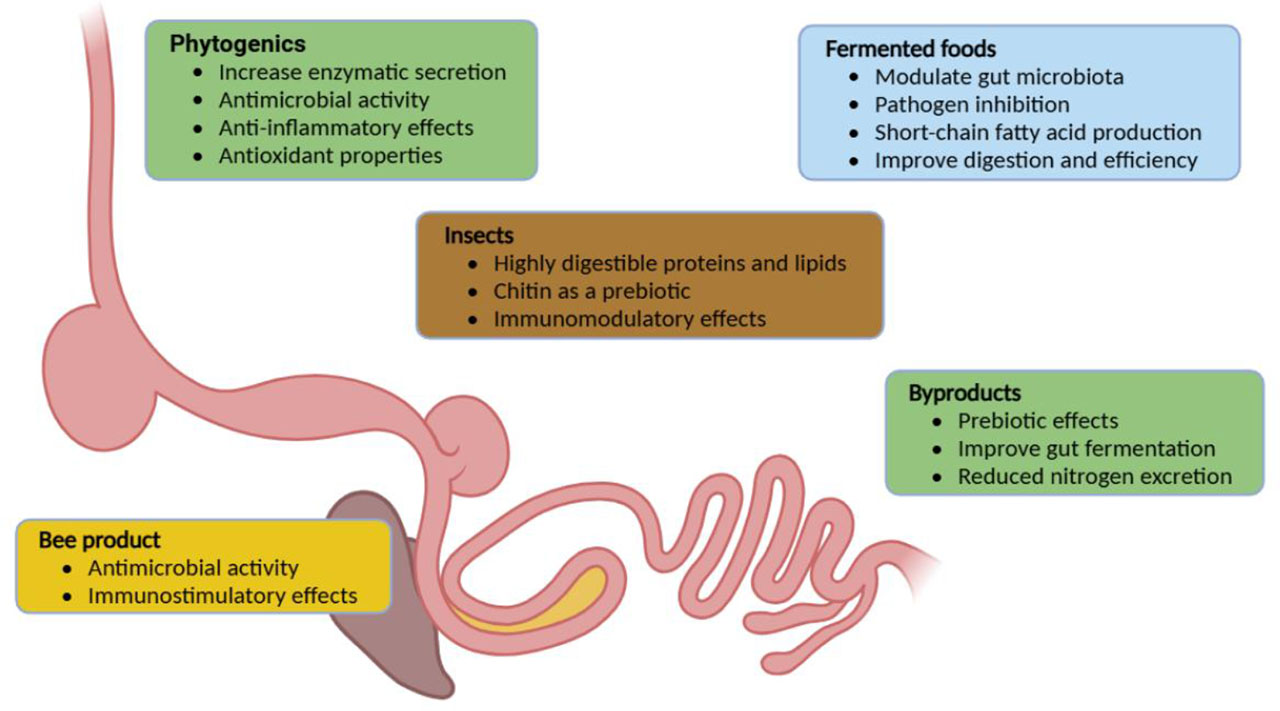
Figure 1.
The effect of some feed additives on chicken’s gastrointestinal tract
Table 1.
Categories of phytobiotics and their specific roles in poultry nutrition
| Category | Source | Dose (mg/kg diet) | Target strains | Main effect1 | References |
|---|---|---|---|---|---|
| 1 | 2 | 3 | 4 | 5 | 6 |
| Essential oils | Origanum vulgare | 300 and 600 | Broilers, Arbor Acres, 0–42 days | BW, ADFI | Peng et al. (2016) |
| 300 | Broilers, Ross 308, 0–42 days | Secondary antibody titer and IgG titer, H/L ratio | Mohiti-Asli and Ghanaatparast-Rashti (2017) | ||
| 50, 100, 150 and 200 | Semi-heavy laying hens, 59–71 weeks | FCR, egg production and egg mass | Migliorini et al. (2019) | ||
| 100 | Duckling, Cherry Valley, 0–5 weeks | ADG, FCR | Ding et al. (2020) | ||
| Macleaya cordata | Not reported | Broilers, Ross 308, 15–21 days | FCR | Abudabos et al. (2018) | |
| Lavandula angustifolia | 300 and 600 | Broilers, Arbor Acres, 0–42 days | BWG, FCR | Yarmohammadi Barbarestani et al. (2020) | |
| Thymus vulgaris | 100 | Laying hens, Lohmann LSL-Lite, 40–48 weeks | EP, EM, FCR, Haugh units | Akbari et al. (2016) | |
| 150 and 300 | Broilers, Indian River, 0–42 days | BW, BWG | El-Ashram and Abdelhafez (2020) | ||
| Mentha piperita | 100 | Laying hens, Lohmann LSL-Lite, 40–48 weeks | EW, FI | Akbari et al. (2016) | |
| Citrullus lanatus | 1000, 2000 | Laying hens, White Leghorn, 18–26 weeks | WG, ADFI, ADG, EM, FCR, Haugh units | Marume et al. (2020) | |
| Allium sativum | 300 | Broilers, Hubbard, 0–42 days | Meat color | Kirkpinar et al. (2014) | |
| Plant extracts | Olea europaea | 750 | Broilers, Ross 308, 21–42 days | ADG, FCR | Herrero-Encinas et al. (2020) |
| Achyranthes japonica | 250, 500 and 1000 | Broilers, Ross 308, 1–35 days | BWG, ADFI, FCR, breast weight, abdominal fat | Park and Kim (2020) | |
| Pinus densiflora | 2.5 and 5 | Laying hens, Hy-line Brown, 40–46 weeks | FI, EP, EYC, ESBS | Kothari et al. (2021) | |
| Mentha piperita | 74, 148, 222, and 296 | Laying hens, Bovans Brown, 32–44 weeks | EW, EM, FI, FCR, Haugh units, ST, | Abdel-Wareth and Lohakare (2020) | |
| Vitis vinifera | 100 and 200 | Duckling, Pekin, 0–6 weeks | BWG, FCR | Ao and Kim (2020) | |
| Thymbra spicata | 1000 | Laying hens, Bovans White, 48–56 weeks | EW, FI | Cimrin (2019) | |
| Rosemarinus officinalis | 1000 | Laying hens, Bovans White, 48–56 weeks | FI, SW | Cimrin (2019) | |
| Curcuma longa | 200 | Laying hens, Hy-Line Brown, 84–90 weeks | EP, EM, FI, FCR | Da Rosa et al. (2020) | |
| Spices and herbs | Pulicaria gnaphalodes | 1000 and 2000 | Broilers, Ross 308, 1–42 days | BWG, FCR | Shirani et al. (2019) |
| Thymus vulgaris | 2000, 5000 and 8000 | Broilers, Cobb 500, 1–42 days | BW, BWG, FI | Hassan and Awad (2017) | |
| Nigella sativa | 5000 and 10000 | Broilers, Ross 308, 1–42 days | BWG, LW, breast weight, abdominal fat | Laudadio et al. (2022) | |
| 5000 | Laying hens, Lohmann Brown Lite, 32–40 weeks | EP, EM, FCR, EYC, Haugh units | Abou-Elkhair et al. (2018) | ||
| Eucalyptus grandis | 500, 800, 1200 | Laying hens, Yueqinhuang, 48–56 weeks | EP, EM, MQ | Chen et al. (2018) | |
| Foeniculum vulgare | 5000 | Laying hens, Lohmann Brown Lite, 32–40 weeks | EP, EW, EM, FCR, EYC, Haugh units | Abou-Elkhair et al. (2018) | |
| Capsicum annuum | 5000 | Laying hens, Lohmann Brown Lite, 32–40 weeks | EP, EW, EM, FCR, EYC, Haugh units | Abou-Elkhair et al. (2018) | |
| Trigonella foenum-graecum | 5000 and 10000 | Broilers, Ross 308, 1–42 days | FCR | Laudadio et al. (2022) | |
| Echinacea purpurea | 2500, 5000, 7500 and 10000 | Laying hens, Hy-Line W-36 Leghorn, 44–54 weeks | EP, EM, FCR, EYC | Jahanian et al. (2017) | |
| Eucalyptus camaldulensis | 100 and 200 | Laying, Japanese quail, 180–240 weeks | Broken eggs, ES, ST, EYC | Fathi et al. (2020) | |
| Astragalus membranaceus | 10000, 30000 and 50000 | Japanese meat quail, 0–35 days | BW, FI, FCR, mortality | Guo et al. (2019) | |
| Mentha piperita | 10000, 20000, 30000 and 40000 | Meat quail, 7–35 days | FCR | Mehri et al. (2015) | |
| Allium sativum | 5000, 10000 and 20000 | Japanese meat quail | BW, BWG | Jalal et al. (2024) |
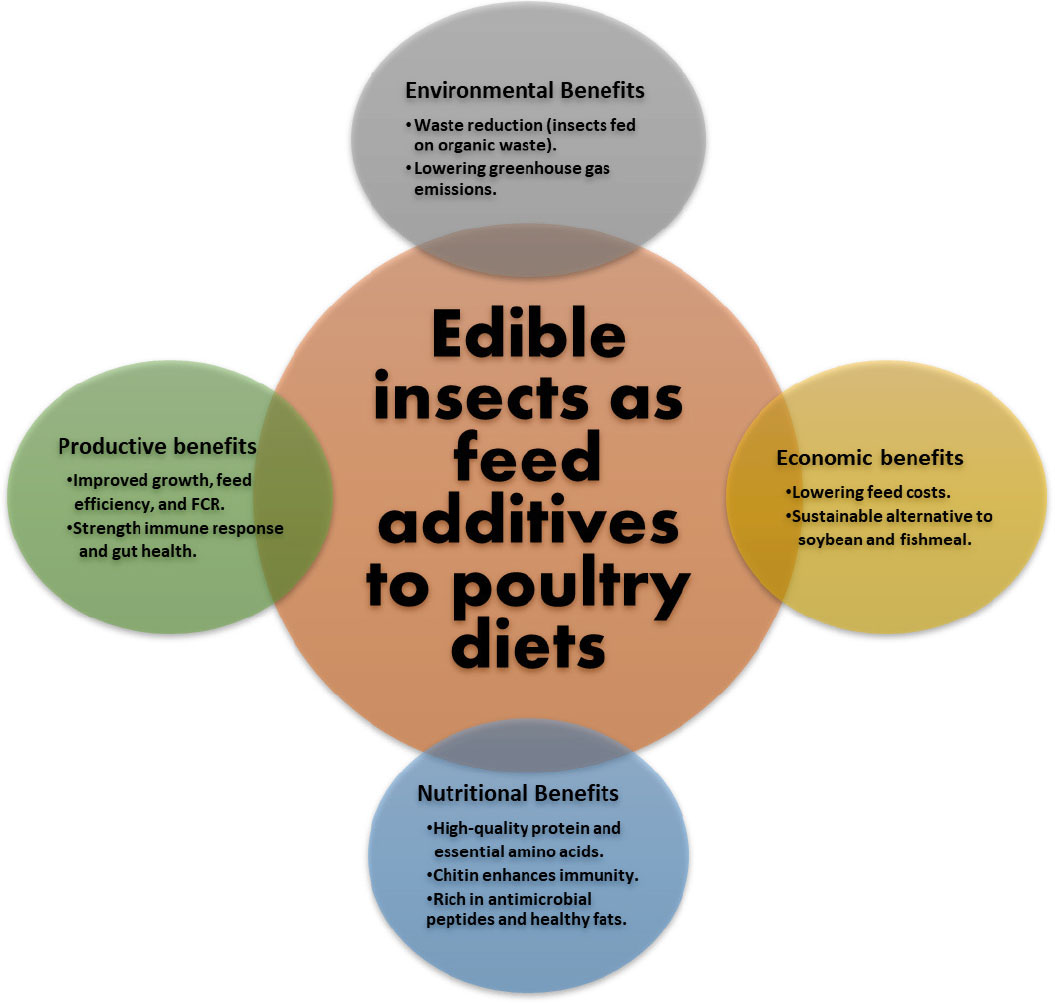
Figure 2.
Edible insects as feed additives to poultry diets
Table 2.
Inclusion rates, effects, and economic considerations of insect meal in poultry diets
| Insect species | Optimal inclusion rate (%) | Growth performance effects | Health and immunity effects | Challenges and limitations | Cost considerations |
|---|---|---|---|---|---|
| Black soldier fly (Hermetia illucens) | 10–15% | Improved FCR, weight gain | Enhances gut microbiota, boosts immunity | High production cost, regulatory restrictions | $1.50–$2.00/kg (high) |
| Mealworm (Tenebrio molitor) | 5–10% | Moderate weight gain improvement | Prebiotic effects due to chitin, enhanced resistance to pathogens | Chitin content may reduce digestibility at high levels | $2.50–$3.00/kg (very high) |
| Housefly larvae (Musca domestica) | 10–12% | Positive growth effects | Antimicrobial peptides improve gut health | Risk of pathogen contamination if not properly processed | $1.20–$1.80/kg (moderate) |
| Locusts (Schistocerca gregaria) | 10–20% | High palatability, increased feed intake | Rich in essential amino acids, support the immune response | Seasonal availability, processing difficulties | Varies (wild-caught vs. farmed) |
| Silkworm pupae (Bombyx mori) | 10–15% | Improved feed conversion | High omega-3 content, better meat quality | Require oil extraction to reduce fat content | $1.00–$1.50/kg (moderate) |
Table 3.
Inclusion rates, effects, and economic considerations of agro-industrial byproducts in poultry diets
| Byproduct type | Optimal inclusion rate (%) | Growth performance effects | Health and immunity effects | Challenges and limitations | Cost considerations |
|---|---|---|---|---|---|
| Apple pomace | 6–25% | Improved weight gain, feed efficiency | Rich in polyphenols, antioxidant properties | High moisture content, spoilage risk | Low-cost, seasonal availability |
| Citrus pulp | 3–10% | Enhanced nutrient digestibility | Prebiotic effects, improved gut microbiota | High fiber may limit intake | Cost-effective, widely available |
| Sunflower meal | 10–15% | Positive effect on growth, egg production | Enhances protein intake, gut health | Antinutritional factors require enzyme supplementation | Moderate cost |
| Distillers’ grains (DDGS) | 10–24% | Maintain broiler and layer performance | Rich in protein, energy, and minerals | Variability in nutrient content, potential mycotoxins | Affordable but quality-dependent |
| Grape pomace | 6–10% | Improved meat quality, antioxidant benefits | Enhances immune response due to polyphenols | Limited protein content, tannins may interfere with digestion | Low-cost but availability varies |
| Olive cake/pulp | 10–20% | Maintains growth performance | Fatty acids improve meat quality | High fiber limits the inclusion rate | Low-cost alternative to cereal grains |
| Pomegranate pulp | 2% | Enhances antioxidant activity | Reduces oxidative stress, boosts immunity | Seasonal availability | Low-cost if locally sourced |
| Sugar beet pulp | 5% | No adverse effects on broilers | Improves gut health due to fiber content | Requires proper processing | Inexpensive feed ingredient |