
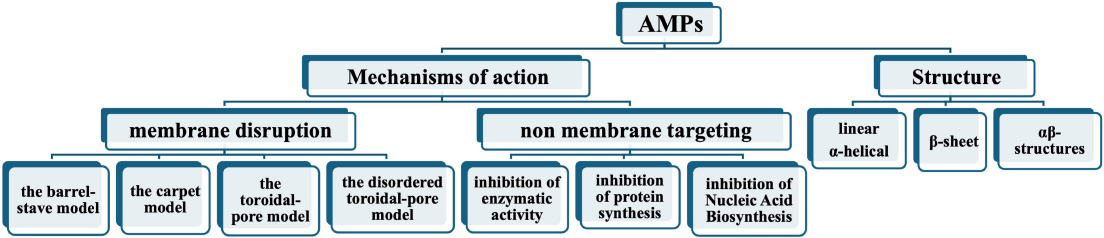
Figure 1.
Mechanism of action and structure of antimicrobial peptides (Czechowicz and Nowicka 2018; Huan et al. 2020).
Table I
Characteristics of selected diseases of the oral cavity
| Disease | Pathogenesis |
|---|---|
| caries | gradual destruction of tooth tissues; consequence of enamel demineralization by acidic products produced by dental plaque microorganisms during the metabolism of food-derived carbohydrates; after the initial demineralization process, secondary remineralization usually occurs; the formation of a cavity is associated with the predominance of demineralization over remineralization; in subsequent stages, the infection involves dentin; the disease is multifactorial (factors include diet, inadequate oral hygiene, decreased salivary flow, bacteria); the main cariogenic bacteria are S. mutans, S. sobrinus, Lactobacillus spp., Bifidobacterium dentium; features of cariogenic bacteria include: rapid metabolism of sugars to acids and the synthesis of extracellular polysaccharides; what is significant in caries is the disruption of dental biofilm homeostasis in favour of acid-forming and acid-resistant bacteria, accompanied by a decrease in the overall species diversity (Bigos et al. 2021; Shifana et al. 2024) |
| gingivitis | inflammation of the gingival tissue most often caused by bacteria; results from chronic action of dental plaque on host tissues; occurs in both children and adults; the microorganisms occurring in the gingival crevice change their profile; bacteria of the genera Streptococcus, Actinomyces, Fusobacterium, Veillonella, Treponema, Capnocytophaga, Eikenella, P gingivalis and P intermedia are most often associated with gingivitis; systemic diseases, immune disorders, hormonal fluctuations, lifestyle (smoking) may influence the composition of the oral microbiota or the immune response and consequently the occurrence of gingivitis; in necrotizing ulcerative gingivitis (ANUG), fusiform bacteria (Fusobacterium nucleatum) and oral spirochetes (Treponema spp.) play a significant role (Samaranayake 2004; Aziz 2024; Bhagat et al. 2024) |
| periodontitis | usually develops from existing gingivitis; most often is divided into two types – chronic (occurs most often) and aggressive; the following predominate in chronic periodontitis: P. gingivalis, P. intermedia, F. nucleatum, A. action-omycetemcomitans, Capnocytophaga spp., Veillonella spp. – 90% are obligate anaerobes; in the aggressive form, approximately 65-76% of the bacteria are gram-negative bacilli, but there are also a few spirochetes, with A. actiono-mycetemcomitans, Capnocytophaga spp., P gingivalis, and P intermedia predominating; the aggressive form occurs relatively rarely, most often during adolescence; the transition from gingivitis to periodontitis is the result of an increase in the number of one or more plaque species and a weakening of the human immune system; disease progression involves interactions between microorganisms, immune factors of the human body, and environmental factors; in advanced stages, tooth loss occurs; the following are considered to be the main periodontopathogens: P. gingivalis, P. intermedia, A. actionomycetemcomitans, F. nucleatum and Capnocytophaga bacteria; (Samaranayake 2004; Yekani et al. 2025) |
| peri-implantitis | tissue inflammation related to the use of an implant; may be accompanied by alveolar bone loss; may be early or late; early inflammation is most often caused by improper osseointegration of implants; late inflammation is a dysfunction of a properly implanted biomaterial, accompanied by chronic infection of the surrounding tissues; peri-implant diseases can be divided into peri-implant mucositis – affects only soft tissues and peri-implantitis – includes bone destruction; inflammatory destruction of the tissues supporting the implant is associated with the formation of a biofilm structure on the surface of the biomaterial; the “peri-implantitis-related complex” includes: S. epidermidis, F. nucleatum, T. denticola, T. forsythia, P intermedia, P gingivalis; other etiological factors of this type of infections include: Staphylococcus aureus, Enterococcus spp., Peptostreptococcus micros, A. actinomycetemcomitans; the immune system’s response to microorganisms residing on the implant is very important for the development and duration of peri-implantitis; (Bigos et al. 2021; Blank et al. 2021; Minkiewicz-Zochniak et al. 2021). |
| halitosis | a chronic disease characterized by unpleasant breath; it may be a symptom of various diseases; among the most common causes of bad breath are abnormalities in the oral cavity; halitosis may accompany systemic, respiratory or gastrointestinal diseases; it may be exacerbated by certain foods, smoking, alcohol consumption or poor oral hygiene; is a result of microbiota disorders (growth of anaerobic microorganisms and increased release of volatile sulfur compounds) (Li et al. 2023) |
| inflammation of the oral mucosa | mostly caused by fungi, mainly yeast-like fungi of the Candida genus, primarily C. albicans; can be primary and secondary; the most common forms include pseudomembranous, atrophic, and hyperplastic; others include denture-related stomatitis; these infections primarily affect immunocompromised individuals as well as individuals suffering from disturbances in the quantitative and qualitative composition of the oral microbiota (antibiotic use). viral infections are caused primarily by herpesviruses (Saramanayake 2004; Vila et al. 2020; Drago et a. 2021) |
Table II
Selected natural AMPs found in the oral cavity
| Peptide | Brief description | Literature |
|---|---|---|
| histatin | histatins 1, 3, and 5 predominate in saliva; contain large amounts of histidine; have antibacterial and antifungal properties; inhibit the formation of biofilm by C. albicans | Kamysz et al. 2004; Vila et al. 2019 Griffith et al. 2022; |
| defensins | rich in cysteine; found e.g. in neutrophils, platelets, respiratory epithelium, skin, liver, but also in body fluids and saliva; have strong bactericidal properties | Vila et al. 2019; Luong et al. 2022; Witkowska et al. 2008). |
| cathelicidins | the only cathelicidin found in humans is LL-37; it occurs in epithelial cells, lungs, keratinocytes in inflammatory conditions of the skin, in plasma, in monocytes and lymphocytes; has a bactericidal effect | Vila et al. 2019; Luong et al. 2022; Witkowska et al. 2008; Nilsson 2020 |
| lactoferrin | binds iron; occurs primarily in biological fluids (milk, colostrum, saliva, tears, plasma); antibacterial, antifungal, antiviral, antiparasitic properties; immunomodulatory properties | Bruni et al. 2016 |
| lysozyme | found in saliva, nasal secretions, tears, sweat, and breast milk; in addition to its antimicrobial properties, it also has anti-inflammatory and immunomodulatory properties | Octiara et al. 2022; Lertsirivorakul et al. 2015 |
Table III
Brief characteristics of selected antimicrobial peptides
| AMP | Amino acid sequence | Brief description | Literature |
|---|---|---|---|
| HBD3-C15 | GKCSTR GRKCCRRKK | active against S. mutans; inhibited biofilm formation; activity dependent on peptide concentration; active against E. faecalis and S. gordonii; potential in the treatment of caries and endodontic infections | Ahn et al. 2017 |
| GHa GHa11R GHaR | FLQHIIGALGHLF FLQRIIGALGRLF FLQHIIGALGRLF | activity against S. mutans (planktonic, biofilm); inhibited S. mutans adhesion, EPS synthesis and biofilm formation; lack of toxicity of GHa and GHa11R towards human oral keratinocytes; low toxicity of GHaR; GHa11R and GHaR reduced caries severity in a rat caries model; activity against S. sanguinis and P gingivalis | Jiang et al. 2023 |
| ZXR 2 | FKIGGFIKKLWRSLLA | active against S. mutans, S. sorbinus, P gingivalis; inhibited S. mutans biofilm formation; moderate hemolytic activity; potential for therapeutic and preventive applications in caries | Chen et al. 2017 |
| DPS-PI | Ser(p)-Ser(p)-Arg-Arg-Trp-Cys--Phe-Arg-Val-Cys-Tyr-Arg-Gly--Phe-Cys-Tyr-Arg-Lys-Cys-Arg | active against S. mutans (planktonic, biofilm); inhibited the formation of biofilm on the surface of rabbit incisors; potential in the prevention and treatment of dental caries | Zhang et al. 2019 |
| GAPI | RRWCFRVCYRGFCYRKCR | active against S. mutans, L. casei, and C. albicans (planktonic; mixed biofilm); reduced enamel demineralization in early carious lesions; low toxicity towards human gingival fibroblasts; stable in saliva | Zhang et al. 2023 |
| hBD3-1 hBD3-2 hBD3-3 | RKLPDAPGMHTWGGGGIN-TLQKYYCRVRG RKLPDAPGMHTWGGGGR-CAVLSCLPKEQI RKLPDAPGMHTWGGGGK-CSTRGRKCCRRKK | activity against S. oralis, S. gordonii, S. sanguinis; peptides absorbed on the surface of titanium plates; hBD3-3 is the most active; hBD3-3 damages the integrity of the bacterial membrane and reduces the expression of sspA and sspB; cytocompatibility with mouse preosteoblasts; relatively stable in saliva; potential in the prevention of peri-implant diseases | Geng et al. 2018 Park et al. 2020 |
| GL13K | GKIIKLKASLKLL-CONH2 | active against P. gingivalis; peptide immobilized on a titanium surface; coating is highly stable, cytocompatible with gingival fibroblasts and mouse osteoblasts; antimicrobial activity | Holmberg et al. 2013; |
| GL13K | GKIIKLKASLKLL-CONH2 | active against P. gingivalis, F. nucleatum; coated on titanium nanotubes; cytocompatible with pre-osteoblasts and mouse macrophage cell lines; supported osteointegration; potential in preventing infections at the implant site | Li et al. 2017 |
| GL13K | GKIIKLKASLKLL-CONH2 | active against S. aureus; immobilized on a polymer surface; inhibiting biofilm development | Hu et al. 2021 |
| nisin | ITSISLCTPGCKTGALMGC- NMKTATCHCSIHVSK | active against A. israelii, A. naeslundii, A. odontolyticus, P. intermedia, S. anginosus, S. constellatus, S. aureus | Enigk et al. 2020 Im et al. 2024 |
| lactoferrin | reduced the growth of Megasphaera sp., B. longum, P micra | ||
| melittin | GIGAVLKVLTTGLPALISWI- KRKRQQ-NH2 | reduced the growth of Megasphaera sp., P micra, S. flueggei; nisin and lactoferrin are a promising alternative to antibiotic therapy |
Table IV
Selected AMPs with potential use in oral mucositis and dentistry
| Peptide | Potential application/properties | Clinical trial stage | Clinical trial ID/Trial registration number | Literature |
|---|---|---|---|---|
| PAC-113 | oral candidiasis | Phase 2 | NCT00659971 | (Browne et al. 2020; Erdem and Kesmen 2022) |
| C16G2 | dental caries | Phase 2 | NCT03196219 | (Browne et al. 2020; Cresti et al. 2024) |
| KSLW | activity against dental plaque | Phase 2 | NCT01877421 | (Czarnowski et al. 2024; Ryan et al. 2024) |
| SGX942 | inflammation of the oral mucosa | Phase 3 | NCT03237325 | (Browne et al. 2020; Cresti et al. 2024) |
| IB367 | inflammation of the oral mucosa | Phase 3 | NCT00022373 NCT00118781 | (Browne et al. 2020) |
| PMX-30063 | inflammation of the oral mucosa | Phase 2 | NCT02324335 | (Browne et al. 2020) |
| ε-PL, funme peptide, domiphen | halitosis, reduction of supragingival plaque | Phase 1 | ChiCTR2300073816 | (Czarnowski et al. 2024; Shen et al. 2024) |