
1. Antimicrobial peptides – historical overview, general characteristics
Antimicrobial peptides (AMPs) are a group of naturally occurring compounds. They are produced by both prokaryotic and eukaryotic organisms and constitute a key element of the innate immune system of various organisms (Lyu et al. 2023; Nowicka et al. 2023). In humans, endogenous peptides constitute the first line of defence of the skin and mucous membranes (Nowicka et al. 2023).
The 1980s were an important period in antimicrobial peptide research. It was then that H. Boman, R. Lehrer and M. Zasloff discovered insect cecropins, human α-defensins and magainins, respectively (Hao et al. 2022). Currently, the peptide database includes (update of18 Jan. 2025) over 5,000 peptides (5,099 to be exact), originating from plants, animals and microorganisms (Hao et al. 2022; APD 2025). Peptides can also be sourced from archaea, protists and fungi (APD 2025). They can serve as a basis for the development of new drugs or new therapeutic options, also effective against microbial biofilms (Hao et al. 2022). Their natural antimicrobial activity and reduced potential for generating drug resistance make them an interesting and very valuable alternative to antibiotics (Hao et al. 2022; Yan et al. 2022).
Discovered in 1922 by Alexander Fleming, lysozyme (a cationic protein) is today considered to be the first AMP (Wang 2015; Zhang and Gallo 2016; Czechowicz and Nowicka 2018; Chen and Jiang 2023). In 1928, Rogers and Whittier identified nisin which is produced by Streptococcus lactis and exhibits broad activity against gram-positive bacteria, including MRSA (methicillin-resistant Staphylococcus aureus) strains (Yan et al. 2022; APD 2025). Gramicidin, which has bactericidal or bacteriostatic activity against gram-positive bacteria, was isolated from Bacillus brevis in 1939 by René Dubos (Nakatsuji and Gallo 2012; Bahar and Ren 2013; Czechowicz and Nowicka 2018; Moretta et al. 2021; APD 2025; Yan et al. 2022). The therapeutic potential of gramicidin has been demonstrated for local treatment of wounds and ulcers (Nakatsuji and Gallo 2012; Bahar and Ren 2013; Czechowicz and Nowicka 2018). The next to be discovered were tyrocidin (1941) and purothionin (1942). Tyrocidin was characterised by antibacterial activity against both gram-positive and gram-negative bacteria, while the activity of purothionin, obtained from common wheat (Triticum aestivum), was mainly antifungal and, to a lesser extent, antibacterial (Bahar and Ren 2013; Czechowicz and Nowicka 2018). In 1956, Skarnes and Watson used rabbit leukocytes to extract leukine which showed bactericidal activity against gram-positive bacteria, while Hirsch and Cohen (1960) obtained phagocytin, which was active against both gram-positive and gram-negative bacteria (Niedźwiedzka-Rystwej and Deptuła 2008; Janiszewska 2014; Czechowicz and Nowicka 2018). The 1960s also witnessed the discovery of bombinin. It was isolated from the skin secretions of frog Bombina variegata (Zhang and Gallo 2016; Yan et al. 2022). In the following years, researchers described cecropins, thionins, tachyplesins and defensins occurring in moths, plants, crabs and mammals, respectively (Czechowicz and Nowicka 2018; Chen and Jiang 2023). Isolated in 1981 by Hans Boman, cecropins are characterised by antibacterial (gram-positive and gram-negative bacteria) and antifungal activity (Zhang and Gallo 2016; Chen and Jiang 2023). In 1985, Lehrer discovered human alpha-defensins and in 1987, Zasloff et al. isolated magainins from frog skin (Xenopus laevis) (Zhang and Gallo 2016; Czechowicz and Nowicka 2018; Chen and Jiang 2023; APD 2025). Alpha-defensins and magainins are characterised by antibacterial, antifungal, antiviral and antiparasitic activity (APD 2025).
In the 1990s, more than 300 AMPs, discovered in almost all organisms, were described (Mabrouk 2022). It is worth noting that in addition to research on peptides derived from natural sources, there are studies on semi-synthetic and synthetic peptides. These studies are aimed at developing peptides with high therapeutic potential (Chen and Jiang 2023). It is essential that the antimicrobial peptide maintain its therapeutic efficacy while exhibiting greater biological stability and less toxicity to the human body (Zainal et al. 2021).
Antimicrobial peptides are short-chain compounds typically consisting of 12-50 amino acid residues with a molecular weight of 3-10 kDa and a positive charge. They are amphiphilic (Czechowicz and Nowicka 2018; Zhang et al. 2021; Mabrouk 2022; Nowicka et al. 2023) and are characterised by a broad spectrum of action, demonstrating antibacterial, antifungal, antiviral and antiprotozoal activity. They have immunomodulatory and anticancer effects, can inhibit the process of tissue destruction by microorganisms and accelerate the wound healing process (Czechowicz and Nowicka 2018; Zhang et al. 2021). They cause cell lysis by destabilizing the pathogen’s cell membrane. It is worth noting that there are several mechanisms of peptide penetration through the membrane: the barrel-stave model, the carpet model, the toroidal-pore model and the disordered toroidal-pore model (Czechowicz and Nowicka 2018; Huan et al. 2020; Zhang et al. 2021). AMPs can also inhibit the process of DNA replication and protein expression or lead to ATP escape (Czechowicz and Nowicka 2018; Huan et al. 2020; Zhang et al. 2021). AMPs bind to negatively charged lipids of the cell membrane (gram-positive bacteria) or to lipopolysaccharides (gram-negative bacteria) (Czechowicz and Nowicka 2018).
AMP classification systems are based primarily on their (i) origin, i.e. the source of isolation (e.g. from mammals, amphibians, insects or microorganisms), (ii) function (antibacterial, antiviral, antifungal, antiparasitic and anticancer), (iii) molecular properties, (iv) amino acid sequence and (v) secondary structure (linear α-helical peptides, β-sheet peptides, cysteine-rich peptides, peptides containing a predominant number of amino acids of one type, e.g. glycine, histidine and/or proline (Czechowicz and Nowicka 2018; Huan et al. 2020)).
Figure 1 presents basic information on the mechanism of action and structure of antimicrobial peptides.
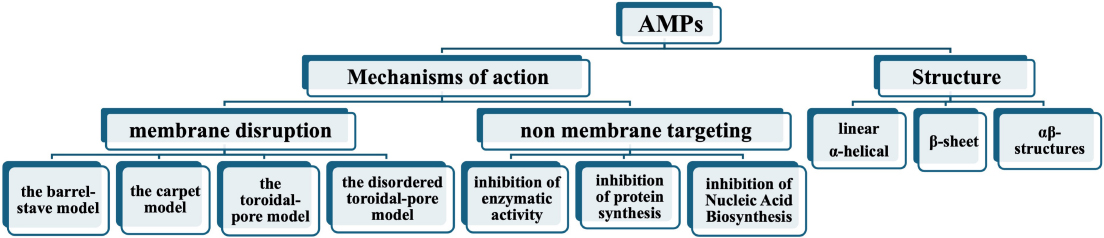
Figure 1.
Mechanism of action and structure of antimicrobial peptides (Czechowicz and Nowicka 2018; Huan et al. 2020).
2. Brief description of oral diseases
The oral microbiome is a diverse and highly populated microbiome of the human body (Giordano-Kel-hoffer et al. 2022). Among other things, its composition is determined by general health condition, use of antimicrobial drugs, diet, stress, smoking, oral hygiene and the level of saliva secretion (Bigos et al. 2021; Giordano-Kelhoffer et al. 2022). The oral microbiota is made up of bacteria, fungi and archaea. In the human oral cavity one can distinguish over 700 bacterial species with different morphology, both gram-positive and gram-negative, and having different requirements for the gaseous composition of the environment. They colonize, among others, the hard surface of the teeth, the soft tissues of the oral mucosa, and the tongue. The interactions of microbiota components affect oral health (Bigos et al. 2021; Pisano et al. 2023). Changes in both qualitative and quantitative balance between individual components of the microbiota may contribute to oral diseases, which in turn may have an impact on overall human health (Bigos et al. 2021; Giordano-Kelh offer et al. 2022). In this context, among frequently discussed diseases are gingivitis and periodontitis, as well as dental caries which is a result of enamel demineralization (Palone et al. 2024).
In their natural environment, microorganisms most often occur in the form of biofilm (Wu et al. 2019; Bigos et al. 2021). The above also applies to the microorganisms that make up the oral microbiota (Pisano et al. 2023). Biofilm most often takes the form of surface-associated microorganisms surrounded by an extracellular matrix (Chałas et al. 2015; Bigos et al. 2021). Bacterial plaque is biofilm formed in the oral cavity, e.g. on the surface of teeth (Chałas et al. 2015). Bacterial plaque can be divided into subgingival and supragingival plaque. Subgingival plaque is composed mainly of gram-negative anaerobic bacteria such as Actinobacillus spp., Fusobacterium nucleatum, Prevotella spp., Treponema spp. and Porphyromonas spp. Supragingival plaque is largely composed of Streptococcus mutans, Streptococcus salivarius, Streptococcus mitis, and Lactobacillus spp. (Chałas et al. 2015; Bigos et al. 2021). Mineralization of dental plaque biofilm results in the formation of dental tartar (Velsko et al. 2019; Bigos et al. 2021). The presence of dead bacterial cells and their metabolites accelerate this process (Bigos et al. 2021). It is worth adding that excessive consumption of carbohydrates as well as their fermentation into acids promotes the predominance of acid-forming bacteria in dental plaque and the development of caries. S. mutans are considered to be the main cariogenic bacteria, but bacteria of the genera Lactobacillus and Bifidobacterium are also among etiologic factors (Bigos et al. 2021; Palone et al. 2024).
Periodontal diseases can lead to loss of periodontal tissue and teeth. They may become chronic and lead to systemic diseases (e.g. endocarditis, atherosclerosis, diabetes) (Wojtkowska et al. 2015; Aleksijević et al. 2022). They are most often caused by P gingivalis, but also by Tannarella forsythia and Treponema denticola, the ‘red complex’ bacteria, i.e. microorganisms with the highest pathogenicity towards periodontal tissues (Wojtkowska et al. 2015; Szewczyk 2019; Aleksijević et al. 2022). The enzymatic activity of these microorganisms has destructive effects on tissues and leads to the production of inflammatory response mediators (Wojtkowska et al. 2015; Szewczyk 2019). However, it is worth noting that the latest metagenomic research has contextualized the ‘red complex’ hypothesis proposing a new model in which periodontitis is the result of polymicrobial dysbiosis. In the dysbiotic biofilm the pathobiont replaces commensal species. In the new model, P. gingivalis is considered a keystone pathogen (Hashim et al. 2025).
Biofilm growth may also result in the development of periodontal disease or peri-implant mucositis (Bigos et al. 2021; Blank et al. 2021). Infections associated with the use of dental implants are caused primarily by gram-positive cocci Staphylococcus aureus, Enterococcus spp., Peptostreptococcus micros, as well as gram-negative bacteria T. forsythia, Aggregatibacter actinomycetemcomitans, P. gingivalis or Prevotella intermedia (Bigos et al. 2021; Blank et al. 2021; Minkiewicz-Zochniak et al. 2021).
Increased biofilm formation may occur in patients undergoing orthodontic therapy. Biomaterials used in dentistry, including orthodontic appliances, may promote plaque formation. They change the composition of the oral microbiota, its metabolic activity, increase the retention of food residues, but also limit the flow of saliva and make oral hygiene difficult (Papaioannou et al. 2012; Yener and Özsoy 2020; Kozak et al. 2021; Palone et al. 2024). It is worth noting that long-term orthodontic treatment facilitates the growth of primarily Streptococcus spp. and Lactobacillus spp., i.e. bacteria causing tooth decay but also those responsible for periodontal diseases like T. forsythia, P. intermedia, P. gingivalis (Papaioannou et al. 2012; Palone et al. 2024).
Oral diseases can also be caused by fungi or viruses (Grinde and Olsen 2010; Vila et al. 2020; Drago et al. 2021; Czechowicz et al. 2022). The most frequently isolated fungi associated with oral diseases are fungi of the Candida genus, primarily Candida albicans. They are found in normal oral microbiota. In immunocompromised individuals, suffering from diabetes or subjected to long-term antibiotic or glucocorticosteroids treatment, they may grow excessively, causing candidiasis (Vila et al. 2020; Rajendra et al. 2021; Czechowicz et al. 2022). The transition from colonization to infection occurs at the time of tissue penetration. When this happens, the pathogenic features demonstrated by C. albicans are adhesion to the oral epithelium, the ability to form biofilm, to evade the immune mechanisms of the human body as well as to invade and destroy host tissues, which is associated, among others, with the production of numerous hydrolytic enzymes. Candidiasis most often manifests itself as white or yellow patches on the oral mucosa. Other symptoms include abnormal taste sensation, as well as pain or loss of appetite (Vila et al. 2020; Rajendra et al. 2021). Candida krusei, Candida glabrata, Candida tropicalis and Candida parapsilosis are also considered to play a role in the development of the disease (Rajendra et al. 2021). Among viral diseases one should mention herpetic stomatitis and gingivitis caused by infection with the herpes simplex virus type 1 (HHV-1). Herpes manifests itself in redness, swelling and the presence of vesicles on the oral mucosa, gums, tongue and throat (Grinde and Olsen 2010; Drago et al. 2021).
Lichen planus is also worth mentioning. It is a chronic disease affecting the skin and mucous membranes, including the oral mucosa. Oral lichen planus (OLP) most likely has an autoimmune component. A link between lichen planus and HCV infection has been noted (Lavanya et al. 2011; Shavit et al. 2020).
A brief description and pathogenesis of selected oral infections are presented in Table I.
Table I
Characteristics of selected diseases of the oral cavity
| Disease | Pathogenesis |
|---|---|
| caries | gradual destruction of tooth tissues; consequence of enamel demineralization by acidic products produced by dental plaque microorganisms during the metabolism of food-derived carbohydrates; after the initial demineralization process, secondary remineralization usually occurs; the formation of a cavity is associated with the predominance of demineralization over remineralization; in subsequent stages, the infection involves dentin; the disease is multifactorial (factors include diet, inadequate oral hygiene, decreased salivary flow, bacteria); the main cariogenic bacteria are S. mutans, S. sobrinus, Lactobacillus spp., Bifidobacterium dentium; features of cariogenic bacteria include: rapid metabolism of sugars to acids and the synthesis of extracellular polysaccharides; what is significant in caries is the disruption of dental biofilm homeostasis in favour of acid-forming and acid-resistant bacteria, accompanied by a decrease in the overall species diversity (Bigos et al. 2021; Shifana et al. 2024) |
| gingivitis | inflammation of the gingival tissue most often caused by bacteria; results from chronic action of dental plaque on host tissues; occurs in both children and adults; the microorganisms occurring in the gingival crevice change their profile; bacteria of the genera Streptococcus, Actinomyces, Fusobacterium, Veillonella, Treponema, Capnocytophaga, Eikenella, P gingivalis and P intermedia are most often associated with gingivitis; systemic diseases, immune disorders, hormonal fluctuations, lifestyle (smoking) may influence the composition of the oral microbiota or the immune response and consequently the occurrence of gingivitis; in necrotizing ulcerative gingivitis (ANUG), fusiform bacteria (Fusobacterium nucleatum) and oral spirochetes (Treponema spp.) play a significant role (Samaranayake 2004; Aziz 2024; Bhagat et al. 2024) |
| periodontitis | usually develops from existing gingivitis; most often is divided into two types – chronic (occurs most often) and aggressive; the following predominate in chronic periodontitis: P. gingivalis, P. intermedia, F. nucleatum, A. action-omycetemcomitans, Capnocytophaga spp., Veillonella spp. – 90% are obligate anaerobes; in the aggressive form, approximately 65-76% of the bacteria are gram-negative bacilli, but there are also a few spirochetes, with A. actiono-mycetemcomitans, Capnocytophaga spp., P gingivalis, and P intermedia predominating; the aggressive form occurs relatively rarely, most often during adolescence; the transition from gingivitis to periodontitis is the result of an increase in the number of one or more plaque species and a weakening of the human immune system; disease progression involves interactions between microorganisms, immune factors of the human body, and environmental factors; in advanced stages, tooth loss occurs; the following are considered to be the main periodontopathogens: P. gingivalis, P. intermedia, A. actionomycetemcomitans, F. nucleatum and Capnocytophaga bacteria; (Samaranayake 2004; Yekani et al. 2025) |
| peri-implantitis | tissue inflammation related to the use of an implant; may be accompanied by alveolar bone loss; may be early or late; early inflammation is most often caused by improper osseointegration of implants; late inflammation is a dysfunction of a properly implanted biomaterial, accompanied by chronic infection of the surrounding tissues; peri-implant diseases can be divided into peri-implant mucositis – affects only soft tissues and peri-implantitis – includes bone destruction; inflammatory destruction of the tissues supporting the implant is associated with the formation of a biofilm structure on the surface of the biomaterial; the “peri-implantitis-related complex” includes: S. epidermidis, F. nucleatum, T. denticola, T. forsythia, P intermedia, P gingivalis; other etiological factors of this type of infections include: Staphylococcus aureus, Enterococcus spp., Peptostreptococcus micros, A. actinomycetemcomitans; the immune system’s response to microorganisms residing on the implant is very important for the development and duration of peri-implantitis; (Bigos et al. 2021; Blank et al. 2021; Minkiewicz-Zochniak et al. 2021). |
| halitosis | a chronic disease characterized by unpleasant breath; it may be a symptom of various diseases; among the most common causes of bad breath are abnormalities in the oral cavity; halitosis may accompany systemic, respiratory or gastrointestinal diseases; it may be exacerbated by certain foods, smoking, alcohol consumption or poor oral hygiene; is a result of microbiota disorders (growth of anaerobic microorganisms and increased release of volatile sulfur compounds) (Li et al. 2023) |
| inflammation of the oral mucosa | mostly caused by fungi, mainly yeast-like fungi of the Candida genus, primarily C. albicans; can be primary and secondary; the most common forms include pseudomembranous, atrophic, and hyperplastic; others include denture-related stomatitis; these infections primarily affect immunocompromised individuals as well as individuals suffering from disturbances in the quantitative and qualitative composition of the oral microbiota (antibiotic use). viral infections are caused primarily by herpesviruses (Saramanayake 2004; Vila et al. 2020; Drago et a. 2021) |
The interactions between bacteria and fungi also play a role in the development of infection (Bigos et al. 2021). Among examples of such interactions is the secretion of hydrogen peroxide by some bacteria of the Streptococcus genus, which inhibits the growth of other bacteria, including S. mutans and P. gingivalis (Abranches et al. 2018). It has been demonstrated that the presence of Streptococcus cristatus impairs biofilm formation by P gingivalis (Wang et al. 2009). Also interesting is the inhibitory effect of S. mutans on the formation of hyphal forms of the yeast-like fungus C. albicans in mixed biofilms (Barbosa et al. 2016; Bigos et al. 2021). In turn, bacteriocins of streptococci S. mutans and S. salivarius have a bactericidal effect on bacteria in the oral cavity (Jakubovics and Kolenbrander 2010; Bigos et al. 2021). It is also worth noting that the metabolites of some microorganisms can be a source of energy for others. Produced by streptococci and lactobacilli, lactic acid is the main source of energy for A. actinomycetemcomitans (Shavit et al. 2020). In some oral infections in denture wearers, the presence of biofilm has been demonstrated, as well as synergistic interactions between gram-positive cocci S. epidermidis or S. aureus and C. albicans (Rapala-Kozik et al. 2023).
3. Fundamentals of infection therapy in dentistry, new therapeutic options
In dentistry, antibiotics can be used both to prevent infections and to treat existing ones. Antibiotic prophylaxis aims to prevent surgical site infections, but also distant infections (Kaczmarzyk et al. 2019). Most often, it is not recommended in patients with a well-functioning immune system, but it should be considered, for example, in immunocompromised patients, before implantation combined with bone grafting, in intraoral bone graft procedures, in bone resection, during tooth extraction, in the case of blunt force trauma, gunshot wounds, open fractures or in patients with an artificial heart valve (Kaczmarzyk et al. 2019). Antibiotic therapy for odontogenic infections is recommended primarily for immunocompromised patients. The same applies to the treatment of periodontitis and peri-implantitis. Most often, antibiotic prophylaxis before endodontic therapy is also not recommended in immunocompetent patients. Therapy of this type of infections is based on local treatment – systemic administration of antibiotics plays a complementary role and is recommended in special situations (e.g. in immunocompromised patients or when there is a risk of infective endocarditis) (Kaczmarzyk et al. 2019).
According to the Recommendations of the Working Group of the Polish Dental Association and the National Antibiotic Protection Programme, antibiotics which are most frequently recommended in dentistry include ampicillin, cefazolin, amoxicillin, amoxicillin with clavulanic acid, clindamycin or ampicillin with sulbactam (Kaczmarzyk et al. 2019). Among alternative antibiotics are cefuroxime axetil, spiramycin, clarithromycin, azithromycin, and metronidazole (Kaczmarzyk et al. 2019).
Literature reports indicate increased use of antibiotics in dentistry (Teoh et al. 2018; Sbricoli et al. 2024). Too frequent or inappropriate use of antibiotics contributes to the development of microbial resistance, which limits the possibilities of selecting appropriate antimicrobial therapy (Salam et al. 2023). According to the World Health Organization (WHO), antimicrobial resistance is one of the greatest threats to public health (Sbricoli et al. 2024). Infections caused by resistant microorganisms are one of the most common causes of death in humans (Sbricoli et al. 2024). It is worth noting that oral microorganisms are a reservoir of antimicrobial resistance genes. Exposure to an antibiotic, antiseptic or biocide creates selective pressure, which enables horizontal transfer of resistance determinants. The oral cavity becomes a site for the exchange of mobile genetic elements conferring resistance between different species of microorganisms. The main resistance mechanisms of oral microorganisms are active removal of the drug from the cell (efflux pump), enzymatic inactivation of the antibiotic, or modification of the target site of action. Among the clinical consequences of growing microbial resistance are the aforementioned lower effectiveness of antibiotics and antifungal compounds as well as chronic and recurrent infections (Kulis et al. 2025). For this reason, alternative methods of therapy are being sought. Research is currently underway to develop new drugs that will prevent the spread of antibiotic resistance (Salam et al. 2023). Alternative methods of therapy are also being investigated (Salam et al. 2023), including phage therapy, the use of bacteriocins, plant-derived compounds (e.g. polyphenols, alkaloids), antimicrobial photodynamic therapy or antimicrobial peptides (Griffith et al. 2022; Salam et al. 2023; Sbricoli et al. 2024; Jao at al. 2023).
3.1. Natural AMPs in the oral cavity
Saliva is one of the elements that helps maintain balance in the oral cavity. It is produced primarily by the large salivary glands (parotid, submandibular and sublingual), as well as by numerous scattered smaller salivary glands. About 99% of saliva composition is water, with the remainder including inorganic and organic compounds. Saliva plays a protective role. Among the consequences of disturbances in its secretion are gum disease, tooth decay and oral mycosis (Vila et al. 2019).
Antimicrobial peptides are important components of saliva. As mentioned earlier, they are a major element of innate immunity, constituting the first line of defence against pathogenic microorganisms. The AMPs found in saliva include mainly histatins, defensins and cathelicidins (Khurshid et al. 2016; Vila et al. 2019; Griffith et al. 2022).
Histatins are specific to saliva. They contain a large amount of histidine in their primary structure. Histatins 1, 3 and 5 constitute 80-85% of all salivary histatins. They have primarily antifungal, but also antibacterial, effects. They are active against Candida albicans and other fungal species of this genus. They also inhibit C. albicans biofilm-forming ability. Antifungal activity is primarily attributed to histatin 5 (Kamysz et al. 2004; Khan et al. 2013; Vila et al. 2019; Komatsu et al. 2021; Griffith et al. 2022; Luong et al. 2022). In immunocompromised HIV patients, low levels of histatins, especially histatin 5, are observed, which makes these patients susceptible to oral fungal infections, especially those caused by C. albicans (Kamysz et al. 2004; Khan et al. 2013; Komatsu et al. 2021).
There are potential clinical applications of histatin in dentistry. Histatin can be used for prophylaxis, but also as a therapeutic agent in patients with dentures who are at high risk of developing oral candidiasis. The same is true for patients with dry mouth. When used in dental implants, histatins reduced the adhesion and biofilm-forming ability of microorganisms (Kavanagh and Dowd 2004; Khurshid et al. 2017).
Defensins are short, cysteine-rich cationic peptides. They are produced by epithelial and immune cells and can be found, for example, in neutrophils, platelets, respiratory tract epithelium, skin and liver. They have been detected in body fluids, including urine, as well as in nasal secretions and saliva. They have a strong bactericidal effect (Witkowska et al. 2008; Vila et al. 2019; Luong et al. 2022).
Cathelicidins, on the other hand, come from neutrophils, but also from the salivary glands. The only cathelicidin found in humans is cathelicidin LL-37. It is found, among others, in epithelial cells, in the lungs, in keratinocytes in inflammatory conditions of the skin, in plasma, but also in monocytes and lymphocytes. It accelerates wound healing and promotes angiogenesis. High concentrations of both the previously mentioned defensins and cathelicidin LL-37 at the site of injury or infection have antibacterial, chemotactic and reparative effects. They exhibit bactericidal activity and often act synergistically (Witkowska et al. 2008; Vila et al. 2019; Nilsson 2020; Luong et al. 2022). In Kostmann’s disease, also known as congenital neutropenia, there is a deficiency or complete lack of cathelicidin LL-37 in plasma, saliva and neutrophils. The disease is associated with recurrent infections, including those of the oral cavity and periodontal diseases (Witkowska et al. 2008; Nilsson 2020).
Lactoferrin is an iron-binding glycoprotein. It is found primarily in biological fluids such as milk, colostrum, saliva, tears and plasma. It exhibits a wide range of antimicrobial activity, having antibacterial, antifungal, antiviral and antiparasitic effects. It also has an immunomodulatory effect (Bruni et al. 2016). The presence of lactoferrin in saliva plays an important protective role. The potential of lactoferrin in the prevention and treatment of periodontal diseases has been demonstrated (Bruni et al. 2016). Lactoferrin as a component of oral care products supports the reduction of dental plaque and helps prevent gingivitis. Lactoferrin has been shown to reduce the adhesion of early colonizers, including streptococci, which prevents tooth decay and gum disease. Coating the surface of implants with lactoferrin inhibits the adhesion of microorganisms and thus can potentially in prevent peri-implantitis (Enax et al. 2022).
As already mentioned, lysozyme, discovered in 1922 by Alexander Fleming, is today considered to be the first AMP (Wang 2015; Zhang and Gallo 2016; Czechowicz and Nowicka 2018; Chen and Jiang 2023). Lysozyme is found in saliva, nasal secretions, tears, sweat and breast milk. Lysozyme mechanism of action is to break glycosidic bonds between N-acetylmuramic acid and N-acetylglucosamine molecules in the bacterial cell wall (Lertsirivorakul et al. 2015; Octiara et al. 2022). In addition to antimicrobial activity, it has anti-inflammatory and immunomodulatory effects. Medicinal chewing gums with the addition of lysozyme are used in the treatment of oral cavity and periodontal diseases. The potential of the combination of lysozyme hydrochloride and ascorbic acid in a medicinal chewing gum has been demonstrated in the prevention of caries, but also in the treatment of periodontal and mucosal diseases (Lertsirivorakul et al. 2015; Octiara et al. 2022; Maslii et al. 2023).
Table II summarizes information on selected natural antimicrobial peptides found in the oral cavity.
Table II
Selected natural AMPs found in the oral cavity
| Peptide | Brief description | Literature |
|---|---|---|
| histatin | histatins 1, 3, and 5 predominate in saliva; contain large amounts of histidine; have antibacterial and antifungal properties; inhibit the formation of biofilm by C. albicans | Kamysz et al. 2004; Vila et al. 2019 Griffith et al. 2022; |
| defensins | rich in cysteine; found e.g. in neutrophils, platelets, respiratory epithelium, skin, liver, but also in body fluids and saliva; have strong bactericidal properties | Vila et al. 2019; Luong et al. 2022; Witkowska et al. 2008). |
| cathelicidins | the only cathelicidin found in humans is LL-37; it occurs in epithelial cells, lungs, keratinocytes in inflammatory conditions of the skin, in plasma, in monocytes and lymphocytes; has a bactericidal effect | Vila et al. 2019; Luong et al. 2022; Witkowska et al. 2008; Nilsson 2020 |
| lactoferrin | binds iron; occurs primarily in biological fluids (milk, colostrum, saliva, tears, plasma); antibacterial, antifungal, antiviral, antiparasitic properties; immunomodulatory properties | Bruni et al. 2016 |
| lysozyme | found in saliva, nasal secretions, tears, sweat, and breast milk; in addition to its antimicrobial properties, it also has anti-inflammatory and immunomodulatory properties | Octiara et al. 2022; Lertsirivorakul et al. 2015 |
3.2. Antimicrobial peptides in scientific research
As already mentioned, natural antimicrobial peptides can serve as a basis for obtaining synthetic and semi-synthetic peptides. The aim is to obtain peptides with enhanced antimicrobial activity, high stability and low toxicity (Zainal et al. 2021; Luong et al. 2022; Chen and Jiang 2023). Among other important goals are the improvement of the low selectivity of AMPs and the pursuit of better penetration of peptides into human cells. Improvement in the latter aspects is crucial for ensuring the safety of AMP use, their activity against intracellular microorganisms and for obtaining the appropriate concentration at the site of infection (Kong et al. 2024). Physicochemical modifications, various computational and computer systems, and artificial intelligence are used to obtain new sequences and ‘improved versions’ of peptides (Cardoso et al. 2020; Cresti et al. 2024; Kong et al. 2024). Various peptide transport systems are being developed to improve their effectiveness and eliminate undesirable effects. The use of liposomes or nanoparticles increases AMPs stability, protects against degradation and enables release at a proper concentration at the site of ongoing infection. Carriers enable reaching the site of infection, reducing the drug dose, controlling its release or to achieving the previously mentioned protection against enzymatic degradation (Fadaka et al. 2021; Cresti et al. 2024; Kong et al. 2024).
There is currently enormous interest in antimicrobial peptides as a group of compounds with a wide range of applications, including in dentistry. In the case of caries therapy, it is crucial to ensure AMP activity against cariogenic microorganisms, especially Streptococcus mutans, without disturbing the remaining oral microbiota. Among other properties of antimicrobial peptides that should be utilised is protecting the enamel against demineralization. In endodontics, the antimicrobial activity of AMPs (also against microbial biofilm) plays a significant role, as well as their ability to regenerate the dental pulp. Because the use of dental implants carries the risk of peri-implant infections, it is crucial to prevent the adhesion of microorganisms to the implant surface to inhibit the formation of biofilm structures. Another goal is to promote the integration of the biomaterial with the cells of the human body. Biomaterials coated with antimicrobial peptides have been shown to induce fewer inflammatory responses (Guo and Edlund 2017; Xiong et al. 2020; Körtvélyessy et al. 2021; Sun et al. 2023; Zhang et al. 2023; Kong et al. 2024). In periodontal diseases, apart from their antibacterial activity, antimicrobial peptides can also inactivate toxins or bacterial enzymes, promote wound healing and the immune response (Gorr 2012).
3.2.1. HBD3-C15
Ahn et al. (2017) demonstrated the activity of the synthetic peptide HBD3-C15, derived from human β-defensin-3 (HBD3), against planktonic forms and biofilm of S. mutans. The activity of HBD3-C15 was also assessed in combination with calcium hydroxide and chlorhexidine (Ahn et al. 2017). The crystal violet plate method and microscopic methods (confocal and electron microscopy) were used to determine the activity of the peptide against the reference strains S. mutans KCTC 3065, Enterococcus faecalis ATCC 29212 and Streptococcus gordonii M99. As the authors showed, the peptide was active against S. mutans, and the activity was concentration-dependent. The concentration of 50 μg/mL (the highest used in this study) killed 70% of S. mutans. The combination of HBD3-C15 with calcium hydroxide and chlorhexidine enhanced the antimicrobial effect. HBD3-C15 also inhibited biofilm-forming ability and this effect also depended on the peptide concentration. As was the case with planktonic forms, this effect was stronger when HBD3-C15 acted in combination with calcium hydroxide and chlorhexidine. HBD3-C15, calcium hydroxide, and chlorhexidine were also active against E. faecalis and S. gordonii. As the authors conclude, HB-DC-C15 may be an alternative in the treatment of caries and endodontic infections, used either alone or in combination with other compounds (Ahn et al. 2017).
3.2.2. Temporin-GHa, temporin-GHa11R, temporin-GHaR
Another team (Jiang et al. 2023) evaluated the activity of temporin-GHa derivatives, temporin-GHa11R and temporin-GHaR, also against S. mutans. The authors selected the reference strain S. mutans UA159 for the study. To assess the peptide activity, they determined, among others, the value of minimum inhibitory concentration (MIC), the minimum bactericidal concentration (MBC), the value of colony-forming units (CFU/mL), and they used electron microscopy. Finally, the results were verified in a rat model of dental caries. The MIC and MBC values of the derivatives were 4 and 8 times lower for GHa11R and GHaR, respectively, compared to the parent compound. The bactericidal effect depended on the concentration and duration of action of the peptide. Microscopic analysis revealed damage to the S. mutans cell membrane. The authors additionally showed that the derivatives inhibited the ability to form lactic acid better than GHa. GHa11R and GHaR also inhibited the adhesion capacity of the S. mutans and consequently its ability to form biofilm and also, they inhibited the expression of selected virulence genes. The analysis using the rat caries model showed that GHa11R and GHaR reduced the incidence and severity of caries. The authors also assessed the activity of the peptides against Streptococcus sanguinis and Porphyromonas gingivalis. It is worth noting here that with respect to S. sanguinis, the MIC/MBC values were higher for the derivatives than for the parent compound. In the case of P. gingivalis, the derivatives showed higher activity than the parent compound. In their summary, the authors conclude that the results are promising and indicate the potential of using peptides in the therapy of infections caused by S. mutans (Jiang et al. 2023).
3.2.3. ZXR 2
In their paper from 2017 (Chen et al. 2017), Chen et al. focus on the antibacterial activity of the ZXR 2 peptide, primarily with respect to microorganisms that are important factors causing tooth decay but are also etiological factors of oral diseases. Clinical strains of bacteria from the Lactobacillus genus were selected for the study including Lactobacillus fermentum, Lactobacillus oris, bacteria of the Streptococcus genus including S. mutans, Streptococcus sorbinus and P. gingivalis. The analysis of the peptide activity was based on MIC determination, time-dependent bacterial killing and electron microscopy. The effect of ZXR 2 on the formation and eradication of biofilm was assessed using the crystal violet plate method, and the effect on the mature biofilm structure was also assessed using confocal microscopy. Additionally, the hemolytic activity of ZXR 2 was determined. The MIC values of ZXR 2 against the analysed strains ranged from 2-32 μg/mL, and for four species of Lactobacillus bacteria this value exceeded 32 μg/mL. As the authors point out, ZXR 2 was active against both gram-positive and gram-negative bacteria. The killing rate of S. mutans, S. sorbinius and P. gingivalis was dependent, to some extent, on the peptide concentration. A concentration that was a multiple of MIC (4xMIC) killed bacteria within 5 minutes. When the concentration was twice as high as MIC, the time needed to eliminate streptococci was longer (30 minutes). For the gram-negative, anaerobic P. gingivalis it was still 5 minutes. Electron microscopy showed damage to the microbial cell membrane caused by the peptide. The biofilm mass of S. mutans was reduced by 70% by 10 μM of ZXR 2. However, microscopic analysis showed that the peptide affected primarily the microorganisms in the superficial layer of the biofilm, while its effect on those in deeper layers was limited. The authors demonstrated moderate hemolytic activity of ZXR 2. As the authors point out, the activity of the peptide against microorganisms associated with tooth decay and periodontitis (S. mutans, S. sorbinus, P. gingivalis) is encouraging, but further research is necessary to improve the peptide’s activity against the biofilm structure and to reduce its cytotoxicity. ZXR 2 is a potential compound for preventive and therapeutic applications in dental caries (Chen et al. 2017).
3.2.4. DPS-PI
The activity of the synthetic peptide DPS-PI (polyphemusin with a diphosphoserine domain) against S. mutans was also determined by Zhang et al. (2019). The studies were performed with the reference strain S. mutans ATCC 35668. The peptide activity was evaluated against both planktonic and biofilm forms of S. mutans. The effect on plaque formation was also assessed in an in vivo model using 6-month-old New Zealand rabbits. Sterile distilled water and chlorhexidine were used as negative and positive controls, respectively. DPS-PI MIC was 80 μg/mL. Electron microscopy and an analysis using 96-well polystyrene plates showed that DPS-PI inhibited the growth and biofilm formation ability of S. mutans. As the authors point out, the domain of diphosphoserine in DPS-PI may bind to the enamel surface, inhibiting the growth of S. mutans. Inhibition of biofilm formation on the surface of rabbit incisors was also demonstrated. The authors emphasize that before DPS-PI can be used, e.g. in toothpastes, further research is necessary to improve its antimicrobial activity as well as to analyze its cytotoxicity (Zhang et al. 2019).
3.2.5. GAPI
Zhang et al. (2023) have also evaluated another peptide, GAPI (polyphemusin and gallic acid) for its activity against cariogenic bacteria. The authors assessed the peptide stability in saliva, its biocompatibility, antimicrobial activity, and mineralization effect. The research pool consisted of S. mutans UA 159, Lactobacillus casei ATCC 334 and Candida albicans ATCC 90028. The minimum inhibitory concentration/minimum bactericidal or fungicidal concentration values were 40/80 μg/mL, 40/160 μg/mL and 20/40 μg/mL for S. mutans, L. casei and C. albicans, respectively. It is worth noting that these values were higher for the parent compound. Electron microscopy revealed changes in microbial morphology, cell damage and leakage of its contents. Microscopic methods also showed inhibition of three-species biofilm formation under the influence of the peptide. GAPI was biocompatible with human gingival fibroblasts and was stable in human saliva. GAPI also reduced demineralization of early enamel caries lesions. As the authors point out, further animal studies are necessary to assess the anti-caries effect (Zhang et al. 2023).
In order to facilitate osseointegration, but also to prevent infections associated with the use of various dental biomaterials, implant surface modifications are often used, including covering the implants with coatings or bioactive compounds. Interactions between AMPs and osteoblasts or bone marrow stem cells promote the formation of connections between the biomaterial and human bone. AMPs used on the surface of implants can have a direct antimicrobial effect but can also act indirectly by facilitating the attachment of gingival epithelial cells to the implant surface, which creates a protective barrier hindering the adhesion of microorganisms (Körtvélyessy et al. 2021).
3.2.6. TBP-1-GGG-hBD3-1, TBP-1-GGG-hBD3-2 and TBP-1-GGG-hBD3-3
Geng et al. (2018) synthesized and evaluated the antimicrobial activity of 3 chimeric peptides derived from human β-defensin-3 (hBD-3): TBP-1-GGG-hBD3-1, TBP-1-GGG-hBD3-2 and TBP-1-GGG-hBD3-3. The peptides were indirectly absorbed onto the surface of titanium plates. The research pool consisted of reference strains of streptococci: S. oralis (ATCC 9811), S. gordonii (ATCC 10558) and S. sanguinis (ATCC 10556). The authors demonstrated quite high values of MIC; the lowest MIC – 320 μg/mL – was demonstrated for TBP-1-GGG-hBD3-3 against S. oralis. The MBC values were greater than the MIC values. The lowest MBC range (640-850 μg/mL) was shown for TBP-1-GGG-hBD3-3. The peptides showed antibiofilm activity, with the greatest effect also being observed in the case of TBP-1-GGG-hBD3-3. Further analysis was performed only with respect to the TBP-1-GGG-hBD3-3 peptide. Confocal microscopy demonstrated the anti-biofilm ‘efficacy’ of peptide-coated titanium plates, while electron microscopy demonstrated S. gordonii cell damage induced by the peptide. TBP-1-GGG-hBD3-3 also reduced the expression of genes encoding adhesion proteins facilitating biofilm formation. No cytotoxicity of the peptide towards osteoblasts was demonstrated. It is worth noting that TBP-1-GGG-hBD3-3 was relatively stable in saliva. The authors emphasize that due to its properties, TBP-1-GGG-hBD3-3 may become an effective compound for modifying the surface of titanium implants and thus for preventing peri-implant diseases (Geng et al. 2018; Park et al. 2020).
3.2.7. GL13K
Another research team evaluated the antibacterial activity of the GL13K peptide. The authors developed a titanium coating with an incorporated peptide to prevent peri-implant infections. The obtained material was subjected to physicochemical analysis, and its susceptibility to adhesion, development of biofilm as well as cytotoxicity were assessed. The reference strain P gingivalis ATCC 33277 was selected for the study. P. gingivalis is the etiological factor of periodontitis. This microorganism, together with Treponema denticola and Tannarella forsythia, belongs to the ‘red complex’, i.e. bacteria that play a key role in pathogenicity against periodontal tissues. Quantitative culture and electron microscopy were used to assess the antimicrobial activity of GL13K. The obtained material was characterized by mechanical, thermochemical and enzymatic stability. On the surface of the biomaterial with GLK13 the authors demonstrated significantly fewer viable P. gingivalis cells than on the control surfaces. It is worth noting that decrease in the viability of gingival fibroblasts and osteoblasts was demonstrated in contact with the GLK13-modified surface, which indicates the biocompatibility of the obtained material (Holmberg et al. 2013; Jia et al. 2019).
The activity of GLK13 against P. gingivalis, but also against F. nucleatum, was evaluated by another research team (Li et al. 2017). The authors developed a combination of titanium nanotubes and GLK13. The goal was to obtain an antimicrobial coating for use in dentistry. As the authors point out, systemic administration of the drug is associated with side effects and low concentration at the site of biomaterial implantation. Local administration of the drug, on the other hand, allows for the achievement of an appropriate concentration at the site of implantation, which is considered more effective. The ideal coating for local administration of an antimicrobial compound should provide an appropriate release rate in the initial stage after implantation of the biomaterial, followed by continuous, slow delivery of the compound. This approach can prevent initial adhesion of microorganisms or kill those that are already colonizing the implant, as well as can act prophylactically later after implant insertion. The authors used metronidazole as a positive control. The reference strains P. gingivalis ATCC 33277 and F. nucleatum ATCC 25586 were selected for the study. A pre-osteoblast cell line and a mouse macrophage cell line were used to determine the cytocompatibility of GLK13. The authors demonstrated growth inhibition zones of both P. gingivalis and F. nucleatum when exposed to samples with GLK13 and metronidazole, with the growth inhibition zones being significantly larger for metronidazole. No growth inhibition zone was observed in the control (without the addition of the peptide or metronidazole). A slow, sustained release of GLK13 has been demonstrated. The peptide showed cytocompatibility towards preosteoblasts and macrophages and it supported osteointegration. The biocompatibility of the biomaterial with the peptide was greater than that of the biomaterial with metronidazole (Li et al. 2017).
Due to their properties – high strength and good biocompatibility – synthetic polymers are biomaterials with great potential for use in dentistry. Unfortunately, the hydrophobicity of the surface of polymer-based implants favours the adhesion of microorganisms. The incorporation of AMPs into polymer surfaces may change their properties (Hu et al. 2021; Sun et al. 2023). Hu et al. (2021) used GLK13 to modify polyetheretherketone (PEEK). In their study, the authors assessed the properties of the obtained surface and antimicrobial activity against the reference strain Staphylococcus aureus BCRC 10781. The authors demonstrated a zone of growth inhibition of S. aureus for GLK13-coated PEEK, but no growth inhibition was demonstrated for PEEK. An analysis of the obtained biomaterials showed their smooth surface with hydrophilic properties. Significantly reduced staphylococcal adhesion to the modified surface was demonstrated. As the authors point out, the obtained smooth, hydrophilic surface is less susceptible to the adhesion of S. aureus and, consequently, to the formation of biofilm structures, and at the same time promotes the adhesion of soft tissues. The above seems to be an interesting research direction (Hu et al. 2021).
3.2.8. Nisin, melittin, lactoferrin, parasin-1 and LL-37
Microorganisms that are the etiological factor of periodontitis are often the research pool when assessing the antimicrobial activity of both natural and synthetic AMPs. Enigk et al. (2020) evaluated the activity of AMPS (nisin, melittin, lactoferrin, parasin-1 and LL-37) against various species of gram-positive and gram-negative bacteria (including Actinomyces israelii, A. actinomycetemcomitan, F. nucleatum, P. gingivalis, and P. intermedia). The research pool also included the yeast-like fungus C. albicans. Some of the strains were clinical strains, while others were reference strains. The dilution method in solid medium was used to evaluate the activity of the peptides. The authors demonstrated the activity of nisin, lactoferrin and melittin, with the highest activity being demonstrated for nisin. The range of MIC values for selected strains was 1-128 μg/mL. As the authors point out, nisin is active towards both early and late colonizers. Parasins-1 and LL-37 showed no activity against the strains selected for testing (Enigk et al. 2020).
Table III includes a summary of information on selected antimicrobial peptides.
Table III
Brief characteristics of selected antimicrobial peptides
| AMP | Amino acid sequence | Brief description | Literature |
|---|---|---|---|
| HBD3-C15 | GKCSTR GRKCCRRKK | active against S. mutans; inhibited biofilm formation; activity dependent on peptide concentration; active against E. faecalis and S. gordonii; potential in the treatment of caries and endodontic infections | Ahn et al. 2017 |
| GHa GHa11R GHaR | FLQHIIGALGHLF FLQRIIGALGRLF FLQHIIGALGRLF | activity against S. mutans (planktonic, biofilm); inhibited S. mutans adhesion, EPS synthesis and biofilm formation; lack of toxicity of GHa and GHa11R towards human oral keratinocytes; low toxicity of GHaR; GHa11R and GHaR reduced caries severity in a rat caries model; activity against S. sanguinis and P gingivalis | Jiang et al. 2023 |
| ZXR 2 | FKIGGFIKKLWRSLLA | active against S. mutans, S. sorbinus, P gingivalis; inhibited S. mutans biofilm formation; moderate hemolytic activity; potential for therapeutic and preventive applications in caries | Chen et al. 2017 |
| DPS-PI | Ser(p)-Ser(p)-Arg-Arg-Trp-Cys--Phe-Arg-Val-Cys-Tyr-Arg-Gly--Phe-Cys-Tyr-Arg-Lys-Cys-Arg | active against S. mutans (planktonic, biofilm); inhibited the formation of biofilm on the surface of rabbit incisors; potential in the prevention and treatment of dental caries | Zhang et al. 2019 |
| GAPI | RRWCFRVCYRGFCYRKCR | active against S. mutans, L. casei, and C. albicans (planktonic; mixed biofilm); reduced enamel demineralization in early carious lesions; low toxicity towards human gingival fibroblasts; stable in saliva | Zhang et al. 2023 |
| hBD3-1 hBD3-2 hBD3-3 | RKLPDAPGMHTWGGGGIN-TLQKYYCRVRG RKLPDAPGMHTWGGGGR-CAVLSCLPKEQI RKLPDAPGMHTWGGGGK-CSTRGRKCCRRKK | activity against S. oralis, S. gordonii, S. sanguinis; peptides absorbed on the surface of titanium plates; hBD3-3 is the most active; hBD3-3 damages the integrity of the bacterial membrane and reduces the expression of sspA and sspB; cytocompatibility with mouse preosteoblasts; relatively stable in saliva; potential in the prevention of peri-implant diseases | Geng et al. 2018 Park et al. 2020 |
| GL13K | GKIIKLKASLKLL-CONH2 | active against P. gingivalis; peptide immobilized on a titanium surface; coating is highly stable, cytocompatible with gingival fibroblasts and mouse osteoblasts; antimicrobial activity | Holmberg et al. 2013; |
| GL13K | GKIIKLKASLKLL-CONH2 | active against P. gingivalis, F. nucleatum; coated on titanium nanotubes; cytocompatible with pre-osteoblasts and mouse macrophage cell lines; supported osteointegration; potential in preventing infections at the implant site | Li et al. 2017 |
| GL13K | GKIIKLKASLKLL-CONH2 | active against S. aureus; immobilized on a polymer surface; inhibiting biofilm development | Hu et al. 2021 |
| nisin | ITSISLCTPGCKTGALMGC- NMKTATCHCSIHVSK | active against A. israelii, A. naeslundii, A. odontolyticus, P. intermedia, S. anginosus, S. constellatus, S. aureus | Enigk et al. 2020 Im et al. 2024 |
| lactoferrin | reduced the growth of Megasphaera sp., B. longum, P micra | ||
| melittin | GIGAVLKVLTTGLPALISWI- KRKRQQ-NH2 | reduced the growth of Megasphaera sp., P micra, S. flueggei; nisin and lactoferrin are a promising alternative to antibiotic therapy |
The presence of antimicrobial peptides in clinical studies confirms their therapeutic potential. Table IV summarizes information on selected AMPs with potential use in oral mucositis and dentistry.
Table IV
Selected AMPs with potential use in oral mucositis and dentistry
| Peptide | Potential application/properties | Clinical trial stage | Clinical trial ID/Trial registration number | Literature |
|---|---|---|---|---|
| PAC-113 | oral candidiasis | Phase 2 | NCT00659971 | (Browne et al. 2020; Erdem and Kesmen 2022) |
| C16G2 | dental caries | Phase 2 | NCT03196219 | (Browne et al. 2020; Cresti et al. 2024) |
| KSLW | activity against dental plaque | Phase 2 | NCT01877421 | (Czarnowski et al. 2024; Ryan et al. 2024) |
| SGX942 | inflammation of the oral mucosa | Phase 3 | NCT03237325 | (Browne et al. 2020; Cresti et al. 2024) |
| IB367 | inflammation of the oral mucosa | Phase 3 | NCT00022373 NCT00118781 | (Browne et al. 2020) |
| PMX-30063 | inflammation of the oral mucosa | Phase 2 | NCT02324335 | (Browne et al. 2020) |
| ε-PL, funme peptide, domiphen | halitosis, reduction of supragingival plaque | Phase 1 | ChiCTR2300073816 | (Czarnowski et al. 2024; Shen et al. 2024) |
3.3. Potential use of AMPs in odontogenic infections
Spreading by continuity, odontogenic infectious lesions may lead to the involvement of adjacent tissues, e.g. of the head or neck. The effects of microbial seeding into the blood may also include a systemic infection or inflammation in tissues or organs distant from the oral cavity, which may occur even as a result of short-term bacteremia. Often, these types of infections take the form of an abscess or phlegmon. Among others, oral infections can lead to myocarditis, infective endocarditis, pneumonia, mediastinitis, rheumatoid arthritis, brain abscesses, keratitis, optic neuritis, Ludwig’s angina, and sepsis. Severe odontogenic infections may pose a threat to the patient’s life. Therapeutic treatment of odontogenic infections primarily includes drainage of purulent secretions, removal of the cause of inflammation e.g. endodontic treatment or tooth extraction, and antibiotic therapy. The use of antibiotics is not recommended in immunocompetent patients with limited odontogenic infections. Antibiotic therapy is recommended for immunocompromised patients, and for patients with a properly functioning immune system only as an adjunct to causal treatment, and solely in the presence of systemic symptoms or in cases of inflammatory conditions involving extraoral anatomical spaces with a tendency to spread. It is worth noting that infections can be caused by a wide spectrum of both gram-positive and gram-negative bacteria, which also vary in their requirements for the gaseous composition of their environment (aerobes, anaerobes, or facultative anaerobes). The most important role is attributed to streptococci, K. pneumoniae, but also to bacteria of the genus Bacteroides and Prevotella (Pie-koszewska-Ziętek et al. 2016; Kaczmarzyk et al. 2019; Weise et al. 2019).
When considering the potential use of antimicrobial peptides in the treatment of severe odontogenic infections, it is worth noting that many of the synthetic AMPs discussed above are active against important etiological factors of this type of infections, including anaerobic bacteria. Among these AMPs are HBD3-C15, temporin-GHa11R and temporin-GHaR derivatives, ZXR 2, DPS-PI, GAPI or GLK13 (Holmberg et al. 2013; Ahn et al. 2017; Chen et al. 2017; Jia et al. 2019; Zhang et al. 2019; Jiang et al. 2023; Zhang et al. 2023). The activity of antimicrobial peptides against anaerobic bacteria was also demonstrated by Oh et al. (Oh et al. 2000). The authors selected 16 CAMEL peptide analogues for the study, and the research pool consisted of 60 clinical strains of anaerobic bacteria, including: Peptostreptococcus spp., Bacteroides fragilis, Prevotella spp., and Fusobacterium nucleatum. B. fragilis proved to be one of the most sensitive to CAMEL analogues (MIC90 range 1-4 μg/mL), while bacteria of the genus Peptostreptococcus were the least susceptible (MIC90 > 8 μg/mL). The CAMEL24 and CAMEL42 analogues showed the highest activity against the analyzed strains. As the authors point out, these were the only analogues containing histidine (Oh et al. 2000). Another research team (Marianantoni et al. 2022) assessed the antimicrobial activity, including antibiofilm activity, as well as the stability, immunomodulatory activity, and cytotoxicity of the M33D and M33i/l peptides. The research pool included both gram-positive and gram-negative microorganisms (including bacteria from the ESKAPE group), including multidrug-resistant bacteria, and fungi of the Candida genus. As the authors point out, the peptides showed good antimicrobial activity both against bacteria causing severe systemic infections, and against those playing an important role in dental infections. The MIC range of M33D and M33i/l against bacteria was determined to be 0.4-6 μM and 0.3-6 μM, respectively. The two peptides showed an inhibitory effect on both planktonic and biofilm forms of the microorganisms. As the authors point out, the demonstrated immunomodulatory effect of M33D and M33i/l is important in the case of oral diseases, but it also plays a significant role in the prevention of cardiovascular diseases. The peptides inhibited the inflammatory cascade triggered by LPS. Also worth noting is the low toxicity of M33D and M33i/l towards eukaryotic cells, as well as their low susceptibility to proteolytic degradation. As the authors note, antimicrobial peptides offer hope in the fight against dental infections and their serious consequences (Marianantoni et al. 2022).
In addition to the antimicrobial activity of AMPs, their anti-inflammatory and immunomodulatory activity may also be important in severe odontogenic infections. AMPs may influence the recruitment of immune cells to the site of infection and, consequently, the local immune response. It has been shown that by activating dendritic cells and macrophages, LL-37 facilitates the immune response and improves the body’s ability to protect against infection. By regulating the inflammatory response, LL-37 helps control excessive inflammation and protect tissues from damage (Zhang 2025). Selected AMPs can modulate the immune response by binding (neutralizing) LPS. Pep19-2.5 has been shown to be effective in neutralizing endotoxin both in vitro and in a mouse model of bacteremia (Zheng et al. 2025). When assessing the potential of epinecidin-1 in the treatment of sepsis, it was shown that after its administration (mouse model of sepsis), the level of systemic inflammatory markers, including IL-6, IL-12 or TNF-α, was lower (Batoni et al. 2021). However, it is worth adding that antimicrobial peptides may exhibit anti-inflammatory or pro-inflammatory activity, depending on the level of expression of inflammatory factors and cytokines at the site of inflammation (Zheng et al. 2025).
Despite the many advantages of AMPs, there are some limitations to their clinical use, including variable antimicrobial efficacy, poor stability, short half-life, high cost of synthesis, and potential toxicity to the human body (Bucataru and Ciobanasu 2024). It is worth noting that the in vitro activity of AMPs does not always translate into in vivo activity, which may result from the complexity of a given microenvironment (Ali et al. 2025; Gonçalves et al. 2025). Some AMPs for topical application may be degraded, e.g. by tissue proteolytic enzymes (Hetta et al. 2024; Ali et al. 2025). Antibiotics recommended for odontogenic infections are most often administered orally or parenterally (Kaczmarzyk et al. 2019). AMPs show low bioavailability after oral administration due to enzymatic degradation in the gastrointestinal tract and poor penetration through the intestinal mucosa. Additionally, enzymatic degradation by plasma proteases hinders the systemic use of AMPs (Ali et al. 2025; Gao et al. 2025). Therefore, as already mentioned, modifications aimed at increasing antimicrobial efficacy and improving the stability of AMPs are important (Zheng et al. 2025).
The potential toxicity of antimicrobial peptides is their significant property and at the same time a drawback in their clinical application (Ali et al. 2025). AMPs are most often characterized by a broad antimicrobial spectrum but low specificity. Low specificity may result in damage to host cells, especially at high concentrations of AMPs, and may also lead to disturbances in the quantitative and qualitative composition of the components of the host microbiota. High concentrations of AMPs, as well as their repeated dosing, may damage mammalian cell membranes or cause systemic cytotoxicity. Among the main obstacles to the clinical application of many AMPs is their high haemolytic activity, which is related to their affinity for the erythrocyte membrane (Kong et al. 2024). It is worth noting that potential toxicity may be related to the mechanism of action of a given peptide. Membrane-targeting AMPs most often exhibit cytotoxic and haemolytic effects, while receptor-targeting AMPs may induce an impaired immune response. This may lead to prolonged inflammation (e.g. atopic dermatitis, psoriasis or rosacea), especially when antimicrobial peptides are used at high concentrations (Hetta et al. 2024; Ali et al. 2025).
4. Summary
Antimicrobial peptides are enjoying enormous interest as new drugs and as alternative therapy for infections (Moretta et al. 2021; Cresti et al. 2024). The advantages of AMPs over conventional antibiotics include a broad spectrum of action, low accumulation in tissues and the lack of rapid development of resistance. Among their other properties worth mentioning are immunomodulatory effect, inhibition of the process of tissue destruction by microorganisms, as well as acceleration of the wound healing process (Czechowicz and Nowicka 2018; Moretta et al. 2021; Zhang et al. 2021). The efforts of many research centres are currently focused on maintaining the therapeutic efficacy of the peptides while ensuring their greater stability and reduced toxicity to the human body (Zainal et al. 2021). Further research is necessary, especially to improve the properties of the peptides, but also to assess their efficacy and safety of use (Yang et al. 2025).
Notes
[1] Conflicts of interest Conflict of interest
The authors do not report any financial or personal connections with other persons or organizations, which might negatively affect the contents of this publication and/or claim authorship rights to this publication.