
Need for the Research
Worldwide, many individuals suffer from neurological diseases, which significantly contribute to death and disability (Carroll, 2019). Billions are estimated to be affected, often facing limited daily functioning and a lowered quality of life (Feigin et al., 2020). Rehabilitation programs can help mitigate the disabilities associated with these disorders (Marge, 1988). advances in policy, funding, and technology have propelled rehabilitation medicine forward (Scrutinio et al., 2019).
Diabetes mellitus, with an estimated 366 million cases anticipated in 2030, is a prevalent chronic illness characterized by hyperglycaemia. A common complication is diabetic peripheral neuropathy (DPN), which involves damage to nerve fibres impacting sensory and motor functions (Karalliedde and Gnudi, 2016).
Neuromodulation techniques have been explored for managing painful DPN, including transcutaneous electrical nerve stimulators, spinal cord stimulators, and scrambler therapy (ST). Approved by the U.S. FDA in 2009, ST is a non-invasive method thought to retrain pain processing centres by sending synthetic “non-pain” signals, potentially restoring normal responses to pain. Although its mechanism remains unclear, research suggests ST may be effective for various chronic pain syndromes (Yoo et al., 2023).
Rationale
The increasing number of studies the authors cite points to the advantages of neural mobilization (A technique used to relief stress or pain etc from nerves) techniques as an important management technique for diabetic peripheral neuropathies. The available treatments are claimed to relieve pain and improve the quality of life by targeting mechanical, physiological and pain modulation factors. It remains to be seen if there are standardized protocols for the procedures and whether the elements have long-term effects, but the available evidence indicates that the procedures are useful and indeed beneficial.
Objective
The purpose of this systematic review is to investigate the effectiveness of neural mobilization techniques on diabetic peripheral neuropathies (DPN) and also to evaluate the impact of these techniques on alleviating symptoms and improving nerve function in individuals with DPN. This includes improvement in sensory function, enhancement of functional mobility and quality of life.
Literature review
One study assessed the effectiveness of a six-week program of ankle and first MTP joint mobilizations with 61 participants, noting improvements in ankle and hallux joint mobility and stability but no reduction in foot ulcer risk (Lepesis et al., 2023b). Another systematic review found an eight to twelve-week exercise regimen improved nerve conduction velocities in diabetic patients regardless of neuropathy presence (Sharma et al., 2024). In a separate RCT, 30 elderly patients with DPN participated in either power training or neurodynamic exercises over four weeks, measured by the Berg Balance Scale and Functional Gait Assessment (Mythili et al., 2023). Another RCT randomized 42 out of 65 screened patients into two groups, showing no significant changes in characteristics (Alshimy et al., 2023). A scoping review conducted in 2023 which confirmed that neural mobilization (NM) alone or with other interventions improved various DPN symptoms, including vibration perception threshold (VPT) and nerve conduction velocity. Despite the generally low evidence quality from six included studies, NM consistently showed positive effects on individuals with DPN, although severity metrics were rarely reported. NM may enhance sensory perception by stimulating kinesthetic signals from foot and ankle muscles, influencing sensory thresholds and addressing both small and large nerve fiber damage associated with DPN. (Azharuddin et al., 2023)
A study conducted in 2019 by using a multigroup pretest-posttest design was carried out. Randomization will be used to select participants, and each individual will be asked to provide informed consent before being included. A 1.5-Tesla MR System (Multiva-Philips), Visual Analog Scale (VAS), and a universal goniometer will be used to gather baseline and post-treatment data for fractional anisotropy (FA), apparent diffusion coefficient (ADC), pain, and disability.
Participants involved in study as a sample will continue to receive their regular medical care during the intervention period. Although their data will still be included under intention-to-treat analysis, any changes to their medication regimen will result in their exclusion from per-protocol analysis. Participants will be people with peripheral neuropathy brought on by type II diabetes mellitus. Criteria-based purposive sampling will be used to choose 90 patients in total. Block randomization and allocation will be implemented using the sealed opaque envelope method. Six blocks, each containing 15 participants, will be prepared. Each block includes six chits (three for each treatment group), and participants will draw chits to determine group allocation. Once all chits in a block are used, the next block will be opened. For three weeks, a skilled physiotherapist will perform neurodynamic mobilization twice a week. Five sets of ten cycles will be performed during each session, with a one-minute rest period in between. The tibial nerve (from the popliteal fossa to the foot) will also receive longitudinal and transverse nerve massage twice a week for three weeks (six sessions total, 10 repetitions each), with each session lasting four minutes.
Over the course of three weeks, patients will also receive ten transcutaneous electrical nerve stimulation (TENS) sessions spaced out by two days. Electrodes will be positioned over the proximal tibia and ankle, and the parameters will be applied for 20 minutes at a frequency of 80 Hz, an intensity of 50 mA, and square pulses of 0.2 ms (at a sensory threshold of 2–3×). MRI scanning will be performed using a 1.5-Tesla Multiva-Philips system by a radiologist with over 10 years of experience. Pain intensity will be measured using VAS. “No pain” to “worst imaginable pain” are on this 100 mm scale. Millimeters are used to measure the distance between the “no pain” end and the line that patients mark to indicate their current level of pain.
Physical and emotional quality of life will be evaluated using the Neuro-QoL questionnaire, which is tailored to diabetic peripheral neuropathy. The 27 questions are divided into six categories: emotional/physical dependence, pain/paresthesia, sensory loss, balance impairment, limitations on daily activities, and emotional distress. A 5-point Likert scale from “never” to “always” is used to record responses. The Kolmogorov-Smirnov test will be used to determine whether something is normal. The distribution will determine which statistical techniques are used. The mean and standard deviation are examples of descriptive statistics. The Friedman test (if non-normal) or repeated measures ANOVA (if normal) will be used for within-group comparisons. Mann-Whitney U tests or independent t-tests will be used for between-group analyses. 95% confidence intervals and a significance level of p < 0.05 will be used. Diabetic neuropathy, as defined by the International Consensus Meeting , is a diagnosis of exclusion characterized by altered neural mechanosensitive, which results in sensory disturbances, decreased quality of life, and functional impairment. While conventional diagnostics such as ultrasonography, nerve conduction velocity (NCV), and MRI are effective, prior studies have demonstrated the effectiveness of nerve mobilization in improving nerve conduction parameters. However, the effect of neurodynamic mobilization on reducing neural oedema reflected in free water proton diffusion values measured via DTI remains unclear. This review aims to fill this gap by exploring the impact of NM on diffusion-based imaging of the posterior tibial nerve. The outcomes of this study may provide critical insight into the role of NM in improving neural health and potentially preventing limb complications such as foot and extremity amputations. The primary objective is to determine the efficacy of neurodynamic mobilization in enhancing nerve sensitivity, as measured by DTI parameters, and to strengthen evidence for its use in pain management among diabetic neuropathy patients (Goyal et al., 2019).
An RCT conducted by Lepesis et AL and this study is the first to explore whether combining ankle and first metatarsophalangeal joint (1st MTPJ) mobilizations with home-based stretching exercises can improve joint mobility and reduce foot ulcer risk in individuals with diabetic peripheral neuropathy (DPN). The findings indicate that while this intervention is effective at increasing static joint range of motion, particularly at the ankle and hallux and also enhances anteroposterior stability, it does not lead to a significant reduction in peak plantar pressures (PPP), which are a key risk factor for foot ulceration. Additionally, no measurable improvement in functional outcomes or direct reduction in ulcer risk was observed. These results suggest that although joint mobilizations and stretching may improve biomechanical aspects like flexibility and balance, they might not be sufficient on their own to reduce the clinical risks associated with diabetic foot complications. The study raises the possibility that such interventions may only be beneficial for a specific subgroup of patients, such as those with ankle equines, a condition where ankle dorsiflexion is restricted. This supports the notion of customizing interventions according to the unique characteristics of each patient and emphasizes the necessity for more exact inclusion criteria in subsequent research. According to the International Working Group on the Diabetic Foot’s (IWGDF) recommendations, the authors urge more study to clarify the function of physical therapy in controlling foot health outcomes in diabetics, emphasizing clinically significant outcomes rather than just biomechanical enhancements (Lepesis et al., 2023b).
Data Collection Method
Literature search
To locate relevant studies, each set of keywords was independently searched on selected databases. Additionally, a careful assessment of the reference lists of publications gathered from various databases was done in order to optimize the inclusion of the primary studies pertinent to the subject of this SLR.
Studies selection
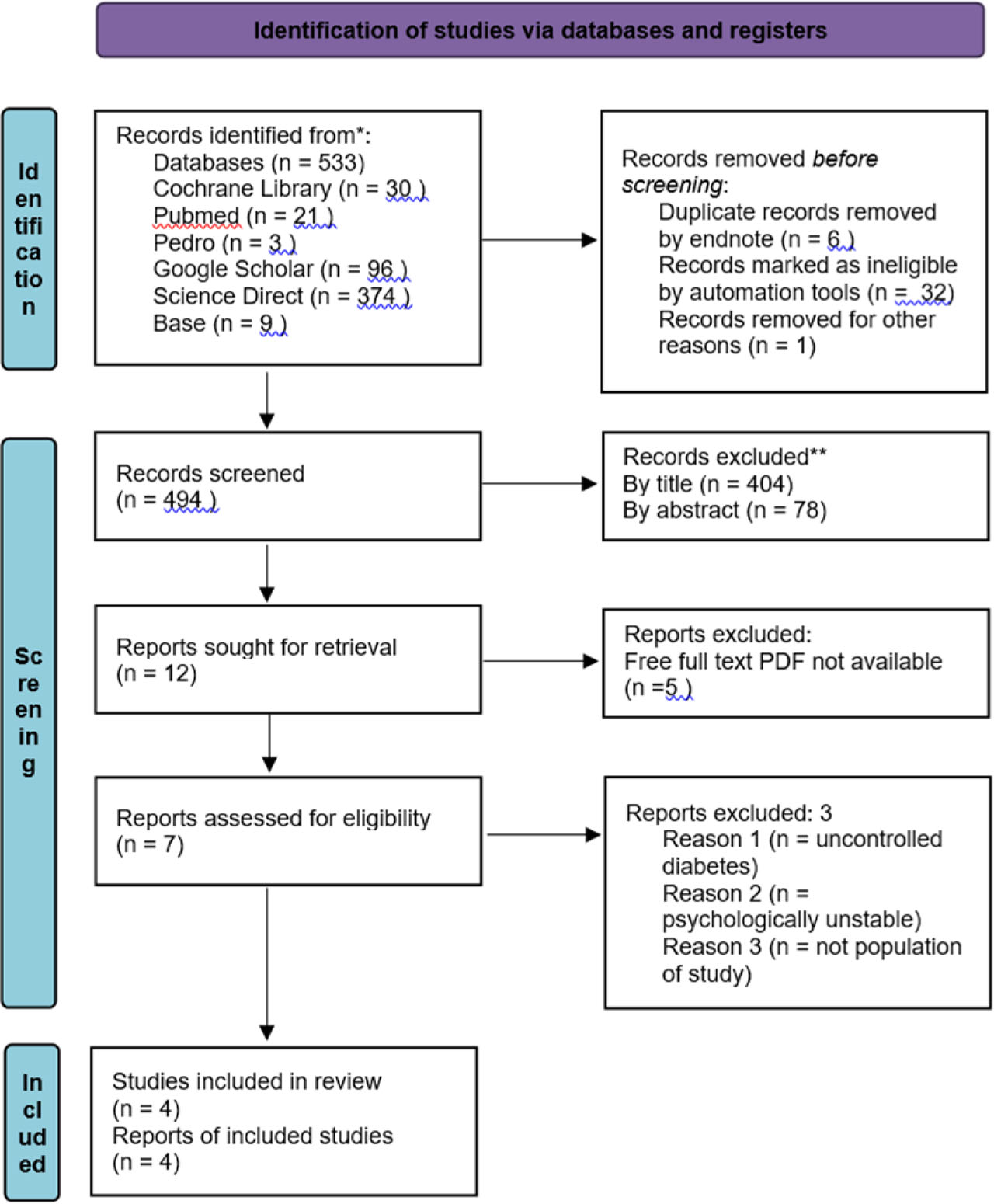
A selection method was applied to the literature search results in order to find appropriate studies that fit the review topic and the inclusion and exclusion criteria outlined by the PICO(S) framework. Filters were utilized to focus findings included years, the full article, and journals with peer review. Using the PRISMA criteria, papers can be carefully chosen for a systematic review. Start by looking up pertinent terms in the relevant databases. By closely examining the titles and abstracts of the research papers that were retrieved, assess their relevancy and eliminated any duplicate entries through Endnote 21. Subsequently, a rationale was furnished for the exclusion of particular research findings, and the remaining publications were incorporated into an exhaustive systematic review. The PRISMA flowchart template (Appendix-I), which displays the quantity of records found, screened, assessed and included in the systematic review, offers a clear visual depiction of the research selection procedure.
Data extraction process
In accordance with (PICO) criteria, all the relevant studies based on the inclusion/exclusion criteria have been included; the methodology of this systematic review will be based on the Preferred Reporting Items for Systematic Reviews and Meta-Analyses (PRISMA) guidelines. Manuscripts and publications published during 2019 to 2025 have been analysed. Choose the best relevant research from around the globe since research conduct in various nations indicated that there is widespread interest in the subject. The full text articles have been analysed; the initial screening have been conduct base on the title and abstract analysis, as well as the duplication of the results. A second search has verified that the papers was accurately chosen and checked for any potential omissions. Conflict have been resolved by carefully examining a few chosen articles. The selection process illustrated in a PRISMA flow chart. A predefined extraction form have been used to extract data independently which includes: characteristics of participants; number of participants, age, type of diagnosis, type of neurodynamic, type of comparative therapy, dosage of treatment and detail of outcome measures results. Transparency throughout the process have been guaranteed by this entire procedure (Voinescu et al., 2021).
Results
The results section started with the commencement of quality appraisal on four selected RCTs that fulfilled eligibility criteria. It marked the initiation of data extraction and synthesis. Applying the PRISMA criteria, the literature search yielded a total of 533 publications, 494 papers were selected. After conducting a comprehensive study, a total of 482 papers were eliminated and 12 articles were retrieved for full text; five studies were excluded due to unavailability of free full text access, finally 7 full text articles were evaluating from which 3 where excluded reason of their exclusion were outlined in Table 4 only 4 RCTs remained which met the necessary criteria.
Discussion
The purpose of this systematic review was to assess how well neural mobilization (NM) techniques can help patients with diabetic peripheral neuropathy (DPN) recover from their condition. Four randomized controlled trials (RCTs) that were published between 2011 and 2024 and satisfied the predetermined inclusion criteria based on methodological quality and relevance to the research question were included in the review.
Table 1:
Population characteristics of included trials
| Study | Country | Study Type (RCTs) | Participants | Age (Years) | Diagnosis |
|---|---|---|---|---|---|
| Alshimy, Ahmed Mag dy, et al., (Nct, 2022) | Egypt | RCT | N = 42 NMG = 21 STPG = 21 | NMG = 52.72 ± 4 STPG = 51.14 ± 4.92 | Diabetic Neuropathy |
| (Sharma & Kalia, 2023) | India | RCT | N = 40 Group 1 = 20 Group 2 = 20 Male = 18 Female = 22 | Group 1 = 56.65 ± 4.57 Group 2 = 56.8 ± 3.87 | Diabetic Neuropathy |
| (Kumar et al., 2011) | India | RCT | N = 32 CG = 16 EG = 16 | CG = 57.43 ± 12.04 EG = 62.81 ± 10.43 | Diabetic Neuropathy |
| (Chacón et al., 2024) | Mexico | RCT | N = 34 Older adults = 17 Adults = 17 | Older adults = 76.5 Adults = 23.5 | Diabetic Neuropathy |
Table 2:
Details of interventions of included trials
| Study | Control Group Intervention | Experimental Group Intervention | Dosage | ||
|---|---|---|---|---|---|
| Session | Duration | Total Weeks | |||
| (Nct, 2022) | STGP graduated active range of motion exercises for both UL and LL joints and gait training | NMG on median nerve and tibial nerve | 3 session per week | 30 minutes | 4 weeks |
| (Sharma & Kalia, 2023) | Balance gait training | Neural mobilization with balance gait training | Once a day for 5 days a week | 35 minutes | 4 weeks |
| (Kumar et al., 2011) | Drugs for glycemic control, analgesics, lifestyle modifications and walk | In addition, tibial nerve neurodynamic mobilization | One session per week | 45 minutes | 5 weeks |
| (Chacón et al., 2024) | Radial neurodynamics, ulnar neurodynamics and median neurodynamics | Sciatic neurodynamics and Peroneus neurodynamics | Once a day per week | 25 minutes | 8 weeks |
Table 3:
Outcome measures, findings, and results of included studies
| Study | Outcome measures | Follow UP | Results | Conclusion | ||
|---|---|---|---|---|---|---|
| Experimental Group Differences (Mean±SD) | Findings | |||||
| Experimental Group | Control Group | |||||
| (Nct, 2022) | (Sensory and motor nerve conduction velocity) (Visual analogue scale) (Katz index) | 4 weeks | VAS = 7 ± 1.14 MSN-NcV = 39.12 ± 5.61 TMN-NcV = 37.42 ± 2.49 Katz index = 3 ± 1.14 | VAS = 7 ± 1.14 MSN-NcV = 39.95 ± 5.89 TMN-NcV = 38.48 ± 2.54 Katz index = 3 ± 1.14 | VAS P = 0.001 MSN-NcV P = 0.002 TMN-NcV p = 0.001 Katz index P = 0.001 | No significant difference |
| (Sharma & Kalia, 2023) | BBS DGI TUG VPT | 4 weeks | BBS = 40.5 ± 5.73 DGI = 13.60 ± 3.25 TUG = 19.50 ± 4.11 VPT = 17.77 ± 2.48 | BBS = 47.5 ± 5.73 DGI = 18.5 ± 3.69 TUG = 15.85 ± 3.65 VPT = 16.74 ± 2.60 | EG BBS P = 0.0001 DGI P = 0.0001 TUG P = 0.0001 VPT P = 0.0001 CG BBS P = 0.63 DGI P = 0.52 TUG P = 0.69 VPT P = 0.001 | NM with BGT showed significant impact on BBS, DGI and TUG. BGT alone showed non-significant difference. |
| (Kumar et al., 2011) | NPQ (pre- post) NeuroQoL (pre-post) Vibration Thresholds (pre- post) volts SLR2 ROM (pre-post) degrees | 5 weeks | NPQ (pre- post) = 28.5 ± 7.15 NeuroQoL (pre- post) = 28.63 ± 6.84 Vibration Thresholds (pre- post) = 16.5 ± 3.14 volts SLR2 ROM (pre- post) degrees = −8.62 ± 5.79 | NPQ (pre- post) = 9.61 ± 4.69 NeuroQoL (pre- post) = 12.7 ± 3.99 Vibration Thresholds (pre-post) = 10.56 ± 2.22 volts SLR2 ROM (pre-post) degrees = −4.62 ± 2.94 | NPQ (pre- post) P = .000 NeuroQoL (pre- post) P = .000 Vibration Thresholds (pre- post) P = .000 volts SLR2 ROM (pre-post) degrees P = .020 | Both the groups showed statistically significant improvements in all the four variables studied |
| (Chacón et al., 2024) | Michigan Questionnaire Sensitivity test | 8 weeks | MNSI = 76.5% TSSM = (2,0,0) ThSSM = (1.88235,0.0,0.11765) TSLM = (1.76471,0.00,0.23529) ThSLM = (1.52941,0.00,0.47059) VSM = (0.588,0.294,0.118) VLM = (0.706,0.176,0.118) | MNSI = 100% TSSM = (2,0,0) ThSSM = (2,0,0) TSLM = (2,0,0) ThSLM = (2,0,0) VSM = (1,0,0) VLM = (0.882,0.118,0) | MNSI P = (4.6610×10−29,4.4833×10−25,1.8120× 10−45) TSSM P = (□□, □□,□□) ThSSM P = (5.8069×10⁻¹², □□, 1.5987×10⁻¹⁴) TSLM P = (2.6017×10⁻²²,□□, 0.00) ThSLM P = (7.3437×10⁻³¹, □□,0.00) VSM P = (1.9620×10−30,0.00,6.7526×10−12) VLM P = (2.2287×10−30,2.5083×10−7,2.1578× 10−12) | This study showed significant results of neurodynamic mobilization techniques. |
[i] Pubmed : ((((diabetic neuropathy[MeSH Terms]) OR (diabetic neuropathy)) OR (diabetic neuropathy[Text Word])) AND (((mobilization) OR (neurodynamic)) OR (neurodynamics[Text Word]))) AND (((rehabilitation[MeSH Terms]) OR (rehabilitation[Text Word])) OR (rehabilitation))
[ii] Pedro : ((((diabetic neuropathy[MeSH Terms]) OR (diabetic neuropathy)) OR (diabetic neuropathy[Text Word])) AND (((mobilization) OR (neurodynamic)) OR (neurodynamics[Text Word]))) AND (((rehabilitation[MeSH Terms]) OR (rehabilitation[Text Word])) OR (rehabilitation))
Recommendations for Future Research
There is a need for more robust, multicentric RCTs with standardized NM protocols and long-term follow-ups to assess sustained benefits. Future research should also investigate specific neural mobilization types (e.g., slider vs tensioner), dose-response relationships, and their standalone effects compared to active control interventions.
Limitations of the Study
Despite the comprehensive approach taken in this systematic review, several limitations must be acknowledged:
Limited Number of High-Quality Studies
The review included a relatively small number of randomized controlled trials (RCTs) that met the strict inclusion criteria. The limited pool of eligible studies restricted the breadth and generalizability of the findings.
Heterogeneity of Study Designs
Considerable heterogeneity was observed across the included studies regarding participant characteristics, intervention protocols (type, intensity, and duration of neural mobilization techniques), outcome measures, and follow-up periods. This variation limited the ability to conduct a meta-analysis and draw unified conclusions.
Inconsistent Outcome Measures
Different studies used varying tools and scales to assess outcomes such as pain, nerve conduction velocity, and quality of life, making direct comparisons challenging.
Short Follow-Up Periods
Most studies had short-term follow-up durations, which limited the understanding of the long-term effectiveness and sustainability of neural mobilization techniques in managing diabetic peripheral neuropathy.
Lack of Standardization in Intervention Protocols
There was no universal protocol for the neural mobilization interventions used across studies. Variability in technique application (e.g., sliders vs. tensioners) affects reproducibility and interpretation.
Language and Time Frame Restrictions
Only studies published in English and within a specific timeframe (2015–2025) were included, which may have led to the exclusion of relevant literature published in other languages or earlier years.
Potential for Publication Bias
Despite efforts to conduct a thorough search using multiple databases, the possibility of publication bias cannot be excluded, especially as unpublished data and grey literature were not systematically included.
Subjectivity in Study Selection and Data Extraction
Although predefined inclusion and exclusion criteria were used, some degree of subjectivity in study selection and interpretation of findings may exist, which is inherent to any systematic review process.
Difficulties Encountered During the Study
While conducting this systematic review, several difficulties were encountered that posed challenges to the research process:
Limited Access to Full-Text Articles
One of the major difficulties faced was the lack of access to the full text of several potentially relevant studies. Many articles were behind paywalls or not freely available, which restricted their inclusion despite having relevant abstracts.
Time Constraints
The study was conducted within a limited academic timeframe. The processes of comprehensive database searching, screening, data extraction, and quality assessment were time-intensive and required careful planning to meet the deadline.
Data Extraction Complexity
Extracting consistent and comparable data from studies with diverse designs and reporting formats proved to be difficult. Some studies lacked clear descriptions of interventions or outcome measures, requiring additional effort to interpret and cross-reference data.
Difficulty in Locating RCTs Specific to Neural Mobilization for DPN
Although neural mobilization is a growing area of research, the availability of high-quality RCTs specifically targeting diabetic peripheral neuropathy (DPN) was limited. This made the selection process more challenging and prolonged.
Variability in Terminology Across Databases
Different databases used varying indexing terms, MeSH terms, and keyword structures. This required multiple search iterations and careful refinement of search strategies to ensure comprehensive literature retrieval.
Managing Duplicates and Screening Bias
Screening hundreds of articles and managing duplicate entries across multiple databases using reference management software (e.g., EndNote) was a meticulous and time-consuming task, with a constant need to avoid selection and confirmation bias.
Methodological Inconsistencies in Included Studies
A number of included studies had unclear methodologies, incomplete outcome data, or lacked control groups, making it difficult to assess their reliability and integrate them into the overall findings with confidence.
Conclusion
The usefulness of neural mobilization techniques in diabetic peripheral neuropathy patients was assessed in this systematic review. According to the synthesis of four RCTs, NM is a therapeutic option that shows promise for improving nerve function, reducing pain, and improving functional performance in people with DPN.
While some variability in results was noted, particularly in terms of statistical significance across outcome domains, the general trend indicates that NM techniques, when used in conjunction with standard rehabilitation programs, offer clinically meaningful benefits. The improvements observed in nerve conduction velocity, balance, and gait parameters reinforce the role of NM as a complement to conventional therapy.
Despite some methodological limitations in the included studies, the overall evidence supports the use of NM in physical therapy interventions for DPN. However, to establish definitive clinical guidelines, further high-quality trials with larger sample sizes, standardized intervention protocols, and long-term outcomes are necessary.
To sum up, neural mobilization seems to be a safe, non-invasive, and successful method that may improve the quality of life and rehabilitation results for diabetic peripheral neuropathy patients.