
Table 1
Typical applications of radiation processing
| Product | Effect | Dose range (kGy) | Ref. |
|---|---|---|---|
| Healthcare products; medical devices (implants syringes, needles, scalpels, blades, aspirators, etc.) | Sterilisation | 15−30 | 3 |
| Active ingredients in medicinal and medical cosmetic products | Sterilisation | 25–50 | 4 |
| Food components and ingredients (spices, fillers, herbs, herb teas, etc.) | Killing a variety of microorganisms and insects | 1−10 | 2, 5, 6 |
| Raw materials for pharmaceutical industry (starch, plant extracts, etc.) | Enhanced functional properties (solubility, viscosity), sterilisation, enhanced extraction of beneficial compounds | 5−30 | 5, 6 |
| Polymers | Crosslinking, grafting | 5−1000 | 7 |
| Bone allografts | Sterilisation | 25−50 | 8 |
| Wastewater treatment | Killing pathogenic microorganisms for safe release of the sludge into the environment, degradation of organic pollutants | 1−10 | 2, 9 |
| Cultural heritage objects | Killing insects, moulds, and fungi | 0.5−20 | 10 |
Table 2
Advantages and disadvantages of radiation-based sterilisation
| Advantages | Ref. | |
|---|---|---|
| Terminal processing | Due to the penetration depth of ionising radiation, products can be processed in their fully sealed, final packaging. This limits risk of contamination following sterilisation | 3 |
| Temperature independence | Temperature increases during treatment are minimal. Radiation sterilisation is efficient at both ambient and sub-zero temperatures. It can be used to treat thermolabile and frozen materials at any temperature and any pressure | 3 |
| Chemical independence | No volatile or toxic chemicals are needed. The only parameter is radiation dose | 3 |
| No residue | Radiation leaves no residue on the sterilised product | 3 |
| Flexibility | Radiation can sterilise gaseous, liquid, or solid materials of variable density and size, homogeneous and heterogeneous alike | 3 |
| Sterility assurance level (SAL) | Radiation treatment can yield a high SAL of 10−6 or better, ensuring that less than one out of a million microorganisms survive the sterilisation | 67 |
| Ease of use | Only a single variable, exposure dose/time, must be monitored | 3 |
| Disadvantages | ||
| Instrumentation | Capital costs are high and specialised facilities are needed | 2, 68 |
| Product degradation | Radiation-based methods are not compatible with all materials and can break down the packaging material and/or product | 69 |
| Radioactive source | Handling and disposal of radioactive source material requires special, highly regulated care and may involve high cost | 68 |
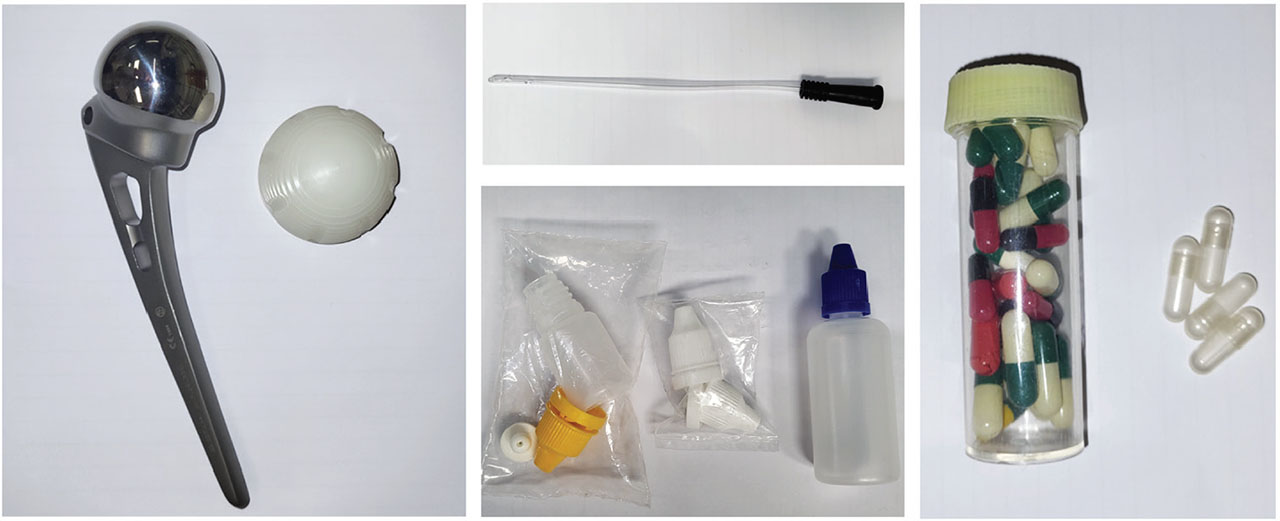
Figure 1
Examples of products sterilised with gamma radiation at RCDL. Left to right: artificial hip, catheter, plastic bottles with caps, and hard gelatine capsules)