
INTRODUCTION
Dipsacus fullonum L. (wild teasel) from the family Caprifoliaceae is among the plants widely distributed in the region of Central Europe with potential antimicrobial properties. In addition to D. fullonum, other species from the genus Dipsacus that are used and studied today are D. asperoides C.Y. Cheng & T.M. Ai, D. ferox Loisel and D. laciniatus L. In folk medicine, teasel root is utilised especially for Lyme borreliosis, which is caused by the bacterium Borrelia burgdorferi. Teasel is also used externally for eczema, wounds, fistulae and rheumatism (Jahodář, 2010).
The secondary metabolites identified in D. fullonum so far are iridoids: loganin, loganic acid, loganic acid ethyl ester (Saar-Reismaa et al., 2022a) and secoiridoid sweroside (Jensen et al., 1979). Furthermore, interesting molecules are bis-iridoids sylvestroside I–IV, which were identified for the first time in seeds of D. fullonum (Jensen et al., 1979), and cantleyoside (Oszmiański et al., 2020). Several caffeic acid derivatives were identified as well, such as derivatives of caffeoylquinic and di-caffeoylquinic acids (chlorogenic acid, neochlorogenic acid, cryptochlorogenic acid) (Kuhtinskaja and Vaher, 2018; Oszmiański et al., 2020; Saar-Reismaa et al., 2022a, 2022b). To date, flavonoids have been identified only in the leaves of this plant, specifically apigenin and luteolin derivatives (saponarin, isovitexin, luteolin, orientin, isoorientin) (Kuhtinskaja and Vaher, 2018; Oszmiański et al., 2020; Saar-Reismaa et al., 2022a, 2022b).
The biological activities of teasel have so far been studied only in vitro. Several effects were detected, among them anticancer activity of leaf extract in breast cancer cell lines (Kuhtinskaja et al., 2020), acetylcholinesterase inhibition of root extract (Oszmiański et al., 2020) and inhibition of α-amylase (Witkowska-Banaszczak, 2018). Antioxidant properties of leaf extracts of D. fullonum prepared via different extraction procedures were compared via DPPH (2,2-Diphenyl-1-picrylhydrazyl), CUPRAC (CUPric Reducing Antioxidant Capacity) and FRAP (Ferric Reducing Antioxidant Power Assay) assays. The strongest activity was observed for the amino acid ionic liquid-assisted ultrasound extraction with the use of [TEAH]+[Thr]−, compared with the water extraction (Roman et al., 2021). Antioxidant properties of leaf and root extracts were evaluated via the oxygen radical absorbance capacity (ORAC) method (Oszmiański et al., 2020; Saar-Reismaa et al., 2022a). The leaf extract demonstrated greater antioxidant capacity compared with the root extract (Oszmiański et al., 2020). The antibacterial activity of root and leaf extracts was evaluated for the bacteria Pseudomonas aeruginosa, Pseudomonas fluorescens, Bacillus subtilis, Staphylococcus aureus and Escherichia coli. The study confirmed the antibacterial activity of the root extract against S. aureus and E. coli (Oszmiański et al., 2020). The activity of root extracts against B. burgdorferi, which causes Lyme disease, was also evaluated. Dichloromethane, ethyl acetate and 70% (V/V) water-ethanolic extracts were compared. The most remarkable results occurred when the ethyl acetate extract was used. The water-ethanolic extract did not show any activity (Liebold et al., 2011). On the contrary, the 70% water-ethanolic extract of the leaves showed significant activity against B. burgdorferi. However, a high cytotoxic effect against mammalian cells was discovered as well. After fractionation and purification of the extract, the most suitable properties in terms of the highest antibacterial activity and the lowest cytotoxicity were reported for the sylvestroside III/IV fraction (Saar-Reismaa et al., 2022a).
This study aimed to evaluate and compare the antioxidant activity of the individual extracts and the mixture of these extracts, analysed by the DPPH method. Antimicrobial activity was expressed as minimum inhibitory concentration (MIC) and minimum bactericidal concentration (MBC), which were determined using the microdilution method against bacteria S. aureus (methicillin susceptible and resistant form), Proteus mirabilis, Enterococcus faecalis, E. coli and P. aeruginosa. Thanks to this research, it will be possible to determine the antioxidant and antimicrobial activities, which have not been evaluated by these methods so far. Based on previously published studies, we have assumed that the extracts of D. fullonum will express antioxidant and antibacterial activities against the selected bacterial strains expressed as IC50 and MIC values.
METHODS
The leaves and roots of D. fullonum were collected on the outskirts of Bratislava, Slovakia. Leaves were collected before flowering, at the beginning of summer 2023. The roots were collected after flowering, in the autumn of 2023. The plant samples were dried at room temperature, followed by grinding and homogenised by a sieve with an aperture size of 220 μm. The extracts were prepared using ultrasound-assisted extraction for 1 h in 70% ethanol (V/V). A 70% ethanol solution was selected as the extraction solvent to ensure the extraction of both polar and non-polar compounds, based on the extraction procedure of D. fullonum described by Saar-Reismaa et al. (2022a). After vacuum evaporation, lyophilisation was the final step in extract preparation.
Spectrophotometric determination of the content of secondary metabolites
For the analyses, 5 mg of lyophilisates were dissolved in 5.0 mL of demineralised water. Quantification of total hydroxycinnamic derivatives (THD) was performed by a modified spectrophotometric method from the monograph ‘Rosmarini folium’, European Pharmacopoeia 11 (Ph. Eur. 11) using an Arnow solution, HCl 0.5 mol/L and NaOH (EDQM Council of Europe, 2024a). THD were expressed on rosmarinic acid (96%, Sigma-Aldrich, Slovakia). The absorbance for quantification of THD was determined at 505 nm. The quantification of total polyphenol content and the content of tannins was performed according to the modified spectrophotometric method from Ph. Eur. 11 ‘Tannins in herbal drugs’ (EDQM Council of Europe, 2024b). In this measurement, absorbance was recorded at 760 nm. Folin-Ciocalteau solution and sodium carbonate (c = 0.29 g/mL) were used in this measurement. Tannins were quantified after deduction of the content absorbed by the skin powder after shaking. The results were expressed on gallic acid (99%, J&C Scientific, USA). All measurements were performed in quadruplicates on the Tecan Infinite M200 reader (Tecan AG, Grödig/Salzburg, Austria). The results were analysed using Magellan V 6.4 (Tecan AG, Grödig/Salzburg, Austria) and Microsoft Excel (Microsoft Corporation, Redmond, WA, USA) programs.
DPPH scavenging assay for determination of antioxidant activity
The assay was performed according to the optimised method used by Kurin et al. (2012). Samples were prepared from lyophilisates of roots, leaves and their combination in a ratio of 1:1 by dissolution in 70% ethanol with serial dilution (100–6.25 μg/mL). DPPH (Sigma-Aldrich, St. Louis, MO, USA; 225 μL, 55 μM) and the samples (25 μL) were pipetted into 96-well flat-bottom microplates (UV-Star F-bottom chimney well μCLEAR, Greiner Bio-One, Frickenhausen, Germany). A solution of DPPH with 70% ethanol was used as the negative control. Chlorogenic acid (primary reference standard, HWI group, Rülzheim, Germany) was used as a reference. Analysis was performed after 30 min at 517 nm in quadruplicates on Tecan Infinite M200 reader (Tecan AG, Grödig/Salzburg, Austria). The percentage of DPPH radical inhibition was calculated using the equation: % inhibition = (ADPPH − ASAMPLE)/ADPPH × 100. IC50 values were calculated from the dose–response curves using CompuSyn software.
Determination of antibacterial activity
Stock solutions of lyophilisates were prepared at a concentration of 80 mg/mL by dissolution in demineralised water, followed by filtration through a bacteriological filter (Millex-GP 0.22 μm, Merck Millipore Ltd., Tullagreen, Carrigtwohill, Ireland). The first analysed concentration was 40 mg/mL. Bacterial strains (S. aureus subsp. aureus CCM 4223/ATCC 29213 MSSA - methicillin susceptible S. aureus; S. aureus subsp. aureus CCM4750/ATCC 43300 MRSA – methicillin-resistant S. aureus; P. mirabilis ATCC 29906/WDCM 00023 Vitroids, Sigma-Aldrich, St. Louis, MO, USA, manufactured in Switzerland; E. coli ATCC 25922/WDCM 00013 Vitroids, Sigma-Aldrich, St. Louis, USA, MO, manufactured in Switzerland; E. faecalis ATCC 29212/WDCM 00087 Vitroids, Sigma-Aldrich, St. Louis, USA, manufactured in Switzerland; P. aeruginosa ATCC 27853/WDCM 00025 Vitroids, Sigma-Aldrich, St. Louis, MO, USA, manufactured in Switzerland) were cultivated overnight before analysis on Columbia blood agar (MkB Test, Rosina, Slovakia). Streptomycin (streptomycin sulphate salt for cell culture, Sigma-Aldrich, St. Louis, MO, USA) served as a reference antibiotic. Antibacterial activity was determined using the broth microdilution method according to EUCAST (The European Committee on Antimicrobial Susceptibility Testing, 2024) and ISO standards (ISO 20776-1, 2019). The results were expressed as MIC and MBC. Mueller-Hinton broth, pre-autoclaved at 121°C for 20 min was used as a growing medium (Sigma-Aldrich, St. Louis, MO, USA).
Statistical and interaction analyses
The experimental data were analysed using GraphPad Prism version 5.00 for Windows (GraphPad Software, San Diego, CA, USA). The results are presented as the mean ± standard deviation (SD) of quadruplicate measurements. Pearson’s two-tailed correlation test was applied for analysis, with P ≤ 0.05 considered statistically significant for dose-dependent inhibition of DPPH radical. Changes in the content of secondary metabolites of D. fullonum extracts were evaluated using a paired, two-tailed Analysis of Variance (ANOVA) test followed by the Bonferroni post hoc test. Statistical significance was set at P ≤ 0.05.
The IC50 values were calculated using the median-effect equation, based on the theory developed by Chou (2006). Calculations were performed using CompuSyn software (ComboSyn Inc., Paramus, NJ, USA), which applies the mass-action law to determine dose-effect parameters from experimental data. The median-effect Eq. (1) is defined as:
where fa and fu are the fractions of the system affected and unaffected by the treatment, respectively; D is the dose; Dm is the median-effect dose (equivalent to IC50); and m is the slope of the dose–effect curve, indicating its shape (m = 1: hyperbolic, m > 1: sigmoidal, m < 1: flat sigmoidal). The correlation coefficient r, also provided by CompuSyn, was calculated as the linear correlation coefficient of the median-effect plot, reflecting the conformity of the data to the theoretical model. A value of r = 1 indicates perfect conformity.The interaction between D. fullonum leaves and roots was quantified as synergistic or antagonistic using Eq. (2) for n-drug combinations at x% inhibition, based on Chou’s method (Chou, 2006) with the combination index (CI):
where n(CI)x is the sum of doses for n drugs achieving x% inhibition. The denominator (Dx) is the dose of drug D alone that produces x% inhibition. A CI value = 1, <1 or >1 indicates additive, synergistic, or antagonistic effects, respectively. The r value represents the fit to the median-effect principle of the mass-action law. For calculation, CompuSyn software (version 1.0.1, CompuSyn, Inc.) was used.RESULTS AND DISCUSSION
This study investigates the biological effects of D. fullonum (teasel) with a focus on extracts from its leaves and roots. The plant samples were collected in Slovakia, where both the leaves and roots were identified using a plant identification key (Martinovský et al., 1987). The leaves were harvested in late June 2023, just before flowering, while the roots were collected in September 2023 after the leaves had dried, allowing for clear species identification. Extraction was performed using 70% (V/V) ethanol under ultrasound, followed by lyophilisation to facilitate subsequent analyses. The yield of leaf extract was 24.0%, three times higher than the root extract yield of 8.1%.
This study also focused on the quantification of selected groups of secondary metabolites, as plant constituents are responsible for their biological activities. Quantitative spectrophotometric analysis was employed, based on modified methods from the European Pharmacopoeia from the monograph “Rosmarini folium” (EDQM Council of Europe, 2024a). Hydroxycinnamic acid derivatives (THD) are a group of secondary compounds, where caffeic, coumaric, chlorogenic and rosmarinic acids are included. THD were quantified in both leaf and root extracts, with higher concentrations found in the leaf. For the leaf extract, the content of hydroxycinnamic acid derivatives was 4.55 ± 0.41%, compared with 2.56 ± 0.16% in the root extract. When calculated on the dried leaves, THD were present at the level of 1.09 ± 0.10% and 0.02 ± 0.01% of the roots.
Total phenolic and tannin content was also quantified using a modified method from the monograph ‘Tannins in herbal drugs’ in European Pharmacopoeia (EDQM Council of Europe, 2024b). Tannins, known for their astringency and therapeutic use in conditions like diarrhoea and skin inflammation, were present at higher concentrations in the leaf extract (3.36 ± 0.34%) compared with the root (2.59 ± 0.12%). Expressed on the dried samples, tannins were present at the level of 0.80 ± 0.08% of the leaves and 0.21 ± 0.01% of the roots. Total polyphenols were determined at the level of 7.75 ± 0.33% in the leaf extract and 4.21 ± 0.22% in the root extract. When calculated on the weight of the dried drug, polyphenols formed a part of 1.86 ± 0.08% of the leaves and 0.34 ± 0.02% of the roots. These results indicate that the leaf extract of D. fullonum has a higher content of polyphenols than the root, consistent with findings by Oszmiański et al. (2020), who reported 2–4 times higher polyphenol content in the leaves compared with the roots of D. fullonum. The overview of the content is shown in Fig. 1.
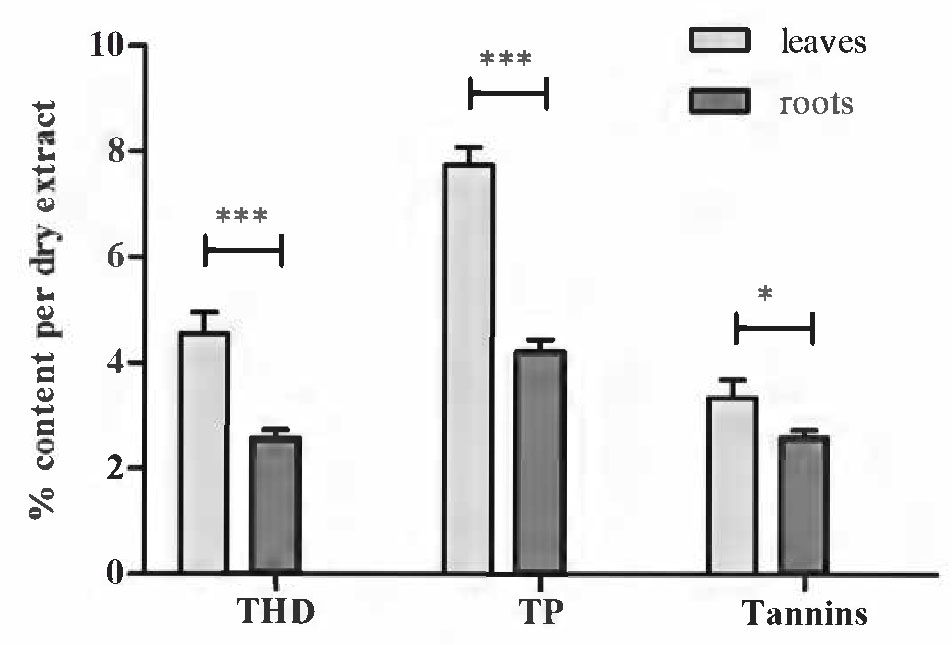
Figure 1.
Comparison of the content of groups of secondary metabolites: hydroxycinnamic derivatives (THD), total polyphenols (TP), and tannins, calculated per weight of dried extract of leaves and roots of D. fullonum. The bars represent mean ± SD, n=4; *** = p <0.001 extracts of leaves vs. extracts of roots (ANOV A/Bonferroni).
Antioxidant activity was assessed using the DPPH radical scavenging method, where lower IC50 values indicate higher antioxidant activity. The IC50 values for the leaf and root extracts were 34.78 μg/mL and 53.81 μg/mL, respectively, with the mixture of both extracts in a ratio of 1:1 yielding an IC50 of 42.67 μg/mL. The effect of the mixture of extracts was evaluated as the value of the CI, which is a mathematical expression of the synergy (CI < 1), additivity (CI = 1) or antagonism (CI > 1) of the effect of a combination of several substances. In the case of a synergistic effect, the observed phenomena of the whole are higher than the phenomena of the separate subsystems. The total effect, therefore, does not correspond to the simple summation of the effects of the individual parts (Chou, 2006; Kurin and Nagy, 2012). The CI for the combination of both extracts was calculated at 1.01, indicating an additive effect rather than synergy or antagonism. Chlorogenic acid derivatives are among the main secondary metabolites found in D. fullonum (Kuhtinskaja and Vaher, 2018; Oszmiański et al., 2020; Saar-Reismaa et al., 2022a, 2022b). These compounds are well-known antioxidants (Liang and Kitts, 2015), therefore chlorogenic acid was selected as a positive control for antioxidant activity measurements. The IC50 of chlorogenic acid was measured at 3.56 μg/mL (Fig. 2). These findings are in line with the paper by Oszmiański et al. (2020), in which similarly stronger antioxidant activity of leaf extract compared with the root extract was found. It seems that the in vitro antioxidant activity may correlate with the number of polyphenols in the sample, which agrees with the previously published articles (Büyüktuncel et al., 2014; Dobrinas et al., 2021; Paixão et al., 2007). An overview of calculated values of IC50, correlation index (r) and CI is displayed in Table 1.
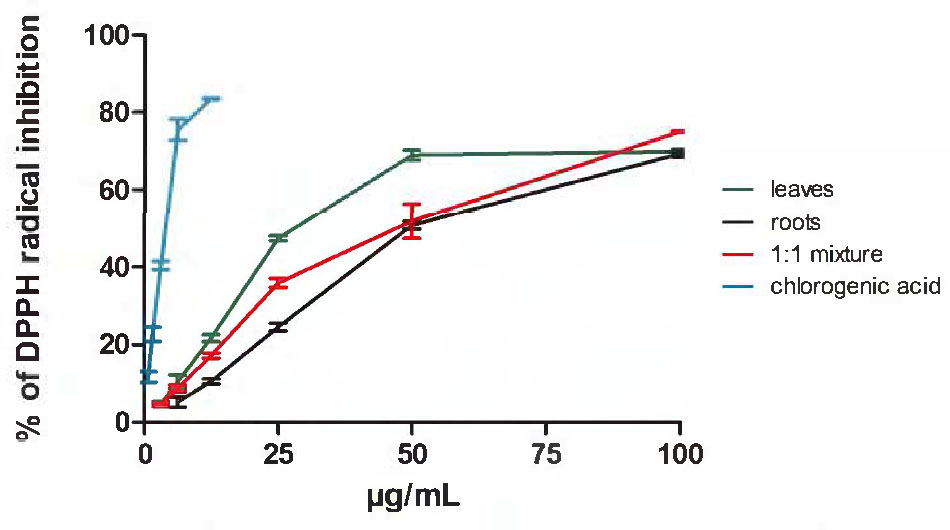
Figure 2.
Dose-dependent inhibition of DPPH radical by D. fullonum extracts of leaves, roots a 1:lmixture of leaves and roots extracts, and chlorogenic acid as the positive control. The bars represent the mean ± SD, n=4. Pearson’s two-tailed correlation test was used to assess the correlation, where p<0.05 was observed for the leaves and chlorogenic acid, and p<0.01 for the roots and 1:1 mixture.
Table 1.
Overview of IC50, correlation coefficient (r) and CI values for D. fullonum leaves extract, roots extract, their mixture in the ratio of 1:1 and chlorogenic acid.
| Extract/combination | IC50 [μg/mL] | r | CI |
|---|---|---|---|
| Leaves | 34.78 | 0.9816 | - |
| Roots | 53.81 | 0.9945 | - |
| 1:1 mixture | 42.67 | 0.9970 | 1.01 |
| Chlorogenic acid | 3.56 | 0.9879 | - |
Antibacterial activity was assessed using microdilution methods against several bacterial strains, including S. aureus (MSSA, MRSA), P. aeruginosa, E. coli, E. faecalis and P. mirabilis expressed as MIC and MBC (Table 2). The root extract showed no antibacterial activity at concentrations of up to 40 mg/mL, while the leaf extract demonstrated weak activity against P. aeruginosa and P. mirabilis (MIC = 40 mg/mL) and moderate activity against S. aureus (MIC = 10 mg/mL for MSSA, 20 mg/mL for MRSA). Streptomycin was used as a positive control with about four orders of magnitude lower concentrations, compared with the extracts. These results are relatively weak compared with other antibacterial agents, such as Origanum vulgare leaf extract against S. aureus (MIC ~ 0.5 mg/mL) (Pérez-Delgado et al., 2021). Differences in antibacterial findings compared with those of Oszmiański et al. (2020) may be attributed to variations in extraction methods and bacterial strain sensitivity.
Table 2.
MIC and MBC of extracts of leaves and roots of D. fullonum on reference bacterial strains.
| Bacteria | Leaves | Roots | Streptomycin | |||
|---|---|---|---|---|---|---|
| MIC [mg/mL] | MIC [mg/mL] | MIC [mg/mL] | MBC [mg/mL] | MIC [mg/mL] | MBC [mg/mL] | |
| MSSA | 10 | >40 | >40 | >40 | 0.002 | 0.002 |
| MRSA | 20 | >40 | >40 | >40 | 0.002 | 0.004 |
| P. aeruginosa | 40 | >40 | >40 | >40 | 0.004 | 0.008 |
| E. coli | >40 | >40 | >40 | >40 | 0.004 | 0.008 |
| E. faecalis | >40 | >40 | >40 | >40 | 0.015 | 0.060 |
| P. mirabilis | 40 | >40 | >40 | >40 | 0.008 | 0.008 |
CONCLUSIONS
D. fullonum (teasel) has traditionally been used in folk medicine, particularly for Lyme borreliosis. This study compared the antioxidant and antibacterial activities of extracts from its root and leaves. The leaf extract exhibited higher yields of secondary metabolites and stronger antioxidant activity, while the root extract had weaker effects. Antibacterial testing revealed mild activity of the leaf extract against certain bacterial strains with no antibacterial activity observed for the root extract. Further studies are needed to explore these effects in greater detail, especially considering different extraction methods and bacterial strains. These findings highlight the potential for further research on D. fullonum, a plant with relatively limited scientific exploration.
ACKNOWLEDGEMENTS
This work was supported by the Grant Agency of the Ministry of Education, Science, Research, and Sport of the Slovak Republic (Grant No. VEGA 1/0170/24), the Slovak Research and Development Agency (Grant No. APVV-19-0056) and the Excellent Grant of Comenius University Bratislava GUKE 2024 (Grant No. UK/3037/2024).