
INTRODUCTION
Chronic obstructive pulmonary disease (COPD), as defined by the Global Initiative for Chronic Obstructive Lung Disease (GOLD), is a progressive, preventable and treatable respiratory condition marked by enduring airflow restriction and chronic respiratory symptoms, including cough, dyspnoea and sputum production1. Chronic inflammation leads to lung structural changes, causing airway constriction and less elastic recoil, compromising breathing efficiency2,3. COPD is a predominant cause of illness and death globally, imposing a substantial strain on healthcare systems and adversely affecting patients’ quality of life (QoL)4,5.
Urinary incontinence (UI), defined by the International Continence Society (ICS) as the complaint of any involuntary leakage of urine, is a common disorder that disproportionately impacts women, especially as they age due to menopausal hormonal changes and age-related pelvic floor muscle weakening6,7. Contributing factors encompass pregnancy, childbirth and menopause, with stress urinary incontinence (SUI) frequently induced by increased intra-abdominal pressure during actions such as coughing, sneezing or physical exertion8,9. Recent epidemiological estimates indicate that more than 420 million individuals worldwide are impacted by UI; however, the real numbers may be understated due to the condition’s sensitive nature, variability in diagnostic criteria and differences in study methodologies10.
Recent research reveals a significant comorbidity between COPD and UI, with prevalence rates among COPD patients varying from 34.9% to 49.6%11,12. Given that the primary mechanism linking COPD and UI is chronic coughing, which elevates intra-abdominal pressure, SUI is the most prevalent subtype observed in this population13. Recurrent strain may further compromise pelvic floor muscles and connective tissues, increasing the likelihood of UI in this demographic14,15.
Physiotherapeutic therapies are regarded as the primary non-invasive treatment for UI, with pelvic floor muscle training (PFMT) being extensively endorsed16,17. PFMT aims to enhance pelvic floor strength and optimise neuromuscular control during activities that increase intra-abdominal pressure18,19,20. Pilates, which focuses on core stability, breath control, posture and pelvic alignment, is a potential alternative21. It may indirectly improve pelvic floor function by promoting the coordinated activation of the transversus abdominis, diaphragm and pelvic floor muscles22,23,24. This synergy can enhance the modulation of intra-abdominal pressure and facilitate anticipatory contraction of the pelvic floor during exertion, such as coughing, thereby potentially reducing stress-related leakage episodes25,26.
While both PFMT and Pilates have shown efficacy in enhancing UI and QoL in general populations27, direct comparative data are scarce and evidence is particularly limited for individuals with COPD, a population for whom chronic coughing presents a distinct pathophysiological mechanism for UI. The relative efficacy of one technique over the other in managing UI specifically related to respiratory disorders remains uncertain.
This study examines the efficacy of PFMT and Pilates in mitigating UI, relieving cough-related symptoms, and improving QoL in female COPD patients aged 50 years and older. It is posited that both therapies will produce substantial enhancements, with Pilates providing supplementary advantages owing to its focus on core stability and respiratory regulation. Only female patients were recruited to ensure homogeneity, as the pathophysiology of UI in men (often related to prostate issues) differs significantly from that in women.
MATERIALS AND METHODS
Study design and participants
A randomised controlled experiment was performed to evaluate the effects of PFMT against Pilates on UI in female patients with COPD. The research was conducted in the outpatient physiotherapy department of Manshyet El Bakry General Hospital in Cairo, Egypt, from January 2023 to November 2024. Participants were recruited via referrals from the hospital’s respiratory and gynaecology clinics. The study protocol received approval from the Ethical Committee of the Faculty of Physical Therapy, Cairo University (Approval No. P.T.REC/012/003950), and informed consent was acquired from all participants before participation. The study was retrospectively registered on ClinicalTrials.gov under ID: NCT06337240 on 27 March 2024, after data collection had commenced but before data analysis began. All primary and secondary outcome measures were defined and documented in the study protocol prior to the initiation of participant enrollment. The study followed the Declaration of Helsinki.
Sixty female patients diagnosed with moderate to severe COPD and UI were recruited, a number determined to be sufficient by our a priori power analysis to detect a statistically significant difference between groups, for the study and randomly allocated into two equal groups of 30 participants each (1:1). Eligibility criteria mandated that participants be 50 years or older due to menopausal hormonal changes and age-related pelvic floor muscle weakening, possess a clinically confirmed diagnosis of UI and have a stable diagnosis of moderate to severe COPD, as evidenced by pulmonary function testing indicating forced expiratory volume in 1 second (FEV1) between 30% and 80% of the predicted value. All patients were mandated to be clinically stable, with no recent exacerbations at enrollment. Patients were excluded from the study if they had undergone gynaecological surgery in the past 6 months, had an active urinary tract infection, suffered from uncontrolled diabetes mellitus or neurological disorders impacting pelvic floor muscle function, experienced a COPD exacerbation or received inhaled corticosteroids in the 4 weeks prior to enrollment, or had a history of psychiatric illness or depression. Further exclusion criteria encompassed the existence of an arterial aneurysm or indications of unstable cardiac events (e.g. congestive heart failure, severe arterial hypertension), due to the potential cardiovascular strain of the exercise programmes. A history of psychiatric illness or depression was also grounds for exclusion, as these conditions can profoundly influence self-reported outcomes such as QoL and symptom perception, and may affect adherence to the intervention protocol.
Participants were randomly assigned to Group A (PFMT) or Group B (Pilates) using a sealed-envelope randomisation technique prepared by an independent biostatistician using computer software to maintain allocation concealment; each group comprised 30 participants. Opaque, sequentially numbered envelopes were prepared, and the lead physiotherapist conducted group assignments upon a participant’s completion of baseline assessments. All outcome assessments, including administration of questionnaires and pad tests, were performed by assessors who were blinded to the participants’ group allocation. A CONSORT flow diagram was employed to depict the progression of the investigation (Figure 1).
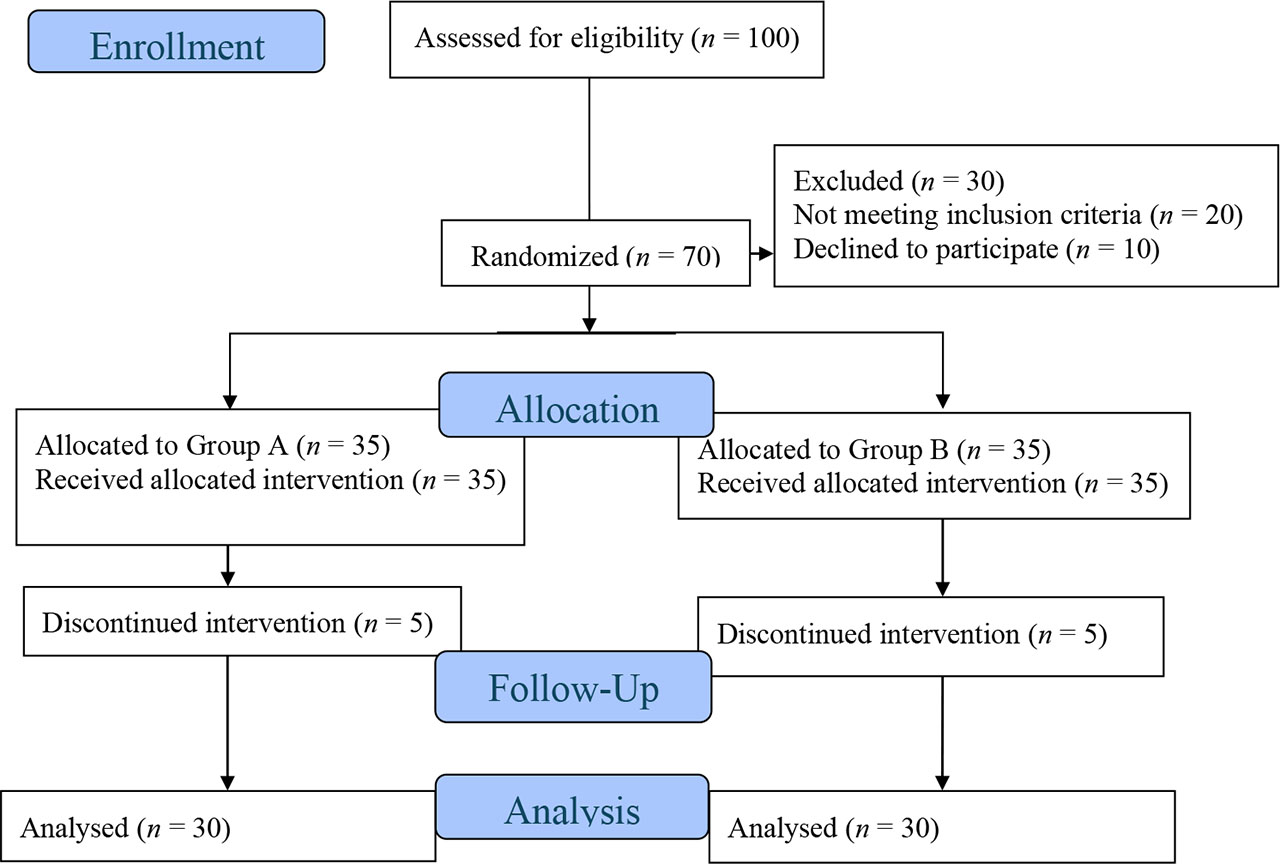
Figure 1.
Study flowchart
Materials and equipment
This study employed standardised data collection sheets intended to document demographic and clinical data, such as age, medical history and pulmonary function test (PFT) outcomes. Fitness yoga mats were supplied to each participant during exercise sessions to enhance comfort and safety during floor-based motions. An electronic weighing scale (SECA 877, GmbH, Germany) was utilised to determine participants’ body weight during the baseline and follow-up evaluations. The scale was calibrated monthly according to the manufacturer’s guidelines. PFTs were performed using a spirometer (MasterScreen PFT, Jaeger, Germany), which was calibrated daily using a 3-L syringe prior to testing.
Procedures
Evaluation and outcome measures
The study results were classified into primary and secondary measures to assess the interventions’ efficacy thoroughly. The primary outcomes concentrated on UI severity, evaluated by the 1-hour and 24-hour pad tests to objectively measure urinary leakage. Furthermore, the incontinence severity index (ISI) was utilised to assess the subjective judgement of incontinence severity. The secondary outcomes examined the wider effects of the interventions. The incontinence quality of life questionnaire (I-QOL), a validated tool, was utilised to evaluate the QoL by measuring the psychological and functional impacts of UI. Cough-related symptoms, a pertinent comorbidity in individuals with COPD, were assessed utilising two instruments: the cough symptoms score (CSS) and the cough symptoms questionnaire (CSQ), both of which offer systematic evaluations of cough frequency, severity and its effect on daily activities.
Interventions
Participants in Group A got PFMT in conjunction with bladder training. The PFMT regimen was conducted thrice weekly for 12 weeks. Each session consisted of three sets of 8–12 slow, maximal voluntary contractions of the pelvic floor muscles, each sustained for 6–10 seconds and succeeded by a corresponding rest interval. Exercises are advanced via progressively functional positions, commencing from supine and culminating in standing. Patients activated their pelvic floor muscles under circumstances that commonly trigger leakage, such as coughing, sneezing or physical exertion, thereby mitigating episodes of stress-induced incontinence28,29. All interventions were delivered by two certified physiotherapists with specialised training in pelvic floor rehabilitation and Pilates for special populations. Both therapists underwent a 2-week training and standardisation workshop led by a senior Pilates instructor to ensure protocol fidelity. Session attendance was recorded by the treating therapist for each participant. COPD-specific precautions were strictly observed. Participants’ oxygen saturation (SpO2) was monitored via pulse oximetry before and after each session. Rest breaks were provided as needed, and participants were instructed to stop immediately if they experienced dizziness, chest pain or severe dyspnoea. Emergency oxygen was readily available.
Group B received Pilates-based fitness training alongside the identical bladder training procedure. Pilates classes were conducted thrice weekly for 12 weeks, with each session lasting around 60 minutes. Exercises were conducted barefoot on yoga mats to enhance proprioceptive feedback and pelvic stability. Sessions commenced with a 7- to 10-minute warm-up using breathing exercises, hip rotations and arm circles to ready the body for physical action. The primary Pilates session lasted 40 minutes and comprised five specific exercises: bent-knee fallouts, pelvic bridges, adductor squeezes, assisted squats and quadruped motions. These workouts were chosen for their ability to target deep core stabilisers (transversus abdominis, multifidus) and promote pelvic floor engagement, while being safe and feasible for individuals with moderate-to-severe COPD. These exercises avoid positions that could restrict breathing or cause excessive fatigue. Sessions ended with a 7- to 10-minute cool-down period that included stretching and breathing techniques to facilitate relaxation and recuperation. The Borg Rating of Perceived Exertion Scale was utilised to evaluate exercise intensity, with warm-up and cool-down phases conducted at light intensity (9–11) and the core phase executed at moderate intensity (12–14)30,31.
It is important to acknowledge that both groups received identical bladder training, which is an effective intervention for UI. The programme encompassed thorough instruction on standard bladder function and urine control mechanisms. Participants were urged to follow a voiding regimen that progressively lengthened the intervals between voids, aiming for a target interval of 3–4 hours. This common component may have contributed to the improvements observed in both groups and potentially attenuated the observable difference between PFMT and Pilates. Cognitive strategies such as mental imagery and motivational affirmations (e.g. ‘I can wait’, ‘I am in control’) were employed to enhance the patient’s continence by strengthening their psychological resilience and self-regulation during urgency episodes. Furthermore, participants were provided with continuous psychological support and positive reinforcement to promote adherence and bolster confidence throughout the programme32. All physical assessments and exercise interventions were performed on standard examination tables and supportive cushions to ensure appropriate placement and participant comfort during the procedures. For participant safety, pulse oximeters (Nonin 9590 Onyx II, USA) and emergency oxygen were available in the exercise room at all times during intervention sessions.
Statistical analysis
Using the G*Power software (version 3.1.9.4), the proper sample size was determined. With a power of 80%, an alpha level of 0.05 and a large effect size (d = 0.74) based on pilot data from a similar study comparing Pilates and PFMT for UI33, a total of 60 participants were necessary to detect statistically significant changes between groups34,35. This was based on the assumption that a two-tailed t-test would be used.
The IBM SPSS (v26.0) was utilised to conduct the statistical analysis. The Shapiro–Wilk test was used to assess data normality. Levene’s test was used to confirm the equality of variances for all continuous variables. For within-group comparisons, paired t-tests were used; for between-group comparisons, independent t-tests were employed. A mixed repeated-measures ANOVA was planned a priori and used to test for significant interaction effects (time × group) for all primary and secondary outcomes. Effect sizes were reported using partial eta squared (η2) for ANOVA and Cohen’s d for t-tests, alongside 95% confidence intervals for mean differences to complement p-values. All analyses were conducted on a complete-case basis. Had normality assumptions been violated, non-parametric alternatives (Wilcoxon signed-rank and Mann–Whitney U tests) would have been used. When the p-value was less than 0.05, it was deemed statistically significant.
RESULTS
There were a total of 60 female patients who had been diagnosed with COPD and UI. Adherence to the intervention was high, with participants in both groups attending a mean of 34.5 out of 36 scheduled sessions (95.8%). There were no dropouts and no major protocol deviations reported during the study period. The average FEV1 was 55.12% ± 12.11% expected, and the mean age of the individuals was 54.08 years, with a standard deviation of 2.52 years. At the beginning of the study, no statistically significant differences were found between the groups in terms of demographic or clinical variables. These factors included ratings for UI, the severity of incontinence, cough-related symptoms and QoL (Table 1). No adverse events related to the interventions were reported during the study.
Table 1.
Baseline characteristics between the studied groups
| Variables | Total (n = 60) | Group A (n = 30) | Group B (n = 30) | t/χ2 | p-value |
|---|---|---|---|---|---|
| Age (years) | 54.08 ± 2.52 (50–60) | 54.27 ± 2.70 (50–60) | 53.90 ± 2.35 (50–58) | −0.560 | 0.577 |
| FEV1 (% predicted) | 55.12 ± 12.11 (35–75) | 53.37 ± 12.51 | 56.87 ± 11.66 | 1.121 | 0.267 |
| UI (1 hour) | 30.90 ± 15.56 | 31.20 ± 17.41 | 30.60 ± 13.75 | −0.148 | 0.883 |
| UI (24 hours) | 56.02 ± 19.87 | 57.60 ± 23.64 | 54.43 ± 15.46 | −0.614 | 0.542 |
| ISI | 8.20 ± 2.69 | 7.97 ± 2.95 | 8.43 ± 2.42 | 0.670 | 0.506 |
| CSS | 3.88 ± 0.67 | 3.80 ± 0.71 | 3.97 ± 0.61 | 0.968 | 0.337 |
| CSQ | 11.55 ± 2.27 | 12.03 ± 2.24 | 11.07 ± 2.24 | −1.672 | 0.100 |
| I-QOL | 44.18 ± 10.77 | 43.73 ± 10.88 | 44.63 ± 10.83 | 0.321 | 0.749 |
Table 2.
Comparison of UI at 1-hour and 24-hour pad test and ISI pre- and post-intervention between the two groups
| Variables | Pre-intervention | Post-intervention | MD (95%CI) | % of change | p-valuea | Time × Group interaction | ||
|---|---|---|---|---|---|---|---|---|
| F | p-valuec | η2 | ||||||
| UI 1 hour | ||||||||
| Group A (n = 30) | 31.20 ± 17.41 | 15.90 ± 8.37 | −15.30 (−22.78, −7.82) | 49.04 | <0.001** | 4.508 | 0.038* | 0.072 |
| Group B (n = 30) | 30.60 ± 13.75 | 6.07 ± 2.42 | −24.53 (−29.35, −19.71) | 80.16 | <0.001** | |||
| p-valueb | 0.883 | <0.001** | ||||||
| UI 24 hour | ||||||||
| Group A (n = 30) | 57.60 ± 23.64 | 40.97 ± 18.14 | −16.63 (−25.63, −7.64) | 28.87 | <0.001** | 12.240 | 0.001** | 0.174 |
| Group B (n = 30) | 54.43 ± 15.46 | 18.23 ± 7.70 | −36.20 (−40.75, −31.65) | 66.51 | <0.001** | |||
| p-valueb | 0.542 | <0.001** | ||||||
| ISI | ||||||||
| Group A (n = 30) | 7.97 ± 2.95 | 4.90 ± 2.06 | −3.07 (−3.83, −2.30) | 38.52 | <0.001** | 18.897 | <0.001** | 0.246 |
| Group B (n = 30) | 8.43 ± 2.42 | 3.10 ± 1.47 | −5.33 (−6.08, −4.59) | 63.23 | <0.001** | |||
| p-valueb | 0.506 | <0.001** | ||||||
CI - confidence interval, CSQ - cough symptoms questionnaire, CSS - cough symptom score, I-QOL - incontinence quality of life questionnaire, ISI - incontinence severity index, MD - mean difference (Post-Pre), UI - urinary incontinence.
Primary outcomes
Both groups demonstrated statistically significant decreases in UI at 1 hour and 24 hours following the intervention. Nonetheless, Group B had a markedly superior enhancement, with an 80.16% reduction in the 1-hour pad test and a 66.51% reduction in the 24-hour pad test. Group A displayed decreases of 49.04% and 28.87%, respectively. The mixed repeated-measures ANOVA validated significant interaction effects between time and group for both outcomes (p < 0.05). The ISI showed considerable improvement in both groups, with Group B exhibiting a more substantial reduction (63.23% vs 38.52%, p < 0.001), alongside a pronounced interaction effect (η2 = 0.246; Table 2), indicating a large effect size.
Secondary outcomes
The severity of cough symptoms, assessed via the CSS, showed considerable improvement in both groups following the intervention. Group B exhibited a 74.06% reduction (mean change = −2.93), whereas Group A demonstrated a 44.74% reduction (mean change = −1.70). The disparity between groups was statistically significant (p < 0.001), exhibiting a robust interaction effect (η2 = 0.321).
The scores of the CSQ rose dramatically, indicating enhanced cough management. Group B had a 296.57% rise (from 11.07 to 43.90), in contrast to 21.36% in Group A (from 12.03 to 14.60) (p < 0.001), demonstrating an exceptionally strong interaction effect (η2 = 0.822).
I-QOL ratings enhanced in both cohorts, with Group B seeing a 65.65% rise compared with 46.58% in Group A (p < 0.001). The interaction effect between time and group was statistically significant (η2 = 0.180), demonstrating a more pronounced enhancement in QoL within Group B.
Table 3.
Comparison of CSS, CSQ and I-QOL pre- and post-intervention between the two groups
| Variables | Pre-intervention | Post-intervention | MD (95%CI) | % of change | p-valuea | Time × group interaction | ||
|---|---|---|---|---|---|---|---|---|
| F | p-valuec | η2 | ||||||
| CSS | ||||||||
| Group A (n = 30) | 3.80 ± 0.71 | 2.10 ± 0.80 | −1.70 (−1.98, −1.42) | 44.74 | <0.001** | 27.475 | <0.001** | 0.321 |
| Group B (n = 30) | 3.97 ± 0.61 | 1.03 ± 0.72 | −2.93 (−3.32, −2.54) | 74.06 | <0.001** | |||
| p-valueb | 0.337 | < 0.001** | ||||||
| CSQ | ||||||||
| Group A (n = 30) | 12.03 ± 2.24 | 14.60 ± 1.71 | 2.57 (2.02, 3.11) | 21.36 | <0.001** | 268.748 | <0.001** | 0.822 |
| Group B (n = 30) | 11.07 ± 2.24 | 43.90 ± 9.39 | 32.83 (29.10, 36.57) | 296.57 | <0.001** | |||
| p-valueb | 0.100 | <0.001** | ||||||
| I-QOL | ||||||||
| Group A (n = 30) | 43.73 ± 10.88 | 64.10 ± 7.96 | 20.37 (16.68, 24.06) | 46.58 | <0.001** | 12.736 | <0.001** | 0.180 |
| Group B (n = 30) | 44.63 ± 10.83 | 73.93 ± 6.98 | 29.30 (25.75–32.85) | 65.65 | <0.001** | |||
| p-valueb | 0.749 | <0.001** | ||||||
CI - confidence interval, CSQ - cough symptoms questionnaire, CSS - cough symptom score, MD - mean difference (Post-Pre), I-QOL - incontinence quality of life questionnaire.
DISCUSSION
This study aimed to investigate the efficacy of two conservative physiotherapeutic therapies, namely Pilates and PFMT, on UI, respiratory-related symptoms and QoL in women diagnosed with COPD. The current study provides novel evidence by directly comparing PFMT and Pilates in a cohort of women with COPD, a population uniquely burdened by chronic increases in intra-abdominal pressure due to persistent coughing. While previous studies have evaluated these interventions in postmenopausal or pregnant women36,37, our findings extend this knowledge to a clinical population where the mechanical trigger for UI (coughing) is intrinsic to the primary disease process. Following a training period of 12 weeks, these two interventions were found to be related to statistically significant improvements in all of the assessed outcomes. On the other hand, the Pilates-based intervention was shown to be more effective than other interventions in every category. The most notable results were seen in the reduction of urinary leakage (both in the 1-hour and 24-hour pad tests), the improvement in the severity of incontinence, the enhancement of respiratory symptom control and the elevation of QoL scores. Pilates is an example of a multi-component workout regimen that can address the multifactorial deficits COPD patients face, particularly those with UI. These findings provide more evidence that Pilates has this potential.
It is consistent with the known role of PFMT as a first-line conservative treatment for stress and mixed UI38,39, as the considerable improvement in UI that was reported in both groups is compatible with this role. Group B, on the other hand, showed significantly bigger benefits, which suggests that the exercise had a wider neuromuscular influence. Pilates exercises not only focus on activating the pelvic floor but also emphasise the coordination of breathing, trunk stabilisation and postural control40. All of these aspects contribute to the support of the pelvic floor and the maintenance of continence.
According to Hein et al.33, who demonstrated sustained improvements in SUI with a community-based Pilates pelvic floor programme, this conclusion is confirmed by the findings of the original study. Additionally, Pavithralochania et al.36 conducted a direct comparison between Kegel exercises and Pilates, and they discovered that Pilates was much more helpful in minimising urine leakage than Kegel exercises. According to Gonzaga et al.37, who conducted a study on postmenopausal women, those who participated in Pilates experienced a significant improvement in the pad test outcomes. This suggests that the benefits of Pilates are not limited to a specific age group or hormonal situation.
The coordinated training of the transversus abdominis, diaphragm and pelvic floor, which is an interdependent muscular system that forms the ‘core’41,42, may be responsible for the improved outcomes that were observed in Group B. This synergy most likely results in improved regulation of intra-abdominal pressure, spinal stability and anticipatory contraction of the pelvic floor during exertion. These are all essential processes for maintaining continence, particularly when the chronic strain of coughing caused by COPD is present.
In addition to further demonstrating the greater therapeutic benefit of Pilates, the reduction in ISI scores is also presented. Although both groups had clinically significant reductions, Group B showed a 63.23% improvement, while the PFMT group showed just a 38.52% improvement. Despite the fact that isolated PFMT is useful, its effects may become less noticeable if it is not integrated into full-body neuromuscular training43.
Research conducted by Rodríguez-López et al.44 has underscored the significance of synchronised muscle activation, illustrating that trunk stabilisation improves pelvic floor engagement22. Pilates, emphasising controlled movements and breath synchrony, seemingly cultivates this synergy inherently. Similarly, Saleem et al.45 determined that modified Pilates, when integrated with conventional physical therapy, was more effective in diminishing incontinence severity and improving QoL in women with UI.
A distinctive and significant aspect of this study is the assessment of respiratory symptom amelioration with the CSS and the CSQ. The substantial decrease in cough-related symptom scores, especially the 296.57% enhancement in Group B, underscores a secondary but clinically relevant advantage of the intervention. The substantial improvement in CSQ scores, particularly in Group B, may reflect a genuine enhancement in cough control through improved respiratory mechanics from Pilates. However, we acknowledge that such a large percentage change could also be influenced by participant motivation, reporting bias, or a placebo effect associated with the novel and engaging nature of the Pilates programme. Future studies should consider using objective measures of cough frequency (e.g. cough monitors) to corroborate these subjective findings. Considering that continuous coughing is a primary trigger of SUI in COPD patients, its alleviation likely facilitates enhanced continence12.
Pilates-based breathing exercises enhance thoracoabdominal coordination, inspiratory muscle strength and general ventilatory efficiency46,47. Giacomini et al.48 exhibited increases in maximal expiratory volume and transverse abdominal muscle thickness subsequent to Pilates training, whereas Maki et al.49 indicated improvements in respiratory function and psychological well-being after respiratory-focused rehabilitation. Consequently, it is conceivable that Pilates not only alleviated the mechanical stimuli of UI (e.g. coughing) but also enhanced the musculoskeletal mechanics necessary for efficient bladder control20.
The significant enhancement in I-QOL scores, demonstrating a 65.65% improvement in Group B compared with 46.58% in the PFMT group, illustrates the extensive biopsychosocial advantages of Pilates. UI causes considerable psychological discomfort, social humiliation and restrictions on activities. Pilates may improve self-efficacy, body awareness and functional independence by targetting both the physiological and emotional aspects of UI and COPD50. It is also possible that the greater improvements observed in the Pilates group were influenced by non-specific factors, such as the novelty of the exercises, the group-based social interaction, or enhanced psychological well-being derived from participating in a comprehensive and engaging fitness programme. These factors may have amplified participant motivation and adherence, contributing to the observed outcomes. Saleem et al.45 and Alam et al.51 highlighted that Pilates enhanced pelvic muscle strength, postural balance, psychological well-being and interpersonal functioning in women. Considering the comprehensive character of COPD and its extensive influence on patients’ daily activities, such integrative effects are particularly significant. The discovery that patients in Group B attained markedly superior QoL scores emphasises its significance as a multifaceted therapy.
This study’s outcomes support the use of Pilates in clinical rehabilitation regimens for COPD patients with concurrent UI. Pilates provides a systematic, low-impact and inclusive method that may be tailored to different fitness levels and respiratory capacities. The integration of pelvic floor activation, postural alignment and respiratory retraining effectively corresponds with the primary objectives of pulmonary and continence rehabilitation. Pilates may potentially diminish long-term dependence on pharmacological or surgical procedures by providing a sustainable, self-managed approach to symptom control, thereby facilitating cost-effective healthcare delivery. Moreover, the enhancements in respiratory regulation and continence indicate that Pilates may function as a dual-modality intervention targetting two common and interrelated issues in the elderly female COPD demographic.
The clinical implications of this study suggest that incorporating Pilates into the rehabilitation programmes for female patients with COPD and UI can significantly improve UI severity, respiratory symptoms, and overall QoL. Since COPD often exacerbates UI due to increased intra-abdominal pressure from persistent coughing and dyspnoea, Pilates offers a potential non-invasive therapeutic approach by enhancing core stability, pelvic floor function and respiratory efficiency. These findings support the integration of Pilates as a potential adjunct or alternative to traditional PFMT, particularly for patients seeking comprehensive management strategies that address both pulmonary and pelvic health. As such, clinicians should consider prescribing structured Pilates programmes within multidisciplinary care plans to optimise functional outcomes and patient well-being in this population.
Limitations
The sample size was comparatively limited, perhaps constraining the statistical power and generalisability of the results. Seasonal fluctuation, particularly during winter, may have impacted COPD exacerbation rates, possibly influencing adherence to or tolerance of interventions. The study population was restricted to women aged 50 years and older with moderate-to-severe COPD. Therefore, the findings cannot be generalised to men, younger women or individuals with mild COPD. Anatomical, hormonal and disease-severity differences may significantly alter the efficacy of these interventions in other populations. The intervention period was limited to 12 weeks; consequently, the long-term sustainability of the observed benefits is unknown. Future studies should incorporate extended follow-up periods (e.g. 6 months or 12 months) to evaluate whether the improvements in UI, cough symptoms and QoL are maintained over time. In addition, no adjustments for multiple comparisons (e.g. Bonferroni correction) were applied. Furthermore, while all intervention sessions were supervised, compliance with any recommended home practice or lifestyle modifications outside these sessions was not objectively monitored. This lack of monitoring may have introduced unmeasured variability in participant behaviour, potentially biasing the results towards the null and underestimating the total benefit of the interventions.
Future research should incorporate bigger, multicenter trials utilising stratified sampling to investigate the varying benefits of Pilates across different severities of COPD, age groups and forms of UI (stress, urge or mixed). Integrating objective neuromuscular evaluations, such as electromyography (EMG), with urodynamic testing may yield enhanced understanding of mechanistic processes. Investigating hybrid therapies, such as the integration of Pilates with mindfulness techniques or resistance training, may provide novel approaches for enhancing pelvic and pulmonary rehabilitation. Ultimately, qualitative research that captures patient opinions may adjust programme delivery to improve engagement and long-term adherence.
CONCLUSIONS
This study demonstrates that Pilates is a more effective conservative intervention than typical PFMT for addressing UI in older women with moderate-to-severe COPD. Further research is needed to determine its efficacy in other demographic and clinical subgroups. In addition to enhancing continence, Pilates improves cough control and general QoL, rendering it a beneficial, multifaceted approach to addressing the intricate demands of this population. Importantly, the Pilates intervention was well-tolerated and safe, with no adverse events reported, suggesting it is a feasible option for this clinical population. Incorporating Pilates into standard therapeutic rehabilitation may provide a realistic, non-invasive and economical approach to enhancing pelvic and respiratory health in older women with chronic ailments.