
Table 1
Accessions of perennial Glycine species and soybean checks inoculated with Meloidogyne incognita, Rotylenchulus reniformis, and Pratylenchus penetrans.
| Glycine species | Accession | Origin | Chromosome number |
|---|---|---|---|
| G. argyrea | PI 509451 | Queensland, Australia | 40 |
| G. canescens | PI 573045 | Western Australia, Australia | 40 |
| G. canescens | PI 440932 | South Australia, Australia | 40 |
| G. clandestina | PI 440960 | New South Wales, Australia | 40 |
| G. cyrtoloba | PI 509472 | Queensland, Australia | 40 |
| G. curvata | PI 505167 | Queensland, Australia | unknown |
| G. latifolia | PI 559298 | Queensland, Australia | 40 |
| G. latifolia | PI 559300 | Queensland, Australia | 40 |
| G. microphylla | PI 509487 | New South Wales, Australia | 40 |
| G. microphylla | PI 505188 | Queensland, Australia | 40 |
| G. pescadrensis | PI 505197 | Queensland, Australia | 80 |
| G. tabacina | PI 446974 | Okinawa, Japan | 80 |
| G. tabacina | PI 373990 | New South Wales, Australia | 40 |
| G. tomentella | PI 446983 | Papua New Guinea | 40 |
| G. tomentella | PI 505214 | Queensland, Australia | 80 |
| G. tomentella | PI 339655 | Taichung, Taiwan | 80 |
| G. tomentella | PI 441001 | Queensland, Australia | 78 |
| G. tomentella | PI 505238 | Queensland, Australia | 80 |
| G. max cv. Pickett71a | PI 548982 | USA | 40 |
| G. max cv. Forrestb | PI 548655 | USA | 40 |
| G. maxc,d | PI 88788 | Liaoning Sheng, China | 40 |
| G. max cv. Lee 68e | PI 559369 | USA | 40 |
| G. max cv. Williams 82d | PI 518671 | USA | 40 |
Notes:
a Susceptible check for M. incognita (Vanderspool et al., 1994).
b Resistant check for M. incognita and R. reniformis (Hussey et al., 1991; Robbins et al., 1994).
c Susceptible check for R. reniformis (Robbins and Rakes, 1996).
e Susceptible check for P. penetrans (Schmitt and Barker, 1981).
Table 2
Eggs per gram of root and gall index of Meloidogyne incognita 8 weeks after inoculation.
| Glycine speciesa | Accession | Nb | Gall indexc,d | Eggs per gram of rootc,e |
|---|---|---|---|---|
| G. canescens | PI 573045 | 9 | 6.7 a | 34122 a |
| G. latifolia | PI 559298 | 7 | 6.1 a | 13031 ab |
| G. max cv. Pickett 71 (S) | PI 548982 | 7 | 6.1 a | 6896 ab |
| G. microphylla | PI 509487 | 9 | 4.1 b | 40918 a |
| G. tomentella | PI 505238 | 10 | 3.0 bc | 4285 ab |
| G. clandestina | PI 440960 | 6 | 3.0 b-d | 285 c-f |
| G. pescadrensis | PI 505197 | 10 | 2.6 cd | 52 ef |
| G. tomentella | PI 505214 | 10 | 2.4 cd | 5058 ab |
| G. cyrtoloba | PI 509472 | 10 | 2.3 c-e | 437 d-f |
| G. latifolia | PI 559300 | 8 | 2.3 c-f | 210 d-f |
| G. microphylla | PI 505188 | 7 | 2.1 c-f | 4597 ab |
| G. canescens | PI 440932 | 9 | 1.9 c-f | 169 d-f |
| G. tabacina | PI 446974 | 10 | 1.8 c-f | 430 de |
| G. max cv. Forrest (R) | PI 548655 | 10 | 1.8 c-f | 1981 a-c |
| G. argyrea | PI 509451 | 5 | 1.7 c-g | 579 b-d |
| G. curvata | PI 505167 | 6 | 1.2 d-h | 4867 ab |
| G. tabacina | PI 373990 | 10 | 0.9 e-h | 53 ef |
| G. tomentella | PI 441001 | 10 | 0.8 f-h | 238 d-f |
| G. tomentella | PI 446983 | 9 | 0.3 gh | 111 f |
| G. tomentella | PI 339655 | 10 | 0.2 h | 3 f |
Notes:
b Sample number. The Bartlett tests for homogeneity of variances for eggs per gram of root and gall index were not significant (P > 0.05) between two trials so data were pooled before the analyses.
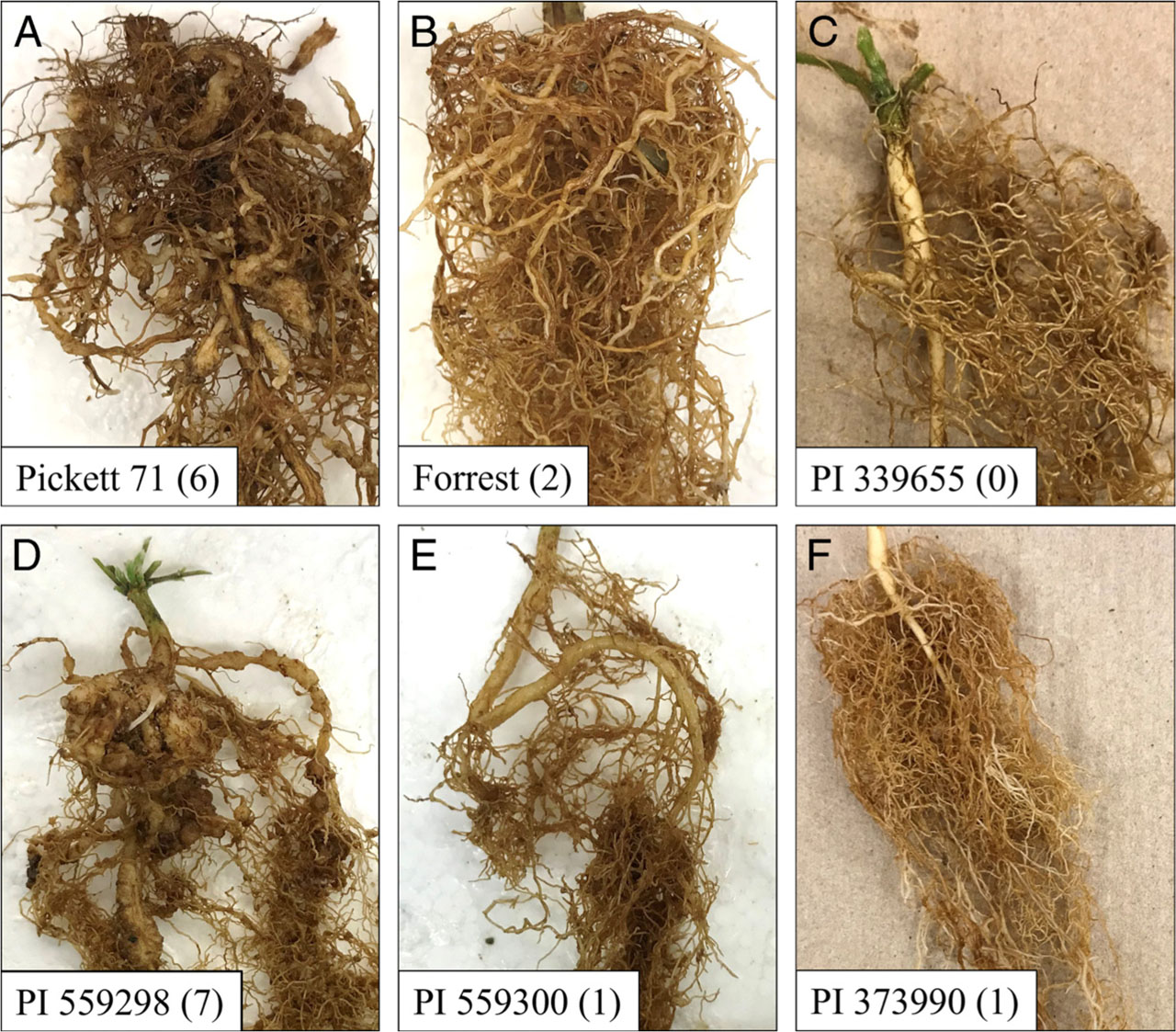
Figure 1
Representative images of soybean and perennial Glycine species roots at 8 weeks post-inoculation of Meloidogyne incognita. Gall index rating is given in parentheses A, susceptible check G. max cv. Pickett 71. B, resistant check G. max cv. Forrest. C, G. tomentella PI 339655. D, G. latifolia PI 559298. E, G. latifolia PI 559300. F, G. tabacina PI 373990.
Table 3
Number of eggs and vermiform Rotylenchulus reniformis per gram of root on perennial Glycine species and two soybean cultivars 10 weeks after inoculation.
| Glycine speciesa | Accession | Nb | Nematodes per gram of rootc |
|---|---|---|---|
| G. canescens | PI 573045 | 9 | 41245 a |
| G. microphylla | PI 509487 | 7 | 33424 a-c |
| G. microphylla | PI 505188 | 7 | 31744 ab |
| G. tomentella | PI 505238 | 10 | 31274 ab |
| G. latifolia | PI 559298 | 5 | 28578 a-c |
| G. tomentella | PI 505214 | 9 | 25039 a-c |
| G. cyrtoloba | PI 509472 | 8 | 10983 b-d |
| G. tabacina | PI 373990 | 6 | 10811 b-d |
| G. pescadrensis | PI 505197 | 10 | 8594 c-e |
| G. canescens | PI 440932 | 8 | 8265 c-e |
| G. max (S) | PI 88788 | 8 | 5910 d-f |
| G. latifolia | PI 559300 | 8 | 5897 d-f |
| G. curvata | PI 505167 | 8 | 5408 d-g |
| G. tomentella | PI 339655 | 7 | 2697 e-g |
| G. tabacina | PI 446974 | 9 | 1806 gh |
| G. argyrea | PI 509451 | 6 | 1783 f-h |
| G. clandestina | PI 440960 | 8 | 1511 i |
| G. tomentella | PI 446983 | 10 | 673 hi |
| G. max cv. Forrest (R) | PI 548655 | 10 | 306 i |
| G. tomentella | PI 441001 | 9 | 84 j |
| Fallowd | 10 | 223d |
Notes:
b Sample number. The Bartlett test for homogeneity of variance was not significant (P > 0.05) between two trials so data were pooled before the analysis.
Table 4
Nematode per gram of root of Pratylenchus penetrans on perennial Glycine species and soybean cultivars six days after inoculation.
| Trial 1b | Trial 2b | ||||
|---|---|---|---|---|---|
| Glycine speciesa | Accession | N | Nematodes per gram of rootc | N | Nematodes per gram of rootc |
| G. clandestina | PI 440960 | 5 | 259 a | 4 | 349 a |
| G. tomentella | PI 339655 | 5 | 221 a | 4 | 71 abc |
| G. microphylla | PI 505188 | 4 | 144 ab | 2 | 124 abc |
| G. tabacina | PI 373990 | 4 | 96 ab | 5 | 40 abc |
| G. pescadrensis | PI 505197 | 4 | 77 ab | 4 | 111 abc |
| G. tabacina | PI 446974 | 4 | 70 ab | 2 | 0 c |
| G. tomentella | PI 441001 | 4 | 65 ab | 5 | 127 ab |
| G. canescens | PI 440932 | 5 | 34 ab | 3 | 40 abc |
| G. max cv. Lee 68 (S) | PI 559369 | 5 | 8 b | 2 | 64 abc |
| G. max cv. Williams 82 | PI 518671 | 4 | 7 b | 3 | 9 abc |
| G. max | PI 88788 | 4 | 7 b | 5 | 2 c |
Table 5
Summary of the response of perennial Glycine species to Meloidogyne incognita, Rotylenchulus reniformis, Pratylenchus penetrans, Heterodera glycines, and Phakopsora pachyrhizi.
| M. incognitaa | R. reniformisa | P. penetransa | H. glycinesb | P. pachyrhizic | |||
|---|---|---|---|---|---|---|---|
| Glycine species | Accession | Eggs/g rootd | Gall indexd | Nematodes/g roote | Nematodes/g rootf | ||
| G. canescens | PI 573045 | S | S | S | -g | S | - |
| G. latifolia | PI 559298 | S | S | S | - | - | - |
| G. microphylla | PI 509487 | S | MR | S | - | S | - |
| G. tomentella | PI 505214 | S | R | S | - | S | - |
| G. microphylla | PI 505188 | S | R | S | S | R | - |
| G. argyrea | PI 509451 | S | R | S | - | R | IMh |
| G. curvata | PI 505167 | S | R | S | - | MS | - |
| G. tomentella | PI 505238 | S | R | S | - | MR | - |
| G. clandestina | PI 440960 | R | R | R | S | MR | S |
| G. tabacina | PI 446974 | R | R | MR | S | S | R |
| G. pescadrensis | PI 505197 | R | R | S | S | R | - |
| G. latifolia | PI 559300 | R | R | S | - | - | - |
| G. cyrtoloba | PI 509472 | R | R | S | - | R | - |
| G. canescens | PI 440932 | R | R | S | S | R | - |
| G. tabacina | PI 373990 | R | R | S | S | R | - |
| G. tomentella | PI 446983 | R | R | R | - | S | - |
| G. tomentella | PI 441001 | R | R | R | S | R | MR |
| G. tomentella | PI 339655 | R | R | S | S | R | - |
Notes:
a S (susceptible) ≥ susceptible check > MR (moderately resistant) > resistant check ≥ R (resistant). There was no MR for M. incognita eggs/g root since the susceptible check and resistant check were not significantly different. Rating was determined by the results from two tests for each of M. incognita and R. reniformis.
b MS = moderately susceptible to H. glycines HG 0 (Wen et al., 2017).
d Eggs per gram root was determined as the total number of eggs extracted from roots per gram of fresh roots 8 weeks after inoculation. The gall index was determined by the extent of root galling comparing with the root-knot rating chart 8 weeks after inoculation (Bridge and Page, 1980).
e Nematodes per gram of root for R. reniformis was determined as the total number of eggs and vermiform nematodes from the roots and soil per gram of fresh roots 10 weeks after inoculation.
f Nematodes per gram of root for P. penetrans was determined as the total number of vermiform nematodes from the roots per gram of fresh roots 6 days after inoculation.
h IM = Immune response to isolate MAL19 (Herman et al., 2020).