
Southern root-knot nematode (Meloidogyne incognita (Kofoid & White) Chitwood), reniform nematode (Rotylenchulus reniformis Linford & Oliveira), and lesion nematode (Pratylenchus penetrans (Cobb) Filipjev & Shuurmans Stekhoven) are common plant-parasitic nematodes that infect soybean (Glycine max (L.) Merr.) and other crops, causing yield losses (Noel et al., 2015; Bradley et al., 2021). These nematodes occur in diverse soybean growing regions (Karssen et al., 2013; Noel et al., 2015). Yield loss caused by plant-parasitic nematodes including Meloidogyne spp., R. reniformis, and Pratylenchus spp. in the United States and Ontario, Canada in 2019 was estimated at 366,647 metric tons (Bradley et al., 2021). M. incognita was the second most damaging pathogen in the southern United States in 2019 (Bradley et al., 2021) and can cause up to 90% yield reduction on susceptible soybean cultivars (Kinloch, 1974). R. reniformis can cause 30–60% yield loss depending on the soybean cultivar (Noel et al., 2015). Pratylenchus spp. cause dark lesions on soybean roots reducing root mass by 25% (Ferris and Bernard, 1962).
Host resistance is an important management strategy for controlling plant-parasitic nematodes on soybean. For example, plant introduction (PI) 88788 is the most commonly used source of resistance in soybean against the soybean cyst nematode (SCN, Heterodera glycines Ichinohe) (Faghihi et al., 2010; McCarville et al., 2017). However, soybean fields planted with the SCN-resistant soybean cultivars may be vulnerable to attack by other nematodes including M. incognita and R. reniformis (Robbins and Rakes, 1996; Klepadlo et al., 2018). Among 76 soybean accessions with PI 88788-derived SCN resistance, 72% and 50% were susceptible to M. incognita and to R. reniformis, respectively (Klepadlo et al., 2018).
Numerous soybean germplasm accessions and cultivars were screened for resistance to Meloidogyne spp. and R. reniformis and resistant soybean lines have been identified (Rebois et al., 1968; Birchfield and Brister, 1969; Luzzi et al., 1987; Hussey et al., 1991; Robbins and Rakes, 1996; Robbins et al., 1999; Harris et al., 2003; Stetina et al., 2014; Klepadlo et al., 2018). Biparental linkage mapping and genome-wide association studies showed that resistance to M. incognita and R. reniformis in soybean is a quantitative trait (Williams et al., 1981; Tamulonis et al., 1997; Li et al., 2001; Ha et al., 2007; Pham et al., 2013; Xu et al., 2013; Jiao et al., 2015; Passianotto et al., 2017; Li et al., 2018; Wilkes et al., 2020). However, resistance mechanisms and associated resistance genes are poorly understood. For P. penetrans, no resistance has been identified in soybean, despite several efforts (Schmitt and Barker, 1981; Melakeberhan, 1998).
Wild relatives of domesticated crops may have unique disease resistance traits absent from modern-day crop varieties. For example, M. incognita resistance genes (Mi genes) originated from wild tomato relative Solanum peruvianum (Smith, 1944) and have been introgressed into many modern tomato varieties (S. lycopersicum L.) (Williamson, 1998). Wild perennial Glycine species are taxonomically and genetically related to soybean. Primarily originating from Australia, there are currently 27 described species of perennial Glycine (Barrett and Barrett, 2015; Singh, 2019). Perennial Glycine accessions have resistance to SCN (Riggs et al., 1998; Bauer et al., 2007; Wen et al., 2017; Herman et al., 2020). We hypothesize that resistance to other nematodes also exists in perennial Glycine. The objective of this study was to evaluate 18 accessions of 10 perennial Glycine species against M. incognita and R. reniformis, and eight accessions of six species against P. penetrans. To ensure diverse genetic representation, we selected SCN-susceptible and resistant accessions identified previously (Wen et al., 2017); G. latifolia (PI 559298 and PI 559300) and G. tomentella PI 505214 were chosen because of the availability of sequence information (Liu et al., 2018).
Materials and methods
Plant preparation
Eighteen perennial Glycine species and five soybean cultivars were obtained from the USDA-ARS Soybean Germplasm Collection (https://www.ars-grin.gov/) (Table 1). All accessions were originally collected from Australia except G. tabacina PI 446974 (Okinawa, Japan) and two G. tomentella accessions, PIs 446983 (Papua New Guinea) and 339655 (Taichung, Taiwan). Chromosome numbers varied from 40 to 80 (USDA-ARS Germplasm Resources Information Network, https://www.ars-grin.gov/).
Table 1
Accessions of perennial Glycine species and soybean checks inoculated with Meloidogyne incognita, Rotylenchulus reniformis, and Pratylenchus penetrans.
| Glycine species | Accession | Origin | Chromosome number |
|---|---|---|---|
| G. argyrea | PI 509451 | Queensland, Australia | 40 |
| G. canescens | PI 573045 | Western Australia, Australia | 40 |
| G. canescens | PI 440932 | South Australia, Australia | 40 |
| G. clandestina | PI 440960 | New South Wales, Australia | 40 |
| G. cyrtoloba | PI 509472 | Queensland, Australia | 40 |
| G. curvata | PI 505167 | Queensland, Australia | unknown |
| G. latifolia | PI 559298 | Queensland, Australia | 40 |
| G. latifolia | PI 559300 | Queensland, Australia | 40 |
| G. microphylla | PI 509487 | New South Wales, Australia | 40 |
| G. microphylla | PI 505188 | Queensland, Australia | 40 |
| G. pescadrensis | PI 505197 | Queensland, Australia | 80 |
| G. tabacina | PI 446974 | Okinawa, Japan | 80 |
| G. tabacina | PI 373990 | New South Wales, Australia | 40 |
| G. tomentella | PI 446983 | Papua New Guinea | 40 |
| G. tomentella | PI 505214 | Queensland, Australia | 80 |
| G. tomentella | PI 339655 | Taichung, Taiwan | 80 |
| G. tomentella | PI 441001 | Queensland, Australia | 78 |
| G. tomentella | PI 505238 | Queensland, Australia | 80 |
| G. max cv. Pickett71a | PI 548982 | USA | 40 |
| G. max cv. Forrestb | PI 548655 | USA | 40 |
| G. maxc,d | PI 88788 | Liaoning Sheng, China | 40 |
| G. max cv. Lee 68e | PI 559369 | USA | 40 |
| G. max cv. Williams 82d | PI 518671 | USA | 40 |
Notes:
a Susceptible check for M. incognita (Vanderspool et al., 1994).
b Resistant check for M. incognita and R. reniformis (Hussey et al., 1991; Robbins et al., 1994).
c Susceptible check for R. reniformis (Robbins and Rakes, 1996).
e Susceptible check for P. penetrans (Schmitt and Barker, 1981).
Perennial Glycine seeds were scarified with a razor blade by slightly cutting the seed coat on the opposite side of the hilum. Seeds were germinated for 5 to 7 days on wet tissue paper in a plastic box for M. incognita tests and on Sun Gro® Sunshine® LC1 Grower Mix (BFG Supply, Burton, OH) in petri dishes for R. reniformis tests. Seedlings were planted in steam pasteurized torpedo sand, for M. incognita, or sandy loam (77% sand, 11% silt, and 12% clay), for R. reniformis, in SC10 Conetainers (Stuewe and Sons, Tangent, OR). Three weeks after planting, the seedlings were inoculated with nematodes. Seeds of susceptible (cv. Pickett 71 for M. incognita; PI 88788 for R. reniformis) and resistant soybean checks (cv. Forrest) were germinated following the same methods above (but not scarified) and planted in torpedo sand or sandy loam 1 week prior to inoculation.
For P. penetrans, root explants were prepared on agar media. Scarified perennial Glycine seeds were surface disinfected in 0.5% sodium hypochlorite (NaOCl) for 5 min and rinsed three times with sterilized distilled water. Susceptible check cv. Lee 68 and other soybeans, PI 88788 and cv. Williams 82 were surface disinfected in 0.5% NaOCl for 20 min and rinsed three times with sterilized distilled water. Five seeds of each accession were transferred onto a Murashige and Skoog (MS) (Murashige and Skoog, 1962) solid medium supplemented with 2% sucrose for germination. Seeds were incubated in a growth chamber at 25°C with 16 hr of fluorescent light per day for nine days. Germinated seedlings were transferred to new MS medium supplemented with 2% sucrose (one plant per plate) for inoculation.
Nematode source and plant inoculations
M. incognita, originally isolated from soybean in southern Illinois (generous gift from Jason Bond) and identified using polymerase chain reaction (PCR) with species-specific primers (Adam et al., 2007), was maintained on tomato (S. lycopersicum) cv. Tiny Tim in the greenhouse. Tomato roots with root galls were cut into small pieces and mixed with 200 ml of 0.5% NaOCl and vigorously shaken manually for 4 min to release eggs from the gelatinous matrix (Hussey and Barker, 1973). The mixture was filtered through 74- and 25-μm sieves and thoroughly rinsed with tap water. Eggs were centrifuged in 45.4% sucrose solution to remove plant and soil debris (Jenkins, 1964). Perennial Glycine and soybean seedlings were inoculated with 2,000? M. incognita eggs in 1 ml of water per plant into a 2.5-cm deep hole made 1.5-cm away from each stem.
R. reniformis, originally isolated from a cotton (Gossypium hirsutum L.) in College Station, Texas, was maintained on soybean cv. Macon or cv. Braxton in the greenhouse (generous gift from Martin Wubben). To extract vermiform R. reniformis, the roots were removed, soil was suspended in water, and poured through 841- and 38-μm sieves (Robbins et al., 1999). Extracted nematodes on the 38-μm sieve were placed on a Baermann funnel to collect live nematodes after 24 hr. Perennial Glycine and soybean seedlings were inoculated with 1,000 mixed stage nematodes in 1 ml of water per plant into a 2.5-cm deep hole made 1.5-cm away from each stem.
P. penetrans, originally isolated from potato in Rosholt, Wisconsin (Solanum tuberosum L.) and identified based on morphological characteristics and mitochondrial cytochrome c oxidase subunit 1 and 28S rDNA sequences (Saikai and MacGuidwin, 2020), was maintained on monoxenic corn root cultures (Rebois and Huettel, 1986). The root cultures were cut and immersed into sterilized distilled water in a beaker and shaken at 75 RPM for 24 hr at room temperature to suspend nematodes into water. The suspension was poured onto an autoclaved hatching chamber in a plastic box to collect live nematodes in a sterile condition (Thapa et al., 2017). Live nematodes were collected after 24 hr at room temperature. Perennial Glycine and soybean seedlings were inoculated with 150 mixed stages nematodes of P. penetrans in 50 μl of sterilized distilled water per plant.
Experimental design
All tests were conducted in a completely randomized design (CRD) with five replications and each test was repeated once. Data were not collected from a few experimental units where seeds did not germinate or where seedlings were too small to inoculate. M. incognita and R. reniformis tests were conducted in a growth chamber at 28°C and 16 hr of fluorescent light per day for 8 weeks for the M. incognita test and 10 weeks for the R. reniformis test. Plants were fertilized with a 100-ppm solution general purpose fertilizer (Peter's Professional 20-20-20) weekly after transplanting. Two soybean genotypes for susceptible and resistant checks were included in each experiment (Table 1). The susceptible and resistant checks were selected based on previous research (Luzzi et al., 1987; Hussey et al., 1991; Robbins et al., 1994; Vanderspool et al., 1994; Robbins and Rakes, 1996; Allen et al., 2005). R. reniformis infested fallow soil was included in the test as a survival baseline control without host (Robbins and Rakes, 1996; Robbins et al., 1999).
P. penetrans tests were conducted in a growth chamber at 25°C and 16 hr of fluorescent light per day for six days. G. max cv. Lee 68 was included as a susceptible check (Schmitt and Barker, 1981). G. max cv. Williams 82 and PI 88788 were also included to examine their response to P. penetrans. No resistant soybean checks were included in this study because there are no resistant checks known for soybean.
Nematode response evaluation
The response to M. incognita was recorded based on the number of eggs per gram of fresh roots and gall index (the extent of root galling) 8 weeks after inoculation (Taylor and Sasser, 1978; Bridge and Page, 1980). Plant roots were washed to remove sand and weighed. The gall index was assessed based on the root-knot rating chart (Bridge and Page, 1980). M. incognita eggs were extracted from whole root systems as described above and enumerated under a dissecting microscope at ×50 magnification.
The response to R. reniformis was evaluated using the final number of nematodes (eggs and vermiform) per gram of fresh root 10 weeks after inoculation. To extract R. reniformis, soil was washed from the plant root, suspended in water, and poured through 250- and 38-μm sieves. Nematodes collected on the 38-μm sieve were further processed by sucrose-centrifugation (Jenkins, 1964). R. reniformis eggs were extracted from the roots as described above after measuring the fresh weight of the washed plant roots.
The response to P. penetrans was based on nematode counts in the roots following acid fuchsin staining (Bybd et al., 1983). Seedlings were removed from media six days after inoculation and cut below cotyledons. Roots were weighed and stained with acid fuchsin. Nematodes in the stained roots were enumerated under a dissecting microscope and reported as nematodes per gram of root.
Data analysis
To determine if trials within each test could be combined, homogeneity of variance was determined by the Bartlett test using JMP Pro 14.2.0 Fit X by Y platform (SAS Institute, Cary, NC). The analysis of variance (ANOVA) was done for each trial individually and for both tests pooled if homogeneity of variance was not significant between trials. M. incognita eggs per gram of root data and P. penetrans nematodes per gram of root were log (x + 1) transformed and R. reniformis nematodes per gram of root data were log (x) transformed to meet normality and homogeneity of variance assumptions. The ANOVA analyses were done with JMP Pro 14.2.0 Fit X by Y or Fit Model platforms. Mean separations were done using JMP Pro 14.2.0 Tukey-Kramer HSD test at α = 0.05 (Dunnett, 1980).
Resistance rating
Nematode resistance levels in perennial Glycine species were categorized as susceptible (S), moderately resistant (MR), and resistant (R) based on the statistical comparison with susceptible and resistant soybean checks: S ≥ susceptible check; susceptible check > MR > resistant check; R ≤ resistant check. Ratings were determined by combining trial data for both M. incognita and R. reniformis, while P. penetrans trial data were kept separate.
Results
Evaluation of perennial Glycine species for resistance to M. incognita
The Bartlett tests for homogeneity of variance for eggs per gram of root and gall index were not significant (P > 0.05) between trials, so data were pooled for analysis (Table 2). Our results demonstrate substantial variation in nematode reproduction and gall index among perennial Glycine accessions (Table 2 and Fig. 1). The susceptible check soybean cv. Pickett 71 was not significantly different from the resistant check cv. Forrest in eggs per gram of root but had a significantly greater gall index (Table 2; Fig. 1A, B). Ten perennial Glycine accessions (PIs 373990, 339655, 440932, 440960, 441001, 446974, 446983, 505197, 509472, and 559300) had significantly fewer eggs per gram of root than the susceptible check cv. Pickett 71, and fewer root galls (Fig. 1C–F). Among the accessions, all but PI 440960 had significantly fewer eggs per gram of root than the resistant check cv. Forrest. All the tested PIs except PIs 573045 and 559298 had lower gall indices than cv. Pickett 71. Only G. tomentella PIs 339655 and 446983 had a significantly lower gall index (Fig. 1C) than cv. Forrest.
Table 2
Eggs per gram of root and gall index of Meloidogyne incognita 8 weeks after inoculation.
| Glycine speciesa | Accession | Nb | Gall indexc,d | Eggs per gram of rootc,e |
|---|---|---|---|---|
| G. canescens | PI 573045 | 9 | 6.7 a | 34122 a |
| G. latifolia | PI 559298 | 7 | 6.1 a | 13031 ab |
| G. max cv. Pickett 71 (S) | PI 548982 | 7 | 6.1 a | 6896 ab |
| G. microphylla | PI 509487 | 9 | 4.1 b | 40918 a |
| G. tomentella | PI 505238 | 10 | 3.0 bc | 4285 ab |
| G. clandestina | PI 440960 | 6 | 3.0 b-d | 285 c-f |
| G. pescadrensis | PI 505197 | 10 | 2.6 cd | 52 ef |
| G. tomentella | PI 505214 | 10 | 2.4 cd | 5058 ab |
| G. cyrtoloba | PI 509472 | 10 | 2.3 c-e | 437 d-f |
| G. latifolia | PI 559300 | 8 | 2.3 c-f | 210 d-f |
| G. microphylla | PI 505188 | 7 | 2.1 c-f | 4597 ab |
| G. canescens | PI 440932 | 9 | 1.9 c-f | 169 d-f |
| G. tabacina | PI 446974 | 10 | 1.8 c-f | 430 de |
| G. max cv. Forrest (R) | PI 548655 | 10 | 1.8 c-f | 1981 a-c |
| G. argyrea | PI 509451 | 5 | 1.7 c-g | 579 b-d |
| G. curvata | PI 505167 | 6 | 1.2 d-h | 4867 ab |
| G. tabacina | PI 373990 | 10 | 0.9 e-h | 53 ef |
| G. tomentella | PI 441001 | 10 | 0.8 f-h | 238 d-f |
| G. tomentella | PI 446983 | 9 | 0.3 gh | 111 f |
| G. tomentella | PI 339655 | 10 | 0.2 h | 3 f |
Notes:
b Sample number. The Bartlett tests for homogeneity of variances for eggs per gram of root and gall index were not significant (P > 0.05) between two trials so data were pooled before the analyses.
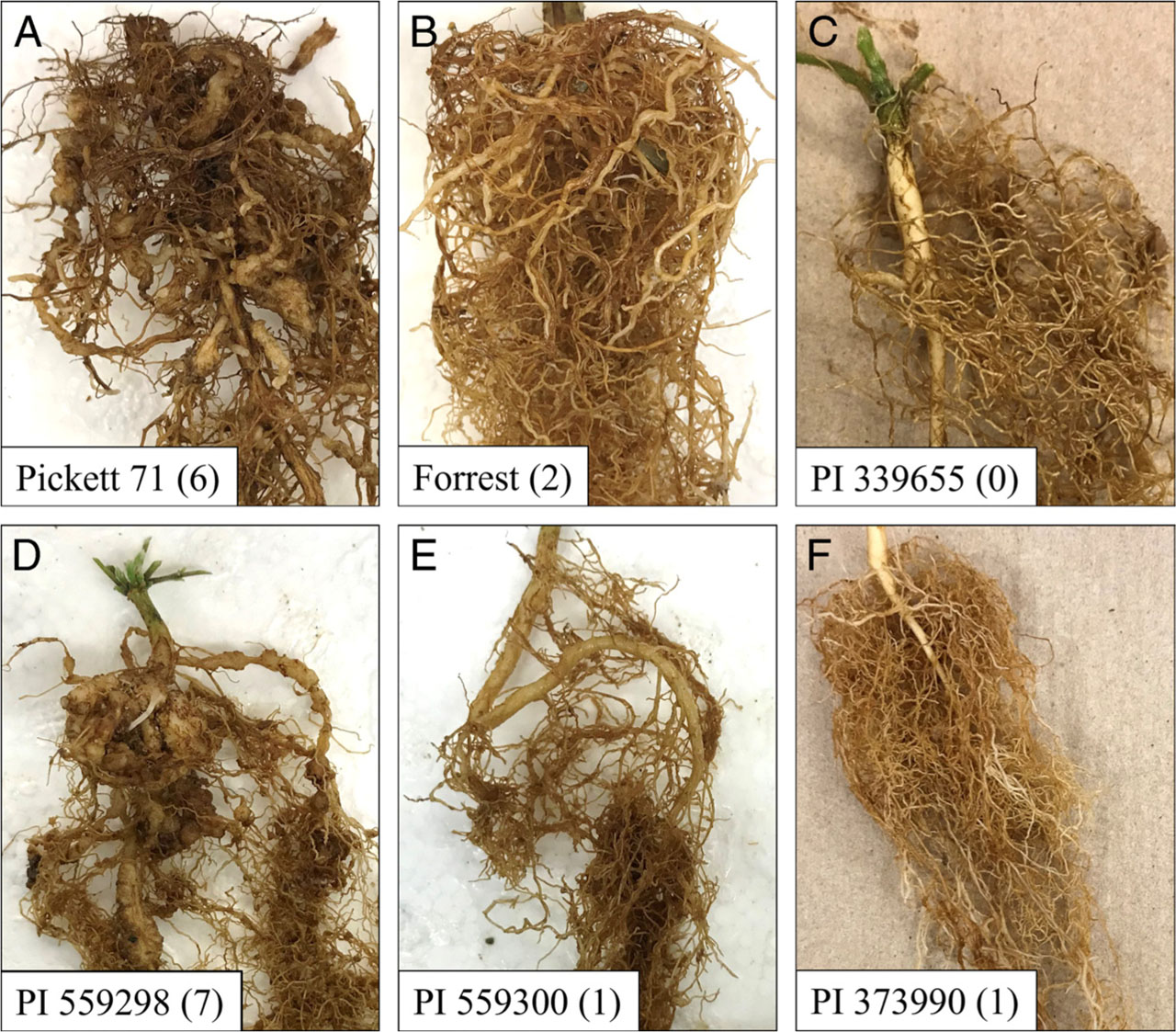
Figure 1
Representative images of soybean and perennial Glycine species roots at 8 weeks post-inoculation of Meloidogyne incognita. Gall index rating is given in parentheses A, susceptible check G. max cv. Pickett 71. B, resistant check G. max cv. Forrest. C, G. tomentella PI 339655. D, G. latifolia PI 559298. E, G. latifolia PI 559300. F, G. tabacina PI 373990.
Evaluation of perennial Glycine species for resistance to R. reniformis
The Bartlett test for homogeneity of variance was not significant (P > 0.05) between trials so data were pooled for analysis (Table 3). The perennial Glycine species and soybean checks differed in their response to R. reniformis based on the number of eggs and vermiform nematodes per gram of root. The mean number of R. reniformis per gram of root on susceptible check PI 88788 was significantly higher than that of resistant check cv. Forrest. In contrast to M. incognita, some perennial Glycine accessions (PIs 505188, 505214, 505238, 509487, 559298, and 573045) were significantly more susceptible to R. reniformis than the susceptible check PI 88788. Only G. tomentella PI 441001 had a significantly lower number of R. reniformis per gram of root than cv. Forrest.
Table 3
Number of eggs and vermiform Rotylenchulus reniformis per gram of root on perennial Glycine species and two soybean cultivars 10 weeks after inoculation.
| Glycine speciesa | Accession | Nb | Nematodes per gram of rootc |
|---|---|---|---|
| G. canescens | PI 573045 | 9 | 41245 a |
| G. microphylla | PI 509487 | 7 | 33424 a-c |
| G. microphylla | PI 505188 | 7 | 31744 ab |
| G. tomentella | PI 505238 | 10 | 31274 ab |
| G. latifolia | PI 559298 | 5 | 28578 a-c |
| G. tomentella | PI 505214 | 9 | 25039 a-c |
| G. cyrtoloba | PI 509472 | 8 | 10983 b-d |
| G. tabacina | PI 373990 | 6 | 10811 b-d |
| G. pescadrensis | PI 505197 | 10 | 8594 c-e |
| G. canescens | PI 440932 | 8 | 8265 c-e |
| G. max (S) | PI 88788 | 8 | 5910 d-f |
| G. latifolia | PI 559300 | 8 | 5897 d-f |
| G. curvata | PI 505167 | 8 | 5408 d-g |
| G. tomentella | PI 339655 | 7 | 2697 e-g |
| G. tabacina | PI 446974 | 9 | 1806 gh |
| G. argyrea | PI 509451 | 6 | 1783 f-h |
| G. clandestina | PI 440960 | 8 | 1511 i |
| G. tomentella | PI 446983 | 10 | 673 hi |
| G. max cv. Forrest (R) | PI 548655 | 10 | 306 i |
| G. tomentella | PI 441001 | 9 | 84 j |
| Fallowd | 10 | 223d |
Notes:
b Sample number. The Bartlett test for homogeneity of variance was not significant (P > 0.05) between two trials so data were pooled before the analysis.
Evaluation of perennial Glycine species for resistance to P. penetrans
The Bartlett test for homogeneity of variance was significant (P < 0.05) between trials so data were analyzed separately (Table 4). For both trials, none of the perennial Glycine species showed reduced infection compared with the soybean varieties. For trial 1, G. clandestina PI 440960 and G. tomentella PI 339655 had significantly more nematodes per gram of root than cv. Lee 68, which had an average of 8 nematodes per gram of root. For trial 2, no accessions were significantly different from cv. Lee 68.
Table 4
Nematode per gram of root of Pratylenchus penetrans on perennial Glycine species and soybean cultivars six days after inoculation.
| Trial 1b | Trial 2b | ||||
|---|---|---|---|---|---|
| Glycine speciesa | Accession | N | Nematodes per gram of rootc | N | Nematodes per gram of rootc |
| G. clandestina | PI 440960 | 5 | 259 a | 4 | 349 a |
| G. tomentella | PI 339655 | 5 | 221 a | 4 | 71 abc |
| G. microphylla | PI 505188 | 4 | 144 ab | 2 | 124 abc |
| G. tabacina | PI 373990 | 4 | 96 ab | 5 | 40 abc |
| G. pescadrensis | PI 505197 | 4 | 77 ab | 4 | 111 abc |
| G. tabacina | PI 446974 | 4 | 70 ab | 2 | 0 c |
| G. tomentella | PI 441001 | 4 | 65 ab | 5 | 127 ab |
| G. canescens | PI 440932 | 5 | 34 ab | 3 | 40 abc |
| G. max cv. Lee 68 (S) | PI 559369 | 5 | 8 b | 2 | 64 abc |
| G. max cv. Williams 82 | PI 518671 | 4 | 7 b | 3 | 9 abc |
| G. max | PI 88788 | 4 | 7 b | 5 | 2 c |
Resistance rating
Of 18 PIs evaluated, 10 and 15 PIs were identified as resistant to M. incognita based on eggs per gram of root and gall index, respectively (Table 5) and three PIs were identified as resistant to R. reniformis, while PI 446974 was identified as moderately resistant. All of the eight perennial Glycines PIs evaluated for response to P. penetrans were identified as susceptible.
Table 5
Summary of the response of perennial Glycine species to Meloidogyne incognita, Rotylenchulus reniformis, Pratylenchus penetrans, Heterodera glycines, and Phakopsora pachyrhizi.
| M. incognitaa | R. reniformisa | P. penetransa | H. glycinesb | P. pachyrhizic | |||
|---|---|---|---|---|---|---|---|
| Glycine species | Accession | Eggs/g rootd | Gall indexd | Nematodes/g roote | Nematodes/g rootf | ||
| G. canescens | PI 573045 | S | S | S | -g | S | - |
| G. latifolia | PI 559298 | S | S | S | - | - | - |
| G. microphylla | PI 509487 | S | MR | S | - | S | - |
| G. tomentella | PI 505214 | S | R | S | - | S | - |
| G. microphylla | PI 505188 | S | R | S | S | R | - |
| G. argyrea | PI 509451 | S | R | S | - | R | IMh |
| G. curvata | PI 505167 | S | R | S | - | MS | - |
| G. tomentella | PI 505238 | S | R | S | - | MR | - |
| G. clandestina | PI 440960 | R | R | R | S | MR | S |
| G. tabacina | PI 446974 | R | R | MR | S | S | R |
| G. pescadrensis | PI 505197 | R | R | S | S | R | - |
| G. latifolia | PI 559300 | R | R | S | - | - | - |
| G. cyrtoloba | PI 509472 | R | R | S | - | R | - |
| G. canescens | PI 440932 | R | R | S | S | R | - |
| G. tabacina | PI 373990 | R | R | S | S | R | - |
| G. tomentella | PI 446983 | R | R | R | - | S | - |
| G. tomentella | PI 441001 | R | R | R | S | R | MR |
| G. tomentella | PI 339655 | R | R | S | S | R | - |
Notes:
a S (susceptible) ≥ susceptible check > MR (moderately resistant) > resistant check ≥ R (resistant). There was no MR for M. incognita eggs/g root since the susceptible check and resistant check were not significantly different. Rating was determined by the results from two tests for each of M. incognita and R. reniformis.
b MS = moderately susceptible to H. glycines HG 0 (Wen et al., 2017).
d Eggs per gram root was determined as the total number of eggs extracted from roots per gram of fresh roots 8 weeks after inoculation. The gall index was determined by the extent of root galling comparing with the root-knot rating chart 8 weeks after inoculation (Bridge and Page, 1980).
e Nematodes per gram of root for R. reniformis was determined as the total number of eggs and vermiform nematodes from the roots and soil per gram of fresh roots 10 weeks after inoculation.
f Nematodes per gram of root for P. penetrans was determined as the total number of vermiform nematodes from the roots per gram of fresh roots 6 days after inoculation.
h IM = Immune response to isolate MAL19 (Herman et al., 2020).
Discussion
Soybean has narrow genetic diversity due to genetic bottlenecks (Hyten et al., 2006), while perennial Glycine species, wild relatives of soybean, have greater genetic diversity (Hwang et al., 2019). Transferring traits from perennial Glycine species to G. max by classical hybridization is challenging due to genetic barriers. Embryo rescue and colchicine treatment to produce amphidiploid plants (2n = 118) enabled hybridization between G. max cv. Dwight (2n = 40) and G. tomentella PI 441001 (2n = 78) (Akpertey et al., 2018; Singh, 2019). Hybrid lines with 2n = 40 and 41 chromosomes obtained by backcrossing with cv. Dwight showed resistance to soybean rust indicating successful genetic introgression of the disease resistance traits from PI 441001 to Dwight (Singh, 2019). Studies confirmed that perennial Glycine have novel sources of resistance to multiple SCN HG types (Wen et al., 2017; Herman et al., 2020). Our study shows that perennial Glycine species also have resistance to other soybean-parasitic nematodes including M. incognita and R. reniformis that infect and negatively affect yield in soybean. Finding novel resistance sources to additional nematode species in perennial Glycine species may lead to enhanced nematode resistance traits in soybean.
We evaluated 18 PIs from 10 perennial Glycine species for their response to M. incognita and R. reniformis, and eight PIs for response to P. penetrans. PIs were selected based on prior evaluation confirming a resistant or susceptible reaction to SCN (Wen et al., 2017), use in another genetic study (Chang et al., 2014), or due to availability of sequence information (Liu et al., 2018). Our results demonstrated that M. incognita, R. reniformis, and P. penetrans infected all PIs used in this study. G. tomentella PIs 441001 and 446983, and G. clandestina PI 446960 were classified as resistant to two nematode species, M. incognita and R. reniformis. Of these, PI 441001 was previously reported as resistant to SCN (Wen et al., 2017) and as moderately resistant to soybean rust (Phakopsora pachyrhizi) (Hartman et al., 1992). PI 440960 was reported as moderately resistant to SCN (Wen et al., 2017) and susceptible to P. pachyrhizi (Hartman et al., 1992). PI 446983 has not been identified as resistant to other pathogens. All PIs used in the P. penetrans tests were not significantly different from the susceptible check cv. Lee 68 and were thus classified as susceptible.
Several accessions were resistant or moderately resistant to M. incognita based on the gall index, but susceptible based on egg production (eggs per gram of root). This group included G. argyrea PI 509451, G. curvata PI 505167, G. microphylla PI 505188, PI 509487, G. tomentella PI 505214, and PI 505238. The contrast between reproduction and gall indices in these accessions to M. incognita was also previously seen in soybean (Harris et al., 2003); indeed, studies suggest that soybean QTL associated with M. incognita reproduction and root galling may be different (Tamulonis et al.,1997; Li et al., 2001; Ha et al., 2007; Fourie et al., 2008; Pham et al., 2013; Xu et al., 2013; Jiao et al., 2015; Passianotto et al., 2017; Li et al., 2018). Further investigation will be needed to understand the genetic basis for resistance in perennial Glycine species.
The observed range of responses in the perennial Glycine accessions to M. incognita or R. reniformis may be the result of the perennial Glycine accessions having independently developed resistance under selective pressure by these nematodes or may be due to other factors associated or genetically linked to resistance. Both M. incognita and R. reniformis, as well as P. penetrans, are found in Australia, Japan, Papua New Guinea and Taiwan where test accessions are native (Tu et al., 1972; Bridge and Page, 1984; Nakasono, 2004; Stirling, 2007; Hollaway et al., 2008; Min et al., 2011; Sherman-Broyles et al., 2014; Singh, 2019). A genomic study comparing a one million-base pair region in soybean with related legume species (including G. tomentella) found that, in contrast to conserved low-copy genes, gene families associated with disease resistance had undergone rapid diversification, such as genomic duplications and losses, and suggested that the rapid diversification of disease resistance genes might have been driven by pathogen-mediated pressure (Innes et al., 2008). Thus, even though the perennial Glycine species originate from the same geographical region, they may have undergone independent evolutionary events leading to variability in nematode resistance responses.
Our initial trials using pot-grown plants to infect the perennial Glycine species with P. penetrans were not successful in that we observed very low infection on plant roots 4 weeks after inoculation. Alternatively, using in vitro tests for P. penetrans and eight perennial Glycine species PIs that germinated and grew on MS medium supplemented with 2% sucrose, we observed either a similar or more susceptible response compared to cv. Lee 68 in all accessions, as well as in cv. Williams 82 and PI 88788, in both trials. One caveat to this in vitro test was that it only assessed infection and did not determine reproductive rates of P. penetrans. Though P. penetrans resistance has not yet been reported in soybean or perennial Glycine species, there have been previous reports of resistance or tolerance in soybean cultivars to other Pratylenchus species, for example, tolerance to P. brachyurus (Lindsey and Cairns, 1971), resistance to P. scribneri (Acosta and Malek, 1979), and moderate resistance to a new species of Pratylenchus spp. found in North Dakota (Chowdhury, 2020). Improvement of methods for P. penetrans infection and rating, as well as testing of additional PIs, is needed to determine if resistance exists in perennial Glycine species and soybean.
Perennial Glycine species identified in this study with resistance to M. incognita and R. reniformis may have novel nematode resistance genes not found in soybean. A genome-wide association study (GWAS) using wild soybean (G. soja) identified a novel SCN-resistance locus on chromosome 19 (Zhang et al., 2016). Beyond a recent success of hybridization between G. max cv. Dwight and G. tomentella PI 441001 (Singh, 2019), it may be possible to overcome the genetic barriers and transfer resistance genes from perennial Glycine to soybean using CRISPR-Cas9 gene-editing technologies (Sun et al., 2015). To increase the usefulness of genetic resistance found in perennial Glycine species and to discover and characterize additional resistance genes, molecular and genomic studies may provide the tools needed to further develop soybean resistance to M. incognita, R. reniformis, and P. penetrans. PIs identified in this study will serve as resources in ongoing efforts to identify novel nematode resistance genes for M. incognita and R. reniformis.
Acknowledgments
Trade and manufacturers’ names are necessary to report factually on available data; however, the USDA neither guarantees nor warrants the standard of the product, and the use of the name by USDA implies no approval of the product to the exclusion of others that may also be suitable. This study was financially supported by Hatch Act funds ILLU 802 992, the Agroecology and Sustainable Agriculture Program, Corn and Turf Pathology Fellowship, and Jonathan Baldwin Turner Fellowship.