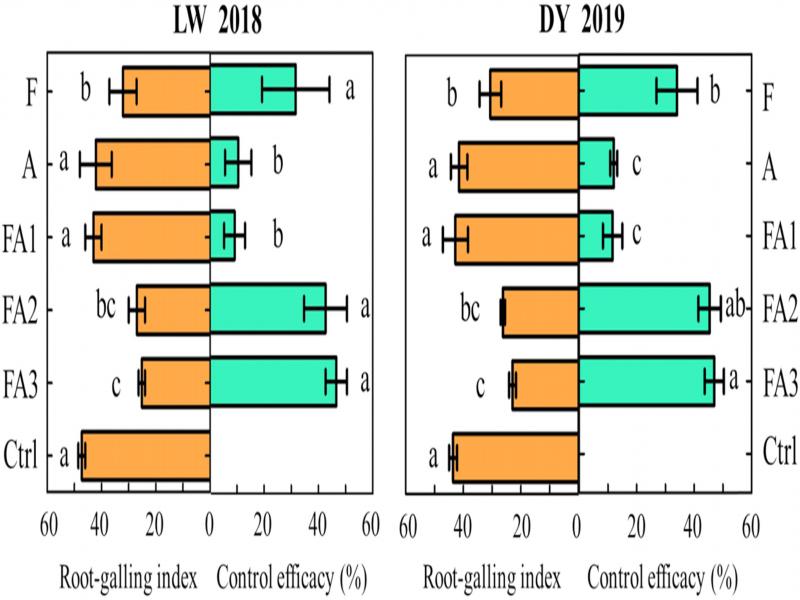
Nematodes are important parasites of crops. The economic losses caused by nematodes worldwide exceed 157 billion US dollars annually (Abad et al., 2008). Root-knot nematodes have a wide host range and are especially harmful to plants in the Cucurbitaceae and Solanaceae (Nicol et al., 2011). Tomato is extensively cultivated worldwide and highly susceptible. When the southern root-knot nematode (RKN) Meloidogyne incognita infects tomato, the second-stage juveniles (J2) penetrate young roots, causing root galls that disrupt water relations and the physiology of infected plants. This can result in severe stunting of the plant (Pinkerton and Finn, 2005). The RKN can also interact with other pathogenic microorganisms, causing serious diseases in tomato (Tian et al., 2015). The damage caused by the RKN to tomato reduces production by 10–30% and losses can exceed 50% in northern China (Sun et al., 2006; Huang et al., 2019a).
Nematodes have historically been controlled by applications of soil fumigants. However, the use of fumigants such as methyl bromide and 1,3-dichloropropene is now banned or restricted (Giannakou et al., 2005). Some non-fumigant nematicides, such as aldicarb and carbofuran, are restricted because of their high mammalian toxicity and environmental risks (Shi et al., 2019). Although current agricultural, physical, and biological control measures are used alone or in combination, the RKN is not effectively controlled in China.
Fluopyram, a systemic pesticide used for the control of fungal diseases, is being evaluated for its nematicidal activity (Faske and Hurd, 2015). Fluopyram inhibits succinate dehydrogenase (SDH) in the tricarboxylic acid cycle and blocks electron transport in the mitochondria of fungi (Abad-Feuntes et al., 2015; Huang et al., 2019b). It has low toxicity to mammals, is environmentally friendly, and has been proposed as a nematicide for use in vegetable production (Jones et al., 2017). The application of fluopyram to soil has shown potential for the control of Belonolaimus longicaudatus nematode populations in Florida (USA) strawberries (Watson and Desaeger, 2019; Watson et al., 2020). The nematicide Velum@, with fluopyram as its main active ingredient, successfully controlled M. incognita populations in tomato (Dahlin et al., 2019).
Avermectins are macrocyclic lactones derived from the fermentation of Streptomyces avermitilis (Putter et al., 1981). Abamectin, with avermectins B1a and B1b as the active ingredients, affects the γ-amino butyric acid (GABA) nervous system of nematodes. It has been widely used for nematode control because of its nematicidal properties (Qiao et al., 2012; Shaver et al., 2016; Zhang et al., 2017). Abamectin can be used in combination with other nematicides, such as 1,3-dichloropropene (1,3-D), fosthiazate, and microbial nematicides. These combinations have potential for controlling M. incognita in tomato and cucumber fields in China (Qiao et al., 2012; Huang et al., 2016; Qiao et al., 2014; Huang et al., 2014). Abamectin can reduce populations of Meloidogyne paranaensis in coffee fields during transplantation, or 60 days later, and it is not phytotoxic to coffee plants (Arita et al., 2020). The application of abamectin has been an important component of an integrated pest management strategy for nematodes.
In this study, we combined fluopyram and abamectin to evaluate their management potential for M. incognita in infested tomatoes. We evaluated growth rate indicators, the root-galling index (RGI), number of nematodes in soil, and tomato yield. Our objective was to evaluate an effective mixture option for the integrated management of RKN.
Materials and methods
Preparation of M. incognita
Tomato roots with numerous M. incognita root knots were collected from a solar greenhouse in Daiyue (DY), Tai’an City, Shandong Province, China, and cut into smaller sections. The egg masses were collected from the knots using a dissecting needle under a microscope, soaked in a 0.2% NaOCl solution for 30 sec, and then washed several times with sterile water (Hussey and Barker, 1973). The eggs were then incubated for 2 or 3 days in an incubator at 25°C and sterile water was changed daily. The hatched second-stage juveniles (J2) in suspension were collected. The J2 nematode suspension was stored at 25°C and tested within two days.
Chemicals
Pure fluopyram (97.5%, Sigma-Aldrich, Inc., St. Louis, MO, USA) and abamectin (94.8%, Qingdao Dongsheng Pharmaceutical Co., Ltd) and commercial pesticides based on fluopyram (41.7% SC, Bayer Crop Science Company, China), abamectin (1.8% EC, Henan Xinnong Chemical Co., Ltd), and triphenyltetrazolium chloride (TTC, 98%, Shanghai Fortuneibo Tech Co., Ltd) were used in this study. All other reagents used were analytically pure.
Toxicity in vitro
Fluopyram (97.5%) or abamectin (94.8%) was dissolved in acetone, to obtain 2,000 μg/mL solutions, which were diluted using a 0.1% Tween 80 aqueous solution. The dilution concentrations were 0.10, 0.30, 0.90, 2.70, 8.10 μg/mL and 0.30, 0.60, 1.20, 2.40, 4.80 μg/mL for fluopyram and abamectin, respectively. Then, 500 μL of each dilution was added to a J2 nematode suspension of 500 μL (about 120 nematodes) in each well of the 12-well plates. The plates were sealed with food-grade Saran wrap to prevent volatilization and were placed in an incubator at 25 ± 2°C. All treatments were observed under a microscope after 48 h. Then, contact with the treated nematodes was made very slightly using a fine needle and the nematodes were identified as dead if they did not move. The total number of nematodes and the number of living nematodes were recorded, and the LC50 (i.e., lethal concentration required to kill 50% of the population) values were calculated by PROBIT analysis using SPSS software. The untreated control (Ctrl) consisted of equivalent amount of acetone in a 0.1% Tween 80 aqueous solution. The toxicity experiment was independently replicated three times.
Different combinations of 97.5% fluopyram and 94.8% abamectin (mass ratios of 1:1, 1:3, 1:5, 3:1, and 5:1) were also used to determine in vitro toxicity using the laboratory method mentioned above. The final concentration of the active ingredients of each combination was kept the same as that for the individual pesticides alone. The co-toxicity coefficient (CTC) of each combination was calculated according to Sun and Johnson (1960), and the most effective combination of commercial pesticides fluopyram (41.7% SC) and abamectin (1.8% EC) at an active ingredient (a.i.) mass ratio of 1:5 was used in the pot and field trials.
Pot trials
Pot trials were conducted in a greenhouse of Shandong Agricultural University, Tai’an, China. The soil used in the clay pots (d × h, 24 × 26.5 cm) was a commercial vermiculite and silt loam without any nematodes. The soil had an organic matter content of 16.2 g/kg soil, pH of 6.9 (1: 5 soil: water), and available N, P, and K of 62.1 mg/kg, 7.8 mg/kg, and 221.5 mg/kg, respectively. Pots were filled with 2 kg of soil that was moistened before transplantation. One-month-old tomato seedlings (cv. JinPeng 11-8, four to five true leaf stage, susceptible to M. incognita) were transplanted into the pots (one seedling per pot). Each seedling was inoculated with about 1800 freshly hatched J2 of M. incognita in a 20 mL suspension, by injecting the nematode suspension into four 5 cm deep holes in the plant root rhizosphere soil. Two days after inoculation, 250 mL of different water-diluted commercial pesticide solutions were used for the soil drench. Water alone was used for the Ctrl treatment (Figure 1). Chemical application rates were based on the label application directions (ICAMA, 2019). The tomato plants received natural light about 10 h, with day and night average temperatures of approximately 30 and 20°C, respectively, and 60–70% relative humidity. Each treatment included 10 pots, and all treatments were independently replicated three times.
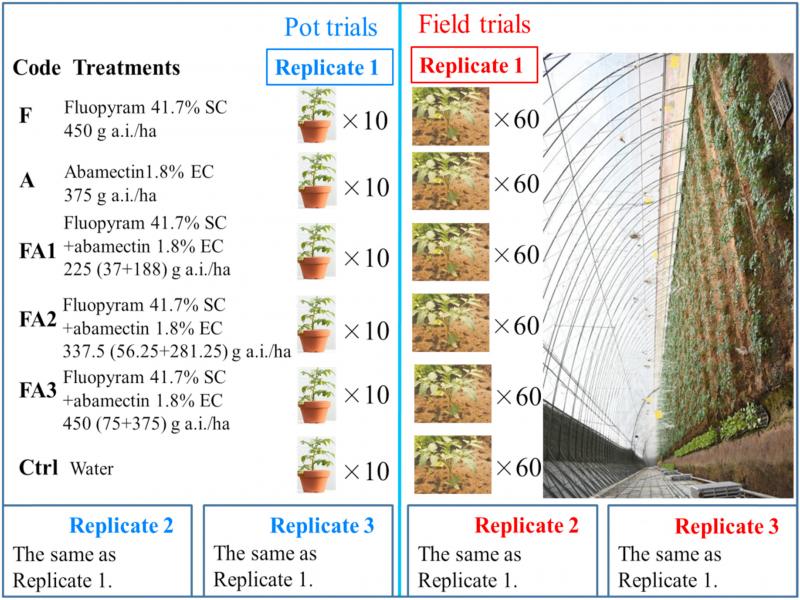
Figure 1:
Experiments design of the pot and field trials.
Growth rate of indicator
The stem diameter and plant height of the tomatoes were measured at 30 and 60 days after transplanting (DAT). The stem diameter was measured with Vernier callipers. The root length and the fresh weights of the root and shoot were measured at 60 DAT with a ruler and a balance, respectively. The relative growth rate of each physiological growth indicator (I) was calculated to evaluate the growth status of tomato plants as follows:
Root activity
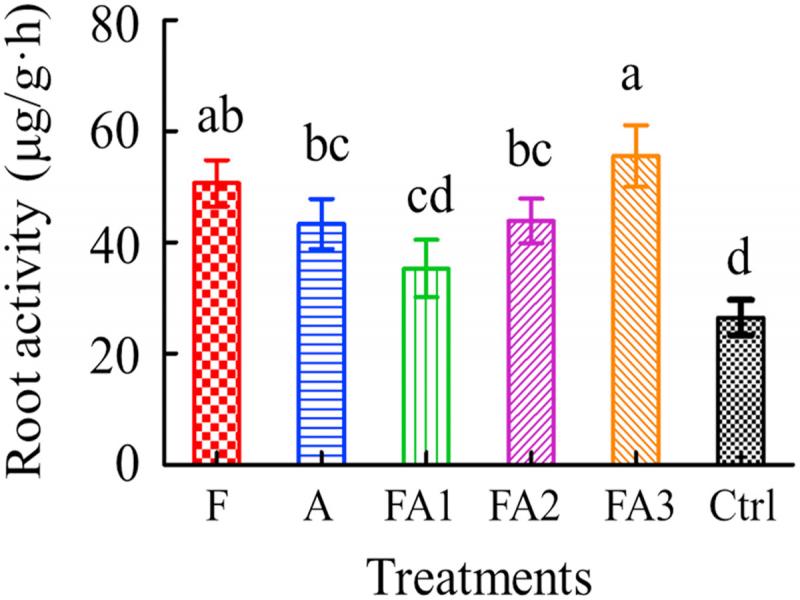
The root activity reflects the ability of root system to absorb water and nutrients directly, which is an indicator of plant health. The root activity of tomato was determined according to the TTC (triphenyltetrazolium chloride) method (Li, 2000). First, a TTC standard curve was obtained using the following method. A small amount (0.2 mL) of 0.4% TTC solution and 9.8 mL of methanol solution were placed in a 20 mL centrifuge tube; 0.10 g of Na2S2O4 was added. The solution was shaken well, and an 80 μg/mL concentration of red TTF (triphenylformazan) was produced. Then, 0.25 mL, 0.50 mL, 1.00 mL, 1.50 mL, and 2.00 mL of the red TTF solution were diluted to 10 mL with methanol to obtain 2 μg/mL, 4 μg/mL, 8 μg/mL, 12 μg/mL, and 16 μg/mL TTF standard solutions, respectively. The absorbance of each TTF standard solution was measured at 485 nm with a spectrophotometer (Epoch 2, Biotek, Winooski, VT, USA). A methanol solution was used as the control. The TTC standard curve was then calculated.
Root activity was determined as follows. Tomato root tips (0.5 cm in length, 0.20 g in total) of each treatment was placed in a culture dish, and 5 mL of 0.4% TTC solution and 5 mL of 0.1 mol/L PBS buffer (pH = 7.5) were added. The culture dish was placed in a 37°C incubator for 2.5 h for a shading reaction, and then a 2 mL solution of 1 mol/L H2SO4 was added. The Ctrl group received a 2 mL solution of 1 mol/L H2SO4 in the culture dish, followed by the addition of 0.2 g of root tip samples. The culture dish was placed in a 37°C incubator for 2.5 h for a shading reaction. The stained root samples were then removed and placed in a centrifuge tube with 10 mL methanol for decolorization. The centrifuge tube was placed in a 30°C incubator for 5 h. The absorbance of each methanol extract was measured at 485 nm with a spectrophotometer (Epoch 2, Biotek, Winooski, VT, USA). The content of TTF (mTTF) was calculated from the standard curve. The root activity was obtained according to the following formula:
Soil nematode and RGI control efficacy
Soil was collected from each pot of the treatment. Plant debris was removed, and soil was filtered with a 500-mesh sieve (25 μm) and mixed to get 100 g of soil samples for each pot independently. Nematodes were extracted from soil samples using the shallow dish method (Mao et al., 2004). The mortality and control efficacy of nematodes in soil were calculated using the following formulas:
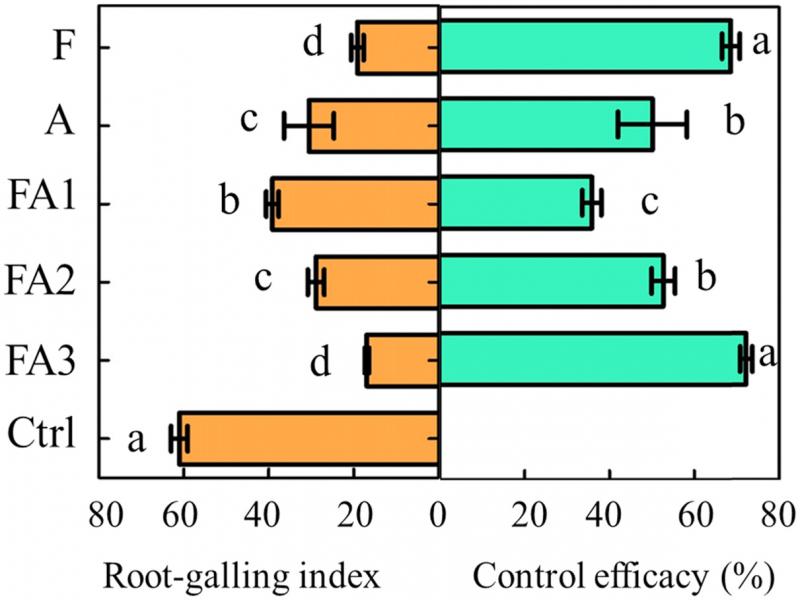
The RGI was determined by digging up all the roots of tomato plants in each treatment and evaluating root damage according to a scale of 0–10, where 0–10 represented no galls, 0–10%, 10–20%, 20–30%, 30–40%, 40–50%, 50–60%, 60–70%, 70–80%, 80–90%, and 90–100% galled roots, respectively (Barker et al., 1986). The RGI and control efficacy were calculated using the following formulas:
Field trials
The field trials were conducted in a solar greenhouse in Laiwu (LW), Jinan City in March 2018, and in a solar greenhouse in Daiyue (DY), Tai’an City in November 2019, Shandong Province, with loam and sandy loam soil, respectively. Southern RKN have been a serious problem for tomatoes in both the fields for more than 10 years. The initial number of southern RKN in the field soil ranged from 1200 to 1800 per 100 cc (g) soil. We arranged six treatments randomly allocated to each of three blocks in the test field. The area of each plot was 24 m2 and it contained 60 tomato (JinPeng 11-8) plants. The tomato roots were irrigated by hand with pesticide solutions at 2 DAT; tomato seedlings were irrigated with 400 mL of a solution of the respective pesticide dilutions, while water was used for the Ctrl treatment. The dosages of the active ingredient of the pesticides (Figure 1), the calculation methods for the nematode control efficacy in the field rhizosphere soil, and RGI were the same as those used in the pot trials.
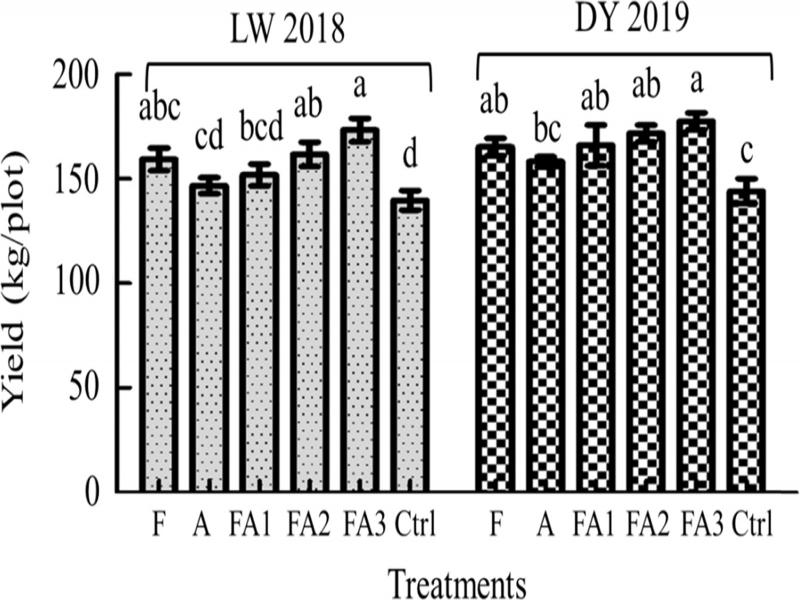
To assess tomato yield, the number of tomatoes was counted on 10 randomly selected tomato plants per plot after 12 and 15 weeks of treatment (Lu et al., 2017). A total of 20 randomly selected tomato fruits were weighed and their mean weight was calculated. Yield was measured twice (Qiao et al., 2011). The field trial was repeated twice (March 2018 and November 2019).
Statistical analysis
We analyzed data using analysis of variance (ANOVA) and evaluated differences among the means by Tukey’s multiple comparison test (p = 0.05). The statistics software used was SPSS 16.0 (SPSS Inc., Chicago, IL, USA). The data are expressed as the mean ± SE (n = 3), and significant differences are indicated at p < 0.05 using different lowercase letters.
Results
Toxicities of fluopyram and abamectin against J2
The LC50 values of fluopyram and abamectin to the J2 of RKN were 2.53 mg/L and 1.62 mg/L, respectively (Table 1). The LC50 values of the different ratio combinations of fluopyram and abamectin were also determined. The 1:5 combination of fluopyram and abamectin had the lowest LC50 value (0.64 mg/L), and the CTC was 268. This synergistic effect was the best among the different combinations. Thus, the combination of active ingredients at the 1:5 ratio of fluopyram (41.7% SC) and abamectin (1.8% EC) was selected for the pot and field trials.
Table 1.
Toxicities of fluopyram and abamectin against second-stage juveniles (J2) of Meloidogyne incognita (48 h).
| Pesticides | Mass ratio of active ingredient | Slope ± SE | LC50 (mg/L) | 95% Confidence limits (mg/L) | r | p | χ 2 | CTC |
|---|---|---|---|---|---|---|---|---|
| Fluopyram | – | 1.43 ± 0.22 | 2.53 | 1.41–4.52 | 0.96 | 0.0082 | 120.28 | – |
| Abamectin | – | 1.56 ± 0.14 | 1.62 | 1.34–1.95 | 0.98 | 0.0017 | 49.69 | – |
| Fluopyram:Abamectin | 1:1 | 1.65 ± 0.26 | 0.99 | 0.71–1.40 | 0.96 | 0.0084 | 139.20 | 198 |
| 1:3 | 2.04 ± 0.40 | 0.78 | 0.50–1.24 | 0.95 | 0.0150 | 92.22 | 227 | |
| 1:5 | 1.29 ± 0.29 | 0.64 | 0.37–1.12 | 0.93 | 0.0212 | 321.94 | 268 | |
| 3:1 | 1.89 ± 0.18 | 1.99 | 1.64–2.42 | 0.98 | 0.0021 | 79.68 | 111 | |
| 5:1 | 1.81 ± 0.22 | 3.16 | 2.42–4.11 | 0.98 | 0.0038 | 100.36 | 73 | |
| Growth rate (%) | |||||
|---|---|---|---|---|---|
| Code | Plant height | Stem diameter | Fresh root weight | Fresh shoot weight | Root length |
| F | 17.44 ± 5.23 ab | 9.84 ± 3.24 ab | 28.71 ± 9.09 ab | 29.51 ± 10.29 a | 15.51 ± 6.38 a |
| A | 10.62 ± 6.26 ab | 3.48 ± 9.68 b | 22.30 ± 4.90 b | 14.34 ± 8.82 abc | 11.23 ± 1.91 a |
| FA1 | 8.66 ± 4.35 b | 2.50 ± 6.63 b | 7.93 ± 1.77 c | 8.83 ± 8.39 c | 5.62 ± 5.11 a |
| FA2 | 13.51 ± 7.34 ab | 6.71 ± 3.36 ab | 27.57 ± 9.01 ab | 24.14 ± 13.95 ab | 15.51 ± 1.59 a |
| FA3 | 20.84 ± 4.71 a | 14.89 ± 6.73 a | 40.30 ± 4.34 a | 29.78 ± 2.56 a | 21.57 ± 8.34 a |
| Ctrl | – | – | – | – | – |
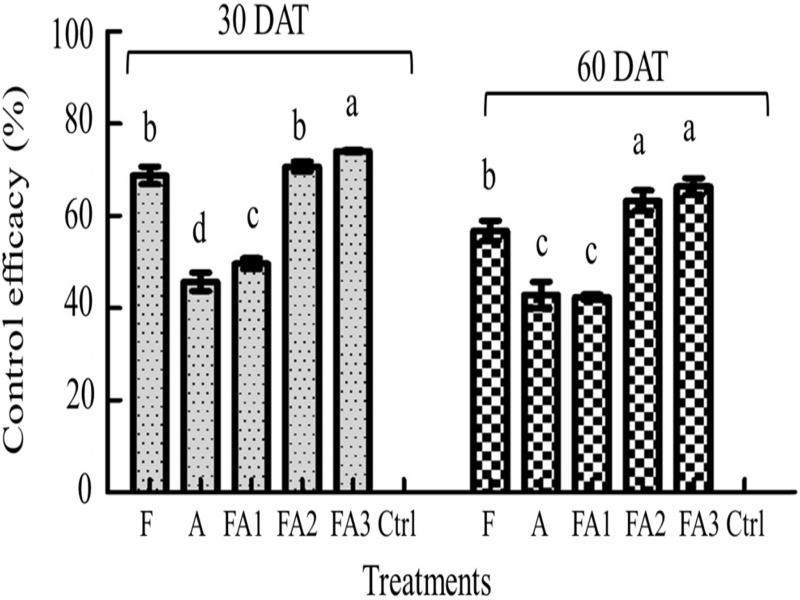
| Control efficacy (%) | ||||
|---|---|---|---|---|
| Site/year | Code | Initial no. of nematodes (nematodes/100 g soil) | 30 DAT | 60 DAT |
| LW/2018 | F | 1780.88 ± 203.11 a | 29.52 ± 1.60 b | 37.31 ± 7.09 b |
| A | 1439.19 ± 201.26 a | 15.43 ± 3.76 c | 29.77 ± 1.73 b | |
| FA1 | 1520.80 ± 573.47 a | 12.86 ± 3.04 c | 17.75 ± 4.75 c | |
| FA2 | 1441.61 ± 124.94 a | 35.12 ± 1.89 b | 53.19 ± 1.75 a | |
| FA3 | 1658.66 ± 277.33 a | 53.04 ± 5.27 a | 58.13 ± 3.75 a | |
| Ctrl | 1638.89 ± 411.11 a | – | – | |
| DY/2019 | F | 1288.33 ± 223.45 a | 31.50 ± 1.80 b | 38.67 ± 3.79 b |
| A | 1457.41 ± 159.75 a | 14.67 ± 2.51 c | 30.67 ± 2.52 b | |
| FA1 | 1523.16 ± 188.47 a | 15.70 ± 2.25 c | 22.46 ± 3.50 c | |
| FA2 | 1287.33 ± 182.67 a | 38.33 ± 2.30 b | 52.53 ± 4.10 a | |
| FA3 | 1461.12 ± 160.25 a | 57.50 ± 3.61 a | 59.73 ± 1.60 a | |
| Ctrl | 1314.16 ± 110.32 a | – | – | |