
Bromeliads (Bromeliaceae) are abundant in neotropical rainforests. Some estimates reach densities above 100 thousand individuals/hectare (Sugden and Robins, 1979; Goffredi et al., 2011). In many bromeliads, the arrangement of the leaves creates a tank or phytotelma (pl. phytotelmata), i.e., a reservoir of fresh water and organic debris. Bromeliad phytotelmata play a central role for many fauna species by providing shelter, breeding grounds, food and water (Benzing, 2000; Kitching, 2000). In return, the microorganisms and metazoans associated with the phytotelma provide nutrients to the plant (Leroy et al., 2015). Phytotelmata are also found in tree and bamboo holes and pitcher plants.
Nematodes are increasingly recognized as important participants in the ecology of aquatic ecosystems. Marine nematodes connect primary producers, decomposers, and macroscopic consumers; and in lentic and lotic ecosystems nematodes respond mainly to the input of organic matter, and secondarily to the microorganisms on which they feed (Majdi and Traunspurger, 2015; Majdi et al., 2017). Thus far little is known about nematodes inhabiting phytotelmata, despite the importance of these aquatic ecosystems in neotropical and temperate forests (Kitching, 2001).
Most studies on phytotelma nematodes are taxonomic: around 44 genera and five new species have been reported (Menzel, 1922; Meyl, 1957; Goss et al., 1964; Krügel, 1993; Benick, 1924, Varga, 1928, and Thienemann, 1934 cited by Kitching, 2000; Zullini et al., 2002; Bert et al., 2003; Holovachov et al., 2004; Zullini, 1977, and Jacobs, 1984 cited by Hodda et al., 2006; Quisado, 2013; Kolicka et al., 2016). The ecology of phytotelma nematodes was first examined by Devetter (2004), who found them to be abundant in tree holes in temperate forests. In these phytotelmata, nematode abundance did not vary significantly across seasons and sampling locations.
More detailed studies were conducted in plastic cups mimicking tree holes, also in temperate forests (Ptatscheck and Traunspurger, 2014, 2015; Ptatscheck et al., 2015). In these studies, nematode abundance varied greatly, with mean values as low as 3 and as high as 5,280 individuals/phytotelma. The nematode trophic structure was dominated by bacterial and hyphal feeders, with a greater proportion of the latter in comparison with previous studies in marine, lentic, and lotic ecosystems. The amount of organic matter impounded in the phytotelma, the biomass of algae living in the water, and the average daily air temperature were the only environmental factors that affected nematode abundance and diversity.
The first study in a neotropical region focused on the tank bromeliads Canistropsis billbergioides (Schult.f.) Leme and Nidularium procerum Lindm, in a rainforest in Brazil (Robaina et al., 2015). In both bromeliads, bacterial and hyphal feeders also predominated over carnivores, plant and unicellular eukaryote feeders. Nematode abundance (total and per trophic group) varied seasonally and among leaf axils positioned in different levels (upper, middle, and base) of the plant. This suggests that the physico-chemical properties (PCPs) of the water retained in the phytotelma may impact the nematofauna.
Seasonal variations in nematode abundance were also found in bromeliads living in a rainforest in Panama (Zotz and Traunspurger, 2016). Total abundance and the abundance of epistrate feeders, omnivorous, and predators were higher in the rainy season, while deposit (mainly bacterial) feeders and suction feeders (on plants and fungi) were more abundant in the dry season. The amount of organic matter impounded in the phytotelma correlated positively with total abundance.
Collectively, these studies suggest that bacterial and hyphal feeder nematodes predominate in phytotelmata; and that nematode abundance (total and per trophic group) varies seasonally. What determines this seasonality is less clear. Rainfall and air temperature are major seasonal variables, but only the latter was found to be relevant for nematode abundance (Ptatscheck and Traunspurger, 2015). The few PCPs of the water so far assessed – volume, pH, oxygen content, and electrical conductivity – did not impact the nematodes, while organic matter input in the phytotelma did (Ptatscheck and Traunspurger, 2014; Zotz and Traunspurger, 2016).
To further understand the ecology of phytotelma nematodes, we decided: (i) to focus on ecosystems distinct from tropical and temperate forests, and (ii) to record several environmental variables over a long time and assess their impact on the nematofauna.
Restingas are formed by beaches, dunes, and lagoons along the Atlantic coast in Brazil, in which herbaceous and shrubby species predominate (Rocha et al., 2007). In this seaside environment, the abundant bromeliads are exposed to shortage of fresh water, high salinity, strong insolation, high temperature, and strong winds. We hypothesized that in the restinga areas, variations in climate and microenvironmental conditions would impact the nematode trophic structure.
To test our hypothesis, we conducted preliminary assessments to define the best nematode sampling method and to select the bromeliad species and phenological stage to be sampled. We then: (i) described the nematode trophic structure in the bromeliad/phenological stage chosen; and (ii) evaluated the effect of rainfall, air temperature, amount of organic debris fallen into the phytotelma, and PCPs of the water – volume; temperature; pH; dissolved organic carbon, nitrogen, oxygen, and solids; and electrical conductivity – on the nematode trophic structure.
Materials and methods
Sampling area
Samples were collected in a preserved area of the Restinga de Jurubatiba National Park (RJNP) (coordinates 22°11′07.0″S; 41°25′45.4″W). The sampling area is roughly rectangular, about 600 × 300 m (18 hectares). This region’s climate is AW (tropical savanna) according to the Köppen classification, with mean monthly temperature ranging from 20°C in July to 26°C in February. Rainfall is seasonal, with monthly mean of about 40 mm from June through August, and 130 to 175 mm from November through February.
Assessment of sampling methods, bromeliad species, and phenological stage
Sampling methods were compared for two bromeliad species with wide distribution in the RJNP: Neoregelia cruenta (R. Graham) L. B. Smith and Aechmea nudicaulis (L.) Griseb. These species have markedly different architectures: N. cruenta forms a broad and shallow tank, with an inflorescence that remains submersed in the retained water, while A. nudicaulis forms a narrow tubular tank from which the inflorescence projects (Fig. 1). Both species are terrestrial and are found partially shaded by short trees and shrubs. The bromeliads were sampled in two phenological stages – mature plants with or without inflorescence.
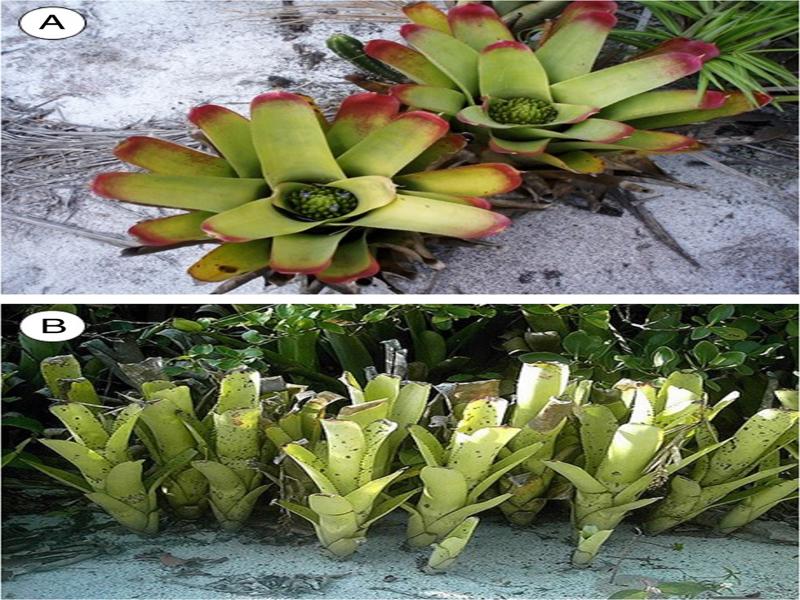
Figure 1:
Bromeliads sampled in Restinga de Jurubatiba National Park. (A) Neoregelia cruenta; (B) Aechmea nudicaulis.
Samplings were carried out on a single day, in February and September 2013 (summer and winter, respectively). On each sampling date, for both bromeliad species, eight plants with inflorescence and eight plants without it were randomly chosen along a random 500 m path.
Since each bromeliad has an unknown abundance of nematodes, methods M1 through M5 were assessed successively in the same plants, and their relative efficiencies to recover additional nematodes were compared.
Method M1 consisted of suction of the phytotelma water with an automatic pipette connected to a thin rubber hose. The water collected was passed through precision sieves (60 and 500 mesh), and the resulting suspension was placed in a plastic flask. For M2, the same phytotelma was washed with 200 ml of tap water applied under pressure by a back-mounted sprayer, to suspend the organic matter and nematodes retained in the small space between leaf axils. The water was collected by pipetting and placed in a flask. This procedure was repeated twice, and the three volumes obtained were pooled and passed through precision sieves. The resulting suspension was stored in a flask. Method M3 consisted of the same three cycles of water jetting-pipetting, pooling of suspensions, and sieving employed for M2. Method M4 consisted of three additional cycles. Method M5 involved removing the same bromeliad from the soil and taking it to the laboratory in a plastic bag. The plant was entirely defoliated and the material was washed in tap water, collecting all the water in a five liter bucket. The suspension was passed through sieves and stored in a flask.
The 160 samples were individually submitted to extraction of nematodes by the method of Coolen and D’Herde (1972), with modification – without previous grinding in a blender – with centrifugation at 760.24 G for 3 min and 190.06 G for 2 min, and sieving as described before. The resulting nematode suspensions were entirely counted on Peter’s slides under an inverted microscope. The total abundance of nematodes and the abundance per trophic group were computed. Nematodes were assigned as plant, hyphal or bacterial feeders, unicellular eukaryote feeders or carnivores (Moens et al., 2006) by examination in a Nikon Eclipse® microscope with Nomarski interference contrast.
Nematode trophic structure as related to climate variables, organic matter input, and PCPs of the water
This study was conducted in mature N. cruenta individuals with inflorescence using the M5 sampling method, as indicated by the preliminary assessments (see Results).
Samplings were carried out every three months from June 2014 through March 2016. On each sampling date, the tank water from eight bromeliads was suctioned and subjected to the following measurements: volume (in ml); temperature (in °C); pH; dissolved oxygen (DO2, in mg.L−1); dissolved solids (DS, in mg.L−1); and electrical conductivity (EC, in mS.cm−1). These were measured with an Icel Manaus® meter (model PH–1500) with appropriate sensors. A 10 ml aliquot was collected in an unused penicillin flask and used for measurement of dissolved organic carbon (DOC, in mg.L−1) and dissolved nitrogen (N, in mg.L−1) using a Shimadzu meter (model TOC–Vcph). Macroscopic organic debris (OD) fallen into the phytotelma was collected in a paper bag, dried for 24 hr in an oven at 80°C and expressed in grams.
Each bromeliad was removed from the soil and placed in a plastic bag, with care to add the water initially sucked from the phytotelma for the PCP measurements. In the laboratory, the M5 sampling method, sample processing, and nematode counting were performed as described before.
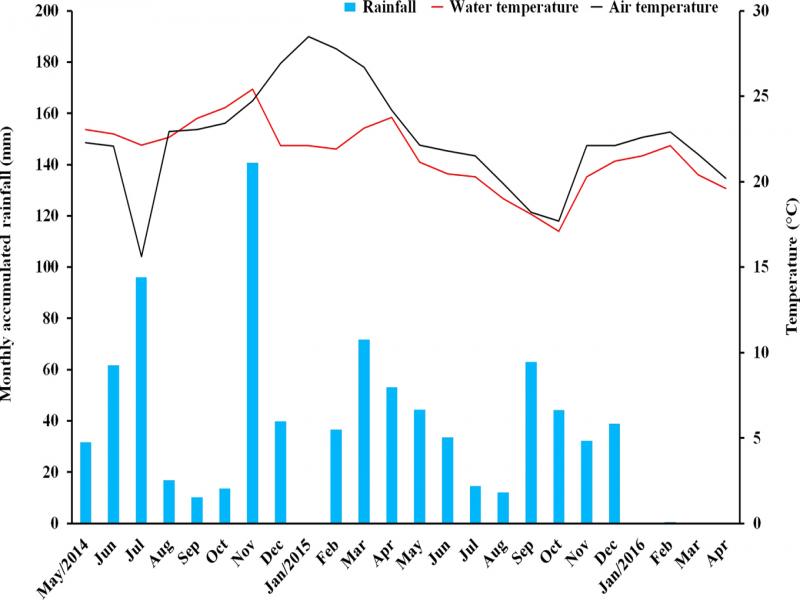
A WatchDog® weather station was used from May 2014 through April 2016 to monitor the following parameters: rainfall (incidence and accumulated monthly volume, in mm); mean monthly air temperature (in °C); and mean monthly temperature (in °C) of the water retained in a specimen of N. cruenta. For this measurement, a temperature sensor was kept continuously in the phytotelma and the temperature was recorded at 60 min intervals.
Data analysis
To assess the efficacy of the sampling methods M1 through M5 in N. cruenta and A. nudicaulis, the nematode counts obtained on the two sampling dates were pooled and tested for homogeneity of variance (Cochran and Bartlett tests) and for normality of errors (Lilliefors test), at 5% probability (Ribeiro, 2001). Since the assumptions were satisfied, ANOVA was conducted and the method’s mean values of nematode recovery were compared through the Tukey test at 5% probability.
To identify the phenological stage at which nematodes were more abundant, only the nematode counts obtained using the best sampling method (M5, see Results) were considered. Data from the two sampling dates were pooled and tested for homogeneity of variance and normality of errors. Since the data did not satisfy the requirements, they were transformed to √x + 1. The transformed data satisfied the requirements, so they were submitted to ANOVA and comparison of the means by the Tukey test, at 5% probability.
To determine how nematode trophic structure relates to rainfall, air temperature and PCPs of the water, regression and redundancy analyses (RDA) of nematode counts, climate and PCP variables were conducted using the R language v.3.6.1. (R Core Team, 2019). The RDA was performed with the R package vegan. All the raw data are available at https://doi.org/10.6084/m9.figshare.12933215.
Results
Assessment of sampling methods, bromeliad species, and phenological stage
Among the five sampling methods assessed, M5 stood out with higher efficiency to recover nematodes from the phytotelma of A. nudicaulis and N. cruenta (Fig. S1). In both bromeliads, the number of nematodes (total and per trophic group) recovered by M1 to M4 was statistically equivalent.

Figure S1.
Number of nematodes recovered by sampling methods M1 through M5 from the phytotelma of Aechmea nudicaulis (left graphs) and Neoregelia cruenta (right). Different lowercase letters indicate different means by the Tukey test at 5%. Values are means of 16 plants for each method and each bromeliad species.
In the assessment to select the bromeliad species and phenological stage for the long-term sampling, N. cruenta with inflorescence stood out for total abundance and abundance of bacterial feeders, in comparison with N. cruenta without inflorescence and A. nudicaulis with or without it (Table S1). Regardless of the phenological stage, more nematodes were found in N. cruenta than in A. nudicaulis.
Table S1.
Nematode abundance (total and per trophic groups) recovered from the phytotelma of mature N. cruenta and A. nudicaulis, in two phenological stages.
| Abundance | |||||||||
|---|---|---|---|---|---|---|---|---|---|
| Species/phenological stage | Total | Bacterial feeders | Hyphal feeders | Carnivores | |||||
| N. cruenta with inflorescence | 194.6aa | 42.1a | 48.8a | 103.7a | |||||
| N. cruenta without inflorescence | 139.6b | 15.2b | 22.3ab | 102.1a | |||||
| A. nudicaulis with inflorescence | 40.7c | 1.2b | 9.7b | 29.8b | |||||
| A. nudicaulis without inflorescence | 49.9c | 3.7b | 10.2ab | 36b | |||||
| Abundance | |||||||||
|---|---|---|---|---|---|---|---|---|---|
| Statistics | Total | Bacterial feeders | Hyphal feeders | Carnivores | |||||
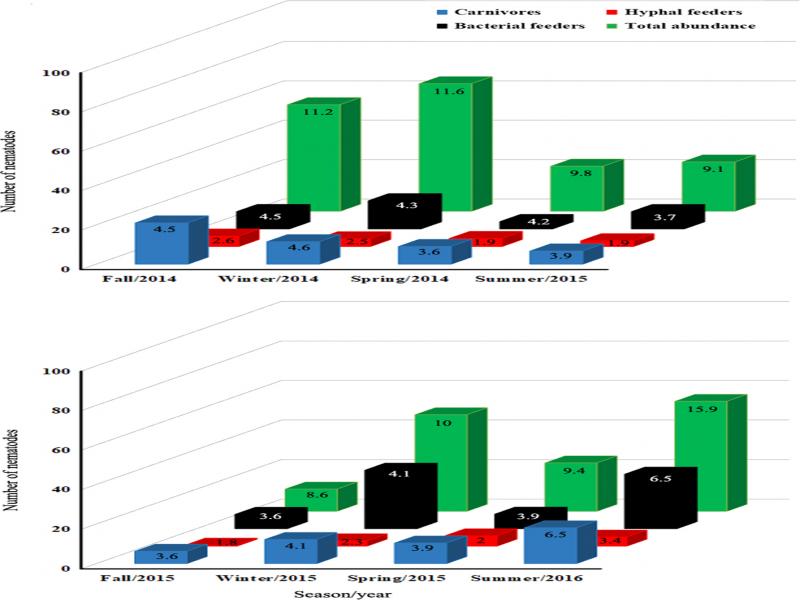
| Mean (min–max) | 62.8a (1-534) | 30 (1-504) | 13.3 (0-201) | 14.2 (0-87) | |||||
| SD | 14 | 15.6 | 47.7 | 11 | |||||
| CV% | 22.3 | 52 | 358.6 | 77.5 | |||||
| Statistical parameters | |||||||||
|---|---|---|---|---|---|---|---|---|---|
| Abundance | p value | F test | r 2 | ||||||
| Rainfall | |||||||||
| Total | 0.39 | 0.87 | 0.13 | ||||||
| Bacterial feeders | 0.78 | 0.08 | 0.01 | ||||||
| Hyphal feeders | 0.09 | 4.17 | 0.4 | ||||||
| Carnivores | 0.82 | 0.06 | 0.01 | ||||||
| Air temperature | |||||||||
| Total | 0.97 | 0.001 | 0.0002 | ||||||
| Bacterial feeders | 0.77 | 0.09 | 0.02 | ||||||
| Hyphal feeders | 0.85 | 0.04 | 0.01 | ||||||
| Carnivores | 0.35 | 1.04 | 0.15 | ||||||
| Variables | |||||||||
|---|---|---|---|---|---|---|---|---|---|
| Statistics | ODa(g) | Volume (ml) | DOC (mg.L−1) | N (mg.L−1) | Temp (°C) | pH | DO2 (mg.L−1) | DS (mg.L−1) | EC (mS.cm−1) |
| Mean (min–max) | 13.7b (1–51) | 222.5 (37–910) | 97.4 (15.9–574) | 4.2 (0.1–12.8) | 22.1 (20–29) | 5.6 (3.5–8.1) | 5.7 (3.2–8) | 80 (8–247) | 0.1 (0.01–0.4) |
| SD | 10.4 | 157.8 | 108.5 | 2.9 | 2.6 | 0.7 | 1 | 56.6 | 0.1 |
| CV % | 75.8 | 71 | 111.4 | 68.2 | 11.7 | 12.5 | 17.6 | 70.7 | 72.7 |
