
Yellow and purple nutsedges (Cyperus esculentus and C. rotundus, respectively) are among the worst weeds affecting agriculture production worldwide (Peerzada, 2017). In Florida, nutsedges are highly damaging and ubiquitous weeds in almost every agricultural and horticultural production system. Coffee senna, or coffee weed (Senna occidentalis syn. Cassia occidentalis) is a leguminous annual weed found in tropical and subtropical regions worldwide (CABI, 2016). In the United States, coffee senna is a common weed in agronomic crops and is particularly important because its seeds contain animal toxins (Furlan et al., 2012).
Weeds often serve as alternative hosts to plant-parasitic nematodes, thereby increasing their incidence and severity. In addition, they reduce the efficacy of nematode management tactics. For example, nutsedges and plant-parasitic nematodes are two of the most common soilborne pest problems in Florida vegetable production and often occur concomitantly (Rich et al., 2003). Yellow and purple nutsedges are both hosts to Meloidogyne incognita (Schroeder et al., 1993) and can harbor life stages of the nematode within their tubers. Consequently, fumigant nematicides fail to kill many of the individuals housed within tubers (Thomas et al., 2004). Yellow nutsedge is reported to be a host to M. graminicola and Hoplolaimus columbus (Bird and Hogger, 1973; Minton et al., 1987; Schroeder et al., 1993), whereas purple nutsedge is reported to be a host to M. graminicola, H. columbus, Belonolaimus longicaudatus, Dolichodorus heterocephalus, Nanidorus minor, and Ditylenchus destructor (Rhoades, 1964; Bird and Hogger, 1973; Minton et al., 1987; De Waele et al., 1990; Schroeder et al., 1993). Furthermore, nutsedge tuber counts were highly correlated with soil infestation densities of M. incognita (Thomas et al., 1995; Ou et al., 2008).
In Florida’s high-value vegetable and strawberry production systems nutsedges are a primary weed problem, and root-knot nematodes (RKN) of various species and sting nematode (B. longicaudatus) are the nematodes of greatest concern (Kokalis-Burelle, 2003; Khanal and Desaeger, 2020). Meloidogyne incognita, M. javanica, M. arenaria, M. enterolobii, and M. floridensis are the most common RKN reported in Florida vegetable fields (Brito et al., 2008), whereas M. hapla is second only to sting nematode in importance on strawberry (Desaeger, 2019). Bermudagrass sod farms, golf courses, athletic fields, lawns, and pastures are often infested with nutsedges that may serve as alternative hosts to sting nematode and the grass RKN M. graminis, the two most damaging plant-parasitic nematodes on this plant.
Coffee senna is a common weed in cotton and peanut production in northern Florida, as are yellow and purple nutsedges. Meloidogyne incognita and Rotylenchulus reniformis on cotton, and M. arenaria on peanut, are the most important nematodes on these crops in the region. Coffee senna was reported as a host to R. reniformis (Lawrence et al., 2008), whereas it was a nonhost to M. arenaria, M. enterolobii, M. floridensis, M. incognita, and M. javanica (Kaur et al., 2007).
In order to improve the effectiveness of nematode management strategies it is very important to know the host status of common weeds to the nematode species present in agricultural fields. The objective of this study was to determine the host suitability of yellow and purple nutsedges and coffee senna to some of the common plant-parasitic nematodes important to Florida agriculture and turfgrass production systems. To meet this objective, three experiments were conducted under greenhouse conditions and each was repeated.
Material and methods
Host status of common weeds to Meloidogyne spp.
We evaluated the host status of yellow and purple nutsedge and coffee senna to Meloidogyne arenaria, M. enterolobii, M. floridensis, M. hapla, M. incognita, and M. javanica. ‘AgriSet 334’ tomato (Solanum lycopersicum) was included as a susceptible control. This experiment was originally conducted in summer of 2014 (trial 1) and repeated in summer of 2015 (trial 2). There were five replications of the 18 RKN species × host plant combinations placed on a greenhouse bench in a completely randomized design. Six tubers of either of yellow (C. esculentus) or purple nutsedge (C. rotundus) from greenhouse cultures were sown in clay pots (16.0-cm-top outside diam.) containing 1,400 cm3 of steam pasteurized soil (92% sand, 3% silt, 5% clay, and 1% organic matter). Coffee senna and tomato were pre-germinated in a vermiculite medium and transplanted to the clay pots 3 weeks later. Nematode inocula were prepared by extracting eggs from infected tomato root systems from greenhouse cultures using the technique of Hussey and Barker (1973), as modified by Bonetti and Ferraz (1981). The test plants, 12-week old nutsedge and 6-week old tomato and coffee senna seedlings, were inoculated with 5,000 eggs and second-stage juveniles (J2) of the respective RKN species. Inoculated plants were maintained under greenhouse conditions, greenhouse temperatures for this experiment, and the subsequent experiments, ranged from 23 to 31°C, with an average temperature of 27°C. At 85 days after inoculation the plant roots were removed from pots, thoroughly washed to remove soil and debris, fresh root weights recorded, and any visible galls rated by using the 0 to 5 scale (Taylor and Sasser, 1978). Eggs were extracted as described above to determine the reproductive factor (Rf) for each nematode species.
Host status of nutsedges to Meloidogyne graminis
This experiment assessed the host suitability of yellow and purple nutsedges to the grass RKN, M. graminis. ‘Tifway’ bermudagrass was used as a known susceptible control (W. T. Crow, pers. comm.). This experiment was originally conducted in spring-summer of 2016 (trial 1) and repeated in spring-summer of 2018 (trial 2). There were five replications of three different host plant treatments placed on a greenhouse bench in a completely randomized design. Clay pots (16.0-cm-top outside diam.) containing 1,400 cm3 of sterilized sand were planted with six tubers of either yellow or purple nutsedge, or sprigs of bermudagrass. Twelve-week-old nutsedge and 8-week-old bermudagrass were inoculated with 4,000 J2 of M. graminis per pot. To collect inoculum, infected bermudagrass roots from greenhouse cultures were incubated in a mist chamber for a period of 72 hr (Crow et al., 2020) to collect J2 exiting roots. After inoculation plants were maintained under glasshouse conditions as described above. In total, 150 days after inoculation the plants were uprooted and nematode population density was assessed along with fresh root and tuber weights. Vermiform J2 and males were extracted separately from the entire pot contents of roots and tubers by using the mist extraction method for a period of 72 hr (Crow et al., 2020). Before the incubation in the mist chamber, the tubers were superficially disinfected with 0.5% sodium hypochlorite for 20 min to remove live nematodes from tuber surfaces. Because M. graminis is a bisexual species with abundant males, J2 and male life stages were counted separately; however, only J2 were used to calculate the Rf.
Host status of nutsedges to Belonolaimus longicaudatus
This experiment was originally conducted in spring of 2017 (trial 1) and repeated in winter of 2018 to 2019 (trial 2). ‘FX 313’ St. Augustinegrass (Stenotaphrum secundatum) was used as a known host to B. longicaudatus (Busey et al., 1991). Clay pots (16.0-cm-top outside diam.) containing 1,400 cm3 of sterilized sand were planted with six tubers of either yellow or purple nutsedge, or sprigs of St. Augustinegrass. Twelve-week-old nutsedge and 6-week-old St. Augustinegrass were inoculated with 120 mixed-life stages (J2, J3, J4, male, and female) of B. longicaudatus per pot. One hundred eighty days after inoculation the nematode population density was recorded. In trial 1 sting nematodes were extracted from 200 cm3 of soil using a sieving and incubation method (McSorley and Frederick, 1991), and in trial 2 they were extracted using the centrifugal-flotation method (Jenkins, 1964). The nematodes recovered from 200 cm3 of soil were multiplied by seven to estimate the total number of nematodes per pot (1,400 cm3 of soil) for calculating the Rf.
Statistical analysis
For all experiments data were subjected to analysis of variance and treatment means were separated according to Duncan’s multiple range test (P ≤ 0.05) using SAS software (SAS Institute, Cary, NC). When no significant trial or trial × treatment effects occurred the data from the two trials were combined for analysis, otherwise the results of the two trials were analyzed separately.
Results
Host status of common weeds to Meloidogyne spp.
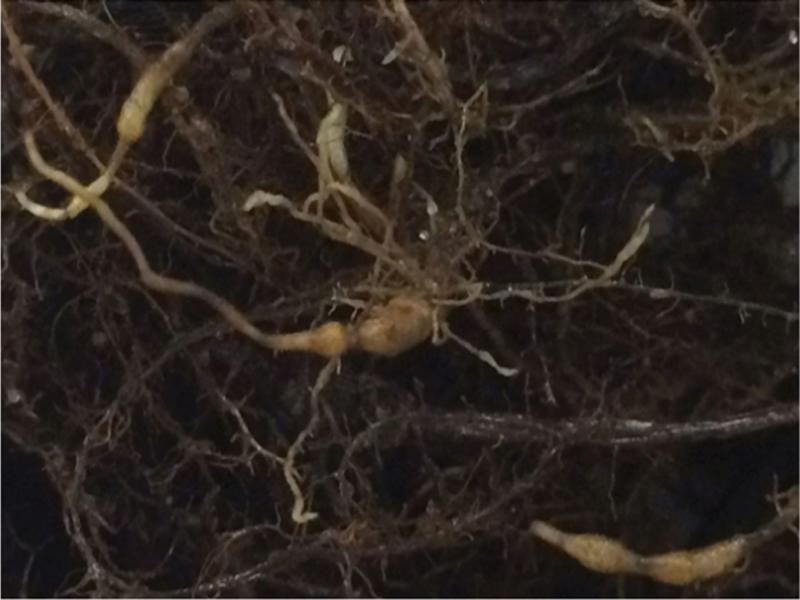
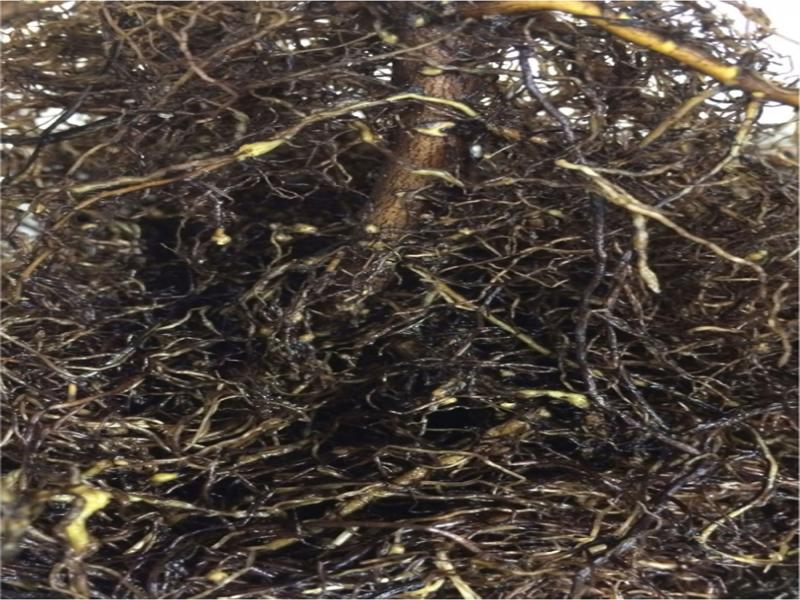
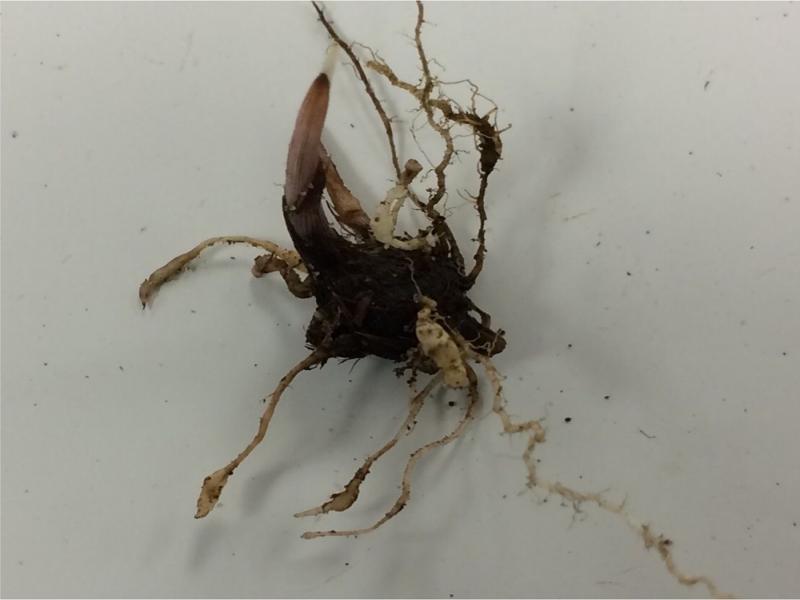
Because of significant trial and trial × treatment effects, the data from the two trials were subjected to separate statistical analysis. In the first trial all of the yellow nutsedge plants and three of the purple nutsedge plants inoculated with M. hapla died before termination. As plants died their roots were inspected for galling, these measurements were noted but not included in the statistical analysis. Yellow and purple nutsedges were good hosts for all six RKN species (Table 1). The Rf of M. floridensis in trial 1 was the highest (P ≤ 0.05) among the nematode species on yellow and purple nutsedges with the exception of being similar to M. arenaria on purple nutsedge. In trial 2, M. floridensis had similar (P ≤ 0.05) Rf values on yellow nutsedge to that of M. hapla and M. javanica, and again on purple nutsedge both M. floridensis and M. arenaria had higher Rf values among the Meloidogyne spp. tested. In both trials, the Rf of M. arenaria was higher (P ≤ 0.05) on purple nutsedge than on yellow nutsedge, whereas it was reversed for M. enterolobii. Meloidogyne incognita and M. javanica had a similar Rf value on both nutsedges in trial 1; however, in trial 2 both reproduced more readily (P ≤ 0.05) on yellow nutsedge. Only M. hapla (trial 2 only) and M. javanica (Fig. 1) induced visible galls on yellow nutsedge and no galls were visible on purple nutsedge (Table 1).
Table 1.
Reproductive factor (Rf) and gall ratings of Meloidogyne arenaria, M. enterolobii, M. floridensis, M. hapla, M. incognita, and M. javanica on yellow and purple nutsedges, coffee senna, and a known susceptible host ‘AgriSet 334’ tomato in two trials of a greenhouse experiment 84 days after plants were inoculated with 5,000 eggs and second–stage juveniles.
| Nematode sp. | Y. nutsedge | P. nutsedge | C. senna | Tomato | Y. nutsedge | P. nutsedge | C. senna | Tomato |
|---|---|---|---|---|---|---|---|---|
| Rf | Gall index (0-5) | |||||||
| Trial 1 | ||||||||
| M. arenaria | 2.82 c BC1 | 4.76 b A | 0.00 d B | 7.75 a A | 0.00 b B | 0.00 b A | 0.00 b C | 5.00 a A |
| M. enterolobii | 3.93 b B | 1.47 c B | 1.89 c A | 6.88 a A | 0.00 b B | 0.00 b A | 4.60 a A | 5.00 a A |
| M. floridensis | 5.27 ab A | 3.69 b A | 0.00 c B | 6.66 a A | 0.00 b B | 0.00 b A | 0.00 b C | 5.00 a A |
| M. hapla | – | 1.57 b B | 0.00 c B | 2.90 a B | – | 0.00 b A | 0.00 b C | 5.00 a A |
| M. incognita | 2.40 b C | 1.61 b B | 0.08 c B | 6.73 a A | 0.00 c B | 0.00 c A | 4.00 b B | 5.00 a A |
| M. javanica | 2.11 b C | 1.72 b B | 0.00 c B | 8.24 a A | 3.00 b A | 0.00 c A | 0.00 c C | 5.00 a A |
| Trial 2 | ||||||||
| M. arenaria | 3.10 c C | 6.75 b A | 0.00 d B | 49.30 a A | 0.00 b B | 0.00 b A | 0.00 b C | 5.00 a A |
| M. enterolobii | 5.95 b B | 1.83 c B | 1.77 c A | 24.20 a C | 0.00 c B | 0.00 c A | 4.40 b A | 5.00 a A |
| M. floridensis | 8.93 b A | 6.06 b A | 0.00 c B | 35.99 a B | 0.00 b B | 0.00 b A | 0.00 b C | 5.00 a A |
| M. hapla | 6.83 a AB | 1.59 b B | 0.00 b B | 7.80 a E | 0.80 b B | 0.00 c A | 0.00 c C | 5.00 a A |
| M. incognita | 5.46 b B | 1.44 c B | 0.07 c B | 15.45 a D | 0.00 c B | 0.00 c A | 3.00 b B | 5.00 a A |
| M. javanica | 8.97 b A | 2.28 c B | 0.00 c B | 32.05 a B | 1.80 b A | 0.00 c A | 0.00 c C | 5.00 a A |
| Host | J2/g root | Males/g root | J2/g tuber | Males/g tuber | Rfa |
|---|---|---|---|---|---|
| Yellow nutsedge | 26bb | <1b | 1b | <1b | 0.35b |
| Purple nutsedge | 240b | <1b | 5a | <1a | 2.48a |
| Bermudagrass | 509a | 24a | – | – | 3.64a |
| Trial 1a | Trial 2 | |||
|---|---|---|---|---|
| Host | Nematodes/pot | Rf | Nematodes/pot | Rf |
| Yellow nutsedge | 21ab | 0.16a | 228a | 1.90a |
| Purple nutsedge | 23a | 0.19a | 375a | 3.12a |
| St. Augustinegrass | 25a | 0.21a | 389a | 3.24a |