Entomopathogenic nematodes (EPNs) of the Steinernematidae and Heterorhabditidae families are widely used as biological control agents that represent a promising alternative to replace pesticides (Labaude and Griffin, 2018), because of their ability to parasitize insects, being able to identify, locate, and infect a host and to kill it within 48 hr, as well as they are safe to vertebrates, plants, and other non-target organisms. Moreover, they can be applied by means of standard spraying equipment (Poinar, 1972; Hazir et al., 2003; Van Zyl and Malan, 2014), and can be propagated in mass either in vivo using host insects such as Galleria mellonella (Lepidoptera: Pyralidae) or in vitro in bioreactors using artificial culture media (Shapiro-Ilan et al., 2014).
EPNs life cycle has six states: egg, four juvenile stages, and adults: males, females, or hermaphrodites (Shapiro-Ilan et al., 2014). EPNs of the Steinernematidae family are characterized by symbiotic associations with bacteria of the genus Xenorhabdus, while EPNs of the Heterorhabditidae family have symbiotic associations with bacteria of the genus Photorhabdus. In these relationships, the nematode acts as a vector allowing the bacteria to reach and enter the host insect where they produce metabolites that kill it within 24 to 48 hr, degrade it and transform it into an optimal environment for the development of EPNs. Almost every stage of EPNs development takes place inside the insect. The exception is the infective juvenile (IJ) which is a modification of the J3 stage that does not feed or develop, responsible for actively mobilizing in the soil in search of potential hosts and for carrying the bacterial symbionts in the intestinal lumen (Heterorhabditis sp.), or in a specialized structure called the receptacle; a modification of the two most anterior intestinal cells (Steinernema sp.) (Griffin et al., 2005; Stock, 2015).
Because various environmental conditions can affect survival, reproductive potential, and virulence of EPNs, the use of native species for pest control is of great importance since they are better adapted to local environmental conditions than are foreign species (Campos-Herrera and Gutiérrez, 2009). Nevertheless, in a number of countries information on EPNs and their bacterial symbionts is scarce (De Brida et al., 2017). Colombia’s records of native EPNs, a tropical country with a large agricultural population and sector, do include Steinernema websteri, S. kraussei, S. colombiense, and Heterorhabditis bacteriophora (López-Núñez et al., 2007, 2008; Melo et al., 2009). The municipality of Toribío, in the Department of Cauca, Colombia, is a place where EPNs had never been registered before. It is characterized by small-scale family and community agriculture with varied subsistence and pasture crops. The aim of this study was to isolate and identify EPNs and their bacterial symbiont from crops and natural habitats at this municipality for later in vitro evaluation of susceptibility of two insect pests of economic interest for Hass avocado crops (Persea americana), the potato flea beetle (Epitrix cucumeris [Coleoptera: Chrysomelidae]), and a broad-nosed weevil (Pandeleteius cinereus [Coleoptera: Curculionidae]), to the EPNs isolated and the reference isolate Steinernema carpocapsae FA2015.
Materials and methods
Isolation and identification of entomopathogenic nematodes
Soil sampling
Soil samples were taken in the Toribío and Tacueyó reserves of the municipality of Toribío, in the Department of Cauca, Colombia, where EPNs have never been applied. These rural areas are located between 1,757 and 2,963 meters above sea level (m.a.s.l) where temperatures range between 13.9° and 20°C. Following the sampling method developed by Varón de Agudelo and Castillo (2001), 10 sampling sites in eight types of vegetation cover were selected: natural grassland (NG), pasture bordering annual crops (PBAC), natural forest (NF), first-growth American bamboo (Guadua sp.) (FGAB), coffee cultivation (Coffea arabica) (CC), horticultural cultivation (HC), strawberry cultivation (Fragaria sp.) (SC), and combined lulo (Solanum quitoense) and papaya cultivation (Carica sp.) (CLPC). At each site, two composite soil samples (10 subsamples, ~1 kg) were taken at depths between 20 and 30 cm, after removing soil cover to avoid cross contamination. Each independent composite sample was taken in an area measuring approximately 16 m2 with a zigzag distribution of 10 subsampling points. Samples were packed in plastic bags, labeled, and stored in a cooler (~15°C) (Orozco et al., 2014) in dark conditions for less than 24 hr until they arrived at the Biological Control laboratory of Pontificia Universidad Javeriana in Bogotá, Colombia to be immediately processed.
Isolation of EPNs
Composite soil samples taken from each site were mixed and stored at room temperature for 24 hr prior to testing for IJs using the insect baiting technique (Bedding and Akhurst, 1975). For this, six samples of 150 g of mixed soil were deposited in 200 cm3 plastic boxes. Then, five G. mellonella larvae and five Tenebrio molitor (Colepotera: Tenebrionidae) larvae were added per box at the soil surface. The boxes were labeled, inverted, and kept in darkness at 20°C. Four days later, the boxes were evaluated for dead larvae killed by EPNs. Sagging bodies and color changes were noted. Subsequently, dead larvae were placed individually in White traps (White, 1927) to obtain IJs. The IJs recovered were then multiplicated in G. mellonella larvae and maintained for later identification. To corroborate whether EPNs were absent or present in soil samples, samples were processed twice by repeating the process described above.
The IJs isolated were stored in polyurethane foams at 10°C in the Biological Control laboratory and deposited in the Entomology collection of the Javeriana Museum of Natural History of the Pontificia Universidad Javeriana in Bogotá, Colombia.
Abundance of EPNs at sampled sites (positive sites for EPNs/total sites) and the recovery frequency of EPNs (positive samples for EPNs/total samples analyzed) were determined according to the type of vegetation cover (Liu and Berry, 1995) and expressed as a percentage.
Molecular identification
DNA extraction
Genomic DNA was extracted individually from females following the protocol described by Çimen et al. (2016). After lysis of the nematodes, protein content was separated using NaCl at a final concentration of 1.7 M and centrifuging at 3,000 g for 15 min at room temperature. Finally, the supernatant was transferred to another tube for alcohol precipitation of DNA.
Amplification and sequencing of taxonomic markers
Sequences of the following three taxonomic markers commonly used for nematodes were amplified by PCR and used for molecular identification: a fragment of the 18S rRNA sequence using primers SSU18A-4F: 5′-GCTTGTCTCAAAGATTAAGCCATGCATG-3′ and SSU26Rplus4: 5′-AAGACATTCTTGGCAAATGCTTTCG-3′ (Morise et al., 2012); a fragment that contained the sequences ITS1, 5.8S, and ITS2 using primers 18S: 5′-TTGATTACGTCCCTGCCCTTT-3′ and 26S: 5′-TTTCACTCGCCGTTACTAAGG-3′ (Vrain et al., 1992); and a rRNA 28S fragment that contained the D2/D3 expansion sequence using D2F: 5′-CCTTAGTAACGGCGAGTGAAA-3′ (Nguyen et al., 2006) and 536: 5′-CAGCTATCCTGAGGAAAC-3′ as primers (Stock et al., 2001).
For fragment amplification, 50 µl of PCR mixture was prepared using 1X NH4 Buffer (Bioline, England), 3 mM MgCl2, 0.2 mM dNTPs, and 0.5 µg/µl Bovine Serum Albumin (New England Biolabs, United States), 0.5 µM forward primer, 0.5 µM reverse primer, Taq DNA polymerase 2U (Bioline, England), and 100 to 200 ng of template DNA (Hominick et al., 1997; Stock et al., 2001).
The PCR protocol for the 18S fragment consisted of one initial denaturation cycle at 94°C for 2 min followed by 35 cycles at 94°C for 10 sec, 55°C for 30 sec, 68°C for 1 min (Morise et al., 2012), and a final extension at 68°C for 7 min. For the ITS and D2/D3 fragments, the PCR protocol consisted of one cycle of initial denaturation at 94°C for 7 min followed by 35 cycles at 94°C for 1 min, 1 min at the annealing temperature (ITS: 50°C and D2/D3: 55°C), 72°C for 1 min and a final extension at 72°C for 7 min (Çimen et al., 2016).
Amplification of all PCR products and their respective negative amplification controls were verified by 1% (w/v) agarose gel electrophoresis in 1X TBE buffer stained with 0.5 X Hydragreen (ACTGene, United States). PCR products were purified for sequencing with Wizard SV Gel and PCR clean-up system (Promega, United States). Three purified amplicons obtained from three independent DNA extractions were sequenced for each molecular marker. Sequencing of each amplicon was performed in both directions.
Processing of the obtained sequences
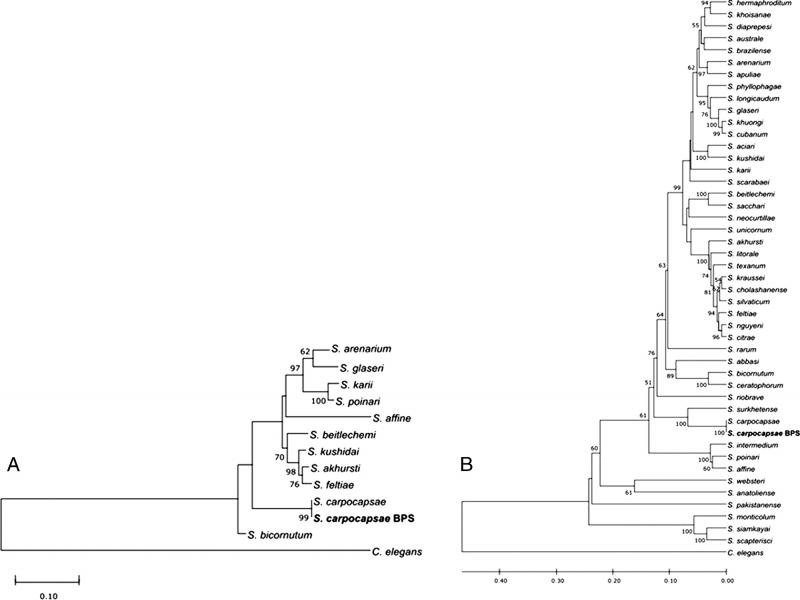
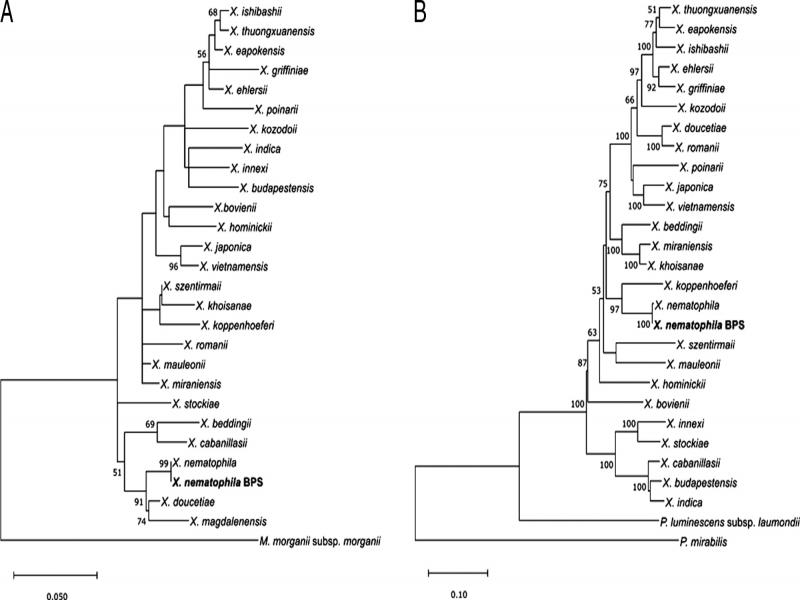
The six sequences obtained for each marker were visualized, aligned, and edited manually using MEGA X software (Kumar et al., 2018) in order to obtain a consensus sequence. Its identity was initially verified by means of the Basic Local Alignment Search Tool (BLAST) (Altschul et al., 1990) on the basis of the non-redundant (nr) database of the NCBI. Consensus sequences of all markers were deposited in GenBank (NCBI) under the accession numbers listed in Table 1.
Table 1.
Accession numbers of sequences used for phylogenetic analysis of the EPN isolated and its bacterial symbiont.
| Gen | ||||||
| Species | 18S | ITS | 28S | |||
| Steinernema carpocapsae BPS | MK558002 ■ | MK558041 ■ | MK558056 ■ | |||
| Steinernema carpocapsae | KJ636405 | AF121049 | KJ950293 | |||
| Steinernema arenarium | KJ636393 | KU194614 | KU194619 | |||
| Steinernema feltiae | KJ636413 | AF121050 | JF920963 | |||
| Steinernema glaseri | KU180674 | AF122015 | GU177831 | |||
| Steinernema bicornutum | KT878311 | AF121048 | GU569045 | |||
| Steinernema poinari | KT878314 | KF241753 | KF241750 | |||
| Steinernema akhursti | KT878310 | DQ375757 | KF289902 | |||
| Steinernema karii | AJ417021 | AY230173 | AF331902 | |||
| Steinernema beitlechemi | KT878316 | KT373856 | KT580949 | |||
| Steinernema kushidai | LC157426 | GQ497741 | AF331897 | |||
| Steinernema affine | FJ040425 | AY230159 | AF331899 | |||
| Steinernema websteri | – | FJ381666 | AY841762 | |||
| Steinernema scarabaei | – | FJ263673 | AY172023 | |||
| Steinernema khuongi | – | GU174002 | GU177835 | |||
| Steinernema diaprepesi | – | AF122021 | GU177828 | |||
| Steinernema hermaphroditum | – | MF663703 | MF693228 | |||
| Steinernema rarum | – | DQ221115 | AY253296 | |||
| Steinernema intermedium | – | AF122016 | AF331909 | |||
| Steinernema unicornum | – | GQ497167 | GU191462 | |||
| Steinernema scapterisci | – | AF122020 | AF331898 | |||
| Steinernema neocurtillae | – | AF122018 | FJ263674 | |||
| Steinernema monticolum | – | AF122017 | AF331895 | |||
| Steinernema nguyeni | – | KP325084 | KR815816 | |||
| Steinernema sacchari | – | KC633095 | KC633096 | |||
| Steinernema phyllophagae | – | FJ410327 | FJ666054 | |||
| Steinernema pakistanense | – | MF289981 | JX068823 | |||
| Steinernema australe | – | FJ235125 | FJ235126 | |||
| Steinernema brazilense | – | FJ410325 | FJ410326 | |||
| Steinernema riobrave | – | AY230182 | GU177834 | |||
| Steinernema cubanum | – | AY230166 | AF331889 | |||
| Steinernema ceratophorum | – | AY230165 | AF331888 | |||
| Steinernema texanum | – | EF152568 | EF152569 | |||
| Steinernema cholashanense | – | MF039642 | EF520284 | |||
| Steinernema apuliae | – | HQ416968 | KU194621 | |||
| Steinernema khoisanae | – | DQ314287 | DQ314289 | |||
| Steinernema aciari | – | AY787660 | GU395637 | |||
| Steinernema citrae | – | FJ235074 | MF540678 | |||
| Steinernema silvaticum | – | MG543848 | MG547579 | |||
| Steinernema surkhetense | – | MF919614 | KU187262 | |||
| Steinernema litorale | – | JF892546 | JQ795723 | |||
| Steinernema anatoliense | – | EU200356 | AY841761 | |||
| Caenorhabditis elegans | X03680 | X03680 | X03680 | |||
| Panagrellus redivivus | – | – | AF331910 | |||
| 16S | dnaN | recA | gltX | rplB | ||
| Xenorhabdus nematophila BPS | MK558196 ■ | MK570079 ■ | MK570081 ■ | MK570080 ■ | MK570082 ■ | |
| Xenorhabdus nematophila ATCC19061 | D78009 | NC_014228 | AF127333 | NC_014228 | CBJ88402 | |
| Xenorhabdus beddingii | AY278675 | FJ831460 | FJ823415 | FJ840506 | FJ808999 | |
| Xenorhabdus bovienii | X82252 | FJ831466 | FJ823426 | FJ840514 | FJ809005 | |
| Xenorhabdus japonica | DQ202310 | FJ831453 | FJ823400 | FJ840503 | FJ808989 | |
| Xenorhabdus poinarii | D78010 | FJ831454 | FJ823409 | FJ840499 | FJ808995 | |
| Xenorhabdus szentirmaii | AJ810295 | FJ831458 | FJ823416 | FJ840508 | FJ809002 | |
| Xenorhabdus ehlersii | AJ810294 | FJ831448 | FJ823398 | FJ840495 | FJ808992 | |
| Xenorhabdus innexi | AJ810292 | FJ831476 | FJ823424 | FJ840522 | FJ809018 | |
| Xenorhabdus budapestensis | AJ810293 | FJ831474 | FJ823418 | FJ840518 | FJ809017 | |
| Xenorhabdus indica | AM040494 | FJ831470 | FJ823421 | FJ840520 | FJ809013 | |
| Xenorhabdus cabanillasii | AY521244 | FJ831472 | FJ823422 | FJ840521 | FJ809015 | |
| Xenorhabdus doucetiae | DQ211709 | FJ831450 | FJ823402 | FJ840497 | FJ809001 | |
| Xenorhabdus griffiniae | DQ211710 | FJ831449 | FJ823399 | FJ840496 | FJ808991 | |
| Xenorhabdus hominickii | DQ211719 | FJ831461 | FJ823410 | FJ840510 | FJ809010 | |
| Xenorhabdus koppenhoeferi | DQ205450 | FJ831457 | FJ823413 | FJ840504 | FJ809004 | |
| Xenorhabdus kozodoii | DQ211716 | FJ831446 | FJ823404 | FJ840493 | FJ808994 | |
| Xenorhabdus mauleonii | DQ211715 | FJ831464 | FJ823417 | FJ840507 | FJ809003 | |
| Xenorhabdus miraniensis | DQ211713 | FJ831459 | FJ823414 | FJ840505 | FJ808990 | |
| Xenorhabdus romanii | DQ211717 | FJ831451 | FJ823403 | FJ840498 | FJ809000 | |
| Xenorhabdus stockiae | DQ202309 | FJ831477 | FJ823425 | FJ840524 | FJ809020 | |
| Xenorhabdus vietnamensis | DQ205447 | FJ831452 | FJ823401 | FJ840502 | FJ808998 | |
| Xenorhabdus ishibashii | GQ149086 | JQ348908 | JQ348906 | JQ348909 | PHM62307 | |
| Xenorhabdus magdalenensis | HQ877464 | JF798399 | JF798401 | JF798400 | - | |
| Xenorhabdus khoisanae | HQ142625 | AB685733 | AB685736 | AB685734 | KMJ46808 | |
| Xenorhabdus thuongxuanensis | KX602193 | KX602195 | KX602194 | KX602196 | OKP02162 | |
| Xenorhabdus eapokensis | KX602187 | KX602189 | KX602188 | KX602190 | OKP00696 | |
| Morganella morganii subsp. morganii | AJ301681 | – | – | – | – | |
| Photorhabdus luminescens subsp. laumondii | – | FJ831497 | KT963835 | KT963845 | FJ817457 | |
| Proteus mirabilis | – | NC_010554 | X14870 | CAR43779 | CAR46384 | |
| Vegetation cover | Location | Altitude (m.a.s.l) | Soil temperature (°C) | Recovery frequency (%) | Larvae of G. mellonella affected by EPNs (%) | Larvae of T. molitor affected by EPNs (%) |
|---|---|---|---|---|---|---|
| Natural grassland (NG) | 02°58′43.2″ N 076°09′36.9″ W | 2,963 | 13.9 | 0.0 | 0.0 | 0.0 |
| Pasture bordering annual crops (PBAC) | 02°56′57,3″ N 076°16′21,5″ W | 1,757 | 20.0 | 0.0 | 0.0 | 0.0 |
| Natural forest (NF) | 02°56′0.99″ N 76°17′19.8″ W | 1,863 | 16.4 | 50.0 | 21.7 | 1.7 |
| First-growth bamboo (FGAB) | 03°00′49.5″ N 076°12′41,3″ W | 1,894 | 18.0 | 0.0 | 0.0 | 0.0 |
| Coffee cultivation (CC) | 02°56′0.45″ N 76°17′19.1″ W | 1,852 | 16.6 | 8.3 | 3.3 | 1.7 |
| Horticultural cultivation (HC) | 03°00′49.5″ N 076°12′41,3″ W | 1,894 | 18.0 | 0.0 | 0.0 | 0.0 |
| Strawberry cultivation (SC) | 02°58′43.2″ N 076°09′36.9″ W | 2,963 | 13.9 | 0.0 | 0.0 | 0.0 |
| Combined lulo and papaya cultivation (CLPC) | 02°56′0,39″ N 076°17′15″ W | 1,820 | 18.5 | 0.0 | 0.0 | 0.0 |