Ditylenchus dipsaci (Kuhn) Filipjev, a migratory endoparasite with a worldwide distribution, is ranked no. 5 of the top 10 plant-parasitic nematodes worldwide (Jones et al., 2013). Although primarily infecting onion and garlic, D. dipsaci has a wide range of host plants, including sugar beet. All stages of D. dipsaci can infect sugar beet through stomata or wounds, followed by feeding on cell contents. Surrounding cells then start to divide and enlarge, resulting in malformation of tissue and consequently leading to severe crop damage. Even at low initial population densities in soil, rapid reproduction with up to six generations per season at 15 to 20°C can lead to severe losses in sugar beet (Yuksel, 1960; Duncan and Moens, 2013). As currently no resistant varieties are available for the control of D. dipsaci, chemical control has been the method of choice, but fumigation or use of nematicides are either no longer available or uneconomical worldwide (Jones et al., 2013). Due to the ability of the D. dipsaci fourth-stage juveniles (J4) to survive for many years in soil or plant debris (Fielding, 1951), management of this nematode is challenging. Since 2016, the Swiss Federal Office for Agriculture has been implementing an exemption on the use of fluopyram on D. dipsaci infected sugar beet fields.
Fluopyram is a succinate dehydrogenase inhibitor fungicide inhibiting fungal respiration (Avenot et al., 2012). The fungicide activity spectrum of fluopyram includes a number of pathogens belonging to Ascomycota (Veloukas and Karaoglanidis, 2012). The acute LD50 of fluopyram to rats via oral administration is greater than 2,000 mg/kg (European Food Safety Authority, 2013), as opposed to aldicarb, which is 0.5 to 1.5 mg/kg (Oka et al., 2012). The active ingredient has also nematicidal or nemastatic properties (Faske and Hurd, 2015). Nematicides with fluopyram as the active ingredient are registered in several countries to control plant-parasitic nematodes such as Meloidogyne incognita or Rotylenchus reniformis. In the USA, fluopyram has been used since 2015 to control nematodes in cotton and peanut. In 2014, fluopyram was registered as a seed treatment to control the soybean cyst nematode, Heterodera glycines (Beeman and Tylka, 2018). Currently available studies also demonstrated how fluopyram affects the development of the nematodes species, M. incognita, M. javanica, H. glycines, H. schachtii, and Pratylenchis loosi (Hurd et al., 2015; Kim et al., 2016; Beeman and Tylka, 2018; Mohotti et al., 2018; Dahlin et al., 2019; Hajihassani et al., 2019; Ji et al., 2019; Oka and Saroya, 2019; Schleker et al., 2019; Silva et al., 2019).
This study aimed to (i) evaluate the sensitivity of D. dipsaci to fluopyram (ii), determine the effect of different concentrations of fluopyram on the penetration rate of D. dipsaci into sugar beet seedlings, (iii) determine the effect of different concentrations of fluopyram on the reproduction rates of D. dipsaci in sugar beet, and (iv) determine the optimum application strategy for fluopyram under field conditions.
Materials and methods
Nematode inoculum and chemical
The Ditylenchus dipsaci population used in all experiments was extracted using Oostenbrink dishes (European and Mediterranean Plant Protection Organization, 2013) from infested sugar beets collected in the Seeland region in Switzerland. Using a fine needle, 2,000 fourth-stage juveniles (J4) and adult nematode stages were hand-picked and transferred to sterile centrifuge tubes. After suspending the nematodes in an antibiotic solution containing 0.1% streptomycin sulfate (w/v) and 0.1% amphotericin-B (w/v), nematodes were inoculated on carrot cylinders (2.5 × 5 cm) and incubated at 20°C in the dark for 50 days (Kühnhold et al., 2006). After extraction from the carrot cylinders, nematodes were stored at 6 to 8°C in the dark up to 20 days until further use.
The nematode population for the inoculation of in vitro, growth chamber, and glasshouse experiments consisted of J2, J3, J4 juveniles, and adults, with a predominance of adults and J4 juveniles.
A suspension concentrate formulation, containing fluopyram at 500 g a.i./L (MOON PRIVILEGE), was supplied by Bayer CropSciences Schweiz AG (Zollikofen, Switzerland). This formulation was already registered for use on tree crops, floriculture crops, and vegetable crops in Switzerland (FOAG, 2019).
Effect of fluopyram on D. dipsaci motility
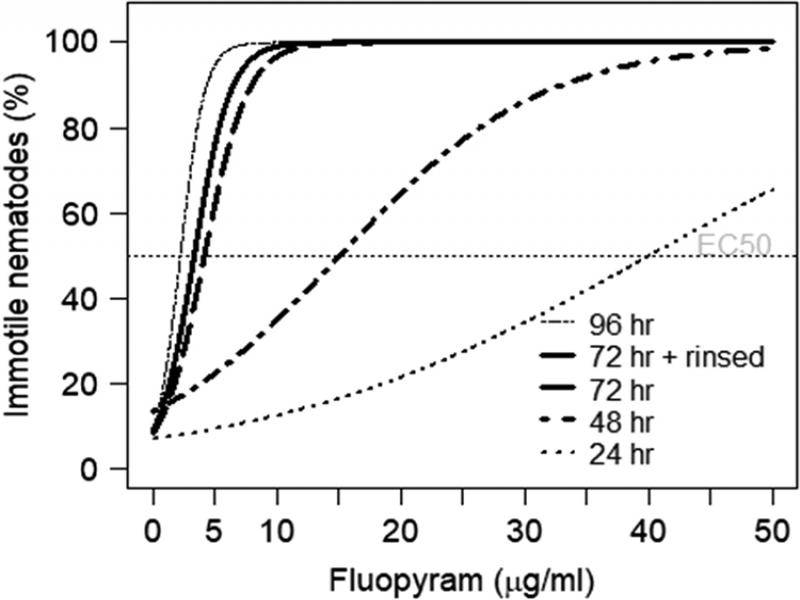
To evaluate the direct effect of fluopyram on Ditylenchus dipsaci, nematodes were incubated for 96 h at 22°C in water containing of 50, 30, 10, 5, 3, 2, 1, and 0 µg/ml of fluopyram. The experiment was conducted in six-well polystyrene plates with each well receiving 2.5 ml of a 2 × concentrated test solution and 2.5 ml of distilled water containing 1,000 D. dipsaci (Dutta et al., 2012). Each treatment was replicated three times, and the experiment was conducted four times. After exposure for 24, 48, 72, and 96 h, motile and immotile nematodes were counted using an optical microscope at 100 × magnification. Motile D. dipsaci were characterized by their serpentine shape, while immotile nematodes were straight with no visible movement. Additionally, after 72 h exposure to fluopyram, nematodes were washed with water over a 20 µm sieve, and after further 24 h incubation in water, the number of motile/immotile D. dipsaci was recorded to determine their recovery in motility (Faske and Hurd, 2015).
Effect of fluopyram under controlled conditions
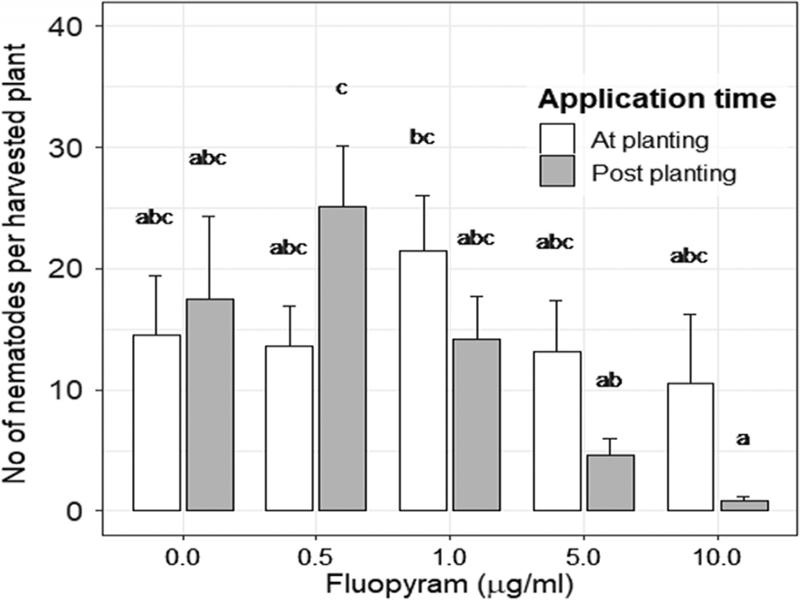
The impact of fluopyram on the penetration rate of D. dipsaci into sugar beet was investigated in a growth chamber. The treatments were two application methods, either at planting or post-planting (cotyledons horizontally unfolded, BBCH 10), and five concentrations (10, 5, 1, 0.5, and 0.0 µg/ml). The susceptible cultivar Dorena (KWS Saat SE, Germany) was sown into 3-cm-diameter plastic pots filled with 80 ml of soil. The soil was a loam that was steamed, passed through a 2 mm sieve, and mixed with sand (1/1,v/v). Each plastic pot contained one sugar beet seed sown 2 cm deep. Fluopyram was applied to the soil surface of the pots receiving the at-planting application. At 7 days post-planting (dpp), 1 ml fluopyram solution was applied 3 h before nematode inoculation to the sugar beet leaves and soil surface of the pots receiving the post-plant application. Because BBCH 11 (first pair of leaves visible, not yet unfolded) seedlings allow optimal staining of the nematodes in the plant, fluopyram was applied at BBCH 10 instead of BBCH 12 (two leaves unfolded), as done in the glasshouse and field experiments. At BBCH 10, approximately 200 nematodes per seedling were inoculated in 10 µl of 1% carboxymethylcellulose (w/v), which increases the adhesion of nematodes to the leaf-axils. The inoculation droplet was placed between the first pair of true leaves of the seedlings (Kühnhold et al., 2006). At 7 days post-inoculation (dpi), the seedlings were removed from the pots, gently washed, transferred to a 100-ml plastic beaker containing a 0.1% acid fuchsin/lactic acid solution and boiled twice in a microwave oven for 1 min. Stained seedlings were then rinsed to remove the staining solution. The total number of nematodes per seedling was counted using a stereomicroscope at 10 × magnification after maceration in 30 ml tap water using an Ultra Turrax blender (T25 basic, IKA Labortechnik, Germany). The experimental design was a factorial design arranged in randomized complete blocks, each treatment was replicated ten times, and the experiment was conducted twice. The experiment was conducted at 15°C with a 16-h photoperiod and covered with a transparent plastic foil to ensure 95% relative humidity.
The impact of fluopyram on the reproduction rate of D. dipsaci in sugar beet was investigated in a glasshouse. The treatments were two application methods, either at planting or post-planting (two leaves unfolded, BBCH 12), and four concentrations (5.0, 1.0, 0.5, and 0.0 µg/ml). The susceptible cultivar Dorena (KWS Saat SE, Germany) was sown in 1 L plastic pots filled with 800 ml soil. The soil was a loam that was steamed, passed through a 2 mm sieve, and mixed with sand (1/3, v/v). The aim to obtain well-developed roots motivated the higher rate of sand in the soil mixture compared to the experiment conducted in the growth chamber. Each plastic pot contained one sugar beet seed sown 2 cm deep. Fluopyram was applied to the soil surface of the pots receiving the at-planting application. At BBCH 10, approximately 200 nematodes per seedling were inoculated in 10 µl of 1% carboxymethylcellulose (w/v). The inoculation droplet was placed between the first pair of true leaves of the seedlings (Kühnhold et al., 2006). At BBCH 12, 1 ml fluopyram solution was applied to the sugar beet leaves and soil surface of the pots receiving the post-plant application. The experiment was started in a growth chamber at 15°C with a 16-h photoperiod and covered with a transparent plastic foil to ensure 95% relative humidity to ensure nematode infection. At 7 dpi, the plants were transferred for higher temperatures to a glasshouse at 20 ± 1°C with an 18-h photoperiod. At 50 dpi, the plants were removed from pots, washed, weighed, and cut in 0.5 cm pieces. Nematodes were extracted from the sliced plant material using Oostenbrinck dishes (European and Mediterranean Plant Protection Organization, 2013). The number of D. dipsaci per sugar beet plant was determined by counting 3 × 1 ml aliquots from 200 ml total volume using a stereomicroscope. The experimental design was a factorial design arranged in randomized complete blocks, each treatment was replicated 10 times, and the experiment was conducted twice.
Field experiments
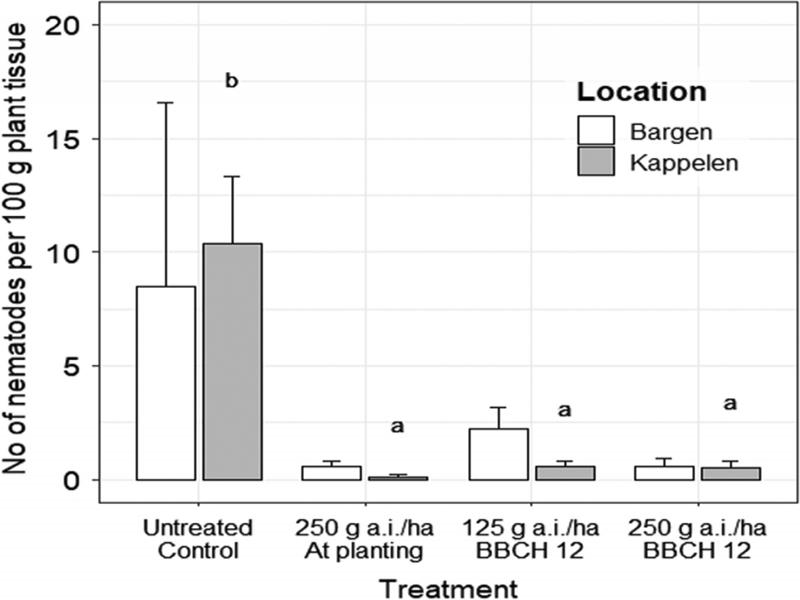
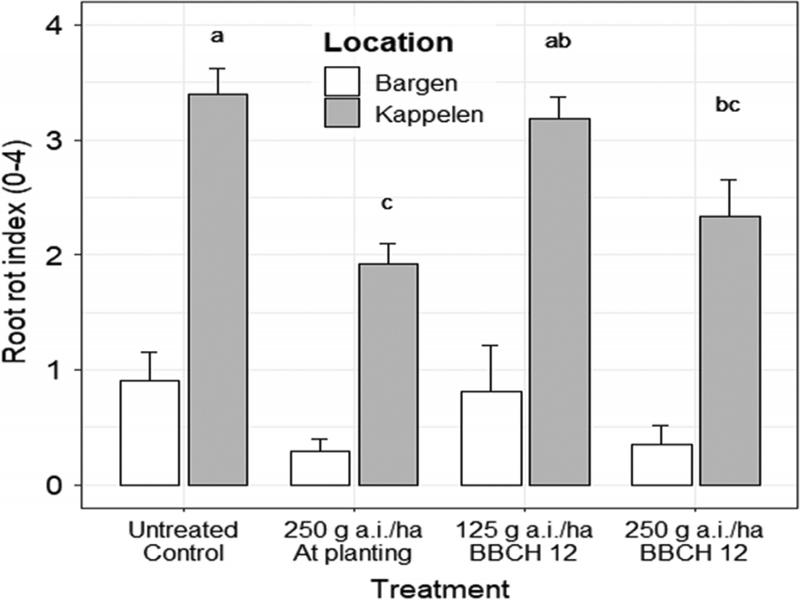
The field experiment, conducted in 2016, was set up as randomized complete block designs with four treatments: fluopyram applied in-furrow at planting at 250 g a.i./ha, in-band at BBCH 12 at either 125 or 250 g a.i./ha, and an untreated control. According to the Swiss standard, fluopyram was applied with 300 L/ha. The timing of the post-plant application (BBCH 12) was 28 dpp. The two widely used cultivars Samuela (KWS Saat SE, Germany) and Hannibal (Strube GmbH, Germany) were planted at two locations in Kappelen and Bargen, respectively. Both cultivars are similar in their susceptibility to D. dipsaci compared to the cultivar Dorena. Sugar-beet plant samples (10 plants/plot and sampling date) were randomly collected 27 and 62 dpp. Plants collected at 27 dpp were analyzed by staining with 0.1% acid fuchsin (see above), whereas the Oostenbrink dish technique was used to determine nematode numbers in plants collected 62 dpp.
Population densities of D. dipsaci (Pf/Pi) in these field sites were investigated by taking random soil samples seven days before planting and at harvest. In all, 10 subsamples/plot of harvested sugar beets were randomly collected, and the number of D. dipsaci in 100 g sugar beet hypocotyl tissue was determined by extraction using Oostenbrink dishes.
The effect of fluopyram on root-rot symptom development on sugar beets was determined by de-heading 20 beets/plot down to the crown surface and slicing them vertically until the bottom of the root. The percentage of root volume showing rot symptoms was determined using an index with 0 = no rot visible, 1 = ≤ 10% of rotten root, 2 = 11 to 33% of rotten root, 3 = 34 to 66% of rotten root, and 4 = 67 to 100% of rotten root.
In 2017, field experiments were repeated, but warm and dry conditions in spring were unfavorable to D. dipsaci development. Consequently, nematode populations were low and did not lead to any damage symptoms. Therefore, we did not use the data for the year 2017.
Statistical analysis
Data for nematode motility, infectivity (D. dipsaci/seedling), reproduction under glasshouse conditions (D. dipsaci/plant 50 dpi), soil populations (Pf/(Pi + 1)), reproduction in the field (D. dipsaci/100 g beet crown tissue), and root rot symptoms were tested for normality (Shapiro-Wilk normality test) and homogeneity of variances (Bartlette and Levene Test). Data obtained in the growth chamber and in the glasshouse were subjected to a two-way analysis of variance. The data from repeated experiments were pooled after confirming the absence of variation between the experiment replications. Data from field experiments were analyzed individually for each site and subjected to a Friedman test. Tukey multiple comparisons of means were performed as a post hoc test (Lenth, 2016). Statistical analysis, as well as graphs, were performed with R.
A logistic dose-response curve was used in the motility bioassay to describe the relationship between inactive D. dipsaci after 24, 48, 72, 96 h, and 72+rinse (y) and the concentration (x) of the active ingredient fluopyram (Hutchinson et al., 1999; Kiewnick and Sikora, 2006). The logistic curve can be expressed as follows:
(1)where c and d are the lower and upper limits of the curve, respectively. The EC50 is the concentration reducing the response (y) 50% between d and c, i.e., the point of inflection. The parameter b is the proportional slope of the curve around the point of inflection (Ritz and Streibig, 2005). The four-parameter logistic model (Equation (1)) was reduced to a three-parameter model:(2)where d is the upper limit of response (upper asymptote) (Ritz and Streibig, 2005; Kiewnick and Sikora, 2006). Curve fitting was performed by non-linear regression using the extension package drc in R (Ritz et al., 2015).Results
Effect of fluopyram on D. dipsaci motility
When exposed to fluopyram, the percentage of immotile D. dipsaci increased with exposure time and concentration (Fig. 1). After 24 h, only 58% of D. dipsaci were immotile at the maximum concentration of 50.0 µg/ml fluopyram, resulting in an EC50 value of 46.73 µg/ml (Table 1). After exposure for 48, 72, and 96 h to fluopyram, EC50 values were 9.32, 3.98, and 2.02 µg/ml, respectively. After 72 h, only concentrations of 30 and 50 µg/ml fluopyram resulted in 100% immotile D. dipsaci. However, after washing D. dipsaci free of fluopyram and further incubation in water for 24 h, no increase in motility was observed. The EC50 value for the 72 h + rinse was 3.00 µg/ml (Table 1). The percentage of immotile D. dipsaci continued to grow with the exposure time for each fluopyram concentration, except for 0 µg/ml. After a further 24 h incubation in water (72 h + rinse), the percentage of immotile D. dipsaci continued to grow compared to 72 h exposure to fluopyram. At 3.00 µg/ml a.i., the percentage of immotile nematodes was 40, 76, and 58% after exposure for 72 h, 96 h, and 72 h + rinse, respectively.
Table 1.
Estimated parameters for non-linear regression of the parameter inactive Ditylenchus dipsaci at different fluopyram exposure times (y) and concentrations (± SE).
| Parameter | ||||
|---|---|---|---|---|
| Exposure time (y) | b | EC50 (µg/ml)a | c | d |
| 24 h | −1.17 ± 0.65 | 46.73 ± 88.19 | 3.54 ± 3.19 | 108.50 ± 119.46 |
| 48 h | −1.68 ± 0.68 | 9.32 ± 2.27 | 5.11 ± 4.70 | 96.03 ± 12.80 |
| 72 h | −2.43 ± 0.48 | 3.98 ± 0.33 | 7.62 ± 3.52 | 101.52 ± 4.01 |
| 96 h | −2.27 ± 0.34 | 2.02 ± 0.16 | 5.56 ± 3.73 | 101.68 ± 3.23 |
| 72 h + rinsed | −2.11 ± 0.27 | 3.00 ± 0.22 | 4.98 ± 2.96 | 101.96 ± 3.53 |
| Fluopyram application | ||
|---|---|---|
| Fluopyram concentration (a.i.) | at planting | BBCH 12 |
| 0.0 (µg/ml) | 27,681 ± 34,208 | 12,344 ± 18,727 |
| 0.5 (µg/ml) | 16,782 ± 28,521 | 13,750 ± 22,242 |
| 1.0 (µg/ml) | 23,901 ± 37,066 | 8,596 ± 7,637 |
| 5.0 (µg/ml) | 20,315 ± 22,765 | 14,126 ± 22,566 |
| Treatment/site | Bargen | Kappelen |
|---|---|---|
| Untreated control | 4.4 ± 3.7 | 28.8 ± 11.3 |
| 125 g a.i./ha BBCH 12 | 4.6 ± 2.1 | 22.0 ± 6.8 |
| 250 g a.i./ha BBCH 12 | 4.4 ± 3.5 | 29.0 ± 9.9 |
| 250 g a.i./ha at planting | 1.0 ± 0.2 | 1.8 ± 1.7a** |
| ns |