Turmeric (Curcuma longa L.) is a highly valuable medicinal plant, widely used as a cooking spice or for various medicinal purposes. Studies on the nutritional value of turmeric have shown the presence of many useful compounds with numerous useful medicinal properties including anti-inflammatory, antidiabetic, hepatoprotective, neuroprotective, chemoprotective, anticancer, anti-allergic, and anti-dermatophytic effects (Salehi et al., 2019). In addition, many studies have reported the usefulness of turmeric in treating different ailments such as gastrointestinal diseases, biliary and hepatic disorders, diabetic wounds, rheumatism, inflammation, sinusitis, anorexia, coryza, and cough (Ammon et al., 1992; Nasri et al., 2014; Salehi et al., 2019). Thanks to these valuable properties, turmeric is widely cultivated in many regions in Vietnam, such as Lao Cai, Lang Son, Vinh Phuc, Hung Yen, Nghe An, and the Central Highlands, where it represents a crop of high economic significance to farmers. In order to achieve a sustainable development of turmeric in these regions, it is vital that comprehensive plant-pathogen management strategies can be formulated and put into practice, including the management of plant-parasitic nematodes (Sikora et al., 2018). A number of nematode species have been reported associated with turmeric world-wide (Sikora et al., 2018; CABI, 2019), and Meloidogyne incognita and Rotylenchus reniformis in particular are known to be widely distributed and to cause significant damage to turmeric crops (Mani et al., 1987; Routaray et al., 1987; Haider et al., 1998). To the best of our knowledge, studies of pathogens associated with turmeric in Vietnam is very limited, especially for plant-parasitic nematodes. The reports of M. incognita and M. javanica in Vietnamese turmeric are the only studies that can be found on the subject (Vu et al., 2018; Le, 2019). It is therefore vital to implement further study on plant-parasitic nematodes in Vietnam using an integrated approach, and to evaluate their damage potential to turmeric crops in order to provide a basis for pest management strategies.
Material and methods
Soil samples were collected following a grid pattern method from a turmeric growing area in the Central Highlands of Vietnam. At 10 sampling sites a visual inspection of plant symptoms was combined with the collection of four samples around a clump of turmeric, after removing the detritus layer to create a bulk sample (collection of 40 soil samples using a core (5 × 25 cm) resulted in 10 bulk samples). Percentage of yellowing leaves, dry rot rhizomes, and rhizome weight for each clump of turmeric were recorded (Coyne et al., 2018). Permanent slides of nematodes were made following Nguyen et al. (2019a). Morphological identification was done based on Robinson et al. (1997) and Dasgupta et al. (2011). For molecular identification, D2-D3 regions of 28 S rDNA and COI mtDNA sequences were amplified and analyzed following Nguyen et al. (2019b). The correlations between the density of R. reniformis and any plant damage (yellowing leaves and dry rot rhizome), as well as rhizome weight over all sampling sites was analyzed using SPSS version 25 after checking data assumptions (IBM Corp, 2017).
Results and discussion
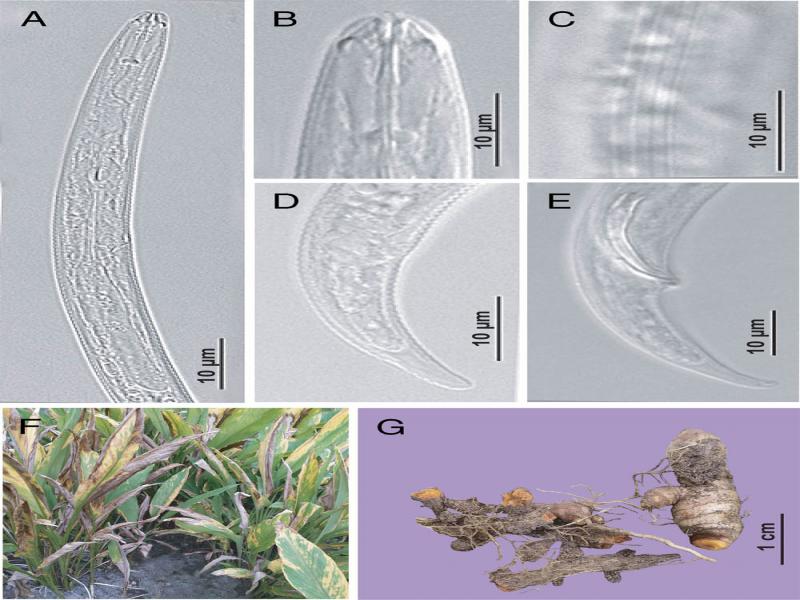
The inspection of soil samples from the turmeric growing area revealed a high frequency of R. reniformis (90%) at a relatively high density (up to 480 nematodes/100 ml of soil). Morphological characterizations of R. reniformis in this study are in agreement with the description of R. reniformis by Robinson et al. (1997) and Dasgupta et al. (2011), including body length of immature females (409 ± 21 (380−430) µm), stylet length (16.5 ± 0.8 (15−17) µm), vulva position (71 ± 2 (69−74)%), and presence of males. The D2-D3 of 28 S rDNA (accession number: MT225542) and COI mtDNA (accession number: MT232760, MT232761) sequences of our population were respectively 99.5 and 100% similar to the most closely-related D2-D3 of 28 S rDNA sequences (accession number: KT003743-KT003745, HM131858) and COI mtDNA sequences (accession number: MK908054, MK908055, LC348942−LC348948, KT003730) of R. reniformis from GenBank.
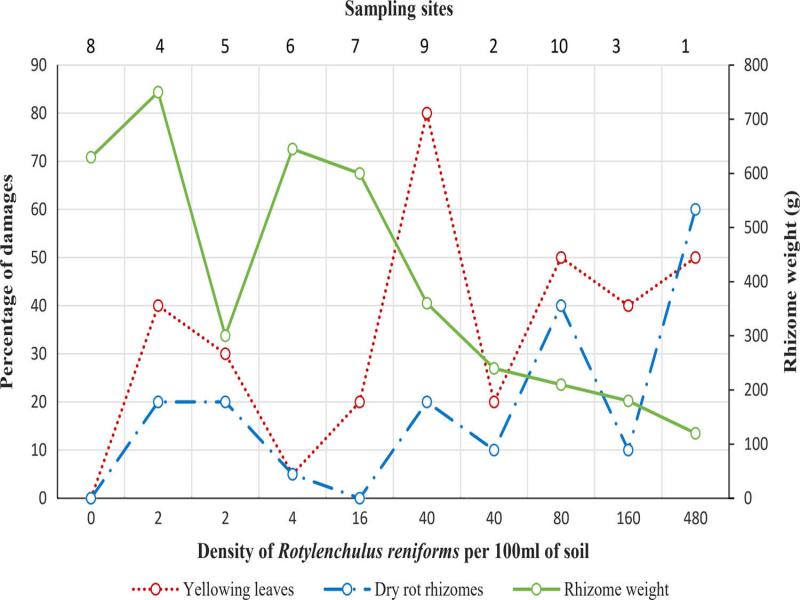
A strong correlation between the density of R. reniformis and rhizome weight was found (RS = −0.841, Spearman correlation test, significance level = 0.002). The relation of nematode density and damage (yellowing leaves and dry rot rhizome) appeared to be more fluctuating (Figure 1). However, a highly significant correlation between the density of R. reniformis and the amount of plant damage (yellowing leaves and dry rot rhizomes) was found (RS = 0.64, Spearman correlation test, significance level = 0.046 and R = 0.781, Pearson correlation test, significance level = 0.008, respectively) (Table 1).
Table 1.
Correlation coefficient between the density of R. reniformis, the percentage of yellowing leaves, dry rot rhizomes, and rhizome weight.
| Correlations | R. reniformis | Yellowing leaves | Dry rot rhizome |
|---|---|---|---|
| Yellowing leaves | |||
| Pearson (RP) | 0.355 | ||
| Spearman (RS) | 0.640* | ||
| Dry rot rhizome | |||
| Pearson (RP) | 0.781** | 0.601 | |
| Spearman (RS) | 0.506 | 0.838** | |
| Rhizome weight | |||
| Pearson (RP) | −0.623 | −0.480 | −0.600 |
| Spearman (RS) | −0.841** | −0.502 | −0.519 |