The members of the superfamily Aphelenchoidea (Fuchs, 1937) are known to be typologically similar, primarily characterized by having a well-developed metacorpus, and some other shared characters discussed by Kanzaki and Giblin-Davis (2012), with exceptions such as the smaller metacorpus does rarely occur (Pedram et al., 2018). A wide range of feeding habit including mycetophagy, predatory, plant feeding, and insect parasitism is seen inside the superfamily (Hunt, 1993; Kanzaki and Giblin-Davis, 2012).
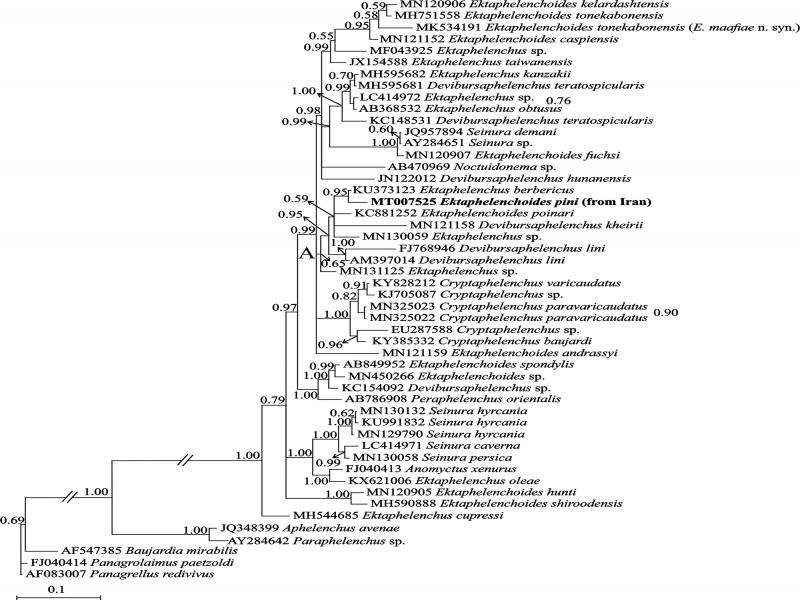
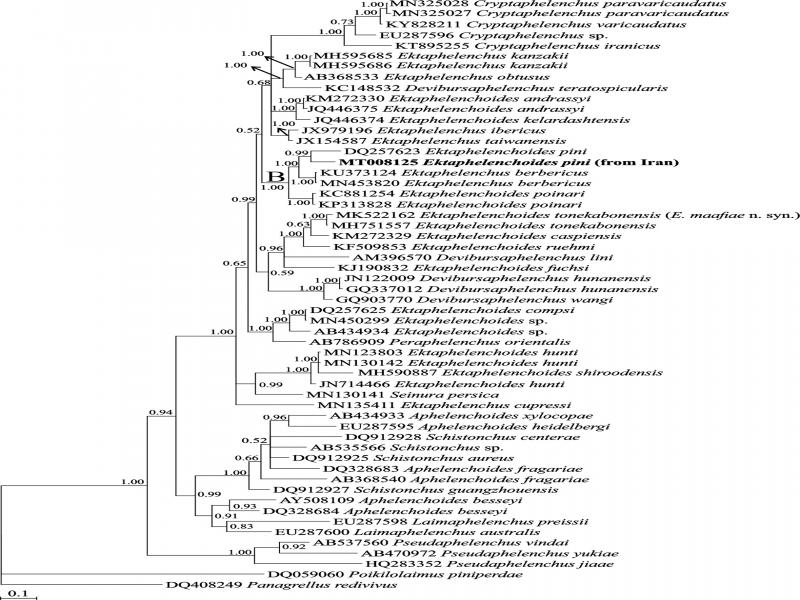
The biology and morphology of Ektaphelenchinae (Paramonov, 1964) members are already discussed (Hunt, 1993; Kanzaki and Giblin-Davis, 2012). Phylogenetically, the subfamily is not monophyletic, but the genus Cryptaphelenchus (Fuchs, 1937) seems to be monophyletic after available data (e.g. Pedram, 2019). The genus Ektaphelenchoides was erected by Baujard (1984), with E. pini (Massey, 1966; Baujard, 1984) as its type species. A compendium of the known species of the genus was given by Aliramaji et al. (2014). Since then, six further species were added to the genus (Esmaeili et al., 2014, 2018; Aliramaji et al., 2015, 2019a, 2019b; Golhasan et al., 2019), and it currently contains 18 species (http://www.organismnames.com). Following our recent studies on occurrence of aphelenchoidids (e.g. Aliramaji et al., 2018, 2020), and especially ektaphelenchid genera and species in Iran, a population of Ektaphelenchoides was recovered in natural forests in north of Iran. The spicules characters and the general morphology of the adults corroborated it belongs to the type species of the genus, E. pini. Thus, the aims of the present study were to characterize Iranian population of this species from Iran and discuss its morphological differences/similarities compared to available data and discuss its phylogenetic affinities. Furthermore, new taxonomic and morphological findings related with some other species of the genus are presented and discussed.
Materials and methods
Nematode extraction and morphological observations
Wood and bark samples (48 in total) were collected from natural forests of Golestan province in north of Iran, during 2019. The nematodes were extracted from the samples using the tray method (Whitehead and Hemming, 1965), handpicked under a Nikon stereomicroscope model SMZ1000, heat killed by adding boiling 4% formalin solution, transferred to anhydrous glycerin according to De Grisse (1969) and mounted on permanent slides. The slides were then studied and the nematodes were measured under a Nikon Eclipse E600 light microscope. Photographs were taken using an Olympus DP72 digital camera attached to an Olympus BX51 microscope equipped with differential interference contrast (DIC). The paratype specimens and the original descriptions of some previously described species of the genus were also studied in detail to amend their characterization or propose new taxonomic placements.
DNA extraction, PCR, and sequencing
To prepare DNA samples, a single live nematode specimen of the recovered species was picked out, examined on a temporary slide and transferred to a small drop of TE buffer (10 mMTris-Cl, 0.5 mM EDTA, pH 9.0; Qiagen) on a clean slide and crushed using a cover slip. The suspension was collected by adding 20 μl TE buffer. The DNA sample was stored at −20°C until used as PCR template (two separate females were used for this purpose, and two DNA samples were prepared). The SSU rDNA was amplified using the forward primer F22 (5´-TCCAAGGAAGGCAGCAGGC-3´) (Dorris et al., 2002) and reverse primer 18S 1573R (5´-TACAAAGGGCAGGGACGTAAT-3´) (Mullin et al., 2005) (the several primers designed to amplify this fragment, e.g. two pairs designed by Holterman et al., 2006 did not yield on high-quality amplifications, or yield on no amplifications). The D2–D3 expansion segments of LSU rDNA were amplified using the forward D2A (5´-ACAAGTACCGTGAGGGAAAGT-3´) (Nunn, 1992) and reverse primer 1006R (5´-GTTCGATTAGTCTTTCGCCCCT-3´) (Holterman et al., 2008). The ITS1 region was amplified using the forward primer rDNA1 (5´-TTGATTACGTCCCTGCCCTTT-3´) and reverse primer rDNA1.58S (5´-ACGAGCCGAGTGATCCACCG-3´) (Subbotin et al., 2000). The polymerase chain reaction (PCR) cycles and sequencing of amplified fragments were according to Heydari et al. (2020). The newly obtained sequences of the species were deposited into GenBank database (accession number MT007525 for partial SSU and MT008125 for partial LSU rDAN D2-D3).
Alignment and phylogenetic inference
For phylogenetic studies, two separate SSU and LSU datasets were prepared. Several available ektaphelenchid and seinurid species were included in both datasets. The SSU dataset included 50 sequences and the LSU dataset totaled 56 sequences (including newly generated sequences and sequences of the outgroup taxa), their accession numbers being given in the SSU and LSU phylogenetic trees. Each dataset was aligned using the QINS-i algorithm of online version of MAFFT version 7 (http://mafft.cbrc.jp/alignment/server/) (Katoh and Standley, 2013). The Gblocks program (version 0.91b) with all the three less stringent parameters, a server tool at the Castresana Lab (http://molevol.cmima.csic.es/castresana/Gblocks_server.html) was used for post-editing of the alignments, i.e., to eliminate poorly aligned regions or divergent positions. The Akaike-supported model, a general time reversible model, including among-site rate heterogeneity and estimates of invariant sites (GTR + G + I), was used in both phylogenies. The Bayesian analyses were performed using MrBayes v3.1.2 (Ronquist and Huelsenbeck, 2003) with a random starting tree, running the chains for 4 × 10⁶ generations. After discarding burn-in samples and evaluating convergence, the remaining samples were retained for further analyses. The Markov chain Monte Carlo (MCMC) method within a Bayesian framework was used to estimate the posterior probabilities of the phylogenetic trees (Larget and Simon, 1999) using the 50% majority rule. The convergence of model parameters and topology was assessed based on the average standard deviation of split frequencies and potential scale reduction factor values. Adequacy of the posterior sample size was evaluated using autocorrelation statistics, as implemented in Tracer v.1.6 (Rambaut and Drummond, 2009). The output files of the phylogenetic programs were visualized using Dendroscope V.3.2.8 (Huson and Scornavacca, 2012) and both SSU and LSU Bayesian trees were redrawn in CorelDRAW software version 17.
Results
Systematics
Iranian population of Ektaphelenchoides pini (Massey, 1966; Baujard, 1984) is shown in Figure 1.
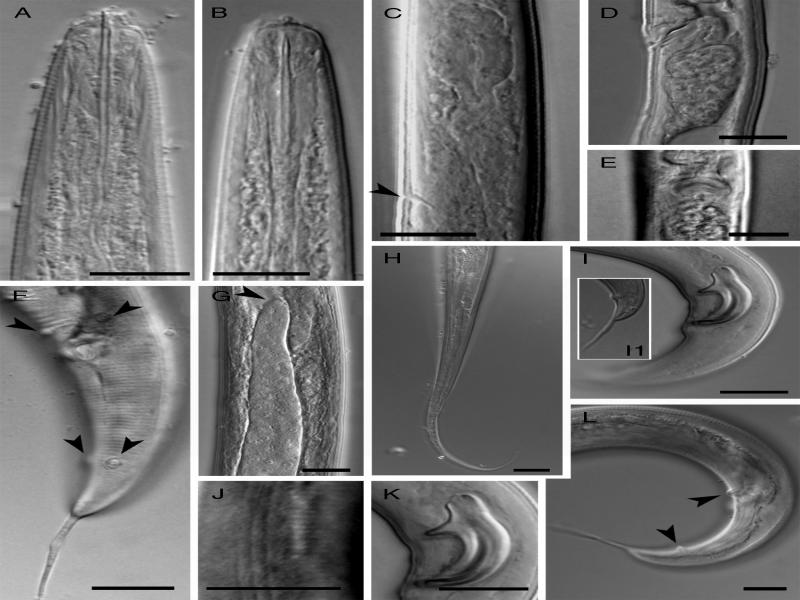
Figure 1:
Iranian population of Ektaphelenchoides pini (Massey, 1966; Baujard, 1984). A: Anterior body region of male; B: Anterior body region of female; C: Metacorpus and the position of E pore (arrow) (male); D: Vulval region and PUS; E: Vulval slit in ventral view; F: Ventro-lateral view of male caudal region showing P2 (upper arrows) and P3 (lower arrows) papillae; G: Tip of ovary; H: Female posterior body region; I: Male cloacal region and spicule and tail tip (I1); J: Lateral lines; K: Spicule (close up), L: Male posterior body region showing P2 (upper arrow) and P3 (lower arrow) and single ventral P1 lacking. (Scale bars = 10 µm).
Measurements
Measurements of this population are given in Table 1.
Table 1.
Morphometrics of Ektaphelenchoides pini (Massey, 1966; Baujard, 1984) from Golestan province, Iran, and comparison with data of the type population and the population from France.
| This study | Type population, studied by Baujard (1984) | French population (Baujard, 1984) | ||||
|---|---|---|---|---|---|---|
| Character | Females | Males | Female | Males | Females | Males |
| n | 14 | 9 | 1 | 10 | 40 | 5 |
| L | 829.4 ± 70.2 | 611.8 ± 59.6 | 720 | 840 | 740 | 750 |
| (756–947) | (502–701) | (730–980) | (630–950) | (680–820) | ||
| a | 37.4 ± 3.1 | 38.8 ± 3.2 | 33 | 32.5 | 33 | 33 |
| (30.0–37.7) | (33.8–39.6) | (28–38) | (31–36) | (31–36) | ||
| b | 7.2 ± 0.8 | 6.7 ± 0.7 | 9 | 8 | 8 | 8 |
| (6.03–8.2) | 4.3 ± 0.8 | (7–9) | (7–11) | (7–9) | ||
| b´ | 4.7 ± 0.5 | (3.3–5.8) | – | – | – | – |
| (4–5.6) | 13.9 ± 1.1 | |||||
| c | – | (12.5–15.8) | – | 14 | – | 14 |
| 2.9 ± 0.2 | (13–17) | (12.5–118.0) | ||||
| c´ | – | 2.9 ± 0.2 | – | 2.9 | – | 3.1 |
| (2.7–3.1) | (2.6–3.0) | (2.2–3.6) | ||||
| T or V | 69.4 ± 2.0 | 90.6 ± 1.9 | 74 | – | 70 | – |
| (70.2–72.3) | (87.0–88.6) | (67–74) | ||||
| Cephalic region height | 3.6 ± 0.4 | 3.0 ± 0.4 | – | – | – | – |
| (3.0-4.3) | (2.4-3.7) | |||||
| Cephalic region width | 8.2 ± 0.5 | 7.4 ± 0.6 | – | – | – | – |
| (7.4–8.8) | (6.4–8.5) | |||||
| Stylet | 20.9 ± 1.1 | 18.7 ± 1.0 | 23 | 24 | 23 | 23 |
| (20–23) | (17.3–19.8) | (21–26) | (20–26) | (22–24) | ||
| Max. body dim. | 22.4 ± 2.2 | 15.8 ± 1.2 | – | – | – | – |
| (20–26) | (14–18) | |||||
| m | 40.4 ± 5.0 | 44.4 ± 4.9 | – | – | – | – |
| (32.5–44.0) | (36.6–47.4) | |||||
| Body width at MB | 17.1 ± 1.4 | 15.0 ± 1.2 | – | – | – | – |
| (16–20) | (13–17) | |||||
| E pore from anterior | 97.5 ± 5.4 | 99.2 ± 8.3 | 104 | 119 | 105 | |
| end | (92–106) | (91.2–108.1) | (101–132) | (94–123) | ||
| Nerve ring from | 100.5 ± 7.5 | 85.8 ± 14.2 | – | – | – | – |
| anterior end | (87–97) | (71–110) | ||||
| Median bulb width | 11.1 ± 1.4 | 9.9 ± 1.5 | – | – | – | – |
| (10–14) | (8–12) | |||||
| Median bulb length | 20.7 ± 2.7 | 18.3 ± 2.3 | – | – | – | – |
| (17–25) | (16–22) | |||||
| Median bulb length/ | 1.9 ± 0.2 | 1.8± 0.1 | – | – | – | – |
| diam. ratio | (1.5–2.2) | (1.7–2.0) | ||||
| Ovary/testis length | 360.5 ± 34.7 | 197.8± 6.6 | – | – | – | – |
| (310–420) | (184–201) | |||||
| Hemizonid from | 98 ± 3 | 104.4 ± 7.9 | – | – | 109 | – |
| anterior end | (92–105) | (93–109) | (97–115) | |||
| Vulval body diam. | 22.3 ± 3.1 | – | – | – | – | – |
| (17–28) | ||||||
| PUS length | 27.6 ± 3.3 | – | – | – | ? | – |
| (23–33) | ||||||
| Anal/cloacal body | – | 15.1 ± 1.5 | – | – | – | – |
| diam. | (13–18) | |||||
| Tail | – | 44.0 ± 3.1 | – | – | – | 53 |
| (40–49) | (38–61) | |||||
| Spicules arc line | – | 20.6 ± 1.0 | 25.5 | 24 | ||
| length | (19–22) | (22–28) | (21–26) | |||
| Capitulum width | – | 5.6 ± 0.5 | – | – | – | – |
| (5-6) | ||||||