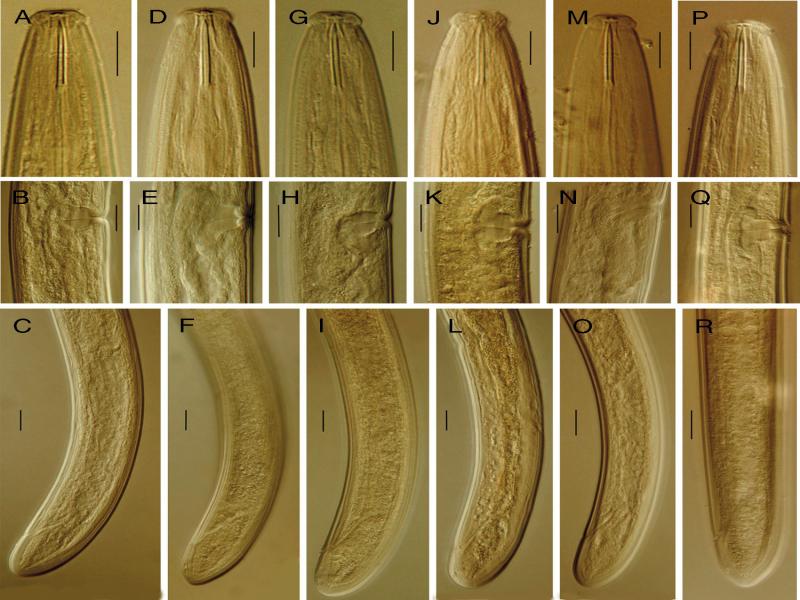
The genus Pungentus is an interesting dorylaimid genus, often found in forest habitats of the Northern Hemisphere, and with very restricted presence in southern territories. Its taxonomy was updated by Álvarez-Ortega and Peña-Santiago (2014), who listed 16 valid species and other four inquirendae or incertae sedis and provided a key to their identification as well a compendium of their main morphometrics.
Available information about Pungentus species from Iran is very limited. Solouki et al. (2010) recorded P. engadinensis (Altherr, 1950) Altherr, 1952 and P. silvestris (de Man, 1912) Coomans and Geraert (1962) in [Uremia (West Azarbaijan) and Marand (East Azarbaijan) provinces, respectively], whereas, very recently, Heydari et al. (2019) described a new species, P. azarbaijanensis, associated with grass in West Azarbaijan, and P. engadinensis in several locations of the country.
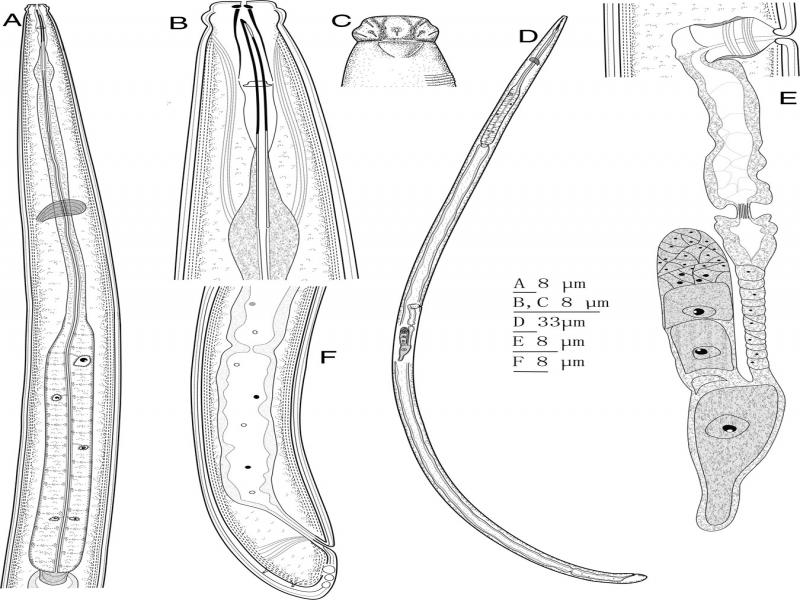
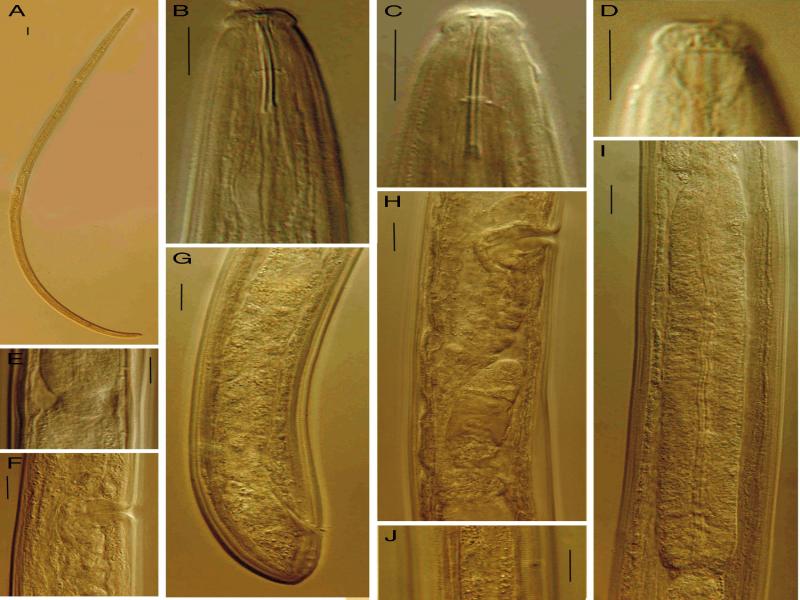
Several Pungentus populations were collected in the course of a nematological survey conducted in natural and cultivated soils of northwest Iran (East–West Azarbaijan and Kurdistan provinces) to explore the dorylaimid diversity of this region. Their study revealed that they belonged to one new and one known species. The objective of this work was to report Pungentus sufiyanensis n. sp. using morphology, morphometric, and molecular methods and provide new data about P. engadinensis.
Materials and methods
Extraction and processing of nematodes
Soil samples were collected from the rhizosphere of several crops and orchards of East–West Azarbaijan and Kurdistan provinces, northwest Iran, during the period 2010–2017. Nematodes were extracted following the protocols by Jenkins (1964) and Whitehead and Heming (1965), transferred to anhydrous glycerin according to De Grisse (1969), and mounted on glass slides for handling.
Light microscopy
Mounted specimens were observed under an Olympus BX 41 light microscope equipped with a drawing tube and a DP50 digital camera attached to it. Morphometrics include Demanian indices and the usual measurements and ratios. Line illustrations were prepared using CorelDRAW® software version 12. Microphotographs were edited using Adobe® Photoshop® CS software.
DNA extraction, PCR and sequencing
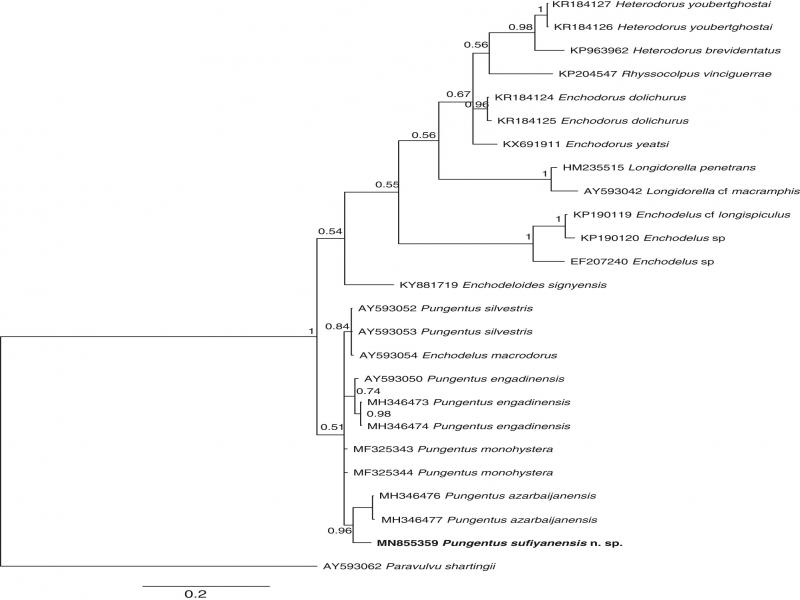
For the molecular study of the new species, DNA samples were extracted from a live adult nematode, hand-picked, and placed on a clean slide containing a drop of distilled water or worm lysis buffer (WLB) and crushed by a sterilized scalpel. Then, the suspension was transferred to an Eppendorf tube containing 25.65 μl ddH2O, 2.85 μl 10 × PCR buffer and 1.5 μl proteinase K (600 μg/ml) (Promega, Benelux, the Netherlands). The tubes were incubated at −80°C (1 h), 65°C (1 h) and 95°C (15 min). The extracted DNA was stored at −20°C until use. The D2-D3 domains of the 28S rDNA were amplified with forward primer D2A (5´-ACAAGTACCGTGAGGGAAAGTTG-3´) and reverse primer D3B (5´-TCGGAAGGAACCAGCTACTA-3´) (Nunn, 1992). In total, 25 μl PCR reaction mixture was prepared constituting of 10 μl ddH2O, 12.5 μl master mix (Ampliqon, Denmark), 0.75 μl of each forward and reverse primers, and 1 μl of DNA template. PCR was carried out using a BIO RAD thermocycler machine in accordance with Archidona-Yuste et al. (2016). PCR cycle conditions were as follows: denaturation at 94°C for 2 min, 35 cycles of denaturation at 94°C for 30 s, annealing of primers at 55°C for 45 s and extension at 72°C for 3 min followed by a final elongation step at 72°C for 10 min. The purified PCR products were sent for sequencing to Bioneer Company, South Korea. The newly obtained sequences of P. sufiyanensis n. sp. were deposited in the GenBank database under accession number MN855359 as indicated on the phylogenetic tree of Table 2.
Table 1.
Morphometric data for Pungentus sufiyanensis n. sp.
| Sufiyan population | ||||||
|---|---|---|---|---|---|---|
| Locality | Female | Bokan population | Marand population | |||
| Characters | Holotype | Paratypes | Female | Female | ||
| n | – | 7 | 8 | 2 | ||
| L | 1.49 | 1.53 ± 0.08 | 1.41 ± 0.09 | 1.27 ± 0.07 | ||
| (1.40–1.57) | (1.33–1.54) | (1.22–1.33) | ||||
| a | 45 | 42.0 ± 3.3 | 47.0 ± 2.8 | 46.0 ± 2.3 | ||
| (40.0–47.0) | (42.0–50.0) | (43.0–49.0) | ||||
| b | 4.4 | 4.5 ± 0.1 | 4.4 ± 0.3 | 3.9 ± 0.7 | ||
| (4.3–4.8) | (4.0–5.0) | (3.9–4.0) | ||||
| c | 68 | 75.0 ± 6.1 | 70.0 ± 4.7 | 68.0 ± 1.4 | ||
| (65.0–84.0) | (66.0–75.0) | (67.0–70.0) | ||||
| c´ | 1 | 0.8 ± 0.01 | 0.9 ± 0.07 | 0.9 ± 0.01 | ||
| (0.7–1.0) | (0.8–1.0) | (0.8–1.0) | ||||
| V | 50 | 49.0 ± 1.0 | 49.0 ± 1.0 | 51.0 ± 2.3 | ||
| (47.0–50.0) | (48.0–51.0) | (49.0–54.0) | ||||
| Lip region diam. | 8 | 8.4 ± 0.3 | 8.2 ± 0.6 | 8.0 ± 0.5 | ||
| (8.0–9.0) | (7.5–9.0) | (7.0–9.0) | ||||
| Odontostyle length | 20 | 19.0 ± 0.7 | 19.0 ± 1.4 | 20.0 ± 0.4 | ||
| (18.0–20.0) | (18.0–20.5) | (19.0–21.0) | ||||
| Odontophore length | 18 | 17.0 ± 0.8 | 16.5 ± 0.2 | 17.0 ± 1.8 | ||
| (15.0–18.0) | (16.0–17.0) | (16.0–19.0) | ||||
| Guiding ring from ant. end | 13 | 13.0 ± 0.5 | 13.5 ± 0.0 | 14.0 ± 0.0 | ||
| (12.0–14.0) | (13.5) | (14.0) | ||||
| Neck length | 325 | 335 ± 7 | 340 ± 15 | 315 ± 10 | ||
| (325–348) | (304–356) | (309–328) | ||||
| Phar. expansion length | 148 | 150.0 ± 2.8 | 149.0 ± 5.2 | 138.0 ± 4.7 | ||
| (147.0–155.0) | (138.0–161.0) | (133.0–144.0) | ||||
| Body diam. at neck base | 30 | 33.0 ± 1.9 | 29.0 ± 1.8 | 26.0 ± 0.0 | ||
| mid-body anus | (30.0–38.0) | (27.0–31.0) | (26.0) | |||
| 32 | 35.0 ± 1.6 | 29.0 ± 0.4 | 27.5 ± 0.3 | |||
| (32.0–38.0) | (28.0–30.0) | (27.0–28.0) | ||||
| 20 | 23.0 ± 2.6 | 19.5 ± 1.1 | 20.0 ± 0.6 | |||
| (20.0–26.0) | (18.0–21.0) | (19.0–21.0) | ||||
| Prerectum length | 75 | 71 ± 11 | 67.0 ± 3.1 | 83.0 ± 2.0 | ||
| (57–90) | (62.0–73.0) | (82.0–85.0) | ||||
| Rectum length | 18 | 19.0 ± 1.8 | 20.0 ± 1.2 | 20.5 ± 0.4 | ||
| (18.0–23.0) | (19.0–22.0) | (20.0–21.0) | ||||
| Tail length | 21 | 20.0 ± 1.8 | 19.0 ± 2.0 | 18.5 ± 0.2 | ||
| (18.0–23.0) | (17.5–23.0) | (18.0–19.0) | ||||
| Species | Locality | Host-plant | Accession number | |||
|---|---|---|---|---|---|---|
| Enchodelus cf longispiculus | Gorgan province, Iran | – | KP190119 | |||
| Enchodelus sp | Hamedan province, Iran | – | KP190120 | |||
| Enchodelus sp | – | – | EF207240 | |||
| Enchodelus macrodorus | – | – | AY593054 | |||
| Enchodeloides signyensis | KY881719 | |||||
| Enchodorus dolichurus | – | – | KR184124 | |||
| Enchodorus dolichurus | – | – | KR184125 | |||
| Enchodorus yeatsi | Andimeshk, Khuzestan province, Iran | Mosses in a natural region | KX691911 | |||
| Heterodorus youbertghostai | Sabalan mountains, Iran | Grasslands | KR184127 | |||
| Heterodorus youbertghostai | Arasbaran forests, Kaleybar, East-Azarbayjan province, Iran | Grasses | KR184126 | |||
| Heterodorus brevidentatus | Kerman, Iran | – | KP963962 | |||
| Longidorella penetrans | – | – | HM235515 | |||
| Longidorella cf macramphis | – | – | AY593042 | |||
| Paravulvus hartingii | – | – | AY593062 | |||
| Pungentus silvestris | – | – | AY593052 | |||
| Pungentus silvestris | – | – | AY593053 | |||
| Pungentus engadinensis | – | – | AY593050 | |||
| Pungentus engadinensis | Damghan, Semnan province, Iran | Fruit trees | MH346473 | |||
| Pungentus engadinensis | Noshahr, Mazandaran province, Iran | Forest trees | MH346474 | |||
| Pungentus monohystera | Germany | Sediment | MF325343 | |||
| Pungentus monohystera | Germany | Sediment | MF325344 | |||
| Pungentus azarbaijanensis | West-Azarbaijan province, Iran | Grasses | MH346476 | |||
| Pungentus azarbaijanensis | West-Azarbaijan province, Iran | Grasses | MH346477 | |||
| Pungentus sufiyanensis n. sp. | Sufiyan, East-Azarbaijan province, Iran | Black cherry trees (Prunus cerasus L.) | MN855359 | |||
| Rhyssocolpus vinciguerrae | Astara forests, north-western Iran | Forest trees | KP204547 |
| Locality | Urmia population | Divandarreh population | Bokan population | Maragheh population | Sufiyan population | Basmenj population |
|---|---|---|---|---|---|---|
| Characters | Female | Female | Female | Female | Female | Female |
| n | 5 | 6 | 7 | 7 | 5 | 6 |
| L | 0.90 ± 0.06 | 1.10 ± 0.01 | 0.99 ± 0.07 | 1.00 ± 0.05 | 0.95 ± 0.03 | 0.99 ± 0.03 |
| (0.83–1.00) | (0.91–1.22) | (0.90–1.10) | (0.90–1.10) | (0.90–0.99) | (0.96–1.06) | |
| a | 39.0 ± 2.4 | 40.5 ± 0.5 | 39.0 ± 2.3 | 35.5 ± 1.4 | 38.0 ± 1.9 | 34.8 ± 2.0 |
| (36.5–42.0) | (36.5–50.5) | (34.5–41.5) | (34.0–37.0) | (36.0–41.0) | (35.0–37.0) | |
| b | 3.7 ± 0.2 | 4.0 ± 0.6 | 3.9 ± 0.2 | 4.0 ± 0.2 | 4.0 ± 0.1 | 3.8 ± 0.2 |
| (3.5–4.5) | (3.8–5.0) | (3.5–4.0) | (4.0–4.5) | (3.9–4.2) | (3.5–4.2) | |
| c | 47.0 ± 4.6 | 60.5 ± 5.5 | 52.0 ± 0.5 | 60.5 ± 6.4 | 54.0 ± 3.4 | 58.6 ± 7.7 |
| (42.0–52.5) | (55.0–68.0) | (44.5–59.0) | (52.0–72.0) | (50.0–59.0) | (46.0–68.0) | |
| c´ | 1.1 ± 0.08 | 0.9 ± 0.09 | 1.0 ± 0.01 | 0.0 ± 0.06 | 0.94 ± 0.05 | 0.81 ± 0.07 |
| (1.0–1.2) | (0.7–1.1) | (0.9–1.1) | (0.8–0.9) | (0.9–1.0) | (0.7–0.9) | |
| V | 48.0 ± 2.5 | 45.5 ± 0.8 | 46.0 ± 1.4 | 46.0 ± 1.3 | 47.0 ± 1.6 | 44.3 ± 3.2 |
| (44.0–52.0) | (44.5–47.0) | (44.0–48.0) | (44.0–47.0) | (45.0–49.0) | (41.0–49.0) | |
| Lip region diam. | 8.3 ± 0.5 | 10.6 ± 0.2 | 10.0 ± 0.6 | 10.0 ± 0.5 | 8.6 ± 0.4 | 8.8 ± 0.4 |
| (8.0–9.0) | (10.0–11.0) | (8.0–11.0) | (9.0–11.0) | (8.0–9.0) | (8.0–9.0) | |
| Odontostyle length | 15.0 ± 0.5 | 18.0 ± 0.5 | 15.3 ± 0.1 | 17.5 ± 0.2 | 16.0 ± 0.0 | 15.9 ± 0.9 |
| (14.5–16.0) | (17.5–18.5) | (14.0–17.0) | (16.0–18.0) | (16.0) | (15–17.5) | |
| Odontophore length | 19.5 ± 0.6 | 15.6 ± 2.1 | 16.6 ± 1.8 | 20.8 ± 1.3 | 14.2 ± 0.6 | 19.6 ± 0.9 |
| (19.0–20.5) | (13.0–18.5) | (14.1–19.3) | (19.0–22.0) | (13.0–15.0) | (17.0–21.0) | |
| Guiding ring from ant. end | 10.3 ± 0.5 | 11.2 ± 0.4 | 10.6 ± 0.8 | 10.3 ± 0.4 | 10.2 ± 0.4 | 11.3 ± 0.4 |
| (10.0–11.4) | (11.0–12.0) | (9.0–12.0) | (10.0–11.0) | (9.0–11.0) | (9.6–12.0) | |
| Neck length | 238 ± 13 | 265 ± 14 | 259 ± 21 | 302 ± 13 | 236 ± 11 | 254 ± 10 |
| (223–255) | (233–295) | (228–293) | (228–329) | (219–248) | (243–266) | |
| Phar. expansion length | 91.2 ± 8.3 | 104.2 ± 3.1 | 89.6 ± 9.7 | 108.2 ± 4.4 | 96.0 ± 9.1 | 101.0 ± 5.2 |
| (84.0–105.0) | (102.0–108.0) | (81.0–106.0) | (101.0–116.0) | (85.0–108.0) | (95.0–109.0) | |
| Body diam. at neck base | 26.2 ± 0.4 | 29.6 ± 2.7 | 22.2 ± 1.5 | 26.0 ± 0.7 | 23.0 ± 0.7 | 26.0 ± 0.9 |
| (25.0–27.0) | (25.0–34.0) | (21.0–24.1) | (25.0–27.0) | (22.0–24.0) | (25.0–27.0) | |
| mid-body | 27.4 ± 0.3 | 32.2 ± 2.0 | 23.3 ± 0.8 | 28.3 ± 0.4 | 24.8 ± 0.1 | 28.2 ± 1.3 |
| (27.0–28.2) | (28.0–37.0) | (22.0–25.0) | (27.0–29.1) | (24.0–25.0) | (27.0–30.0) | |
| anus | 18.3 ± 0.5 | 22.3 ± 2.3 | 18.1 ± 0.6 | 20.0 ± 0.7 | 18.0 ± 0.7 | 20.0 ± 1.7 |
| (17.0–19.0) | (20.0–25.0) | (17.0–19.0) | (19.0–21.0) | (17.0–19.0) | (19.0–22.0) | |
| Prerectum length | 72.6 ± 13.2 | 85.1 ± 12.4 | 55.2 ± 7.7 | 82.2 ± 2.2 | 40.0 ± 6.8 | 64.3 ± 5.1 |
| (52.0–94.0) | (72.0–101.0) | (50.3–64.0) | (77.0–88.0) | (30.2–50.0) | (59.0–69.0) | |
| Rectum length | 17.6 ± 0.2 | 20.3 ± 1.5 | 14.3 ± 0.5 | 18.1 ± 1.2 | 16.0 ± 2.4 | 22.0 ± 2.2 |
| (16.0–18.0) | (18.0–22.0) | (13.0–16.0) | (16.0–20.0) | (14.0–20.0) | (19.0–25.0) | |
| Tail length | 18.5 ± 0.8 | 17.5 ± 0.9 | 19.0 ± 0.7 | 16.7 ± 1.2 | 18.0 ± 0.8 | 17.1 ± 2.4 |
| (17.5–22.5) | (16.5–21.0) | (18.0–20.0) | (14.0–18.0) | (17.0–19.0) | (15.0–21.0) |