
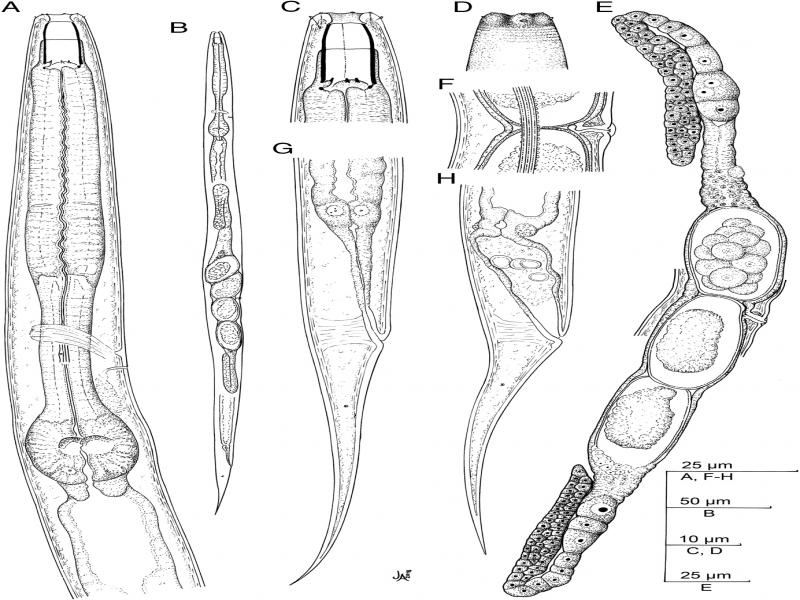
Figure 1:
Oscheius saproxylicus sp. n. (line drawing). (A) Neck; (B): Entire female; (C) Stoma; (D) Lip region; (E) Genital system; (F) Vagina; (G, H) Female tail.
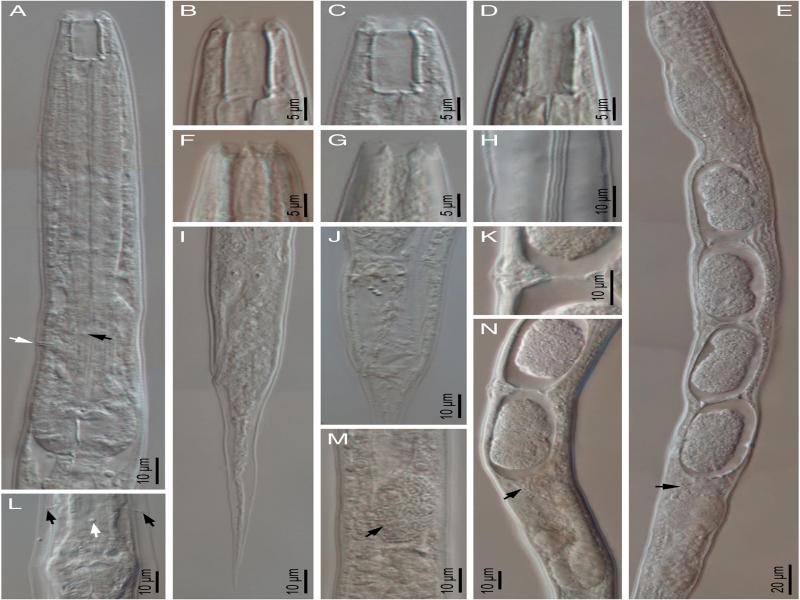
Figure 2:
Oscheius saproxylicus sp. n. (light microscopy, female). (A) Neck; (B-D) Stoma in lateral (B, C) and dorso-ventral (D) views; (E, N) Reproductive system (arrow at spermatozoa); (F, G) Lip region in lateral and ventral views, respectively; (H) Lateral field; (I, J) Posterior end with rectum empty and swollen, respectively; (K) Vagina; (L) Excretory pore in ventral view (white arrow) and deirids (black arrow); (M) Intestine cell with microsporidia (arrow).
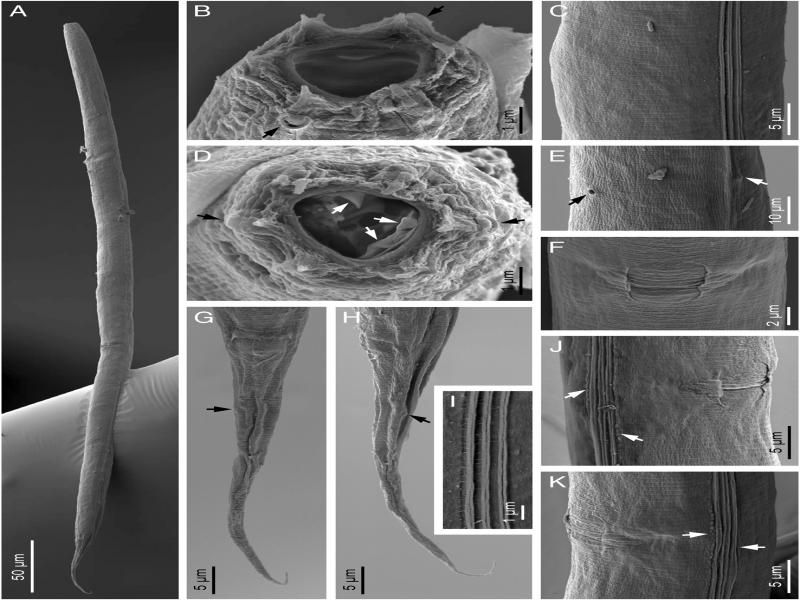
Figure 3:
Oscheius saproxylicus sp. n. (scanning electron microscopy, female). (A) Entire body; (B, D) Lip region in subfrontal and frontal views, respectively (black arrows at amphid and white arrows pointing the metastegostomatal teeth, up: dorsal tooth, down: sublateral teeth); (C) Cuticle at midbody; E: Excretory pore (black arrow) and deirid (white arrow); (F, J, K) Vulval region at ventral, sublateral right and left views, respectively (arrows at lineal warts of the lateral fields); (G, H) Tail in ventral and lateral views, respectively (arrow at phasmid); (I) Lateral field.
Table 1.
Morphometrics of Oscheius saproxylicus sp. n. Measurements in μm and in the form: mean ± standard deviation (range) where appropriate.
| Locality | Puente de la Sierra | |
|---|---|---|
| Province | Jaén | |
| Habitat | Dead wood | |
| n | Holotype female | Paratypes 50 females |
| Body length | 829 | 837 ± 78.4 (669–994) |
| a | 37.7 | 29.6 ± 3.2 (23.9–37.1) |
| b | 5.1 | 5.0 ± 0.5 (3.9–6.5) |
| c | 11.5 | 11.0 ± 1.2 (8.7–13.8) |
| c' | 5.5 | 5.5 ± 0.5 (5.0–7.0) |
| V | 57 | 54.8 ± 2.4 (48–59) |
| Lip region width | 9 | 9.6 ± 0.5 (9–10) |
| Stoma length | 18 | 18.7 ± 1.0 (17–21) |
| Stoma width | 5 | 5.8 ± 0.6 (5–7) |
| Pharyngeal corpus length | 72 | 75.9 ± 6.5 (68–96) |
| Isthmus length | 48 | 47.7 ± 3.9 (39–54) |
| Bulbus length | 26 | 26.6 ± 1.4 (24–29) |
| Pharynx length | 146 | 149 ± 9.4 (113–165) |
| Neck length | 164 | 168 ± 9.6 (131–182) |
| Body diameter at neck base | 22 | 23.9 ± 1.7 (20–28) |
| Body diameter at midbody | 22 | 28.5 ± 3.4 (21–37) |
| Vulva - anterior end | 469 | 459 ± 49.0 (366–549) |
| Rectum length | 48 | 44.8 ± 3.8 (40–54) |
| Anal body diameter | 13 | 13.9 ± 1.1 (11–16) |
| Tail length | 72 | 76.3 ± 5.0 (67–88) |
| Phasmid - anus distance | 19 | 23.9 ± 3.4 (20–30) |
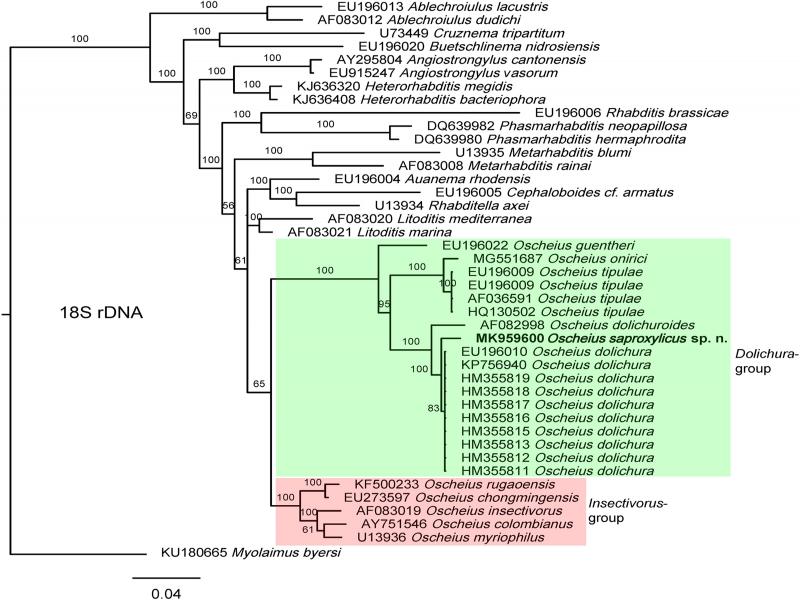
Figure 4:
Bayesian Inference tree from known and the newly sequenced Oscheius saproxylicus sp. n. based on sequences of the 18S rDNA region. Bayesian posterior probabilities (%) are given for each clade. Scale bar shows the number of substitutions per site.
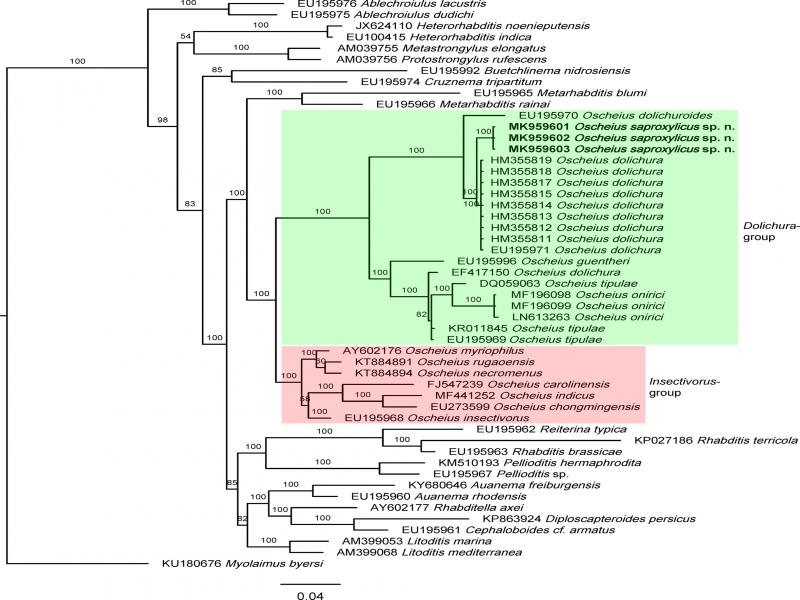
Figure 5:
Bayesian Inference tree from known and the newly sequenced Oscheius saproxylicus sp. n. based on sequences of the 28S rDNA region. Bayesian posterior probabilities (%) are given for each clade. Scale bar shows the number of substitutions per site.

Figure 6:
Lip region, male and female posterior ends of the species of the subgenus Oscheius (Andrássy, 1976) (not to scale). Based in the original illustrations (line drawings and LM pictures) except: isolated spicule in O. lucianii (cf. Chitwood, 1933).
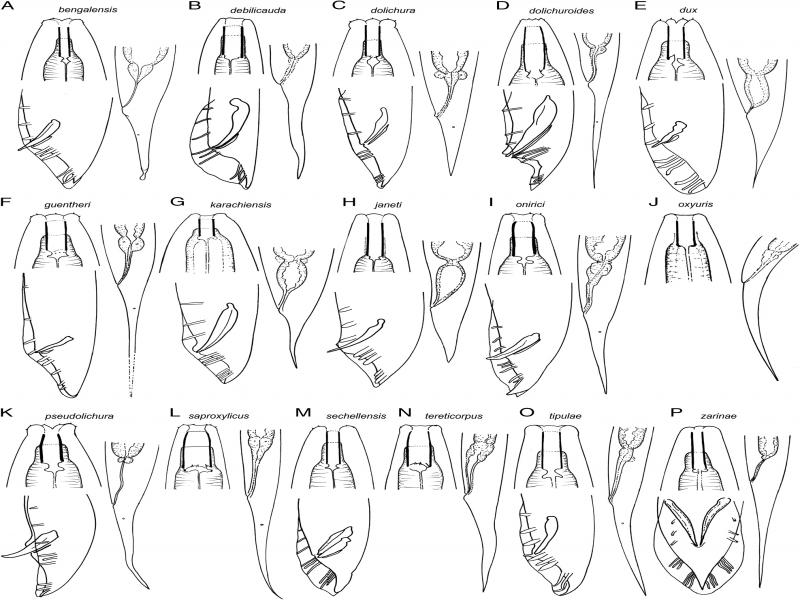
Figure 7:
Lip region, male and female posterior ends of the species of the subgenus Dolichorhabditis (Andrássy, 1983) (not to scale). Based on the original illustrations (line drawings and LM pictures) except: O. bengalensis (cf. Sudhaus, 1974), O. dolichura (cf. Andrássy, 2005), lip region in O. sechellensis (cf. Sudhaus,1976), O. tipulae (cf. Abolafia and Peña-Santiago, 2010).