
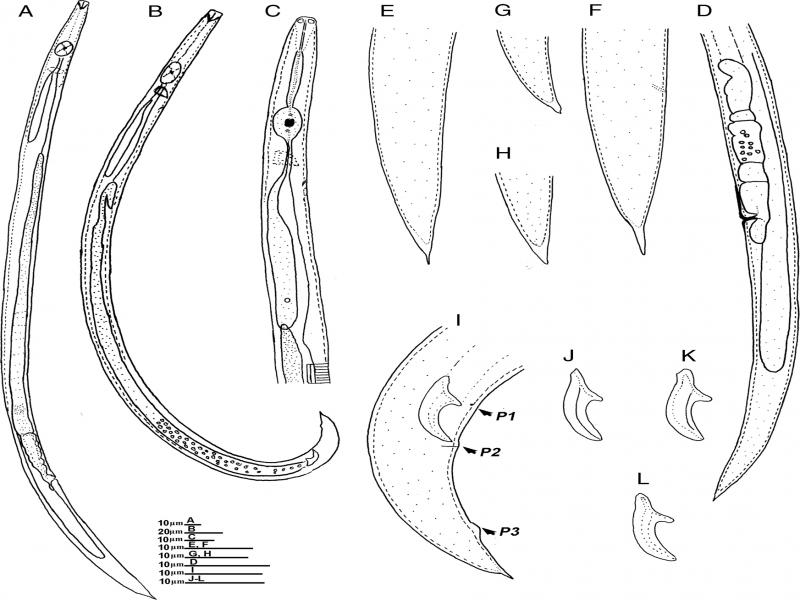
Figure 1:
Line drawings of Ektaphelenchus koreanus n. sp. (A) female; (B) male; (C) head region; (D) posterior part of female; (E–H) female tail region; (I) lateral view of male tail; (J–L) spicules. (Scale bars = A–L = 10; B = 20 μm).
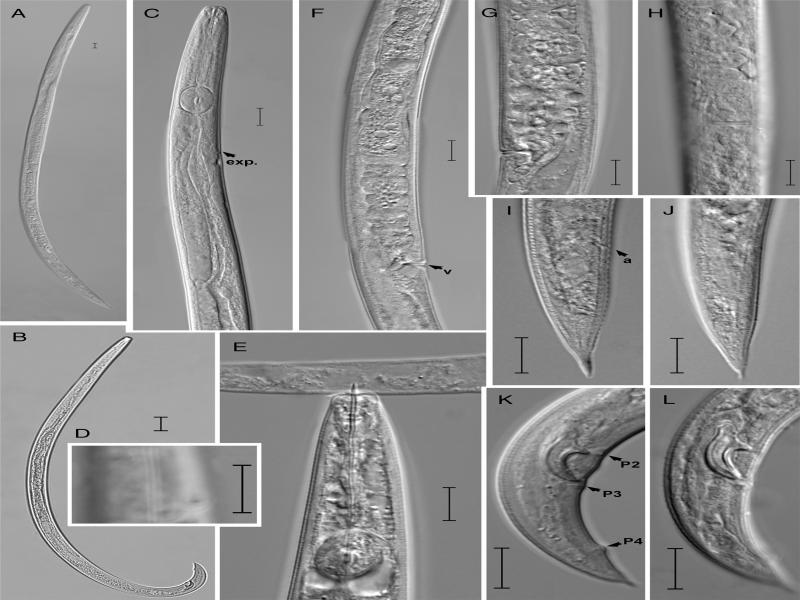
Figure 2:
Light photomicrographs of Ektaphelenchus koreanus n. sp. (A) female; (B) male; (C) head region; (D) lateral region; (E) feeding on Aphelenchoides sp.; (F, G) vulval region (lateral view); (H) vulval region (ventral view); (I, J) female tail; (K, L) Male tail. (Scale bars = 10 μm).
Table 1.
Morphometrics data for Ektaphelenchus koreanus n. sp. All measurements are in µm and in the form of mean ± s.d. (range).
| Female | Male | ||
|---|---|---|---|
| Characters | Holotype | Paratypes | Paratypes |
| n | – | 20 | 8 |
| L | 631 | 585 ± 68.2 (474–705) | 475 ± 20.0 (448–517) |
| a | 32.3 | 33.1 ± 1.7 (30.2–36.4) | 32.5 ± 2.5 (27.2–35.4) |
| b | 10.5 | 9.9 ± 0.8 (8.2–10.9) | 8.1 ± 0.6 (7.2–8.7) |
| b′ | 4.2 | 4.0 ± 0.4 (3.2–4.6) | 3.5 ± 0.2 (3.3–4.0) |
| c | – | – | 16.5 ± 0.9 (15.2–18.2) |
| c′ | – | – | 2.6 ± 0.2 (2.3–3.0) |
| V or T | 77.9 | 77.3 ± 0.7 (75.7–78.1) | 31.3 ± 3.4 (27.3–38.1) |
| Max body diam | 19.5 | 17.8 ± 2.4 (14.0–21.8) | 14.7 ± 1.2 (13.4–16.7) |
| Lip diam | 8.2 | 6.8 ± 0.9 (5.5–8.2) | 6.6 ± 0.2 (6.3–7.0) |
| Lip height | 3.9 | 3.2 ± 0.6 (2.3–4.3) | 2.6 ± 0.2 (2.2–2.9) |
| Stylet length | 15.8 | 14.0 ± 0.8 (12.4–16.4) | 13.5 ± 0.9 (12.4–14.9) |
| Median bulb length | 16.2 | 15.9 ± 0.8 (13.6–17.1) | 14.8 ± 0.7 (14.0–15.9) |
| Median bulb diam | 10.8 | 10.3 ± 0.9 (8.2–11.7) | 9.6 ± 0.7 (8.5–11.0) |
| Median bulb length/diam | 1.5 | 1.6 ± 0.1 (1.4–1.8) | 1.5 ± 0.0 (1.5–1.6) |
| Excretory pore position | 89.6 | 86.7 ± 4.7 (77.1–93.5) | 86.1 ± 5.5 (76.3–92.7) |
| Spicule(chord) | – | – | 13.2 ± 0.3 (12.7–13.7) |
| Ovary or testis length | 372 | 298 ± 66.7 (201–411) | 148 ± 14.1 (130–171) |
| Post-uterine sac length | 14.5 | 11.3 ± 2.1 (7.1–14.7) | – |
| Post vulval intestinal/blind sac | 102 | 81.9 ± 16.4 (55.0–106.0) | – |
Table 2.
Morphometrical values of Ektaphelenchus species.
| Species | L | Stylet L | Spicule L | Vulva to tail terminus | a | b | c | V/T | Reference | |
|---|---|---|---|---|---|---|---|---|---|---|
| Species having 2 incisures in the lateral field | ||||||||||
| E. josephi | Male | 710 | – | – | – | 32 | 7 | 12 | Massey (1974) | |
| Female | 830–920 | 22 | – | – | 29.5–33 | 8–9 | – | 75–77 | ||
| E. riograndensis | Male | 670–810 | – | – | – | 24–34 | 6.3–8 | 1.6–1.8 | – | Massey (1964a, 1964b) |
| Female | 750–910 | – | – | – | 25–34 | 6.4–8.5 | – | 80 | ||
| Male | 620–650 | 21–22 | 20–22.5 | – | 26–31 | 7.1–8.1 | 2.5–2.6 | Kaisa (2000) | ||
| Female | 630–780 | 22–23 | – | – | 25.2–31.5 | 6.8–9.5 | – | 79–81 | ||
| Species having 3 incisures in the lateral field | ||||||||||
| E. joyceae | Male | 400–470 | 14–16 | 13–14 | – | 26–35 | 5–7 | 15–18 | – | Kaisa, et al. (1995) |
| Female | 550–740 | 14–18 | – | 29–44 | 7–13 | – | 77–86 | |||
| E. macrobulbosus | Male | 432–463 | 14–16 | 13 | – | 25.7–30.8 | 9.1–9.3 | 20.5–22.0 | – | Rühm (1956) |
| Female | 518–576 | 16 | – | 93–112 | 24–28.7 | 9.9–10.8 | 5.1–5.6 | 80.5–82.1 | ||
| E. obtusus | Male | 700 | – | 18.5 | – | 23 | 7 | – | – | Massey (1956) |
| Female | 800 | 24 | – | 30 | 8 | – | 41–78 | |||
| Male | 968 | – | 22.5 | – | 20.6 | Kanzaki et al. (2008) b | ||||
| Female | 648–881 | 24–30 | – | – | 25.9–33.3 | 6.4–9.8 | – | 71.8–79 | Kanzaki et al. (2008) c | |
| E. sandiaensis | Male | 620–640 | – | 16 | – | 32 | 8.0–8.5 | 16 | – | Massey (1964a) |
| Female | 630–640 | – | – | – | 28–31 | 8.0–8.5 | – | – | ||
| E. taiwanensis | Male | 474–540 | 11.9–15.7 | 11.3–13.1 | – | 26.6–31.9 | 6.3–8.6 | 15.2–18.6 | – | Gu et al. (2013a) |
| Female | 482–661 | 12–16.9 | – | – | 26.8–31.1 | 7.2–9.6 | – | 76.7–79 | ||
| Species having 4 incisures in the lateral field | ||||||||||
| E. ibericus | Male | 453 | 13.1 | 12.8 | – | 32.8 | 7.5 | 15.4 | – | Gu et al. (2013b) |
| Female | 475–624 | 11.2–14.6 | – | – | 30.1–34.7 | 8–9.6 | – | 76–78 | ||
| E. koreanus n. sp. | Male | 448–517 | 12.4–14.9 | 12.7–13 | – | 30.2–36.4 | 7.2–8.7 | 15.2–18.2 | 27.3–38.1 | This study |
| Female | 474–705 | 12.4–16.4 | – | – | 27.2–35.4 | 8.2–10.9 | – | 75.7–78.1 | ||
| E. olea | Male | 452–602 | 15–17 | 16–18 | – | 26.5–33 | 6.7–8 | 14–16.5 | – | Miraeiz et al. (2017) |
| Female | 441–652 | 15–19 | – | – | 28–41 | 6.9–8.7 | 14.8–19 | 70–81.5 | ||
| Species with unknown incisures in lateral field | ||||||||||
| E. betulae | Male | 600–675 | 17 | 15–17 | – | 34.3–38 | 6.6–7.4 | 21.5–22.5 | – | Rühm (1956) |
| Female | 750–945 | 21 | – | 180–225 | 27–30 | 7.4–9.3 | 4.1–4.2 | 76–77 | ||
| E. dendroctoni | Male | 720–810 | 22 | 18 | – | 29.4–30 | 7.3–7.4 | 18.9–20.2 | – | Rühm (1956) |
| Female | 780–870 | 23 | – | 191–196 | 31.1–31.8 | 6.9–8.0 | 3.9–4.6 | 74–78 | ||
| E. goffarti | Male | 442–485 | 16–18 | 13–16 | – | 17.3–20 | 10.7–11.1 | 16.7–17 | – | Rühm (1956) |
| Female | 547–701 | 19–20 | – | 125–163 | 25–27 | 10.3–11.7 | 12.5–15.6 | 77–78 | ||
| E. piniperdae | Male | 483–750 | 14–15 | – | – | 31–44 | 9.3–12.5 | 19.4–25 | – | Kakulia and Lazarevskaja (1965) |
| Female | 615–780 | 14–16 | – | – | 28–38 | 10–12 | – | 67–75 | ||
| E. prolobos | Male | 610–660 | 35 | 7 | 14 | – | Massey (1964a, 1964b) | |||
| Female | 700–810 | 12 | – | – | 35 | 8.5 | – | 79 | ||
| E. propora | Male | 630–900 | 9.8–24 | 15–22 | – | 32.6–45.1 | – | 23.3–40.4 | – | Yang (1985) |
| Female | 900–1,260 | 15–30.5 | – | – | 34.5–54 | – | – | 64.4–82.6 | ||
| E. scolyti | Male | 690–765 | 15–17 | 14–15 | – | 32.8–36.4 | 6.7–8.4 | 25.5–27.1 | – | Rühm (1956) |
| Female | 900–1,185 | 21 | – | 291–315 | 32.1–48.4 | 8.0–17.8 | 2.8–4.1 | 65–75 | ||
| E. skrjabini | Male | 370–420 | 13–14 | – | – | 28–35 | – | 13.2–15 | – | Lazarevskaya (1961) |
| Female | 466–508 | 13–15 | – | – | 28.5–35.5 | 8.1–13.7 | – | 78–81 | ||
| E. stammeri | Male | 796–867 | 15–17 | 18–21 | – | 34.6–41.3 | 8.9–9.2 | 16.9–20.2 | – | Körner (1954) |
| Female | 645–931 | 17–18 | – | – | 31.9–35.8 | 7.6–10 | 12.4–17.2 | 68–77 | ||
| E. tuerkorum | Male | 645–690 | 15–18 | 11–14 | – | 32.8–36.8 | 7.1–8.4 | 23–25.5 | – | Rühm (1956) |
| Female | 705–735 | 16–19 | – | 147–158 | 35–40.2 | 9.5–9.6 | 4.5–5.0 | 77–80 | ||
| E. tenuidens | Male | 750 | – | – | – | – | – | – | – | Thorne (1935) |
| Female | 800 | – | – | – | – | – | – | – | ||
| E. zwoelferi | Male | 682–1,056 | 21–37 | 16–24 | – | 33–35.8 | 8.6–9.7 | 17–17.3 | – | Rühm (1957) |
| Female | 1,056–1,320 | 34–40 | – | 270–344 | 33–35 | 8.7–10.7 | 13.1–14.9 | 66–68 | ||
| Species described without males and unknown incisures in lateral field | ||||||||||
| E. amitini | 523 | 10–14 | – | – | 27.5 | 11.5 | – | 81 | Fuchs (1937) and Rühm (1956) | |
| E.hylastophilus | 893 | 17 | – | – | 37.2 | 21.7 | 16.8 | 72.4 | Fuchs (1930) | |
| E. larici | 480–800 | 17–23 | – | 24.7–42.7 | 8.1–9.7 | – | – | Lazarevskaya (1963) | ||
| E. olitorius | 480–550 | 21–22 | – | – | 28–33 | – | 15–16 | 60–80 | Chaturvedi and Khera (1977) | |
| E. typographi | 705–735 | 23 | – | – | 24.5–25.2 | 6.9–7.2 | 5.1–5.3 | 80–81 | Rühm (1956) | |
| a E.berbericus | 512–691 | 19–22 | – | – | 28.7–36.3 | 7.2–9.6 | 16.7–19.2 | 79.1–81.4 | Alvani et al. (2016) | |
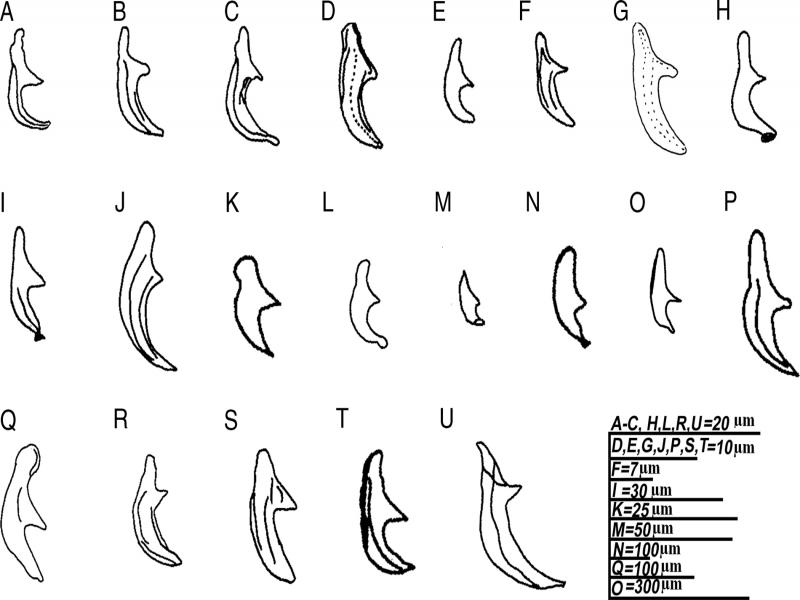
Figure 3:
Spicule morphology of accessible Ektaphelenchus species. (A) = E. betulae; (B) = E. dendroctoni; (C) = E. goffarti; (D) = E. ibericus; (E) = E. josephi; (F) = E. joyceae; (G) = E. koreanus n. sp.; (H) = E. macrobulbosus; (I) = E. obtusus; (J) = E. oleae; (K) = E. piniperdae; (L) = E. prolobos; (M) = E. propora; (N) = E. riograndensis; (O) = E. sandiaensis; (P) = E. scolyti; (Q) = E. skrjabini; (R) = E. stammeri; (S) = E. taiwanensis; (T) = E. tuerkorum; (U) = E. zwoelferi. Scale bars (A–C, H, L, R, U, S = 20 µm; D, E, G, J, P, S, T = 10 µm; F = 7 µm; I = 30 µm; K = 25 µm; M = 50 µm; N = 100 µm; Q = 100 µm, O = 300 µm).
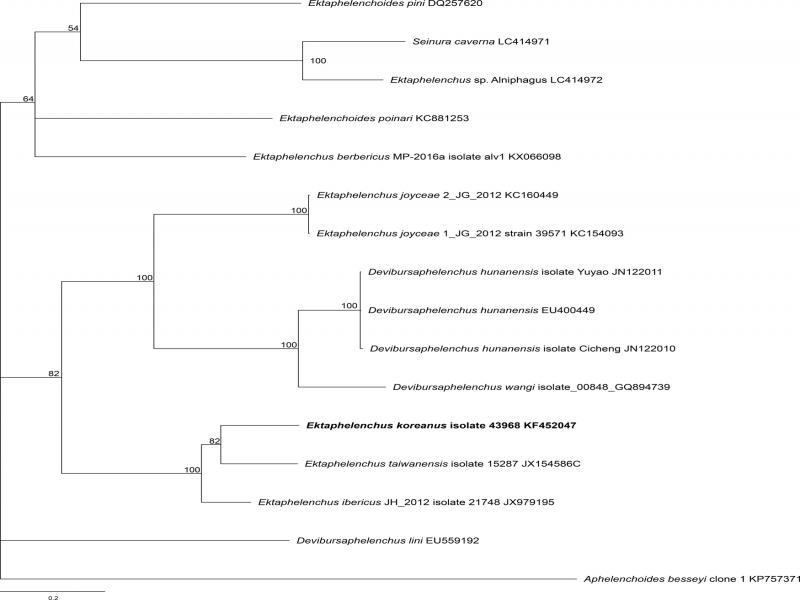
Figure 4:
Phylogenetic relationships of Ektaphelenchus koreanus n. sp. and aphelenchid nematodes based on full length of ITS. The 100001st Bayesian tree inferred from ITS under TVM+I+G model (ln L = −14,363.6136; freqA = 0.2773; freqC = 0.1724; freqG = 0.2291; freqT = 0.3213; R(a) = 1.0903; R(b) = 3.5149; R(c) = 1.7693; R(d) = 0.9479; R(e) = 3.5149; R(f) = 1.0000; Pinva = 0.0940; Shape = 1.3200). Aphelenchoides besseyi served as the outgroup species. Posterior probability values exceeding 50% are given on appropriate clades.