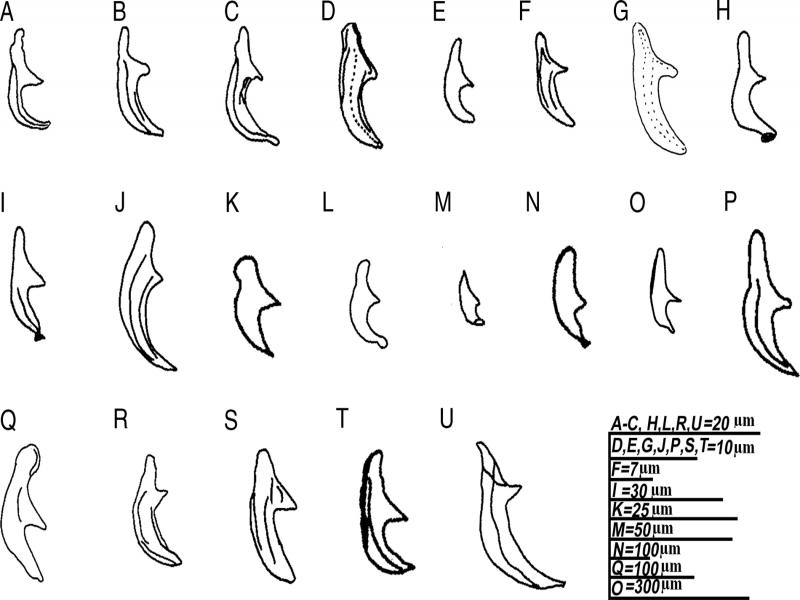
Most of Ektaphelenchus (Fuchs, 1937) species were found in association with beetles (Rühm, 1956; Massey, 1974). The word Ektaphelenchus derived from the Greek word ektos=outside and apheles=smooth, enchus=spear (Hunt, 1993). Currently, the genus contains 28 species that have been reported from Europe, North America, Russia, Iran, India, and China (Yang, 1985; Hunt, 1993; Alvani et al., 2016; Miraeiz et al., 2017). Three Ektaphelenchus were detected in the quarantine samples from Korea, Taiwan, and Spain examined at Ningbo customs, China, indicating that the known distribution range has increased (Gu et al., 2013a, 2013b). Unlike Bursaphelenchus and Aphelenchoides species, Ektaphenchid nematodes are not qualified as quarantine pests but their presence in the examined sample complicates the phytosanitary inspections. Therefore, the detection of another Ektaphelenchus species at Ningbo customs leads us to perform morphological, morphometrical, and molecular studies which revealed the status of this species as a new species and it is described herein E. koreanus n. sp.
Materials and methods
Nematode isolation and morphological study
Sawn samples taken from logs were cut into small pieces ca 1 cm wide and 10 cm long. Nematodes were extracted by a modified Baermann funnel technique for 24 hr. For morphometric studies, the extracted individuals were killed by heat, fixed with FA 4:1, and processed via ethanol-glycerin dehydration, according to Seinhorst (1959), as modified by De Grisse (1969) and mounted in glycerin on slides. The measurements and light micrographs of nematodes were made using a Zeiss Imager Z1 microscope equipped with a Zeiss AxioCam MRm CCD camera.
Molecular and phylogenetic analyses
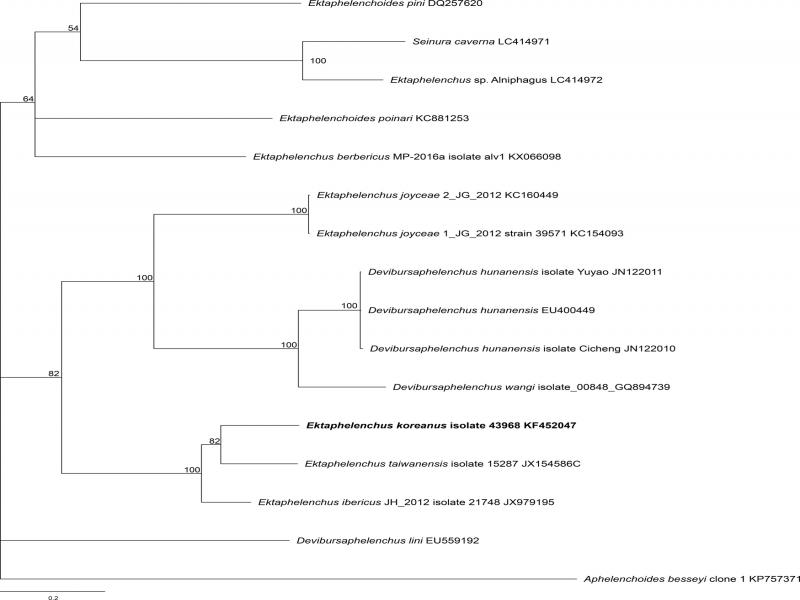
DNA was extracted from single nematode into an Eppendorf tube. The nematode was crushed and the sample was processed for extraction as described by Zheng et al. (2003). The ITS region was amplified with the forward primer F194 (Ferris et al., 1993) and the reverse primer 5368r (Vrain, 1993). PCR products were separated on 1% agarose gels and visualized by staining with ethidium bromide. PCR products of sufficiently high quality were purified for cloning and sequencing by Majorbio, Shanghai, China. The sequences of the ITS region of E. koreanus n. sp. were compared with those of other Ektaphelenchus species available in GenBank using the BLAST homology search program. The selected sequences were aligned by MAFFT (Katoh and Standley, 2013) with default parameters. The alignments of sequences were manually edited and assembled in one data set by using AliView (Larsson, 2014). The best-fitted model of DNA evolution was obtained using jModelTest2 (Darriba et al., 2012) with the Akaike information criterion (AIC). The Bayesian tree was inferred using MrBayes 3.2.3 (Ronquist and Huelsenbeck, 2003) with four chains (three heated and one cold). Model parameters were unlinked and the overall rate was allowed to vary across partitions. The number of generations for the total analysis was set to 1×10⁸, with the chains sampled every 1,000 generations and the burn-in value set to 25%. The Markov chain Monte Carlo (MCMC) method within a Bayesian framework was used to estimate the posterior probabilities of the phylogenetic trees using the 50% majority rule (Larget and Simon, 1999). The consensus tree was selected to represent the phylogenetic relationships with branch length and support level and visualized using TreeGraph 2 (Stöver and Müller, 2010).
Results
Systematics
Ektaphelenchus koreanus n. sp.
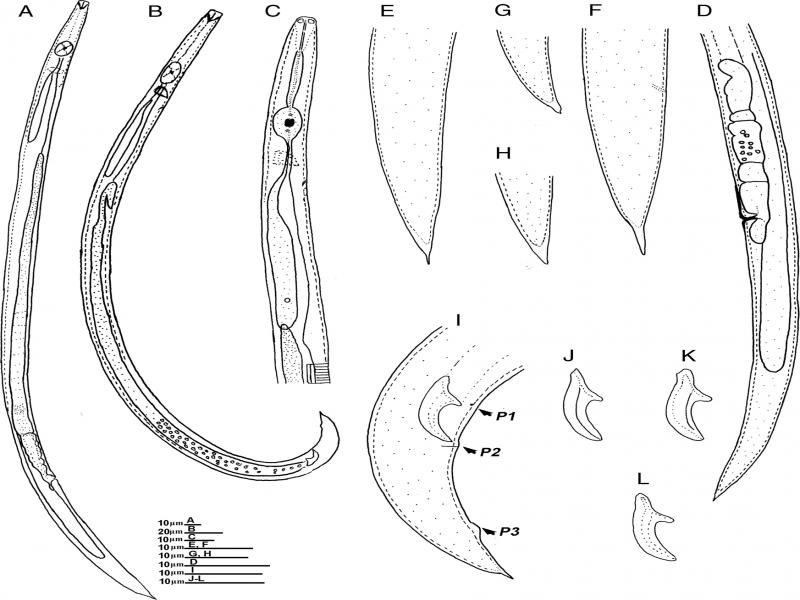
Figure 1:
Line drawings of Ektaphelenchus koreanus n. sp. (A) female; (B) male; (C) head region; (D) posterior part of female; (E–H) female tail region; (I) lateral view of male tail; (J–L) spicules. (Scale bars = A–L = 10; B = 20 μm).
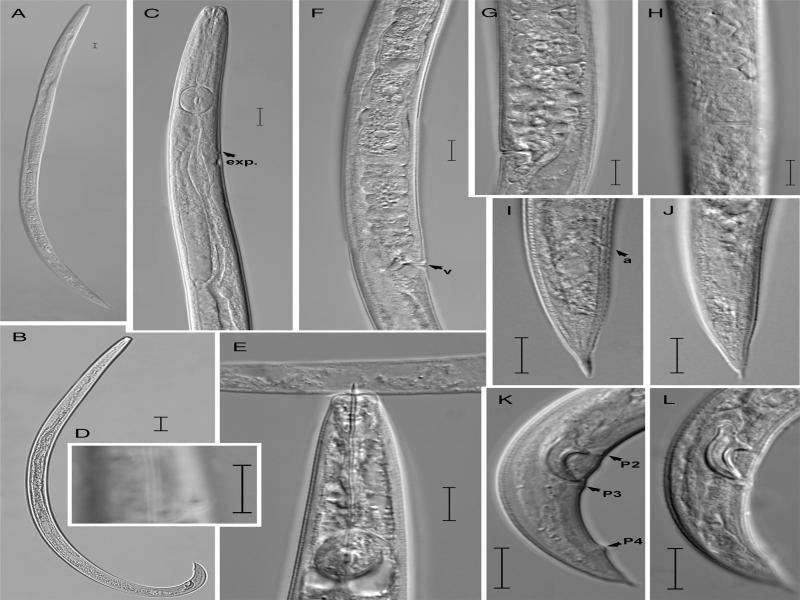
Figure 2:
Light photomicrographs of Ektaphelenchus koreanus n. sp. (A) female; (B) male; (C) head region; (D) lateral region; (E) feeding on Aphelenchoides sp.; (F, G) vulval region (lateral view); (H) vulval region (ventral view); (I, J) female tail; (K, L) Male tail. (Scale bars = 10 μm).
Measurements
Measurements of the new species are given in Table 1.
Table 1.
Morphometrics data for Ektaphelenchus koreanus n. sp. All measurements are in µm and in the form of mean ± s.d. (range).
| Female | Male | |||||||||
|---|---|---|---|---|---|---|---|---|---|---|
| Characters | Holotype | Paratypes | Paratypes | |||||||
| n | – | 20 | 8 | |||||||
| L | 631 | 585 ± 68.2 (474–705) | 475 ± 20.0 (448–517) | |||||||
| a | 32.3 | 33.1 ± 1.7 (30.2–36.4) | 32.5 ± 2.5 (27.2–35.4) | |||||||
| b | 10.5 | 9.9 ± 0.8 (8.2–10.9) | 8.1 ± 0.6 (7.2–8.7) | |||||||
| b′ | 4.2 | 4.0 ± 0.4 (3.2–4.6) | 3.5 ± 0.2 (3.3–4.0) | |||||||
| c | – | – | 16.5 ± 0.9 (15.2–18.2) | |||||||
| c′ | – | – | 2.6 ± 0.2 (2.3–3.0) | |||||||
| V or T | 77.9 | 77.3 ± 0.7 (75.7–78.1) | 31.3 ± 3.4 (27.3–38.1) | |||||||
| Max body diam | 19.5 | 17.8 ± 2.4 (14.0–21.8) | 14.7 ± 1.2 (13.4–16.7) | |||||||
| Lip diam | 8.2 | 6.8 ± 0.9 (5.5–8.2) | 6.6 ± 0.2 (6.3–7.0) | |||||||
| Lip height | 3.9 | 3.2 ± 0.6 (2.3–4.3) | 2.6 ± 0.2 (2.2–2.9) | |||||||
| Stylet length | 15.8 | 14.0 ± 0.8 (12.4–16.4) | 13.5 ± 0.9 (12.4–14.9) | |||||||
| Median bulb length | 16.2 | 15.9 ± 0.8 (13.6–17.1) | 14.8 ± 0.7 (14.0–15.9) | |||||||
| Median bulb diam | 10.8 | 10.3 ± 0.9 (8.2–11.7) | 9.6 ± 0.7 (8.5–11.0) | |||||||
| Median bulb length/diam | 1.5 | 1.6 ± 0.1 (1.4–1.8) | 1.5 ± 0.0 (1.5–1.6) | |||||||
| Excretory pore position | 89.6 | 86.7 ± 4.7 (77.1–93.5) | 86.1 ± 5.5 (76.3–92.7) | |||||||
| Spicule(chord) | – | – | 13.2 ± 0.3 (12.7–13.7) | |||||||
| Ovary or testis length | 372 | 298 ± 66.7 (201–411) | 148 ± 14.1 (130–171) | |||||||
| Post-uterine sac length | 14.5 | 11.3 ± 2.1 (7.1–14.7) | – | |||||||
| Post vulval intestinal/blind sac | 102 | 81.9 ± 16.4 (55.0–106.0) | – | |||||||
| Species | L | Stylet L | Spicule L | Vulva to tail terminus | a | b | c | V/T | Reference | |
|---|---|---|---|---|---|---|---|---|---|---|
| Species having 2 incisures in the lateral field | ||||||||||
| E. josephi | Male | 710 | – | – | – | 32 | 7 | 12 | Massey (1974) | |
| Female | 830–920 | 22 | – | – | 29.5–33 | 8–9 | – | 75–77 | ||
| E. riograndensis | Male | 670–810 | – | – | – | 24–34 | 6.3–8 | 1.6–1.8 | – | Massey (1964a, 1964b) |
| Female | 750–910 | – | – | – | 25–34 | 6.4–8.5 | – | 80 | ||
| Male | 620–650 | 21–22 | 20–22.5 | – | 26–31 | 7.1–8.1 | 2.5–2.6 | Kaisa (2000) | ||
| Female | 630–780 | 22–23 | – | – | 25.2–31.5 | 6.8–9.5 | – | 79–81 | ||
| Species having 3 incisures in the lateral field | ||||||||||
| E. joyceae | Male | 400–470 | 14–16 | 13–14 | – | 26–35 | 5–7 | 15–18 | – | Kaisa, et al. (1995) |
| Female | 550–740 | 14–18 | – | 29–44 | 7–13 | – | 77–86 | |||
| E. macrobulbosus | Male | 432–463 | 14–16 | 13 | – | 25.7–30.8 | 9.1–9.3 | 20.5–22.0 | – | Rühm (1956) |
| Female | 518–576 | 16 | – | 93–112 | 24–28.7 | 9.9–10.8 | 5.1–5.6 | 80.5–82.1 | ||
| E. obtusus | Male | 700 | – | 18.5 | – | 23 | 7 | – | – | Massey (1956) |
| Female | 800 | 24 | – | 30 | 8 | – | 41–78 | |||
| Male | 968 | – | 22.5 | – | 20.6 | Kanzaki et al. (2008) b | ||||
| Female | 648–881 | 24–30 | – | – | 25.9–33.3 | 6.4–9.8 | – | 71.8–79 | Kanzaki et al. (2008) c | |
| E. sandiaensis | Male | 620–640 | – | 16 | – | 32 | 8.0–8.5 | 16 | – | Massey (1964a) |
| Female | 630–640 | – | – | – | 28–31 | 8.0–8.5 | – | – | ||
| E. taiwanensis | Male | 474–540 | 11.9–15.7 | 11.3–13.1 | – | 26.6–31.9 | 6.3–8.6 | 15.2–18.6 | – | Gu et al. (2013a) |
| Female | 482–661 | 12–16.9 | – | – | 26.8–31.1 | 7.2–9.6 | – | 76.7–79 | ||
| Species having 4 incisures in the lateral field | ||||||||||
| E. ibericus | Male | 453 | 13.1 | 12.8 | – | 32.8 | 7.5 | 15.4 | – | Gu et al. (2013b) |
| Female | 475–624 | 11.2–14.6 | – | – | 30.1–34.7 | 8–9.6 | – | 76–78 | ||
| E. koreanus n. sp. | Male | 448–517 | 12.4–14.9 | 12.7–13 | – | 30.2–36.4 | 7.2–8.7 | 15.2–18.2 | 27.3–38.1 | This study |
| Female | 474–705 | 12.4–16.4 | – | – | 27.2–35.4 | 8.2–10.9 | – | 75.7–78.1 | ||
| E. olea | Male | 452–602 | 15–17 | 16–18 | – | 26.5–33 | 6.7–8 | 14–16.5 | – | Miraeiz et al. (2017) |
| Female | 441–652 | 15–19 | – | – | 28–41 | 6.9–8.7 | 14.8–19 | 70–81.5 | ||
| Species with unknown incisures in lateral field | ||||||||||
| E. betulae | Male | 600–675 | 17 | 15–17 | – | 34.3–38 | 6.6–7.4 | 21.5–22.5 | – | Rühm (1956) |
| Female | 750–945 | 21 | – | 180–225 | 27–30 | 7.4–9.3 | 4.1–4.2 | 76–77 | ||
| E. dendroctoni | Male | 720–810 | 22 | 18 | – | 29.4–30 | 7.3–7.4 | 18.9–20.2 | – | Rühm (1956) |
| Female | 780–870 | 23 | – | 191–196 | 31.1–31.8 | 6.9–8.0 | 3.9–4.6 | 74–78 | ||
| E. goffarti | Male | 442–485 | 16–18 | 13–16 | – | 17.3–20 | 10.7–11.1 | 16.7–17 | – | Rühm (1956) |
| Female | 547–701 | 19–20 | – | 125–163 | 25–27 | 10.3–11.7 | 12.5–15.6 | 77–78 | ||
| E. piniperdae | Male | 483–750 | 14–15 | – | – | 31–44 | 9.3–12.5 | 19.4–25 | – | Kakulia and Lazarevskaja (1965) |
| Female | 615–780 | 14–16 | – | – | 28–38 | 10–12 | – | 67–75 | ||
| E. prolobos | Male | 610–660 | 35 | 7 | 14 | – | Massey (1964a, 1964b) | |||
| Female | 700–810 | 12 | – | – | 35 | 8.5 | – | 79 | ||
| E. propora | Male | 630–900 | 9.8–24 | 15–22 | – | 32.6–45.1 | – | 23.3–40.4 | – | Yang (1985) |
| Female | 900–1,260 | 15–30.5 | – | – | 34.5–54 | – | – | 64.4–82.6 | ||
| E. scolyti | Male | 690–765 | 15–17 | 14–15 | – | 32.8–36.4 | 6.7–8.4 | 25.5–27.1 | – | Rühm (1956) |
| Female | 900–1,185 | 21 | – | 291–315 | 32.1–48.4 | 8.0–17.8 | 2.8–4.1 | 65–75 | ||
| E. skrjabini | Male | 370–420 | 13–14 | – | – | 28–35 | – | 13.2–15 | – | Lazarevskaya (1961) |
| Female | 466–508 | 13–15 | – | – | 28.5–35.5 | 8.1–13.7 | – | 78–81 | ||
| E. stammeri | Male | 796–867 | 15–17 | 18–21 | – | 34.6–41.3 | 8.9–9.2 | 16.9–20.2 | – | Körner (1954) |
| Female | 645–931 | 17–18 | – | – | 31.9–35.8 | 7.6–10 | 12.4–17.2 | 68–77 | ||
| E. tuerkorum | Male | 645–690 | 15–18 | 11–14 | – | 32.8–36.8 | 7.1–8.4 | 23–25.5 | – | Rühm (1956) |
| Female | 705–735 | 16–19 | – | 147–158 | 35–40.2 | 9.5–9.6 | 4.5–5.0 | 77–80 | ||
| E. tenuidens | Male | 750 | – | – | – | – | – | – | – | Thorne (1935) |
| Female | 800 | – | – | – | – | – | – | – | ||
| E. zwoelferi | Male | 682–1,056 | 21–37 | 16–24 | – | 33–35.8 | 8.6–9.7 | 17–17.3 | – | Rühm (1957) |
| Female | 1,056–1,320 | 34–40 | – | 270–344 | 33–35 | 8.7–10.7 | 13.1–14.9 | 66–68 | ||
| Species described without males and unknown incisures in lateral field | ||||||||||
| E. amitini | 523 | 10–14 | – | – | 27.5 | 11.5 | – | 81 | Fuchs (1937) and Rühm (1956) | |
| E.hylastophilus | 893 | 17 | – | – | 37.2 | 21.7 | 16.8 | 72.4 | Fuchs (1930) | |
| E. larici | 480–800 | 17–23 | – | 24.7–42.7 | 8.1–9.7 | – | – | Lazarevskaya (1963) | ||
| E. olitorius | 480–550 | 21–22 | – | – | 28–33 | – | 15–16 | 60–80 | Chaturvedi and Khera (1977) | |
| E. typographi | 705–735 | 23 | – | – | 24.5–25.2 | 6.9–7.2 | 5.1–5.3 | 80–81 | Rühm (1956) | |
| a E.berbericus | 512–691 | 19–22 | – | – | 28.7–36.3 | 7.2–9.6 | 16.7–19.2 | 79.1–81.4 | Alvani et al. (2016) | |