
Potato (Solanum tuberosum) is a staple crop and food source in many places throughout the world. In the USA, Florida is a key provider of potatoes during the spring season. In 2016, Florida produced 274 million kg of potatoes, worth $48 million, which constituted 35% of the spring crop in the USA by volume (NASS-USDA, 2017). Potatoes are grown in many parts of the Florida peninsula, but approximately 66% of acreage is in three counties in Northeastern Florida (NASS-USDA, 2014). Plant-parasitic nematodes are a major problem in this warm area with coastal sandy soils (Weingartner et al., 1993; Crow et al., 2000a). A wide variety of plant-parasitic nematodes are abundant in the area, but sting nematode (Belonolaimus longicaudatus) and the stubby-root nematodes, Paratrichodorus (Nanidorus) spp. and Trichodorus spp., are the most problematic (Perez et al., 2000; Crow et al., 2000b). Sting nematode is a very damaging pathogen of potato that stunts the root system, reducing tuber yield (Weingartner et al., 1993). The economic damage threshold for sting nematode in Florida potato production, based on a two-year research trial, is at or near the detection limit in pre-plant soil (Crow et al., 2000b). Based on the same study, each sting nematode detected per 130 cm−3 soil suppresses potato yield by 199 kg/ha.
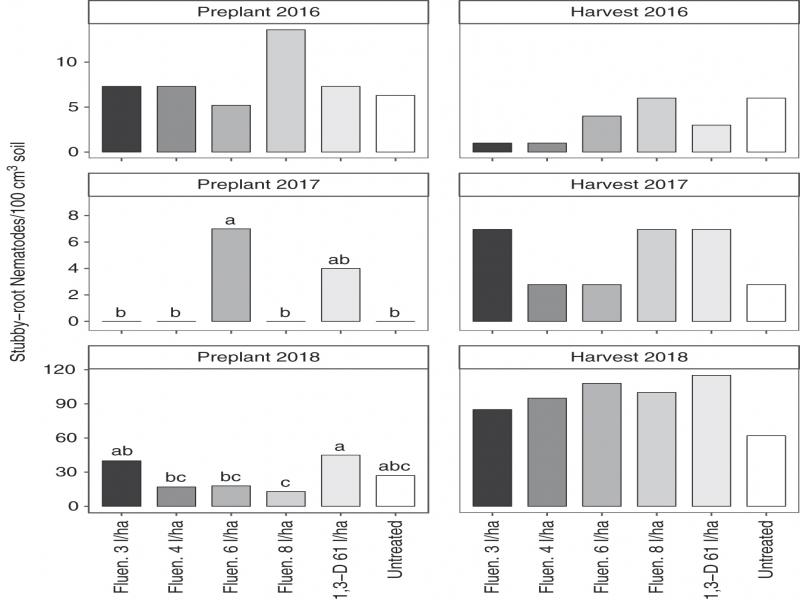
Stubby-root nematodes are not thought to cause much direct damage to potato (Weingartner et al., 1993; Crow et al., 2000a), but they vector tobacco rattle virus (Perez et al., 2000; Brown et al., 2009), the causal agent of corky ringspot disease (CRS). Corky ringspot disease has been confirmed in Northeast Florida and is a recurring problem with yield suppression of 25% reported in some trials (Weingartner and Shumaker, 1990c; Perez et al., 2000). Potatoes infected with CRS have mottled skin and internal arcs or rings of necrosis making them unmarketable (Weingartner et al., 1993). Symptoms of CRS are correlated with stubby-root nematode abundance, particularly early in the growing season, so management of this nematode is an important strategy for CRS management (Perez et al., 2000).
There are relatively few nematode management options for potato producers in Northeast Florida. Sting and stubby-root nematodes have wide host ranges making it difficult to manage these nematodes with crop rotation or cover cropping (Crow et al., 2000a, 2001). Production constraints for Northeast Florida potato producers – such as specialized equipment, the need for high-value rotation crops, and a potato growing season that extends into early summer – also limit the number of viable rotation cash crops or cover crops. Additionally, crop rotation apparently does not eliminate CRS as the disease can persist in fields that have been rotated out of potato for many years (Weingartner and Shumaker, 1990c). There are some CRS resistant potato cultivars available that exhibit reduced incidence of CRS (Weingartner et al., 1993; Brown et al., 2009), but sting nematode resistant or tolerant cultivars are not available. Because of the limitations of other management strategies and the high pressure from nematodes, fumigant and non-fumigant nematicide application is an important component of nematode management in Florida potato production.
The limited number of nematicides labeled and available for Florida potato production is also a challenge for nematode management. In recent years, growers have temporarily or permanently lost use of some nematicides, such as oxamyl and aldicarb, due to registration cancellations or production interruption. Oxamyl and aldicarb have been important products for control of stubby-root nematodes and CRS as they have provided good control of these pathogens; often better control than fumigants (Weingartner and Shumaker, 1990a, 1990b; Weingartner et al., 1993). This has left growers reliant on a limited number of nematicides, particularly the fumigant 1,3-dichloropropene (1,3-D), or a combination of 1,3-D and ethoprop when CRS is present. Therefore, it is important to identify viable alternative nematicides for nematode management in potato production. Fluensulfone (NIMITZ®, ADAMA) is a relatively new nematicide in the fluoroalkenyl group. It has irreversible nematicide activity with a different mode of action than organophosphate or carbamate non-fumigant nematicides (Oka et al., 2012; Kearn et al., 2014, 2017). Fluensulfone has been effective for managing root-knot nematodes (Meloidogyne spp.) in various vegetable crops in lab (Oka et al., 2013), greenhouse (Jones et al., 2017), and field studies (Morris et al., 2015, 2016). It was also relatively effective at managing Globodera pallida (potato cyst nematode) in field trials (Norshie et al., 2016). There is little published research on the efficacy of fluensulfone against other nematodes and no previous reports on fluensulfone efficacy against sting or stubby-root nematodes in potato production to our knowledge.
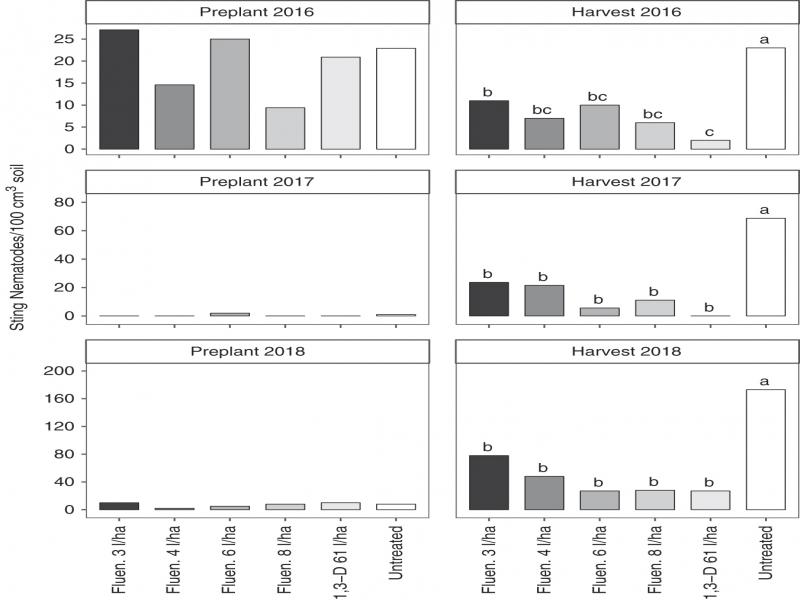
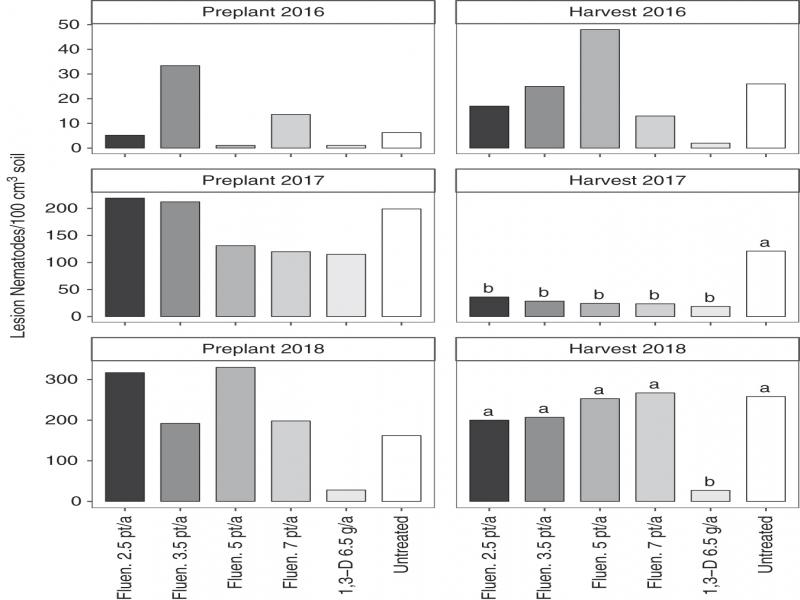
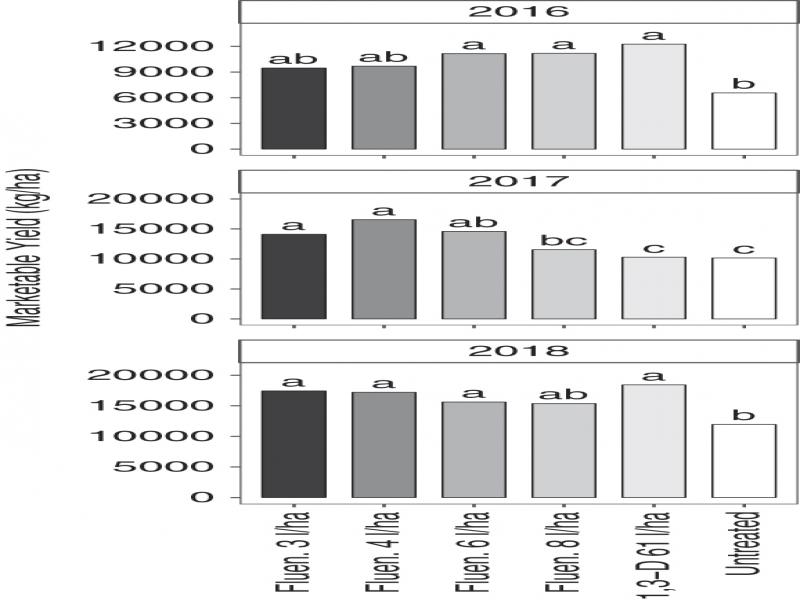
Based on these needs, the objectives of this study were to evaluate the efficacy of fluensulfone at various rates and the fumigant 1,3-D for (i) management of plant-parasitic nematodes and (ii) potato yield response in Florida potato production.
Materials and methods
Field site and experimental design
The field trials were located at the University of Florida Hastings Agricultural Education Center in Hastings, Florida (29.692, −81.441). Soil at the field site was an Ellzey fine sand (sandy, silicaceous, hyperthermic Arenic Ochraqualf) with 95% sand, 2% silt, 3% clay, and <1% organic matter. The experimental units were field plots of four rows spaced 102 cm apart and 26 m long. The study was a randomized complete block design with six replicates and a single factor – nematicide application. The study was conducted in 2016, 2017, and 2018 at the same field site and treatments were not re-randomized each year. There were six nematicide application treatments as describe in Table 1: (i) fluensulfone at 1.40 kg a.i./ha, (ii) fluensulfone at 1.96 kg a.i./ha, (iii) fluensulfone at 2.80 kg a.i./ha, (iv) fluensulfone at 3.92 kg/ha, (v) 1,3-D at 60.90 l/ha, and (vi) untreated control.
Table 1.
Nematicide application treatment rates and application methods.
| Treatment number | Product | Active ingredient | Total product rate (l/ha) | Active ingredient rate (kg a.i./ha) | Application method | ||||
|---|---|---|---|---|---|---|---|---|---|
| 1 | Nimitz | Fluensulfone | 2.92 | 1.40 | Boom-applied, chopper-incorporated to 15 cm | ||||
| 2 | Nimitz | Fluensulfone | 4.11 | 1.96 | Boom-applied, chopper-incorporated to 15 cm | ||||
| 3 | Nimitz | Fluensulfone | 5.87 | 2.80 | Boom-applied, chopper-incorporated to 15 cm | ||||
| 4 | Nimitz | Fluensulfone | 8.20 | 3.92 | Boom-applied, chopper-incorporated to 15 cm | ||||
| 5 | Telone II | 1,3-dichloropropene | 60.90 | – | Injected 25 cm deep, 1 shank per bed (102 cm wide) | ||||
| 6 | Untreated control | ||||||||
| Task | 2016 | 2017 | 2018 | ||||||
|---|---|---|---|---|---|---|---|---|---|
| Pre-plant soil samples | January 25 | January 3 | January 10 | ||||||
| Nematicides applied | January 25 | January 3 to 4 | January 10 | ||||||
| Potatoes planted | February 15 | January 19 | February 6 | ||||||
| Harvest soil samples | May 31 | May 2 | May 7 | ||||||
| Potatoes harvested | May 31 | May 2 | May 23 to 24 | ||||||
| 2016 | 2017 | 2018 | |||||||
|---|---|---|---|---|---|---|---|---|---|
| Temperature (C) | Temperature (C) | Temperature (C) | |||||||
| Time perioda | Rainfallb | Soilc | Aird | Rainfall | Soil | Air | Rainfall | Soil | Air |
| 4 WBA | 2.29 | 21.1 | 19.9 | 0.00 | 18.3 | 15.6 | 0.00 | 15.7 | 15.1 |
| 3 WBA | 0.61 | 17.0 | 13.3 | 0.69 | 19.1 | 17.1 | 0.15 | 18.0 | 16.8 |
| 2 WBA | 2.46 | 15.5 | 11.3 | 0.08 | 18.2 | 16.6 | 0.18 | 14.9 | 9.6 |
| 1 WBA | 2.13 | 13.4 | 8.3 | 0.25 | 18.3 | 17.2 | 3.73 | 11.2 | 7.5 |
| Day nematicide applied | 0.00 | 12.0 | 8.9 | 0.00 | 19.6 | 19.0 | 1.65 | 15.9 | 18.5 |
| 1 WAA | 2.67 | 15.0 | 14.6 | 2.16 | 16.3 | 11.6 | 1.45 | 14.5 | 11.6 |
| 2 WAA | 7.24 | 15.9 | 14.6 | 0.08 | 17.8 | 18.2 | 0.53 | 13.1 | 11.6 |
| 3 WAA | 0.00 | 13.2 | 11.6 | 0.08 | 18.6 | 18.4 | 8.94 | 15.0 | 14.3 |
| 4 WAA | 2.51 | 15.9 | 15.5 | 0.00 | 16.8 | 12.4 | 0.30 | 15.0 | 15.1 |
| Grade | Cb | B | A1 | A2 | A3 | A123 |
|---|---|---|---|---|---|---|
| Nematicide treatment | 2016 | |||||
| Fluensulfone 3 l/ha | 547 | 1,095 | 7,174 ab | 441 b | 220 | 7,835 ab |
| Fluensulfone 4 l/ha | 547 | 1,166 | 6,563 ab | 1,223 ab | 192 | 7,977 ab |
| Fluensulfone 6 l/ha | 576 | 1,180 | 7,551 a | 1,849 a | 0 | 9,399 a |
| Fluensulfone 8 l/ha | 704 | 1,315 | 7,985 a | 1,130 ab | 50 | 9,165 a |
| 1,3-dichloropropene 61 l/ha | 597 | 1,230 | 8,418 a | 1,969 a | 43 | 10,430 a |
| Untreated control | 661 | 939 | 4,721 b | 242 b | 0 | 4,963 b |
| Nematicide treatment | 2017 | |||||
| Fluensulfone 3 l/ha | 594 | 1,299 | 8,774 ab | 2,167 ab | 1,275 ab | 12,216 ab |
| Fluensulfone 4 l/ha | 679 | 1,505 | 9,665 a | 2,842 a | 1,851 a | 14,357 a |
| Fluensulfone 6 l/ha | 771 | 1,244 | 9,503 a | 1,353 bc | 1,706 a | 12,562 ab |
| Fluensulfone 8 l/ha | 540 | 997 | 7,648 abc | 1,079 c | 1,285 ab | 10,011 bc |
| 1,3-dichloropropene 61 l/ha | 712 | 1,313 | 6,029 c | 1,613 bc | 634 bc | 8,276 c |
| Untreated control | 492 | 1,239 | 6,611 bc | 1,359 bc | 467 c | 8,437 c |
| Nematicide treatment | 2018 | |||||
| Fluensulfone 3 l/ha | 3,235 | 6,143 a | 7,160 a | 533 | 313 | 8,006 a |
| Fluensulfone 4 l/ha | 3,427 | 5,567 ab | 7,430 a | 675 | 284 | 8,383 a |
| Fluensulfone 6 l/ha | 3,263 | 5,610 ab | 6,051 ab | 633 | 114 | 6,797 ab |
| Fluensulfone 8 l/ha | 3,214 | 5,524 ab | 6,079 ab | 398 | 114 | 6,591 ab |
| 1,3-dichloropropene 61 l/ha | 3,647 | 5,809 ab | 8,006 a | 626 | 277 | 8,909 a |
| Untreated control | 3,512 | 4,494 b | 3,868 b | 100 | 43 | 4,010 b |
| Total | Rotted | Green | Growth crack | Misshapen | |
|---|---|---|---|---|---|
| Nematicide treatment | 2016 | ||||
| Fluensulfone 3 l/ha | 6,100 | 6,100 | 0 | 0 | 0 |
| Fluensulfone 4 l/ha | 6,157 | 6,157 | 0 | 0 | 0 |
| Fluensulfone 6 l/ha | 6,719 | 6,719 | 0 | 0 | 0 |
| Fluensulfone 8 l/ha | 6,385 | 6,385 | 0 | 0 | 0 |
| 1,3-dichloropropene 61 l/ha | 7,266 | 7,266 | 0 | 0 | 0 |
| Untreated control | 5,091 | 5,091 | 0 | 0 | 0 |
| Nematicide treatment | 2017 | ||||
| Fluensulfone 3 l/ha | 4,639 | 1,779 | 1,024 | 930 | 907 |
| Fluensulfone 4 l/ha | 4,001 | 1,642 | 1,246 | 759 | 352 |
| Fluensulfone 6 l/ha | 3,504 | 1,397 | 855 | 444 | 807 |
| Fluensulfone 8 l/ha | 2,945 | 851 | 821 | 675 | 597 |
| 1,3-dichloropropene 61 l/ha | 3,271 | 1,679 | 542 | 430 | 619 |
| Untreated control | 2,601 | 880 | 787 | 553 | 382 |
| Nematicide treatment | 2018 | ||||
| Fluensulfone 3 l/ha | 1,522 | 1,159 ab | 64 | 78 | 228 c |
| Fluensulfone 4 l/ha | 1,237 | 761 b | 206 | 107 | 164 c |
| Fluensulfone 6 l/ha | 2,190 | 1,379 ab | 220 | 78 | 519 ab |
| Fluensulfone 8 l/ha | 1,586 | 946 ab | 263 | 85 | 313 bc |
| 1,3-dichloropropene 61 l/ha | 2,481 | 1,529 a | 185 | 107 | 654 a |
| Untreated control | 1,436 | 825 b | 199 | 36 | 377 bc |