
The genus Xiphinema, excluding the X. americanum group, comprises a complex of more than 220 species divided into eight morphospecies groups (Loof and Luc, 1990), based on the structural diversity of the female reproductive system, body habitus, lip region shape, total spear, body length and tail shape of female and juveniles using a polytomous key. Within the proposed groups, members of the group 6 (X. pyrenaicum species complex) are characterised by having two equally developed female genital branches with the presence of spines in the tubular part of the uterus and a rounded tail with or without a conspicuous projecting bulge.
According to Ghaderi et al. (2018), 26 species of the genus Xiphinema have been reported from Iran. Later on, some other species including X. simile (Lamberti et al., 1983; Naghavi et al., 2018), X. macroacanthum (Lamberti et al., 1989), and X. utahense (Lamberti and Bleve-Zacheo, 1979; Jabbari et al., 2018) have also been added to our country’s nematode fauna.
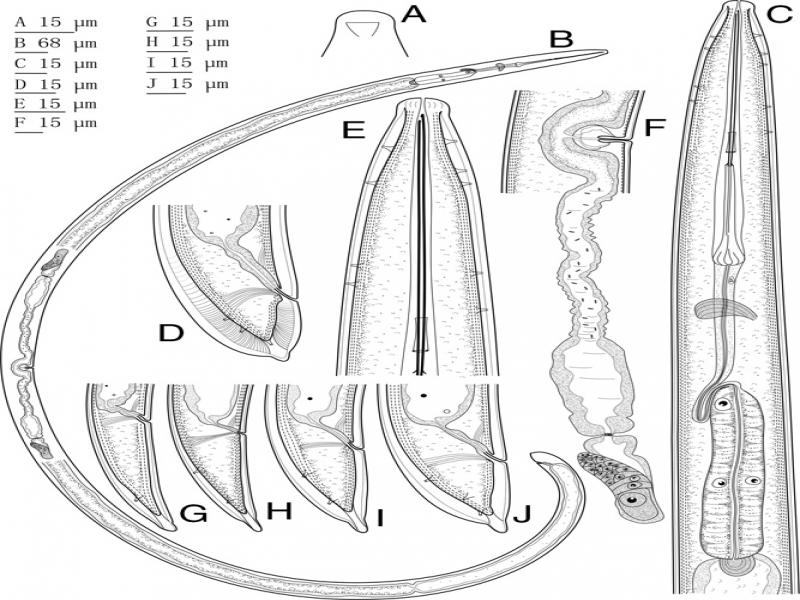
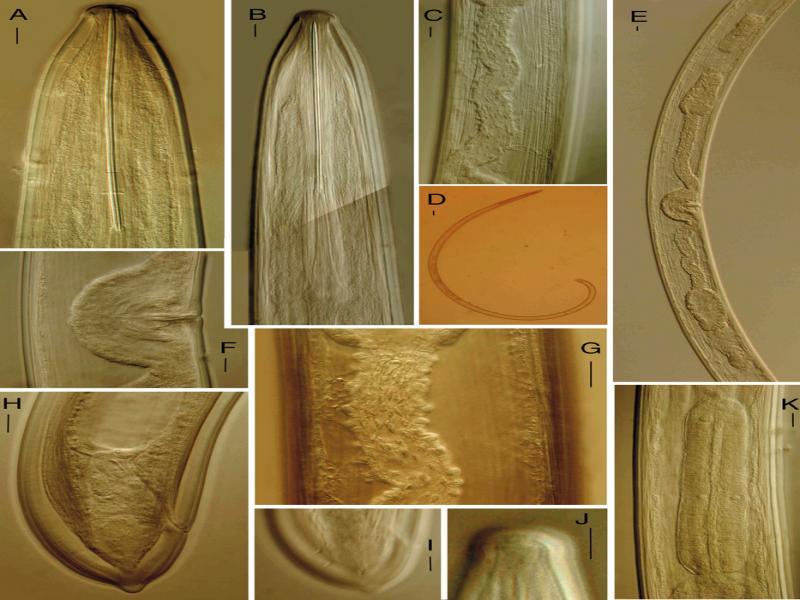
In a recent nematological survey on longidorids in Roodghat area, Sufiyan, East-Azarbaijan province in northwest of Iran, three known and one new species of the genus Xiphinema were found in several agroecosystems. The new species belonging to morphospecies group 6 of the genus was recovered from soil samples collected from the rhizosphere of common wheat and is described herein as X. barooghii n. sp. This is the fifth species belonging to morphospecies group 6 originally described from Iran, the other species being X. robbinsi (Pedram et al., 2008), X. iranicum (Pedram et al., 2009), X. mazandaranense (Pedram, Pourjam, Robbins, Ye, Atighi, and Decramer, 2012; Pedram, Pourjam, Palomares-Rius, Ghaemi, Cantalapiedra-Navarrete and Castillo, 2012) and X. zagrosense (Ghaemi et al., 2012), and except for X. robbinsi, the remaining three species have only been reported from Iran.
Materials and methods
Sampling, extraction, mounting, and drawing
During a survey on nematode diversity in agroecosystems of Roodghat area, Sufiyan, East- Azarbaijan province in northwest of Iran, several soil samples were collected during 2016 and 2017 and processed at the Nematology Laboratory, University of Tabriz, Tabriz, Iran. The samples were taken from a depth of 5–30 cm. Nematodes were extracted using a tray (Whitehead and Hemming, 1965) and posteriorly killed, fixed and transferred to anhydrous glycerin using the method proposed by De Grisse (1969). Temporary and permanent microscopic slides of the nematodes were prepared to study morphological and morphometric characters. Morphometric data were obtained using a drawing tube attached to an Olympus BX41 light microscope. Photographs were taken by a DP50 digital camera system connected to the microscope. Raw photographs were edited using Adobe® Photoshop® CS. Drawings were made by Corel DRAW®, software version 12.
DNA extraction, PCR, and sequencing
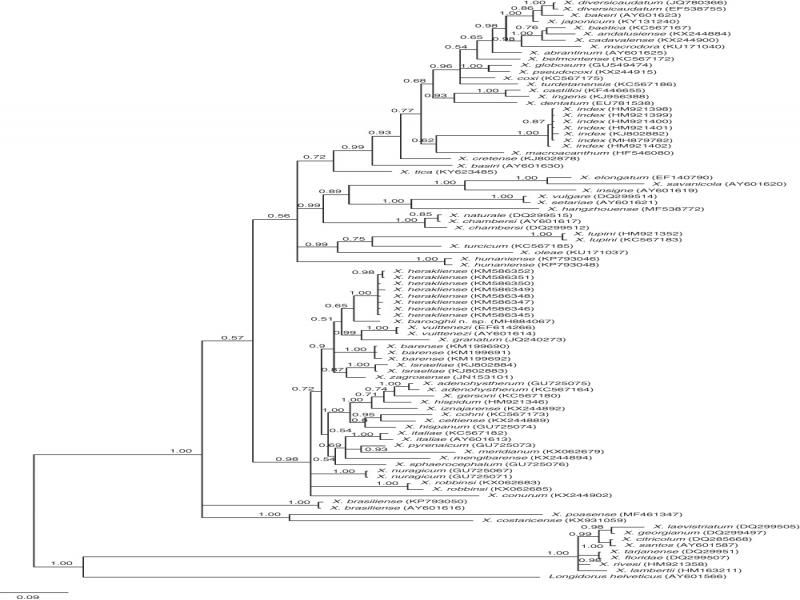
For DNA extraction from X. barooghii n. sp. and X. index, a live adult nematode from each was handpicked and separately placed in a small drop of distilled water or worm lysis buffer on a clean slide and crushed by a sterilized scalpel. The suspension was transferred to an eppendorf tube containing 25.65 μl ddH2O, 2.85 μl 10x PCR buffer and 1.5 μl proteinase K (600 μg/ml) (Promega, Benelux, The Netherlands). The tubes were stored at −80°C for 1 hr, incubated at 65°C for 1 hr and heated for 15 min at 95°C to inactivate the proteinase. The DNA sample was stored at −20°C until used as the PCR template. The D2–D3 domain region of LSU was amplified with the forward primer D2A (5′-ACAAGTACCGTGAGGGAAAGTTG-3′) and the reverse primer D3B (5′-TCGGAAGGAACCAGCTACTA-3′) (Nunn, 1992). The 25 μl PCR reaction mixture was composed by 10 μl ddH2O, 12.5 μl PCR master mix (Ampilliqon, Denmark), 0.75 μl of each forward and reverse primers and 1 μl of DNA template. The process was carried out using a Thermocycler Machine in accordance with Archidona-Yuste et al. (2016). PCR cycle conditions were as follows: denaturation at 94°C for 2 min, 35 cycles of denaturation at 94°C for 30 s, annealing of primers at 55°C for 45 s and extension at 72°C for 3 min followed by a final elongation step at 72°C for 10 min. PCR products were purified and sequenced by the Applied Biosystems® 3730/3730xl DNA Analyzer in South Korea. The recently obtained sequences of the new species and X. index were deposited in GenBank database under accession numbers MH884067 for X. barooghii n. sp. and MH879782 for X. index as indicated on the phylogenetic tree (Fig. 5).
Phylogenetic analyses
The newly obtained sequences were aligned using MEGA6 (Tamura et al., 2013) and compared with other Xiphinema D2–D3 expansion segment of 28S rDNA gene sequences available in GenBank using the Nblast homology search program. Longidorus helveticus (Lamberti et al., 2001) (AY601566) was chosen as out group. The best-fitted model of DNA evolution was obtained using MrModeltest 2.3 (Nylander, 2004) with the Akaike Information Criterion (AIC). Phylogenetic analysis of the sequence data sets was performed based on Bayesian Inference algorithm implemented in MrBayes 3.1.2 (Ronquist and Huelsenbeck, 2003) under the general time-reversible model with invariable sites and a gamma-shaped distribution (GTR + I + G). After discarding burn-in samples and evaluating convergence, the remaining samples were retained for further analyses. Posterior probabilities (PP) are given on appropriate clades. Tree was visualised using Fig tree 1.4.3 v.
Results
Systematics
Xiphinema barooghii n. sp.
Table 1
Morphometrics of Xiphinema barooghii n. sp. All measurements are in μm (except L in mm), and in the form: mean ± s.d. (range).
| Female | |||||||||||||
|---|---|---|---|---|---|---|---|---|---|---|---|---|---|
| Characters | J1 | J2 | J3 | J4 | Holotype | Paratypes | |||||||
| n | 3 | 1 | 5 | 5 | – | 8 | |||||||
| L | 1.15 ± 0.01 (1.14–1.16) | 1.73 | 2.19 ± 0.12 (2.01–2.31) | 3.07 ± 0.17 (2.87–3.34) | 4.10 | 4.02 ± 0.21 (3.67–4.25) | |||||||
| a | 44.0 ± 2.3 (41.0–47.0) | 41 | 55.0 ± 3.9 (51.0–62.0) | 58.0 ± 5.0 (51.0–64.0) | 55 | 59.0 ± 2.4 (53.0–63.0) | |||||||
| b | 3.7 ± 0.1 (3.6–3.8) | 5.1 | 5.1 ± 0.3 (4.7–5.6) | 6.5 ± 0.6 (5.9–7.5) | 8.2 | 7.7 ± 0.3 (7.0–8.5) | |||||||
| c | 18.0 ± 0.7 (17.0–19.0) | 29 | 44.0 ± 2.0 (42.0–47.0) | 66.0 ± 6.1 (60.0–76.0) | 132 | 117 ± 10 (103–133) | |||||||
| c′ | 3.2 ± 0.1 (3.1–3.3) | 2.3 | 1.62 ± 0.04 (1.60–1.70) | 1.1 ± 0.1 (1.0–1.3) | 0.7 | 0.80 ± 0.05 (0.70–0.90) | |||||||
| V | – | – | – | – | 47 | 47.0 ± 0.9 (46.0–48.0) | |||||||
| Lip region diam. | 10.5 ± 0.3 (10.0–11.0) | 10.6 | 12.2 ± 0.2 (12.0–13.0) | 14.0 ± 1.1 (13.0–16.0) | 15 | 14.6 ± 0.3 (14.0–15.0) | |||||||
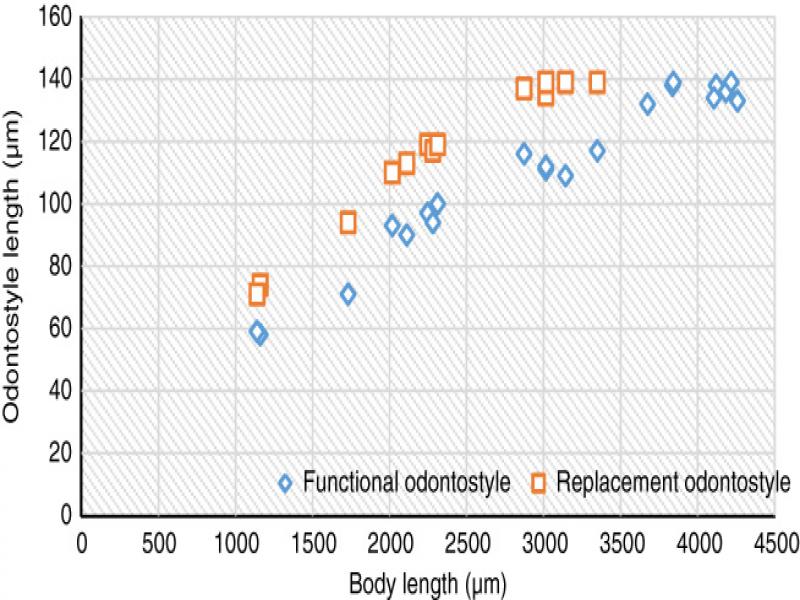
| Odontostyle length | 58.5 ± 0.2 (58.0–59.0) | 70 | 95.0 ± 2.8 (93.0–100.0) | 113.0 ± 3.3 (109.0–117.0) | 139 | 136.0 ± 2.7 (132.0–139.0) | |||||||
| Odontophore length | 45.0 ± 1.4 (44.0–47.0) | 54 | 63.0 ± 3.0 (60.0–67.0) | 76.0 ± 6.3 (70.0–87.0) | 82 | 82.0 ± 3.2 (75.0–85.0) | |||||||
| Spear length | 104.0 ± 0.4 (103.0–105.0) | 124 | 158.0 ± 4.8 (150.0–167.0) | 189.0 ± 5.7 (181.0–196.0) | 221 | 220.0 ± 3.3 (215.0–225.0) | |||||||
| Replacement odontostyle | 72.0 ± 1.6 (71.0–74.0) | 93 | 115.0 ± 2.9 (110.0–119.0) | 137.0 ± 1.7 (135.0–139.0) | – | – | |||||||
| Oral aperture to guide ring | 51.0 ± 0.5 (50.0–52.0) | 65 | 82.0 ± 3.1 (76.0–86.0) | 101.0 ± 2.4 (98.0–104.0) | 129 | 124.0 ± 5.3 (117.0–132.0) | |||||||
| Pharynx length | 311.0 ± 3.4 (307.0–315.0) | 337 | 423 ± 27 (396–476) | 447 ± 31 (416–484) | 500 | 520 ± 19 (493–553) | |||||||
| Pharyngeal bulb length | 88.0 ± 0.7 (87.0–89.0) | 88 | 112.0 ± 8.6 (103.0–125.0) | 122.0 ± 2.5 (118.0–125.0) | 144 | 141.0 ± 9.3 (128.0–153.0) | |||||||
| Body diam. at phar. base | 24.0 ± 1.6 (23.0–26.0) | 37 | 36.0 ± 3.6 (33.0–41.0) | 45.0 ± 4.1 (41.0–51.0) | 65 | 57.0 ± 7.5 (52.0–69.0) | |||||||
| mid-body | 24.0 ± 2.1 (24.0–28.0) | 42 | 40.0 ± 3.4 (34.0–44.0) | 52.0 ± 5.0 (46.0–59.0) | 74 | 67.0 ± 6.7 (60.0–79.0) | |||||||
| anus | 18.0 ± 0.4 (17.0–19.0) | 26 | 30.0 ± 0.8 (29.0–31.0) | 40.0 ± 2.7 (36.0–43.0) | 41 | 42.0 ± 1.8 (40.0–44.0) | |||||||
| G1 | – | – | – | – | 13 | 12.3 ± 0.4 (12.0–13.0) | |||||||
| G2 | – | – | – | – | 13 | 11.0 ± 1.3 (9.0–13.0) | |||||||
| Prerectum length | 265 ± 16 (246–284) | 305 | 412 ± 28 (319–444) | 572 ± 40 (525–625) | 603 | 595 ± 74 (503–700) | |||||||
| Rectum length | 14.0 ± 0.6 (13.0–15.0) | 19 | 26.0 ± 1.4 (22.0–28.0) | 33.0 ± 1.5 (31.0–35.0) | 49 | 43.0 ± 5.4 (35.0–51.0) | |||||||
| Tail length | 61.0 ± 1.3 (59.0–63.0) | 60 | 49.0 ± 1.1 (48.0–51.0) | 46.0 ± 1.5 (44.0–48.0) | 30 | 33.0 ± 2.6 (30.0–38.0) | |||||||
| Hyaline part of tail | 8.4 ± 0.3 (8.0–10.0) | 13 | 13.0 ± 1.3 (12.0–15.0) | 14.2 ± 0.5 (13.0–15.0) | 13 | 13.0 ± 0.8 (11.0–16.0) | |||||||
| Xiphinema spp. | A | B | C | D | E | F | G | H | I | J | K | L | References |
|---|---|---|---|---|---|---|---|---|---|---|---|---|---|
| spinuterus | 4 | 3 | 1 | 1 | 4 | 3 | 3 | 2 | 12 | – | – | 2 | 1 |
| mluci | 4 | 3 | 2 | 123 | 45 | (3)45 | 23 | 2 | 34 | 2 | – | 1 | 1 |
| xenovariabile | 4 | 3 | 23 | 34 | 56 | 23 | 1 | 2 | 3(4) | 2 | – | 2 | 1 |
| diannae | 4 | 3 | 3 | 4 | 45 | 3 | 12 | 2 | 23 | 3 | – | 2 | 1 |
| coomansi | 4 | 3 | 3 | 45 | 456 | 3 | 2 | 2 | 3 | 3 | – | 2 | 1 |
| lacrimaspinae | 4 | 3 | 4 | 4 | 4 | 3 | 2 | 2 | 3 | 34 | 2 | 1 | 1 |
| barbercheckae | 4 | 3 | 4 | 5 | 56 | 3 | 2 | 2 | 23 | 3 | – | 1 | 1 |
| mammatum | 4 | 3 | 5a | 4 | 4 | 3 | 2 | 2 | 3 | 5 | 2 | 2 | 1 |
| aequum | 4 | 3 | 5a | 5 | 5 | 45 | 3 | 2 | 3 | 5 | 2 | 2 | 1 |
| aceri | 4 | 3 | 6a | 56 | 5 | 4 | 23 | 3 | 3 | 6 | – | 1 | 1 |
| robbinsi | 4 | 3 | 5a | 65 | 56 | 3(4) | 2 | 2 | 3(4) | 5a | 2 | 2 | 2 |
| iranicum | 4 | 3 | 5a, b | 6 | 6 | 4 | 3(4) | 2 | 3 | 5 | 4 | 1 | 3 |
| nuragicum | 4 | 3 | 7 | 6 | 56 | 345 | 3 | 2 | 3 | 7 | 2 | 1 | 4 |
| pyrenaicum | 4 | 3 | 6 | 6 | 56 | 345 | 3 | 2 | 3 | 6 | 2 | 1 | 4 |
| adenohystherum | 4 | 3 | 7 | 6 | 56 | 45 | 3 | 2 | 3 | 7 | – | 1 | 4 |
| sphaerocephalum | 4 | 3 | 5 | 6 | 56 | 34 | 3 | 2 | 3 | 5 | 2 | 1 | 4 |
| mazandaranense | 4 | 3 | 7b | 6 | 456 | 45 | 2 | 2 | 23 | 7b | 2 | 1 | 5 |
| zagrosense | 4 | 3 | 6 | 6 | 456 | 45 | 34 | 2 | 3 | 5 | 2 | 1 | 6 |
| vuittenezi | 4 | 3 | 5(7b) | 56 | 56 | 34 | 23 | 2 | 3 | 45 | 2 | 1 | 7 |
| barooghii n. sp. | 4 | 3 | 5a | 6 | 5 | 4 | 3 | 2 | 3 | 4 | 2 | 1 | 8 |
| Species | Locality | Host-plant | Accession number |
|---|---|---|---|
| X. abrantinum | – | – | AY601625 |
| X. adenohystherum | Bollullos par del Condado, Huelva province, Spain | Vitis vinifera L. | GU725075 |
| X. adenohystherum | Arévalo de la Sierra, Soria province, Spain | Holly tree | KC567164 |
| X. andalusiense | Belmez, Cordoba province, Spain | Wild olive | KX244884 |
| X. baetica | Manzanilla, Huelva province, Spain | Grapevine | KC567167 |
| X. bakeri | – | – | AY601623 |
| X. barense | Apulian region, Torre pozzella, Brindisi province, southern Italy | Wild olive (Olea europaea sylvestris L.) | KM199690 |
| X. barense | Apulian region, Torre Pozzella, Brindisi Province, southern Italy | Wild olive (Olea europaea sylvestris L.) | KM199691 |
| X. barense | Apulian region, Torre Pozzella, Brindisi Province, southern Italy | Wild olive (Olea europaea sylvestris L.) | KM199692 |
| X. barooghii n. sp. | Roodghat area, Sufiyan, East-Azarbaijan province, northwest of Iran | Common wheat (Triticum aestivum L.) | MH884067 |
| X. basiri | – | – | AY601630 |
| X. belmontense | Merza, Coruña province, Spain | Pedunculate oak | KC567172 |
| X. brasiliense | Shenzhen, China | – | KP793050 |
| X. brasiliense | – | – | AY601616 |
| X. castilloi | Sefid Rud River near Rasht, Gilan province, Iran | Ash tree | KF446655 |
| X. cadavalense | Espiel ,Cordoba province, Spain | Cultivated olive | KX244900 |
| X. celtiense | Peñafor, Sevilla province, Spain | Wild olive | KX244889 |
| X. chambersi | Florida, USA | – | DQ299512 |
| X. chambersi | – | – | AY601617 |
| X. citricolum | Florida, USA | – | DQ285668 |
| X. cohni | El Puerto de Santa María, Cádiz province, Spain | Stone pine | KC567173 |
| X. conurum | Uleila del Campo, Almeria province, Spain | cultivated olive | KX244902 |
| X. cretense | Hersonisos, Heraklion province, Crete, Greece | Olive (Olea europaea L. subsp. europaea) | KJ802878 |
| X. costaricense | Pacayitas, La Suiza de Turrialba, Cartago, Costa Rica | Sugarcane | KX931059 |
| X. coxi | Hinojos, Huelva province, Spain | Carob tree | KC567175 |
| X. dentatum | Czech Republic | Carpinus betulus and Acer platanoides | EU781538 |
| X. diversicaudatum | – | – | EF538755 |
| X. diversicaudatum | Marchegg, Austria | – | JQ780366 |
| X. elongatum | China | – | EF140790 |
| X. floridae | Florida, USA | – | DQ299507 |
| X. gersoni | Almonte, Huelva province, Spain | Eucalyptus | KC567180 |
| X. georgianum | Florida, USA | – | DQ299497 |
| X. globosum | Valdeinfierno in the Los Alcornocales Regional Park, Alcalá de los Gazules, Cádiz province, southern Spain | Black alder, Alnus glutinosa L. Gaertn., and river bank grapevine, Vitis riparia | GU549474 |
| X. granatum | Saveh, Markazi province, Iran | Pomegranate trees (Punica granatum L.) | JQ240273 |
| X. hangzhouense | Hangzhou, Zhejiang Province, China | Magnolia grandiflora L. | MF538772 |
| X. herakliense | Vathy Rema, Heraklion province, Crete, Greece | Olive tree (Olea europaea subsp. sylvestris) | KM586345 |
| X. herakliense | Vathy Rema, Heraklion province, Crete, Greece | Olive tree (Olea europaea subsp. sylvestris) | KM586346 |
| X. herakliense | Agiofarago, south west Heraklion province, Crete, Greece | Olive | KM586347 |
| X. herakliense | Agiofarago, south west Heraklion province, Crete, Greece | Olive | KM586348 |
| X. herakliense | Agiofarago, south west Heraklion province, Crete, Greece | Olive | KM586349 |
| X. herakliense | Agiofarago, south west Heraklion province, Crete, Greece | Olive | KM586350 |
| X. herakliense | Hersonisos, northeast Heraklion province, Crete, Greece | Olive (Olea europaea subsp. europaea L.) | KM586351 |
| X. herakliense | Hersonisos, northeast Heraklion province, Crete, Greece | Olive (Olea europaea subsp. europaea L.) | KM586352 |
| X. hispanum | Andujar, Jaen province, Spain | Cistus albidus L. | GU725074 |
| X. hispidum | Bollullos par del Condado, Huelva province, Spain | Grapevine (Vitis vinifera L.) | HM921346 |
| X. hunaniense | Shenzhen, China | – | KP793046 |
| X. hunaniense | Shenzhen, China | – | KP793048 |
| X. index | Córdoba province, Spain | Grapevine | HM921398 |
| X. index | Kentri, Greece | Olive | KJ802882 |
| X. index | Córdoba province, Spain | Grapevine | HM921399 |
| X. index | Córdoba province, Spain | Grapevine | HM921400 |
| X. index | Córdoba province, Spain | Grapevine | HM921401 |
| X. index | Cádiz province, Spain | Grapevine | HM921402 |
| X. index | Roodghat area, Sufiyan, East-Azarbaijan province, northwest of Iran | Apple (Malus domestica L.) variety Red delicious | MH879782 |
| X. ingens | Chogha Kaboud village, Harsin, Kermanshah province, Iran | Astragalus sp. | KJ956388 |
| X. insigne | – | – | AY601619 |
| X. israeliae | Roufas, Greece | Olive | KJ802883 |
| X. israeliae | Agiofarago, Greece | Wild olive | KJ802884 |
| X. italiae | Cabra, Córdoba province, Spain | Grapevine | KC567182 |
| X. italiae | AY601613 | ||
| X. iznajarense | Iznaajar, Cordoba province, Spain | Cultivated olive | KX244892 |
| X. japonicum | Japan | Podocarpus macrophyllus L. | KY131240 |
| X. laevistriatum | Florida, USA | – | DQ299505 |
| X. lambertii | India | – | HM163211 |
| X. lupini | Bollullos par del Condado, Huelva province, Spain | Grapevine (Vitis vinifera L.) | HM921352 |
| X. lupini | Hinojos, Huelva province, Spain | Grapevine | KC567183 |
| X. macroacanthum | Southern Italy | Olive orchards | HF546080 |
| X. macrodora | La Granjuela, Córdoba province, Spain | Cultivated olive | KU171040 |
| X. mengibarense | Mengibar, Jaen province, Spain | Cultivated olive | KX244894 |
| X. meridianum | Sbitla, Kasserine, Tunisia | Cultivated olive | KX062679 |
| X. naturale | Florida, USA | – | DQ299515 |
| X. nuragicum | Marchena, Seville province, Spain | Olea europaea sp. europaea L. | GU725071 |
| X. nuragicum | Puente Genil, Cordoba province, Spain | Vitis vinifera L. | GU725067 |
| X. oleae | Tarifa, Cádiz province, Spain | Wild olive | KU171037 |
| X. poasense | Toro Amarillo, Valverde Vega, San Carlos Alajuela, Costa Rica | Eucalyptus, cypress and fountain grass | MF461347 |
| X. pseudocoxi | Alcaracejos, Cordoba province, Spain | Wild olive | KX244915 |
| X. pyrenaicum | Cahors, Midi-Pyrenees province, France | Vitis vinifera L. | GU725073 |
| X. rivesi | Bollullos par del Condado, Huelva province, Spain | Grapevine (Vitis vinifera L.) | HM921358 |
| X. robbinsi | Sbitla, Kasserine, Tunisia | Cultivated olive | KX062683 |
| X. robbinsi | Abida, Kairouan, Tunisia | Cultivated olive | KX062685 |
| X. santos | – | – | AY601587 |
| X. savanicola | – | – | AY601620 |
| X. setariae | – | – | AY601621 |
| X. sphaerocephalum | Coto Rios, Jaen province, Spain | Quercus faginea L. | GU725076 |
| X. tarjanense | DQ299511 | ||
| X. tica | Chirraca, San Ignacio de Acosta, San José, Costa Rica | Grapevine | KY623485 |
| X. turcicum | Sanlúcar de Barrameda, Cádiz province, Spain | Grapevine | KC567185 |
| X. turdetanensis | Sanlúcar de Barrameda, Cádiz province, Spain | Stone pine | KC567186 |
| X. vuittenezi | Czech Republic | – | EF614266 |
| X. vuittenezi | – | – | AY601614 |
| X. vulgare | Florida, USA | – | DQ299514 |
| X. zagrosense | Madavan village, Kohgiluyeh and Boyer-Ahmad province, Iran | Grasses | JN153101 |
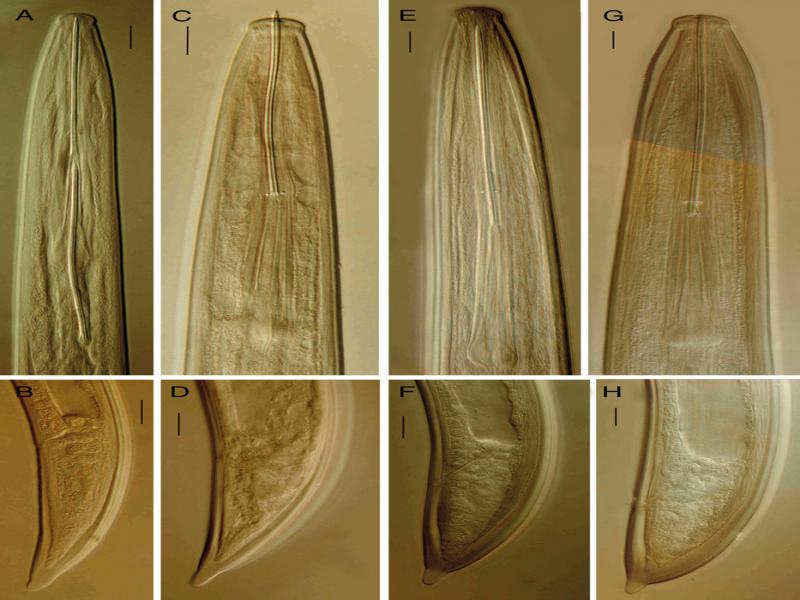
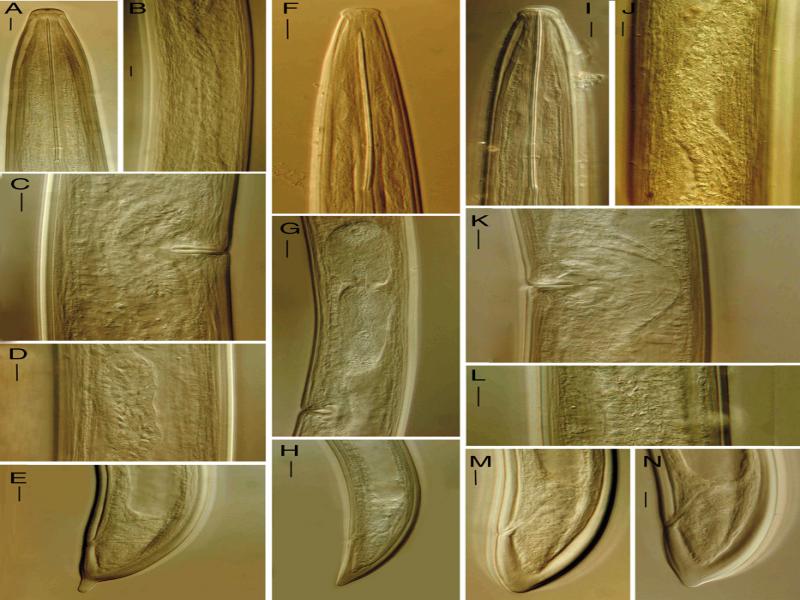
| X. index | X. pachtaicum | X. vuittenezi | |
|---|---|---|---|
| Characters | Female | Female | Female |
| n | 5 | 5 | 6 |
| L | 2.98 ± 0.18 (2.68–3.13) | 2.04 ± 0.08 (1.95–2.17) | 3.51 ± 0.16 (3.25–3.76) |
| a | 55.0 ± 4.2 (50.0–60.0) | 61.0 ± 8.7 (52.0–74.0) | 69.0 ± 5.0 (63.0–78.0) |
| b | 6.7 ± 0.3 (6.3–7.3) | 6.7 ± 0.6 (6.3–7.8) | 7.6 ± 0.1 (7.3–7.9) |
| c | 76.0 ± 2.4 (74.0–80.0) | 69.0 ± 3.6 (64.0–73.0) | 89.0 ± 3.6 (77.0–95.0) |
| c′ | 1.04 ± 0.05 (1.00–1.10) | 1.50 ± 0.10 (1.40–1.70) | 1.10 ± 0.08 (1.00–1.20) |
| V | 37.0 ± 0.7 (36.0–38.0) | 54.0 ± 1.2 (53.0–56.0) | 49.0 ± 0.4 (47.0–50.0) |
| Lip region diam. | 13.0 ± 0.8 (12.0–14.0) | 9.4 ± 0.5 (9.0–10.0) | 13.0 ± 0.7 (12.0–14.0) |
| Odontostyle length | 121.0 ± 2.7 (118.0–125.0) | 83.0 ± 2.6 (81.0–87.0) | 122.0 ± 3.7 (118.0–128.0) |
| Odontophore length | 70.0 ± 1.7 (69.0–73.0) | 50.0 ± 3.3 (44.0–54.0) | 68.0 ± 4.1 (51.0–75.0) |
| Spear length | 192.0 ± 2.7 (189.0–195.0) | 133.0 ± 2.7 (130.0–137.0) | 191.0 ± 6.8 (175.0–200.0) |
| Oral aperture to guide ring | 114.0 ± 4.3 (106.0–119.0) | 70.0 ± 3.6 (68.0–77.0) | 108.0 ± 4.3 (100.0–113.0) |
| Pharynx length | 437 ± 11 (421–450) | 303 ± 20 (250–328) | 457 ± 11 (443–475) |
| Pharyngeal bulb length | 99.0 ± 6.4 (87.0–110.0) | 77.0 ± 4.6 (72.0–84.0) | 114 ± 10 (100–131) |
| Body diam. at phar. base | 47.0 ± 3.4 (43.0–52.0) | 29.0 ± 2.2 (26.0–32.0) | 41.0 ± 2.7 (37.0–45.0) |
| mid-body | 54.0 ± 3.8 (45.0–59.0) | 33.0 ± 2.4 (28.0–37.0) | 49.0 ± 5.3 (41.0–56.0) |
| anus | 35.0 ± 3.5 (31.0–40.0) | 19.0 ± 1.4 (17.0–21.0) | 35.0 ± 2.1 (32.0–38.0) |
| G1 | 13.2 ± 0.4 (13.0–14.0) | 12.0 ± 1.2 (11.0–14.0) | 12.6 ± 0.3 (12–13) |
| G2 | 12.0 ± 1.3 (11.0–14.0) | 12.0 ± 1.9 (10.0–14.0) | 12.0 ± 0.8 (11.0–13.0) |
| Prerectum length | 320 ± 46 (250–381) | 168 ± 17 (134–187) | 496 ± 58 (431–575) |
| Rectum length | 30.0 ± 1.9 (27.0–32.0) | 24.0 ± 3.5 (23.0–28.0) | 31.0 ± 1.2 (29.0–33.0) |
| Tail length | 39.0 ± 0.9 (36.0–41.0) | 29.0 ± 1.1 (28.0–31.0) | 39.0 ± 1.4 (38.0–41.0) |
| Hyaline part of tail | 17.0 ± 1.4 (15.0–19.0) | 10.0 ± 0.8 (9.0–11.0) | 14.0 ± 1.8 (12.0–16.0) |