
Table 1
Morphometrics of Pratylenchus vulnus from apples stoolbeds, nurseries (males and females), and orchards from four Tunisian regions (Kasserin, Kairouan, Monastir, and Zaghouan, Tunisia).
| Stoolbed | |||
| Locality | MM106 Chiha | ||
| Characters | Females | Males | |
| n | 5 | 5 | |
| L | 444.4 ± 29.36 (415.71–485.86) | 419.83 ± 32.43 (395.01–475.2) | |
| Stylet length (µm) | 14.29± 0.16 (14.17–14.55) | 14.85 ± 0.21 (14.56–15.1) | |
| Spicules (µm) | 16.88± 0.26 (16.58–17.2) | ||
| Gubernaculum (µm) | 4.8± 0.39 (4.2–5.25) | ||
| V or T | 81.22± 0.73 (80.55–82.39) | 34.02± 1.17 (32.11–35.2) | |
| a | 26.73 ± 1.32 (24.59–28.1) | 28.99 ± 2.76 (25.2–31.4) | |
| b | 7.62 ± 0.55 (6.87–8.16) | 6.72 ± 0.66 (5.88–7.5) | |
| b′ | 4.92 ± 0.9 (3.76–5.66) | 4.85 ± 0.27 (4.55–5.22) | |
| c | 19.11 ± 0.44 (18.57–19.5) | 20.75 ± 0.55 (19.88–21.3) | |
| c′ | 2.29 ± 0.22 (2.01–2.58) | 2.14 ± 0.1 (2.01–2.28) | |
| Nursery females | |||
| Locality | Lorca Chiha | Meski SMCCSPS | |
| Characters | Females | Females | |
| n | 5 | 5 | |
| L | 556.71 ± 33.21 (521.32–607.49) | 512.48 ± 51.46 (450.11–578.12) | |
| Stylet length (µm) | 15. 45± 0.31 (15.17–15.93) | 14. 44± 0.6 (13.69–15.19) | |
| Spicules (µm) | |||
| Gubernaculum (µm) | |||
| V or T | 78.77± 1.31 (76.95–80.55) | 79.14 ± 1.74 (76.58–81.3) | |
| a | 28.8 ± 4.12 (25.93–35.73) | 28.88 ± 3.72 (25.72–35.33) | |
| b | 7.82 ± 1.33 (6.1–9.56) | 7.97 ± 0.84 (7.12–9.18) | |
| b′ | 5.26 ± 0.11 (5.16–5.41) | 4.27 ± 0.27 (3.88–4.55) | |
| c | 20.22 ± 1.91 (18.17–22.7) | 21.79 ± 2.81 (18.68–25.5) | |
| c′ | 2.44 ± 0.27 (2.08–2.78) | 2.33 ± 0.33 (2.04–2.91) | |
| Nursery males | |||
| Locality | Lorca Chiha | Anna Manzel Nour | Meski SMCCSPS |
| Characters | Males | Males | Males |
| n | 5 | 5 | 5 |
| L | 483.75 ± 10.58 (468.63–492.7) | 478.62 ± 30.09 (431.65–503.93) | 485.52 ± 34.38(451.12–540.76) |
| Stylet length (µm) | 14.81 ± 0.49 (14.41–15.66) | 14.46 ± 0.75 (13.49–15.26) | 14.31 ± 0.28 (14.01–14.66) |
| Spicules (µm) | 17.07± 1.35 (15.47–19.14) | 19.16± 0.61 (18.25–19.65) | 18.15 ± 0.58 (17.37–19) |
| Gubernaculum (µm) | 4.92± 0.34 (4.46–5.31) | 5.26± 0.27 (4.95–5.66) | 5.07 ± 0.43 (4.56–5.72) |
| V or T | 35.38± 2.75 (32–38.17) | 37.56± 2.55 (33.72–40.6) | 36.42 ± 2.76 (34.05–40.54) |
| a | 28.85 ± 1.45 (26.5–30.3) | 29.37 ± 2.33 (25.87–32.15) | 27.01 ± 1.37 (25.36–28.91) |
| b | 8.24 ± 1.21 (7.23–10.22) | 9.11 ± 0.38 (8.66–9.67) | 9.2 ± 1.01 (8.14–10.5) |
| b′ | 5.31 ± 0.1 (5.2–5.43) | 4.29 ± 0.45 (3.77–4.95) | 4.85 ± 0.53 (4.47–5.75) |
| c | 19.89 ± 1.48 (17.86–21.62) | 20.95 ± 1.46 (18.7–22.47) | 20.16 ± 1.83 (18.85–23.37) |
| c′ | 2.29 ± 0.18 (2.09–2.51) | 2.06 ± 0.08 (2–2.21) | 2.26 ± 0.21 (1.92–2.45) |
| Orchads | |||
| Locality | Lorca Chiha | Anna Manzel Nour | Meski SMCCSPS |
| Characters | Males | Males | Males |
| n | 5 | 5 | 5 |
| L | 483.75 ± 10.58 (468.63–492.7) | 478.62 ± 30.09 (431.65–503.93) | 485.52 ± 34.38(451.12–540.76) |
| Stylet length (µm) | 14.81 ± 0.49 (14.41–15.66) | 14.46 ± 0.75 (13.49–15.26) | 14.31 ± 0.28 (14.01–14.66) |
| Spicules (µm) | 17.07± 1.35 (15.47–19.14) | 19.16± 0.61 (18.25–19.65) | 18.15 ± 0.58 (17.37–19) |
| Gubernaculum (µm) | 4.92± 0.34 (4.46–5.31) | 5.26± 0.27 (4.95–5.66) | 5.07 ± 0.43 (4.56–5.72) |
| V or T | 35.38± 2.75 (32–38.17) | 37.56± 2.55 (33.72–40.6) | 36.42 ± 2.76 (34.05–40.54) |
| a | 28.85 ± 1.45 (26.5–30.3) | 29.37 ± 2.33 (25.87–32.15) | 27.01 ± 1.37 (25.36–28.91) |
| b | 8.24 ± 1.21 (7.23–10.22) | 9.11 ± 0.38 (8.66–9.67) | 9.2 ± 1.01 (8.14–10.5) |
| b′ | 5.31 ± 0.1 (5.2–5.43) | 4.29 ± 0.45 (3.77–4.95) | 4.85 ± 0.53 (4.47–5.75) |
| c | 19.89 ± 1.48 (17.86–21.62) | 20.95 ± 1.46 (18.7–22.47) | 20.16 ± 1.83 (18.85–23.37) |
| c′ | 2.29 ± 0.18 (2.09–2.51) | 2.06 ± 0.08 (2–2.21) | 2.26 ± 0.21 (1.92–2.45) |
[ii] Abbreviations are defined in Siddiqi (2000).
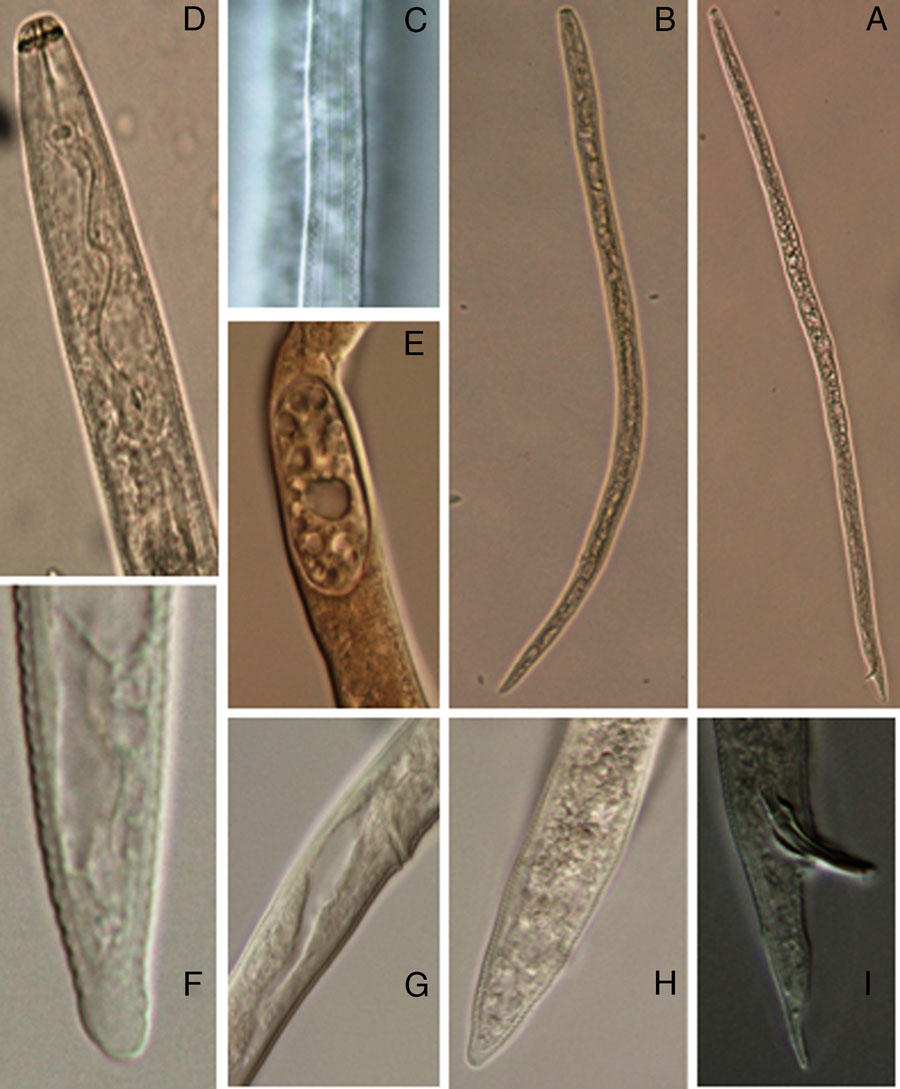
Figure 1
Photo micrographs of Pratylenchus vulnus specimens: females (B) and males (A), (C): lateral field at mid – body; (D): spermatheca; (E): pharyngeal region; (F) and (H): female tails; (G): vulval region; (I): male tail (Scale bars: A, B = 100 mm; C–I = 20 mm).
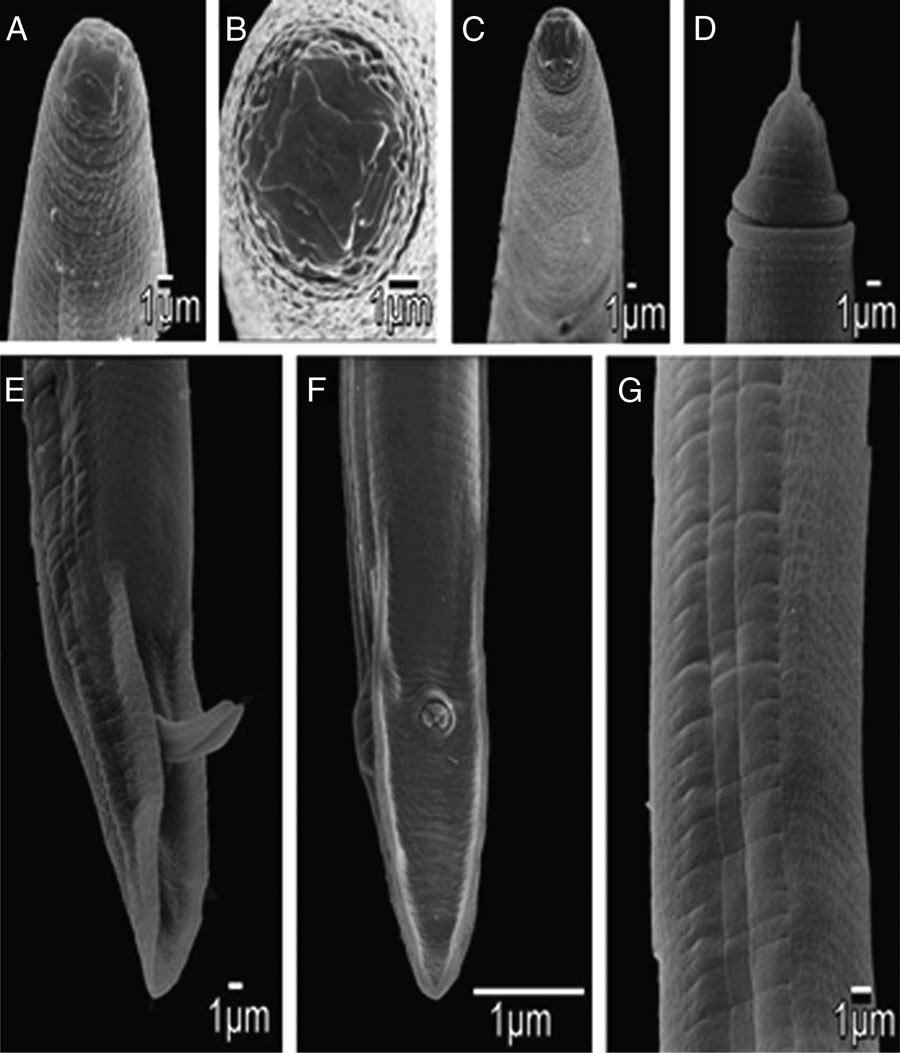
Figure 2
SEM micrograph of P. vulnus male morphology from Tunisia (A, B, C, D): anterior region, (E, F) : tail, (G) : lateral fields; sp : spicules, lig : 4 lateral lines ; anx : 3 labial annuli).
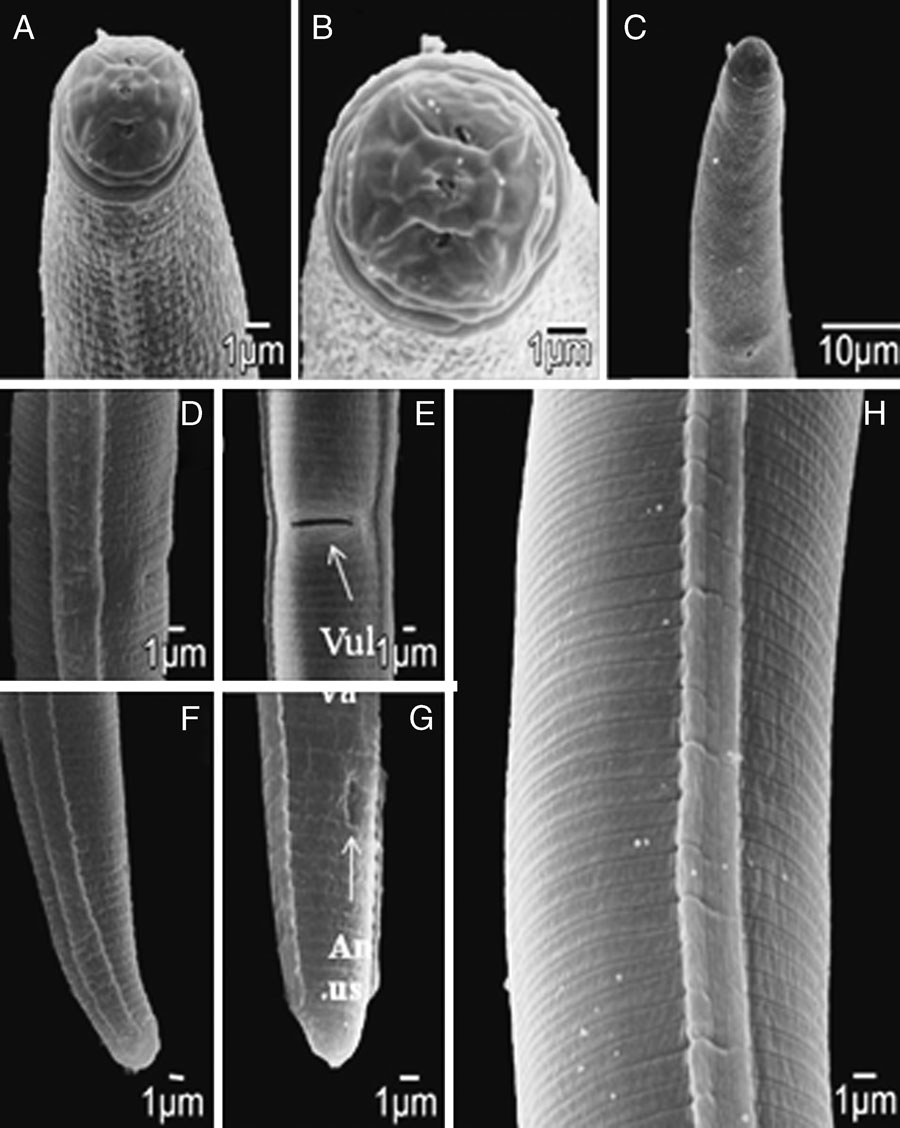
Figure 3
SEM micrograph of P. vulnus female morphology from Tunisia (A; B; C): anterior region, (D): lateral lines at vulva region, (E): vulva, (F, G): tail, (H): lateral fields).
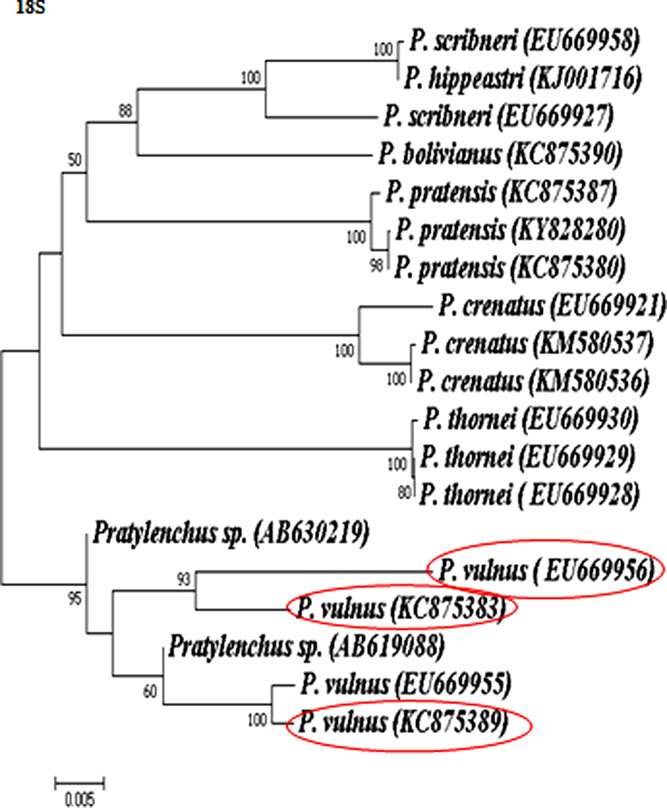
Figure 4
Phylogenetic relationships between Pratylenchus vulnus identified in Tunisia and other Pratylenchus already deposited in GenBank. The Pratylenchus sequences aligned in MEGA with CLUSTALW and the phylogenetic tree made by MEGA version 7.0 based on the Neighbor-Joining method as inferred from partial 18S rRNA gene.
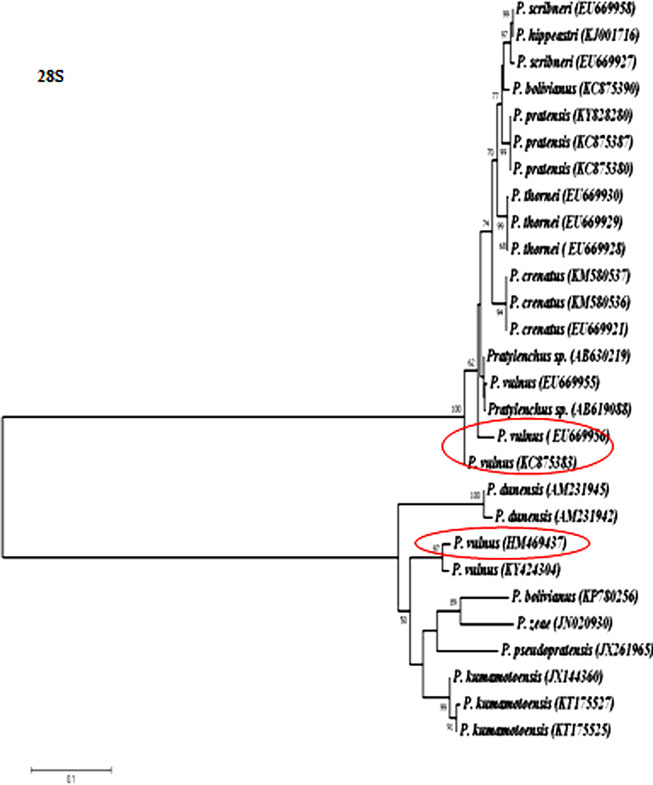
Figure 5
Phylogenetic relationships between Pratylenchus vulnus identified in Tunisia and other Pratylenchus already deposited in GenBank. The Pratylenchus sequences aligned in MEGA with CLUSTALW and the phylogenetic tree made by MEGA version 7.0 based on the Neighbor-Joining method as inferred from D2-D3 expansion segments of the 28S rRNA.