Along with dates and citrus, which represent the main fruit tree commodities produced and exported in Tunisia, apples have an important place in the fruit sector. Pome and stone fruit trees can be infected by plant parasitic nematodes which are a serious problem influencing the growth and production of trees in all major fruit producing area (Askary et al., 2012). The root-lesion nematodes, Pratylenchus genus, are common endoparasites of plants worldwide. These nematodes cause severe production constraints and have great economic impact on numerous important crops (Castillo and Vovlas, 2007). They are migratory parasites, cause local lesions, and affect root growth by penetrating and feeding on young roots of host plant (Pinochet et al., 1996).
Within the genus Pratylenchus, 12 species have been reported as potential pathogens on apple (Castillo and Vovlas, 2007). Moreover, root-lesion nematodes, particularly Pratylenchus vulnus, is a major pest attacking pome and stone fruit crops in warm Mediterranean environments (Mckenry, 1989; Pinochet et al., 1992; Nyczepir and Becker, 1998; Askary et al., 2012).
The purpose of this study is to identity morphologically and by molecular tools the population of plant parasitic nematode (Pratylenchus spp.) in apple nurseries and orchards in Tunisia.
Materials and methods
Nematodes collection and extraction
Nematode surveys were conducted during 2013-14 in three different sites (stoolbeds, nurseries, and orchards) located in central Tunisia (Kairouan, Zaghouan, Kasserine, Jendouba, and Monastir). Samples were collected with a shovel from the upper 50 cm of soil and roots of four to five holes. Nematodes were extracted from 500 g of soil and from 1 g of roots by a modified sugar centrifugal-flotation method (De Grisse, 1969). Single females of root-lesion nematodes were transferred to carrot discs at 25°C (Castillo et al., 1995). After incubation of carrot cultures for up 8 wk, the carrot discs were cut into pieces in petri dishes containing sterile water. Then, the petri plates were incubated for 24 hr and collected by sterile Pasteur pipettes. Finally, purified nematodes extracted from carrot discs were used for further morphological and molecular analysis.
Morphological identification
Nematodes were preliminarily identified by morphological features. For that, five females and five males of each population of Pratylenchus were killed by gentle heat, fixed in buffered formalin (Seinhorst, 1959), and processed to pure glycerin. Specimens were examined using a Nikon Eclipse 80i compound microscope with Normarski differential interference contrast at powers up to 1,000× magnification. Measurements were made on glycerin infiltrated specimens with Nikon Digital Sight DS-FI2 K10410 camera and expressed in µm. The used measurement’s abbreviations were defined as Siddiqi (2000). Camera observations were performed as defined by De Man (1880). Nematodes were identified to the species level using Castillo and Vovlas (2007) diagnostic keys.
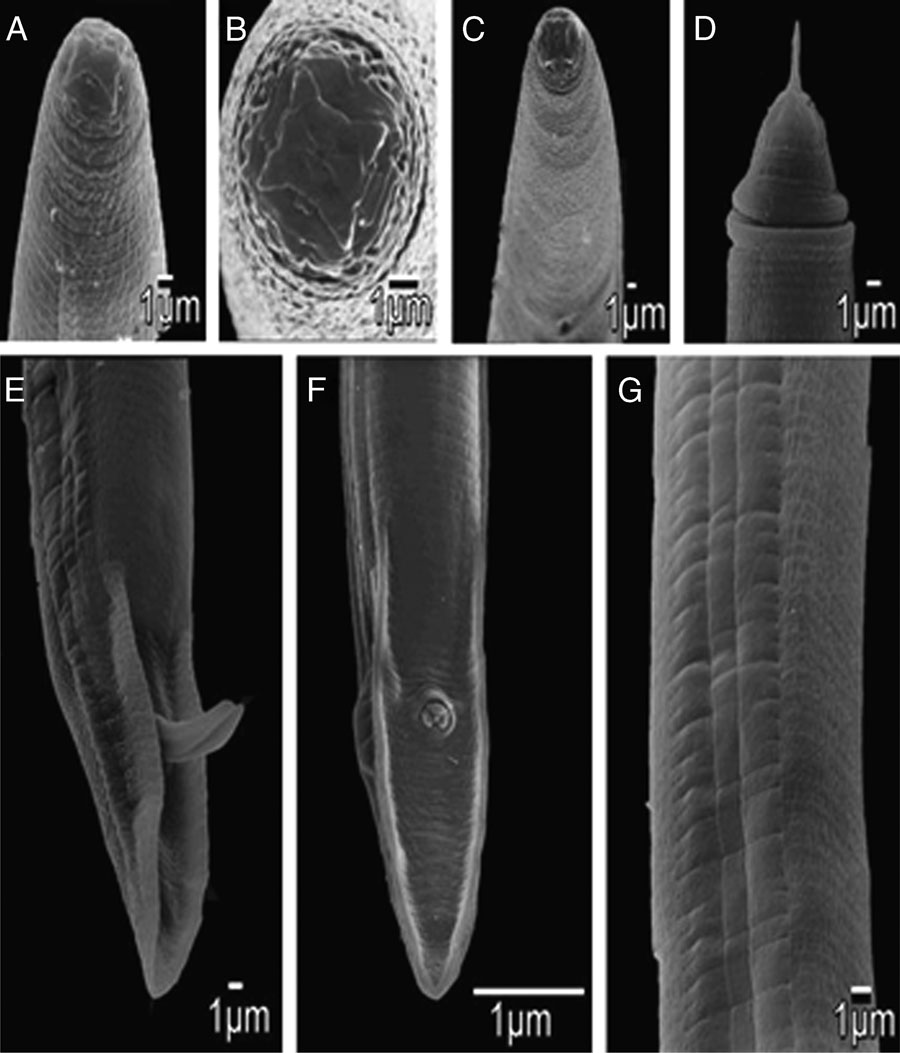
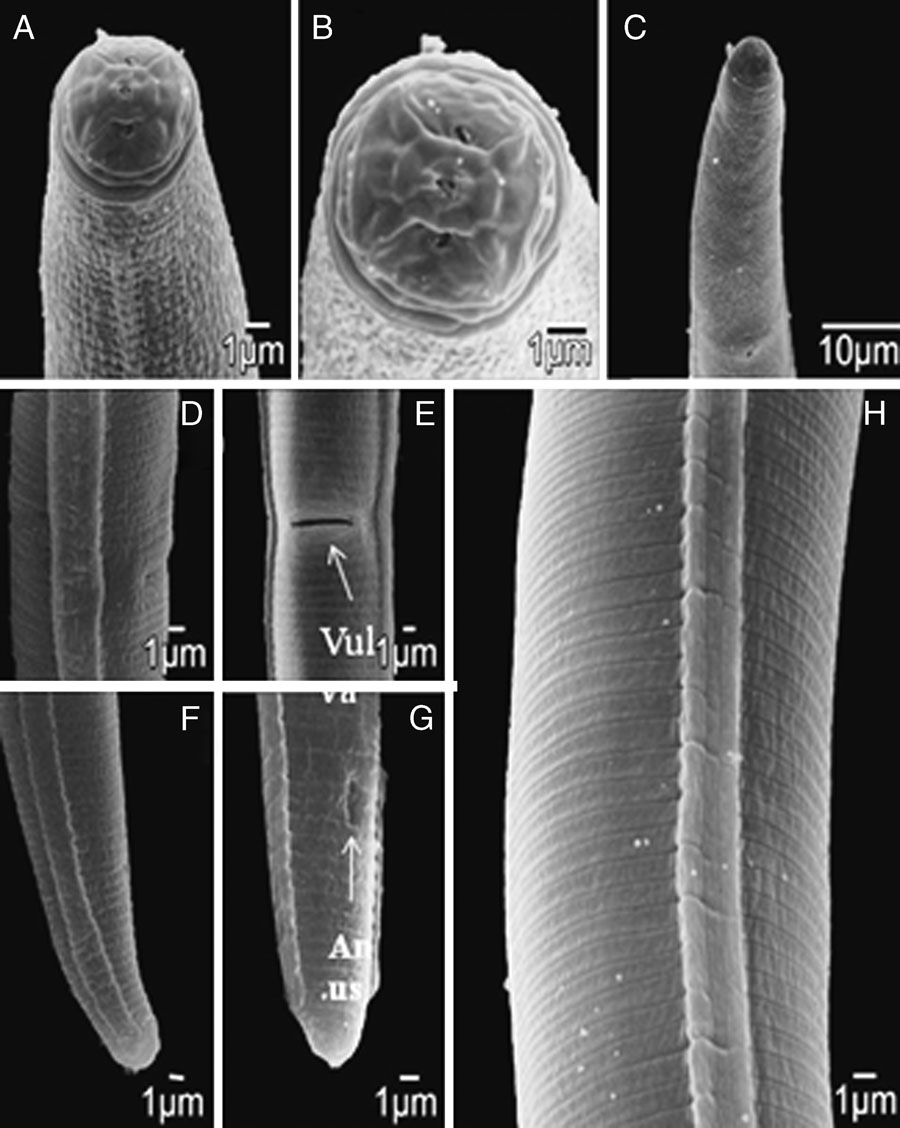
The scanning electron microscopy (SEM) of Pratylenchus males and females were assessed as described by Abolafi (2015).
Molecular identification
DNA extraction
DNA was extracted from several specimens from each sample. Each nematodes specimen was transferred to an Eppendorf tube containing 30 µL 10× PCR buffer (100 mMTris-HCl, pH 9.0 at 25°C, 500 mMKCl, 15 mM MgCl2), 10 µL Proteinase K (1 mg/mL), 50 µL distilled water. Specimens were crushed for 3 min with an ultrasonic homogenizer. The tubes were incubated at 68°C for 2 hr, then at 100°C for 15 min and stored at −20°C.
DNA amplification and cloning
The forward 18S-F (5′-TTGGATAACTGTGGTTTAACTAG-3′) and the reverse 18S-R (5′-ATTTCACCTCTCACGCAACA-3′) primers and the forward D2a (5′-ACAAGTACCGTGAGGGAAAGTTG-3′) and the reverse D3b (5′-TCGGAAGGAACCAGCTACTA-3′) were used for amplification and sequencing of the partial 18S r RNA genes and the D2-D3 expansion segments of the 28S r RNA, respectively. The amplification condition were: 95°C for 3 min, followed by 40 cycles of 30 sec at 95°C, 45 sec at 60°C and 2 min at 72°C, with final extension of 10 min at 72°C. All PCR reactions were performed in 25 µl volumes including 3 µl DNA, 2.5 µl 10× PCR buffer, 1.25 µl of 2.5 mM dNTPs, 0.4 µl from each primers and 0.25 µl Titanium Taq.
The PCR products were separated by electrophoresis (110 V, 45 min) in 2.0% agarose gels in TAE buffer with 2.5 µl DNA Ladder. The gels were stained with Ethidium bromide, visualized, and photographed under UV-light (Bio-rad DX, USA). All reactions were repeated twice for clear and stable banding patterns. The presence or absence of DNA fragments was scored as 1 or 0, respectively, in the binary matrix. Simple matching coefficients (SM) (Digby and Kempton, 1987).
Sequence alignment and phylogenetic analysis
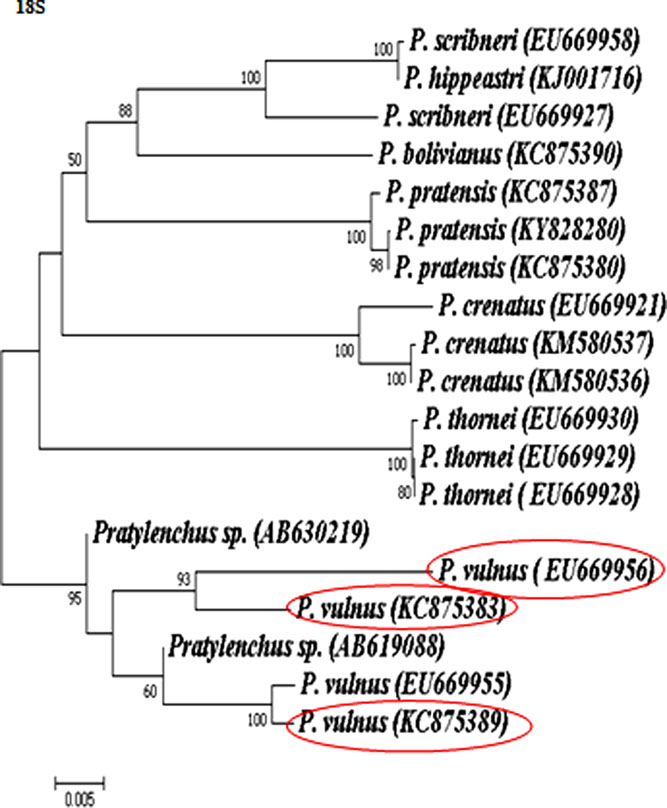
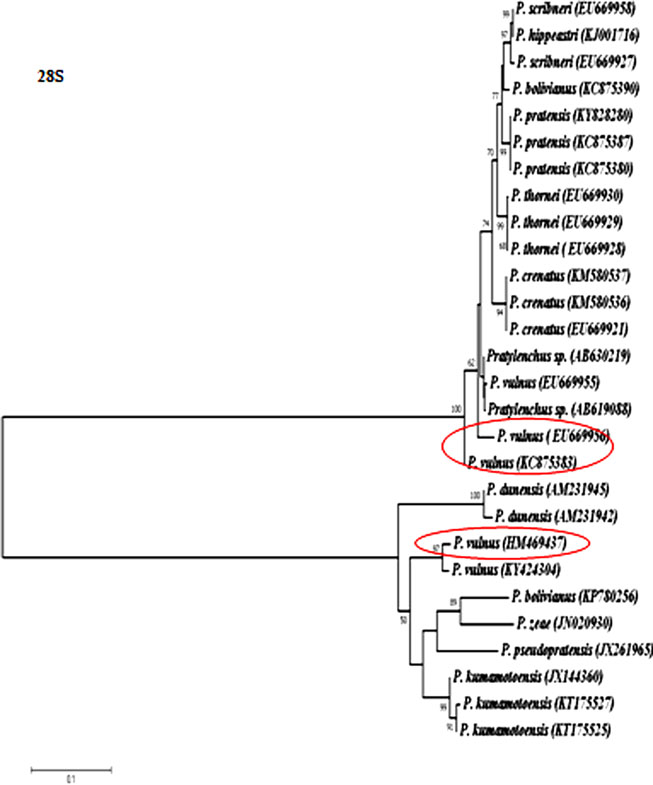
The 18S and 28S fragments were sequenced in-house with an ABI Prism 377 sequencer (Perkin Elmer) in both directions and unambiguous consensus sequences obtained. The sequences were deposited into the GenBank database. DNA sequences were aligned by Clustal W (http://workbench.sdsc.edu, Bioinformatics and Computational Biology group, Department of Bioengineering, UC San Diego, CA). The sequences were compared with those of the other Pratylenchus species available at the GenBank sequence database using the BLAST homology search program. The model of base substitution was evaluated using MODELTEST (Posada and Crandall, 1998). The Pratylenchus sequences were aligned using CLUSTALW implemented in the MEGA package (Kumar et al., 2008). Clade reliability was examined though a nonparametric bootstrap with 1,000 replicated samples. The phylogenetic tree was constructed by neighbor-joining method with MEGA package v.7 (Kumar et al., 2016).
Results and discussion
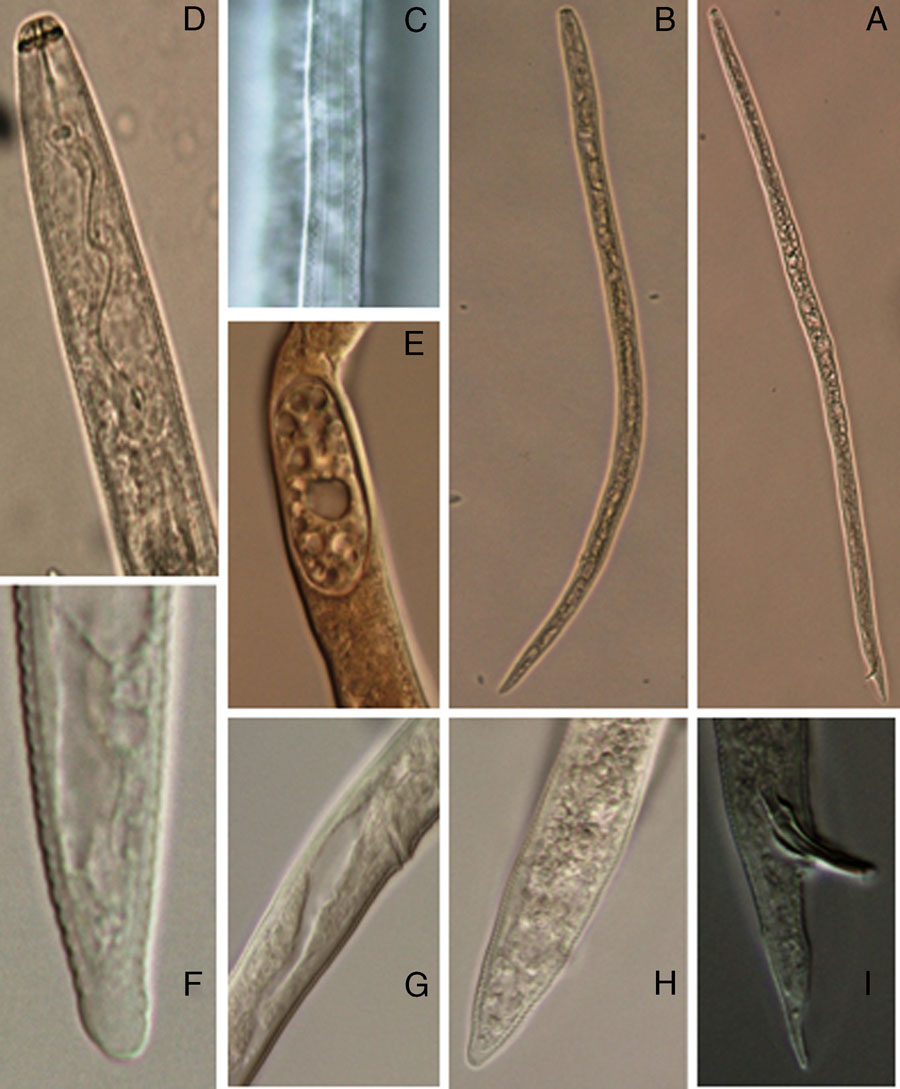
Morphological identification showed the presence of P. vulnus in root and soil samples of apple trees located in the four regions visited and their abundance compared to other plant parasitic nematode varied between 58.24% in orchard in the region of Kasserine and 91.45% in nursery located in the region of Kairouan. All the qualitative and quantitative characters including number of lip annuli, spermatheca (presence and shape), post-vulval uterine sac, and tail shape of Tunisian populations of P. vulnus agreed with the original descriptions (Figs 1–3; Table 1). However, a few characters fell outside the range of the original descriptions. The measurements reported in the original description of Gao et al. (1999): 0.50 to 0.81 mm for female and 0.43 to 0.61 mm for male were similar to ours Pratylenchus specimens.
Table 1
Morphometrics of Pratylenchus vulnus from apples stoolbeds, nurseries (males and females), and orchards from four Tunisian regions (Kasserin, Kairouan, Monastir, and Zaghouan, Tunisia).
| Stoolbed | |||
| Locality | MM106 Chiha | ||
| Characters | Females | Males | |
| n | 5 | 5 | |
| L | 444.4 ± 29.36 (415.71–485.86) | 419.83 ± 32.43 (395.01–475.2) | |
| Stylet length (µm) | 14.29± 0.16 (14.17–14.55) | 14.85 ± 0.21 (14.56–15.1) | |
| Spicules (µm) | 16.88± 0.26 (16.58–17.2) | ||
| Gubernaculum (µm) | 4.8± 0.39 (4.2–5.25) | ||
| V or T | 81.22± 0.73 (80.55–82.39) | 34.02± 1.17 (32.11–35.2) | |
| a | 26.73 ± 1.32 (24.59–28.1) | 28.99 ± 2.76 (25.2–31.4) | |
| b | 7.62 ± 0.55 (6.87–8.16) | 6.72 ± 0.66 (5.88–7.5) | |
| b′ | 4.92 ± 0.9 (3.76–5.66) | 4.85 ± 0.27 (4.55–5.22) | |
| c | 19.11 ± 0.44 (18.57–19.5) | 20.75 ± 0.55 (19.88–21.3) | |
| c′ | 2.29 ± 0.22 (2.01–2.58) | 2.14 ± 0.1 (2.01–2.28) | |
| Nursery females | |||
| Locality | Lorca Chiha | Meski SMCCSPS | |
| Characters | Females | Females | |
| n | 5 | 5 | |
| L | 556.71 ± 33.21 (521.32–607.49) | 512.48 ± 51.46 (450.11–578.12) | |
| Stylet length (µm) | 15. 45± 0.31 (15.17–15.93) | 14. 44± 0.6 (13.69–15.19) | |
| Spicules (µm) | |||
| Gubernaculum (µm) | |||
| V or T | 78.77± 1.31 (76.95–80.55) | 79.14 ± 1.74 (76.58–81.3) | |
| a | 28.8 ± 4.12 (25.93–35.73) | 28.88 ± 3.72 (25.72–35.33) | |
| b | 7.82 ± 1.33 (6.1–9.56) | 7.97 ± 0.84 (7.12–9.18) | |
| b′ | 5.26 ± 0.11 (5.16–5.41) | 4.27 ± 0.27 (3.88–4.55) | |
| c | 20.22 ± 1.91 (18.17–22.7) | 21.79 ± 2.81 (18.68–25.5) | |
| c′ | 2.44 ± 0.27 (2.08–2.78) | 2.33 ± 0.33 (2.04–2.91) | |
| Nursery males | |||
| Locality | Lorca Chiha | Anna Manzel Nour | Meski SMCCSPS |
| Characters | Males | Males | Males |
| n | 5 | 5 | 5 |
| L | 483.75 ± 10.58 (468.63–492.7) | 478.62 ± 30.09 (431.65–503.93) | 485.52 ± 34.38(451.12–540.76) |
| Stylet length (µm) | 14.81 ± 0.49 (14.41–15.66) | 14.46 ± 0.75 (13.49–15.26) | 14.31 ± 0.28 (14.01–14.66) |
| Spicules (µm) | 17.07± 1.35 (15.47–19.14) | 19.16± 0.61 (18.25–19.65) | 18.15 ± 0.58 (17.37–19) |
| Gubernaculum (µm) | 4.92± 0.34 (4.46–5.31) | 5.26± 0.27 (4.95–5.66) | 5.07 ± 0.43 (4.56–5.72) |
| V or T | 35.38± 2.75 (32–38.17) | 37.56± 2.55 (33.72–40.6) | 36.42 ± 2.76 (34.05–40.54) |
| a | 28.85 ± 1.45 (26.5–30.3) | 29.37 ± 2.33 (25.87–32.15) | 27.01 ± 1.37 (25.36–28.91) |
| b | 8.24 ± 1.21 (7.23–10.22) | 9.11 ± 0.38 (8.66–9.67) | 9.2 ± 1.01 (8.14–10.5) |
| b′ | 5.31 ± 0.1 (5.2–5.43) | 4.29 ± 0.45 (3.77–4.95) | 4.85 ± 0.53 (4.47–5.75) |
| c | 19.89 ± 1.48 (17.86–21.62) | 20.95 ± 1.46 (18.7–22.47) | 20.16 ± 1.83 (18.85–23.37) |
| c′ | 2.29 ± 0.18 (2.09–2.51) | 2.06 ± 0.08 (2–2.21) | 2.26 ± 0.21 (1.92–2.45) |
| Orchads | |||
| Locality | Lorca Chiha | Anna Manzel Nour | Meski SMCCSPS |
| Characters | Males | Males | Males |
| n | 5 | 5 | 5 |
| L | 483.75 ± 10.58 (468.63–492.7) | 478.62 ± 30.09 (431.65–503.93) | 485.52 ± 34.38(451.12–540.76) |
| Stylet length (µm) | 14.81 ± 0.49 (14.41–15.66) | 14.46 ± 0.75 (13.49–15.26) | 14.31 ± 0.28 (14.01–14.66) |
| Spicules (µm) | 17.07± 1.35 (15.47–19.14) | 19.16± 0.61 (18.25–19.65) | 18.15 ± 0.58 (17.37–19) |
| Gubernaculum (µm) | 4.92± 0.34 (4.46–5.31) | 5.26± 0.27 (4.95–5.66) | 5.07 ± 0.43 (4.56–5.72) |
| V or T | 35.38± 2.75 (32–38.17) | 37.56± 2.55 (33.72–40.6) | 36.42 ± 2.76 (34.05–40.54) |
| a | 28.85 ± 1.45 (26.5–30.3) | 29.37 ± 2.33 (25.87–32.15) | 27.01 ± 1.37 (25.36–28.91) |
| b | 8.24 ± 1.21 (7.23–10.22) | 9.11 ± 0.38 (8.66–9.67) | 9.2 ± 1.01 (8.14–10.5) |
| b′ | 5.31 ± 0.1 (5.2–5.43) | 4.29 ± 0.45 (3.77–4.95) | 4.85 ± 0.53 (4.47–5.75) |
| c | 19.89 ± 1.48 (17.86–21.62) | 20.95 ± 1.46 (18.7–22.47) | 20.16 ± 1.83 (18.85–23.37) |
| c′ | 2.29 ± 0.18 (2.09–2.51) | 2.06 ± 0.08 (2–2.21) | 2.26 ± 0.21 (1.92–2.45) |