Invasive plant species such as moso-bamboo (Phyllostachys edulis (Carrière) J. Houz.) and kudzu (Pueraria lobata (Willd) Ohwi) are extremely destructive to ecosystems in Japan. Researchers are finding uses for these invasive weeds to encourage their removal from the natural ecosystem (Kameyama, 1978; Isagi et al., 1997). Since the bamboo and kudzu are characterized by rich carbon and nitrogen, respectively (Wang et al., 2013; Nakhshiniev et al., 2014), their combination is ideal as a feed stock for vermicomposting. Vermicomposting is a nutrient recycling process for biodegradable solid wastes through the decomposition and digestion of earthworms and its associated microorganisms (Elvira et al., 1998; Tajbakhsh et al., 2011). Generally, a minimum of two months are needed to produce vermicompost suitable to be used as organic fertilizer (Radovich and Arancon, 2011). Various feed stock commonly used for vermicomposting include animal manure, shredded paper, vegetable or fruit scrap from kitchens or farms (Atiyeh et al., 2000; Garg et al., 2006). Vermicompost tea (VCT) is a water extract of vermicompost generally at 1:10 or 1:20 dilution ratio of vermicompost to water aerated over a certain period of time, pending on usage, for the purpose of numerous bioactive molecules as well as microbial populations of the vermicompost (Edwards et al., 2006). Applying VCT to crops is easier than applying vermicompost, which is bulky and heavier, and needs soil incorporation that makes post-plant treatment impractical in many cases. Many scientists reported that drenching VCT suppressed plant-parasitic fungi (Singh et al., 2003; Scheuerell and Mahaffee, 2004), or plant-parasitic nematodes such as Meloidogyne spp. in different crops (Arancon et al., 2002; Edwards et al., 2007; Mishra et al., 2017). Although the mechanisms on how VCT drench suppresses plant-parasitic fungi or plant-parasitic nematodes are not completely known, there is evidence showing its consistent effect against various diseases. For example, Mishra et al. (2018) showed that VCT could induce host-plant resistance in cucumber against Meloidogyne spp. through split-root experiments. Moreover, some suggested that the abundant organic acids substances such as humic acids, hormones such as N-indole-3-acetic acid (IAA), cytokinin, and gibberellins found in VCT could suppress nematode infestation (Oka, 2010; Arancon et al., 2012).
Owing to the effective disease suppression, VCT has become a potential alternative to chemical pesticides in agriculture. Previous research by the authors has demonstrated that VCT prepared from vermicompost produced from using invasive weeds, bamboo and kudzu, as feed stock (here by referred to as weed VCT) showed promising suppressive effects on several soil-borne plant pathogens including Pythium aphanidermatum (Edson) Fitzp., P. ultimum Trow var. ultimum, and Rhizoctonia solani J.G. Kühn AG1-IB (You et al., 2018), but its potential effects against plant-parasitic nematodes has not been examined. A comparison of weed VCT versus a conventional VCT prepared from vermicompost using vegetable food waste as feed stock (here by referred to as vegetable VCT) was conducted to examine for their nematode suppressive effects against two common plant-parasitic nematodes in the tropics, the southern root-knot nematode (Meloidogyne incognita) and the reniform nematode (Rotylenchulus reniformis). Previously, vegetable VCT has been demonstrated to suppress root penetration and egg hatching, but not the reproduction, of M. incognita.
Besides suppressing plant-parasitic nematodes, another advantage of drenching VCT to plant rhizosphere is to improve soil and plant health. Free-living nematodes have been used as soil health bioindicators as they can be used to determine dominant nutrient decomposition pathways, soil food web structure and ecosystem functions in soil (Ingham et al., 1985; Bongers and Ferris, 1999; Wang and McSorley, 2005). A healthy soil food web should sustain nematodes with different life strategies and feeding behaviors ranging from fast growing and reproducing bacteria-feeding nematodes (colonizers) at the bottom of the soil food web to slow reproducing but longer living predaceous nematodes at the top of the soil food web (Bongers, 1990). This research project aimed to also evaluate the soil health benefits of drenching roots with weed VCT vs vegetable VCT.
Specific objectives of this project were to compare the ability of weed VCT and vegetable VCT on mitigating (i) egg hatching, (ii) vermiform stages mobility, (iii) root penetration, and (iv) damage of M. incognita and R. reniformis on cowpea, as well as their ability to improve soil health.
Materials and methods
Vermicompost tea preparation
Weed vermicompost made from moso-bamboo (Phyllostachys edulis (Carrière) J. Houz.) and Kudzu (Pueraria lobata (Willd) Ohwi) and vegetable vermicompost made from vegetable food waste were prepared as described by You et al. (2018) and Mishra et al. (2017), respectively. Weed vermicompost was prepared from 10 kg of the bamboo shoots powder mixed with 100 g of air dried kudzu vine pieces (< 10 cm in length) and 20 g of a commercial horse manure/wheat straw compost (Iris Ohyama Inc., Sendai, Japan) and adding 100 g of red wiggler (Eisenia fetida Savigny) (Commercial name ‘Kumataro-futomushi,’ Yokomizo-shokai Inc., Mito, Japan) in a closed container to conduct vermicomposting for 2 mon. Vegetable vermicompost was initiated 3 yr prior to this experiment with approximately 100 g of commercial mix of red wiggler (E. fetida) and blue worms (Perionyx excavatus Perrier) (Waikiki Worms Co., Honolulu, HI). The worms were fed weekly with vegetable food waste such as lettuce, kale, papaya, and banana peel. All earthworms were removed from the vermicompost right before VCT preparation. The VCTs were prepared fresh for each experiments, and were prepared by mixing each type of vermicompost in water at 1:10 (v/v) ratio, and aerated for 24 hr using 2.5 W Elite 800 air pumps (Rolf C. Hagen Inc., Montreal, Canada) at room temperature (24). The VCT was filtered using a kitchen strainer to separate the solid from the liquid prior to application. Samples of weed VCT and vegetable VCT were submitted to the Agriculture Diagnostic Services Center (ADSC) at the University of Hawaii at Manoa to assay for concentrations of macro-nutrients (nitrogen, phosphorus, potassium, calcium, magnesium, and boron) and micro-nutrients (Fe, Mn, Zn, and Cu).
Hatching experiment
A laboratory assay was conducted to examine the effects of weed VCT and vegetable VCT on the hatching of M. incognita and R. reniformis compared to that of water control. Meloidogyne incognita eggs were extracted from coleus (Plectranthus scutellarioides (L.) R. Br.) roots and R. reniformis eggs were extracted from pineapple (Ananas comosus (L.) Merr.) roots using NaOCl and centrifugal flotation methods (Hussey and Barker 1973). Water, weed VCT or vegetable VCT were contained in 60-ml plastic cups at 15 ml/cup. The experiment was arranged in complete randomized design with four replications. Each plastic cup served as a hatching chamber where approximately 200 freshly extracted M. incognita eggs or R. reniformis eggs were suspended in 200 μl of water over a 60.33-μm pore size screen (Fig. 1). This mesh size kept nematode eggs on the screen but allowed second stage juveniles (J2s) to pass through. To avoid bacterial growth, VCT or water was replaced every day with fresh VCT or water. Hatched J2s were collected every day for 7 d and total hatching was counted under an inverted microscope (Leica DMIL LED, Wetzlar, Germany). The egg hatching experiment was repeated once.
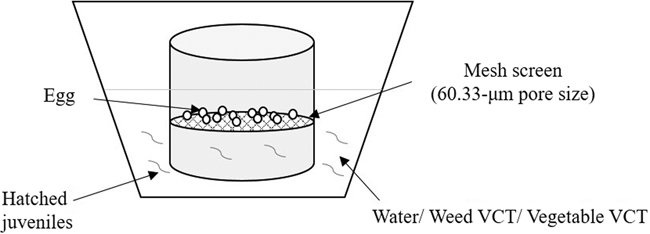
Figure 1
Hatching chamber used to allow harvesting of hatch juveniles over a 7 d period.
Mobility experiment
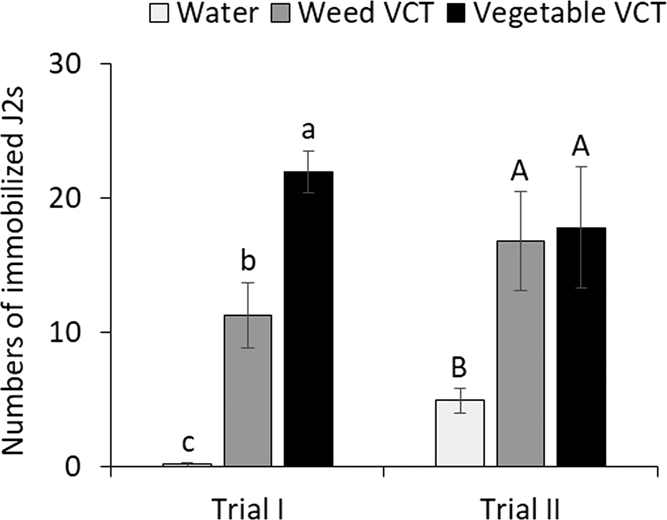
A laboratory assay was established to examine the effects of weed VCT and vegetable VCT on the mobility of M. incognita J2s. After adding 10 ml of water, weed VCT or vegetable VCT into individual 60-mm diameter petri plates, 0.5 ml of water suspension containing approximately 100 freshly hatched M. incognita J2s were added to each plate. Treatments were replicated four times and the experiments were repeated once. Mobility of M. incognita J2s was examined by probing with a dental probe after 24 hr incubation of the nematodes in the solutions. Percentile of immobilized nematodes was calculated for each petri dish.
Root penetration experiment using split-root assay
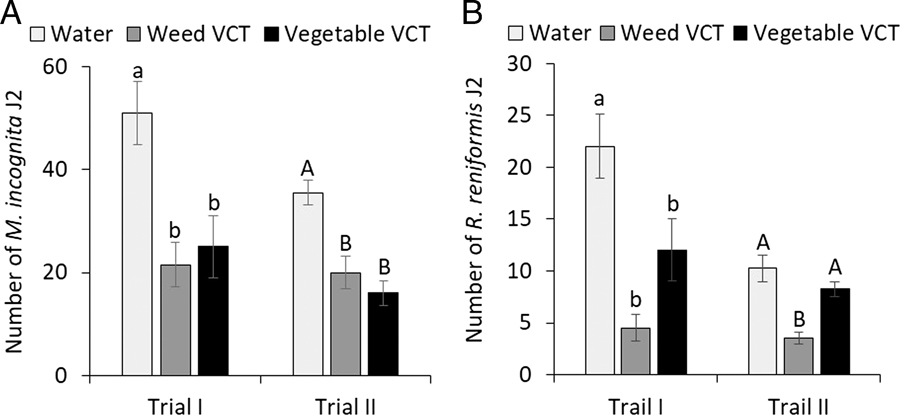
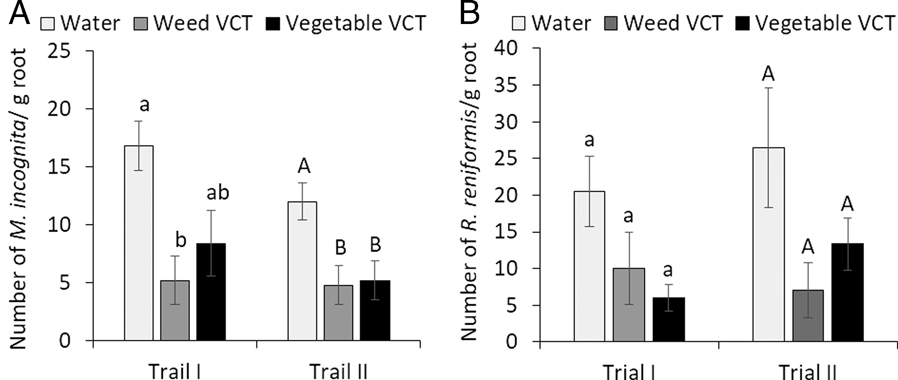
Two greenhouse trials were conducted in the Gilmore Greenhouse at the University of Hawaii at Manoa, Honolulu, HI from April to July 2017 to examine the effects of the VCTs on root penetration of M. incognita on ‘Bush Champion’ cucumber (Cucumis sativus L.), and that of R. reniformis on ‘Blackeye #5’ cowpea (Vigna unguiculata (L.) Walp.) by inducing host-plant resistance against nematodes. Roots of cucumber or cowpea seedlings were split into two parts and transplanted into two conjoined pots (Fig. 2). The purpose of using split-root assay was to avoid direct contact of VCTs on the tested nematodes that would lead to parasitism or immobilization of the nematodes by the chemical compounds or microbes in the VCTs. One side of the root system was drenched with weed VCT, vegetable VCT, or water 3 d prior to inoculation of the targeted nematode (Fig. 2). Two hundred J2s of M. incognita or 100 J2s of R. reniformis were introduced into the untreated conjoined pot. One week after M. incognita inoculation, or 3 wk after R. reniformis inoculation, roots from the nematode inoculated side were stained with Acid Fuchsin (Daykin and Hussey, 1985) and quantified for nematode penetration under the microscope.
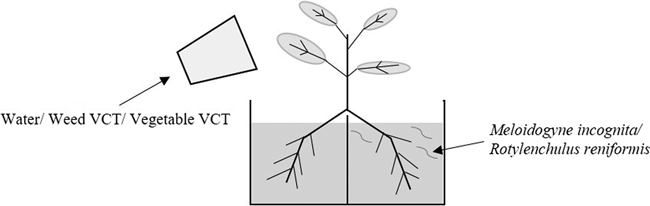
Figure 2
Split-root experiment constructed by two conjoint pots where one side of the roots will be drenched with vermicompost tea (VCT) and the other side of the roots will be inoculated with the designated plant-parasitic nematodes.
Bioindicators of biological activities of vermicompost
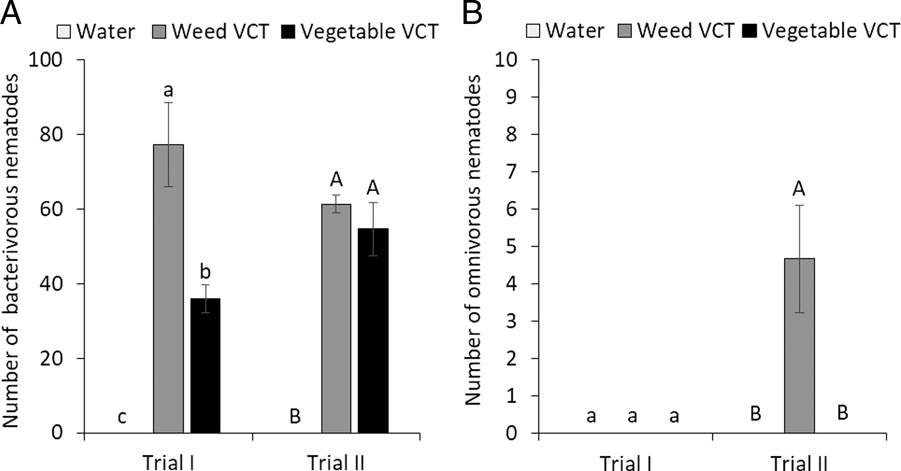
To examine biological activities of weed vermicompost or vegetable vermicompost, free-living nematodes were used as bioindicators. Nematodes were extracted from 30 cm3 weed vermicompost or vegetable vermicompost by immersing the vermicompost into 300 ml water using Baermann trays for 24 hr (Southey, 1986). Each treatment was replicated three times. Bacterivorous and omnivorous nematodes, the two most dominant nematode trophic groups present, were counted under an inverted microscope (Leica DMIL LED, Wetzlar, Germany).
Cowpea field experiment
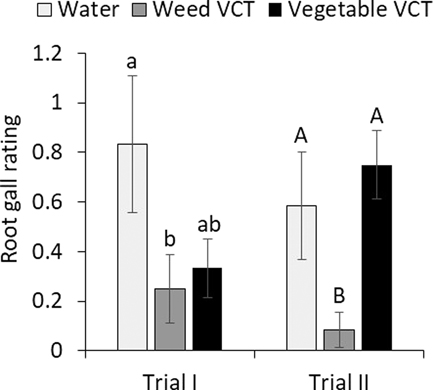
Two field trials were conducted at the Poamoho Research Station in Waialua, Oahu, HI to compare the mitigation of nematode damage on ‘Black Eye #5’ cowpea by weed VCT or vegetable VCT compared to water control using cowpea as a bioassay crop in field naturally infested with M. incognita and R. reniformis. Cowpea plants were drenched with weed VCT or vegetable VCT, or water weekly at 50 ml per plant during the first 2 wk, followed by 250 ml per plant for the rest of the crop over a three-month growing period from 27 April to 12 July, 2017. Each experimental plot had eight cowpea plants in a 1 × 3 m2 -area. The three treatments were arranged in randomized complete block design with four replications. Soil nematode population densities were monitored at pre-plant, and at 1 and 2 mon after planting. Shoot and root weights, and root-gall index (RGI) were measured from three plants randomly selected in each plot at 2 mon after planting. Root galling was rated using a root-gall index based on a scale of 0 to 5, where 0 = 0, 1 = 1–2, 2 = 3–10, 3 = 11–30, 4 = 31–100, and 5 ≥ 100 galls (Taylor and Sasser, 1978). Cowpea pods from five plants per plot were harvested and weighted weekly from 21 June to 12 July, 2017.
Nematode assay
Soil samples were collected 1 and 2 mon after cowpea planting in both trials. Four 20-cm deep soil samples were collected from each plot and combined into one bag. Nematodes were extracted from 250-cm3 soil by elutriation and centrifugal floatation (Jenkins, 1964; Byrd et al., 1976). All nematodes extracted were identified and assigned to a trophic group of bacterivores, fungivores, omnivores, or predators (Yeates et al., 1993), but herbivores were identified to the genus level with the aid of the inverted microscope described above.
Statistical analysis
Differences in macro- and micro-nutrient content between the weed VCT and vegetable VCT were analyzed by Student’s t-test. The other data were checked for normality, nematode data were log transformed [log10(x+1)] if needed and subjected to one-way analysis of variance (ANOVA) using SAS (SAS Inc., Cary, NC). Repeated measures of nematode abundance from the cowpea field experiment were subjected to homogeneity of variance test over time. If there was no significant interaction between sampling date and treatment effect, data were subjected to repeated measures analysis. Means were separated using Waller–Duncan k-ration (k = 100) t-test. Only true means were presented.
Results
Nutrient analysis
Weed VCT contained lower concentrations of nitrogen, phosphorus, potassium, boron, Fe, and Cu than vegetable VCT, but both VCTs contained similar concentration of calcium, magnesium, Mn, and Zn levels (Table 1).
Table 1
Macro- and micro-nutrients content of weed VCT prepared from vermicompost with moso-bamboo and kudzu as feed stock and vegetable VCT prepared from vermicompost with vegetable waste as feed stock.
| Content (mg/l) | Weed VCT | Vegetable VCT | ||||
|---|---|---|---|---|---|---|
| Nitrogen | 27.60 b | 280.00 a | ||||
| Phosphorus | 0.80 b | 5.62 a | ||||
| Potassium | 53.59 b | 213.24 a | ||||
| Calcium | 20.86 a | 25.74 a | ||||
| Magnesium | 17.21 a | 18.89 a | ||||
| Boron | 0.06 b | 0.47 a | ||||
| Fe | 0.03 b | 0.27 a | ||||
| Mn | 0.01 a | 0.02 a | ||||
| Zn | 0.03 a | 0.03 a | ||||
| Cu | 0.01 b | 0.02 a | ||||
| Trial I | Trial II | |||||
|---|---|---|---|---|---|---|
| Nematodes | Water | Weed VCT | Vegetable VCT | Water | Weed VCT | Vegetable VCT |
| 5/25/17 | ||||||
| M. incognita | 62 a | 90 a | 120 a | 155 A | 132 A | 35 A |
| R. reniformis | 312 a | 465 a | 435 a | 728 A | 450 A | 402 A |
| % Bacterivores | 40.45 a | 27.11 a | 27.12 a | 20.82 A | 21.18 A | 25.00 A |
| % Fungivores | 22.22 a | 15.77 a | 12.19 a | 17.53 A | 17.91 A | 12.37 A |
| % Omnivores | 0.28 a | 0.35 a | 0.00 a | 0.39 A | 0.10 A | 0.61 A |
| 6/21/17 | ||||||
| M. incognita z | 25 a | 95 a | 60 a | 28 B | 195 A | 30 B |
| R. reniformis | 402 a | 285 a | 495 a | 338 A | 385 A | 502 A |
| % Bacterivoresy | 18.89 a | 17.84 a | 12.21 a | 17.99 A | 12.68 A | 13.38 A |
| % Fungivores | 10.62 a | 10.92 a | 6.53 a | 9.82 A | 10.76 A | 6.89 A |
| % Omnivores | 3.62 a | 1.42 a | 0.96 a | 0.45 B | 2.90 A | 1.75 AB |