
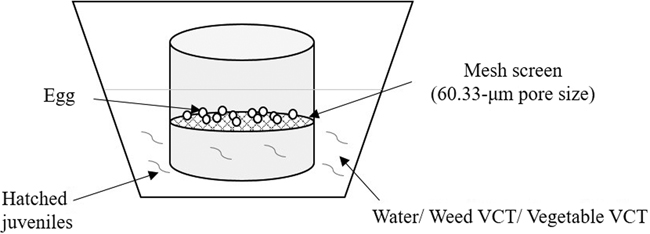
Figure 1
Hatching chamber used to allow harvesting of hatch juveniles over a 7 d period.
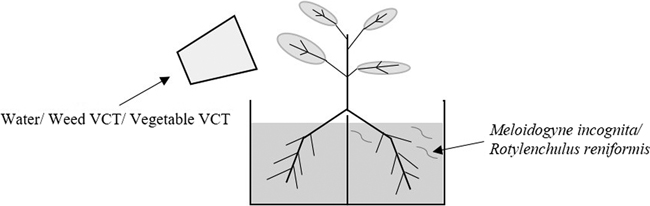
Figure 2
Split-root experiment constructed by two conjoint pots where one side of the roots will be drenched with vermicompost tea (VCT) and the other side of the roots will be inoculated with the designated plant-parasitic nematodes.
Table 1
Macro- and micro-nutrients content of weed VCT prepared from vermicompost with moso-bamboo and kudzu as feed stock and vegetable VCT prepared from vermicompost with vegetable waste as feed stock.
| Content (mg/l) | Weed VCT | Vegetable VCT |
|---|---|---|
| Nitrogen | 27.60 b | 280.00 a |
| Phosphorus | 0.80 b | 5.62 a |
| Potassium | 53.59 b | 213.24 a |
| Calcium | 20.86 a | 25.74 a |
| Magnesium | 17.21 a | 18.89 a |
| Boron | 0.06 b | 0.47 a |
| Fe | 0.03 b | 0.27 a |
| Mn | 0.01 a | 0.02 a |
| Zn | 0.03 a | 0.03 a |
| Cu | 0.01 b | 0.02 a |
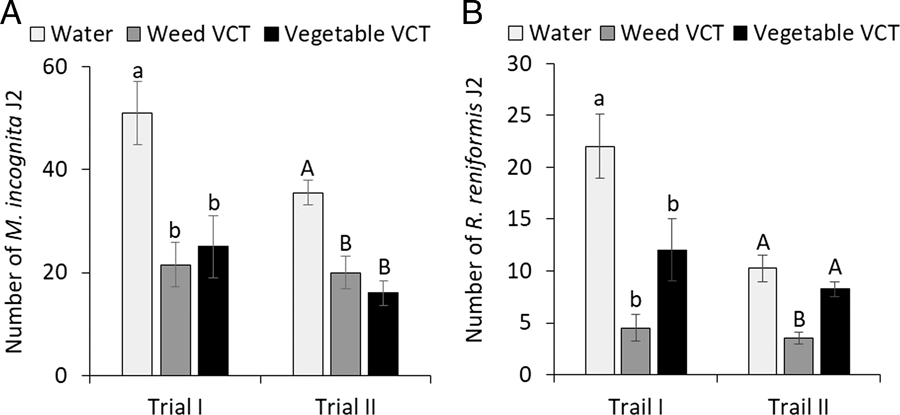
Figure 3
Numbers of juveniles of (A) Meloidogyne incognita and (B) Rotylenchulus reniformis hatched after incubating their eggs in vermicompost teas prepared from vermicompost composed of bamboo and kudzu (weed VCT) and vegetable food waste (vegetable VCT), and water control for 7 d. Columns (n = 4) with same letter(s) are not different according to Waller–Duncan k-ration (k = 100) t-test.
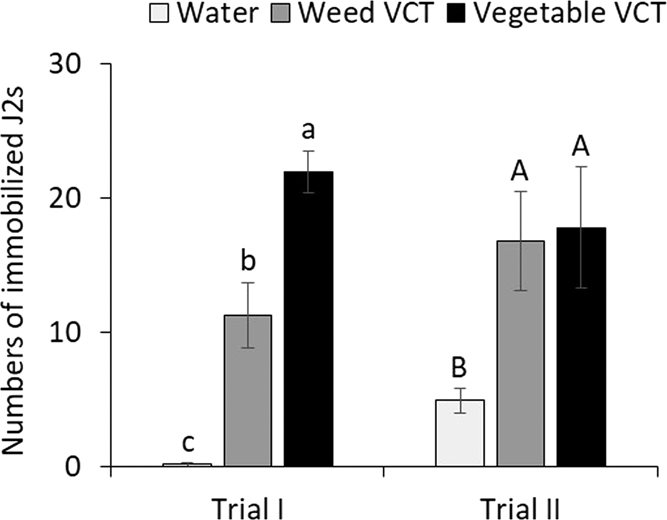
Figure 4
Numbers of Meloidogyne incognita J2 immobilized after incubating in vermicompost teas prepared from vermicompost composed of bamboo and kudzu (weed VCT), vegetable food waste (vegetable VCT) and water for 24 hr. Columns (n = 4) followed by the same letter(s) are not different according to Waller–Duncan k-ration (k = 100) t-test.
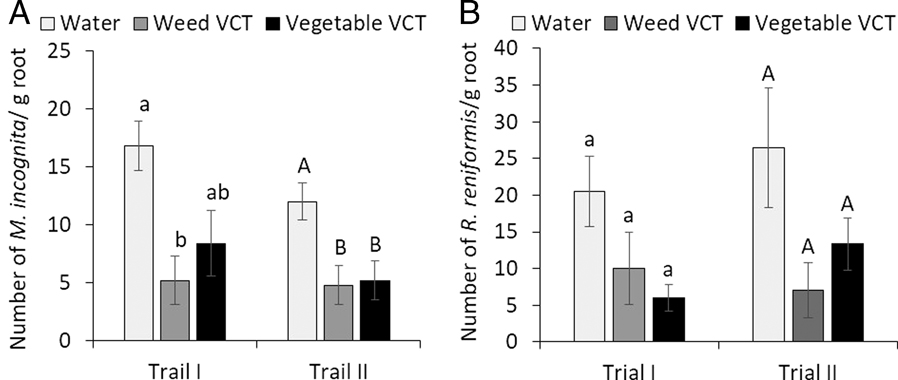
Figure 5
Effect of vermicompost teas prepared from vermicompost composed of bamboo and kudzu (weed VCT), vegetable food waste (vegetable VCT) compared to water control on root penetration of (A) Meloidogyne incognita in cucumber, and (B) Rotylenchulus reniformis in cowpea using split-root assays. Means are average of five and four replications for M. incognita and R. reniformis, respectively. Column followed by same letter(s) are not different according to Waller-Duncan k-ration (k = 100) t-test based on log transformed values, log (x+1).
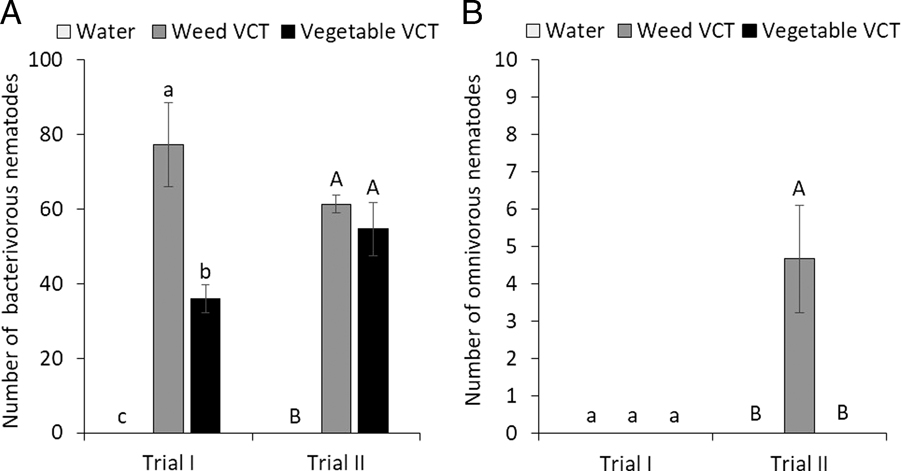
Figure 6
Abundance of (A) bacterivorous and (B) omnivorous nematodes in water or vermicompost teas prepared from 30 cm3 of vermicompost composed of bamboo and kudzu (weed VCT) or vegetable food waste (vegetable VCT) incubated in Baermann trays. Columns (n = 3) followed by the same letter(s) are not different according to Waller–Duncan k-ration (k = 100) t-test.
Table 2
Effect of vermicompost tea on plant-parasitic nematodes and percent trophic groups of free-living nematodes in a cowpea agroecosystem.
| Trial I | Trial II | |||||
|---|---|---|---|---|---|---|
| Nematodes | Water | Weed VCT | Vegetable VCT | Water | Weed VCT | Vegetable VCT |
| 5/25/17 | ||||||
| M. incognita | 62 a | 90 a | 120 a | 155 A | 132 A | 35 A |
| R. reniformis | 312 a | 465 a | 435 a | 728 A | 450 A | 402 A |
| % Bacterivores | 40.45 a | 27.11 a | 27.12 a | 20.82 A | 21.18 A | 25.00 A |
| % Fungivores | 22.22 a | 15.77 a | 12.19 a | 17.53 A | 17.91 A | 12.37 A |
| % Omnivores | 0.28 a | 0.35 a | 0.00 a | 0.39 A | 0.10 A | 0.61 A |
| 6/21/17 | ||||||
| M. incognita z | 25 a | 95 a | 60 a | 28 B | 195 A | 30 B |
| R. reniformis | 402 a | 285 a | 495 a | 338 A | 385 A | 502 A |
| % Bacterivoresy | 18.89 a | 17.84 a | 12.21 a | 17.99 A | 12.68 A | 13.38 A |
| % Fungivores | 10.62 a | 10.92 a | 6.53 a | 9.82 A | 10.76 A | 6.89 A |
| % Omnivores | 3.62 a | 1.42 a | 0.96 a | 0.45 B | 2.90 A | 1.75 AB |
[i] zNematode abundance (numbers/250 cm3 soil) was log transformed, log(x + 1) prior to analysis of variance; yPercent nematode in trophic groups was square-root transformed √(x + 0.1) whenever needed to normalize the data prior to analysis of variance; Means (n = 4) followed by the same letter (s) are not different according to Waller–Duncan k-ratio (k = 100) t-test.
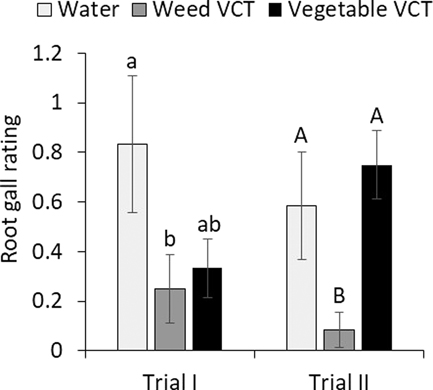
Figure 7
Effect of vermicompost teas prepared from vermicompost composed of bamboo and kudzu (weed VCT), vegetable food waste (vegetable VCT) compared to water control on root-gall index (in a scale of 0-5) of cowpea in two field trials. Columns (n = 4) followed by same letter(s) are not different according to Waller–Duncan k-ration (k = 100) t-test.