
The 18S small subunit (SSU) ribosomal DNA (rDNA) sequence is one of the most useful molecular loci for identifying agricultural invertebrates (Kiewnick et al., 2016). Small segments have been successfully used as barcodes (Floyd et al., 2002; Powers, 2004), and longer segments are standard molecular sequences for deep level phylogenetics. Single or multiple pairs of primers were reported to amplify nematode 18S SSU rDNA from different taxon templates (Table 1). Although the amplifications by these primers have been reproducible in other studies, no single or multiple universal pairs of primers applicable across all nematode taxa have been reported. The challenges remain for what primers and strategies should be selected, particularly when the specimens are from unknown species with limited amounts of extracted DNA. Three pairs of universal 18S SSU rDNA primers that have been successfully used for many years to amplify a relatively long sequence with diverse nematodes (Thomas et al., 1997) (Table 1) for direct de novo sequencing of rDNA have been problematic for certain nematode taxa in our laboratory. The PCR failures with the primers were seen in Acrobeloides, Bursaphelenchus, and Ditylenchus and partially in Laimaphelenchus/Aphelenchoides heidelbergi (Carta et al., 2016) and other taxa. The failures were seen with the G18S4 and 18P primer pair (Table 1) as well (Blaxter et al., 1998). Sequencing failures were also observed in many cases even if all of the three primer pairs worked well enough to amplify a PCR product. Also, the use of multiple standard primer pairs consumed too much sample genomic DNA (2 µl of nematode lysate for each set) to satisfactorily amplify 18S rDNA when specimen DNA was in limited supply. Therefore, in this work we selected new primers from conserved DNA sequences in a multiple-sequence alignment of many plant parasitic and saprophytic nematodes, developed protocols, and successfully tested them on multiple, difficult-to-amplify specimens.
Table 1
Single pair or multiple pairs of primers frequently used for the amplification of near-full length 18S SSU rDNA.
| Primers (old name) | Direction | Position | Single pair | Size | Reference | Note | |
|---|---|---|---|---|---|---|---|
| SSU_F_04 (G18S4) | F | 963-983 | G18S4 and 18P | 1,723bp | Blaxter et al. (1998) | ||
| SSU_R_81 (18P) | R | 2667-2686 | Blaxter et al. (1998) | ||||
| Nem_SSU_F74 | F | 1006-1026 | Nem_SSU_F74 and 18P | 1,680bp | Blaxter et al. (1998), Donn et al. (2011) | ||
| G18S4 and 18S1573R | 1,522bp | Yaghoubi et al. (2016) | |||||
| 988F | F | 969-987 | 998F and 1912R, | 962bp | Holterman et al. (2006) | 1544–1711 bp generated by these three pairs (Holterman et al., 2006) | |
| 1096F | F | 1076-1095 | 1096F and 1912R | 855bp | Holterman et al. (2006) | ||
| 1912R | R | 1913-1931 | Holterman et al. (2006) | ||||
| 1813F | F | 1795-1812 | 1813F and 2646R | 870bp | Holterman et al. (2006) | ||
| 2646R | R | 2646-2665 | Holterman et al. (2006) | ||||
| 18S965 | F | 1898-1920 | 18S965 and 18S1573R | 629bp | Mullin et al. (2005), Zeng et al. (2012) | 2,121bp generated by these three pairs (Zeng et al., 2012) | |
| 18S1573R | R | 2506-2527 | Mullin et al. (2005), Zeng et al. (2012) | ||||
| SSUF07 | F | 972-990 | SSUF07 and SSUR26 | 889bp | Floyd et al. (2002), Zeng et al. (2012) | ||
| SSUR26 | R | 1841-1861 | Floyd et al. (2002), Zeng et al. (2012) | ||||
| 18SnF | F | 1065-1089 | 18SnF and 18SnR | 1,591bp | Kanzaki and Futai (2002), Zeng et al. (2012) | ||
| 18SnR | R | 2637-2656 | Kanzaki and Futai (2002), Zeng et al. (2012) | ||||
| 18S39F (A or 39F) | F | 972-990 | 18S39F(39F) and 18S977R | 959bp | Blaxter et al. (1998), Olson et al. (2017) | 1,706bp generated by these two pairs (Olson et al., 2017) | |
| 18S977R | R | 1910-1931 | Olson et al. (2017) | ||||
| 18S900F | F | 1841-1861 | 18S900F and 18S1713R | 833bp | Olson et al. (2017) | ||
| 18S1713R | R | 2652-2674 | Olson et al. (2017) | ||||
| 18SF Cocktail or Remix: | F | 18SF Cocktail and 530R | 527bp | Thomas (2011) | 1,400–1,727bp generated by these three pairs (Thomas, 2011) | ||
| G18S4 | F | 963-983 | Blaxter et al. (1998) | ||||
| SSU_F_03 | F | 963-987 | Medlin et al. (1988) | ||||
| 18S-82F | F | 969-988 | Lopez-Garcia et al. (2003) | ||||
| eukF(10) | F | 935-955 | Medlin et al. (1988) | ||||
| 530R | R | 1470-1490 | |||||
| 385F | F | 1314-1333 | 385F and 1108R | 754bp | Thomas (2011) | ||
| 1108R | R | 2047-2068 | |||||
| 550F | F | 1467-1488 | 550F and 18SR Cocktail | 1,200bp | Thomas (2011) | ||
| 18SR Cocktail or Remix: | R | ||||||
| 18P | R | 2667-2686 | Blaxter et al. (1998) | ||||
| eukR(10) | R | 2667-2690 | Medlin et al. (1988) |
| Primers | Direction | Sequence (5′-3′) | Tm (°C) | rRNA gene | PCR | Sequencing | Reference |
|---|---|---|---|---|---|---|---|
| 18S-CL-F | F | TCAAAGATTAAGCCATGCAT | 53 | 18S | √ | √ | This study |
| 18S-CL-F2 | F | CTGTGATGCCCTTAGATGTCC | 58 | 18S | √ | √ | This study |
| 18S-CL-F3 | F | CTTGTCTCAAAGATTAAGCCATGCAT | 60 | 18S, ITS | √ | √ | This study |
| 18S-CL-F6 | F | TGAGAAATGGCCACTACGTC | 57 | 18S | √ | √ | This study |
| 18S-CL-R1 | R | ACCTTGTTACGACTTTTGC | 54 | 18S | √ | √ | This study |
| 18S-CL-R2 | R | GTTGAGTCAAATTAAGCCGCA | 57 | 18S | √ | This study | |
| 18S-CL-R5 | R | GCGGTGTGTACAAAGGGCAGGGAC | 67 | 18S | √ | This study | |
| ITS-CL-F2 | F | ATTACGTCCCTGCCCTTTGTA | 59 | ITS, 28S | √ | √ | This study |
| G18S4 | F | GCTTGTCTCAAAGATTAAGCC | 55 | 18S | √ | √ | Blaxter et al. (1998) |
| 530R | R | GCGGCTGCTGGCACCACACTT | 68 | 18S | √ | √ | Thomas (2011) |
| 550F | F | GGCAAGTCTGGTGCCAGCAGCC | 68 | 18S | √ | √ | Thomas (2011) |
| 1912R | R | TTTACGGTCAGAACTAGGG | 54 | 18S | √ | √ | Holterman et al. (2006) |
| 81R | R | TTCCTCCGCTAAATGATATGCTTAA | 58 | ITS | √ | √ | Reverse of 28S-81for (Holterman et al., 2008) |
| D2AR | R | ACTTTCCCTCACGGTACTTGT | 59 | ITS | √ | √ | Reverse of D2A (Nunn, 1992) |
| AB28 | R | ATATGCTTAAGTTCAGCGGGT | 57 | ITS | √ | √ | Joyce et al. (1994) |
| VRAIN 2R (V2R) | R | TTTCACTCGCCGTTACTAAGGGAATC | 63 | ITS | √ | √ | Vrain et al. (1992) |
| 28S-1006rev (1006R) | R | AGGGGCGAAAGACTAATCGAAC | 60 | ITS, 28S | √ | √ | Holterman et al. (2008) |
| 28S-1032rev (1032R) | R | TCGGAAGGAACCAGCTACTA | 57 | ITS, 28S | √ | √ | Holterman et al. (2008) |
| 18S-CL-F3 (26 nt, Tm = 60°C) | 5′-CTTGTCTCAAAGATTAAGCCATGCAT-3′ | |||
| G18S4 (21 nt, Tm = 55°C) | 5′-GCTTGTCTCAAAGATTAAGCC-3′ | |||
| 18S-CL-F (20 nt, Tm = 53°C) | 5′-TCAAAGATTAAGCCATGCAT-3′ |
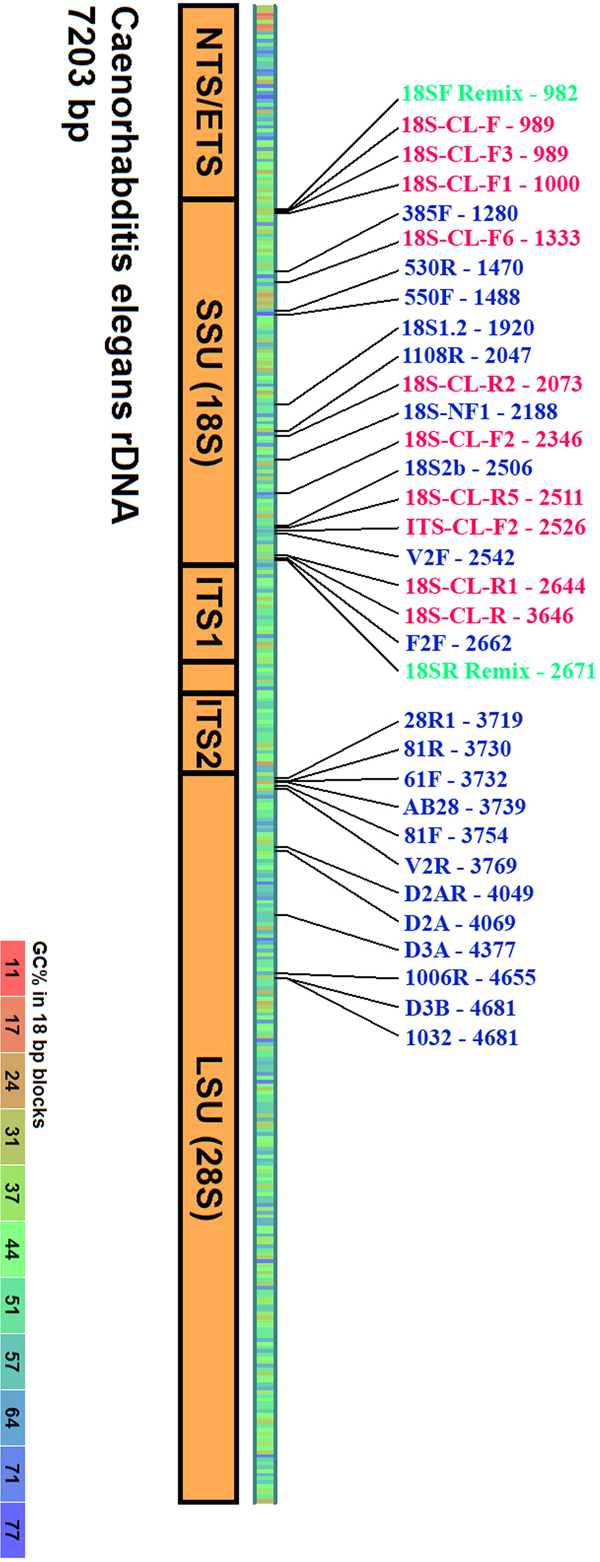
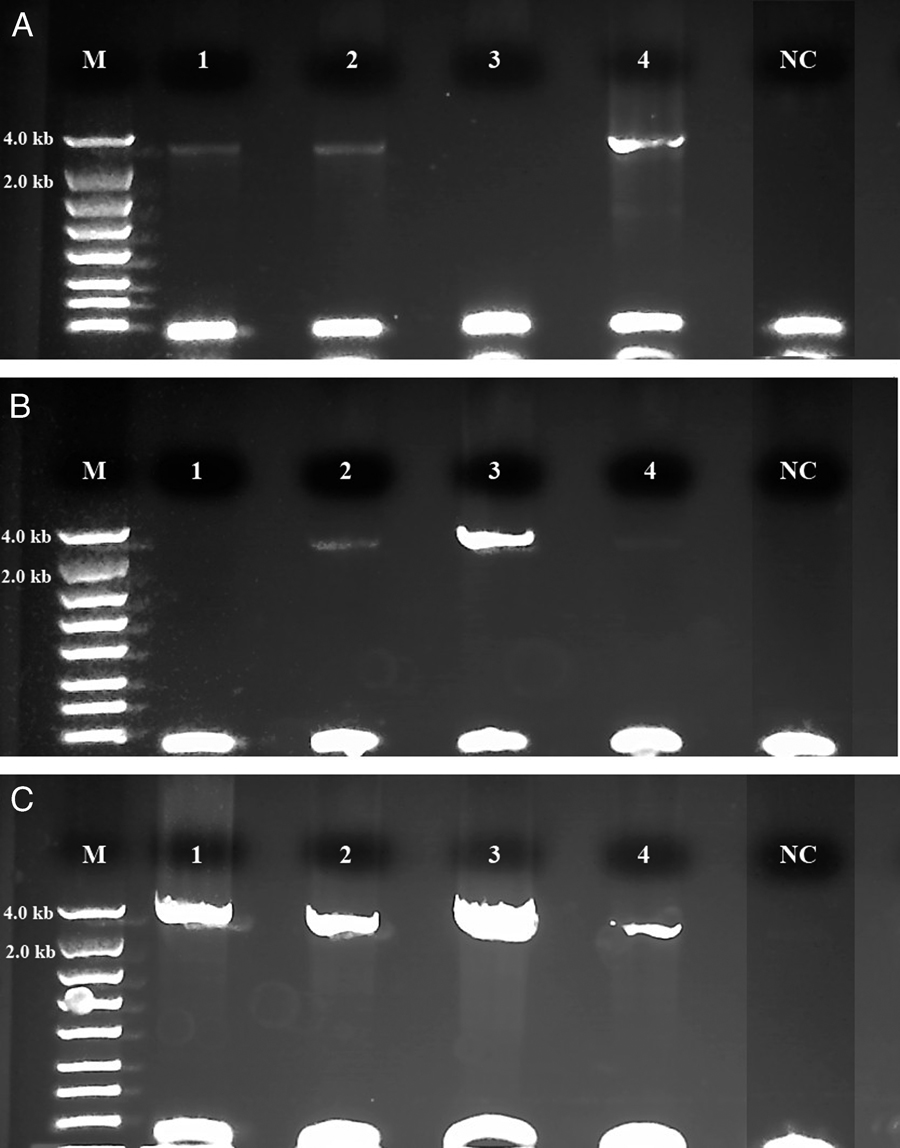
| Taxon | Primer set | Amplified rRNA gene (length) | Ta (°C) | Taq |
|---|---|---|---|---|
|
Acrobeloides sp. LKC52 Pratylenchus penetrans Thailand | 18S-CL-F/18S-CL-R1 | 18S (around 1,700bp) | 50–55 | Invitrogen™ Platinum™ |
|
Aphelenchoides sp. No1 Idaho Aphelenchoides sp. No2 Idaho Panagrolaimus sp. Idaho | 18S-CL-F3/81R | 18S and ITS (around 2,400bp) | 58 | TaKaRa EX |
|
Panagrolaimus sp. LKC44, LKC46 LKC47, LKC53, LKC56, PS1162 Poikilolaimus sp. Idaho | 18S-CL-F3/D2AR | 18S and ITS (around 2,900bp) | 58 | TaKaRa EX |
|
Pratylenchus neglectus Malad Idaho Pratylenchus penetrans Maryland Pratylenchus agilis Maryland | 18S-CL-F3/AB28 or V2R | 18S and ITS (around 2,400bp) | 59 | Phusion |
| Ditylenchus sp. Idaho | 18S-CL-F6/81R | 18S and ITS (around 2,000bp) | 54 | TaKaRa EX |
|
Bursaphelenchus sp. MX Aphelenchoides sp. No1 Idaho Scutellonema bradys Congo Vittatidera zeaphila New York Deladenus Georgia (in egg masses) Deladenus Georgia (in wood) Pratylenchus sp. Cuba | 18S-CL-F3/1912R | 18S (around 1,000bp) | 50 | Invitrogen™ Platinum™ |
|
Aphelenchoides sp. No1 Idaho Aphelenchoides sp. No2 Idaho Ditylenchus cf. myceliophagus sp. Idaho Ditylenchus dipsaci Diphtherophora sp. Malad, Idaho | 18S-CL-F3/530R | 18S (530bp) | 50 | Invitrogen™ Platinum™ |
| Ditylenchus sp. Idaho | 18S-CL-F2/1032R | ITS and 28S ( around 2,000bp) | 54 | TaKaRa EX |
| Pratylenchus neglectus Malad, Idaho | ITS-CL-F2/1006R or 1032R | ITS and 28S ( around 2,000bp) | 54 | TaKaRa EX |