
Table 1
Single pair or multiple pairs of primers frequently used for the amplification of near-full length 18S SSU rDNA.
| Primers (old name) | Direction | Position | Single pair | Size | Reference | Note |
|---|---|---|---|---|---|---|
| SSU_F_04 (G18S4) | F | 963-983 | G18S4 and 18P | 1,723bp | Blaxter et al. (1998) | |
| SSU_R_81 (18P) | R | 2667-2686 | Blaxter et al. (1998) | |||
| Nem_SSU_F74 | F | 1006-1026 | Nem_SSU_F74 and 18P | 1,680bp | Blaxter et al. (1998), Donn et al. (2011) | |
| G18S4 and 18S1573R | 1,522bp | Yaghoubi et al. (2016) | ||||
| 988F | F | 969-987 | 998F and 1912R, | 962bp | Holterman et al. (2006) | 1544–1711 bp generated by these three pairs (Holterman et al., 2006) |
| 1096F | F | 1076-1095 | 1096F and 1912R | 855bp | Holterman et al. (2006) | |
| 1912R | R | 1913-1931 | Holterman et al. (2006) | |||
| 1813F | F | 1795-1812 | 1813F and 2646R | 870bp | Holterman et al. (2006) | |
| 2646R | R | 2646-2665 | Holterman et al. (2006) | |||
| 18S965 | F | 1898-1920 | 18S965 and 18S1573R | 629bp | Mullin et al. (2005), Zeng et al. (2012) | 2,121bp generated by these three pairs (Zeng et al., 2012) |
| 18S1573R | R | 2506-2527 | Mullin et al. (2005), Zeng et al. (2012) | |||
| SSUF07 | F | 972-990 | SSUF07 and SSUR26 | 889bp | Floyd et al. (2002), Zeng et al. (2012) | |
| SSUR26 | R | 1841-1861 | Floyd et al. (2002), Zeng et al. (2012) | |||
| 18SnF | F | 1065-1089 | 18SnF and 18SnR | 1,591bp | Kanzaki and Futai (2002), Zeng et al. (2012) | |
| 18SnR | R | 2637-2656 | Kanzaki and Futai (2002), Zeng et al. (2012) | |||
| 18S39F (A or 39F) | F | 972-990 | 18S39F(39F) and 18S977R | 959bp | Blaxter et al. (1998), Olson et al. (2017) | 1,706bp generated by these two pairs (Olson et al., 2017) |
| 18S977R | R | 1910-1931 | Olson et al. (2017) | |||
| 18S900F | F | 1841-1861 | 18S900F and 18S1713R | 833bp | Olson et al. (2017) | |
| 18S1713R | R | 2652-2674 | Olson et al. (2017) | |||
| 18SF Cocktail or Remix: | F | 18SF Cocktail and 530R | 527bp | Thomas (2011) | 1,400–1,727bp generated by these three pairs (Thomas, 2011) | |
| G18S4 | F | 963-983 | Blaxter et al. (1998) | |||
| SSU_F_03 | F | 963-987 | Medlin et al. (1988) | |||
| 18S-82F | F | 969-988 | Lopez-Garcia et al. (2003) | |||
| eukF(10) | F | 935-955 | Medlin et al. (1988) | |||
| 530R | R | 1470-1490 | ||||
| 385F | F | 1314-1333 | 385F and 1108R | 754bp | Thomas (2011) | |
| 1108R | R | 2047-2068 | ||||
| 550F | F | 1467-1488 | 550F and 18SR Cocktail | 1,200bp | Thomas (2011) | |
| 18SR Cocktail or Remix: | R | |||||
| 18P | R | 2667-2686 | Blaxter et al. (1998) | |||
| eukR(10) | R | 2667-2690 | Medlin et al. (1988) |
Table 2
Primers used for PCR and sequencing.
| Primers | Direction | Sequence (5′-3′) | Tm (°C) | rRNA gene | PCR | Sequencing | Reference |
|---|---|---|---|---|---|---|---|
| 18S-CL-F | F | TCAAAGATTAAGCCATGCAT | 53 | 18S | √ | √ | This study |
| 18S-CL-F2 | F | CTGTGATGCCCTTAGATGTCC | 58 | 18S | √ | √ | This study |
| 18S-CL-F3 | F | CTTGTCTCAAAGATTAAGCCATGCAT | 60 | 18S, ITS | √ | √ | This study |
| 18S-CL-F6 | F | TGAGAAATGGCCACTACGTC | 57 | 18S | √ | √ | This study |
| 18S-CL-R1 | R | ACCTTGTTACGACTTTTGC | 54 | 18S | √ | √ | This study |
| 18S-CL-R2 | R | GTTGAGTCAAATTAAGCCGCA | 57 | 18S | √ | This study | |
| 18S-CL-R5 | R | GCGGTGTGTACAAAGGGCAGGGAC | 67 | 18S | √ | This study | |
| ITS-CL-F2 | F | ATTACGTCCCTGCCCTTTGTA | 59 | ITS, 28S | √ | √ | This study |
| G18S4 | F | GCTTGTCTCAAAGATTAAGCC | 55 | 18S | √ | √ | Blaxter et al. (1998) |
| 530R | R | GCGGCTGCTGGCACCACACTT | 68 | 18S | √ | √ | Thomas (2011) |
| 550F | F | GGCAAGTCTGGTGCCAGCAGCC | 68 | 18S | √ | √ | Thomas (2011) |
| 1912R | R | TTTACGGTCAGAACTAGGG | 54 | 18S | √ | √ | Holterman et al. (2006) |
| 81R | R | TTCCTCCGCTAAATGATATGCTTAA | 58 | ITS | √ | √ | Reverse of 28S-81for (Holterman et al., 2008) |
| D2AR | R | ACTTTCCCTCACGGTACTTGT | 59 | ITS | √ | √ | Reverse of D2A (Nunn, 1992) |
| AB28 | R | ATATGCTTAAGTTCAGCGGGT | 57 | ITS | √ | √ | Joyce et al. (1994) |
| VRAIN 2R (V2R) | R | TTTCACTCGCCGTTACTAAGGGAATC | 63 | ITS | √ | √ | Vrain et al. (1992) |
| 28S-1006rev (1006R) | R | AGGGGCGAAAGACTAATCGAAC | 60 | ITS, 28S | √ | √ | Holterman et al. (2008) |
| 28S-1032rev (1032R) | R | TCGGAAGGAACCAGCTACTA | 57 | ITS, 28S | √ | √ | Holterman et al. (2008) |
| 18S-CL-F3 (26 nt, Tm = 60°C) | 5′-CTTGTCTCAAAGATTAAGCCATGCAT-3′ |
| G18S4 (21 nt, Tm = 55°C) | 5′-GCTTGTCTCAAAGATTAAGCC-3′ |
| 18S-CL-F (20 nt, Tm = 53°C) | 5′-TCAAAGATTAAGCCATGCAT-3′ |
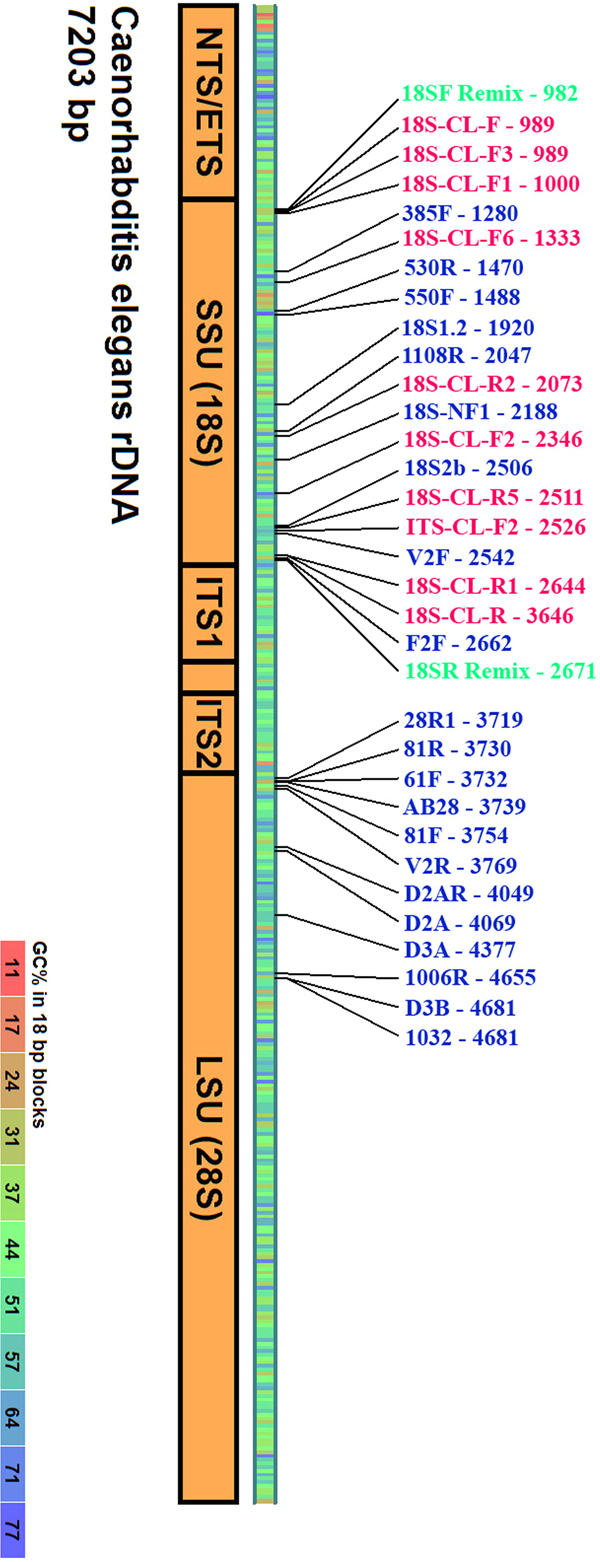
Figure 1
Position diagram of 18S primers constructed with pDRAW32 DNA analysis by AcaClone software. http://www.acaclone.com/ Primer pairs in green and blue are older universal primers (Table 2), and those in red were generated in this study (Table 2).
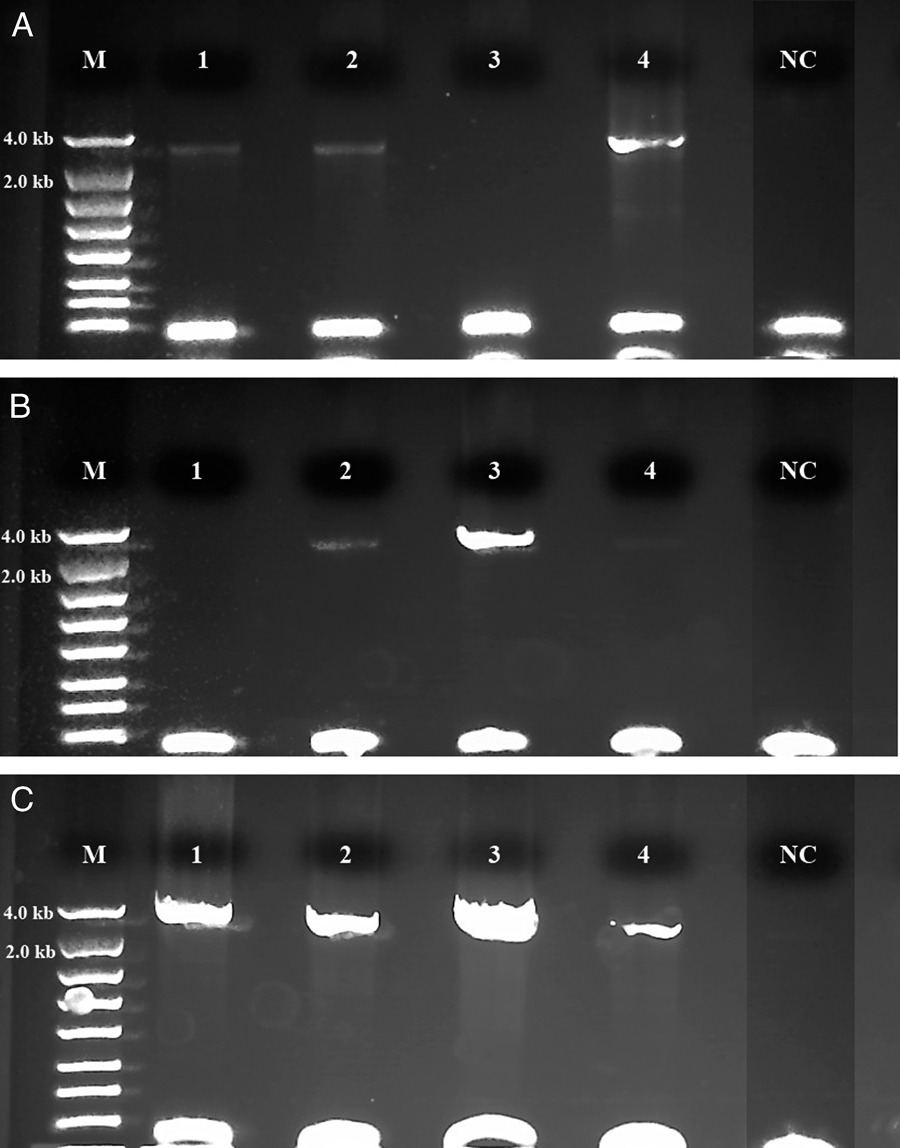
Figure 2
Comparison of 18S primers by the PCR amplification. (A) G18S4 and D2AR; (B) 18S-CL-F and D2AR; (C) 18S-CL-F3 and D2AR; M: DNA ladder (0.1-4.0kb); 1: Panagrolaimus sp. Idaho; 2: Aphelenchoides bicaudatus, Maryland; 3: Bursaphelenchus sp. MX; 4: Ditylenchus sp. Idaho; NC was the negative control. The PCRs were performed with TaKaRa Ex Taq as described in Materials and Methods and the conditions: 95°C for 5 min, 35X (95°C for 30′, 50°C for 45′, 72°C for 2 min 30′), 72°C for 2 min, 4°C until finish. An approximately 2,900 nt amplicon was generated.
Table 3
Taxa tested successfully with our newly designed ribosomal primers or paired with universal ribosomal primers.
| Taxon | Primer set | Amplified rRNA gene (length) | Ta (°C) | Taq |
|---|---|---|---|---|
|
Acrobeloides sp. LKC52 Pratylenchus penetrans Thailand | 18S-CL-F/18S-CL-R1 | 18S (around 1,700bp) | 50–55 | Invitrogen™ Platinum™ |
|
Aphelenchoides sp. No1 Idaho Aphelenchoides sp. No2 Idaho Panagrolaimus sp. Idaho | 18S-CL-F3/81R | 18S and ITS (around 2,400bp) | 58 | TaKaRa EX |
|
Panagrolaimus sp. LKC44, LKC46 LKC47, LKC53, LKC56, PS1162 Poikilolaimus sp. Idaho | 18S-CL-F3/D2AR | 18S and ITS (around 2,900bp) | 58 | TaKaRa EX |
|
Pratylenchus neglectus Malad Idaho Pratylenchus penetrans Maryland Pratylenchus agilis Maryland | 18S-CL-F3/AB28 or V2R | 18S and ITS (around 2,400bp) | 59 | Phusion |
| Ditylenchus sp. Idaho | 18S-CL-F6/81R | 18S and ITS (around 2,000bp) | 54 | TaKaRa EX |
|
Bursaphelenchus sp. MX Aphelenchoides sp. No1 Idaho Scutellonema bradys Congo Vittatidera zeaphila New York Deladenus Georgia (in egg masses) Deladenus Georgia (in wood) Pratylenchus sp. Cuba | 18S-CL-F3/1912R | 18S (around 1,000bp) | 50 | Invitrogen™ Platinum™ |
|
Aphelenchoides sp. No1 Idaho Aphelenchoides sp. No2 Idaho Ditylenchus cf. myceliophagus sp. Idaho Ditylenchus dipsaci Diphtherophora sp. Malad, Idaho | 18S-CL-F3/530R | 18S (530bp) | 50 | Invitrogen™ Platinum™ |
| Ditylenchus sp. Idaho | 18S-CL-F2/1032R | ITS and 28S ( around 2,000bp) | 54 | TaKaRa EX |
| Pratylenchus neglectus Malad, Idaho | ITS-CL-F2/1006R or 1032R | ITS and 28S ( around 2,000bp) | 54 | TaKaRa EX |