
Table 1
Sequenced genes pf plant-parasitic nematodes sampled from cultivated and wild olive in Crete and two other hosts in Evia and Thessaly, Greece.
| Nematode species | Sample code | Host and Locality | D2-D3 | ITS |
|---|---|---|---|---|
| Bitylenchus hispaniensis | OLI106 | Cultivated olive, Episkopi, Crete | MG770479 | – |
| B. hispaniensis | OLI013 | Cultivated olive, Roufas, Crete | * | – |
| B. hispaniensis | OLE011 | Wild olive, Trypiti, Crete | * | |
| B. hispaniensis | OLE015 | Wild olive, Lentas, Crete | * | – |
| B. hispaniensis | OLE023 | Wild olive, Ag. Ioannis, Crete | * | – |
| B. hispaniensis | OLE029 | Wild olive, Ag. Georgios, Crete | * | – |
| B. hispaniensis | OLE032 | Wild olive, Tsoutsouros, Crete | * | – |
| Helicotylenchus microlobus | OLI066 | Cultivated olive, Vori, Crete | MG770480 | MG770406 |
| H. microlobus | OLI002 | Cultivated olive, Vori, Crete | * | – |
| H. microlobus | OLI074 | Cultivated olive, Vori, Crete | * | – |
| H. microlobus | POT017 | Potted cultivated olive, Chania, Crete | MG770481 | MG770407 |
| H. microlobus | WAL17 | Walnut, Evia, Greece | MG770482 | MG770408 |
| Helicotylenchus vulgaris | OLI004 | Cultivated olive, Petrokefali, Crete | MG770483 | – |
| H. vulgaris | OLI005 | Cultivated olive, Petrokefali, Crete | * | – |
| H. vulgaris | OLI046 | Cultivated olive, Gonies, Crete | * | – |
| H. vulgaris | OLI055 | Cultivated olive, Voutes, Crete | * | – |
| H. vulgaris | OLI071 | Cultivated olive, Pentamodi, Crete | * | – |
| H. vulgaris | OLI129 | Cultivated olive, Perama, Crete | * | – |
| H. vulgaris | OLE026 | Wild olive, Agiofarago, Crete | * | – |
| H. vulgaris | GOBERR | Goji berry, Thessaly, Greece | MG770484 | – |
| Merlinius brevidens a | OLI106 | Cultivated olive, Episkopi, Crete | MG770485 | – |
| M. brevidens | OLE009 | Wild olive, Kefali, Crete | * | – |
| Pratylenchoides alkani b | OLI060 | Cultivated olive, Sivas, Crete | MG770486 | – |
| P. alkani | OLI111 | Cultivated olive, Amygdali, Crete | * | – |
| P. alkani | OLE007 | Wild olive, Vathy, Crete | * | – |
| P. alkani | OLE017 | Wild olive, Agiofarago, Crete | * | – |
| P. alkani | OLE018 | Wild olive, Agiofarago, Crete | * | – |
| P. alkani | OLE031 | Wild olive, Listis, Crete | * | – |
| P. alkani | OLE032 | Wild olive, Tsoutsouros, Crete | * | – |
| P. alkani | OLE036 | Wild olive, Agiofarago, Crete | * | – |
[i] Notes: (*) Sequenced population but not deposited in GenBank database because of its high similarity with previously deposited sequences.
(−) Not obtained.
aFound in 29 further cultivated olive samples (OLI007, OLI010, OLI030, OLI031, OLI033, OLI050, OLI051, OLI066, OLI070, OLI071, OLI080, OLI084, OLI086, OLI097, OLI100, OLI102, OLI103, OLI104, OLI105, OLI108, OLI110, OLI111, OLI114, OLI129, OLI131, OLI134, OLI135, OLI142, and OLI146) and in nine further wild olive samples (OLE011, OLE013, OLE015, OLE021, OLE027, OLE028, OLE029, OLE030, and OLE032).
bMay be a junior synonym of P. ritteri, as supported by phylogenetic analyses by Azizi et al. (2016) and noted by some other researchers (Brzeski, 1998; Ghaderi and Karegar, 2014; Ghaderi et al., 2014).
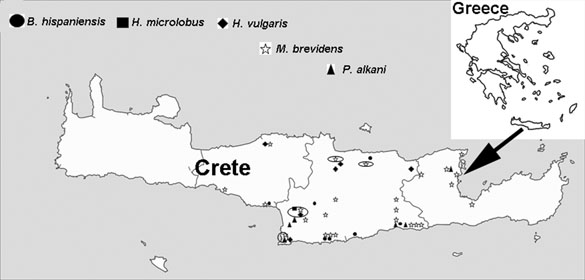
Fig. 1
Geographic distribution of plant-parasitic nematodes of the genera Bitylenchus, Helicotylenchus, Merlinius and Pratylenchoides in field survey of cultivated and wild olive in Crete, Greece. Numbers of samples for each nematode species are as follows: Bitylenchus hispaniensis (seven samples), Helicotylenchus microlobus (three samples), Helicotylenchus vulgaris (seven samples), Merlinius brevidens (40 samples) and Pratylenchoides alkani (eight samples). 44 sites are presented, as some samples were derived from spatially close (encircled) areas and may therefore not be independent populations.
Table 2
Morphometrics of Bitylenchus hispaniensis (Handoo, et al., 2014); Helicotylenchus microlobus (Perry et al., 1959); Helicotylenchus vulgaris (Yuen, 1964); Merlinius brevidens (Allen, 1955; Siddiqi, 1970); and Pratylenchoides alkani (Yüksel, 1977) from olive in Crete, Greecea.
| B. hispaniensis | H. microlobus | H. vulgaris | M. brevidens | P. alkani | |
|---|---|---|---|---|---|
| Episkopi | Vori | Petrokefali | Episkopi | Sivas | |
| Characters/ratiosb | Females | Females | Females | Females | Females |
| n | 3 | 4 | 3 | 3 | 3 |
| L | 722 ± 47 (670–760) | 652 ± 31 (609–680) | 672 ± 35 (634–702) | 564 ± 116 (490–698) | 907 ± 69.1 (840–978) |
| a | 32.3 ± 0.6 (31.9–33.0) | 25.4 ± 1.6 (24.2–27.7) | 30.6 ± 0.4 (30.2–31.0) | 26.3 ± 3.8 (22.9–30.3) | 35.3 ± 0.8 (34.7–36.2) |
| B | 6.3 ± 0.4 (6.1–6.8) | 4.5 ± 0.4 (4.1–4.9) | 5.1 ± 0.02 (5.1–5.2) | 4.4 ± 0.6 (4.0–5.1) | 6.7 ± 0.2 (6.4–6.8) |
| C | 14.9 ± 0.6 (14.4–15.5) | 43.7 ± 8.4 (35.8–55.4) | 48.1 ± 1.1 (46.8–48.8) | 14.3 ± 2.4 (12.9–17.0) | 16.7 ± 0.2 (16.5–16.9) |
| c′ | 3.0 ± 0.2 (2.7–3.2) | 1.1 ± 0.2 (0.9–1.4) | 1.1 ± 0.0 (1.1–1.1) | 3.0 ± 0.1 (2.9–3.2) | 3.1 ± 0.2 (2.8–3.2) |
| V | 55.0 ± 1.0 (54.0–56.0) | 61.2 ± 1.6 (59.3–63.2) | 64.0 ± 2.0 (62.0–66.0) | 54.7 ± 3.1 (52.0–58.0) | 52.7 ± 1.5 (51.0–54.0) |
| Stylet length | 17.3 ± 0.3 (17.0–17.5) | 26.4 ± 1.2 (25.0–28.0) | 24.0 ± 1.0 (23.0–25.0) | 14.3 ± 1.5 (13.0–16.0) | 23.7 ± 0.6 (23.0–24.0) |
| Pharynx length | 114.0 ± 5.3 (110–120) | 145.5 ± 7.0 (139–153) | 130.7 ± 6.8 (123–136) | 127.7 ± 7.2 (123–136) | 135.7 ± 11.2 (123–144) |
| Max. body diam. | 22.3 ± 1.2 (21.0–23.0) | 25.7 ± 1.5 (24.0–27.0) | 22.0 ± 1.0 (21.0–23.0) | 21.3 ± 2.1 (19.0–23.0) | 25.7 ± 1.5 (24.0–27.0) |
| Anal body diam. | 16.5 ± 2.2 (14.0–18.0) | 14.1 ± 1.4 (12.5–16.0) | 13.0 ± 1.0 (12.0–14.0) | 13.0 ± 1.0 (12.0–14.0) | 17.7 ± 0.6 (17.0–18.0) |
| Tail | 48.3 ± 3.1 (45.0–51.0) | 15.3 ± 2.4 (12.0–17.0) | 14.0 ± 1.0 (13.0–15.0) | 39.3 ± 1.5 (38.0–41.0) | 54.3 ± 3.5 (51.0–58.0) |
[ii] bAbbreviations are defined in Siddiqi (2000).