
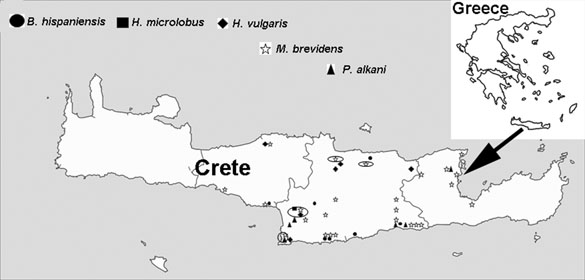
Olive (Olea europaea subsp. europaea L.) is the most common crop on the island of Crete, Greece, while clusters of wild olives (Olea europaea subsp. sylvestris L.) are located also in several non-agricultural areas (Tzortzakakis et al., 2014). Surveys for detection of plant-parasitic nematodes were conducted on both cultivated and wild olives during the period 2013 to 2015. Soil samples were collected with a hoe, discarding the upper 5-cm top soil profile, from 5 to 40 cm depth in the close vicinity of active roots from 2 to 5 olive trees randomly chosen in each from 146 orchards. Similarly, soil samples were also collected from the rhizosphere of individual 36 wild olives distributed in various areas. Furthermore, three additional soil samples, where populations of Helicotylenchus were detected, were included in this study. One sample was from pots where cultivated olive stock plants were maintained for research purposes (Institute of Olive Tree, Subtropical Crops, and Viticulture, Chania, Crete), the second from the roots of walnut (Juglans regia L.) in Evia, Greece, and the third from the roots of goji berry (Lycium barbarum L.) in Thessaly, Greece. Nematodes were extracted from several soil samples of 500 g by the wet-sieving and decanting method (Cobb, 1918). Additional samples were collected later from the same sampling sites to obtain sufficient specimens for morphological and molecular identification. Specimens to be observed under light microscopy (LM) were heat killed by adding hot 4% formaldehyde solution and were processed to pure glycerin using De Grisse’s (1969) method. Microscopical observations were carried out using a Zeiss III compound microscope with Nomarski differential interference contrast at up to ×1,000 magnification. Diagnostic measurements were made using a drawing tube attached to the microscope. Specimens for molecular analysis were preserved in DESS (Yoder et al., 2006). Here, we report five species as identified by morphological and molecular analyses of females: Bitylenchus hispaniensis (Handoo et al., 2014); Helicotylenchus microlobus (Perry et al., 1959); Helicotylenchus vulgaris (Yuen, 1964); Merlinius brevidens (Allen, 1955; Siddiqi, 1970); and Pratylenchoides alkani (Yüksel, 1977; Table 1, Fig. 1). These plant-parasitic nematode species, except H. microlobus and M. brevidens, are new records for Greece. The morphology and morphometry of the isolated nematode species (Table 2) agreed with original and previous descriptions of them, except for minor intraspecific differences (Koliopanos and Vovlas, 1977; Castillo and Gómez Barcina, 1988; Ghaderi et al., 2014; Subbotin et al., 2015; Azizi et al., 2016). Nematode DNA was extracted from single individuals and PCR assays were conducted as described by Castillo et al. (2003). Primers and PCR conditions used in this research were specified in Cantalapiedra-Navarrete et al. (2013), and single amplicons of 800 bp and 1,100 bp in length was obtained by sequencing of the D2-D3 expansion segments of 28S and of ITS rRNA genes, respectively. Sequence alignments for D2-D3 from the Cretan B. hispaniensis, which showed 99 to 100% similarity (differing in 0 to 1 bp, 0 indels) to the Spanish type population, were deposited in NCBI GenBank (accession numbers MG770479, KJ461547, and KJ461545, respectively). The H. microlobus populations from cultivated olive from Crete and walnut from Evia (MG770480–MG770482) showed 99% similarity (differing in 1 to 6 bp, 0 indels) with H. microlobus (KM506793–KM506800) and Helicotylenchus pseudorobustus populations (HM014264, KU722387) deposited in the NCBI. ITS from populations of H. microlobus (MG770406–MG770408) showed 98 to 99% similarity (differing in 13 to 18 bp, 9 indels) to H. microlobus populations (KM506864–KM506867) and only 93% similarity (differing in 68 to 69 bp, 26 indels) to H. pseudorobustus populations (KM506875 and KM506880), which agree with previous data by Subbotin et al. (2015) and which confirmed the integrative diagnosis of our specimens. Similarly, the H. vulgaris populations from wild and cultivated olive, Crete and goji berry, Thessaly (MG770483–MG770484) showed 99 to 100% similarity (differing in 0 to 4 bp, 0 indel) with H. vulgaris populations (FJ485650, KU722388, DQ328759–DQ328761) deposited in NCBI. Intraspecific variability for D2-D3 was low for H. microlobus and H. vulgaris (differing in 5 to 7 bp, 1 indels, and 1 bp, 0 indels, respectively). The D2-D3 sequence of the Cretan population of M. brevidens (MG770485) showed 99% similarity (differing in 4 to 9 bp, 0 to 1 indel) to M. brevidens populations (KJ585416, KP313844, and KP313847). Finally, the D2-D3 28 S expansion segment from the Cretan populations of P. alkani (MG770486) showed 99% similarity to P. alkani (JX261953 and JX261962) and Pratylenchoides ritteri populations (KP313850 and KU855004) (differing in 2–4 bp, 1 to 2 indels, and 4–9 bp, 1–2 indels, respectively). These data support previous suggestions for synonymizing P. alkani and P. ritteri, as suggested by some other researchers (Brzeski, 1998; Karegar, 2006; Ghaderi and Karegar, 2014; Ghaderi et al. 2014; Azizi et al., 2016). Nevertheless, additional studies with other ribosomal and mitochondrial markers on topotype populations of both species are needed to clarify whether the two taxa are conspecific or cryptic species.
Table 1
Sequenced genes pf plant-parasitic nematodes sampled from cultivated and wild olive in Crete and two other hosts in Evia and Thessaly, Greece.
| Nematode species | Sample code | Host and Locality | D2-D3 | ITS | |
|---|---|---|---|---|---|
| Bitylenchus hispaniensis | OLI106 | Cultivated olive, Episkopi, Crete | MG770479 | – | |
| B. hispaniensis | OLI013 | Cultivated olive, Roufas, Crete | * | – | |
| B. hispaniensis | OLE011 | Wild olive, Trypiti, Crete | * | ||
| B. hispaniensis | OLE015 | Wild olive, Lentas, Crete | * | – | |
| B. hispaniensis | OLE023 | Wild olive, Ag. Ioannis, Crete | * | – | |
| B. hispaniensis | OLE029 | Wild olive, Ag. Georgios, Crete | * | – | |
| B. hispaniensis | OLE032 | Wild olive, Tsoutsouros, Crete | * | – | |
| Helicotylenchus microlobus | OLI066 | Cultivated olive, Vori, Crete | MG770480 | MG770406 | |
| H. microlobus | OLI002 | Cultivated olive, Vori, Crete | * | – | |
| H. microlobus | OLI074 | Cultivated olive, Vori, Crete | * | – | |
| H. microlobus | POT017 | Potted cultivated olive, Chania, Crete | MG770481 | MG770407 | |
| H. microlobus | WAL17 | Walnut, Evia, Greece | MG770482 | MG770408 | |
| Helicotylenchus vulgaris | OLI004 | Cultivated olive, Petrokefali, Crete | MG770483 | – | |
| H. vulgaris | OLI005 | Cultivated olive, Petrokefali, Crete | * | – | |
| H. vulgaris | OLI046 | Cultivated olive, Gonies, Crete | * | – | |
| H. vulgaris | OLI055 | Cultivated olive, Voutes, Crete | * | – | |
| H. vulgaris | OLI071 | Cultivated olive, Pentamodi, Crete | * | – | |
| H. vulgaris | OLI129 | Cultivated olive, Perama, Crete | * | – | |
| H. vulgaris | OLE026 | Wild olive, Agiofarago, Crete | * | – | |
| H. vulgaris | GOBERR | Goji berry, Thessaly, Greece | MG770484 | – | |
| Merlinius brevidens a | OLI106 | Cultivated olive, Episkopi, Crete | MG770485 | – | |
| M. brevidens | OLE009 | Wild olive, Kefali, Crete | * | – | |
| Pratylenchoides alkani b | OLI060 | Cultivated olive, Sivas, Crete | MG770486 | – | |
| P. alkani | OLI111 | Cultivated olive, Amygdali, Crete | * | – | |
| P. alkani | OLE007 | Wild olive, Vathy, Crete | * | – | |
| P. alkani | OLE017 | Wild olive, Agiofarago, Crete | * | – | |
| P. alkani | OLE018 | Wild olive, Agiofarago, Crete | * | – | |
| P. alkani | OLE031 | Wild olive, Listis, Crete | * | – | |
| P. alkani | OLE032 | Wild olive, Tsoutsouros, Crete | * | – | |
| P. alkani | OLE036 | Wild olive, Agiofarago, Crete | * | – |
| B. hispaniensis | H. microlobus | H. vulgaris | M. brevidens | P. alkani | |
|---|---|---|---|---|---|
| Episkopi | Vori | Petrokefali | Episkopi | Sivas | |
| Characters/ratiosb | Females | Females | Females | Females | Females |
| n | 3 | 4 | 3 | 3 | 3 |
| L | 722 ± 47 (670–760) | 652 ± 31 (609–680) | 672 ± 35 (634–702) | 564 ± 116 (490–698) | 907 ± 69.1 (840–978) |
| a | 32.3 ± 0.6 (31.9–33.0) | 25.4 ± 1.6 (24.2–27.7) | 30.6 ± 0.4 (30.2–31.0) | 26.3 ± 3.8 (22.9–30.3) | 35.3 ± 0.8 (34.7–36.2) |
| B | 6.3 ± 0.4 (6.1–6.8) | 4.5 ± 0.4 (4.1–4.9) | 5.1 ± 0.02 (5.1–5.2) | 4.4 ± 0.6 (4.0–5.1) | 6.7 ± 0.2 (6.4–6.8) |
| C | 14.9 ± 0.6 (14.4–15.5) | 43.7 ± 8.4 (35.8–55.4) | 48.1 ± 1.1 (46.8–48.8) | 14.3 ± 2.4 (12.9–17.0) | 16.7 ± 0.2 (16.5–16.9) |
| c′ | 3.0 ± 0.2 (2.7–3.2) | 1.1 ± 0.2 (0.9–1.4) | 1.1 ± 0.0 (1.1–1.1) | 3.0 ± 0.1 (2.9–3.2) | 3.1 ± 0.2 (2.8–3.2) |
| V | 55.0 ± 1.0 (54.0–56.0) | 61.2 ± 1.6 (59.3–63.2) | 64.0 ± 2.0 (62.0–66.0) | 54.7 ± 3.1 (52.0–58.0) | 52.7 ± 1.5 (51.0–54.0) |
| Stylet length | 17.3 ± 0.3 (17.0–17.5) | 26.4 ± 1.2 (25.0–28.0) | 24.0 ± 1.0 (23.0–25.0) | 14.3 ± 1.5 (13.0–16.0) | 23.7 ± 0.6 (23.0–24.0) |
| Pharynx length | 114.0 ± 5.3 (110–120) | 145.5 ± 7.0 (139–153) | 130.7 ± 6.8 (123–136) | 127.7 ± 7.2 (123–136) | 135.7 ± 11.2 (123–144) |
| Max. body diam. | 22.3 ± 1.2 (21.0–23.0) | 25.7 ± 1.5 (24.0–27.0) | 22.0 ± 1.0 (21.0–23.0) | 21.3 ± 2.1 (19.0–23.0) | 25.7 ± 1.5 (24.0–27.0) |
| Anal body diam. | 16.5 ± 2.2 (14.0–18.0) | 14.1 ± 1.4 (12.5–16.0) | 13.0 ± 1.0 (12.0–14.0) | 13.0 ± 1.0 (12.0–14.0) | 17.7 ± 0.6 (17.0–18.0) |
| Tail | 48.3 ± 3.1 (45.0–51.0) | 15.3 ± 2.4 (12.0–17.0) | 14.0 ± 1.0 (13.0–15.0) | 39.3 ± 1.5 (38.0–41.0) | 54.3 ± 3.5 (51.0–58.0) |