
Table 1
Outcome category coding scheme synthesized from relevant literature (Fisher et al., 2017; Passow & Passow, 2017; Simmons et al., 2017a; White et al., 2020; Woodcock, 2019).
| OUTCOME CATEGORY | DESCRIPTION |
|---|---|
| Business Competence | Make Decisions, Devise Process (Passow & Passow, 2017); Critical Thinking, Strategy (Fisher et al., 2017) |
| Career Direction Outcomes | Career and Professional Development (Simmons et al., 2017a); Networking (Fisher et al., 2017) |
| College Outcomes | Satisfaction with College, College Belongingness and Connectedness (Simmons et al., 2017a) |
| Communication Competence | Communicate Effectively (Passow & Passow, 2017); Communication Skills, Academic and Social Engagement (Simmons et al., 2017a); Interpersonal Communication, Written Communication (Fisher et al., 2017; White et al., 2020); Public Speaking (Fisher et al., 2017); Technical Presentation (White etal., 2020); Communications Skills Across Domains (Woodcock, 2019) |
| Cultural Competence | Cross-cultural Skills, Global Awareness (Fisher et al., 2017); Intercultural Competence (Simmons et al., 2017a); Knowledge of Non-disciplinary Perspectives (Woodcock, 2019) |
| Data Competence | Interpret Data, Measure Accurately (Passow & Passow, 2017); Statistics, Signal Processing, Instrumentation (White et al., 2020) |
| Design Competence | Gather Information, Define Constraints, Think Creatively, Design Solutions (Passow & Passow, 2017) Solve Problems (Fisher et al., 2017; Passow& Passow, 2017; White et al., 2020); Design Experience (White etal., 2020); Creativity (Fisher et al., 2017) |
| Disciplinary Competence | Experience With Relevant Software, Regulatory Procedures, Biomaterials, Quantitative Biology, Biomechanics, Advanced Courses in Traditional Engineering, Advanced Courses in Traditional Engineering, Programming Skills (White et al., 2020); Apply Skills, Apply Knowledge (Passow & Passow, 2017); Disciplinary Knowledge (Fisher et al., 2017); Intellectual Development (Simmons et al., 2017a); Knowledge of Disciplinary Perspectives (Woodcock, 2019) |
| Ethical Competence | Civic Responsibility, Ethics, Humanitarianism (Fisher et al., 2017); Take Responsibility (Passow & Passow, 2017) |
| Interdisciplinary Competence | Integration of Knowledge Domains, Reflective Behavior, Critical Awareness (Woodcock, 2019) |
| Leadership Competence | Coordinate Efforts (Passow & Passow, 2017); Leadership Development (Simmons et al., 2017a); Organizational Management (Fisher et al., 2017) |
| Personal Attribute Outcomes | Self-confidence, Self-direction, Time Management, (Fisher et al., 2017); Take Initiative, Expand Skills (Passow & Passow, 2017); Persistence, Personal and Social Development (Simmonset al., 2017a) |
| Teamwork Competence | Teamwork (Fisher et al., 2017); Team Projects (White et al., 2020) |
Table 2
Participant demographic and participation information.
| Gender | Female (11) | Male (3) | |
| Race/Ethnicity | Asian (6) | Hispanic/Latinx (2) | White/Caucasian (6) |
| Co-Curricular | MDE Only (3) | Research Only (7) | Both (4) |
Table 3
A non-comprehensive list of interview questions.
| INTERVIEW SECTION | EXAMPLE QUESTIONS |
|---|---|
| Research or MDE | What would you say the goals of the lab/organization are in which you’re working?
Can you tell me about a project you are currently working on in ____?
What are some of the BME concepts and skills your team is applying in the work that you do? Are there non-BME concepts being used in your project currently? |
| Summary/Synthesis | Thinking about what you have gotten out of Research and/or MDE, what BME career preparation have you developed without it?
How is your experience in research and/or MDE helping you reach your professional goals in BME? Have any other experiences you’ve had at [University] been helpful in preparing you for your professional goals?
|
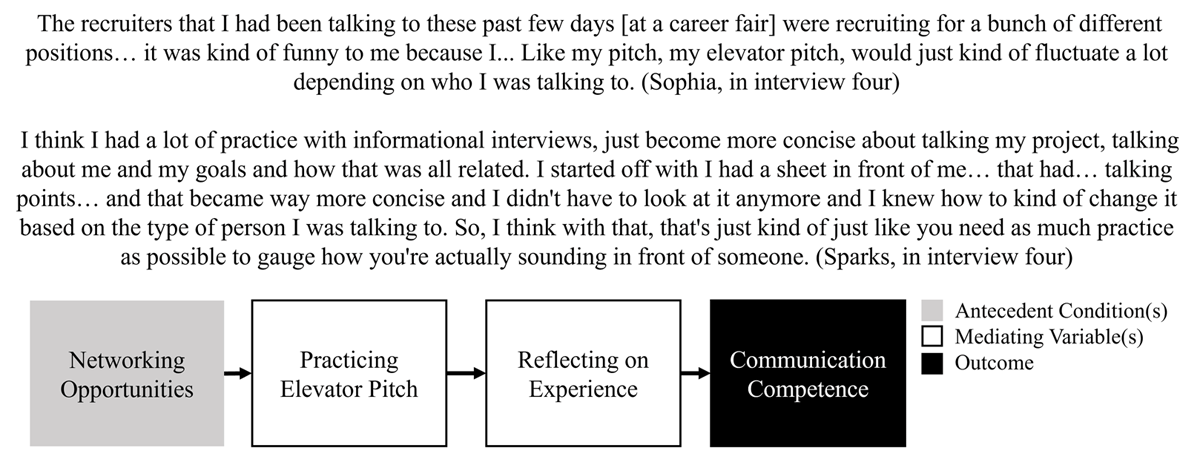
Figure 1
Example of the causation coding approach using data examples.
Table 4
Definitions of terms used for causation coding approach.
| TERM | DEFINITION AND EXAMPLES |
|---|---|
| experience element | The term used as equivalent to an antecedent condition as described by Saldaña (2016). Experience elements described features of a co-curricular setting that spanned across categories of co-curricular activities. For example, having a formal mentor relationship could be present in multiple categories of co-curricular experiences. |
| participant action | The term used as equivalent to mediating variables as described by Saldaña (2016). In our data, we focused on the active role students could play in influencing their development of a particular professional outcome category given the presence of specific experience elements. This emphasizes the importance of student engagement in the development process. |
| outcome category | Outcome categories were used to explore the various professionally relevant outcomes of students’ engagement. The term outcome aligns with Saldaña’s causal analysis approach, and the professional focus stems from prior focus on professional outcomes in engineering co-curricular literature. |
| types of co-curricular activities | This terminology refers to a common strategy used to study co-curricular learning, which buckets opportunities into categories based on archetypes like research, design teams, professional societies, etc. |
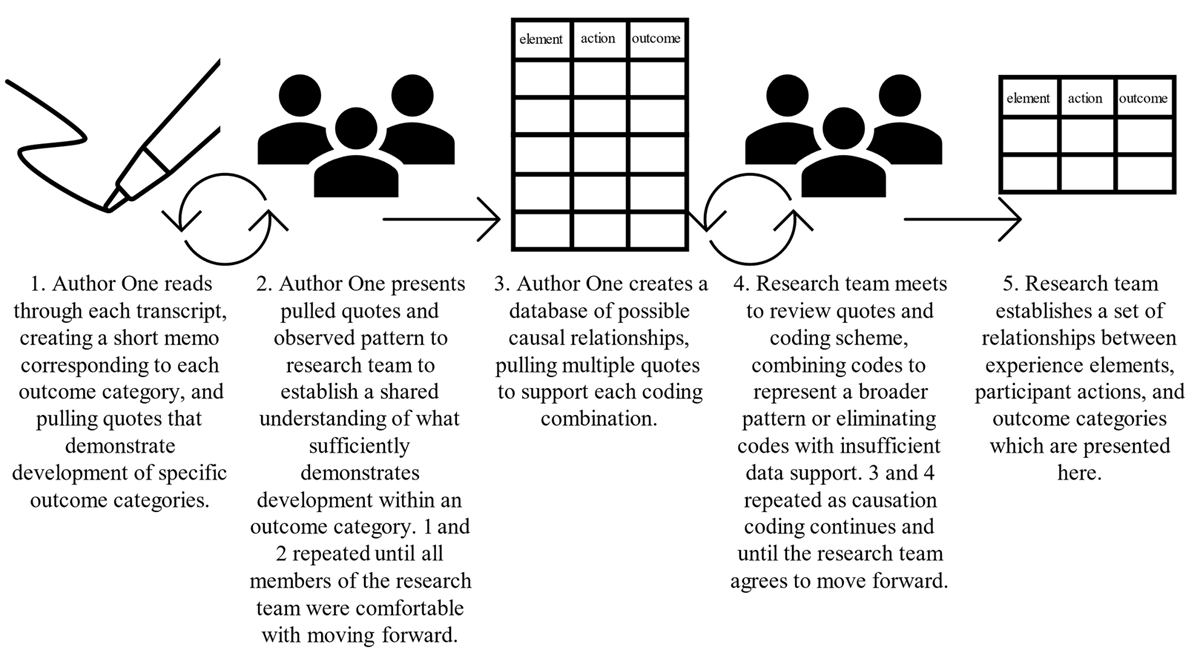
Figure 2
Graphic depiction of data analysis process.
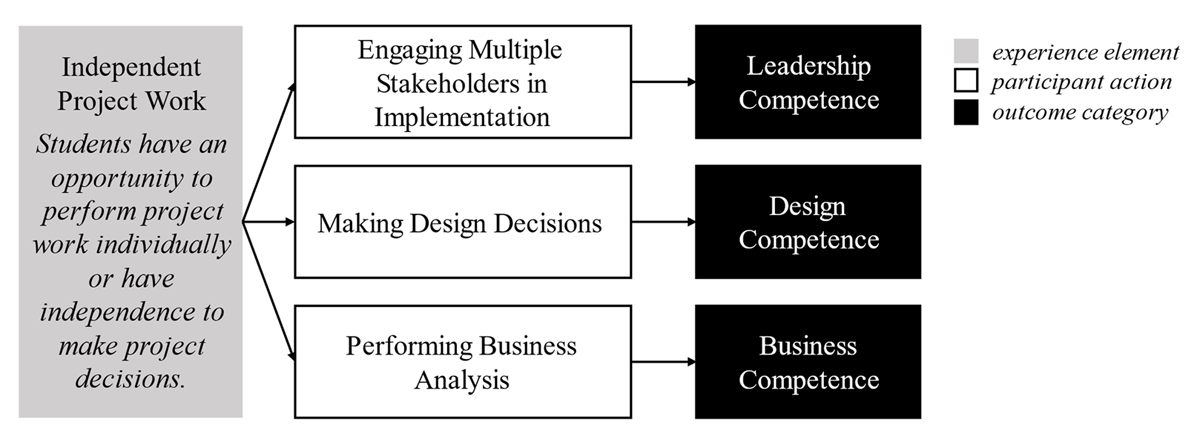
Figure 3
Relationships found between the experience element Independent Project Work and multiple participant actions connecting to a variety of outcome categories.
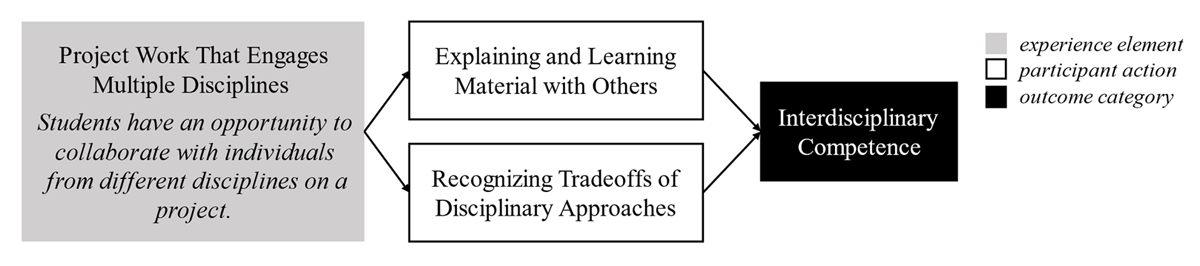
Figure 4
Relationships found between the experience element Project Work that Engages Multiple Disciplines and two different participant actions connecting to the outcome category Interdisciplinary Competence.
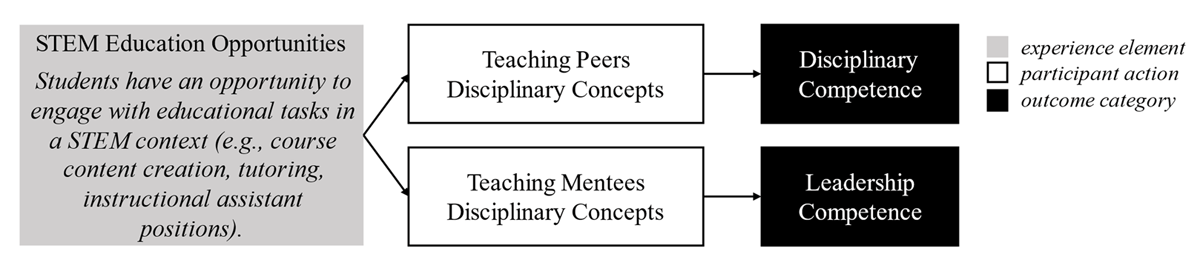
Figure 5
Relationships found between the experience element STEM Education Opportunities and multiple participant actions that connected to a variety of outcome categories.
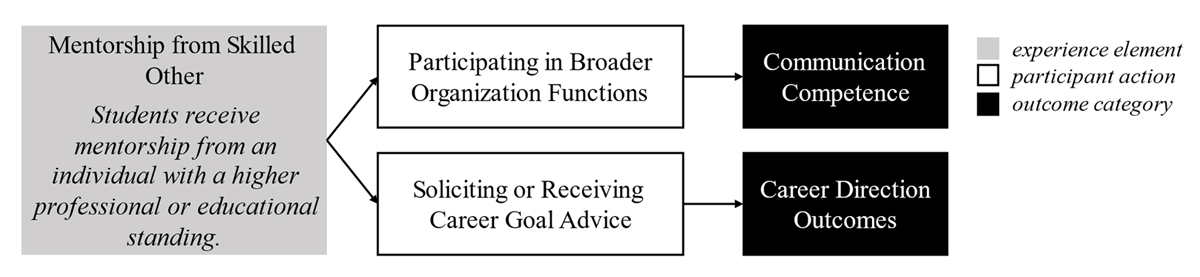
Figure 6
Relationships found between the experience element Mentorship from a Skilled Other and multiple participant actions connecting to a variety of outcome categories.
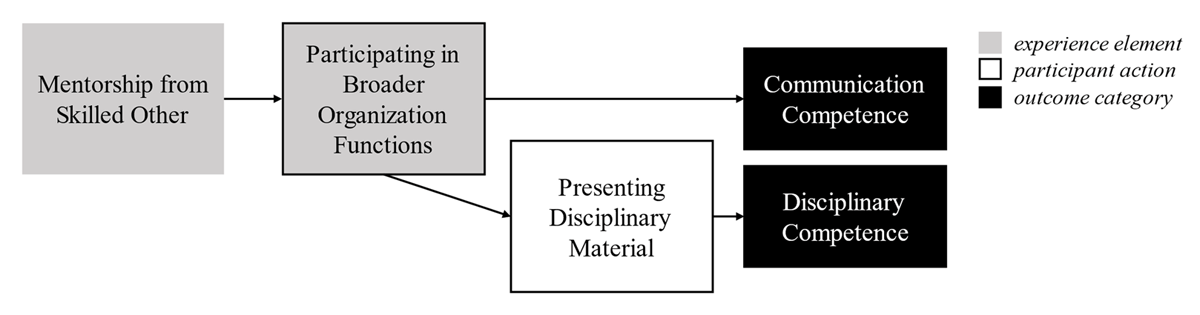
Figure 7
Demonstrated relationship starting with Mentorship from a Skilled Other leading to Participating in Broader Organization Functions and in some cases Presenting Disciplinary Material in relation to the development of Communication and Disciplinary Competence.
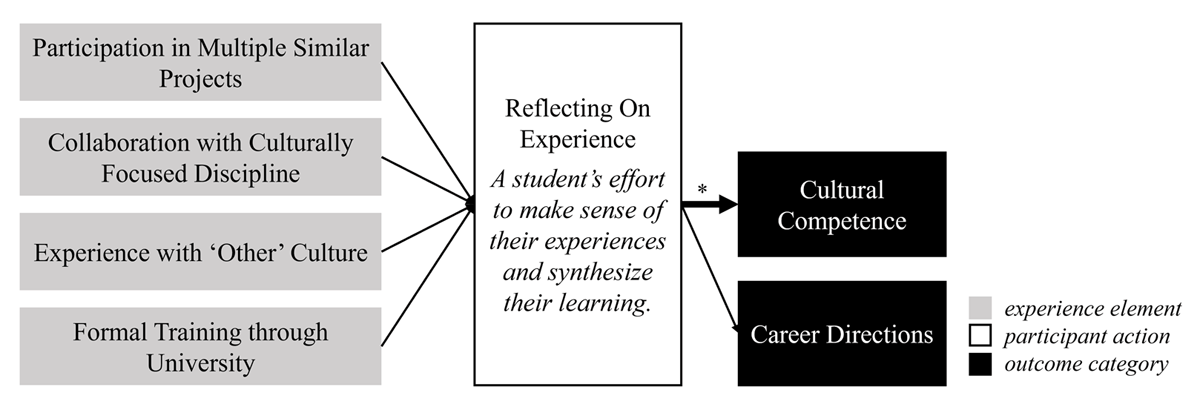
Figure 8
Relationships found between multiple experience elements that connect to a variety of outcome categories through the participant action Reflecting on Experience.
Table 5
Considerations for educators and mentors based on the connections found in this study.
| EXPERIENCE ELEMENT OR PARTICIPANT ACTION | CONSIDERATIONS PROPOSED |
|---|---|
| Independent Project Work | To support Business Competence:
To support Leadership Competence:
|
| Project Work that Engages Multiple Disciplines | To support Interdisciplinary Competence:
|
| STEM Education Opportunities | To support Leadership and Disciplinary Competence:
|
| Mentorship from a Skilled Other | To support Career Direction Outcomes:
To support Communication and Disciplinary Competence:
|
| Reflecting on Experience | To support Cultural Competence and Career Direction Outcomes:
|