
Background
Co-curriculars—“out-of-class” activities associated with students’ majors (Simmons et al., 2017a)—are important aspects of engineering education because of their potential to initiate and reinforce learning and prepare students for future careers (Busby, 2015). As research on co-curricular activities has developed, higher education institutions have placed an increased emphasis on engineering students’ participation in co-curricular activities to supplement curricula (Busby, 2015; Conger et al., 2010) and develop a range of professional, career, and personal outcomes in students. In this work, we explored patterns of common elements across co-curriculars that could be connected to students’ development of professional, career, or personal outcomes. Identification of these patterns can inform new ways of studying and designing engineering co-curricular activities.
Connecting Co-Curricular Engagement with Professional, Career, and Personal Outcomes
Studies exploring engineering student outcomes related to co-curricular participation have argued that these activities are related to the development of a variety of outcomes (Litchfield et al., 2016). Engineering professional outcomes have often included communication competence (Carter et al., 2016; Coyle et al., 2005; Dalrymple & Evangelou, 2006; Young et al., 2015), cultural competence (Oakes et al., 2018), design competence (Coyle et al., 2005; Dukart, 2017), ethical competence (Bielefeldt et al., 2016; Burt et al., 2011; Finelli et al., 2012), leadership competence (Burt et al., 2011; Knight & Novoselich, 2017; Reeve et al., 2015), and teamwork competence (Coyle et al., 2005; Young et al., 2015). Similarly, scholars have studied connections between co-curricular participation and students’ career and personal outcomes, like self-efficacy and sense of belonging (Burt et al., 2011; Dukart, 2017; Fiorini et al., 2014; Fisher et al., 2017) as well as lifelong learning and reflective behavior outcomes (Young et al., 2015). While many of these outcomes have been generally recognized as important for students’ success as professional engineers and incorporated in formal engineering curricula (ABET, 2023; National Academy of Engineering, 2004), students have also often been encouraged to leverage activities outside of their formal coursework to build their skills and improve their professional, career, and personal outcomes in college (Busby, 2015).
Literature on professional, personal, and career impacts of student participation in co-curricular activities has highlighted a variety of outcomes. Based on multiple reviews and comprehensive studies, Table 1 categorizes a broad range of outcomes that have been previously recognized as important in engineering student development. We refer to our categorization of relevant professional, personal, and career outcomes as outcome categories throughout the rest of the manuscript to improve readability.
Table 1
Outcome category coding scheme synthesized from relevant literature (Fisher et al., 2017; Passow & Passow, 2017; Simmons et al., 2017a; White et al., 2020; Woodcock, 2019).
| OUTCOME CATEGORY | DESCRIPTION |
|---|---|
| Business Competence | Make Decisions, Devise Process (Passow & Passow, 2017); Critical Thinking, Strategy (Fisher et al., 2017) |
| Career Direction Outcomes | Career and Professional Development (Simmons et al., 2017a); Networking (Fisher et al., 2017) |
| College Outcomes | Satisfaction with College, College Belongingness and Connectedness (Simmons et al., 2017a) |
| Communication Competence | Communicate Effectively (Passow & Passow, 2017); Communication Skills, Academic and Social Engagement (Simmons et al., 2017a); Interpersonal Communication, Written Communication (Fisher et al., 2017; White et al., 2020); Public Speaking (Fisher et al., 2017); Technical Presentation (White etal., 2020); Communications Skills Across Domains (Woodcock, 2019) |
| Cultural Competence | Cross-cultural Skills, Global Awareness (Fisher et al., 2017); Intercultural Competence (Simmons et al., 2017a); Knowledge of Non-disciplinary Perspectives (Woodcock, 2019) |
| Data Competence | Interpret Data, Measure Accurately (Passow & Passow, 2017); Statistics, Signal Processing, Instrumentation (White et al., 2020) |
| Design Competence | Gather Information, Define Constraints, Think Creatively, Design Solutions (Passow & Passow, 2017) Solve Problems (Fisher et al., 2017; Passow& Passow, 2017; White et al., 2020); Design Experience (White etal., 2020); Creativity (Fisher et al., 2017) |
| Disciplinary Competence | Experience With Relevant Software, Regulatory Procedures, Biomaterials, Quantitative Biology, Biomechanics, Advanced Courses in Traditional Engineering, Advanced Courses in Traditional Engineering, Programming Skills (White et al., 2020); Apply Skills, Apply Knowledge (Passow & Passow, 2017); Disciplinary Knowledge (Fisher et al., 2017); Intellectual Development (Simmons et al., 2017a); Knowledge of Disciplinary Perspectives (Woodcock, 2019) |
| Ethical Competence | Civic Responsibility, Ethics, Humanitarianism (Fisher et al., 2017); Take Responsibility (Passow & Passow, 2017) |
| Interdisciplinary Competence | Integration of Knowledge Domains, Reflective Behavior, Critical Awareness (Woodcock, 2019) |
| Leadership Competence | Coordinate Efforts (Passow & Passow, 2017); Leadership Development (Simmons et al., 2017a); Organizational Management (Fisher et al., 2017) |
| Personal Attribute Outcomes | Self-confidence, Self-direction, Time Management, (Fisher et al., 2017); Take Initiative, Expand Skills (Passow & Passow, 2017); Persistence, Personal and Social Development (Simmonset al., 2017a) |
| Teamwork Competence | Teamwork (Fisher et al., 2017); Team Projects (White et al., 2020) |
While previous engineering co-curricular research has established a broad knowledge base that points to positive impacts that co-curricular activities can have on students’ professional, career, and personal outcomes, much of the research to date has explored these impacts in similar outcome-focused ways, with limited focus on the learning processes that occur in these spaces. Many existing engineering co-curricular studies have focused on the impact of co-curricular activities by investigating one or more predefined outcomes of participation in one or more types of co-curricular activities (e.g., design teams, undergraduate research, affinity organizations, etc.). This approach has led to recommendations that emphasize student participation in specific types of co-curricular activities to support the development of a given student outcome.
As an example, a study by Young and colleagues (2015) looked at perceived communication, professionalism, lifelong learning, teamwork, and reflective behavior development of African American students in engineering through their co-curricular involvement. Their study examined three types of co-curricular activities: “engineering clubs,” “underrepresented minority (URM) clubs,” and “other clubs.” In their analysis, they explored the connections between their types of co-curricular activities and the outcomes they measured, finding that students reported higher teamwork and reflective behavior through participation in each of these co-curricular activity types and that students’ self-reported teamwork skills increased with increased engagement in “engineering clubs” and “other clubs.” Their findings suggested the importance of the “engineering club” and “other club” types of co-curricular activities for the development of teamwork skills.
Similarly, a study on multiple outcomes related to participation in one co-curricular type—undergraduate research—investigated the development of communication, teamwork, and leadership skills (Carter et al., 2016). Their study also focused on exploring linkages between participation in research and development of these three outcomes, finding that students who engaged in undergraduate research reported higher skills than students who did not participate in undergraduate research. However, when accounting for students’ other engagement, the authors found few differences between students who did or did not participate. This study demonstrated the importance of considering other variables that might impact researchers’ abilities to draw outcome conclusions based solely on types of co-curricular activities.
Extending work that has explored connections between one or two co-curricular types and a few outcomes or competencies, some efforts in engineering education research have aimed to more extensively study how connections could be made between types of co-curricular activities and outcomes (Fisher et al., 2017; Simmons et al., 2017a, 2018; Simmons & Groen, 2018). For example, in their review of the literature, Fisher et al. (2017) explored relationships between categorized co-curricular activities and engineering student skills. The work produced a framework that hypothesized connections between 20 student skills and 22 categories of co-curricular activities for engineering students. Similarly, a review by Simmons, Creamer, and Yu (2017a) explored outcomes associated with out-of-class involvement, finding 10 student outcomes linked to engineering student involvement in out-of-class activities.
Simmons and colleagues (2017b) also explored linkages between out-of-class involvement and student outcomes by developing the Postsecondary Student Engagement (PosSE) Survey. This survey explored links between students’ affective engagement in out-of-class activities and their perceived outcomes. Using PosSE, Simmons and co-authors (2018) found differences in students’ choices of co-curricular involvement related to their study participants’ gender and race. Based on their results, they emphasized the importance of continued research on student co-curricular participation, particularly in populations that are historically underrepresented in engineering and discussed the importance of a better understanding of co-curricular learning for informing how we encourage students to engage.
Deepening Our Understanding of Learning through Co-Curricular Engagement
To move our understanding of co-curricular learning beyond connections between types of co-curricular activities and student outcomes and towards a deeper understanding of the learning processes that occur within co-curriculars, new research approaches are needed. A recent study looked deeply at students’ leadership development through participation in one specific co-curricular activity—competition teams (Wolfinbarger et al., 2021). Through their analysis, Wolfinbarger and colleagues identified co-curricular engagement factors that their participants related to leadership development through an engineering competition team (e.g., extent of participation, curricular exposure, pre-college organizational experiences, holding leadership positions). Their study approach, which explored how students developed leadership outcomes within a specific co-curricular context, demonstrated an example of how researchers can develop in-depth understandings of the learning processes involved in student development through co-curricular engagement. Wolfinbarger and colleagues’ work extended our understanding of student development in competition teams beyond evidence that leadership outcomes are developed to contribute an understanding of how leadership outcomes were developed, identifying elements of that participation that may contribute to strengthened leadership development (Wolfinbarger et al., 2021).
Studies that acknowledge the nuances of a particular co-curricular context when exploring the outcomes of participation are particularly important because co-curricular activities can provide very different learning environments across similar co-curricular types. For example, as recognized by Faber and colleagues (2020) in their work that explored students’ undergraduate research participation, opportunities within the same co-curricular type can vary by institution, major, or time of engagement. Acknowledging differences in context within the same co-curricular type necessitates a more nuanced study approach to extend our understanding of the learning processes that establish the connections observed between co-curricular participation and the development of student outcomes. More research is needed that explores student learning processes that occur in co-curricular activities so that we can better identify how co-curricular activities can lead to the student outcomes already identified in the literature.
Study Design
Our work aimed to identify elements of students’ co-curricular participation that could be linked to their development of multiple outcome categories. We employed qualitative methods to identify and name patterns in the learning processes associated with students’ growth in certain competencies and that could be linked to specific elements of their experiences across multiple types of co-curricular activities. We used a set of four semi-structured interviews performed over the course of one year to gather data from fourteen BME students involved in co-curricular activities at a large research university. We selected BME as a study context because literature has implicated co-curricular engagement as particularly important to BME students, with some work citing these activities as critical to their professional preparation during their undergraduate degree (Berglund, 2015; Jamison et al., 2020). Using prior literature to inform what outcomes students may be learning about (refer to Table 1), we employed a qualitative causal approach to data analysis to identify elements across co-curricular activities that students discussed in relation to their professional, career, or personal learning processes. Our study explored the following research questions:
What outcome categories are discussed in relation to the professional, career, or personal learning processes students experience through their co-curricular engagement?
What experience elements and participant actions occur across co-curricular activities that can be linked to students’ growth in the outcome categories?
Connecting Learning Theory to Co-Curricular Learning Processes
In this study, we applied two learning theories that were helpful for understanding the ways in which students’ co-curricular participation contributed to their learning. One theory applied in this study was experiential learning theory as described by Kolb (2009; 2015; 2001). In Kolb’s theory, he described learning as a four-phase cycle where a learner has an experience (interacts with their environment), reflects on that experience, conceptualizes what they learned (adjusts their cognitive mental models if necessary), and then experiments in a new setting (interacts with a new environment). Given the co-curricular context of this study, we were interested in exploring how engagement could lead to learning through the lens of Kolb’s theory. We used the constructs described in Kolb’s work to inform our data analysis efforts, specifically, in developing codes to help describe the learning processes we observed in our data (Kolb & Kolb, 2009; Kolb, 2015; Kolb et al., 2001).
While Kolb’s theory highlights cognitive aspects of the learning processes that can occur through a co-curricular activity, it is important to also consider how the social interactions that occur through co-curricular engagement impact students’ learning. Social learning theories emphasize that it is not possible to entirely separate a learner from their environment, and that the learning that occurs is impacted by social aspects of the learning environment (e.g., where and when the learning occurs, how the learner goes about learning, and what the learner wants to get out of their engagement) (Lattuca & Litzinger, 2014). In this study we drew on situated learning as described by Lave and Wenger (1991), which details learning as a process through which a learner meaningfully participates in realistic activities (called “legitimate peripheral participation”); receives mentorship from someone more skilled than themselves (called a “skilled other” or “old-timer”) and interacts with a group of people practicing the same work (called a “community of practice”). They described this meaningful participation as a means for the learner to become more and more identified as a member of the community, building identity and competence as a practitioner within it. Expanding his view of situated learning, Wenger-Trayner and colleagues described the interactions between members in multiple communities of practice as well (Wenger-Trayner et al., 2015). They described these interactions as a “landscape of practice” where a learner may not only build competence in one community of practice, but also build relationships across the boundaries of multiple communities of practice. They called individuals who performed this boundary-crossing work “conveners,” and the skills they have built that allow them to communicate across communities of practice “knowledgeability.” We similarly used constructs described by Lave and Wenger (1991) and Wenger-Trayner et al. (2015) to inform our analysis of the learning processes we observed in our data during data analysis.
Institutional Context
The study was approved by an institutional review board and took place within an undergraduate BME program at a large, public, research-oriented university in the Midwest United States. Around the time of the study (academic year 2019–2020), the enrollment of the BME program was approximately 400 students (~56% identified as female, ~16% had a historically marginalized racial or ethnic identity in engineering). The curricular structure of the BME program has since changed to a broader track-based system for students to pursue one of nine specializations; however, the students in this study completed degrees within the previous three-concentration program. Students selected either a bioelectrical (~11% of graduates), biochemical (~58% of graduates), or biomechanical (~31% of graduates) concentration. Data collected from an alumni survey in 2016 indicated that approximately 26% of bachelor’s degree graduates from this university enrolled in medical school, 45% went into industry or government jobs, and 29% pursued other career pathways such as consulting and other post-secondary programs.
Participants
Guided by a criterion-based, purposeful sampling approach, criteria for recruitment were that the student was entering their third year at the time of the study and participated in at least one of two common co-curricular activities for BME students at the study institution: a multidisciplinary design experience (MDE) or directed research. Students within the research team’s network who fit the criteria were emailed asking if they would like to participate in the multiple-interview study. Then, students in the research team’s network who held leadership positions in other BME-related co-curricular activities were asked to distribute an email advertisement to their members. This approach facilitated recruitment of students in research or MDE but outside of the research team’s network. Eight participants were recruited through these approaches. After these recruitment steps, the research team employed snowball sampling by asking participants to connect them with other students they felt would be interested in participating and met the selection criteria, which resulted in the recruitment of 6 more participants.
Overall, the study recruited 14 participants, which is within the size range considered to be typical in a qualitative study (Merriam, 2009). To protect the confidentiality of participants, demographic and co-curricular participation information is provided as a summary in Table 2. Participants selected their own pseudonyms.
Co-Curricular Opportunities
The definition we used for co-curricular activities was based on how Simmons and colleagues (2017a)—who have studied co-curricular engagement extensively—described co-curricular activities: an out-of-class activity that complements what students are learning in their major. In this study context, students could elect to earn course credit for their participation in some co-curricular activities through mechanisms like faculty-directed research, co-op credit, or a multidisciplinary design program that provided credit to engineering design teams including, but not limited to, the MDE in this study. A key distinguisher for our classification of an activity as a co-curricular in this study was that students’ participation in the activities did not require course credit to engage with the activity. We made the decision to distinguish co-curricular activities in this way because students in the same labs or MDE groups could be participating in the same activities but be receiving different levels of curricular credit (i.e., 0–3 credits). Furthermore, throughout data analysis, we looked for evidence of differences in student outcomes on the basis of credit versus non-credit bearing status and found none. Finally, the MDE and directed research co-curricular contexts were selected as common activities recommended to BME students at the university where the study took place.
The focus of the MDE co-curricular activity was on addressing healthcare problems by supporting interdisciplinary, global health work through design and entrepreneurship strategies. At the time of the study, approximately half of the organization’s student members were BME majors, however, many other majors participated in the MDE (e.g., electrical engineering, mechanical engineering, materials science, computer science, public health, business, etc.). Multiple forms of engagement were available to students in the MDE: as a design incubator participant, on a design team, on a travel team, or as a board member.
Students at the study university were also commonly encouraged to participate in directed research, though the specific discipline of research was not specified. Several opportunities existed for students to engage in research through mechanisms like independent study credit, hourly pay, or volunteering. Furthermore, student engagement could vary dramatically in relation to the research tasks they performed or the level of input they had in project decisions.
Data Collection
Participants were asked to participate in four interviews over the course of the 2019–2020 academic year to discuss their experiences during their year-long involvement, which included summer involvement for some participants. Participants were offered a 30 USD incentive for each interview completed. The first interview took place at the beginning of the 2019 fall semester, the second interview at the end of the 2019 fall semester, the third interview at the end of the 2020 winter semester, and the fourth interview before the start of the 2020 fall semester.
We developed semi-structured interview protocols that focused on how students’ engagement in the co-curricular activities targeted for this study contributed to their learning (refer to example interview questions in Table 3). Questions aimed to understand the learning processes that participants connected to growth in their knowledge and skills and were very similar across all four instances of the interview (exceptions include: edits for clarity of questions, order of questions, etc.). Some of the questions aimed to probe learning outcomes in line with the outcome categories developed from our outcome review (Table 1), but participants were not asked to directly comment on each outcome category. We developed questions that would probe the outcome categories we expected, but also that would allow participants to make connections among outcome categories, explore how their learning might align with different theories of learning, and bring up different outcomes we had not accounted for in our initial review. In addition to learning that occurred in research and MDE, we also asked participants to comment on the impact of their coursework and other co-curricular engagement on their learning, which allowed us to explore the learning processes linked to our outcome categories through other co-curricular BME activities like co-ops or internships and volunteer or outreach work. The interview protocol was pilot tested with two graduate students and two undergraduate students to support clarity in questions. Interviews lasted between 45 and 90 minutes, depending on how much students chose to share, and were audio recorded.
Table 3
A non-comprehensive list of interview questions.
| INTERVIEW SECTION | EXAMPLE QUESTIONS |
|---|---|
| Research or MDE | What would you say the goals of the lab/organization are in which you’re working?
Can you tell me about a project you are currently working on in ____?
What are some of the BME concepts and skills your team is applying in the work that you do? Are there non-BME concepts being used in your project currently? |
| Summary/Synthesis | Thinking about what you have gotten out of Research and/or MDE, what BME career preparation have you developed without it?
How is your experience in research and/or MDE helping you reach your professional goals in BME? Have any other experiences you’ve had at [University] been helpful in preparing you for your professional goals?
|
Data Analysis
First, interviews were transcribed verbatim using a transcription service. Then, we analyzed interview transcripts in a two-phase coding process. In the first phase of coding, the first author read through each transcript, deductively coding segments of interviews (Hsieh & Shannon, 2005) that linked to outcome categories previously described as important in engineering education literature. The outcome category coding scheme used came from the outcome categories described in Table 1. The coding scheme was developed by synthesizing literature describing professional, career, or personally relevant student outcomes and competencies from three areas: engineering education broadly (Passow & Passow, 2017), the study context—that is, biomedical and interdisciplinary engineering (White et al., 2020; Woodcock, 2019)—and co-curricular participation in engineering (Fisher et al., 2017; Simmons et al., 2017a). These outcome categories were used to represent students’ possession of relevant knowledge (e.g., conceptual disciplinary knowledge), personality traits (e.g., self-confidence), or skills (e.g., teamworking, communication) for the professional working world (refer to Table 1).
Causal Analysis
After the transcripts were deductively coded for outcome categories, the first author looked at passages coded for a given outcome in each of the participant’s interviews, memoing about how participants described their learning as in line with each outcome category and tagging passages that demonstrated possible explanations for how growth in the outcome category occurred. We were interested in exploring how engagement within a co-curricular activity connected to the learning within an outcome category through processes that could be present in multiple types of co-curricular activities. Our goal of exploring learning processes aligned with the use of causation coding in qualitative research (Maxwell, 2004; Miles et al., 2014; Saldaña, 2016), which has been described as a useful “heuristic for considering or hypothesizing about plausible causes of particular outcomes” (Saldaña, 2016, p. 189). Qualitative education research scholars have noted that this approach is particularly beneficial for researchers aiming to explore causal processes more directly, rather than depending on correlational data provided by quantitative approaches to causal inquiry (Maxwell, 2004).
To support our explanations of learning processes and outcomes, we used an approach described by Saldaña (2016), where the researcher uses participant data to identify multiple possible antecedent condition(s) (i.e., the baseline conditions within in a study), mediating variable(s) (the events, states, processes, or factors that initiate change), and outcome(s) (the result of the antecedent condition and mediating variable) (Miles et al., 2014).
Figure 1 demonstrates an example for how we used causation coding to make sense of participant quotes and demonstrates the complexity of causation coding. In this example, one antecedent condition connected to two different mediating variables to lead to one outcome. While the causation coding process can be approached graphically (e.g., as demonstrated in Figure 1), it can also be performed in a list format (e.g., in excel with a column for antecedent conditions [that lead to], mediating variables [that lead to], outcomes). In this study, we used Excel to organize our data into three columns (i.e., antecedent conditions, mediating variables, outcome).
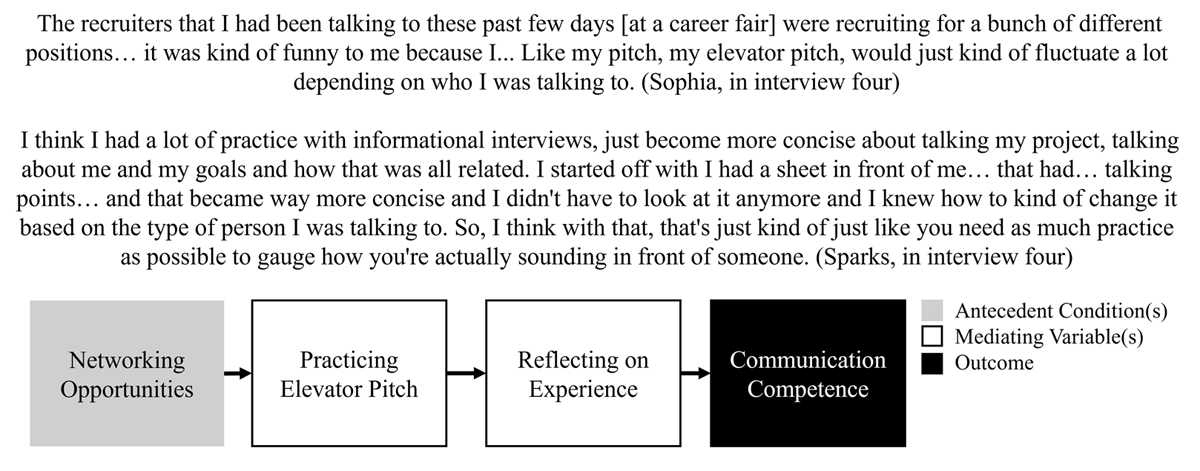
Figure 1
Example of the causation coding approach using data examples.
The key terms we used in our coding process to correspond to the terms used in causation coding approaches included experience element, participant action, outcome category, and types of co-curricular activities. These terms are defined in Table 4.
Table 4
Definitions of terms used for causation coding approach.
| TERM | DEFINITION AND EXAMPLES |
|---|---|
| experience element | The term used as equivalent to an antecedent condition as described by Saldaña (2016). Experience elements described features of a co-curricular setting that spanned across categories of co-curricular activities. For example, having a formal mentor relationship could be present in multiple categories of co-curricular experiences. |
| participant action | The term used as equivalent to mediating variables as described by Saldaña (2016). In our data, we focused on the active role students could play in influencing their development of a particular professional outcome category given the presence of specific experience elements. This emphasizes the importance of student engagement in the development process. |
| outcome category | Outcome categories were used to explore the various professionally relevant outcomes of students’ engagement. The term outcome aligns with Saldaña’s causal analysis approach, and the professional focus stems from prior focus on professional outcomes in engineering co-curricular literature. |
| types of co-curricular activities | This terminology refers to a common strategy used to study co-curricular learning, which buckets opportunities into categories based on archetypes like research, design teams, professional societies, etc. |
In our analysis, we first identified outcome categories, and then experience elements and participant actions that could be linked to each outcome category. The experience elements and participant actions were developed inductively but were informed by our understanding of current research in co-curricular learning contexts as well as Kolb’s experiential learning theory (Kolb & Kolb, 2009; Kolb, 2015; Kolb et al., 2001) and situated learning theory (Lave & Wenger, 1991; Wenger-Trayner et al., 2015).
We also identified experience elements and participant actions that were present across multiple co-curricular categories, which aligned with Saldaña’s (2016) recommendations for producing trustworthy conclusions. To identify those experience elements and participant actions present across multiple co-curricular types, we explored patterns of repeating antecedent conditions and mediating variables. We looked for causal relationships between experience elements (i.e., antecedent conditions), participant actions (i.e., mediating variables) and outcome categories that occurred across multiple co-curricular types, were discussed by multiple participants, and led to multiple outcome categories.
The overarching goal of this approach was to determine many experience elements that could connect to students’ growth within our outcome categories. While we identified some interesting connections, we also identified many other possible relationships and did not reach saturation in data analysis, suggesting a need for continued exploration in identifying experience elements and participant actions that can lead to the wide variety of outcome categories of interest to engineering students. Figure 2 demonstrates the generalized analytical process in this exploratory work.
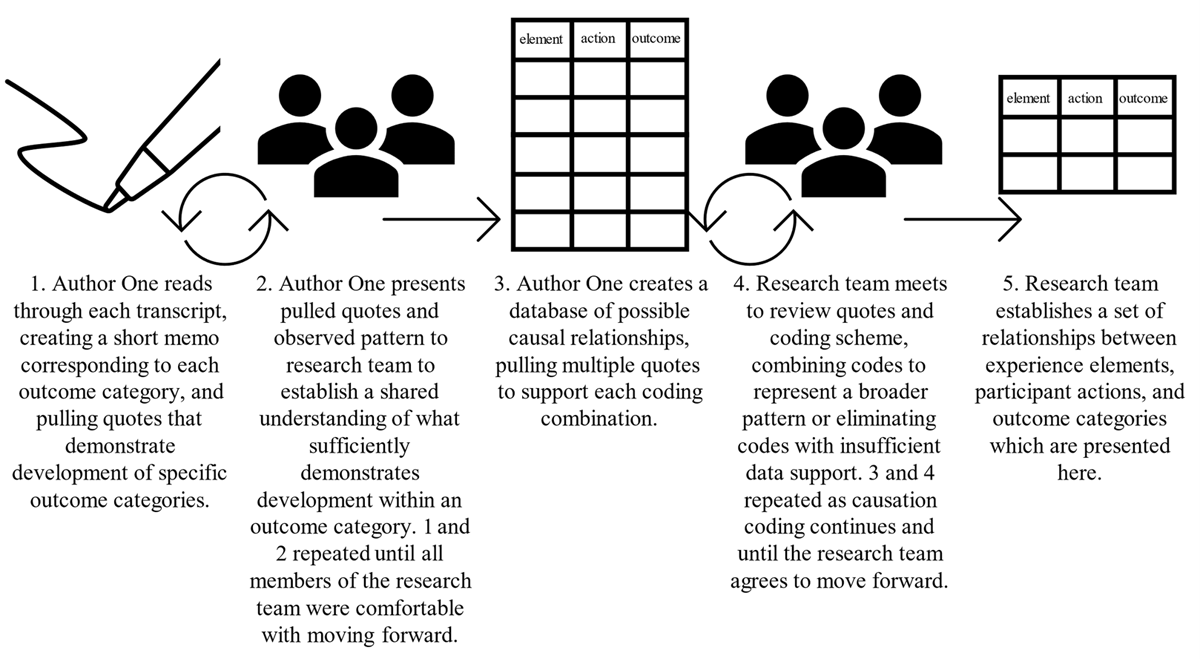
Figure 2
Graphic depiction of data analysis process.
In Maxwell’s (2004) discussion of the usefulness of causation coding in qualitative research, he emphasized the importance of study design in increasing the trustworthiness of causal interpretations. To improve the reliability of our findings, given that coding was performed primarily by author one, the research team met regularly between rounds of coding to discuss the alignment of our findings with the data. Our study also employed comparison strategies (across time, individuals, and co-curricular settings) to look for instances where an outcome category was not present in the absence of a presumed experience element, strengthening our confidence in the experience elements identified and presented. Similarly, the intensive, long-term engagement with participants in this study helped us rule out spurious associations based on one or two instances of a relationship in participants’ discussions. Maxwell also described long-term involvement as helpful for collecting rich data—supporting the advancement of a fuller picture of the learning process.
Limitations
This study was limited by our intentional scoping of students in one discipline at one institution. While the decision ensured some continuity across curricular activities and helped us make comparisons across co-curricular and outcome category contexts, the disciplinary focus could have impacted the presence of specific outcome categories in our data based on how these students differently prioritized their co-curricular participation compared to students in another discipline or at a different institution. Furthermore, this decision led to some preliminary evidence of other possible relationships between experience elements and outcome categories that could not be included in this manuscript due to lack of sufficient data to support the connections observed.
Scoping the study to students in one discipline at one institution also limited the diversity of the pool of students from which we could recruit. As a consequence, our study did not include students from minoritized racial or ethnic backgrounds in engineering such as African American or Native American students. Incorporating the experiences of students with these identities would have enhanced the transferability of our work to a broader engineering student context; future studies that include diverse student populations are critical to the field’s understanding of learning processes in engineering co-curricular activities. Furthermore, the broad scope of the student outcomes we aimed to explore in our interviews limited the depth of discussion we elicited from participants on any given outcome category. This scope may have affected our ability to identify additional or more nuanced experience elements or participant actions.
As the lead author engaged in initial analyses, she drew on her own undergraduate engineering experiences in co-curricular learning settings to identify patterns present across types of co-curricular activities in the data; however, she had not had experiences in all the co-curricular activities that participants discussed. The co-authors of this study—faculty with experiences mentoring undergraduate students—served as debriefers, engaging in regular discussions throughout data analysis to check interpretations of the data and improve alignment with the theoretical framing of the work. The variations in disciplinary backgrounds and educational experiences of the research team expanded the range of interpretations of the data and the application of the frameworks to the data that were considered.
Findings
We found connections of four experience elements (i.e., Independent Project Work, Project Work That Engages Multiple Disciplines, STEM Education Opportunities, and Mentorship from a Skilled Other) to multiple outcome categories that encompassed seven of the thirteen literature-informed, deductive outcome categories (i.e., Leadership Competence, Design Competence, Business Competence, Interdisciplinary Competence, Disciplinary Competence, Communication Competence, and Career Direction Outcomes). Similarly, we found that one participant action—Reflecting on Experience—connected experience elements to multiple outcome categories. We also found unique experience elements and participant actions that were not connected to multiple outcome categories, but still present in data from at least two types of co-curricular activities and identified by at least two different participants. While the remainder of the findings section focuses on presenting how four experience elements and one participant action were connected to multiple outcome categories (refer to Figures 3, 4, 5, 6, 7), the additional unique connections found through this study are described in Supplement 1. We focus on the experience elements and participant actions with multiple outcome category connections because the multiple connections may point to important aspects (i.e., broad characteristics of co-curricular contexts or actions participants can take within their experiences) of co-curricular activities that have a potential to support student learning in multiple ways.
Experience Element: Independent Project Work
Independent Project Work was defined as an opportunity to perform project work individually or have independence to make project decisions. Participants connected Independent Project Work within their co-curricular experiences to three outcome categories: Business Competence, Design Competence, and Leadership Competence. Figure 3 illustrates the experience element Independent Project work in gray, three different participant actions within that experience element, and the three subsequent outcome categories for each participant action.
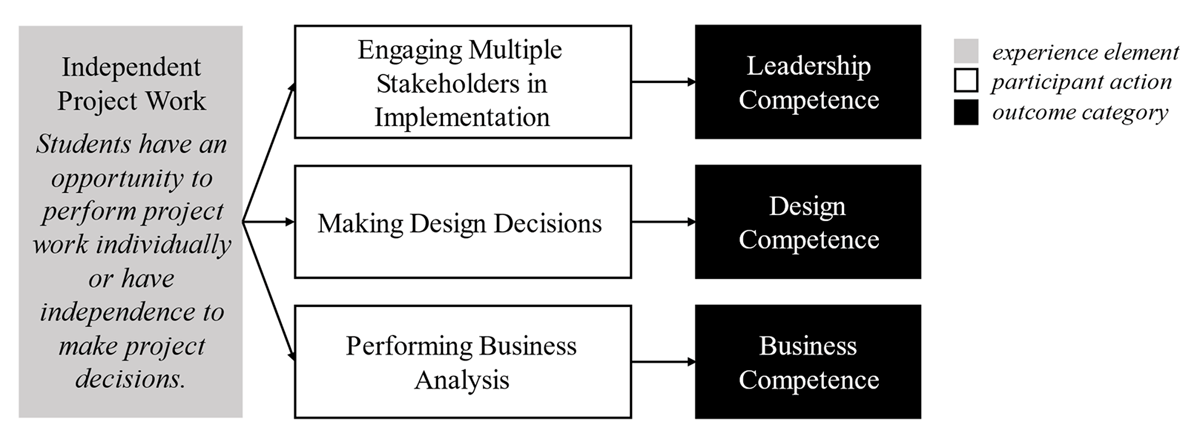
Figure 3
Relationships found between the experience element Independent Project Work and multiple participant actions connecting to a variety of outcome categories.
We saw evidence of growth in Business Competence through Independent Project Work when students participated in cost analysis activities such as making decisions about cost versus quality tradeoffs. For example, Detroit, recruited as an MDE participant, described an opportunity during his summer internship:
So, I presented the different options I deemed were the most efficient to the engineering support teams. And then I was able to show them what my process was. It was seeing like, okay, why X product was the best for our scenario as opposed to the current models or just slightly improving on our models […] in terms of the business aspect, I did an economic kind of research of that and seeing how much this pump would cost. The overhead cost compared to the current models, seeing how, I guess how much money would be saved due to the inefficiency increases. And showing them, if we change this, we would have to spend X amount more at the beginning, but over time we could save like $1000 per year, just based on electrical costs without even taking into consideration the cost of maintenance and downtime. (Detroit, in interview four)
Participants also described multiple forms of independent projects (i.e., in research, internships, design challenges) that gave them Design Competence exposure, each of which gave them the autonomy to make design decisions. For example, Sparks, a research participant, discussed designing a portion of her research mentor’s project. Beyond cost considerations, she also needed to account for timing aspects of the experiment she would be designing when setting up the project:
I think that it was cool to learn how you design an experiment like that and design a panel, and just thinking about, like in the real world… In a school lab you don’t have to think about, “Oh, I need to buy my supplies,” but when you’re designing your own experiment in a lab it’s your responsibility to buy your supplies and go on to whatever website and get whatever you need and know when you want to pay more for something and when you don’t want to pay more for something. So it was interesting to look into that and think about your whole timeline of things because now experiments span over weeks and you have to think about when you’re free in the next four weeks to do something because the [experiments] need a certain number of days. (Sparks, in interview two)
In contrast, Bianca did not discuss developing Design Competence in her research experience and instead discussed a desire to develop her own project after completing a project heavily guided by her research mentor:
I think just being able to do more things by myself. I kind of was doing the same things… We were running similar experiments every time, so I could do all of those by myself and I was the one who was setting it up and running it and stuff, but just maybe doing a whole project alone. Now that he’s graduating, I have more room to work under someone else and learn about different things in the same lab. I can shift people and learn different things. But also, I could also do my own project. (Bianca, in interview three)
Participants also discussed Independent Project Work in connection with Leadership Competence when their projects (i.e., in MDE, MDE travel teams, and internships) necessitated engaging multiple stakeholders to implement. Student M discussed her experience with navigating the responsibilities of her leadership position when coordinating a service trip through her MDE in interview two:
Student M: Last year, all of us were engineers, but this year, [some members are] not engineers, [so] they’re more interested in learning about the social issues in [Partner Community] and learning about the health inequities. [But] because the more engineering and science majors, they’re looking for more professional development experiences there, it’s hard to find the right balance between the different activities.
Interviewer: What has been your approach to finding that balance so far?
Student M: At our meetings I’m trying to get everyone to talk about what they’re looking for through this program and also communicating with our community partner there to see how much of each activity that they could organize for us. And then laying out expectations so that we’re all happy with having both engineering, biotech companies, and the service experience. (Student M, in interview two)
Experience Element: Project Work That Engages Multiple Disciplines
Participants similarly discussed an experience element where they performed project work that engaged multiple disciplines. Here, participants described two participant actions, each of which was linked to Interdisciplinary Competence. Figure 4 demonstrates the two participant actions within the experience element that linked to the outcome category.
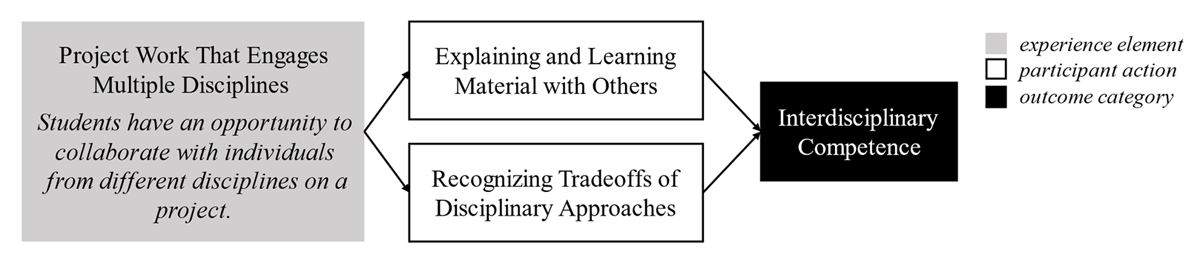
Figure 4
Relationships found between the experience element Project Work that Engages Multiple Disciplines and two different participant actions connecting to the outcome category Interdisciplinary Competence.
Participants described how opportunities to explain and learn material from people in other disciplines (e.g., in research, internship, and MDE projects) contributed to their growth in Interdisciplinary Competence. They also discussed their ability to hear or recognize disciplinary tradeoffs in project discussions which could be linked to Interdisciplinary Competence. In MDE projects like the one described by Sophia, participants had opportunities to explain and learn technical material with their engineering peers outside of BME:
Yeah, being able to… because we can learn a concept that mechanical engineers learn, and we can solve this with the CAD. You can learn how to make the same part a completely different way and not understand what it is that the other person did, or not be able to work off of someone else’s work. I think being able to even just try to understand. Like, in that example, the CAD, one of the students in BME who had taken, I think it was in [a required 300-level BME course] that he had learned how to make something. The mechanical engineer just had no idea how to even just edit the part that he had made. They needed to talk through what they did in order for one to understand the other, and then for the part to, I don’t know, change whatever it needed change. (Sophia, in interview two)
In research projects where multiple disciplinary perspectives were present, like the one Honey described during an interdisciplinary research meeting, participants heard how peers considered the disciplinary tradeoffs associated with performing their project work:
It was cool to be able to understand how they were able to communicate with each other without making their perspective feel more important than another perspective. They would still acknowledge like, “Oh, yes, it’s really important to be able to get this funded, and I understand that if we do things this way, people will like it less. Therefore, it would get funded less. However, I think it’s a risk that is worth taking because,” and they’d talk about their perspective, whether that was a BME or a biology-focused perspective or a clinician perspective. It was really cool to be able to see that because they’re all genuinely working together. (Honey, in interview three)
Experience Element: STEM Education Opportunities
Another experience element participants connected to multiple participant actions was Science, Technology, Engineering, and Mathematics (STEM) Education Opportunities. In these opportunities, students engaged with educational tasks in a STEM context (e.g., course content creation, tutoring, instructional assistant positions). The STEM Education Opportunities were not part of the MDE or research experiences on which study recruitment was based. Instead, participants discussed other co-curricular engagements that facilitated participation in STEM education positions across a spectrum of levels (e.g., K–12 outreach or tutoring, BME instructional aide, grader, or course material design). Participants described these teaching experiences as linked to their Disciplinary Competence and Leadership Competence. Figure 5 demonstrates the different types of teaching that were coded as distinct participant actions leading to different outcome categories.
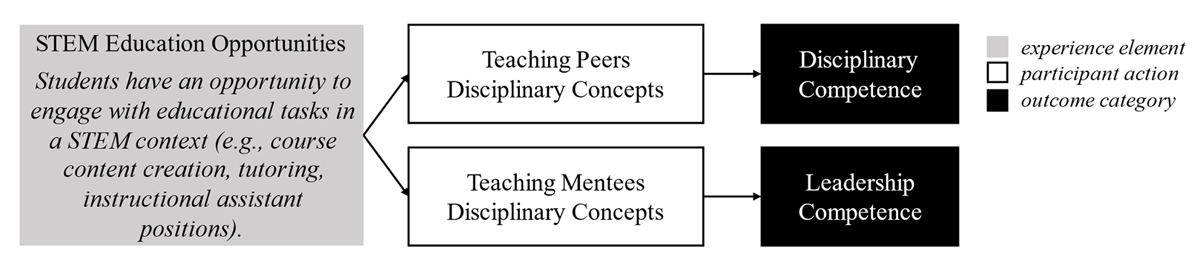
Figure 5
Relationships found between the experience element STEM Education Opportunities and multiple participant actions that connected to a variety of outcome categories.
Al, an MDE participant, talked about re-learning course concepts through an opportunity to develop course material for a BME course over the summer, while Bianca talked more about her STEM Education Opportunity in interview four as practicing Leadership Competence:
When I was learning like BME [course] material, the material was completely new for me. I remember. So it was kind of hard understanding the concepts and even for like the lab too, it used to be BME [course] lab, where like all the labs were together and now they split it into three parts. And even as I was doing the [course] labs, I was always confused about like the [specific content] lab parts, but I think actually working on the material and like looking at the lab manuals over and over again helped me kind of understand the concept a little bit more than before. (Al, in interview four)
I always want to do things like that, like TAing and mentoring and things like that to give back. […] I always like doing STEM-promoting things, because I feel like that was something I did a lot in high school. I went to STEM programs […] so I was just like, “Oh okay, I’ll apply,” and then I interviewed. […] We were teaching high school kids, and we were using some website that wasn’t MATLAB or anything, so it was pretty intuitive. […] I think it’s [the TA position] helped me, just giving me more experience, more things to talk about in interviews, like for grad school. Also, I think […] that’s always good I think to show, because when people invest in you they want to make sure that you’re going to be investing in someone else in the future I think. Because grad school’s fully funded, so if they’re putting in the time for you they want to make sure that you’re going to be taking undergrad from their university, and I don’t know, being a mentor. And once you get out into the industry and out into the world, that you’ll return that in a way. (Bianca, in interview four)
Experience Element: Mentorship from a Skilled Other
Participants also discussed the potential impact of the experience element Mentorship from a Skilled Other. In this experience element, we used the situated learning term “skilled other” (Lave & Wenger, 1991) to distinguish these mentorship experiences from peer-to-peer mentorship, defining the experience element as mentorship from an individual with a higher professional or educational standing. Participants linked Mentorship from a Skilled Other with growth in Communication Competence and Career Direction Outcomes, as demonstrated in Figure 6. These experiences most commonly occurred in research settings, but they also happened in spaces like coursework outside of BME requirements, design project work, MDE, and internships.
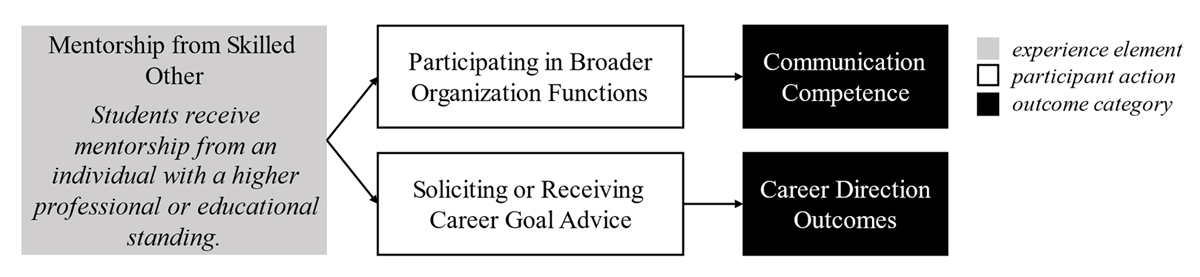
Figure 6
Relationships found between the experience element Mentorship from a Skilled Other and multiple participant actions connecting to a variety of outcome categories.
Participants described how receiving career advice from their mentors, graduate students, and other BME professionals aided in their sense of their Career Direction:
Starting research and talking to grad students was probably the thing that helped me. And being able to have those conversations young, as a freshman, as a sophomore, and them telling me like, “Oh, you should do an REU, you should do a summer research thing here.” Just sort of guiding me down the path. I guess I decided pretty early, so that pushed me towards that path very quickly. (Bianca, in interview four)
When Mentorship from a Skilled Other facilitated the participant action Participating in Broader Organization Functions (e.g., full team meetings, socials, etc.), participants also described impacts on their Communication Competence. Their participation ranged from observation of communication conventions in realistic settings to presenting their progress to a larger part of the organization. For example, Sarah and Sparks, both research participants, discussed the value of observing lab meeting conversations for establishing their own understanding of communication conventions (e.g., what topics are normal, what terminology to use) in those settings:
And even though, I guess, some PIs don’t care if you go to the lab meetings, it was really good for me to go and hear, like, “This is what everybody else is working on, and these are the things that are available.” And see how other people interact with the PI, and each other, and just what is normal in general and what’s really out there. (Sarah, in interview one)
I think sometimes [Taylor] and [Benji] have different ideas of how to represent something, but it’s never in a negative way. They’re like, “Just talk it through,” and then one of them is like, “Oh yeah, that’s actually the better idea.” I do a lot of listening. It’s good to hear people talk about things, even if they’re above your head, but half the stuff I’m telling you right now, I would have no idea what I’m talking about two months ago. (Sparks, in interview one)
Our analysis also found evidence of a relationship between the experience element Mentorship from a Skilled Other and two connected participant actions, Participating in Broader Organization Functions (e.g., full team meetings, socials, etc.) and Presenting Disciplinary Material. When participants experienced the participant action Participating in Broader Organization Functions alone, they discussed developing skills aligned with the Communication Competence outcome category as described above. However, if their Participating in Broader Organization Functions led to Presenting Disciplinary Material through that participation, they also discussed opportunities to grow their Disciplinary Competence. Figure 7 demonstrates this relationship.
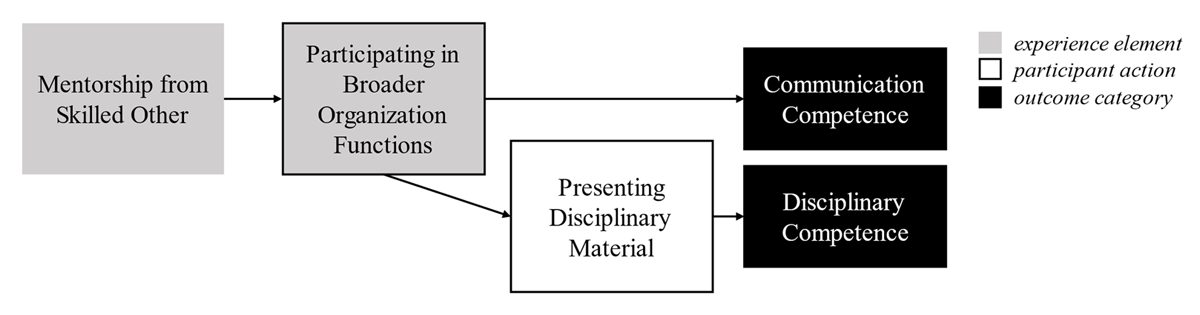
Figure 7
Demonstrated relationship starting with Mentorship from a Skilled Other leading to Participating in Broader Organization Functions and in some cases Presenting Disciplinary Material in relation to the development of Communication and Disciplinary Competence.
Honey discussed experiencing this relationship during her research engagement in interview one:
[The lab PI would] also have the undergrads sign up for slots. […] The undergrads would present about either a topic that they’ve picked, or the research that they’ve done so far. And so my last lab presentation was about PCR because everyone just mutually decided that they didn’t know enough about PCR and how the math worked with PCR. I did most of the PCR in that lab, so I was supposed to explain that to the grad students, and I did it. (Honey, in interview one)
Participant Action: Reflecting on Experience
We also identified one participant action, Reflecting on Experience, that connected to multiple outcome categories. Reflecting on Experience was defined as a student’s effort to make sense of their experiences and synthesize their learning outside of the reflecting we asked them to do as part of the interview process. This participant action aligned with Kolb’s (2015) experiential learning theory, which informed our study. In our data, Reflecting on Experience was most frequently linked to Cultural Competence as an outcome, but students also discussed how it helped inform their Career Directions. We demonstrate these links in Figure 8.
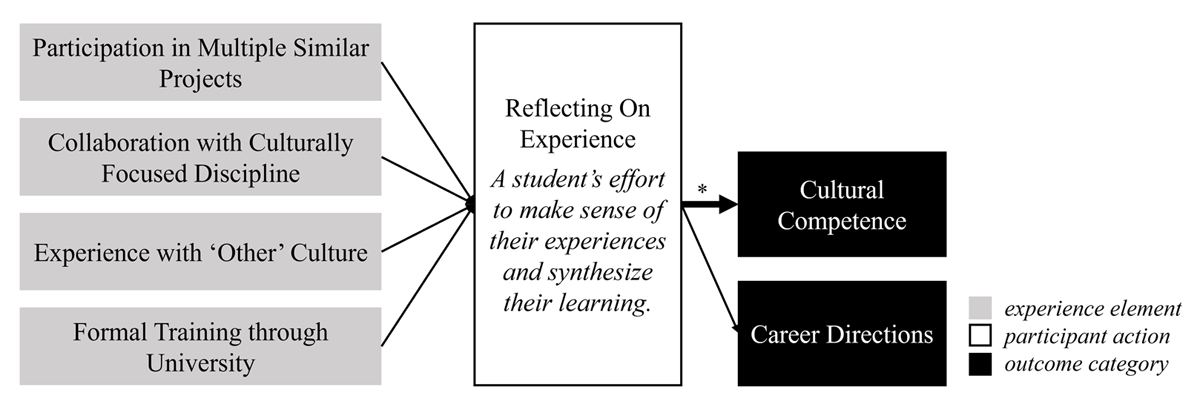
Figure 8
Relationships found between multiple experience elements that connect to a variety of outcome categories through the participant action Reflecting on Experience.
Participants who used reflection on multiple experiences to inform their career direction sometimes compared experiences in the same type of co-curricular activity (e.g., contrasting one research lab to another), while others made connections between different types of co-curricular activities (e.g., MDE and an internship or research and an internship), or even between co-curricular and curricular experiences (e.g., MDE and the content in a course). In interview four, Samantha discussed her process for considering future careers by considering what she had learned across multiple research projects and through her computer science minor coursework:
I definitely think just being involved in BME and seeing all the different types of research that are happening here has been really important [for deciding what I want to do for a career]. I mean, working in a couple of different research labs on campus and then taking computer science classes and thinking about how I could apply those skills. (Samantha, in interview four)
When participants described Reflecting on Experience in connection to Cultural Competence, it linked to the following experience elements: Collaboration with Culturally Focused Discipline (e.g., Bianca, in interview one), Experience with “Other” Culture (e.g., Sophia, in interview four), Formal Training through University (e.g., AJ, in interview one). In each case, participants connected multiple experiences, sometimes including curricular experiences, to make sense of the Cultural Competence they were learning.
Bianca described the ways of thinking she observed as an engineering student working on a project with other students from social science majors:
We were starting a new project so I got to help make all of the tasks. All of the questions that we ask the kids […] All of the people who spoke [different language], they would run things by us. […] So it was a lot of going back and forth. “Okay. In our culture we say this and is that confusing?” Just certain slang, seeing other people from different backgrounds and doing that stuff was cool. But they [the social sciences lab] do think differently, I think. It’s a different environment for sure and it’s less about data and more about qualitative stuff. […] It’s more like, “Okay. How does social factors affect this?” And we do interviews and we look at things like where they grew up, how long have they been in the U.S.? All these things that you don’t really have to consider when you’re working with cells and stuff. It’s kind of humanizing the research experience, which is cool. And I feel like it’s cool to just sit there and they’re talking about the root of this word is going to confuse the kids or how do people think? That stuff you don’t really think about. So it’s cool that they’re always thinking in that way. I feel like they just view people differently because they look at everything instead of just being logical or the numbers, what you see is what you get, yeah, the data I guess, you know? (Bianca, in interview one)
Sophia discussed how an opportunity to teach and interact with students from many backgrounds influenced her own career interests:
I think that also being a [teaching assistant] for [engineering intro course], and I think, in that role, it kind of is […] Like I’m getting different experiences from that, like completely different experiences, but I think in the end, through that, I [am] realizing how passionate I am about just equity, in terms of education, but then also in terms of healthcare. And in terms of just accessibility to a bunch of different things. And, in that, I’m realizing just how different and how different experiences can really shape, not just who you are, but also what you want to do and who you want to be. (Sophia, in interview four)
AJ described how lessons from an elective course outside her major impacted decisions she made within an MDE project:
I took a […] class and I really, really enjoyed that class, especially because it talked a lot about how different areas of the world and different cultures have different ideas when it comes to health, and one might be more preventative while one is more treatment-based, and one might have more religious aspect to it while one is more like science and just basic facts, and what you get on diagnostics and stuff. So I thought that was really interesting to learn about and then be able to think about for, in terms of our [MDE] project in [Partner Community], because being able to incorporate culture into how our product would be used or how it would be accepted into the daily life or if it was considered intrusive to the patient or anything in terms of what [Partner Community] is used to based on proximity and comfortability with the medical devices. (AJ, in interview one)
In summary, the key experience elements we found in this study included: Independent Project Work, Mentorship from a Skilled Other, and STEM Education Opportunities. Through the data analysis, we also found strong evidence for the importance of the participation action Reflecting on Experience.
Discussion
In this exploratory study, we used student interviews to identify experience elements of co-curricular activities and participant actions that could contribute to learning within specific student outcome categories across professional, career, and personal outcome spaces. We focus the discussion on what implications these findings might have on how we study co-curricular learning and provide guidance for educators designing or facilitating co-curricular activities. By looking for patterns across data from multiple co-curricular activities, we identified experience elements that could serve as opportunities to support engineering students. Participants connected experience elements to multiple outcome categories from our coding scheme (i.e., Business Competence, Career Direction Outcomes, Communication Competence, Design Competence, Disciplinary Competence, Interdisciplinary Competence, and Leadership Competence). In this section, we discuss how our findings align with the engineering education research on co-curricular activities that motivated this study, discuss how our approach can inform future studies on co-curricular learning, connect back to learning theories that help explain the relationships we found in our data, and present a set of considerations for educators and mentors based on the connections found in our data.
Connecting Findings to Prior Engineering Co-Curricular Research
A number of previous studies explored the outcomes and competencies of engineering students participating in undergraduate research (Carter et al., 2016; Dalrymple & Evangelou, 2006; Faber et al., 2020), one of the key types of co-curricular activities considered in our study. However, Carter and colleagues (2016) found limited differences in outcome development between undergraduate research participants and a comparison group after controlling for students’ other engagement. Faber and co-authors (2020) highlighted the difficulties associated with categorizing undergraduate research broadly because of the variety of experiences that could be classified as this type of co-curricular activity. Our work extends these findings by suggesting how the experience elements within an undergraduate research experience can support learning (e.g., Mentorship from a Skilled Other facilitates Participating in Broader Organization Functions and connects to Communication Competence). Furthermore, our finding that the experience element, participant action, and outcome category connections we identified were often also present in other co-curricular activity types (e.g., MDE, internships) indicates the potential for an approach to research on engineering co-curricular activities that promotes our understanding of the learning processes that occur in co-curricular spaces in addition to the more frequent approach of identifying the potential student outcomes that result from general participation.
Our approach to data analysis allowed use to draw conclusions about the presence of connections between experience elements, participant actions and outcome categories across multiple types of co-curricular activities. In this study, we employed a methodological approach that is more commonly used in in-depth case study analyses to perform a thematic analysis. In doing so, we examined the processes through which students learned about multiple outcome categories, and used them to identify patterns in the professional, career, and personal learning of BME students. Our exploratory work resulted in numerous possible relationships between an element of an experience that students have, an action they could have an opportunity to take through those elements, and the outcomes that may result because of their actions. Using causation coding allowed us to identify what it was about a given co-curricular activity that benefitted participants, and to create recommendations for change, accordingly. This approach could benefit other researchers looking to explore specifics of learning processes within their context. As we continue to identify more patterns and connect specific experience elements to outcome categories through participants’ actions, we aim to create a deeper understanding of how to support students in navigating the vast array of co-curricular opportunities available to them as engineering students.
Connecting Findings to Learning Theories
We also found that some of the patterns linked to student outcomes in our data could be illuminated through cognitive and social learning theories, pointing to the importance of leveraging multiple theories to understand students’ learning in these co-curricular activities. Our analysis was shaped by the two theories that informed this study: experiential learning as described by Kolb (2015) and situated learning in landscapes of practice as described by Wenger-Trayner et al. (2015).
Kolb described experiential learning cognitively using a four-phase cycle of experience, reflection, conceptualization, and application. In this cycle, a learner has a new learning experience and then reflects on how the experience went. Then the learner moves into the conceptualization stage where they incorporate what they learned from the new experience into how they already understand the problem-space and can then apply that knowledge to a new scenario and start the cycle again. In this study, the importance of reflection appeared multiple times. We identified connections between students’ reflection on their experiences and their Career Direction Outcomes, as well as their Cultural Competence. Moreover, if participants did not report reflecting while engaged in the experience elements, we could not identify any connections between the experience element and the outcome category. This finding points to the importance of a student’s active cognitive engagement while participating in an experience and provides insights into strategies educators can use to improve the learning experience of students in co-curricular activities.
One of the critiques of Kolb’s model of experiential learning, however, is that it doesn’t explicitly account for the role of social interactions in learning. Whether those experiences are with others (e.g., mentors or peers) or with cultural resources and tools that people engage with in their learning (e.g., books, technology), theories of learning that attend to the social dimensions of learning are needed to develop a fuller understanding of how students learn through co-curricular engagement. Concepts from situated theories of learning were particularly helpful for identifying how social interactions in co-curricular experiences supported participants’ learning. In particular, Lave and Wenger’s concept of legitimate peripheral participation (Lave & Wenger, 1991) led to findings regarding how participants’ engagement in particular co-curricular activities became a form of participation in BME communities of practice and contributed to their learning. Participants in this study experienced legitimate peripheral participation through Independent Project Work and Mentorship from a Skilled Other that allowed them genuine, scaffolded participation in a professional setting. Furthermore, their engagement with Project Work that Engaged Multiple Disciplines may have helped them develop what Wenger-Trayner and colleagues (2015) call knowledgeability, or the skills to navigate across multiple communities of practice and make connections between them. Students’ ability to connect these experience elements to Interdisciplinary Competence further supports the idea that they may be developing knowledgeability within the BME professional practice landscape. In the next section, we describe how the connections identified in our data could be used to inform the efforts of educators and mentors to improve co-curricular activities.
Considerations for Educators, Mentors, and Students
Participants in our study discussed multiple links to outcome categories for four experience elements: Independent Project Work, Project Work that Engages Multiple Disciplines, STEM Education Opportunities, and Mentorship from a Skilled Other. Additionally, one participant action, Reflecting on Experience, was linked to multiple experience elements and outcome categories in our study. Table 5 below provides resources for educators and mentors looking to improve curricular or co-curricular learning based on the connections found in our study.
Table 5
Considerations for educators and mentors based on the connections found in this study.
| EXPERIENCE ELEMENT OR PARTICIPANT ACTION | CONSIDERATIONS PROPOSED |
|---|---|
| Independent Project Work | To support Business Competence:
To support Leadership Competence:
|
| Project Work that Engages Multiple Disciplines | To support Interdisciplinary Competence:
|
| STEM Education Opportunities | To support Leadership and Disciplinary Competence:
|
| Mentorship from a Skilled Other | To support Career Direction Outcomes:
To support Communication and Disciplinary Competence:
|
| Reflecting on Experience | To support Cultural Competence and Career Direction Outcomes:
|
Conclusions
Through this exploratory project, we identified common experience elements across co-curricular activities that could be linked to students’ growth in a variety of professional, career, and personal outcome categories. We used our findings to develop recommendations for educators and mentors that can support growth in a variety of professional, career, and personal outcome categories. Furthermore, we synthesized data into the experience elements across a diversity of co-curricular experiences described by the participants (i.e., campus community groups, departmental clubs, project teams, internships, undergraduate research), which supports the reliability of this work for identifying experience elements and participant actions that can be present across current categorizations of co-curricular types. This finding points to an innovative approach to examining co-curricular learning and demonstrates the potential contributions of studies that deeply examine the learning processes occurring in co-curricular activities. As we continue our work to identify experience elements that lead to student outcomes, our goal is to add to the field’s understanding of potential pathways students can take through co-curricular activities to develop professional, career, and/or personally relevant outcomes.
Reproducibility
Full deidentified data transcripts are not available for this project because the longitudinal nature and depth of conversations with participants could lead to identification of participants and breach of confidentiality. Excerpts supporting the data analysis may be provided upon request.
Additional File
The additional file for this article can be found as follows:
Supplement 1
A Comprehensive listing of connections between experience elements and participant actions that connect to outcome categories. DOI: https://doi.org/10.21061/see.94.s1
Acknowledgements
The authors would like to thank the participants for their willingness to engage with the researchers in reflective interviews over the course of a year despite interruptions to their learning caused by the COVID-19 pandemic.
Funding Information
The funding to support participant stipends was provided by the University of Michigan Rackham Graduate School through a Rackham Pre-Candidate Graduate Student Research Grant.
Competing Interests
The authors have no competing interests to declare.
Author Contributions
Cassandra Jamison developed the overall study design, collected and analyzed data, drafted the first version of the manuscript, and led revision and iteration based on feedback from Lisa Lattuca, Shanna Daly, and Aileen Huang-Saad. Lisa, Shanna, and Aileen regularly participated in study meetings with Cassandra to provide feedback on interview protocols, data analysis, interpretation, and reporting.