
Introduction
There continues to be an urgent need to diversify the engineering workforce (Chubin et al., 2005). To achieve a more representative engineering workforce required to meet societal demands (National Academy of Engineering, 2004, 2018), there is a need to tap into every subset of the population for talent (Lichtenstein et al., 2015). The greatest opportunity is in focusing on underrepresented minorities since they represent a large subset of the non-White population and they tend to earn fewer degrees in higher education than their majority peers, especially in engineering (American Society for Engineering Education, 2021; National Science Foundation & National Center for Science and Engineering Statistics, 2021).
Conversely, one group that continues to be underrepresented in engineering is composed of students who identify ethnically as Black or African American (National Science Foundation & National Center for Science and Engineering Statistics, 2021). Despite the creation of several programs and initiatives aimed to create a more diverse engineering workforce, Black graduates in engineering tend to make up roughly 4% of the engineering population (American Society for Engineering Education, 2021). This percentage has remained relatively stagnant over a decade, with Black students making up only 4.2% of graduates in 2011 and 4.5% of graduates in 2020 (American Society for Engineering Education, 2021). This is dismal compared to the goal to achieve parity with national demographics—that is, 13.6% of the population (U.S. Census Bureau, 2020).
Several factors negatively influence the persistence of Black students pursuing engineering degrees. Some of these factors include unsupportive peers and faculty in K–12 and higher education, discrimination resulting in lacking a sense of belonging, culturally irrelevant pedagogy, and inadequate resources from K–12 schools (Banks & Dohy, 2019; Burt & Johnson, 2018; Lancaster & Xu, 2017; Stitt & Happel-Parkins, 2019; Strayhorn, 2010). All of these barriers prevent students from not only choosing engineering as a major but also keep them from persisting in engineering education. Most importantly, structural racism has also contributed to the factors that hinder Black students from gaining entry and persisting in engineering (Mejia et al., 2020; Simmons & Lord, 2019). Given these dismal statistics and the structural barriers that continue to exist in education, focusing on the recruitment and retention of Black students presents the greatest opportunity for diversifying engineering.
Simmons and Lord (2019) state that a way to remove barriers for Black students attempting to gain entry and persist in engineering is through institutionally supported identity-based organizations. Examples of these institutionally supported identity-based organizations are the National Society of Black Engineers (NSBE) and Black Greek Letter Organizations (BGLOs). Prior research has indicated that professional organizations can positively influence the academic success of Black engineering students by providing support. Through social integration within these organizations and consciousness of one’s racial identity, members of these organizations are likely to be successful in engineering (Ross & McGrade, 2016). Ross and McGrade (2016) present compelling evidence in support of the claim that being more socially integrated on campus and being conscious of racial identity were found to be among the factors that positively influenced high-achieving Black students in college. This may explain why professional organizations have been so successful in supporting Black engineering students. For decades, Black students have uniquely recognized the links between community and social networks (Allison, 2016). Engagement in professional organizations is one way the development of such networks is facilitated. These are just two examples of previous studies, but there has not been any published scholarship that reflects a systematic look at this body of work. Consequently, this study was motivated by a need to understand how participation in identity-based organizations, such as NSBE and BGLOs, influences the outcomes of Black engineering students.
Professional organizations have historically served a critical role in the Black community by providing a context for both professional (i.e., needs specific to a particular field or type of career) and psychosocial support for developing professionals. NSBE, established in 1975, is one the largest student-governed societies in the world, with over 17,000 active domestic members at the pre-collegiate, collegiate, and professional levels. NSBE’s mission is to “increase the number of culturally responsible Black engineers who excel academically, succeed professionally and positively impact the community” (The National Society of Black Engineers: A Legacy of Excellence, 2023.) NSBE achieves this mission through fostering academic achievement, self-efficacy, career readiness, and leadership. Ross and McGrade’s (2016) study provide evidence in support of NSBE’s attempts to accomplish its mission; from their study comparing NSBE and non-NSBE members at a private Midwestern university, NSBE members were ten times more likely to graduate than non-NSBE members (Ross & McGrade, 2016). Furthermore, the participation of underrepresented students in ethnic professional organizations at Predominantly White Institutions (PWIs) bolsters engineering identity development; improves persistence and success in engineering studies and subsequent careers; and increases access to role models, leadership opportunities, and a family-like support system (Martin et al., 2016). Given that 84% of its members are retained in engineering between their sophomore and junior year—a critical time in which many students choose to opt-out of engineering (Meyer & Marx, 2014)—NSBEs impact is an example of an enviable accomplishment from which various stakeholders in the engineering ecosystem can learn.
Apart from organizations that primarily focus on a student’s professional needs, there is another class of organizations that provide students a context of sharing values and interests. At the time of their origin, BGLOs were established to provide Black students a haven from racism, sexism, and isolation to uplift the Black community. Kimbrough (2003) stated, “research identifies some of the positive aspects of Black Greek Life, [but] it only scratches the surface of what is known about these organizations” (p. 104). There are nine Black sororities and fraternities that constitute the National Pan Hellenic Council (NPHC), which were envisioned to serve as s supportive counterspace for Black students to grow academically, professionally, and socially (Kimbrough, 2003). Colloquially, they are referred to as The Divine Nine. We are more familiar with what these professional organizations have been able to achieve with Black students, in general, but are less aware of how they support the success of Black engineering students (Kimbrough, 2003; Mitchell, 2012).
Most studies associated with broadening participation focus on what is wrong with entities in the current engineering education ecosystems. Existing scholarship is replete with factors that contribute to attrition issues in engineering—lacking a sense of belonging, mismatched expectations of the engineering curriculum, rejection of the monolithic identity of engineering, and limited opportunities for mentoring, networking, and professional development (Amelink & Creamer, 2010; Besterfield-Sacre et al., 2001; Brooms & Davis, 2017; Lichtenstein et al., 2015; May & Chubin, 2003; McGee & Martin, 2011; Strayhorn & DeVita, 2010). However, there is a need for work that focuses on an aspect of the ecosystem that seems to be contributing to student persistence and success, particularly for Black engineering students. To fully understand what is known and prevent redundancy in future studies, there is a need to explore and synthesize the current body of work available. In light of this, the following research question will be addressed:
According to existing scholarship, what outcomes do Black engineering students experience because of participation in identity-based professional organizations?
This work builds on the growing body of literature that affirms the positive outcomes resulting from engagement with certain types of professional organizations while in college.
Positionality
Before we continue with this article, we must state our positionality as a research team. By discussing our positionalities, we can provide context on why we have chosen to do this work along with the lenses we have applied while approaching this work. The need for this systematic literature review came from the experiential knowledge of two of the authors, the lead investigators for the federally-funded project—both of whom have either participated in or led local chapters of NSBE and BGLOs for at least a decade. Moreover, five out of seven of the authors identify as African American, and for those that identify as African American, all have participated in identity-based professional organizations and programs. Thus, the authors have an insider’s perspective on how identity-based professional organizations and programs like NSBE and BGLOs work to support Black students’ persistence in engineering. This experiential knowledge served as an asset when making sense of the outcomes presented in the literature. Moreover, all the authors have experienced engineering education at the Bachelor’s, Master’s, and Doctoral levels, or are currently experiencing engineering education at the Doctoral level. Additionally, all the authors have experience in conducting engineering education research, with six of the authors having a primary interest in diversity, equity, and inclusion in engineering. Lastly, varying research paradigms exist among the authors of this study. The majority identify as critical scholars and constructivists while others see themselves as pragmatists.
Methodology
The data for this study was collected through a systematic literature review (SLR). The purpose of an SLR is to “provide as complete a list as possible of all the published and unpublished studies relating to a particular subject area” (Cronin et al., 2008, p. 39). SLRs are a rigorous, structured, and transparent approach that consists of systematically searching through the literature on a topic area to provide critical analysis of it in response to a research question. From this critical analysis, one can synthesize all the research on a topic area and begin to make meaning of the existing literature on a given topic. While there are many different types of reviews, one of the strengths of an SLR is the ability to gather all the knowledge on a critical topic, which can include a variety of research designs (Grant & Booth, 2009). Another goal of an SLR is to use the synthesis and gaps in the literature to specify areas of opportunity for expanding an existing body of literature (Borrego et al., 2014). It is our goal that by choosing this methodology, other researchers and university personnel connected to this topic will be less likely to engage in student support efforts that are unnecessary, inappropriate, irrelevant, or unethical due to a lack of insights about previous research (Gough et al., 2012).
We completed five steps as part of conducting this systematic literature review: 1) formulate guiding research questions and corresponding inclusion criteria; 2) find and catalog sources; 3) critique and appraise the quality of selected literature; 4) address bias, validity, and reliability concerns; and 5) synthesize insights (Borrego et al., 2014; Holloman et al., 2021; Petticrew & Roberts, 2006). Each of these steps will be addressed in detail below.
Step 1. Formulate Guiding Research Questions and Corresponding Inclusion Criteria
The research question proposed in this study is: According to existing scholarship, what outcomes do Black engineering students experience because of participation in identity-based professional organizations? For the purpose of this study, we defined outcomes as the direct results that occur because of a professional organization or programs’ resources and interventions. These organizations and programs are not limited to the National Society of Black Engineers, Black Greek Letter Organizations, and Minority Engineering Programs (MEPs). The keywords used for identifying primary sources were based on the proposed research question. Primary sources were identified based on the following criteria: 1) a scholarly publication or national report published in the United States from 1994 to 2019; 2) target population of interest and/or participants explicitly reference Black engineering students; and 3) explicit focus on topics related to access or the experiences of Black students in engineering education.
To ensure a comprehensive set of sources, the study includes sources that include African Americans among other underrepresented racial/ethnic minorities. This was done to get a wider breadth of articles since most of the engineering education literature tends to use terms like minority or underrepresented minority (URM) students. Finally, the keywords and inclusion criteria were tested through a brief pilot phase and adjusted if known publications were not captured. This pilot phase also involved the simulation of a search using sentinel articles. The pilot is a method of validating the search by enabling the researcher to modify the search stream using a set of various keywords (i.e., “African American,” “Black,” “engineering,” etc.). Two researchers were involved in this phase of the study. Sentinel articles are a subset of articles conceptually like those being targeted through the search. The pilot search was tested and refined until all but one of the sentinel articles were located through the search.
Step 2. Finding and Cataloging Sources
The search for the sources included in this review came from the following three electronic databases: Education Source (EBSCO host interface), ProQuest Dissertations & Theses Global, and Compendex (EI Village interface). This search was conducted from March 2019 through May 2019. To identify as many potential sources as possible, we also employed additional search approaches: hand searching, citation searching, and relying on input from experts on our advisory board (Papaioannou et al., 2010). While conducting the search, the research team met with a member of our project advisory board who is an engineer and librarian at a research-intensive PWI. They generated the search strings and conducted the actual search for articles in the library databases as shown in Table 1. By the end of the searches, 325 articles were produced from Compendex, 28 articles were produced from Education Source, and 49 were produced from ProQuest. Collectively, a total of 402 articles resulted from using these search strings.
Table 1
Databases and search strings used to locate articles.
| DATABASE NAME | SEARCH STRING | NOTE |
|---|---|---|
| Education Source (EBSCO host interface) | ((AB STEM OR SU STEM OR TI STEM) OR (AB engineer* OR SU engineer* OR TI engineer*) OR (AB “engineering identity” OR SU “engineering identity” OR TI “engineering identity”)) AND | Advanced search Subject, Title or Abstract |
| ((AB student* OR SU student* OR TI student*) OR (AB undergraduate* OR SU undergraduate* OR TI undergraduate*) OR (AB college OR SU college OR TI college) OR (AB university OR SU university OR TI university) OR (AB education OR SU education OR TI education)) AND | Advanced search Subject, Title or Abstract | |
| ((AB Black OR SU Black OR TI Black) OR (AB “african american” OR SU “african american” OR TI “african american”) OR (AB minorit* OR SU minorit* OR TI minorit*) OR (AB underrepresent* OR SU underrepresent* OR TI underrepresent*)) AND | Advanced search Subject or Title | |
| ((AB “greek letter” OR SU “greek letter” OR TI “greek letter”) OR (AB fraternit* OR SU fraternit* OR TI fraternit*) OR (AB sororit* OR SU sororit* OR TI sororit*) or (AB (professional W1 (organization or society))) OR (SU (professional W1 (organization or society))) OR (TI (professional W1 (organization or society))) OR (AB association OR SU association OR TI association) OR (AB society OR SU society OR TI society)) AND | Advanced search Subject, Title or Abstract | |
| ((AB “academic achievement” OR SU “academic achievement OR TI “academic achievement”) OR (AB belonging OR SU belonging OR TI belonging) OR (AB community OR SU community OR TI community) OR (AB persistence OR SU persistence OR TI persistence) OR (AB graduation OR SU graduation OR TI graduation) OR (AB discrimination OR SU discrimination OR TI discrimination) OR (AB prejudice* OR SU prejudice* OR TI prejudice*) OR (AB success OR SU success OR TI success) OR (AB experience OR SU experience OR TI experience) | Advanced search Subject, Title or Abstract | |
| ProQuest Dissertations & Theses Global | ((AB STEM OR SU STEM OR TI STEM) OR (AB engineer* OR SU engineer* OR TI engineer*) OR (AB “engineering identity” OR SU “engineering identity” OR TI “engineering identity”)) AND | Advanced search Subject, Title or Abstract |
| ((AB student* OR SU student* OR TI student*) OR (AB undergraduate* OR SU undergraduate* OR TI undergraduate*) OR (AB college OR SU college OR TI college) OR (AB university OR SU university OR TI university) OR (AB education OR SU education OR TI education)) AND | Advanced search Subject, Title or Abstract | |
| ((AB Black OR SU Black OR TI Black) OR (AB “african american” OR SU “african american” OR TI “african american”) OR (AB minorit* OR SU minorit* OR TI minorit*) OR (AB underrepresent* OR SU underrepresent* OR TI underrepresent*)) AND | Advanced search Subject, Title or Abstract | |
| ((AB “greek letter” OR SU “greek letter” OR TI “greek letter”) OR (AB fraternit* OR SU fraternit* OR TI fraternit*) OR (AB sororit* OR SU sororit* OR TI sororit*) or (AB (professional PRE/1 (association or society))) OR (SU (professional PRE/1 (association or society))) OR (TI (professional PRE/1 (association or society)))) OR (AB (professional PRE/1 (organization))) OR (SU (professional PRE/1 (organization))) OR (TI (professional PRE/1 (organization))) AND | Advanced search Subject, Title or Abstract | |
| ((AB “academic achievement” OR SU “academic achievement OR TI “academic achievement”) OR (AB belonging OR SU belonging OR TI belonging) OR (AB community OR SU community OR TI community) OR (AB persistence OR SU persistence OR TI persistence) OR (AB graduation OR SU graduation OR TI graduation) OR (AB discrimination OR SU discrimination OR TI discrimination) OR (AB prejudice* OR SU prejudice* OR TI prejudice*) OR (AB success OR SU success OR TI success) OR (AB experience OR SU experience OR TI experience) | Advanced search Subject, Title or Abstract | |
| Compendex (Ei Village interface) | STEM or engineer* or “engineering identity” AND | Quick search Subject/Title/Abstract |
| Student* or undergraduate* or college or university or education AND | Quick search Subject/Title/Abstract | |
| Black or “african american” or minorit* or underrepresent* AND | Quick search in controlled term or Title | |
| “greek letter” or fraternit* or sororit* or professional ONEAR organization or professional ONEAR society or association or society AND | Quick search Subject/Title/Abstract | |
| “academic achievement” or belonging or community or persistence or graduation or discrimination or prejudice* or success or experience | Quick search Subject/Title/Abstract |
Members of the research team hand-searched (Armstrong et al., 2005) the tables of contents of the Journal of Women and Minorities in Engineering and Science, ASEE Annual Conference & Exposition Proceedings from the Minorities in Engineering Division, and IEEE Frontiers in Education Conference Proceedings. The citation lists of identified sources for additional articles and reports were screened, and the results were discussed regularly. A member of the research team conducted an initial evaluation of each primary source based on abstracts, with each potential source discussed and differences resolved by reaching a consensus. A member of the team logged the results of the searches in a RefWorks database and a flowchart that clearly illustrates the number of sources included and excluded at each phase (Liberati et al., 2009). This procedure is consistent with what was practiced by other STEM education scholars conducting SLRs (e.g., Benitti, 2012; Borrego et al., 2014). An additional 40 articles resulted from this part of the search—resulting in a total of 442 initial articles.
Once the corpus of articles was complete, the research team moved on to screening the articles. The goal of this screening process was to find relevant articles. Three people were involved in the screening process. Communicative validation in the form of member checking was done to ensure that all articles meeting the eligibility criteria were included after screening.
There were multiple phases of screening. An article was selected for inclusion based on the “yes” or “no” criteria questions. First, 25 duplicate articles were removed. Then, the remaining 417 articles were evaluated to see if they met the first round of eligibility criteria. The three hierarchical eligibility criteria were: 1) “Was the article written in English?”; 2) “Was the research setting in a US context?”; and 3) “Was the article published 1994 to 2019?”. For an article to be included in the study, the researcher performing the screening must have answered “yes” to all three eligibility criteria. 22 articles were excluded from the study based on this round, resulting in 395 articles.
These 395 articles then underwent a second round of screening. Figure 1 depicts the PRISMA flowchart associated with this phase of the systematic review. The five eligibility criteria applied during this screening were as follows: 1) “Is the article about a co-curricular program?”; 2) “Is the article about student involvement with a Greek organization?”; 3) “Is the article about student involvement in an identity-based organization?”; 4) “Is the article about Black or underrepresented minority (URM) students?”; and 5) “Is the article about engineering college students?”. For the second round, the articles were required to meet at least one of the first three questions about program involvement. If the article did not meet at least one of these criteria, it was excluded from the systematic literature review. For the last part of the screening process, articles needed to meet the Black or URM criteria and the engineering college student criteria. After two rounds of screening, 21 articles were deemed relevant to the research question posed in this systematic review.
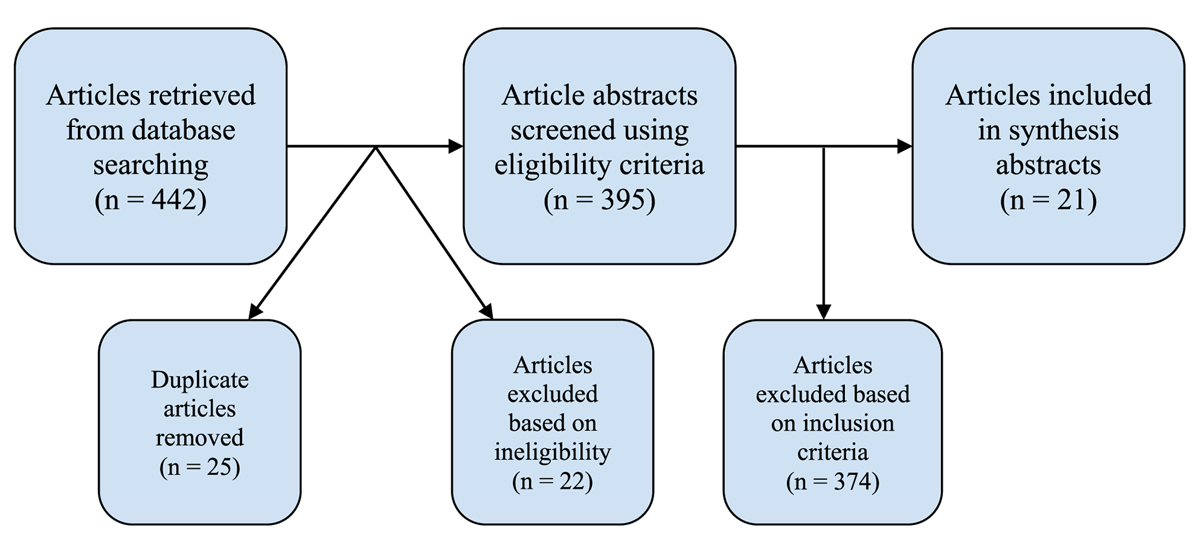
Figure 1
PRISMA Flowchart for Systematic Mapping.
Step 3. Critique and Quality Appraisal of the Literature
After compiling the primary sources and removing duplicates, we assessed the quality of each source by first abstracting details from each. A template was created for abstracting important details from each source:
Is the article about identity-based organizations, Greek-letter organizations, or both?
Is the study an evaluative study or a research study?
What are the research questions?
What do we already know based on the themes of the questions?
What research methods, evaluation methods, and theoretical frameworks were used?
What are the limitations of this study?
What implications, recommendations, and future work have been proposed?
Are there instances where suggestions have been addressed?
What populations are being used to generate information about people at each juncture?
When the context is not HBCU, how often is it PWI?
What factors positively/negatively influence the participation of African Americans in engineering?
Critique: What are some problematic things we observed in the article?
Three members of the research team were involved in this process, with one of the members creating the final critique and appraisal based on the entire team’s work.
Step 4. Address Bias, Validity, and Reliability Concerns
As it is with any research project, the limitations of a systematic literature review stem from both the quality and quantity of the primary studies and the quality of the systematic review procedures (Cook et al., 1997). While the limitations of systematic reviews cannot be eliminated, they can be minimized by employing strategies like defining and following clear procedures and reporting decisions and procedures in detail (Mullen & Ramírez, 2006). To avoid selection bias, primary studies were masked for author names, affiliations, and journal names during the quality appraisal phase. Sources were discussed using a reference ID number as opposed to the authors. Furthermore, the quality of the systematic literature review was determined by consistency and transparency in selecting and reporting procedures for every step along the review. The readers of the review should have enough information (e.g., criteria, protocols) to evaluate the validity of the search procedures, the studies identified as part of the search, and whether the conclusions drawn were warranted. The use of a team to conduct the review, where multiple team members apply and discuss criteria for inclusion/exclusion and the quality assessment, helps establish reliability and minimize our own biases. Important details of primary studies will be presented and cited in the discussion and conclusion sections. A review of our procedures and documentation by the library sciences expert on our advisory board also helped reduce researcher biases.
Step 5. Synthesize Insights
The value of a systematic literature review is largely derived from a thorough synthesis of the primary sources. According to Petticrew and Roberts (2006), there are three basic steps in the synthesis: organize the studies into categories (e.g., by study design, outcome); critique the studies within each category; and critique all studies across all categories.
Thematic analysis was used to complete the first step of organizing the articles into categories. Thematic analysis is a descriptive method that is used to identify, analyze, and report patterns within data (Castleberry & Nolen, 2018). It can be used for multiple types of data, making it ideal for analyzing documents. When conducting a thematic analysis, it is important that the patterns, or themes, identified within go beyond the research topic. In an inductive thematic analysis specifically, the themes are data-driven, whereas in deductive thematic analysis the themes are theory-driven (Braun & Clarke, 2006; Castleberry & Nolen, 2018).
Two members of the research team were involved during this phase. When conducting the thematic analysis (Braun and Clarke, 2006), we familiarized ourselves with the data by creating an article profile for each article, generating initial codes that addressed the guiding research question, then looked for themes (abstract ways to describe the similarities across articles).
During the first phase of thematic analysis, the researchers created an article profile to assess the quality of the literature. During the second phase, initial codes were generated from the article profiles. This was done through an iterative process of descriptive coding and attribute coding to ensure the validity of the findings (Miles et al., 2019). Descriptive codes were assigned to label the types of outcomes that resulted from identity-based professional organizations to accomplish the research question. According to Petticrew and Roberts (2006), by grouping studies by outcomes we can see how the outcomes can be achieved.
Attribute codes were used to distinguish each article that resulted from the systematic literature review (Miles et al., 2019). Articles were distinguished by two attributes: study type and organization type. The study type consisted of research study or evaluative study. If the study was assessing the quality of a program or organization, it was deemed an evaluative study. If the study was based on empirical evidence and aimed to broaden a body of knowledge, it was deemed a research study. This was helpful because the research studies were primarily about identity-based societies such as NSBE, whereas the evaluative studies were primarily about programs hosted by societies and universities. Organization type was used to distinguish whether the article was about a Greek letter organization or any other type of identity-based organization. The third phase began once the coding was complete, which entailed collating codes into themes. After creating themes, they were reviewed to see if each code within each theme properly represented the theme. We relied on terms that are commonly found in engineering education literature to name the themes. A definition for each theme was created and the name for each theme was refined. The themes will be presented in the next two sections. The Results section outlines insights that emerged from critiquing each individual article while the Discussion section presents insights about ideas associated with multiple articles.
Results
Identification and Classification of Studies
Of the 21 articles, 10 articles were classified as evaluative studies and 11 were classified as research studies. Two studies were exclusively focused on BGLOs, 17 focused exclusively on identity-based organizations or programs, and two focused on both BGLOs and identity-based organizations and programs. We found four types of outcomes emerging from students being academically and socially integrated from participation in professional organizations and programs relating to each construct in the model. We relied on terms that are commonly found in engineering education literature to name the themes—namely, self-efficacy, sense of belonging, KSA, and student success. Table 2 contains a list of each theme along with quotes from the articles that exemplify the theme. Table 3, in the Appendix, contains a list of all 21 articles along with their attributes.
Table 2
Quotes from the study that are representative of each theme.
| OUTCOMES | REPRESENTATIVE QUOTES |
|---|---|
| Self-efficacy | “A young lady that had effectively abandoned engineering used her integration in the local and regional NSBE community to remain engaged and successfully complete her undergraduate degree in both engineering and business” (Ross & McGrade, 2016, p. 10). |
| Sense of belonging & community | “Being involved in an organization that expanded beyond the confines of their campus provided the students with access to a larger community of black engineers. As reflected in previous quotes, this created a sense of belonging in engineering. These students created an atmosphere of acceptance and affirmation for themselves, but it expanded to the campus and was likewise, recognized by NSBE regional. This acceptance outside of their university provided them with a greater sense of integration into a larger engineering community” (Ross & McGrade, 2016, p. 13). |
| KSAs | “BGO membership positively impacted academic and career skills such as interview skills, time management, teamwork, and problem solving” (Trenor et al., 2010, p. T4G-4). |
| Success | “Retention rates for program participants were higher than non-program participants as well as higher than College of Engineering students as a whole and this is especially noteworthy from sophomore to pre-junior year. Although there are other variables to consider, these data indicate that the two-week Summer Diversity Program may have provided students with an academic and social advantage that has helped them to succeed at Drexel University” (Erickson-Ludwig & Clyne, 2014, p. 10) |
Self-Efficacy
Research has shown that self-efficacy is a positive predictor of engineering students’ success as it relates to academic achievement (Hsieh et al., 2012) and persistence (Concannon & Barrow, 2010). Self-efficacy is defined as a person’s belief in their abilities to complete a task to achieve a goal (Bandura, 1997). When students believe in their own efficacy, they will then act in ways that will continue their success. One’s self-efficacy can contribute to how they operate within a domain; for the context of this study, the domain is engineering (Mamaril et al., 2016). Within the context of engineering, self-efficacy can be more pronounced due to students’ learning experiences in engineering (Carberry et al., 2010; Jordan & Gaskins, 2011). While only one study used Bandura’s (1997) operationalization of self-efficacy (Jordan & Gaskins, 2011), the definition was used throughout the systematic literature review to recognize when a students’ belief in their ability to be engineers stemmed from participating in a identity-based organization or program. From attribute coding, it was seen that studies reviewed as part of the systematic literature review primarily discussed self-efficacy as a result of participation in identity-based organizations, such as NSBE.
While self-efficacy can operate in reference to a student’s ability to perform engineering tasks and their academic capabilities, this theme was primarily conveyed through a person’s confidence in their ability to be an engineer or pursue an engineering profession. Self-efficacy was discussed by authors revealing that by participating in NSBE, students felt more confident to successfully navigate engineering education or work as an engineer after graduation (Ross & McGrade, 2016). A student’s confidence in their ability to be an engineer was a result of being highly integrated within an identity-based organization such as NSBE by participating in events hosted by the organization (Cola et al., 2010; Ross & McGrade, 2016), and assuming leadership positions in their local NSBE chapter (Ross & McGrade, 2016). An example of this theme comes from Ross and McGrade (2016), which discussed that by seeing other successful Black engineers in their local chapter and at the national level, Black students gained the confidence to work towards becoming an engineer. Jordan and Gaskins (2011) found that students in NSBE reported high mean values of engineering self-efficacy and engineering career success from taking the Longitudinal Assessment of Engineering Self-Efficacy.
Sense of Belonging and Community
It was found throughout the articles that from participating in identity-based societies and programs students felt a sense of belonging within engineering and their community (Cola et al., 2010; Erickson-Ludwig & Clyne, 2014; Prewitt et al., 2007; Ross & McGrade, 2016; Schulte et al., 1999; St. Omer et al., 1999; L. D. Thomas et al., 2009; Trenor et al., 2010). This was conveyed through three codes: sense of belonging, support, and social capital. When defining a sense of belonging as a code, the researcher referred to literature resulting from the systematic literature review. For this work, Hagerty’s definition of a sense of belonging is used. Hagerty et al (1992) defines sense of belonging as “a person’s experience of being valued or important to an external referent and experiencing a fit between self and that referent” (p. 174). For this study, the external referent was defined as engineering. An example of this code was conveyed when Ross and McGrade (2016) reported that NSBE members perceived integration within the society contributed to their sense of belonging within engineering. By gaining a sense of belonging, students were able to perceive themselves as engineers.
Support was defined as people that provide assistance as a result of participating in an organization, and people they are able to assist as a result of participating in an organization. Through support, students were able to build community. There were two sub-codes within the category of support: gaining support and giving support. When discussing gaining support, this is referring to students receiving assistance in the form of role modeling and mentoring. St. Omer et al (1999) and Schulte et al (1999) discussed the importance of professional identity-based organizations in providing mentors and role models for both undergraduate and K-12 members. Oftentimes students in these organizations were paired with a mentor through a formal program or found an older member of the organization or an alumnus who served as a mentor or role model. Additionally, students found role models by going to conferences or other events. Another way students received assistance was by gaining a “family” or sense of community from these organizations (Ross & McGrade, 2016; St. Omer et al., 1999). Organizations providing a sense of family were mentioned multiple times throughout the studies (Prewitt et al., 2007; Trenor et al., 2010). This sense of family was accomplished by having support structures within the organization itself that were beyond academic interactions and more social interactions through social events and mentoring (L. Thomas & Smith, 2010).
The sub-code giving support refers to students having the opportunity to assist others as a result of participation in an organization. This was usually facilitated by serving as mentors and role models, as well as serving the broader community. Giving support was discussed by authors revealing that students who were academically successful were able to mentor and tutor students through programs created by their identity-based organization (Schulte et al., 1999). Additionally, students expressed the desire to become role models and mentors for underclassmen students due to previous support they gained by participating in an identity-based organization (St. Omer et al., 1999). This code was found in both research and evaluative studies and was seen because of identity-based organizations and programs. Schulte et al (1999) discussed that by Black undergraduate students participating in an identity-based organization, students were able to be academically successful. Thus, these members can mentor students and motivate them to pursue engineering.
Lastly, along with support, organizations promoted social capital to build a community within the society or program. Prewitt et al (2007), whose paper was included in the systematic literature review, used Staton-Salazaar’s (2001) definition of social capital “a set of properties existing within socially patterned association among people that, when activated, enable them to accomplish their goals or to empower themselves in some meaningful way” (p. 256). This can be developed through personal relationships and networks with people within these organizations (Prewitt et al., 2007). Social capital was demonstrated by members of an organization perceiving their organization as a way to establish relationships with their peers (Ross & McGrade, 2016). Another paper discussed how through the formation of a “family-like bond”, BGLOs were found to promote social capital at a PWI (Trenor et al., 2010). Social capital was also seen at conferences hosted by professional identity-related organizations, such as the NSBE national convention, by students meeting people with similar interests like them (St. Omer et al., 1999). Social capital was accomplished by organizations having events where members could interact with other Black students such as conferences, mentoring programs, networking events, and workshops. By students being in spaces where there were people who looked like them, they were able to form personal relationships and networks with people that helped empower them succeed in engineering (Prewitt et al., 2007).
KSAs (Knowledge, Skills, and Attributes)
KSAs were defined as knowledge, skill, or attributes that students gained from participating in an organization (Erickson-Ludwig & Clyne, 2014; Loftus, 2008; Prewitt et al., 2007; Ross & McGrade, 2016; Schulte et al., 1999; Simmons & Martin, 2011; L. Thomas & Smith, 2010; Trenor et al., 2010; Young et al., 2014). KSAs were seen in both research studies and evaluative studies that studied identity-based programs and organizations. Oftentimes, KSAs were seen as an outcome for Black students participating in activities that were housed by a MEP or an identity-based organization. In one study, several KSAs resulted from a NSBE program housed within the organization (Schulte et al., 1999). These KSAs include remote control car building, internet usage and web page design, study skills, scholastic aptitude test preparation, and how to apply for college. In another study, it was found that taking advanced math and science classes within NSBE Jr. enhanced the STEM ability of students within the program, an example of an ability that was produced from an identity-related program (Cola et al., 2010).
However, authors did discuss how identity-based organizations collectively produced KSAs for students. Young, Knight, and Simmons (2014) found evidence that students who were involved in engineering clubs reported higher teamwork skills and reflective behavior outcomes than students who were not involved in engineering clubs. Teamwork skills are an example of a skill that a student may gain, and reflective behaviors are an example of an attribute that a student may gain. From a separate study, BGLOs were found to provide some of the traits that the National Academy of Engineering wishes for engineers to have by the time they graduate (Simmons & Martin, 2011). These traits were: “practical ingenuity, good communication skills, business and management skills, leadership, high ethical standards, and professionalism” (Simmons & Martin, 2011, p. 2). While specific factors contributing to the KSAs were not included for these studies, we do know that students can gain these KSAs from participation in an identity-based organization (Erickson-Ludwig & Clyne, 2014; Loftus, 2008; Prewitt et al., 2007; Ross & McGrade, 2016; Schulte et al., 1999; Simmons & Martin, 2011; L. Thomas & Smith, 2010; Trenor et al., 2010; Young et al., 2014).
Additionally, within this theme was the sub-code persistence & motivation. Persistence and motivation was defined as students having the determination or willingness to either pursue engineering or stay in engineering. This attribute is the result of students’ participation in identity-based societies and programs. Persistence and motivation was not seen as much within identity-related programs in the evaluative studies; however, it was discussed when talking about the success of the programs (Erickson-Ludwig & Clyne, 2014; Roemer et al., 1999; Schulte et al., 1999). Examples of this code were seen through authors discussing that students in the organizations believed their membership influenced their decision to not leave engineering and persist (Erickson-Ludwig & Clyne, 2014; Prewitt et al., 2007; Schulte et al., 1999). There were no specific factors mentioned that played into persistence and motivation besides being integrated in the organization.
Success
The success theme included two sub-codes: academic success and professional success. Success was defined as an accomplishment that occurred from participation in an organization. For academic success, this was anything related to students benefiting academically. This can be in terms of GPA or reaching academic goals. Academic success was seen in both evaluative and research studies that examined identity-based programs and organizations and BGLOs. An example of academic success came from a paper discussing how being in a BGLO motivated members to achieve and maintain high academic performance in engineering (Trenor et al., 2010). This was also seen in NSBE and MEPs as student participation was seen to increase GPAs and retain students in engineering (Erickson-Ludwig & Clyne, 2014; Newell et al., 2004; Yates & Nagle, 2016). Academic success was often contributed by identity-based organizations and programs being academically supportive, particularly through having study groups, having tutors and mentors that can help students accomplish their academic goals, and hosting academic related workshops (Cola et al., 2010; Erickson-Ludwig & Clyne, 2014; Trenor et al., 2010; Yates & Nagle, 2016).
Professional success was primarily seen as an outcome for K–12 programs, such as NSBE Jr. which is housed under NSBE’s Pre-College Initiative programs (PCI). When looking specifically at professional success, this was defined as the advancement of progress in students’ careers or education after graduation of either high school or undergraduate. Professional success was primarily exhibited as an outcome in evaluative studies for both identity-based programs and organizations. At the undergraduate level, professional success was exhibited in Yates and Nagle’s (2016) work which found that 92.8 percent of students who participated in NSBE pursued graduate education or a job in the engineering field (Yates & Nagle, 2016). Factors that contributed to professional success after undergraduate were not mentioned. NSBE Jr. was said to influence students to STEM careers because it exposed the students to advanced math and science courses (Cola et al., 2010). In another K–12 program, a former participant went on to attend veterinary school, and feedback from this participant said that tutoring provided by the program was helpful in their success (Roemer et al., 1999). Best practices that contributed to professional success for K–12 students included offering advanced classes in math and science and tutoring from members of NSBE undergraduate chapters. These programs are to serve primarily K–12 students of color, especially students who identify as Black.
Discussion
There are many benefits of Black engineering students’ participation in identity-based professional societies and programs according to existing literature. From the results, it is known that participating in these organizations can help students socially and academically integrate on campus, which in turn can aid in the persistence of these students. According to engineering education literature, self-efficacy has been shown to be an indicator of achievement and persistence (Carberry et al., 2010; Concannon & Barrow, 2010; Hsieh et al., 2012). Identity-based organizations and programs can help minority engineering students increase their confidence in successfully becoming engineers (Cola et al., 2010; Jordan & Gaskins, 2011; Ross & McGrade, 2016). Literature has shown that self-confidence can influence academic success and persistence in engineering, especially those who are from underrepresented groups (Litzler & Samuelson, 2013). By being integrated in an engineering community where there are other students who look like them, they will have increased confidence in themselves and their ability to pursue engineering as a profession. This is due to identity-based societies serving as counterspaces for minority students in which they can develop relationships with peers and mentors and share their experiences with others (Cola et al., 2010; Erickson-Ludwig & Clyne, 2014; Prewitt et al., 2007; Ross & McGrade, 2016; Schulte et al., 1999; St. Omer et al., 1999; L. D. Thomas et al., 2009; Trenor et al., 2010). For undergraduates, this can occur through participating in events hosted by the organization, networking opportunities, attending professional conferences, and receiving recognition of their work from peers (Cola et al., 2010; Ross & McGrade, 2016; Thomas et al., 2009). Additionally, these events will oftentimes have academic and industry professionals who are also Black that can help them along their academic journeys by giving advice in regard to navigating the engineering profession, which boosts their confidence in themselves as engineers (St. Omer et al., 1999).
A sense of belonging is also important to students’ persisting in universities and within engineering, especially underrepresented students (Hausmann et al., 2009; Ross & McGrade, 2016). From participation in professional societies and organizations, Black students are able to be surrounded by a supportive community which fosters a sense of belonging (Jordan & Gaskins, 2011; Ross & McGrade, 2016). This is important because Black students are not represented in engineering and oftentimes can feel alienated in engineering (American Society for Engineering Education, 2021; McGee & Martin, 2011). When these feelings of exclusion arise, this can lower their confidence in feeling like engineers and ultimately affect their ability to receive their engineering degree (Marra et al., 2013). Prior research shows that a sense of belonging is crucial for the academic success and retention of undergraduate students in STEM, especially those who belong to underrepresented groups (Liptow et al., 2016; Litzler & Samuelson, 2013). By belonging to an identity related organization or society, Black students can feel more integrated within college and engineering (Tate & Linn, 2005). This is because they have various means of supports in the form of role models, mentors, and peers who look like them, which can positively impact their persistence and academic success (Anderson & Kim, 2006; Cole & Espinoza, 2008; May & Chubin, 2003). By examining how identity-based organizations foster self-efficacy and a sense of belonging, researchers and practitioners can find ways to increase persistence among other Black engineering students.
Not only do these organizations aid in the development of self-efficacy and a sense of belonging, but they also provide support for students, foster academic achievement, and help students develop KSAs (Erickson-Ludwig & Clyne, 2014; Loftus, 2008; Prewitt et al., 2007; Ross & McGrade, 2016; Schulte et al., 1999; Simmons & Martin, 2011; L. Thomas & Smith, 2010; Trenor et al., 2010; Young et al., 2014). Each of these outcomes helps students persist in the field of engineering. In academia there has been a big push to graduate engineers that not only are knowledgeable of engineering as a subject, but also have professional skills (Brush et al., 2014; Lappalainen, 2009). Examples of these professional skills include written and oral communication skills, the ability to work in teams, problem solving skills, time management skills, and project management skills (Kolmos, 2006). By having engineers who have engineering knowledge with the prerequisites needed to succeed in the engineering workforce, we will be able to meet societal demands as stated by the National Academy of Engineering (Lappalainen, 2009; National Academy of Engineering, 2004, 2018). This makes identity-related organizations that can produce KSAs more important because they can foster these outcomes in an underrepresented group that is needed in the engineering workforce.
Additionally, identity-based societies and programs were academically-supportive, meaning they fostered academic success for those who were in them (Cola et al., 2010). Academic success is oftentimes measured through metrics such as GPA, grades, and retention, which resonated in the articles that discussed academic success as an outcome (York et al., 2015). While it is important to know that those participating in identity-based organizations and societies are academically succeeding by higher retention rates and higher GPAs, there is a need to assess if they are staying in engineering after graduating high school or college. The literature touched on K–12 programs such as NSBE Jr, which occur through NSBE’s Pre-College Initiative. Programs like these are important because Black students are less likely to be offered advanced STEM classes in K–12 education (Patrick et al., 2020). Additionally, Black students’ lack of interest in STEM majors can be contributed to lack of quality STEM education opportunities for these students (Ramsay-Jordan, 2020). Thus, there is a need to focus on creating enriching engineering education opportunities in K–12, which can help address the shortage of Black engineers in the workforce. However, there is a need to focus on the professional success of students after K–12, more specifically undergraduate students. In 2019, African-Americans made up 12 percent of the U.S. workforce but only 9 percent of the STEM workforce (National Science Foundation, 2021).
The synthesis of this literature helps us understand that by participating in these programs, which encompass academic performance, faculty/staff interactions, extracurricular activities, and peer-group interactions, Black students are potentially able to persist and succeed in engineering. The literature also shows that members of these organizations are likely to be successful in engineering because of social integration within these organizations (Ross & McGrade, 2016). If it is understood how these organizations and programs are helping Black engineering students, these benefits can be used to decrease the attrition rate of Black engineers. Most importantly, the outcomes synthesized as a result of the systematic literature review, self-efficacy, sense of belonging and community, KSAs, and success can aid in academic and social integration in engineering and higher education as a whole. The outcomes themselves are important because they are what defines identity-based organizations and programs. They occur because the goals of these organizations and programs are to help Black students and by these students’ participation, their engineering experiences are enhanced. The resources and interventions that occur in identity-based organizations and programs are what is contributing to the outcomes.
Implications
Implications for Researchers
There is a need for more robust studies in this area. Of the final articles, none were published in journals. Publishing in peer-reviewed journals will advance this area of scholarship since they are more widely accessible and searchable than conference proceedings, reports, and other forms of scholarly outputs. Additionally, journal articles that have been peer reviewed also tend to meet higher standards of research quality and have stronger connections to existing literature and/or debates happening among scholars in a field. For these reasons, we want to encourage researchers to publish more peer-reviewed journal articles on this topic.
Lastly, there was a lack of research on BGLOs, as only three of the twenty-one articles studied these organizations. From the articles centered on BGLOs, it was shown that participation in these organizations contributed to traits outlined in the Engineer of 2020 (National Academy of Engineering, 2004). Thus, there is a need to identify how BGLOs are helping engineering students persist and consequently, how other non-engineering identity-based organizations and programs can learn from them to help Black engineering students.
Implications for Practitioners
First, schools should place a heavy emphasis on identity-based programs and organizations for Black students in engineering to participate, especially in schools that are PWIs. A heavier emphasis may include, but is not limited to, investing more resources to promote these organizations and programs, sponsoring student membership in them, and/or providing them a designated space on campus (Blust, 2001; National Academies of Sciences Engineering and Medicine, 2011). This is important because while the results of this study show the importance and benefit of identity-based organizations and programs, the problems that are affecting Black students in engineering still remain since they are still underrepresented in engineering (American Society for Engineering Education, 2021). This should be done at the K–12 and undergraduate levels as our work shows that these outcomes were produced from K–12 programs such as NSBE Jr and tutoring programs for K–12 students. In order to support Black students, all engineering institutions should have a NSBE chapter and/or an MEP. Engineering programs should aim to partner with NSBE chapters and MEPs to bring awareness to their existence and stress their importance. Additionally, partnerships between engineering programs and identity-based engineering programs and societies can foster collaboration that can lead to improved outcomes for all students.
Lastly, all program administrators and organization leaders must assess whether their programs and organizations are producing good outcomes for the students participating in them. Of the 21 articles that were presented, 10 were evaluative studies that were assessing the impact of either local chapters of identity-based organizations or MEPs. We encourage program administrators and organization leaders to continually assess the quality of their programs and use our findings as a guide to what outcomes should be produced in students in their programs. If practitioners choose to share the outcomes of their programs to the research community, we encourage them to situate their studies within larger findings communicated in research studies so that these findings can be used in a broader context, specifically when looking at ways to broaden participation in engineering.
Conclusion
The purpose of this study was to see how identity-based organizations, such as NSBE and BGLOs, influence the outcomes of Black engineers. More specifically, a systematic literature review was conducted to see how students benefited from these identity-based organizations and programs. From the results, various outcomes were found from participating in these organizations and programs. Students who participate gain a sense of self-efficacy, particularly in their beliefs about their abilities to be engineers by participating in an identity-based organization or program. This was shown through how students perceived themselves as engineers and acquired confidence in themselves as engineers by engaging in activities of these organizations and programs. Another outcome of participation in these organizations is a sense of belonging within engineering and the community. A variety of KSAs can also be learned. One of the most common attributes was persistence & motivation, which can help students in achieving success. Various forms of success were discussed in terms of career, GPA, and recognition. Overall, we have discovered that participation in identity-based organizations and programs can lead to Black students feeling socially and academically integrated on campus. Future work should include interviews to see if students within NSBE and BGLOs believe the themes resulting from the systematic literature review are true. This will provide triangulation to ensure the validity of the findings. Additionally, we encourage more studies that probe at the aspects of identity-based organizations and programs that are contributing to Black students’ positive outcomes since this was underdeveloped in the literature. By enhancing this body of literature, we can gain a better understanding of how we can aid in broadening participation efforts in engineering education.
Appendices
Appendix
Table 3
Article summaries.
| AUTHORS | PUBLICATION TYPE | STUDY TYPE | ORGANIZATION/PROGRAM | POPULATION | PURPOSE |
|---|---|---|---|---|---|
| Berry et al. (2007) | Conference | Research | NSBE | African American graduate and undergraduate students in NSBE | Identify learning style preferences for African American undergraduate and graduate engineering students |
| Ross & McGrade (2016) | Conference | Research | NSBE | African American undergraduate students and alumni in NSBE | Explore the impact of NSBE on persistence and graduation of its members |
| Young et al. (2014) | Conference | Research | NSBE, BGLOs, and MEPs | African American engineering students | Analyze the influence of co-curricular experiences on the developing of nontechnical skills for African American engineering students |
| Reyes et al. (1996) | Conference | Evaluative | MEP, NSBE, SHPE, and AISES | Student leaders of minority engineering professional organizations | Give overview of program to advocate for professional organization collaboration and discussed how to make the program better |
| Yates & Nagle (2016) | Conference | Research | NSBE | NSBE chapter officers and advisors | Determine the activities of NSBE chapters and how well members are performing |
| Simmons & Martin (2011) | Conference | Research | BGLOs | African American engineers in BGLOs | Determine the attributes related to the Engineer of 2020 that engineering members of BGLOs report as having learned from participating in BGLOs |
| Cola et al. (2010) | Conference | Evaluative | NSBE | African Americans in NSBE Jr | Detail the activities orchestrated by NSBE Jr at two high schools and map the trajectories of these students |
| Prewitt et al. (2007) | Conference | Research | NSBE | African American members of an HBCU NSBE chapter | Demonstrate how social capital is generated by involvement in NSBE |
| Schulte et al. (1999) | Conference | Evaluative | NSBE | Minority teenagers participating in NSBE PCI and African American students in NSBE | Described the goals and activities of a NSBE outreach program at a PWI |
| Young et al. (2014) | Conference | Research | NSBE, BLGOs, and MEPs | African American engineering students | Understand the experiences of African American engineering students who participate NSBE, BGLOs, and MEPs |
| Erickson-Ludwig & Clyne (2014) | Conference | Evaluative | MEP | Entering first year women and URMs in the College of Engineering at a PWI | Explore the impact of a summer bridge program for women and URMs |
| Thomas & Smith (2010) | Conference | Evaluative | NSBE | African American peer mentors in NSBE and underrepresented K12 students | Give a report on a NSBE program that exposes K12 students to engineering |
| Newell et al. (2004) | Conference | Evaluative | AISES, SHPE, SWE, NSBE and MEP | Women and URMs in engineering | Detail a MEP that is a collaboration between minority engineering societies and SWE, and analyze its success and make recommendations |
| Trenor et al. (2010) | Conference | Research | BGLOs | Engineering undergraduate students in BGLOs | Explore how students in BGLOs at PWIs perceive their participation in BGLOs as it relates to their experiences in engineering |
| Roemer et al. (1999) | Conference | Evaluative | Tutoring program for K12 Black students | K12 Black students and Black undergraduate engineering students who served as tutors | An overview of a tutoring program created by Black engineering undergraduates for K12 Black students |
| Jordan & Gaskins (2011) | Conference | Research | NSBE | Black engineering undergraduate students | Examine how participation in NSBE can impact Black engineering students’ self-efficacy |
| Artiles et al. (2018) | Conference | Research | Dissertation workshop for URM doctoral students in engineering | URM doctoral students in engineering from PWIs | Explore how URM doctoral students in engineering make investments in their socialization experiences of pursuing graduate degrees |
| Loftus (2008) | Magazine publication | Evaluative | NSBE, MEPs and other minority professional organizations | African Americans pursuing engineering | A report framed around underrepresentation of African Americans in engineering |
| Ogunfunmi (2007) | Conference | Evaluative | NSBE | Black graduate students in electrical engineering | Examining the experiences of Black graduate students in an electrical engineering program and how NSBE has helped them in their journey |
| St. Omer et al. (1999) | Conference | Research | NSBE and SHPE | URM undergraduate and graduate students in engineering from a PWI | Explores how minority professional societies can offer institutional support to minority students in engineering |
| Thomas et al. (2009) | Conference | Evaluative | NSBE | African American K12 students | Discussed the formation of outreach program within NSBE and the outcomes of these programs |
Funding Information
This work is supported by the U.S. National Science Foundation award #1828659. Any opinions, findings, and conclusions or recommendations expressed in this material are those of the authors and do not necessarily reflect the views of the National Science Foundation.
Competing Interests
The authors have no competing interests to declare.