
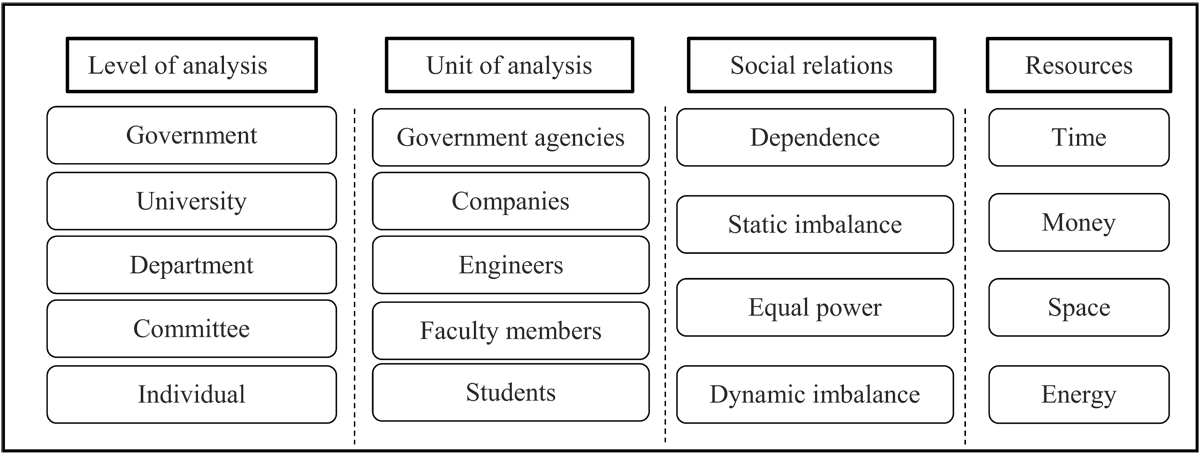
Figure 1
Dimensions (rectangle boxes) and example variables (rounded boxes) to consider in study of political and economic factor affecting engineering education.
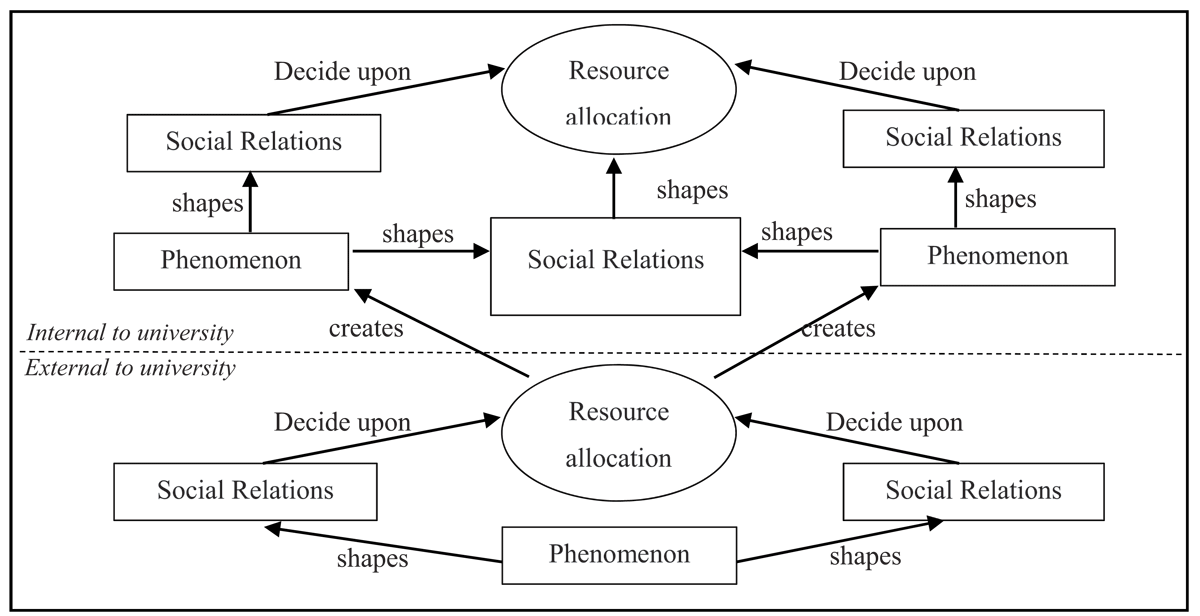
Figure 2
Connections between phenomena, social relations, and resource allocation.
Table 1
Examples from national reports on engineering education alluding to the political economy of the engineering education system.
| SOURCE | QUOTE | INTERPRETATION |
|---|---|---|
| Wickenden (1930) | “Engineering education reflects our national genius for quantity production. Pressed to get a maximum result in a minimum of time, engineering educators have borrowed, half unconsciously, from the management methods of industry. The essence of the scheme consists in first visualizing the process as a whole. Then dividing it into major steps in a logical progression and finally breaking the work down into small units to be done in a definite sequence, under prearranged conditions and with the materials supplied precisely when needed and in the most convenient form, the task sequence to be carried out under close supervision, with continuous inspection and grading of piece parts, and the rewards to be paid in terms of a standard task with quality bonus.” (p. 109) | Engineering education has borrowed the Taylorist philosophy of industrial production to guide decisions in engineering programs. |
| Rising above the Gathering Storm (Committee on Prospering in the Global Economy of the 21st Century (U.S.) & Committee on Science, Engineering, and Public Policy (U.S.), 2007) | “Our culture has always considered higher education a public good—or at least we have seemed to do so…Now, however, funding for state universities is dwindling, tuition is rising, and students are borrowing more than they receive in grants. These seem to be indications that our society increasingly sees higher education as a private good, of value only to the individual receiving it.” (p. 31) | Shifts from viewing higher education as a public good to a private good, reflected in funding levels and public attitudes, which is consistent with larger political economic trends to reduce public spending in favor of private funding through market competition. |
| Phase I Report (ASEE, 2014) | “One respondent noted that there is a market for universities to help teach engineers business skills and provide lower cost options than business school.” (p. 17) | Curricular decisions being influenced by supply and demand due to market relationships of exchange established between engineering departments and employers as well as increased expectations of graduating engineers to be ready for market competition upon graduation. |
Table 2
Phenomena from the political economy of engineering education.
| PHENOMENON | DESCRIPTION OF PHENOMENON | RELEVANT SOCIAL RELATIONS* | IMPLICATED RESOURCE(S) |
|---|---|---|---|
| 1. Market-like behavior | Supply and demand model, students as consumer, marketing and recruitment | Student-Dept; Student-Faculty; Student-University; Dept.-Faculty | Faculty time; Curriculum time; Student time; Money |
| 2. Competition for prestige and reputation | Programs and universities compete for prestige that enable better ability to compete for resources | Dept-Dept; Public-Dept; Faculty Member-Faculty Member | Faculty time; Faculty Member research budget; Dept budget |
| 3. Outsourcing | The decision from department A to call upon department B to teach something in department A’s curriculum | Dept-Dept; Comm-Dept; Dept-Faculty Member (e.g., adjunct faculty) | Faculty time; Dept. budget |
| 4. Program governance | How engineering programs receive and maintain accreditation and approval | Dept.-Eval; Dept.-Faculty; Faculty-Faculty | Faculty time; Curriculum time |
| 5. Job markets and hiring | Departmental and company hiring decisions | Dept.-Industry; Cmte.-Industry; Dept.-Faculty | Faculty time; Dept budget; Curriculum time; Student time |
| 6. Institutional isomorphism, entrepreneurship, and inertia | How faculty members relate to each other through committees or various policies and programs | FacMem-FacMem; Dept.-Dept.; University-Dept. | Faculty time; Dept budget; Student time |
[i] Abbreviations: Dept.-department; Eval-accreditation evaluator; Cmte.-committee; Ind-industry.
* Relations between actors/groups/organizations in the system are depicted with a hyphen.