
Introduction
For Engineering Education Scholars (EES), the complex relationship between role type, institution type, and support available has become increasingly important as the engineering education field continues to evolve and new role types are created (Coso Strong et al. 2021). Recent work by McCave et al. (2020) and Kajfez et al. (2014) has shown that the diversity of positions (tenure-track, teaching-track, lecturer, researcher, etc.) available to EES continues to grow. Over the past two decades, EES-focused job postings on the American Society for Engineering Education (ASEE) Educational Research Methods (ERM) listserv grew from 24 in a 12-month period (Borrego 2006), where only seven of these positions were faculty-focused positions, to 59 during the 2018–19 academic job cycle (McCave et al. 2020), with 51 of these being faculty positions. While announcements for traditional tenure-track positions are often most prominent, teaching-focused positions, administrative roles, and roles with unique combinations of research, teaching, and administration are becoming increasingly prevalent. The faculty positions, either tenure-track or teaching-focused, span both teaching-focused and research-focused institutions, while posted staff positions primarily exist at research-intensive institutions (McCave et al. 2020).
With the rise in engineering education doctoral- and certificate-granting programs across the nation, more EES are graduating and looking for positions that provide the right fit for their expertise. As defined by Sekiguchi (2004), person-job fit is “the fit between the abilities of a person and the demands of a job or the desires of a person and the attributes of a job” (p. 184). Allendoerfer and colleagues (2007) defined engineering education as “an interdisciplinary space at the interface between engineering and education disciplinary perspectives. Engineering education research often involves drawing on theories and research methods from education and applying them to investigations of teaching and learning in engineering contexts” (p. 1). The EES that these developing and established programs (ASEE SD 2011) produce bring an intersectional perspective and unique skill set not common within traditional engineering disciplines. Research by Coso Strong et al. (2021) found that early-career EES in faculty roles had to balance establishing their visibility, seeking support within their institutions, and gaining a better understanding of the expectations they needed to meet, all while completing their research, teaching, and service responsibilities. Given that many of these faculty pursued their roles to impact engineering education, these EES also sought ways in which they could achieve this purpose within the confines of their institutions and, in some cases, their roles. Thus, the challenge becomes connecting new engineering education graduates with roles where they can achieve their specific personal and professional goals.
Doctoral graduates seeking engineering education positions often have a limited understanding of the expectations and responsibilities required in faculty roles. Bieber and Worley (2006), for example, noted that students’ perceptions of academic life developed during their undergraduate experiences and focused mainly on the teaching aspect of faculty roles, which is opposite to the values of a research-intensive institution. With very high research activity (R1) institutions being the largest producer of doctoral graduates (Wapman et al. 2022), most graduate students are trained primarily to be researchers within their field, counter to students’ perceptions of faculty positions as teaching focused. This misalignment led the authors of this paper to question where graduate students learn about the other aspects of their future roles and how to dedicate the appropriate amounts of time and effort to each aspect of their role. And is it possible to provide empirically based representations of faculty life to engineering education doctoral students to better inform their job selection process?
Through our exploration of faculty research literature, we found that there was insufficient understanding of how early-career EES enact their roles in academic environments. This observation led to the following research questions: (1) How do early-career EES craft their roles and responsibilities to achieve their personal and professional goals? and (2) What job crafting practices do early-career EES use as part of their position enactment to make meaning of their positions? The novelty of this research study is its inquiry into how a group of faculty who were trained in engineering education research mold and shape their roles to best suit themselves and their goals, given a variety of position types and institutional contexts.
Literature Review
To date, research demonstrates that faculty role enactment is impacted by role type, institutional context, social identities, and faculty perceptions of their role and their environment. However, as will be illustrated in this section, these studies have primarily focused on tenure-line faculty in established/traditional disciplinary departments at research intensive institutions (Campbell & O’Meara 2014; Gonzales 2015; Kuntz 2012; Olsen 1993). This limited scope cannot fully explain the experiences of interdisciplinary faculty, such as Engineering Education Scholars. We aim to address this gap in the literature. The three main roles that exist within the academic labor force are tenure-line (i.e., tenure-track) faculty (30%), full-time, non-tenure-line faculty (17.6%), and part-time faculty (51.6%) (American Association of University Professors, 2020). Although all of these faculty positions are important to the educational mission of the institution, role enactment is variable based upon position type. Tenure-line faculty are typically evaluated based upon their ability to meet requirements tied to teaching, research, and service. While all three components are necessary for tenure-line positions, research productivity is often prioritized over other components (Lewellan Kasten 1984; Tien & Blackburn 1996). To that end, the focus on tenure-line faculty has been consistent within research on engineering faculty and faculty more broadly. However, there has been a recent increase in investigations focused on instructional, full-time, non-tenured faculty (Cutler & Strong 2023). These studies have found that instructional faculty members select their positions based on a passion for teaching and supporting students (Buswell 2021; Cerros et al. 2021; Fitzmorris et al. 2020). However, they encounter difficulties in achieving their desired goals within their roles due to a lack of resources and often hostile or disrespectful departmental cultures (Fitzmorris et al. 2020; Villanueva Alarcón & Muñoz 2023).
As the above example of instructional faculty demonstrates, institutional context also influences how faculty enact the different elements of their role. For instance, Gonzales (2015) found that in a “striving environment” (i.e., an institutional context that is seeking to increase its rankings), the primary emphasis was placed on research, with faculty being evaluated on their ability to secure research funding, publish in high-impact journals, and gain external recognition through nationally-recognized academies. This description of faculty workload is in contrast to institutions that are in the early stages of program development, where service loads may be significantly higher (Villiers et al. 2007; Yeo et al. 2015) and faculty may struggle with unknown expectations about where they should be dedicating their time (Yeo et al. 2015).
Across diverse groups of academics, research has found variations in faculty expectations and workload. This variation is particularly true of female faculty and members of underrepresented groups (O’Meara et al. 2017; Griffin & Reddick 2011). Female faculty were found to have greater levels of campus service, student advising, and teaching-related activities and requests as compared to their male counterparts who spent more time on research-related activities (Griffin & Reddick 2011). Faculty of color faced compounded requests to serve on diversity committees, mentor students of color, and aid the institution in navigating challenges in racism and discrimination (Banks 1984; Brayboy 2003), in addition to proving their research and teaching value to colleagues (Hirshfield & Joseph 2012; Joseph & Hirshfield 2011). This variation in workload can affect the time spent on research, a key component of most tenure and promotion decisions for tenure-track faculty.
Faculty enactment of their positions can also vary based upon their perspectives of their work and environment. Kuntz (2012) found that faculty held more personal ties to their research and hence would often reserve this work for completion off-campus, whereas teaching and administrative duties were seen to be not as personally relevant to them and would be reserved for when they were on-campus. Additionally, institutional resources were seen as central to supporting faculty productivity towards their career goals, particularly those institutional resources that allowed faculty to gain back time in their schedules (Campbell & O’Meara 2014; Olsen, 1993). However, in changing institutional contexts, resources were not always consistently provided to faculty, leading the faculty to believe that they were not supported in reaching required research, teaching, and service requirements (Yeo et al. 2015).
Theoretical foundation
We situate this study in two different theories. The first theory, Faculty Agency in Professional Lives, informed data collection. This theory was originally selected because it provided one possible approach for exploring the ways in which faculty enact their positions. However, at the stage of data analysis, we found that this theory did not fully capture the social reality under investigation. For this reason, we returned to the literature to identify a theory that was better suited to explain the results we were encountering in our data set. In the end, we found that Job Crafting theory better captured the complexities of how faculty were able to enact their positions as they worked to meet their desired personal and professional goals. Overviews of both of these theories are included here to help situate our work within the relevant literature.
Faculty Agency in Professional Lives theory
As described in Campbell and O’Meara (2014), faculty agency consists of both the “strategic perspectives” and “strategic actions” that faculty undertake to achieve desired outcomes (individual, organizational, and field & society). These strategic perspectives and strategic actions are influenced by factors at the individual, organizational, and field and society level, including, but not limited to, psychological characteristics as well as norms and expectations. Strategic perspectives involve how a faculty member views a situation and identifies existing options for action. Strategic actions are meaningful steps taken towards achieving a desired outcome (Campbell & O’Meara 2014).
Recent work by Coso Strong et al. (2023) expanded upon this faculty agency framework to create a contextualized theory of agency that is applicable to Engineering Education Scholars (EES). The authors’ contextualized theory aligns with existing research while also capturing the internal and external influences related to EES faculty agency. This theory modifies the influences to capture how the self, situation, and situational self are instrumental in the strategic perspectives and actions taken. Additionally, the contextualized theory captures how the output from the strategic perspectives and actions can be interpreted based on feedback obtained (both physiological and social) and the individual’s perspectives. By bringing a lens of faculty agency to engineering education, this research provided a foundation for exploring how the diversity of professional goals within the field are pursued by EES and the overall complexity of that pursuit in the context of the roles these scholars take within their institutions.
We recognize that there are numerous elements that can impact faculty life (i.e., imposter syndrome, identity), but for the scope of this paper, we focused on the strategic actions that faculty were taking to navigate their roles.
Job crafting
We leveraged the model of job crafting (Wrzesniewski & Dutton 2001) to interpret our results. The job crafting model focuses upon explaining 1) an individual’s motivation to craft their position within an organization and 2) the opportunities that are available within the organizational context to craft a position. This study seeks to better explain how early-career EES craft their roles and responsibilities based on their desired personal and professional goals. The job crafting model provided a structure used to capture both the goals of the individual (motivation to undertake crafting) and the organizational context that may assist or undermine the early-career EES’ job crafting efforts. Figure 1 provides an overview of the contributing elements to job crafting and their potential effects.
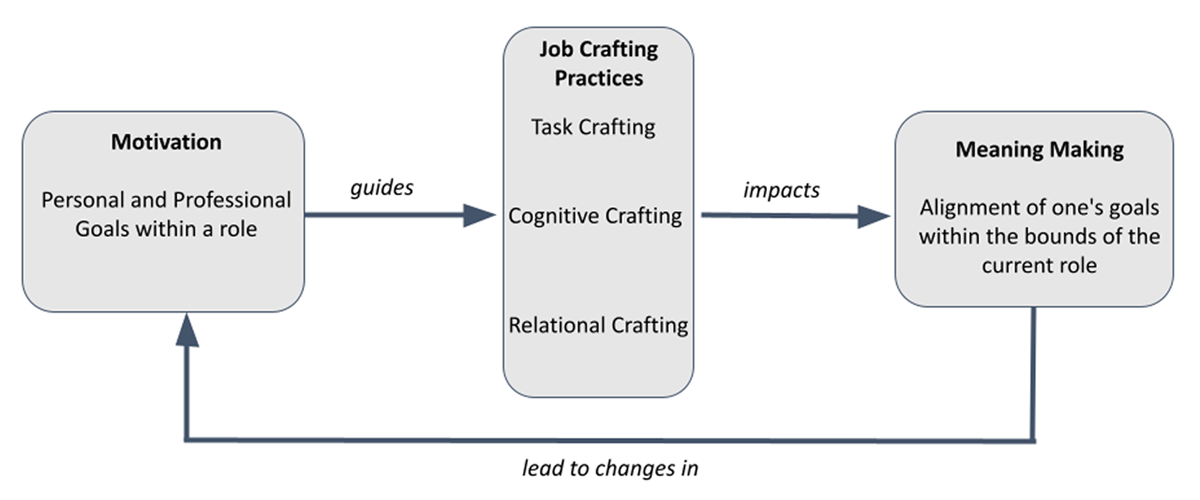
Figure 1
Overview of Job Crafting Model (Adapted from Wrzesniewski & Dutton 2001).
Job crafting encompasses three main approaches: (1) modifying the tasks that are being completed, or “task crafting”; (2) changing their approach to or amount of interactions with others, or “relational crafting”; and (3) modifying how the individual perceives their position, or “cognitive crafting” (Berg et al., 2008). In a higher education setting, task crafting may occur when an individual elects to only serve on committees that are aligned with their desired impact areas, thus allowing them to complete the necessary service tasks required by their department or college while aligning the work with their interest areas. Relational crafting could be represented by how faculty members interact with their students and make themselves available to assist them with coursework and other extracurricular activities. Alternatively, it could also relate to the faculty member’s ability to select the composition of the teams they work with on specific projects (McNaughtan et al. 2022). In the context of engineering education, cognitive crafting could be observed when a faculty member perceives the work they are doing in the classroom as directly tied to supporting their desired research agenda, even if their position does not allow significant time for research.
To date, there have been very few studies applying job crafting within higher education, despite the framework’s recognized alignment with this target population (Castiello-Gutiérrez et al. 2021). Of these studies, many used quantitative measures, such as surveys, to identify the job crafting strategies employed (Bhutta et al. 2018; Lee & Mcnaughtan 2017; Zahoor 2018), and were either performed on diverse groups of faculty from a range of disciplines (Bhutta et al. 2018; McNaughtan et al. 2022; Wang et al. 2022; Zahoor 2018), or were limited to faculty working within a single discipline (Lee & Mcnaughtan 2017) or managerial professionals within a student-focused center (Castiello-Gutiérrez et al. 2021).
Specific to the studies that were performed with faculty, Bhutta et al. (2018) observed that faculty tend to employ all three job crafting approaches. Faculty have applied job crafting to revitalize their positions (Lee & Mcnaughtan 2017) and have been empowered through cognitive crafting to achieve better alignment between their goals and vision for their work and the assigned tasks (McNaughtan et al. 2022). Overall, these job crafting approaches lead to better job satisfaction (Bhutta et al. 2018), work engagement (Zahoor 2018), commitment (McNaughtan et al. 2022), and positioning for future success (Wang et al. 2022).
In engineering education, where there are a large number of new and undefined roles, the need for job crafting is very high. Previous work by Coso Strong et al. (2021) found significant trends in the need for support among EES transitioning into their first roles as engineering faculty. Many of the participants in their study found themselves in positions without clearly defined roles or with constantly shifting expectations that often led them to varying degrees of job crafting. This study aims to expand on the work of the authors by exploring how early-career faculty craft their jobs to satisfy their goals.
Methods
To better understand the nuances of job crafting that exist within the engineering education field, we interviewed early-career engineering education faculty about the connection between their daily tasks and goals. Appropriate human subjects’ approval was obtained prior to any data collection through the Virginia Tech Office of Research Compliance Institutional Review Board [IRB #17-037]. The resulting interviews were examined through an in-depth and iterative process to develop three faculty personas that fictionally represent the ways that EES craft and enact their roles as faculty (Huynh et al. 2021; White & Devitt 2021). The personas allowed us to provide descriptive representations of the experiences of EES and their approaches to job crafting.
Recruitment
Participants were recruited based on their diversity of job-related tasks, as identified by earlier work done by Bodnar et al. (2021) that included a survey of US-based, early-career EES conducted in October 2018. Based on the study results, we created five clusters that captured the diverse actions that faculty took within their positions (e.g., creating or maintaining research-practice partnerships, advising or mentoring students, designing course materials, and participating in or leading student programs). We used the resulting clusters as a guide to ensure that we recruited participants from a range of position types and responsibilities within engineering education. This process resulted in sixteen participants, with the final group of participants including at least two members of each of the five clusters as described in Bodnar et al. (2021).
Data collection
Each participant was interviewed via Zoom using a semi-structured interview protocol. We developed the interview protocol to focus on the day-to-day experiences of members of the EES community and the diverse roles they occupy using the Faculty Agency in Professional Lives theory (Campbell & O’Meara 2014) as a guide. The interview questions focused on the responsibilities of the participant’s roles, the ways in which the participants are evaluated, the participants’ own beliefs and goals for the role, as well as the challenges they experience, and the advice they would provide to others.
Transcriptions of the interviews were completed by a third party. One interview was removed from the data set due to poor recording and transcription; a second interview was discarded due to a change in position between the time of the survey and completion of the interview, which impacted the role and responsibilities of the participant. Due to this major change, the interview data was no longer representative of the participants’ original role. Therefore, 14 of the 16 total interviews were used in the data analysis described in the subsequent section.
Data analysis
We used the Faculty Agency in Professional Lives Theory to draft a provisional coding framework that we applied across each of the transcribed interviews. We then generated descriptive analytic memos (Saldaña 2016) based on the coding process to summarize results. Finally, to develop synergies—and ultimately, cohesive descriptive representations of job crafting within EES—we identified similarities within and across the memos to develop the personas presented in the results. Additional details on each of these data analysis steps are outlined in the sub-sections that follow.
Codebook development
Leveraging the Faculty Agency in Professional Lives theory and the proposed research questions, three members of our research team established a provisional coding framework (Saldaña 2016) of high-level codes important for understanding how early-career EES craft their academic positions. Upon review of the analytic memos created, we observed that the Faculty Agency in Professional Lives Theory did not fully capture the emergent patterns identified, leading to issues in the pragmatic validation of the study (Walther et al. 2013, 2015). This led the authors to return to the Theoretical Validation stage of the Qualitative Research Framework (Walther et al. 2013, 2015) and seek out additional theories from faculty and organizational business literature better suited to capturing the social reality under investigation. It was through this process that the job crafting theory used to frame the results presented in this study was identified. Although the code book and memoing process did not specifically account for every aspect of the job crafting theory it did capture the main key elements–motivation (as captured by Goals, Desires, and Values), job crafting practices (as captured by Strategic Actions) and meaning making. The job crafting theory has been included within the theoretical foundation section as it assists with communicative validation by providing the foundation for the results presented later. Table 1 outlines the provisional coding framework and its mapping to job crafting theory.
Table 1
Provisional Coding Framework and Mapping to Theoretical Framework.
| CODE | DESCRIPTION | MAPPING TO JOB CRAFTING |
|---|---|---|
| Goals, Desires, and Value | Statements related to personal and professional goals, desired job traits and activities, and values the individual holds that influenced job selection. | Motivations for why early-career EES may craft their positions. |
| Role Description | A description of the individual’s current position and the responsibilities associated with their role, including, but not limited to, teaching, research, and service. | Information on the actual job responsibilities, institutional context, and support/resources that were provided to the early-career EES that would determine their flexibility and/or capabilities for crafting their position to meet their individual outcomes (or desired Impact). |
| Strategic Actions | Discussion of actions the individuals take related to their responsibilities to help achieve their goals, desires, and values. | Crafting techniques used by early-career EES when crafting their roles. |
| Meaning Making | Key interpretations of roles and responsibilities that lead individuals to take strategic actions within those roles to obtain their goals, desires, and values. | Bridge between all three areas in job crafting theory (motivations to craft, crafting techniques, and individual outcomes) providing insight into how and why early-career EES believed that they were able to be successful within their roles. |
| Impact | Participants perceived impact through their role(s) and responsibilities. | Individual outcomes that EES sought to achieve through their crafting. |
| Other Notes | A catch-all for anything else captured in the interviews that was deemed relevant to the common themes in the participants’ stories. | Elements important for undertaking actions at EES’ specific institutions not specific to the job or role itself. |
Transcript coding
Once the aforementioned categories were identified, two transcripts were selected for preliminary analysis by three members of the research team. These two transcripts were coded individually by each of the three primary researchers before meeting to discuss their coding process and clarify any discrepancies. This approach allowed consensus to be established in the coding process prior to dividing up the remaining transcripts for analysis. Once the coding process was well established, each research team member served as a primary coder on four of the remaining 12 transcripts and as a secondary coder on an additional four transcripts.
After the transcript was coded by the primary coder, the secondary coder reviewed the transcript and made note of any categorical elements that had been missed or concerns about the codes that had already been applied. The two coders would then meet to reconcile and finalize the coding of the transcript prior to memo construction. An audit trail was maintained throughout the analysis process. These processes were implemented to ensure high research quality in the data analysis process (Walther et al. 2013, 2015).
Memo creation
Analytic memos were drafted for each individual participant to capture emergent patterns associated with the applied provisional codes (Saldaña 2016). Three members of the research team collectively wrote three initial memos. These three team members were assigned two of the six sections of each memo to write. Once the individual sections were written, the team collectively reviewed each memo, highlighting discrepancies and overlapping content contained in each individual memo. Each memo was discussed, and consensus reached. These three finalized memos were circulated to the entire research team to ensure themes from the transcripts were accurately captured in the memos. After establishing a consensus on memo construction, the last 11 memos were written and checked by an assigned pair from the research team consisting of a lead (memo writer) and a support (memo checker) to create final memos.
Persona creation
Personas, often used in design-focused disciplines such as information science and product design, are fictionalized representations of a particular set of individuals (Huynh et al. 2021; Kumar 2013; Somerville et al. 2006; White & Devitt 2021) These personas “help you recognize that different people have different needs and expectations, and it can also help you identify with the user you’re designing for” (Friis Dam & Siang 2022, para. 1). In this study, personas were used to more accurately capture early-career EES roles and how they align with EES’ goals, desires, and values thus contributing to the job crafting activities pursued.
The first step in constructing each persona involved creating multiple 2 × 2 graphical representations and Venn diagrams of relevant aspects identified from the role description section of the memo. These 2 × 2 graphical representations determined (1) the juxtaposition of early-career EES teaching, research, and service responsibilities, (2) distribution of teaching responsibilities (undergraduate vs. graduate, low teaching load vs. high teaching load), (3) service focus (low vs. high service, institutional vs. field-focused service), (4) research breakdown (no mentee researchers vs. graduate student researchers, low research productivity vs. high research productivity), (5) the research support provided (low support and resources vs. high support and resources, low research productivity vs. high research productivity), and (6) the evaluation criteria associated with their role (creating/building criteria vs. extrapolating criteria based on promotions over the past 5 years, no defined criteria vs. well-defined criteria).
The second step of the persona creation process involved creating Venn diagrams representing different aspects of early-career EES goals, desires, and values as identified in participant memos. Examples include resources used, such as the Faculty Success Program (an intensive online coaching program hosted by the National Center for Faculty Development and Diversity), local networks, and external networks, as well as elements that were pertinent to job selection, such as family, geographic location, and access to impact population.
After creating diagrams and assigning participants based on the analytic memos, three groupings of participants were identified. From the data, we observed that each of these groupings enacted job crafting in different ways. Characteristics of the groupings (or personas) were established by pulling information from the memos associated with participants within that persona. The characteristics selected did not fully encompass all of the early-career EES that were found within the group but were found to be representative. In this manner, the personas became a representation of the group and not of any one particular early-career EES. We also reviewed the memos to identify job crafting approaches (task crafting, relational crafting, and cognitive crafting) used to bridge between the early-career EES’ goals and desires and their desired role.
Positionality
As with any qualitative study, we find it particularly important to share the perspectives, identities, and experiences that we brought to this study. The first three authors (aforementioned primary researchers) worked together on the data analysis and development of the personas and engaged in regular discussion about the persona descriptions and their ability to accurately reflect the nature of the faculty roles and institutional contexts being captured. The remaining authors contributed to discussions about participant selection, helped develop the interview protocol and conduct interviews, and served as peer debriefs for persona development. Additionally, all authors are participants in the study: we brought diverse perspectives to this work through our own respective career trajectories and self-held identities.
This positionality statement focuses on the first three authors, since they were the primary researchers responsible for the data analysis. The first author identifies as a female faculty member and serves in a tenure-track role, with previous experience in a teaching-focused role at a higher research-intensive institution. The second author identifies as an African-American female faculty member and works in a teaching-focused position at a higher research-intensive university. She transitioned to this role immediately after completing her graduate program. The third author also identifies as a female faculty member and transitioned into a teaching-focused faculty position after completing a postdoctoral position. She worked in teaching-focused faculty positions at two higher research-intensive institutions over the course of this study.
Our experiences allowed us to examine the data from a variety of different perspectives thus providing a rich description of the crafting processes followed by the faculty members. While each researcher also served as a participant of the study, we recognize and further emphasize that each persona presented is not meant to represent any one of us or any one participant in its entirety. Instead, the personas are meant to allow readers to identify aspects of their own goals, values, and experiences within the personas and/or to get a sense of what a role might be like under varying circumstances.
Limitations
There were some identified limitations associated with this specific study. First, faculty roles were different in each persona and the personas were created by abstracting characteristics across multiple institutional contexts. This may mean that the personas do not capture all elements of a particular type of faculty role, but rather highlight the main shared characteristics across several types of institutional contexts. Finally, the personas were constructed without specific demographic characteristics, although as noted in the literature review, demographic characteristics can serve a significant role in how individuals are assigned tasks and the resources/support they receive for achieving their goals. For this reason, these personas do not capture the potentially marginalizing experiences of faculty who identify as women or faculty of color. We selected to remove the demographic elements of the personas to make them more broadly relatable by EES, many early career EES should be able to identify themselves within one of the three personas created.
Results
The goal behind this work was to gain a better understanding of the job crafting approaches employed by early-career EES and how they use these to meet their desired personal and professional goals. We will present an illustrative ‘day in the life’ scenario of each persona from our analysis and highlight how the findings are able to address our two research questions (1) How do early-career EES craft their roles and responsibilities to achieve their personal and professional goals? and (2) What job crafting practices do early-career EES use as part of their position enactment to make meaning of their positions? We specifically selected animals to represent each of the personas in order to lean on common cultural associations with each animal and to play on characteristics that highlight the personas’ strategic approaches.
Dr. Elephant ~ Nurturing students to the detriment of personal goals
Dr. Elephant’s position facilitates their goals in achieving greater impact in the classroom and with specific student populations at their institution. They also want support to conduct research, while having flexibility in their position to support a better work-life balance. The narrative below provides a vivid and realistic perspective of this position on a day-to-day basis.
“Next class we will review the material that will be covered in your midterm exam,” says Dr. Elephant as they shut down the class presentation. When they look up, they see a group of students clustered around them with eager faces all expectantly waiting for answers to the questions they have about the past few weeks of class material. Dr. Elephant suppresses a sigh as they tell the students that it will be necessary to move out into the hallway to answer their questions to avoid delaying the next class. Although Dr. Elephant loves to interact with the students and help them better prepare for their performance within the course, they acknowledge that the time spent responding to student questions will yet again take them away from the data analysis that they had been hoping to fit in between their administrative meetings today. Fifteen minutes pass by before Dr. Elephant is able to return to their office and check on the next scheduled task on their calendar. It appears that they only have a few minutes left before they are scheduled to attend the program development committee meeting.
Later that day Dr. Elephant returns to their office in hopes that they will be able to spend some time writing up the methods section for their collaborative research paper. They had promised their colleagues that they would have the section done before they meet tomorrow morning. Dr. Elephant opens up the paper and is in the process of reviewing the earlier sections of the paper when they hear a knock on their door. Dr. Elephant gets up and goes to answer the door, only to see one of their students from their first-year engineering class. The student does well in class, but not above average, and is typically not a very vocal participant. Dr. Elephant, surprised to see them, as they have never come to office hours before, points to the chair beside their desk and asks how they can assist them. The student shares that they have recently been struggling with their place in engineering. Although they can do the material, they do not necessarily see how engineering will provide them with a fulfilling career or allow them to help people in the way they had first thought. Dr. Elephant leans into the conversation and shares how they have felt similarly during their engineering career. They discuss what they have learned through their experiences and the value that they have been able to achieve by seeing through the completion of their engineering degree. Several minutes later, the student gets up to leave Dr. Elephant’s office, but before exiting says “You know what, I think that I understand better how I can make a difference with an engineering degree. Thank you for helping remind me why this degree is important for my future.” Dr. Elephant closes the door after the student leaves and leans on it. A smile breaks out on Dr. Elephant’s face. Sure, the data analysis and paper writing didn’t get done today, but another student will persevere in engineering due to the efforts they have made.
Figure 2 summarizes Dr. Elephant’s enactment of their position and the job crafting practices they have leveraged to help in achieving their desired goals.
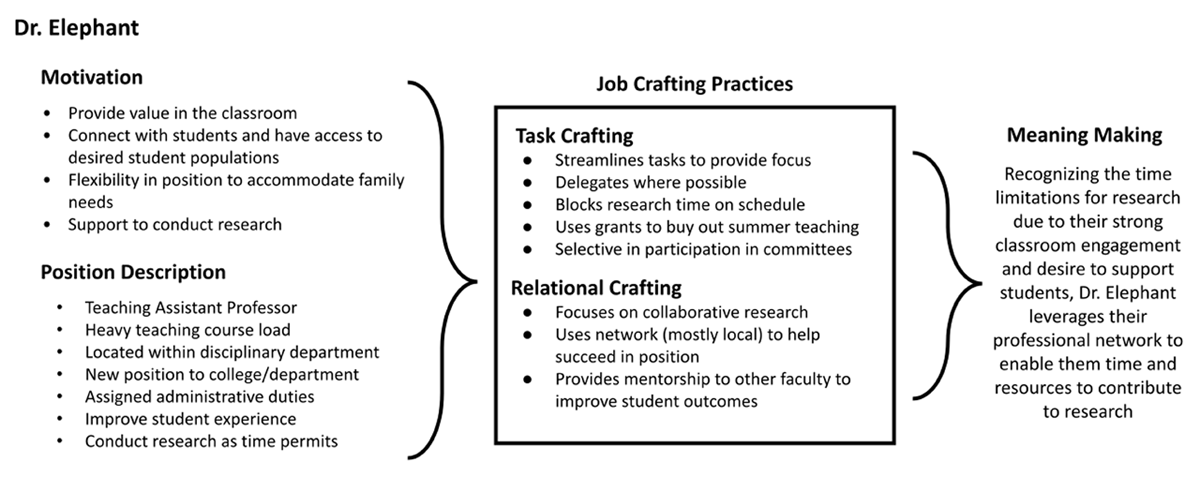
Figure 2
Dr. Elephant Job Crafting Strategies.
Dr. Elephant employs both task and relational crafting to their position as they strive to reach their goals and desires. One of their goals was to be able to provide value in the classroom. For this specific goal, Dr. Elephant develops assignments that are available through the course learning management system as shown in this quote: “course content [LMS pages] for the instructors, things like that. So I build out one and then they can copy from me essentially.” By sharing these materials broadly, it was possible to provide guidance to other faculty without needing to meet with them. Through these job crafting practices, Dr. Elephant was able to create well-vetted course materials that would allow for a cohesive experience for the students, particularly when multiple faculty were teaching different sections of the same course. In their role as a faculty mentor, Dr. Elephant also shares the benefits associated with teaching approaches they employ, such as active learning, to help faculty understand why these approaches can be beneficial to students. Dr. Elephant recognizes that change in the other faculty members within their program may be gradual, but through engaging in these difficult conversations, they are taking the first step to broadly improving the student experience in the classroom as showcased in the following quote: “being prepared to, um, engage in the difficult conversations, um, to try things that, um, you may not have tried and don’t expect them to try things 100 percent the first time.”
Having support to conduct research was another key goal for Dr. Elephant as they seek to modify their position into one that effectively integrates research into their responsibilities. They employ both task and relational crafting for this purpose. For instance, Dr. Elephant streamlines their efforts on administrative tasks, delegates activities where possible, and is selective in their choice of service committees to free up time for research. This job crafting approach is reflected in the following quote: “I’m transitioning that [admin task] off, to someone else this year. …In place of the [admin task] that’ll free up about four hours a week where I can start putting that more towards research.” They also apply techniques learned through professional development, such as blocking designated time on their calendars for research, to meet their desired research objectives. Making the decision to focus where possible on collaborative research allows Dr. Elephant to develop relationships with other engineering education researchers (in similar and different roles) that can support them in conducting the research they seek to complete.
Dr. Beaver ~ Infrastructure building aided by community support
As this is the second faculty position for Dr. Beaver, they have very defined goals in their new position. With prior experience and research activity, they are attempting to go up for tenure early. Looking ahead in their career they are exploring an avenue to administration and thus utilize many crafting strategies to help them obtain these two goals. Lastly, while Dr. Beaver is in a research-intensive position, they aspire to have close relationships with the students they teach and mentor. The narrative gives insight into the day-to-day activities for this persona.
It’s 10am on Wednesday, two weeks before school starts and there is already so much to prepare for the new school year to start. Dr. Beaver is walking down the hall to grab a second cup of coffee to get through their busy morning of administrative tasks and research writing. Many of the administrative tasks are associated with being graduate student chair for their developing department. Luckily, the students haven’t returned to campus yet, so the building wing is still quiet enough and allows for some strategic conversations before all faculty get too busy. On the way back to their office, they catch the new faculty moving their stuff in. “Welcome Dr. X, we are so glad you are joining the faculty here. I have a question for you… thinking back to your qualifying exam, what was the format? We are developing the procedures now that our second class of graduate students is starting. I would love some feedback once you get settled.” Dr. X responds, “I’d love to schedule a coffee break or lunch later this week to discuss my experiences in my program. I also have some questions you might be able to answer for me about expectations here in the new department. I have a graduate student starting this year on my first grant and would love to hear how you are able to balance the research load with your service and teaching.”
Back in their office, Dr. Beaver looks at their task list for the day; next up is editing their most recent publication that just came back with major revisions. While it wasn’t rejected, there is a lot of feedback to synthesize before discussing a strategy for addressing changes with their graduate student leading the paper. First up is creating a document for responses to the reviewers so there is a common place for all the authors to respond to comments, suggestions, and changes. Almost an hour later, time is up as their phone pops up a reminder for their extended lunch meeting with a friend (and previous colleague from their first position at X University) who happens to be in town on vacation. Getting a break from all the work, Dr. Beaver settles into lunch with their friend and releases a deep sigh of relief. Finally, a chance to catch their breath and catch up on life and their recent achievements. Mixing in a bit of business with pleasure, they begin to outline the collaborative proposal they are writing this semester. Before they part ways, Dr. Beaver asks, “Do you have any materials for your research methods course you would be willing to share? I’m teaching our course in the spring and am looking for more current materials than my graduate course I took during my PhD.” Dr. Z responds, “Sure, when I make it back to my office next week I can send along my current syllabus and some strategies for how I teach it.” Arriving back at the office to finish out the day, Dr. Beaver realizes this semester is going to be a busy one. Their time management and organizational skills are going to be key for productivity as they balance research and teaching with all the administrative tasks required to make sure the developing program and their own graduate students are on track.
Figure 3 summarizes Dr. Beaver’s enactment of their position and the strategic actions they have leveraged to achieve their desired goals. The figure depicts from left to right how Dr. Beaver’s goals and descriptors of their position leads to the crafting strategies they often employ.
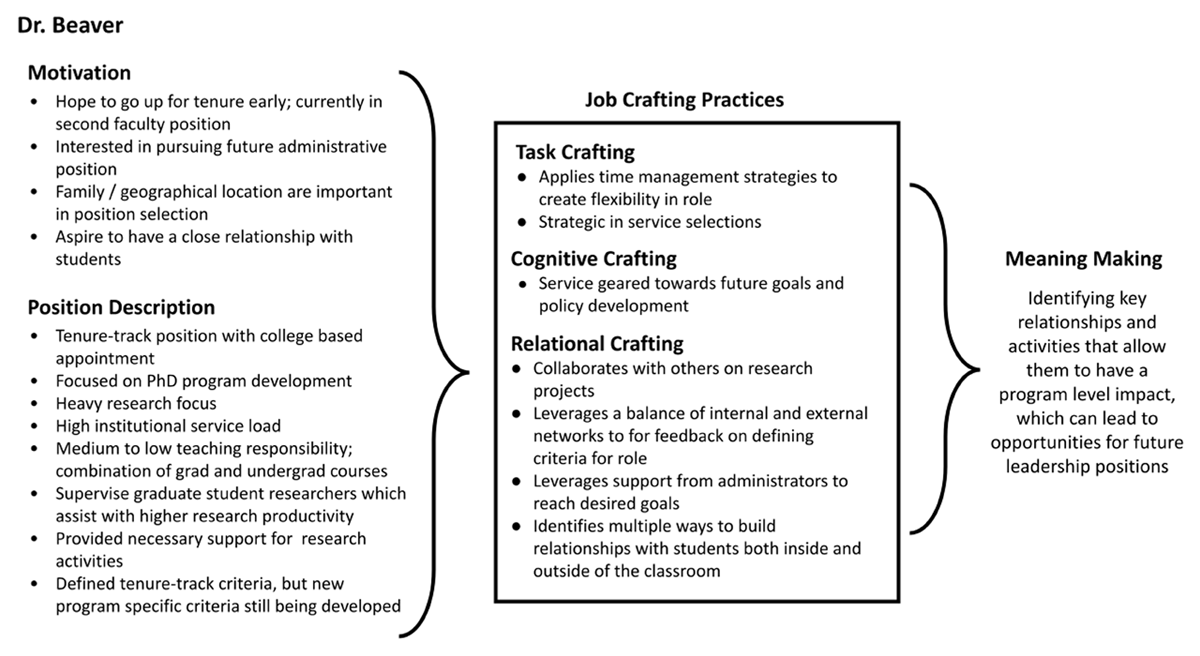
Figure 3
Dr. Beaver Job Crafting Strategies.
Dr. Beaver, while implementing all three job crafting techniques, relies heavily on relational crafting as they enact their role within their new and developing PhD program. Coming to this position with prior faculty experience, Dr. Beaver leverages this experience to navigate obstacles within their current position. As a more senior faculty member hoping to go up for promotion early, they have a growing research lab and reduced teaching responsibilities. However, their service and administrative responsibilities are what dominate their time and where they utilize many of their crafting strategies. While Dr. Beaver fulfills their heavy service load to the department through policy development and student coordination, they cognitively craft their service to align it with their personal and professional goals, pursuing opportunities that open up avenues for future administrative positions. This quote is representative of the cognitive crafting portrayed by Dr. Beaver:
…so the alternate for university senate was my own [choice]. I said, “Oh, I think I could do that, and it’s an alternate, so I don’t have to be there all the time.” … but [also] I’d like to know how things work at the University at a higher level.
Further, Dr. Beaver utilizes task crafting strategies to create flexibility within their role, applying time management and time blocking strategies to effectively focus on important tasks.
In order to balance their heavy service load with research and teaching, Dr. Beaver uses relational crafting to work on collaborative research projects, connect with students both inside and outside of the classroom, and leverages support from administrators to reach their desired goals. This quote encompasses how relational crafting is implemented in developing students: “I love developing relationships with my students …and help[ing] them reach their professional goals … to succeed in attaining where they would like to go with their career.” As they are helping to develop this new program, Dr. Beaver is constantly reaching out to both internal and external networks to help define promotion criteria and benchmark against what other programs are expecting from their faculty. While Dr. Beaver is at an institution that has provided the support and resources necessary to develop a robust research agenda, they continue to develop and cultivate relationships with the administrators in the college and across the university to ensure their goals will be met.
Dr. Fox ~ Cunning in navigating the path to tenure
For Dr. Fox, the goal of tenure drives many of the decisions they make in their role. While they have a vested interest in working with specific populations, living in a certain geographic location and doing what they love, many of these factors played a role in where they chose to work. Specifically, they desire to have alignment in these goals and be successful in earning tenure. To garner a better sense of how Dr. Fox makes daily strategic decisions towards their tenure, a descriptive narrative is provided below.
A color-coded calendar open on the screen, Dr. Fox is wrapping up their scheduled writing time for the day and is beginning to prepare for a committee meeting on graduate student development in the department. The invisible checklist in their mind is ticking the box for both service and teaching, knowing that this meeting will get them double points on their tenure criteria. Just as they stand to leave the office, a knock on the door disrupts the well-timed exit. A graduate student enters to inquire about a meeting to discuss their dissertation and career goals. Gazing at the open calendar, there seems to be time between the lone class on Tuesday and Thursday and each of the research meetings. A look of appreciation and relief appears on the student’s face as the appointment is confirmed and they are sent away with one important piece of advice: “Ask yourself, does it align with your research question?” Finally out the door, headed down the hall, in each passing doorway a colleague seems busy at work, keys clacking, discussions buzzing. Dr. Fox wonders if they’re keeping up, doing enough, checking all the boxes. The reminder notice from the phone in their hand reading “Meeting with Mentor in 1 hour” seems perfectly timed to discuss what other things to consider before going up for tenure.
A few hours later, it’s time to respond to emails and, not surprisingly, there are several requests for participation on committees, panels, research projects, and for advising. With each task there is a weighing of the time commitment, ability to meet the need, and the return on investment. In some cases, it’s a consideration of the long game: “does this set me up for a partnership or opportunity down the road?” One request looks promising, they’ve been asked to engage on a project in one area but see a real fit for how they could contribute in other ways and build some strategic partnerships for the future. Not quite sure how they should open that conversation, they make a note to reach out to their PhD advisor to get some advice on how they have navigated similar situations. An alert indicates it’s time for one of many research meetings, but this is one they look forward to. It’s a project that engages with an aspect of the community that they are truly passionate about and plays a large role in why they chose their institution. It’s projects like this that keep them passionate about their role; they have the ability to have an impact on the community in a way that is meaningful to them in a place that values and provides resources for them to do what they love.
In order to connect Dr. Fox’s goals and desires to their job crafting strategies, Figure 4 contains examples of the crafting strategies from the participants that encompass Dr. Fox’s persona.
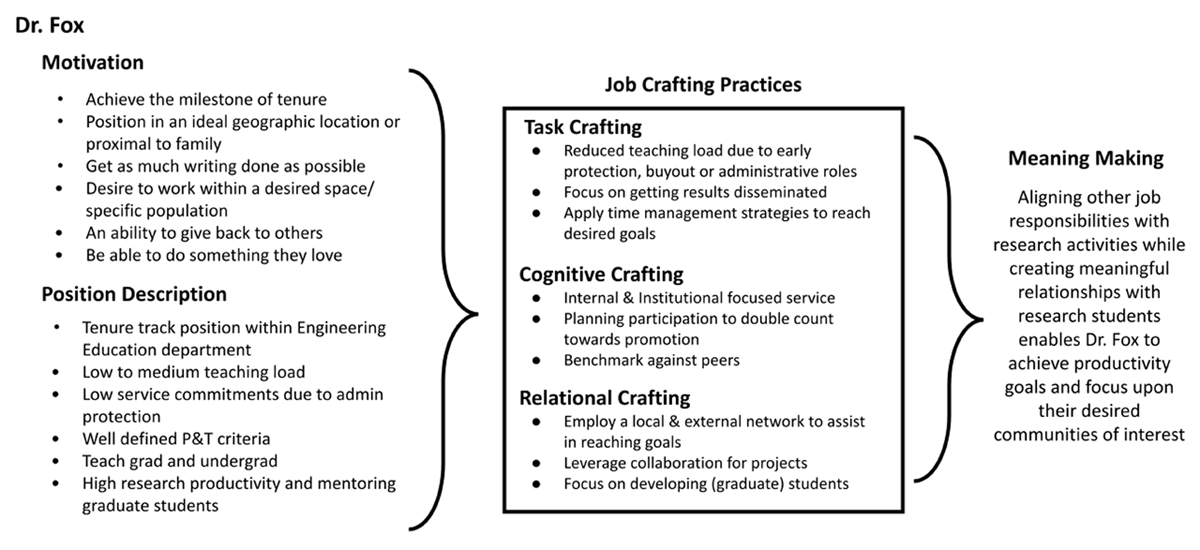
Figure 4
Dr. Fox Job Crafting Strategies.
Dr. Fox worked to achieve their personal and professional goals through the use of all three job crafting techniques: task, relational, and cognitive crafting. With the goal of receiving tenure, Dr. Fox found various ways to modify necessary tasks in the areas of teaching, research, and service. In large part, the utilization of time management techniques dictated how they spent their day and the amount of time they would commit to responsibilities that needed to be completed in each area. This approach is demonstrated by their statement that: “I’m strictly trying to get the current work out as much as possible, you know”. This strategic utilization of time guided their ability to then focus on building relationships, through relational crafting, which also helped drive them towards their goals. Dr. Fox reflected on their approach, stating:
…I needed to be deliberate in that and I needed to build relationships with people and I needed to bring them with me, not necessarily wait for them to ask me, so much as, insert myself into the spaces and try to help them understand why I should be in their space.
The building of relational networks for research collaborations and support was critical to having access to the research they are passionate about and the work that they love. Dr. Fox also invests time in developing their graduate students to build future researchers and to help with their goals of writing and dissemination of research. Along the journey to tenure, Dr. Fox had to apply cognitive crafting, continuously shifting their mindset about certain roles and responsibilities, in order to see how these tasks could lead to obtaining tenure. As reflected in this quote, Dr. Fox had to find ways to make their service roles best fit into their portfolio: “…so I’m still on the fence about whether I want to stay in the admin role, whether I want a certain route. So I mentioned thinking about wanting to be a student support administrator. So another thing that I kept in mind was, ‘which position would set me up the best long term.’” This insight often came in observing their peers broadly to see how they were taking on certain tasks and aligning them with their research. Overall, Dr. Fox was quite cunning in navigating the path to tenure. Being selective with their time and what tasks they took on, while always keeping an eye on how others were navigating the same trail. At various turns in their journey, they leaned on others for guidance, support, and perspective while also building alliances that would benefit both their personal and professional goals.
Discussion
The three personas demonstrate enactment of each of the job crafting techniques: task, relational, and cognitive. The unique utilization of each approach, or the absence of it entirely, is what distinguishes each of the personas. While there are a number of similarities and differences across each persona, what is unique about each is their strategic approaches to the pursuit of their desired role.
All three of the personas, Drs. Elephant, Beaver, and Fox, employed a variety of task crafting strategies. Common to all personas was the use of some form of time management strategies in order to make more effective use of their time. This could be seen through use of tools provided by programs, such as the Faculty Success Program, to block out their calendars for writing time or color code their meetings so that they could quickly visualize what tasks were taking up the greatest amount of their time. Applying these strategies enabled the personas to focus on redirecting time to tasks that they were most interested in, or that aligned with their personal goals, and delegating those tasks that weren’t seen as useful to their own professional development. Additionally, all of the personas were selective in choosing service activities that would help them meet their desired personal or professional goals. For instance, Dr. Beaver was interested in an administrative position in the future and specifically sought out service activities that enabled them to gain visibility within the university. By contrast, Dr. Fox was focused on achieving tenure and selected service activities that would double count (count for service and one other area). Being selective in the type of service activities to undertake has been seen in other examples of faculty job crafting literature. For example, Neumann and Terosky (2007) found that faculty would be selective in their service assignments to ensure they aligned with their desired goals and interests. Similarly, Gonzales (2015) found that faculty would specifically decline service activities if they were not found to help them achieve impact or develop professionally.
All three personas heavily relied on relational crafting to accomplish different personal and professional goals related to their faculty positions. Dr. Beaver and Dr. Fox leveraged both internal and external networks to succeed in, and help define criteria for, their roles. Further, all personas utilized relational crafting to develop and sustain research collaborations. In doing so, these personas are extending their EER community (Allendoerfer et al. 2007; Borrego 2006) and the support and resources available to them (Adams et al. 2007). Bhutta and colleagues (2018) noted that without this relational crafting and community building, faculty will likely experience a lack of work satisfaction, potentially leading to them leaving their current position. Much of the relational crafting employed in the personas was strategic in terms of which local and external members they leveraged, identifying individuals with a common goal (Castiello-Gutiérrez et al. 2021) or individuals one stage ahead of them who could provide feedback on defining their role or promotion milestones. A similar pattern was observed in the work done by Coso Strong et al. (2021), where they observed that EES would leverage institutional connections and others from the EER community to help them with negotiating their legitimacy within their positions. Relational crafting was also a strategy when it came to teaching and mentoring, albeit used in different ways. For Dr. Beaver and Dr. Fox, this was done inside and outside the classroom to develop relationships with their undergraduate and graduate students, while Dr. Elephant was involved in mentoring other faculty members with the goal of improving the overall student experience. This approach to mentoring is a form of vertical partnership that helps raise awareness of student and faculty needs (Castiello-Gutiérrez et al. 2021). Overall, relational crafting comes in many forms and each persona leveraged it to address specific goals related to teaching and research.
Cognitive crafting was utilized across two of the personas as a means for faculty to connect their own identity and experiences to their roles. For Dr. Fox and Dr. Beaver, cognitive crafting was an effort to think strategically about the long-term benefits of their actions. These actions included how they framed their service responsibilities to consider how they may benefit them in the future and how they made decisions about engaging with those on and off campus that they could leverage in the future. This mindset is often seen in scholars who sit between the engineering and educational fields, as they have more of a desire to “spin” what they are doing to fit into the traditional disciplinary standards (Adams et al. 2007; Allendoerfer et al. 2007). This mindset can be best seen in Dr. Fox, who is clearly aware of the promotion standards of their field and is consciously taking steps to meet the expectations.
The absence of cognitive crafting from Dr. Elephant is also significant. Although it would seem they have clear personal and professional goals, and attempt to make many strategic moves to accomplish their teaching and research goals, one could question if the lack of clarity in their often “new” roles and promotion criteria make it challenging for them to think cognitively about what moves would best get them to their goals. Dr. Elephant demonstrates that, regardless of encouragement to pursue certain professional avenues (in this case research productivity) without the necessary infrastructure or support, this perspective of the future can be difficult to achieve. As Dr. Elephant was trained in research through their graduate program, it is possible that they view research as a necessary element of their career path. For this reason, Dr. Elephant may be limited in their ability to frame their desired professional goals without including research. Cognitive crafting’s focus is that of a strategic perspective, one that does not often have visible strategic actions. However, faculty modify their self, situation, and/or strategic perspective (Coso Strong et al. 2023) to cognitively craft their position into one that best suits their own personal goals as well as the expectations of their institution.
In the end, it is important to recognize that faculty want to be able to obtain value from their jobs and are seeking to have impact within their positions. For this reason, they will naturally make changes to the way that they approach tasks and interact with individuals both within and outside the university to align their desired goals with the roles they are expected to fulfill. We observed this behavior in all three personas with the job crafting strategies employed by both Dr. Beaver and Dr. Elephant assisting them in achieving their personal goals and with Dr. Fox making specific changes to facilitate their desired achievement of tenure. As noted in the job crafting literature, once individuals start to recognize how job crafting can help them in achieving this alignment between goals and role, they will inadvertently begin to employ it more often so that they can increase the meaning they are obtaining in their positions (Castiello-Gutiérrez et al. 2021). It is important to note, however, that there are numerous elements that can impact faculty (i.e. imposter syndrome, identity, departmental support, institutional context, etc.), that may also hinder a faculty member’s ability to job craft. These elements can lead to situations where an individual may not be able to align their desired goals with their roles through job crafting, thus leading to the need for a change in position or even institution.
Implications
The main implication associated with our work is that job crafting can provide avenues for EES to meet their desired personal and professional goals within the context of their current job responsibilities, allowing them to gain greater satisfaction from their current position. However, we acknowledge that based upon the specific institutional context, this may not always be possible. We advise EES to create a list of their professional goals and desired areas of impact and map them to their current job responsibilities then review the mapping to visualize how one or more of the job crafting strategies (task, relational, or cognitive) can help make meaning between their role and goals, thus creating better alignment. This mapping can also be used to identify areas where additional support may be needed to achieve their desired impact. For example, Dr. Beaver was able to recognize how the program building that they were doing at the department level would provide them with foundational skills that they could speak to when applying for administrative positions in the future. In their case, they were strategic in how they developed relationships across the university context to help gain visibility for their program-building efforts.
Administrators hiring EES faculty could benefit from having a better understanding of EES needs, allowing them to identify the support and resources needed to assist in EES job crafting approaches while providing the flexibility necessary for EES to be able to craft their role for their desired impact. Necessary resources and flexibility are both types of support that have been found to benefit faculty members in their job crafting (McNaughtan et al. 2022; Wang et al. 2022). Administrators should recognize that if the majority of a job’s tasks are associated with classroom teaching and service commitments, research may not be feasible. Job crafting has been shown to support career satisfaction amongst faculty (Bhutta et al. 2018), so with the support of administrators, job crafting may reduce the frequency of faculty considering leaving their positions.
These results also shed light on areas for improvement in Engineering Education PhD programs. Graduate programs should consider bringing in alumni or external speakers that have alternate career positions to showcase the breadth of job possibilities and the range of impact areas open to graduates, such as those demonstrated in these personas. This will provide a space for Engineering Education graduate students to understand a wider breadth of roles and how they can align their personal and professional goals within the job responsibilities of those roles. It will also enable open discussion about how individuals can modify their job responsibilities through job crafting approaches to align them with their personal and professional goals. PhD graduates on the job market can also consider asking faculty at their prospective institution how well they believe their current roles align with their personal and professional goals and what, if anything, they have modified to achieve better alignment and to ensure that they can have impact in their desired focus areas. They can also ask how accurately the job description reflects the expected enactment of the position.
A minor implication from this work is that job crafting is an appropriate theoretical framework to capture how EES enact their positions in their diverse career positions and contexts as a means for reaching their desired goals. Previous to this work, job crafting had only been used minimally within higher education fields (Castiello-Gutiérrez et al. 2021). Furthermore, most studies applied quantitative measures to assess the approaches to job crafting that were employed (Bhutta et al. 2018; Lee & Mcnaughtan 2017; Zahoor 2018), despite the understanding that qualitative research methods were necessary to capture the nuances associated with this type of behavior (Wrzesniewski & Dutton 2001). Our work addresses these shortcomings through the application of semi-structured interviews and development of personas centered around the three job crafting elements: task crafting, relational crafting, and cognitive crafting. Although this work provides preliminary insight into how EESs utilize job crafting strategies, additional research is necessary to better understand how each of these job crafting strategies are enacted in diverse roles and institutional contexts.
Finally, our findings will provide guidance for prospective early career-EESs that are searching for their first position within the field. In review of the personas, it will be possible to identify the traits that most align with their professional and personal goals and develop an awareness of what types of job crafting strategies may be necessary to ensure better alignment between their goals and assigned role.
Conclusions
In conclusion, this study shows that there are multiple different personas within EER, but each utilizes job crafting strategies to align their desired professional and personal goals with their desired role. Through the lens of job crafting theory, we were better able to understand the job crafting practices each of the personas used as they enacted their role. From this work, the authors recognize that each role is different and unique, however we recommend that administration understand how they can better support and enable EES to better align their goals with the expectations of their role.
Acknowledgements
The authors would like to thank our methods consultants, Jo Walther and Nicki Sochacka, and our advisory board for their support and guidance throughout the project.
Funding Information
This material is based upon work supported by the National Science Foundation under Grant Numbers 1663909, 1664217, 1664038, 1664016, 1664008, 1738262, 1855357, and 2109771. Any opinions, findings, and conclusions or recommendations expressed in this material are those of the author(s) and do not necessarily reflect the views of the National Science Foundation.
Competing Interests
The authors have no competing interests to declare.
Author Contributions
The first three authors on this publication were involved with the design of the study and some of the data collection procedures. They were primarily responsible for the analysis of the data presented and served as the lead contributors to the written manuscript. The fourth through sixth authors were involved with the study design, data collection, and review of data analysis findings. They also provided a critical lens through which to review the prepared manuscript prior to submission.