
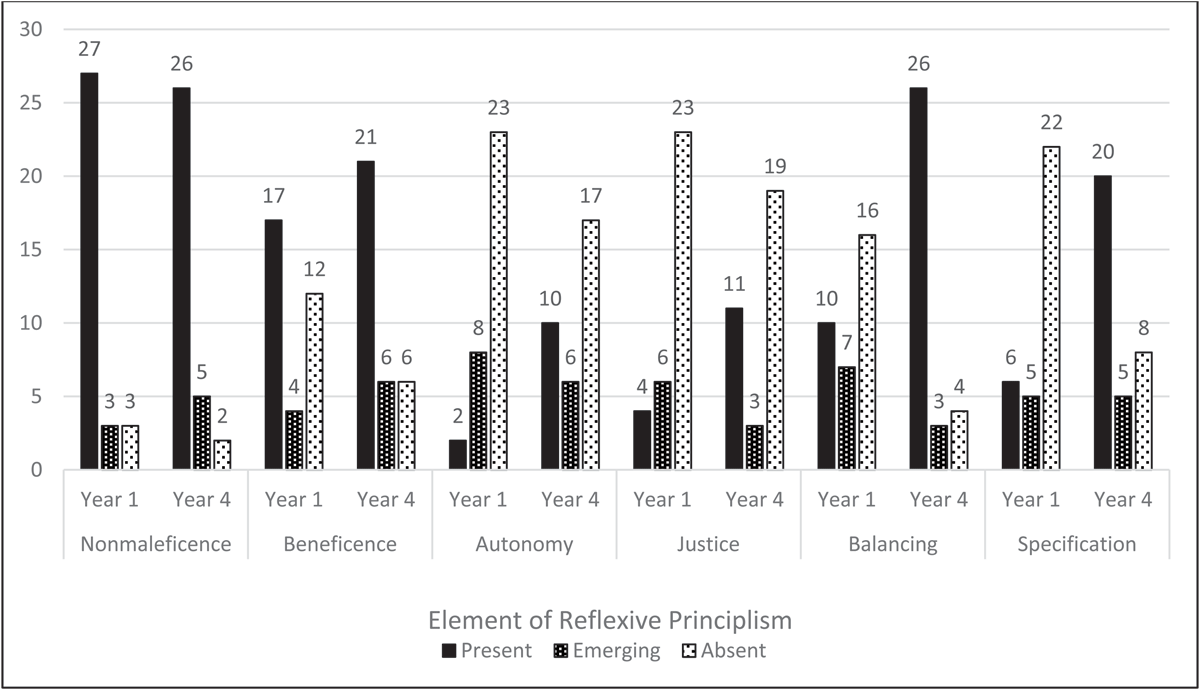
Figure 1
Presence of elements of reflexive principlism in student interviews. The sample consisted of 33 interviews in both Year 1 and Year 4. The numbers indicate the number of interviews in which the interviewee referenced the ethical principle or process (as indicated by the “Present” bars), in which that principle/process was emerging (the “Emerging” bars), or in which the principle was not referenced (the “Absent” bars). As shown here, the principles of beneficence and nonmaleficence were mentioned more frequently than autonomy or justice in both the T1 and T2 interviews. There was a noticeable increase in the number of students engaged in balancing and specification from the T1 to the T2 interviews.
Table A-1
Count of Aspects of Reflexive Principlism in Student Interviews.
| ASPECT OF REFLEXIVE PRINCIPLISM | ||||||
|---|---|---|---|---|---|---|
| NONMALEFICENCE | BENEFICENCE | AUTONOMY | JUSTICE | BALANCING | SPECIFICATION | |
| Year 1 | ||||||
| Present | 27 | 17 | 2 | 4 | 10 | 6 |
| Emerging | 3 | 4 | 8 | 6 | 7 | 5 |
| Absent | 3 | 12 | 23 | 23 | 16 | 22 |
| Year 4 | ||||||
| Present | 26 | 21 | 10 | 11 | 26 | 20 |
| Emerging | 5 | 6 | 6 | 3 | 3 | 5 |
| Absent | 2 | 6 | 17 | 19 | 4 | 8 |
| Total | ||||||
| Present | 53 | 38 | 12 | 15 | 36 | 26 |
| Emerging | 8 | 10 | 14 | 9 | 10 | 10 |
| Absent | 5 | 18 | 40 | 42 | 20 | 30 |
Table A-2
Examples of Emerging Aspects of Reflexive Principlism.
| ASPECT OF REFLEXIVE PRINCIPLISM | EXAMPLE OF EMERGING ASPECT |
|---|---|
| Nonmaleficence | [Make] the choice that is morally right within yourself, and then also morally right for the public, especially as an engineer…they [the public] trust us to do the right thing. – Cameron, T1 I remember taking in our sophomore design class was that a good design takes into consideration all aspects, how it can be used, how it can be misused, how this is meeting your client’s needs. – Paulina, T2 |
| Beneficence | If you know something’s wrong don’t ignore it. You can be a bystander, but that doesn’t make it okay. You still should at least try to make an effort to, no matter what that effort is… – Parson, T1 It’s important to consider them more than to have them in the back of your mind when working on something for a company. That should be the overarching. What am I doing this for? How does it help people? – Palano, T2 |
| Autonomy | I would probably tell the parent that they can tell the child what they want, but that I won’t. [I]f they’re crying cause they lost, then maybe say “It’s okay; it was your mom’s fault.” I don’t know… It’s not my choice what they tell their kid, cause it’s their kid. – Phoebe, T1 I don’t know, social media is very, very tricky. I don’t think it’s completely on the end-user, just because they do sign the terms of use or just because they do sign up for something. They shouldn’t have to worry about their safety or their integrity or their personal data at risk. – Penelope, T2 |
| Justice | I’ve always thought that environmental consciousness and responsibility, and then social and economical equality is important. I do take those into account in my ethical decisions. – Charlotte, T1 The intentions are great, when they go out into maybe impoverished communities and they build these wonderful engineering structures, and they last maybe 10, 15 years. But then they break down, and then they’re just left there and nobody ever goes back to clean them up… They go in and they put in a well, but the well breaks down and they don’t have any way to fix it. – Padme, T2 |
| Balancing | Yeah, like I used to think that I wanted to try my best to get everything that I wanted, just get everything to work, but then like I slowly kind of realized that you have to make sacrifices, compensations for everything, and then have your priorities. Your non priorities might not ever work out. – Penny, Year 1 A lot of your actions are going to have huge consequences and if you don’t fully consider those consequences, it’s [pause] in my opinion it’s not an ethical decision. – Charlotte, Year 4 |
| Specification | We’re designing water filters for homes in the Ganges River valley. When we’re designing those, we have to take into account the culture of the area and that to them the river is a sacred being. It’s a deity basically so you can’t alter the river. – Corvin, T1 The garbage people, people who have jobs, but aren’t really as educated as others. So I feel like that’s something that you also need to think about a lot, when you’re thinking about the moral implications of your actions. It could go all the way down to, I’m not going to throw the trash in the street because somebody will have to pick it up after me, all the way up to, I’m going to design this into a certain way so that all the people who work on this project in the end will either be happier or make it easier for them, or just make sure it’s as safe as possible for those kinds of people. – Cody, T2 |