
Introduction
While ongoing shifts to outcomes-based approaches in engineering education have been widespread and transformative, specifying, teaching, and measuring many key graduate competencies remains a lingering difficulty. After the roll out of ABET’s EC2000 accreditation criteria, for instance, Shuman et al. published a paper titled “The ABET ‘professional skills’—Can they be taught? Can they be assessed?” (2005). While the authors were “encouraged by work directed at assessing these skills,” they observed that “there is considerable research that remains to be done” (p. 41). Others have echoed this refrain. Walther and Radcliffe, for example, commented on the “very general definition of the graduate attributes” (2007, p. 43), while Cajander et al. pointed to “the nontrivial challenge of agreeing on professional competency definitions” (2011, p. 1). Additionally, Cruz et al. surveyed measurement methods related to communication, lifelong learning, innovation/creativity, and teamwork, concluding that “many […] were found to lack competency definitions and evidence of validity and reliability” (2020, p. 729). The most recent revisions to the ABET accreditation criteria—including changes to the Criterion 3 Student Outcomes—fail to offer much additional definitional clarity (ABET, 2021).
In this paper, we focus on professional competencies related specifically to ethics. In addition to being critically important professional skills, engineering ethics, social responsibility, and related constructs exemplify the challenges inherent to measuring engineering professional skills outlined above. As we have argued previously (Jesiek et al., 2022), the most recent ABET framework suggests at least three partially distinct learning outcomes embedded in the ethics-related Criterion 3.4, but with a lack of guidance about how administrators and instructors might actually codify and teach such outcomes. Further, we observe major gaps between the rather general outcomes specified by ABET and the measurement tools and instruments available to assess engineering ethics and related constructs. Previous efforts to study how engineering students’ perceptions of ethics and social responsibility change over time have reported mixed results or found only modest changes over time. Comparisons across studies are also difficult due to the diverse frameworks that scholars have used to define, measure, and report on ethics-related outcomes.
To address these difficulties, this paper explores the potential utility of reflexive principlism (Beever & Brightman, 2016), an ethical reasoning framework, to investigate how engineering students’ views of ethics and social responsibility change during the four years of their undergraduate degrees. Originally developed in the biomedical ethics field, reflexive principlism proposes an iterative process of specification, balancing, and justification of four core ethical principles (beneficence, nonmaleficence, autonomy, and justice). The framework also underscores the importance of a moral agent’s conscious, reflective engagement with ethical decision making (“reflectivity”), as well as their internalization of ethical intuition and habits of mind (“reflexivity”) (Beever & Brightman, 2016, pp. 281–282). Though initially introduced as an approach to teaching ethical reasoning in engineering (Beever & Brightman, 2016), reflexive principlism has also occasionally been used as a research tool to analyze ethical decision-making among undergraduate engineering students (Corple et al., 2020; Hess et al., 2014).
In this paper, we further explore reflexive principlism as an analytical framework by using it to examine longitudinal interview data from a mixed-methods longitudinal research project which aimed to characterize patterns of ethical development among undergraduate engineering students. In this larger project, in addition to collecting longitudinal quantitative data using a variety of survey instruments, we interviewed a sample of students (n = 33) during the first and fourth years of their undergraduate studies (Zoltowski et al., 2020). We employed an interview protocol that included probes and prompts directly aligned with the survey questionnaire, along with more general questions about how students understood and experienced ethics, social responsibility, and related concerns. As we coded the interview data, questions and uncertainties quickly surfaced about what specific conceptual or theoretical frameworks were most suitable for our longitudinal analysis. In response, we identified reflexive principlism as a promising framework and successfully employed it in our analysis; the results of that effort are the focus of this paper.
In the literature review that follows, we present a more detailed overview of prior research on the ethical competencies and perceptions of students in engineering and other professional fields, with a particular emphasis on longitudinal studies. We then turn to a summary of our larger project, which includes a discussion of how we collected and analyzed the interview data. Our findings then discuss the extent to which facets of reflexive principlism were evident in our data. We close the paper with implications for future research and educational efforts.
Literature Review
Scholarly work related to engineering ethics and social responsibility has been informed by theories and frameworks from diverse fields (e.g., philosophy, psychology, and sociology). Such work is also often linked to professional codes of ethics and ABET accreditation criteria, as well as larger questions of collective social responsibility, macroethics, and social justice (e.g., Canney & Bielefeldt, 2015; Herkert, 2005; Leydens, Lucena, & Schneider, 2012; Riley, 2008). Prior research has additionally explored how perceptions of engineering ethics may be related to other individual attributes such as moral foundations (e.g., Clancy, 2020) or empathy (e.g., Hess et al., 2021); how they are influenced by various kinds of experiences (Hess & Fore, 2018), as well as the climate and culture of organizations, programs, and teams (e.g., Cech, 2014); and how they are potentially related to behavior (e.g., Stappenbelt, 2012). Much of the research in these veins has focused on educational settings and student participants.
Other studies have additionally examined how the ethical perceptions and competencies of engineering students change over time using various quantitative measures and have often resulted in mixed or conflicting results. Some of this research has relied on quantitative measures over shorter time spans, such as Loui’s (2006) report of modest increase in scores on the Defining Issues Test, Version 2 (DIT-2, a commonly used measure of a person’s moral judgement (Rest et al., 1999)) after engineering students engaged with an engineering case study video. Harding et al. (2013), on the other hand, deployed DIT-2 and their own Student Engineering Ethical Development (SEED) survey instrument to a large group of engineering students over a two-year span, finding evidence of growth in students’ ethical reasoning but no significant gains on a set of ethics knowledge questions. They also found increases in student participation in community-based projects and pro-social behavior (e.g., volunteering), but this was paradoxically paralleled by evidence pointing to an increased likelihood of cheating among this same group. As another example of varied results within a single study, Hess et al. (2019) assessed the use of reflexive principlism as a teaching tool in a graduate-level ethics course, finding gains in ethical reasoning when measured by the Engineering Ethical Reasoning Instrument (EERI) (Zhu et al., 2014) but no such gains when ethical reasoning was measured by the DIT-2. The study also used the Interpersonal Reactivity Index (IRI) which showed perspective-taking tendencies were enhanced.
Other studies have utilized qualitative approaches to shed light on the multifaceted notion of engineering ethics. For example, Loui (2005) analyzed written reflections from the beginning and end of an undergraduate engineering ethics course to explore possible changes in student perceptions of professional identity and ethical obligations. Notable observations include evidence of increased confidence in moral reasoning abilities and a broader sense of professional responsibility among some students. Shuman et al. (2005), on the other hand, compared different groups of engineering students by coding responses to an ethics scenario designed to probe one’s ability to “resolve ethical dilemmas.” They found that engineering ethics courses may measurably impact such abilities, but more generally observed a lack of significant differences in performance among different academic levels, ranging from first-year to graduate students. Additionally, Corple et al. (2020) investigated ethical decision making in an engineering service-learning program, identifying the different ethical principles (namely, beneficence, nonmaleficence, autonomy, and justice from the reflexive principlism framework) that students reported relying on during various phases of the design process.
Still others have taken a more retrospective approach to examine changing perceptions of engineering ethics. For example, Kim et al. (2020) explored how critical incidents shape perceptions of ethical practice based on interviews with engineers in the health products industry. Even closer to the work presented in this paper, Rulifson and Bielefeldt (2019) carried out a longitudinal study of perceptions of socially responsible engineering (SRE) among engineering students (n = 21). Each participant was interviewed annually over a period of four years, including to probe their evolving understandings of SRE and identify specific influences on those understandings. Among many notable findings, they observed that students in general tended to “converge on basic responsibilities such as safety and bettering society as a whole, but tended to become less concerned with improving the lives of the marginalized and disadvantaged” (p. 939). They also noted a trend among some students toward narrower views of social responsibility and an increased emphasis on company loyalty.
Our own research efforts have additionally involved varying approaches to investigating how students and professionals perceive and reason about engineering ethics, including changes over time. For instance, in some prior works we have focused on specific constructs to guide our analysis, such as when we used a longitudinal, mixed methods approach to explore moral disengagement among engineering students from their first to fourth year of undergraduate study (Kim et al., 2021). As noted below, we have also taken a retrospective approach to examine instances of ethics learning among engineering students, including what they specifically report learning and in what settings/contexts (Howland, Kim, et al., 2022). In yet another paper we used a narrative, single case approach to report longitudinally on the experiences and perspectives of a single student (Claussen et al., 2021). Finally, we plan to conduct a phenomenographic inquiry to qualitatively explore the different ways in which senior engineering students experience engineering ethics and related concerns.
As this overview suggests, both prior literature and our own research efforts reflect a wide range of theoretical, conceptual, and methodological approaches, making it difficult to compare results across studies (Jesiek et al., 2022). The multitude of approaches used in prior research on engineering ethics raised questions about how to examine students’ understanding of engineering ethics and related constructs, particularly longitudinally. To capture both understanding and changes over time in this study, we used reflexive principlism as an analytic lens for our interview data because it aligned well with preliminary themes developed through inductive coding. Reflexive principlism provided a sufficiently wide-ranging but manageable view of participants’ perceptions, including both key principles involved in ethical decision-making and the specific processes through which individuals engage with such principles. We found that the framework also helped reveal and clarify changes over time. While previous studies have reported on the development of moral reasoning over time among students in other professional fields—including nursing, social work, and law enforcement (e.g., see Nolan & Markert 2002; Juujärvi 2006)—we are not aware of any other studies that have used the reflexive principlism framework to carry out similar longitudinal investigations focused on the changes in individual participants over multiple years.
Methods
This paper reports on data collected as part of a larger longitudinal, mixed-methods study examining students’ views of ethics and social responsibility. Results from our quantitative analysis are reported elsewhere (Fuentes et al., 2016; Howland et al., 2024; Howland, Claussen, et al., 2022). While the survey data provided a valuable picture of students’ perspectives and understandings at multiple times in their undergraduate studies, the longitudinal findings from the surveys were limited. With a few notable exceptions, there was little change over time in how students responded to various measures of ethics and social responsibility (Howland et al., 2024), and a lack of evidence linking participation in most experiences to changes in the measures (Howland, Claussen, et al., 2022).
In this paper we turn our attention to interview data from the study to shed light on the nuanced ways that engineering students’ perceptions of ethics and social responsibility changed over the four years of our study. Qualitative data are especially useful in providing “well-grounded, rich descriptions and explanations of human processes” (Miles & Huberman, 2013, p. 4). Indeed, prior efforts to analyze the interview data from this study has allowed fruitful explorations of specific topics like student learning (Howland, Kim, et al., 2022) and moral disengagement (Kim et al., 2021). This paper leverages the same longitudinal interview data to test the use of reflexive principlism as an analytic lens while also addressing the following more general research question: Do engineering students’ views of engineering ethics and social responsibility change over four years of undergraduate studies and if so, in what ways do they change?
Recruitment and selection of interview participants
In the fall of 2015, we recruited 757 first-year engineering students to complete an initial survey for our study. These participants came from four US universities (Arizona State University, Brigham Young University, the Colorado School of Mines, and Purdue University), representing diverse geographic locations and university types (including both public and private, religious and non-religious, and research-intensive and primarily undergraduate institutions). This first survey sample was gender and ethnically diverse. Special efforts were taken to recruit students who were both likely and not likely to receive enhanced exposure to considerations of social and ethical responsibility during their degree programs. All necessary human subjects research approvals were obtained from our institutions prior to the research. Students indicated their gender on a demographic question included with the survey; these same genders are reflected in the pronouns used to refer to participants in this paper. Additionally, our research team selected pseudonyms for all student participants.
In the spring of 2015, we recruited 113 participants from our survey sample to participate in a semi-structured interview during their first year of university studies (T1). We purposefully sampled interviewees to include students whose survey responses indicated prior experience with, or future intent to participate in, various activities and experiences that could potentially impact how they perceive ethics and social responsibility, for example, service learning, volunteering, honors programs, formal religious instruction, internships, and other work experiences. We also sought to stratify our sample to reflect demographic diversity, especially in terms of engineering major and gender. We followed up with these initial interviewees in the fourth year of their studies (Spring 2019), and 33 of these students participated in a second interview (T2). These pairs of longitudinal interviews form the data set discussed in this paper.
Among the 33 longitudinal participants, 8 were from Brigham Young University, 12 were from the Colorado School of Mines, and 13 were from Purdue University. No interview data was included from Arizona State University due to challenges recruiting prior interviewees from this university in the fourth year of the project. In terms of gender, 20 of the interviewees selected the “male” option and 13 selected the “female” option at the time of the second interview. Regarding race/ethnicity, 27 participants identified as white, five as Asian, and one as mixed race. The interviewees ranged in age from 21 to 24 in the T2 interview. One participant had recently graduated at the time of their second interview, and all others expected to graduate in the current or next calendar year. The participants were in various engineering degree programs, including: agricultural/biological (1 student), biomedical (3), chemical/biochemical (2), civil (3), electrical/computer (5), information technology/computer science (2), materials/metallurgical (2), mechanical (11), and manufacturing/industrial/systems (4).
Interview procedures
We conducted pairs of interviews with all 33 participants. The two interviews took place three years apart (in Spring 2016 and Spring 2019). Each interview was 45–60 minutes long, conducted face-to-face and audio recorded. Participants received $20 gift cards for completing the first interview and another $20 gift card for completing the second interview. Following the completion of each interview, the audio recordings were transcribed by a third-party transcription service. The transcripts were then reviewed for accuracy and anonymized by the research team. Pseudonyms were assigned to each participant following the first interview and used again in the second interview transcription.
The semi-structured interview protocols used in both interviews included questions related to 1) general definitions of ethics and engineering ethics, 2) experiences (past, present, and future) that may shape students’ ethical perspectives and sense of social responsibility, 3) ethical climate, 4) ethical scenarios, and 5) select survey items identified as promising for further probing. The first and second interview protocols were very similar, though the questions used in the second interview were reworded to account for the fact that the participants were fourth year engineering students by the time the second interviews took place. For further reference, the complete T2 interview protocol is presented in Howland, Kim, et al. (2022).
Exploratory data analysis
The research approach and findings presented in this paper grew out of earlier efforts to use a narrative case study approach to understand how one’s student’s views of ethics and social responsibility changed over time (Claussen et al., 2021). While the narrative case study served as an effective way to explore the changes in a single participant, it proved difficult to scale and apply to all 33 participants due to the diversity of perspectives across the entire pool and the feasibility of drafting and presenting large numbers of narratives. Thus, we needed a method that could illuminate more nuanced changes in each participant (which our quantitative analysis was largely unable to do, as noted above) while avoiding the risk that too much focus on individual cases might obscure patterns shared among multiple participants.
To better understand the changes across time and across participants, we worked as a team of four researchers (all co-authors on this paper). Two researchers were involved with the project from its inception, and had conducted interviews (both T1 and T2) and participated in the data analysis throughout the project. A third researcher was involved since the midpoint of the project, and had conducted a portion of the second interviews and contributed to many aspects of the data analysis. The fourth researcher joined the project after all interviews were completed and data analysis was underway. Thus, the majority of us were very familiar with the interview transcripts, having read many of them in full for previous analysis efforts. Finally, a fifth co-author who was involved with this project from the beginning joined our team meetings in the later stages of the analysis, serving as a further check on the quality of our findings.
As mentioned previously, we initially used narrative analysis to understand the longitudinal changes in one participant’s views (Claussen et al., 2021). To expand our analysis to all 33 interview pairs, we divided up the transcript pairs among the four researchers primarily involved in the data analysis. Given the limitations of frameworks used in previous studies, we adopted an inductive approach, reading through the pairs of transcripts in full and identifying themes that emerged to describe the changes we were seeing across time. Thus, our unit of analysis was the 33 transcript pairs (rather than 66 individual transcripts). This allowed us to be attentive to changes over time while also accounting for how individual participants talked about engineering ethics in each of their interviews.
Our analysis was initially iterative and inductive: after each of us read through a set of transcript pairs, we created a draft set of themes. After comparing students’ T1 and T2 responses from both interviews and an initial round of open coding on a subset of interviews, there were a few common themes but also enough differences that it was difficult to synthesize results. We realized that the greatest changes we were observing in the data centered on how the participants talked about engineering ethics and social responsibility. We collectively observed an increase in the specificity with which they applied ethical principles to their professional and academic contexts, and an increase in their attention to balancing between multiple and sometimes conflicting principles. In addition, we saw changes in the principles that were mentioned in interviews, both in terms of which specific ethical principles were discussed and the frequency with which they were talked about. These observations in turn led us to adopt the reflexive principlism framework (Beever & Brightman, 2016), as described in more detail below.
Use of reflexive principlism in this study
Reflexive principlism is described by Beever and Brightman (2016) as “an approach to ethical decision making that focuses on internalizing a reflective and iterative process of specification, balancing, and justification of four core ethical principles in the context of specific cases” (p. 275). The four principles, nonmaleficence, beneficence, autonomy, and justice, are derived from an interpretation of previous work in biomedical ethics by Beauchamp and Childress (2009). Reflexive principlism posits that through the ethical reasoning processes of specification, balancing, and justification, the relative value of each of these ethical principles is determined, which allows the individual to weigh and prioritize these four ethical principles according to the specifics of a situation (Beever & Brightman, 2016). The goal is for ethical reasoning to move from “a reflective, conscious, process” to one that is “internalized and applied in a reflexive, ‘second-nature’ way to unique situations” (p. 282).
In previous research, the reflexive principlism framework has been presented as a course-level intervention (Hess et al., 2019), analytical lens for student interviews in the context of an engineering design course (Corple et al., 2020), and framework for analyzing student responses to a case-based assessment exercise (Hess et al., 2014). Whereas Corple et al. (2020) used reflexive principlism as a framework to examine how students engaged with ethical decision-making throughout the design of a community-based project, we used reflexive principlism to examine how students’ engagement with engineering ethics more generally changed over time. Because our interview protocol was not developed with reflexive principlism in mind, we used the open-ended questions about engineering ethics from our interviews to identify illustrative examples of the principles and students’ ethical reasoning using the following definitions presented by Beever and Brightman (2016):
Nonmaleficence: Avoiding causing harm
Beneficence: Providing benefits to society or others
Autonomy: Respecting the agency of individuals in decision making
Justice: Distributing risks, benefits, and costs equitably among all individuals.
In addition to these four principles, Beever and Brightman’s framework (2016) includes two ethical reasoning mechanisms or processes that were relevant in our data: balancing and specification. The authors define balancing as, “adjudicating conflicts among principles in the context of a particular case,” (p. 282) and specification as, “reducing the indeterminateness of general norms to give them increased action guiding capacity, while retaining the moral commitments in the original norm” (p. 282). Finally, though less relevant in our data set, Beever and Brightman include a third process, justification, which they defined as “the process by which the coherence and completeness of an ethical-reasoning decision is evaluated… Both a general method of coherence and also a pedagogical stage in the process of decision-making” (p. 283). It is through these ethical reasoning mechanisms that the value of each principle is determined because the framework does not place the principles in a hierarchy. Reflexive principlism allows the individual to give weight to the principles according to the specifics of a situation.
Deductive data analysis
We next undertook further analysis of our data using a more deductive approach, while also being mindful of how reflexive principlism might constrain our analysis and findings. We returned to the pairs of interview transcripts, working to identify whether aspects of the reflexive principlism framework were present, absent, or emerging in each of the transcripts (Table A-1 of the appendix). In addition, we looked for illustrative examples of each aspect to see how it described (or failed to describe) the changes in our participants over time. The emerging designation was used when a student’s response touched on one of the principles or aspects of ethical reasoning present in reflexive principlism, but did not reach a level of articulation and clarity which would allow us to definitively claim that these aspects were present in the students’ responses. For example, the participant Parson vaguely referenced the principle of beneficence in his T1 interview when he described his motivation to study biomedical engineering: “I wanted to be cutting edge, so [biomedical engineers] do a lot of development of new techniques and stuff like that, and having all my work count towards helping someone and actually benefiting someone’s life is really cool to me.” Parson mentioned that his work will benefit someone, but only as a brief follow-up to a point about innovation. The principle of beneficence was emerging in his response but not in a way that was robust enough to claim that Parson clearly demonstrated beneficence. Further examples of emerging aspects of reflexive principlism can be found in Table A-2 of the appendix.
Although we were able to find evidence of balancing and specification, we found that it was often challenging to identify the justification aspect of reflexive principlism because our interview questions allowed students to share their ethics experiences and general interpretations of engineering ethics without fully explicating their underlying reasoning. In one section of the interviews, the students were asked to explain the reasoning behind their choice in an ethics scenario which could potentially point towards to justification; however, the multiple-choice nature of the ethical scenarios did not give students the opportunity to develop an independent response and justification. Rather, they developed a post hoc justification for their selection.
In addition, the interview questions did not provide adequate insights regarding students’ reflectivity and reflexivity. Although the entire interview was a reflective experience by nature, isolating specific instances of reflection was challenging if not impossible. Reflexivity is another aspect of the framework that was difficult to identify in the study. As Beever & Brightman (2016) argue, reflexivity involves cultivating habits and intuitions, like an ethics reflex, that help individuals make sound ethical decisions. While some students are arguably quicker to recall an experience with ethics or respond to certain prompts, we could not make a confident claim about students’ ethical reflexivity.
We next turn to our findings, focused on the four principles and three processes introduced above. We begin with a high-level overview, and then delve into specific illustrative examples.
Findings
Our analysis revealed the number of interviews in which each of the four principles of reflexive principlism were present and how this engagement with a principle changed over time across our sample, as shown in Figure 1. The number of interviewees which relied on each principle at a given time in our study is suggestive of students’ awareness of, and the value associated with, each principle, with the principles students are more aware of and value more appearing across more responses. In addition, we observed changes in the specificity with which they applied ethical principles to their professional and academic contexts, and an increase in their attention to balancing between multiple and sometimes conflicting principles. Over time, we saw the students engage in increased balancing and specification of their perspectives on ethics. At times, the balancing and specification took place in the context of one of the ethical principles identified by Beever and Brightman (nonmaleficence, beneficence, justice and autonomy), but they also took place outside of those principles. This finding illustrates how our participants often engaged in ethical issues in ways that are not clearly captured in the reflexive principlism framework.
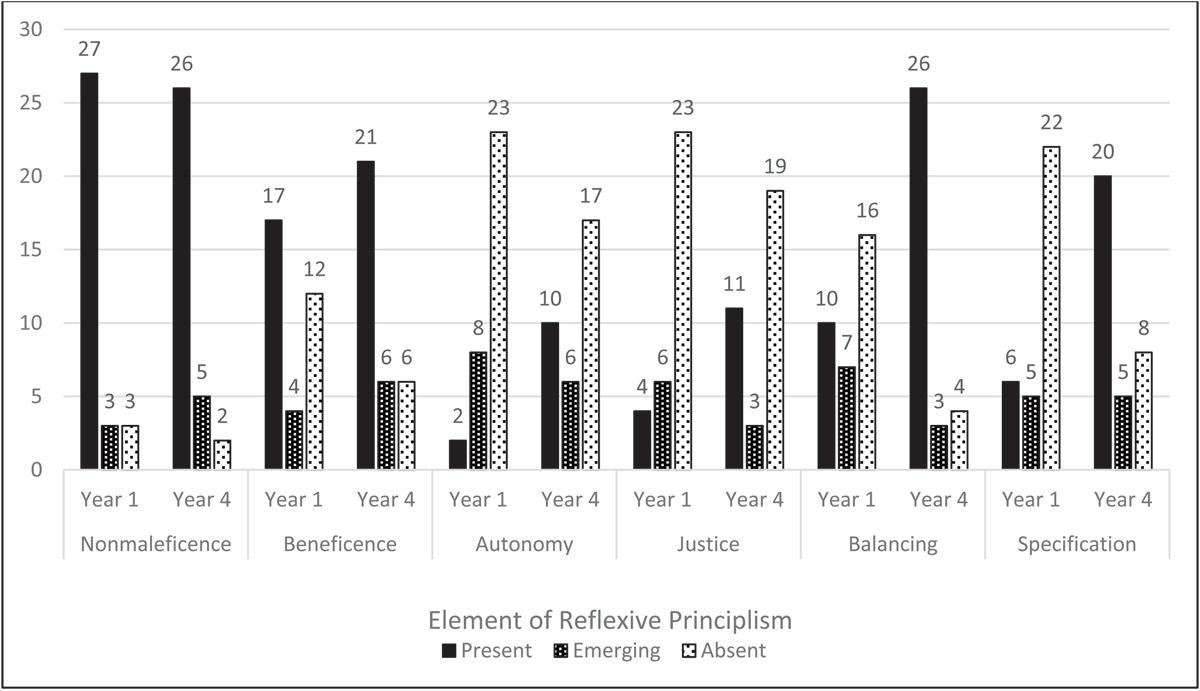
Figure 1
Presence of elements of reflexive principlism in student interviews. The sample consisted of 33 interviews in both Year 1 and Year 4. The numbers indicate the number of interviews in which the interviewee referenced the ethical principle or process (as indicated by the “Present” bars), in which that principle/process was emerging (the “Emerging” bars), or in which the principle was not referenced (the “Absent” bars). As shown here, the principles of beneficence and nonmaleficence were mentioned more frequently than autonomy or justice in both the T1 and T2 interviews. There was a noticeable increase in the number of students engaged in balancing and specification from the T1 to the T2 interviews.
In the following sections, we describe the patterns represented in Figure 1 and provide illustrative examples of where these changes occurred in individual participants. We do this first for reflexive principlism’s four ethical principles. Then, we present evidence for how and when students engaged in specification in relation to each of these principles. We go on to describe the additional increase in students’ use of balancing across principles and end with describing changes in students’ views that are not captured by reflexive principlism.
Ethical principles
This section is organized by each of the four ethical principles outlined in reflexive principlism. For each principle, we describe patterns we observed in the number of interviewees who referenced that ethical principle and provide examples of how those interviewees engaged with the principle. When relevant, we also describe changes in how individual participants relied on that ethical principle over time.
Nonmaleficence
Across all interviews, students cited or mentioned nonmaleficence more than any other ethical principle. A consistent number of students gave it attention across time: nonmaleficence was referenced in 27 of 33 (82%) of the first interviews and 26 of 33 (79%) of the second interviews. Often, the responses explicitly mentioned safety or not doing/avoiding harm, but typically these responses were general and non-specific. Some illustrative examples include:
[Engineers] have a responsibility to keep society safe, first off, because engineers and scientists, they build stuff, and they make the world intelligible. If they’re not being trustworthy and ethical, then that puts the entire world in danger I guess. (Carlos, T1)
I think [engineering professional integrity] goes back to thinking of others because you’re manufacturing or creating things that have impact on a large number of people and you need to make sure that you’re holding their safety paramount. (Petunia, T1)
I think that ethics in engineering is the general code applied to a specific discipline. It’s a relationship of trust in that, customers and society are counting on engineers to do their job to keep society safe so their products function correctly, and I really think that’s just an extension of the larger code of ethics, which is what is right and what is wrong. (Bagheera, T2)
Though nonmaleficence was frequently referenced in both the first and second interviews, the changes we observed over time involved an increase in specification when interviewees discussed nonmaleficence. This result will be discussed in more detail in the specification section.
Beneficence
The principle of beneficence was present in 17 of 33 (52%) of the T1 student interviews and 21 of 33 (64%) of the T2 student interviews. Students who mentioned beneficence seemed to have a general sense that their engineering work should be benefiting society and other people in some way, but the specifics in the student responses were often vague or omitted. As a result, some students provided broad descriptions of engineering benefitting society such as in the following examples:
So improving general welfare of this society, preventing as much harm as possible. I think those are the two big ones. Everything else can kind of be derived from that. Minimizing human suffering, maximizing human good. (Paul T2)
I think engineers have the responsibility to… to constantly be innovating and improving the society, whether it’s just the little things or if it’s large things. (Beverly, T1)
The students’ references to beneficence often appeared as afterthoughts or used beneficence as a catchphrase. Very few students discussed it in a deeper manner, and it was often paired with nonmaleficence.
There were varied patterns over time in the presence of beneficence in students’ interviews. Most often, students who referred to beneficence in T1 mentioned the principle again in T2. For example, Chad referenced beneficence in a similar manner in T1 and T2, though with different phrasing:
A lot of people expect engineers to be working on the next biggest, bestest thing to bring us into the new generation. Also, they are also responsible for keeping everything that we currently have, maintaining it safe or better if possible. (Chad, T1)
As an engineer you should be making something with the intent of it bettering the society as a whole not for the sake of creating it because it hasn’t been made yet. (Chad, T2)
Chad’s T1 quote involved beneficence in developing new technologies, and implied that this change would benefit society. His T2 quote addressed beneficence in a more direct manner and with more professional language, but the substance and depth of the quote were similar to those of the T1 quote. Both quotes mentioned engineers working to improve society without much further elaboration or increased specification.
We also found that students occasionally showed less consideration for beneficence in their T2 interviews compared to their T1 interviews. The decrease can be seen in the student Charlie, who, when asked in his T1 interview about experiences that shaped his views on ethical responsibility, made a connection to his personal commitment to beneficence. In his T2 interview, beneficence was completely absent. Instead, when asked a very similar question about an experience with ethics as an aspiring professional, Charlie shifted the focus of his response to connect with (and justify) his internship for the Department of Defense producing parts for missiles:
It would be really cool if what I built would help people. Whether that’s making a water filter, or making the next latest and greatest driverless car type thing. I don’t know. I feel like it’s your responsibility to just make life better for everyone. (Charlie, T1)
Depending on what side of the line you walk on, missiles kill people, missiles defend people. For me it was just another engineering job. (Charlie, T2)
Charlie shifted from advocating for a better life for everyone through engineering in T1 to describing his work on missiles as “just another engineering job” for him in T2.
For some other students, beneficence was not present in T1 but was present in T2. For example, when asked about the responsibilities engineers have to society, Pete was focused on economics in his T1 interview. Yet in his T2 interview, Pete connected engineering ethics to the American Society of Mechanical Engineers (ASME) code of ethics:
Well, a lot of the work we do is kind of a product of a capitalist economy. There’s a demand and we need a demand. If we say we’re meeting a demand, and we’re actually not, that’s abusing the economy, abusing the system. (Pete, T1)
We covered [ethics] in a few engineering classes, the same list of the ASME code of ethics or something. But I think the first one is an engineer’s role is to work for the betterment of society. And I think that sums it up pretty well. (Pete, T2)
In the T2 quote, Pete attributed learning about beneficence to exposure to a code of ethics in courses he had taken. Yet while Pete showed greater awareness of beneficence, his T2 answer was still somewhat vague and superficial. Rather than describing what a better society would involve, he simply stated that an engineer should work towards a better society.
Despite some students mentioning beneficence in both interviews, there was little change in specification of the principle, unlike what was seen with nonmaleficence. This will be discussed more in the section on specification.
Autonomy
Compared to nonmaleficence and beneficence, autonomy appeared less often in student responses across both the T1 interviews (2 of 33, or 6%) and T2 interviews (10 of 33, or 30%). In addition, autonomy was not integrated into the students’ ethical framework as cohesively as beneficence and nonmaleficence; rather, many of the students who mentioned it did so only once during the interview. Even when present, few examples aligned strongly with Beever and Brightman’s definition of respecting the agency of individuals in decision making (2016). One place where an aspect of autonomy was present in our interviews was when student interviewees were asked to elaborate on their response to a survey that asked if they agreed or disagreed with the prompt, “Surprising and risky uses of new technologies, such as social networking websites, are completely the responsibility of people who use them.” Most of the students interviewed believed that the creator of a product has at least some responsibility for how it is used by the end user but believed that users shared responsibility related to risks resulting from their decision-making or use of the technology.
In only a few cases did students address issues of autonomy, such as when Charlotte raised concerns in her T2 interview about how social media companies algorithmically determine what content users see, reflecting a lack of user autonomy. She described the users as “at the mercy” of how the social media algorithm delivers content to its users, implying a negative impact on a user’s autonomy because the user is not in control of the content the algorithm shows them:
People are often at the mercy of the algorithms that those things run off of and I know that I am too. It’s like I want to get out of this because half the stuff I don’t care about, half this other stuff makes me sad. […] Social media is such a curated experience. (Charlotte, T2)
Another focus of autonomy included attention to one’s own autonomy and agency, such as the need to have individual autonomy as engineers working in industry in order to make ethical decisions. For example, Patricia described a situation at her internship where her autonomy was being challenged by another employee:
So there’s a machinist who was trying to get [a part] pushed forward and trying to go basically above me and trying to get it sent out and I basically told my boss, I said no, these are my measurements. I recorded them. It’s not correct and turns out it didn’t go out. So he listened to me, but it was an ethical situation ’cause if I would have let that person pressure me into just sending it forward, it could have been a bad situation. It was a very tightly tolerance part and there’s a reason for that [small tolerance]. But if [the customers] ask for that, we’re being contracted to do that, I think it should be right. (Patricia, T2)
In this situation, Patricia valued her own autonomy as a stakeholder in the projects she was involved with and refused to be pressured into a decision that could have undesirable or even dangerous results; she also respected the decision making of the customer in setting their own parameters for the part. It is interesting that in this example and in others, many students focused on their own autonomy and agency, and less so on the autonomy of others such as coworkers or end users.
Justice
Justice was mentioned only slightly more often than autonomy, appearing in only 4 of 33 (12%) of T1 interviews and 11 of 33 (33%) of T2 interviews. Many of the references to justice were concerned with the equitable distribution of work/credit within a team, rather than considering justice vis-à-vis a broader group like users, stakeholders, society, and so on. This may have been due to the fact that, although the interview did probe aspects of justice, a specific interview question tied to justice was phrased in a manner that differed from the definition used in reflexive principlism. Our interview question was worded as, “Tell me about a time when you felt that you or someone you know did not receive a fair response/reward for your/their efforts.” This question asked about fairness of a reward and not the more encompassing equitable distribution of benefit and risk, so many of the responses in the interview related to justice focused on that narrower aspect. For example, as Phineas shared in their T1 interview:
I’ve been in situations like volunteering and such where I decided that like, “Oh we need someone to take on leading this project,” and I’m like, “I will lead this project,” and then I do 99 percent of the work, then everybody’s like, “Oh, great job guys!” I’m like, “Yay … “ (Phineas, T1)
Although less prevalent, there were students who focused on justice for others. For example, in her T2 interview, Penny focused on equitable access to technology and designing for multiple stakeholder groups. In her expression of justice, Penny aimed to ensure technology is designed so anyone who needs or wants access to it can access it:
[Ethical engineering is] more like when you’re maybe creating with a product, make sure you consider all groups can have access to it or are able to use it. I mean like, putting aside things that are just exclusively maybe designed for very rich people or… Maybe it’s hard to ask for, let’s say, voice-controlled lights to be installed in every single apartment in the world. But besides that, if you’re designing something and putting product out, maybe you have consideration of what kind of people would have access to it and make sure that they can have access to it. (Penny, T2)
Additionally, the presence of justice was reflected in both of Carly’s interviews as she acknowledged elements of justice in discussing how the benefits of engineering work may not be equitably distributed across all stakeholders:
I guess I don’t want to become an engineer who just widens the wealth gap, makes the stuff for the rich better and does nothing for the poor, which by default makes them poor. I also don’t want to become some crazy oil tycoon who kills the Earth. (Carly, T1)
Since high school, I guess, I’ve been interested in helping people and trying to make people’s lives easier, I guess. And I don’t know, I was really concerned with the wealth gap and poverty and stuff when I was in high school and I come from a pretty privileged area and so I felt guilty, I guess, and that I should give back somehow. (Carly, T2)
In addition, Carly demonstrated her concern for justice when working on a community development project in a Ugandan village. Her student chapter of Engineers Without Borders (EWB) had started a solar street light project in the village, but they did not receive approval for continuation of the project from the EWB national organization. Rather than abandon the project, her chapter decided to move forward with it without the support of the national organization:
So we had to decide like if we wanted to do that project […] on our own or pick a new project with the same community. Or, EWB wanted us to pick one of their already existing projects [in a different location]. So the third option would be sort of abandon the community altogether and go with a different EWB project, so that was a really difficult decision. We ended up deciding to do the project without EWB. (Carly, T2)
In this example, Carly demonstrated a commitment to justice because she was willing to take on the additional risk and work of doing the project independently rather than offload those risks onto the Ugandan village because of a lack of outside support.
Specification
In addition to varied patterns in prevalence among the four principles, there were variations in how students discussed the principles in line with Beever and Brightman’s definition of specification as “reducing the indeterminateness of general norms to give them increased action guiding capacity, while retaining the moral commitments in the original norm” (2016, p. 282).
Increased specification with regards to nonmaleficence
For students who mentioned nonmaleficence in both their T1 and T2 interviews, we often found evidence of increased specification in their discussion of the principle. To illustrate this, we examine two students, Phineas and Bosco.
In the first interview, Phineas referenced nonmaleficence multiple times, often in the context of making products that were safe for their users. They spoke matter-of-factly about why it is important for engineers to find solutions that would not harm their stakeholders. For example, they said that ethical engineering involves remembering, “when it comes to making the right decision for the user of my product, [I’m] making a device that they’re gonna trust you to be safe.” They pointed out that this is what the end users also expected of the engineers: “When you drive on your bridge, you expect your bridge to still be there when you’re driving over it. When you fail to do that, you put society at risk.” The language Phineas used in T1 was basic and lacked nuance. To them, the need to pursue nonmaleficence and the steps to do so were simple and straightforward.
In the second interview, Phineas drew from their co-op experience in automotive manufacturing to specify in much more detail how nonmaleficence is put into action in engineering situations. For context, they started by describing their role designing accelerator pedals: “I’d have to determine how many parts per million [of the pedals] would fail. So it’s kind of like putting a number to your ethics in the sense of, if it only is this very small percentage of these pedals are going to fail, then that’s okay, that’s an error we have.” They went on to emphasize the importance of safety and keeping people from harm in their position: “My responsibility there was to keep people safe and to be the most educated person on that topic and not accept any responsibility if I was not educated. I didn’t want to be responsible for making a decision that could potentially get people hurt.” Phineas’s experience in doing failure analysis within the automotive industry likely solidified their previously-held beliefs regarding the importance of nonmaleficence and gave them concrete applications of this principle to reference in support of their beliefs. They also brought in an element of balancing, as they talked about having to accept the fact that some of their devices would inevitably fail.
A second student, Bosco, also served as an example of increased specification around nonmaleficence over time. In the first interview, he talked about engineers “stepping up” to avoid harming people or the environment:
[Engineers] have to, for example, if they know that something they’re engineering is going to cause harm or is going to have some sort of negative effect on humanity or even on the environment, you know, even if it won’t negatively affect them, they should be willing to step up and do something about it even if it’s not the easiest thing or even if it’s going to cause financial or other types of setbacks for them. (Bosco, T1)
In his second interview, Bosco again discussed nonmaleficence, but this time in the specific context of product design:
I believe the engineer does have a duty to protect the public using their product, but I think even… They also have duties, responsibilities to their employer, but also to safety regulations. Sometimes the public doesn’t know what is best for them, even. They might demand something that you believe is not safe or maybe [pause] I guess just an example may be society’s really hyped about a self-driving vehicle, for example. So you’re developing that, and even if society says, “I want this right now,” if you don’t feel like it’s ready, if you think this might harm someone at its current development stage, then I think in that sense, your duty to the public is not giving them what they want, but rather what is best for them. (Bosco, T2)
In Bosco’s response, we saw evidence of both specification (as he discussed an engineer’s responsibilities in the context of a specific technology) and balancing. The balancing took two forms. First, we saw him balance across the principles of nonmaleficence (preventing harm to the public) and autonomy (respecting the public’s desire to access an untested product). We also saw him balance across stakeholders, including employers, safety regulators, and the public/society. Additional evidence for balancing is presented below.
Increasingly detailed responses regarding beneficence over time
While the majority of students interviewed either did not mention beneficence or did so only briefly, some students did integrate it more deeply into their perception of engineering ethics. These students used more mature language and specific details when discussing beneficence at T2 compared to T1; however, in most cases, we did not see evidence of increased specification as Beever and Brightman (2016) defined the concept. In general, students’ answers fail to “[reduce] the indeterminateness of general norms to give them increased action guiding capacity” (p. 282). Instead, the students’ answers referencing beneficence became more detailed, but they continued to engage with the principle in rather vague and indeterminate ways.
A rare exception came from Penelope, who did show increased specification with regards to beneficence. In her first interview, Penelope described engineering and engineers as follows:
[Engineering is] an applied science so it’s actually working with people to serve an actual purpose. […] I have a friend who is a physics major and he wants to do research. I mean that’ll definitely help society but it’s you’re in a lab all the time versus engineers are helping research and design things for people’s use. […] It’s very important that [engineers] consider the overall benefit of what they’re doing. (Penelope, T1)
As a first-year student, Penelope drew upon her experience in her university’s Engineering Projects in Community Service (EPICS) program to provide an example of how engineering designs can help or benefit people or society. However, she did not articulate how this principle would be enacted to guide engineers’ actions or decisions. In contrast, during her second interview, Penelope provided a detailed account of serving as a judge in a business competition in which a student team proposed a novel design for compression stockings that used a smartphone to monitor a patient’s vital signs. She critiqued their design, arguing that though the designers had good intentions, their idea actually fell short of the principle of beneficence:
The type of people who use compression socks are older generations or people with diabetes. [But those people] don’t use iPhones, aren’t really app savvy. So the idea of this compression sock feeding data back to an iPhone when these end users will likely not use it, I think is unethical because you’re really not servicing that end user. You’re actually doing them more harm or giving them an extra step that makes their daily life more complicated. […] It would be unethical to actually implement that into a population because it would be burdening them more, and probably discouraging them more from wearing this and therefore harming their health.
Here we see increased specification of beneficence in Penelope, who was able to articulate why she felt this particular design failed to fulfill this ethical principle. She argued that, in this case, the intended beneficence but actual lack thereof was so egregious that it could lead to harming the end user (and potentially violating the principle of nonmaleficence).
Increased attention to balancing across principles
One of the most notable changes we saw in our participants’ responses over time was an increase in both the prevalence and depth of their references to balancing across principles, especially balancing between nonmaleficence and beneficence. In T1, 10 (30%) participants showed evidence of balancing, and this number increased to 26 (79%) of participants in T2. These changes were easiest to see when we compared the entire T1 and T2 transcripts. Thus, in this section, we highlight two students, Parson and Beatrice, who showed increased attention to balancing across principles. By focusing on only two students, we are able to better illustrate the multiple instances in their interviews that reflect changes over time in their balancing. It should be noted the explicit use of the terms balance or balancing was not required to be considered as part of the students’ ethical reasoning; however, we have selected quotes that include the term in order to better highlight balancing within student responses.
As a first-year student, Parson talked in the abstract about ethics as maximizing benefits and reducing harm: “Ethics, I feel, is doing what’s right for other people, kind of seeing the effects of what you’re doing, and even if it’s harder, taking the path that will benefit the most people, and reduce hurt.” More specifically, he described a situation where he was forced to account for balancing interests and needs in the context of an engineering course project focused on using a bioprinter to print organs:
There is the balance of yes, we need to make this fast, but we also need to make sure that half the people don’t die from the organs that we make because of … This is all hypothetical, but kind of balancing that. Getting what they call “The Factor of Safety.” How safe do we want to be? How safe is safe enough? What are the odds that we make a bad organ? And weighing those options. (Parson, T1)
Here, Parson wrestled with how to balance beneficence (helping other people by creating 3D printed organs quickly) with nonmaleficence (avoiding harming them with a poorly constructed organ).
As a fourth-year student in T2, Parson spoke in more detail about the balancing required while he was doing biomedical research with rodents in order to design and test a medical device to relieve pain. He described the challenges of creating an animal testing protocol to test pain relief “which is a particularly difficult thing to do because you have to make something go through a painful experience to try and relieve it.” He said he needed to write a protocol “that was not excessive in the way that it applied pain, but also direct in that it did apply pain so that we can relieve it.” Parson appreciated the need to balance minimizing the pain to the rodent (nonmaleficence) while also achieving the research required to develop and test the device he and his collaborators were creating to ultimately benefit future patients (beneficence). He went on to explain that the balancing extended beyond this, since his lab did quite a bit of animal research, and he realized the importance of maintaining their reputation for performing ethical animal testing and of getting their proposed research protocol approved in the first place.
Beatrice provided another example of increased attention to balancing over time. In her T1 interview, Beatrice mentioned balancing only once, in response to an interview question which specifically asked, “How do you engineers balance duties to the public and to their employers?” Her reply was rather vague:
Not sure on that one. Engineers have a duty to the public to, of course, provide better lifestyle, better living, and then to their employers to provide work and income. So I guess finding, how would you balance that, finding … trying to organize thoughts. I’m not sure.
Beatrice responded to the question about balancing, but with no reference to an ethical principle beyond that of providing “better lifestyle, better living” to the public (beneficence).
However, in T2, Beatrice gave multiple examples that showed her understanding of the importance of balancing across ethical principles, drawing many of these examples from her experience interning in a structural engineering firm. As one example, when asked early in the interview about examples of situations where engineers face ethical situations in their work, Beatrice talked about how engineers in her company had to balance the practical sides of working with clients with the desire to ensure that designs are sufficiently safe:
Say that a client installs the wrong size beam, and there’s no way for them to take it out or put it back in, or to add to it, like the house is mostly done, and you’re just like, “All right, how can we look at the calculations to see if this different size beam works?” And if it doesn’t pass, the moral dilemma of, what do you tell them to do? Because it’s like, “According to our conservative calculations, it fails.” But those calculations are conservative, so can we say like, if it’s failing by this much, if it’s only failing by like 3%, it should be fine, but where do we draw that line ethically?
What can we say truly passes when we aren’t sure because we try not to toe the line with conservative values but there are situations where our conservativeness makes it so that—it just makes it very difficult.
Here, Beatrice talked about how conservative safety tolerances can actually harm a client, when they require work (like removing a beam in a house that is nearly complete) that may not actually be needed for a safe design. In effect, she was balancing between nonmaleficence—avoiding designs that lack structural integrity—and beneficence—getting a project completed without unnecessary delays. There also seemed to be hints of the principle of autonomy at work in Beatrice’s example, as she wrestled with who was making the decision (likely the engineers or builder rather than the homeowner) and how much to defer to professional standards.
Later in the interview, she discussed the need to balance creating a good design in an efficient manner:
All our calculations are done in an Excel spreadsheet for us, so all that work’s already been done for us, and we just put in the values, and then we are the judge if it’s good enough or not. So sometimes knowing, are we doing it the exact right way? Is that really the best way we could be doing it? Is the better way harder and that’s why we’re not doing it that way? There are all the ethical questions of what is the best way to do something and still follow the rules? But also not waste our own time and our client’s time. It’s very difficult to find that balance.
Here, along with multiple other times in her T2 interview, we saw Beatrice drawing from her professional experience at the structural engineering firm to offer examples of where she engages in ethical balancing in her everyday work as an engineer.
Development beyond reflexive principlism
In addition to increased specification that we observed over time in our participants’ discussions of the four ethical principles in the reflexive principlism framework—especially that of nonmaleficence—we also found that there was an increase in participants’ specification of ethical norms beyond those contained in the framework. In most cases, these additional norms came from the students’ T2 interviews, where the students relied on their lived experiences from their four years of engineering studies to provide explicit and detailed explanations of how an ethical principle might be applied.
One student, Beverley, demonstrated increased specification in her tackling of how engineers are to guard confidential or secure data. In both her T1 and T2 interviews, she spoke about maintaining security protocols during defense-related engineering work, which enabled us to closely observe changes in her language and perspectives over time. In T1, Beverley referred to the Air Force base near her hometown, and how the engineers who work there are very careful to maintain security protocols: “They know, and I know, that they can’t tell me what they do because it’s in their contract that they can’t release any details or whatever.” She doesn’t portray this as a positive or negative attribute of the engineers, nor does she speculate about how they might actually put the norm into practice.
In T2, Beverley talked about the exact same example—that of the importance of confidentiality when working on defense-related work—but her own personal experience working as a defense contractor helped her realize the benefits of these security guidelines:
There’s a lot of paperwork as to what we can and cannot say outside of work. There’s a lot of standards of conduct that we’re held up to. So we’re asked as employees of such to uphold ourselves to [a] higher standard of… How do I put this? We’re asked to be honest, but there’s a certain point where it’s against… How do I put this? Because of who we work for, and because of what we do, we can only say so much. I can say I work for them, but I can’t say precisely what I do. Because that’s national security and there’s security measures that restrict me from doing so. (Beverly, T2)
Concerns about data security and confidentiality present in Beverly’s response did not fit neatly into the principles defined in reflexive principlism. An argument could be made that confidentiality could be part of nonmaleficence, but confidentiality alone does not prevent harm. Confidentiality could potentially conflict with some ethical principles depending on the context of the engineering project, such as whether a whistleblower should expose unethical practices. Beverly linked confidentiality to national defense, but without any more details about the projects, it was difficult to connect other ethical principles.
In the case of Pete, his specification increased through his experiences in another culture. Pete expressed in his T1 interview that he “generally [thinks his] way is the right way, just in general,” and that he enjoyed arguing for his viewpoints in a discussion-based course he took. In his T2 interview, he consistently referenced living in Mexico for eight months as part of a global engineering program. Throughout the interview, Pete recalled experiences in Mexico that expanded his understanding of other cultural values:
I definitely saw and learned that moral framework is very relative. So like even the concept of white lies between Mexican culture and American culture are incredibly different. And so defining moral or ethical behaviors from a very high level definition is just conducting your behavior always with reference to your moral beliefs, but then your moral beliefs are very much relative to whatever culture you’re in. (Pete, T2)
Pete’s attitude changed from T1 to T2, shifting from defending and debating his own beliefs with others to respecting how culture can affect the ethical beliefs of people. Instead of insisting on the correctness of his own morals and beliefs, there was evidence that he increased his specificity through a learned respect for the autonomous beliefs of the host culture. This example also connects to balancing because he had to balance what he believed is right with what the surrounding culture elieved is right. Pete’s example could potentially also be related to the principle of autonomy because he wanted to respect the autonomy of a culture to make their own decisions and have their own values; however, as defined by reflexive principlism, autonomy is focused on individual decision making. Individual decisions are influenced by the culture the person is situated in, but Pete’s discussion focused on respecting the culture as a whole and did not address the interplay between individual and cultural values.
Discussion
The analysis of 33 pairs of longitudinal interviews using the reflexive principlism framework allowed us to better understand how engineering students changed (or failed to change) during their four years of undergraduate engineering studies in the ways they discussed ethical principles and in how they engaged in specification of and balancing across those principles. In this section, we discuss the implications of some of these notable findings. We then discuss the contributions this work makes to our understanding of the ethical development of engineering students and to conceptualizations of engineering ethics. Finally, we present some of the limitations of using reflexive principlism as an analytical framework for research on how students perceive engineering ethics and social responsibility.
Notable findings
Nonmaleficence was the most frequently cited ethical principle in both the first and second interviews. However, there were instances where a student referenced this principle in the first interview but not the second, and vice versa. Because many students referenced nonmaleficence in one but not both interviews, we hypothesize that nonmaleficence may be an aspect of ethics that is near-universal for these engineering students, and does not necessarily differentiate one participant’s views in time from another’s. This consistent attention to nonmaleficence among our interviewees also raises the question of how engineering students develop an understanding that nonmaleficence is important to engineering ethics. Without explicit instruction around the principle, even first-year students seem to grasp its importance, even if it is not expressed in particularly sophisticated or nuanced ways. Further, we saw many instances where students would cite the importance of safety in engineering designs. We see safety as an important aspect of nonmaleficence, but not one that is synonymous with it.
The heightened attention that our participants seemed to have to questions of safety raises the question of whether this particular concern comes at the expense of other engineering ethics concepts and principles. Our results echo the findings from Rulifson and Bielefeldt’s longitudinal study of students’ views of socially responsible engineering, in which their participants maintained the importance of safety over time but decreased in their concerns toward improving society or addressing poverty (2019). Our participants’ attention to safety, coupled with their overall emphasis on nonmaleficence, leads us to conclude that, in formal engineering ethics education, discussions of nonmaleficence should be rebalanced to make time and space for discussing other, less familiar ethical principles. This conclusion aligns with Ausman et al.’s recent work on the idea of “undone ethics,” in which they argue that engineering students often possess a tacit understanding of the importance of safety, but lack the ability to navigate the multitude of nuances involved in engineering ethics (2022). Because of this, the authors argue for explicit instruction on the other dimensions of ethics that exist in engineering contexts.
Compared to nonmaleficence, beneficence was cited by students less frequently and in less precise ways, though we did see some changes over time towards more detailed discussions of it in select T2 participants. Despite social-good messaging that has emerged around engineering in the last few decades (e.g., National Academy of Engineering, 2004; National Academy of Engineering, 2008), students seem to still not be primarily concerned with benefits to others as they think about engineering ethics. We wonder if this is possibly because they see helping or benefiting others as an important part of their work, but do not equate such concerns with ethics. This finding from our student interviewees may also mirror a pattern we see in engineering as a whole, which emphasizes avoiding harm rather than improving welfare or benefiting the public. This is exemplified in the preamble of the National Society of Professional Engineer’s Code of Ethics, which states that the services provided by engineers must be, “dedicated to the protection [emphasis added] of the public health, safety, and welfare” (NSPE, 2019, p. 1), underlining that health, safety and welfare are things to be preserved (nonmaleficence) rather than increased (beneficence). There is also the potential that unlike nonmaleficence, where the tangible impacts like safety may be easier for students to conceive, beneficence is a more abstract concept. What a better society looks like, and the steps taken by engineers to get there, are not as concrete as safety imagery related to nonmaleficence.
Both autonomy and justice were notably less present in student interviews than the principles of nonmaleficence and beneficence. When open-ended interview questions asked students to define engineering ethics, autonomy and justice were never the primary focus and were often absent from their responses. Even on questions with language more in line with these principles, like a question regarding engineers’ and users’ responsibility for how technology is used, most students focused on user safety and unintended risks rather than the autonomy of user decisions. When students did reference justice or autonomy, it was often on a micro or personal level rather than a macro or societal level application. In order words, they were somewhat attuned to justice and autonomy as it applies to them, but less so for end users or society. The distinction between how justice and autonomy impact the students on a personal level, as opposed to a societal level, is reflective of the microethics and macroethics framing presented by Herkert (2005).
The focus on personal impacts of justice and autonomy may have been influenced by the phrasing of interview questions, as mentioned previously when discussing justice, but that would not explain the overall disengagement from these principles compared to nonmaleficence and beneficence. Students’ relative lack of attention to autonomy and justice may be because these are more abstract concepts than nonmaleficence and even beneficence, and are likely less prevalent in the messaging or culture students receive from faculty, industry, and the broader culture about the responsibilities of engineers (Leydens & Lucena, 2017; Smith & Lucena, 2021). Here again it may be much easier to imagine the impact of a bridge collapsing (nonmaleficence) than to consider the equitable distribution of risks and benefits associated with building a bridge in a specific location and context (justice). As a result, students may not be accustomed to considering issues of autonomy and justice, nor practiced in applying them to ethical situations.
The increase in specification and balancing in student responses across the interviews was often associated with their personal experience in engineering, such as an internship or design course. In T1, the students typically lacked the real-world experience needed to identify the specifics of an engineering ethical dilemma and their language reflected their lack of personal experience. In addition to a lack of specificity observed in T1, the students often described their principles in vague language rooted in a general sense of right and wrong. Examples of ethical engineering and ethical behavior were not grounded in specific engineering problems but rather students’ broad sense of engineering as a field. By T2, many of the students had engineering-related experience, gained through formal education or work/internship experiences, to reflect on and to help guide how their values connect to engineering. The students with engineering experience in T2 were able to reference these experiences when prompted and relate them to engineering ethics. When reflecting on their experiences, the students were able to specify conflicting principles and stakeholders more clearly than in T1. While it is expected that students’ language would become more mature from T1 to T2, the explicit connections students made to engineering suggest that the increase in specificity is not purely the result of individual, general growth from their years in a university setting, but is potentially also influenced by their engineering experiences. The specific engineering experiences varied between each student, but the authentic experiences were important for developing their personal ethical framework within the engineering space. Over the course of their engineering education, the students were socialized to an engineering environment and were able to reflexively reference applicable experiences when prompted. Prior to their engineering studies, most of the interviewed students lacked the experience needed to integrate more technical language into their understanding of engineering ethics. Our results suggest that through their engineering educations, some students were able to utilize their exposure to engineering language and situations to discuss engineering ethics in a more detailed and nuanced manner as compared to when they were first-year students. These observations strongly align with our previously published work, which offered additional insights about what students report learning about ethics through workplace experiences (Howland, Kim, et al. 2022).
Similarly, the students’ experiences in engineering—especially in industry or research settings—increased their ability to balance conflicting ethical values. When exposed to real engineering problems, such as testing a biomedical device or adjusting a building design, students have to address a diverse set of stakeholder needs that may be in conflict. Repeated experience making decisions with inherent tension helps students learn how to articulate and balance the ethical principles involved. Even when two principles may contradict each other, such as Parson’s example of harming a lab animal to develop a device that will help people, the experience of making these real-world ethical decisions increases a student’s ability to acknowledge multiple positions and find middle ground.
Implications of this work
This paper is part of a larger project which aimed to use diverse quantitative and qualitative measures to gain a multi-faceted understanding of engineering students’ perceptions of engineering ethics and social responsibility and how those views changed over time (Zoltowski et al., 2020). The process of analyzing our longitudinal, qualitative data revealed many of the attendant methodological challenges associated with analyzing data related to engineering ethics. Difficulties associated with quantitatively measuring students’ understanding of ethics and qualitatively interpreting students’ understandings of ethics are likely two sides of the same coin.
As discussed in the introduction to this paper, engineering education has long struggled with measuring competencies including communication, lifelong learning, and the ability to work effectively in teams (Cruz et al., 2020; Shuman et al., 2005). We wonder if engineering ethics is difficult to measure—and its associated research data difficult to analyze—for many of the same reasons: the lack of a shared and commonly agreed-upon definition or understanding of what is meant by engineering ethics and social responsibility, and a lack of validity and reliability evidence (Cruz et al., 2020). Research on engineering ethics may benefit from a reliance on multiple frameworks rather than just a single approach, as we originally set out to do in our larger research project. However, identifying what those multiple frames could be and then identifying what framework(s) to use in the associated analysis of specific data sources are challenges that remain, as we saw in the analysis described here.
Despite these challenges, the findings presented in this paper further our understanding of how engineering students conceptualize ethics and social responsibility. Prior work used reflexive principlism to understand how engineering students engage in ethical decision making in a service-learning design course (Corple et al., 2020). In comparison to our work, Corple and co-authors approached their analysis from the assumption that all engineering work—especially that which is service-focused—is fundamentally about beneficence, with the other principles of autonomy, justice, and nonmaleficence acting to specify or mediate beneficence. Their results showed that student design teams’ interactions with users and project partners were the primary factor that influenced student awareness of, and engagement with, ethical principles. Depending on the team and project context, evidence of autonomy, nonmaleficence, and justice was found in multiple stages of the design process. Given the context of our study which examined ethical and social responsibility more generally, we did not begin with a similar assumption situating beneficence as fundamental to answering ethical questions and as being more salient than others. We wonder if the relative lack of justice and autonomy that was present in our data compared to Corple’s may be because our context was more general, and not situated in a service-learning design context with engagement with users and project partners, where they may be more relevant and prevalent.
Finally, our findings have educational implications. They show that engineering students may be prone to relying on nonmaleficence more than any other ethical principle, pointing to a need for engineering ethics instructors to emphasize beneficence, autonomy and justice (while at the same time perhaps limiting the existing disproportionate attention to nonmaleficence). Explicitly introducing students to these four ethical principles, as proposed by Corple et al. (2020), may also make students more attuned to them when ethical situations arise. Finally, we suggest that balancing and specification are important parts of ethical reasoning that might also benefit from direct instruction, though our work finds that some students seem to develop these skills even in the presumed absence of such instruction.
Limitations of the reflexive principlism framework
While reflexive principlism provided a useful lens for examining how students’ understanding of ethics changed over time (in terms of both the ethical principles students referred to and the ethical reasoning processes they engaged in), our approach also highlighted some of its limitations. First, reflexive principlism focuses on only four principles of ethical engineering when there are likely principles beyond those four that are relevant to engineering ethics. As mentioned previously, confidentiality and cultural relativism, two principles which participants in our data set referenced, do not fit neatly into the four principles originally derived from biomedical ethics. There are also aspects of engineering work that the four principles do not address such as design feasibility, budget constraints, professionalism, and community norms. We could argue over each aspect of engineering work and how it fits into one of the four principles of the framework, but that runs the risk of ignoring some nuances in order to force an alignment. Beever and Brightman (2016) argue that the four principles are comprehensive and unified because they converge together with coherence, but they fail to elaborate on the details of this convergence or how it looks in practice. The four principles present in the framework are robust, but there may be room to add more principles and expand the framework as the application extends beyond biomedical ethics and is applied to engineering ethics. Formosa, Wilson, and Richards (2021), for example, propose “explicability” as a fifth principle for cybersecurity ethics, underscoring the need for intelligibility and transparency in this particular domain of technology.
Other limitations may stem from our emergent decision to use reflexive principlism, resulting in potential gaps between our interview protocol and the subsequent analysis. While reflexive principlism was identified as a relevant and applicable conceptual framework to apply to these data, there were some aspects of the framework that the interview protocol was better at eliciting than others. For example, as mentioned previously, the justice-focused question in the interview did not align with the definition of justice presented in reflexive principlism and provided very little usable data as a result. More exact questions about the principles or ethical reasoning used by our interviewees, rooted in their established definitions, could potentially prompt students to respond in kind. Additionally, the aspects of reflection and reflexivity from the framework were difficult to discern from the interview questions. The students were reflecting back on their engineering ethics experiences in the interview, but more critical reflective questions could be asked to better highlight these aspects of the framework.
Reflexive principlism was developed as a pedagogical framework, where students are expected to develop the ethics reflex through repeated and iterative practice. Since we are using the framework as an analytical tool, the framework requires more methodological creativity to measure and evaluate reflexivity that is not present in a post-hoc application of the framework. The reflexivity of responses would be a difficult aspect to measure in interviews and may require supplemental measurement in future studies, such as evaluating the use of filler words or recording the time it took students to respond to questions. Even an analysis into the structure of student responses may not reveal the reflexive nature of student responses due to the limitations of the interview format. The question-and-answer nature of interviews prompts a direct response instead of letting the student incorporate ethics reflexively, without intervention.
While the decision to use reflexive principlism as a theoretical framework only at the analysis phase presents some limitations, the applicability of the framework speaks to its overall strength. The interviews were not designed with reflexive principlism as the theoretical basis, but aspects of the framework were still clear in student responses. The framework was also useful for addressing aspects of the student responses, such as the increased specificity, in ways we struggled to articulate with other analytic approaches. Our emergent decision to use reflexive principlism to analyze our interview data allowed us to more accurately probe which ethical principles and processes students described without the biases that explicitly asking about specific dimensions of the framework may have introduced.
Conclusion
This paper examines how engineering students’ perceptions of ethics and social responsibility changed over the four years of their undergraduate degrees, using longitudinal, qualitative interview data to explore these changes. During our analysis, the need for a suitable theoretical framework for assessing changes in students’ views of engineering ethics became evident. Because evidence of nonmaleficence, beneficence, balancing, and specification were observed in our data, we looked to reflexive principlism as a framework to guide our analysis and structure our findings. Though longitudinal changes in how students engaged in balancing and specification were clearly visible in our data, it was more difficult to see changes in how students engaged the four ethical principles used in reflexive principlism (nonmaleficence, beneficence, autonomy, and justice). The utility of reflexive principlism as an analytical framework, thus, has some limitations. The fact that we did not provide this framework to interviewees, but rather imposed it after data collection during our analysis, may serve to explain some of these limitations. Our findings that students engaged in specification of ethical principles beyond those included in reflexive principlism further demonstrates that this framework, while very useful, is also not sufficient to describe the entirety of the changes we observed in our participants’ perspectives.
However, most of the ethical frameworks available are insufficient in fully describing the breadth and development of students’ views of ethics and social responsibility, a position that our research team has written about previously (Jesiek et al., 2022). A large assortment of competencies and constructs fall within, or can be related to, engineering ethics. As a further complication, many outcomes of interest (e.g., moral reasoning, foundational ethics knowledge) are not well defined. Such outcomes are also sometimes conceptualized in developmental terms, making it important to consider how to detect or measure individual learning or growth over time. Given these realities, it is perhaps not surprising that prior empirical research on perceptions and learning of ethics among engineering students and professionals has produced results that are inconclusive, difficult to compare, or even conflicting. We see existing frameworks—including reflexive principlism—as potentially valuable, shared tools that can be employed by ethics educators and researchers alike. Additionally, the results presented here help underscore the need for additional research instruments for measuring or characterizing students’ views of ethics and social responsibility. For example, we and other research teams are exploring use of phenomenography to characterize engineering students’ conceptions of ethical situations as a potential contribution to meeting this need (Brightman et al., 2018; Fila, Zoltowski, et al., 2023).
The work described in this paper has also recently been expanded to include data collection from early-career engineers, including continued longitudinal interviews with the participants described in this paper (Claussen et al., 2021). We are hopeful that by following our participants as they transition from educational to professional contexts, we will develop a more complete picture of the on-going evolution of their perceptions of ethics and social responsibility—whether through the lens of reflexive principlism or other appropriate frameworks.
Data Accessibility Statement
Access to de-identified project data is available through a direct request to S. Claussen or B. Jesiek.
Appendices
Appendix A – Tabulation of Reflexive Principlism Presence and Supplementary Examples
Table A-1
Count of Aspects of Reflexive Principlism in Student Interviews.
| ASPECT OF REFLEXIVE PRINCIPLISM | ||||||
|---|---|---|---|---|---|---|
| NONMALEFICENCE | BENEFICENCE | AUTONOMY | JUSTICE | BALANCING | SPECIFICATION | |
| Year 1 | ||||||
| Present | 27 | 17 | 2 | 4 | 10 | 6 |
| Emerging | 3 | 4 | 8 | 6 | 7 | 5 |
| Absent | 3 | 12 | 23 | 23 | 16 | 22 |
| Year 4 | ||||||
| Present | 26 | 21 | 10 | 11 | 26 | 20 |
| Emerging | 5 | 6 | 6 | 3 | 3 | 5 |
| Absent | 2 | 6 | 17 | 19 | 4 | 8 |
| Total | ||||||
| Present | 53 | 38 | 12 | 15 | 36 | 26 |
| Emerging | 8 | 10 | 14 | 9 | 10 | 10 |
| Absent | 5 | 18 | 40 | 42 | 20 | 30 |
Table A-2
Examples of Emerging Aspects of Reflexive Principlism.
| ASPECT OF REFLEXIVE PRINCIPLISM | EXAMPLE OF EMERGING ASPECT |
|---|---|
| Nonmaleficence | [Make] the choice that is morally right within yourself, and then also morally right for the public, especially as an engineer…they [the public] trust us to do the right thing. – Cameron, T1 I remember taking in our sophomore design class was that a good design takes into consideration all aspects, how it can be used, how it can be misused, how this is meeting your client’s needs. – Paulina, T2 |
| Beneficence | If you know something’s wrong don’t ignore it. You can be a bystander, but that doesn’t make it okay. You still should at least try to make an effort to, no matter what that effort is… – Parson, T1 It’s important to consider them more than to have them in the back of your mind when working on something for a company. That should be the overarching. What am I doing this for? How does it help people? – Palano, T2 |
| Autonomy | I would probably tell the parent that they can tell the child what they want, but that I won’t. [I]f they’re crying cause they lost, then maybe say “It’s okay; it was your mom’s fault.” I don’t know… It’s not my choice what they tell their kid, cause it’s their kid. – Phoebe, T1 I don’t know, social media is very, very tricky. I don’t think it’s completely on the end-user, just because they do sign the terms of use or just because they do sign up for something. They shouldn’t have to worry about their safety or their integrity or their personal data at risk. – Penelope, T2 |
| Justice | I’ve always thought that environmental consciousness and responsibility, and then social and economical equality is important. I do take those into account in my ethical decisions. – Charlotte, T1 The intentions are great, when they go out into maybe impoverished communities and they build these wonderful engineering structures, and they last maybe 10, 15 years. But then they break down, and then they’re just left there and nobody ever goes back to clean them up… They go in and they put in a well, but the well breaks down and they don’t have any way to fix it. – Padme, T2 |
| Balancing | Yeah, like I used to think that I wanted to try my best to get everything that I wanted, just get everything to work, but then like I slowly kind of realized that you have to make sacrifices, compensations for everything, and then have your priorities. Your non priorities might not ever work out. – Penny, Year 1 A lot of your actions are going to have huge consequences and if you don’t fully consider those consequences, it’s [pause] in my opinion it’s not an ethical decision. – Charlotte, Year 4 |
| Specification | We’re designing water filters for homes in the Ganges River valley. When we’re designing those, we have to take into account the culture of the area and that to them the river is a sacred being. It’s a deity basically so you can’t alter the river. – Corvin, T1 The garbage people, people who have jobs, but aren’t really as educated as others. So I feel like that’s something that you also need to think about a lot, when you’re thinking about the moral implications of your actions. It could go all the way down to, I’m not going to throw the trash in the street because somebody will have to pick it up after me, all the way up to, I’m going to design this into a certain way so that all the people who work on this project in the end will either be happier or make it easier for them, or just make sure it’s as safe as possible for those kinds of people. – Cody, T2 |
Acknowledgements
We thank Dayoung Kim and Swetha Nittala for their important contributions in early rounds of interview data analysis.
Funding Information
These materials are based in part upon work supported by the National Science Foundation under Grant Nos. 1449479, 1449370, 1449470, 1449490, 2024301, and 2130924. Any opinions, findings, and conclusions or recommendations expressed in these materials are those of the author(s) and do not necessarily reflect the views of the National Science Foundation.
Competing Interests
The authors have no competing interests to declare.
Author Contributions
S. Claussen participated in the data analysis and led the writing of the manuscript. L. Stepback participated in data analysis and co-led writing. B. Jesiek advised on the research findings and analysis methods and wrote multiple sections of the manuscript. C. Zoltowski was involved with data analysis from the early stages, made the initial suggestion of using reflexive principlism in our analysis, contributed to the structuring of the findings, and contributed writing and editing across the manuscript. S. Howland was involved with data analysis and provided feedback on relevant parts of the manuscript. S. Claussen, B. Jesiek, C. Zoltowski, and S. Howland conducted interviews across the project.