
Lay Summary
In Australia, veterans encounter considerable challenges when transitioning to civilian life, particularly in maintaining social connections and preserving a sense of identity. The Returned & Services League (RSL), a prominent veterans’ support organisation, is experiencing a decline in its relevance, especially among younger and female veterans. This research explored the cultural barriers within the RSL that impede its ability to effectively foster veterans’ social health and well-being. Historically, the RSL has been a source of camaraderie and belonging for veterans. However, its aging, predominantly male membership has created an environment that many newer and more diverse members find unwelcoming. Younger and female veterans frequently report feelings of exclusion, citing resistance to change and adherence to traditional values as key barriers. These dynamics have contributed to declining membership and reduced engagement with the organisation.
To remain relevant and effectively support veterans, the RSL must modernise and embrace a more inclusive approach. By fostering diversity and adaptability, the organisation can better meet the needs of a broader veteran community while preserving the camaraderie and sense of identity that are crucial for veterans’ successful transition to civilian life. The findings of this research also hold international significance, as veterans’ organisations worldwide face similar challenges in adapting to the evolving needs of contemporary and diverse veteran populations. The insights from this study provide valuable guidance on fostering inclusivity and reform, ensuring these organisations can continue to play a meaningful role in supporting veterans within an increasingly complex and dynamic global landscape.
Introduction
In Australia, numerous organisations within the veterans’ non-profit sector are dedicated to supporting veterans and their families. The RSL has historically been a significant force in this sector, but its relevance and cultural appeal are increasingly being questioned. This is particularly significant as the Vietnam veterans—once a cornerstone of the RSL’s membership— grow older, while younger and female veterans search for new ways to find identity, purpose, and a sense of community after their service. The 2021 Census reported that Australia is home to approximately 581,139 military veterans (Australian Bureau of Statistics [ABS], 2022). The RSL remains the nation’s leading non-government organisation dedicated to supporting these veterans (Hood, 1994; Sekuless & Rees, 1986). However, since 1983, the RSL has experienced a steady decline in membership (Kristianson, 1966; Ryan, 2013). In South Australia, for example, less than one in ten veterans (7.5%) were RSL members in 2023 (ABS, 2022; Returned Services League [RSL], 2023). This ongoing decline threatens the long-established peer support network that has fostered camaraderie, belonging, and identity for generations of veterans. Despite the critical role of this network, there is limited research on Australian veterans’ attitudes and engagement with the organisation. To address this knowledge gap, this exploratory study examined the experiences and attitudes of current and former members of a metropolitan RSL sub-branch in South Australia, which aimed to better understand the factors influencing membership trends.
Camaraderie, Belonging and Identity
Veterans forge deep bonds of military comradeship through meaningful interactions and shared experiences during their service, which contribute significantly to their sense of belonging and formation of a group-based military identity (Barnett et al., 2022; Gade & Wilkins, 2013). This camaraderie helps alleviate feelings of loneliness and social isolation while in uniform, fostering a profound connection among peers (Guthrie-Gower & Wilson-Menzfeld, 2022). However, the transition out of the military often disrupts these relationships and shared identities, exacerbating feelings of loneliness and isolation as veterans attempt to navigate civilian life without the support system they once relied upon (Prevett, 2022; Wadham et al., 2024). The loss of strong attachments formed during military service may leave veterans with a confused sense of self, leading to a perception of not belonging anywhere (Wadham & Morris, 2019). Australian ex-service organisations (ESOs) play a pivotal role in addressing these challenges by serving as sanctuaries where veterans can restore the bonds and identities forged during their military careers. These organisations provide a safe space for veterans to reconnect with peers who share a deep understanding of their experiences, creating a supportive network that helps ease the sense of loss and disconnection commonly experienced after leaving the military (Russell & Russell, 2018). The appeal of these organisations lies in their ability to recreate the camaraderie and shared purpose that defined military life, as evidenced by the fact that, in 2015, more than one in four (27.7%) recently transitioned Australian Defence Force (ADF) personnel joined at least one ESO (Van Hooff et al., 2018). Through participation in activities, events, and discussions centered around their military backgrounds, veterans can reclaim a sense of identity and belonging that may have been disrupted during their transition to civilian life. This continuity of connection supports veterans’ well-being by providing ongoing social support and a platform for reminiscence and reflection on their service experiences. Research indicates that veterans who maintain ties with former military peers tend to experience improved mental health and well-being (Kreminski et al., 2018).
The challenge facing the RSL is generational. The veteran population within the RSL shifts with each conflict, and sometimes, certain wars are unfairly compared to diminish the significance of others. The military framework of identity—how one understands oneself and others—is hierarchical and rooted in group identity (Wadham & Connor, 2024). Veterans often become strongly aligned with their era, creating divisions between generations (Doe, 2020; Wadham & Connor, 2024). For example, Vietnam veterans, once overshadowed by the WWII generation, are now at odds with veterans from the East Timor to Afghanistan conflicts. Additionally, the Vietnam veteran cohort is predominantly white and male, unlike today’s more culturally diverse veteran population. While the camaraderie forged within these groups is tribal and forms deep bonds around a shared identity, it can also be used to exclude and divide.
Australian Veterans’ Non-profit Sector
The formation of the Australian veterans’ non-profit sector is intrinsically tied to Australia’s involvement in World War I (WWI). Between 1914 and 1918, nearly 50% of all eligible males voluntarily enlisted in the First Australian Imperial Force (1st AIF) (Wise, 2014). Of the 416,809 males that comprised the 1st AIF, commonly known as the ANZACS (Australian and New Zealand Army Corps), over half were either killed in action (61,829) or wounded (153,509) (White, 2011). The impact of WWI on Australia’s national psyche, economic stability, and social well-being was profound (Lindsay, 2013), particularly in the aftermath of the Gallipoli campaigns (White, 2011). Recognising the need for support for returning soldiers, Australia, like other nations, acknowledged that this responsibility fell to the government and civil society (Garton, 2015; Smart, 2020). As a result, over 150 ESOs were rapidly established across the country, driven by a spirit of comradeship and dedication to the well-being of veterans (Ryan, 2013), one of which being the Australian RSL.
Returned & Services League of Australia
The RSL, as it is known today, was established on 31 December 1915 (Australian Charities and Not-for-profits Commission [ACNC], 2024). RSL membership, until 1969, was limited to non-Indigenous male soldiers returning from war service (Kristianson, 1966). Membership was considered a testament to one’s dedication to defending the interests and values of the nation and its imperial ties, forming an exclusive club for male bonding through their shared experiences and sense of duty (Crotty, 2007; Kristianson, 1966). By the end of 1919, RSL membership comprised approximately 150,000 returned soldiers and 615 community sub-branches nationwide (Crotty, 2007; Hood, 1994). This growth reflected the immediate post-war need for camaraderie and support among veterans (Ryan, 2013). However, by 1923, membership had sharply declined nationally to 24,482, indicating a significant decrease in engagement and interest as the immediate impacts of the war began to recede from public consciousness (Kristianson, 1966).
Following this initial decline, by 1946, both membership and the number of local branches experienced a significant surge, reaching its highest point within the organisation’s history at 373,947 members and 2,000 branches nationwide, coinciding with the end of WWII (Gregson, 2003; Kristianson, 1966). This revival reflected a renewed recognition of the RSL’s importance as injured soldiers once again returned home, highlighting how veterans’ issues, while fading over time, can re-emerge in the face of global conflicts. However, in the years following the war, membership numbers again declined, partly due to the rise of competing veterans’ organisations and the inevitable passing of veterans from both World Wars.
Responding to shifting dynamics, South Australia spearheaded a transformative move in 1969 by introducing affiliate or associate membership within the RSL, opening its doors to the families of veterans (RSL, 2024). This ground-breaking initiative soon gained traction, spreading to Victoria, Western Australia, and Tasmania, temporarily breathing new life into national membership figures, which had declined, registering at 270,009 by 1983 (Ryan, 2013). In a strategic bid for expansion, the national leadership, recognising the evolving landscape of service, amended its membership criteria in 1983 to encompass all ADF personnel with service of 6 months or more (Ryan, 2013). Despite these proactive measures, the downward trend persisted, with national membership figures dwindling to 227,040 in 1998, 186,652 in 2009, and a sobering 147,000 members and 1,107 sub-branches in 2021, reflecting a staggering 60% reduction in membership and a 45% decrease in sub-branches since its 1946 peak (Kristianson, 1966; RSL, 2021; 2023).
Returned & Services League of South Australia
In South Australia, the Returned & Services League-South Australia (RSL-SA) historically reported that 98% of WWI soldiers returning to the state became members, with approximately 17,200 joining across its 60 sub-branches (Hood, 1994; Kristianson, 1966). However, by 2023, the situation had shifted significantly, mirroring the national trend of declining veteran membership. The number of veteran members in the state had fallen to 3,632, representing less than 10% of South Australia’s veteran population (ABS, 2022; RSL, 2023). This decline is further highlighted by the fact that affiliate members, numbering 4,769, outnumbered veteran members (RSL, 2023). This change indicates a profound shift in both the demographic composition and the societal role of the RSL, signaling a move away from its longstanding position as the premier organisation for veterans.
Study Aims
This study aimed to investigate the role of the RSL in supporting the social health of veterans within a South Australian sub-branch, to assess barriers that may prevent veterans from engaging with this sub-branch, and to recommend strategies for the RSL to adapt to the evolving needs of South Australia’s veteran population.
Methodology
Study Design
Data collection was conducted as part of a qualitative study designed to investigate veterans’ engagement with social groups and services, and their perceptions of the RSL. Ethics approval to conduct the study was granted by the Charles Sturt University Human Research Ethics Committee (H23815). This study also received written approval from the president of the targeted RSL sub-branch, ensuring adherence to ethical standards and gaining essential organisational support. Study participants gave informed consent, permitting their data to be used in the research and any related publications.
Participants
Eligibility for the study required participants to have been members of the sub-branch at any point since 2021. Seventy-six participants completed the survey, resulting in a 63.3% response rate based on the sub-branch membership peak of 120 in 2021. To protect the anonymity and confidentiality of the sub-branch members and mitigate potential risks to their privacy, the specific location of the sub-branch is not disclosed in this paper.
Recruitment Procedures
Eligible participants were invited to complete an anonymous online survey featuring 33 questions, including 22 multiple-choice, eight short answer, and three open-ended items. The survey link was shared through a post on the RSL sub-branch Facebook page and via a group email sent to all current and former sub-branch members from 2021 onwards. A participant information sheet was included in both the Facebook post and the email and was also displayed on the survey’s landing page before commencement. Scripts for the email and Facebook post were supplied to the RSL sub-branch to distribute the survey link. Additionally, computers at the sub-branch were made available for those who preferred to complete the survey on-site.
Measures
The online survey explored several critical aspects of veterans’ experiences and interactions with the RSL. These included opinions on membership, participation rates in RSL activities, perceptions of the organisation, and its direction for the future. A total of 33 questions were asked of participants, including three open-ended questions that offered opportunities for detailed responses. The open-ended questions facilitated a deeper and more nuanced understanding of the perspectives and experiences of veterans and affiliates.
The online survey used the SurveyMonkey platform and was supported by de-identified membership records for the sub-branch from 2021 to 2024. Since membership renewals are due between December and January, the 2024 membership data was collected in March to account for any late payments. Qualitative data was drawn from responses to the three open-ended research questions (RQ):
RQ1: Please add any comments, thoughts, or recommendations for the future of the RSL and its members.
RQ2: Please explain why you have or have not recommended joining the RSL to others.
RQ3: Please add any further comments you have regarding the RSL and its membership.
Sixty-one participants provided comments for RQ1, 60 contributed comments for RQ2, and 41 responded to RQ3. When combined, only five participants (6.4% of the total survey respondents) chose not to comment on any research question. The high level of engagement with these open-ended questions significantly enhanced the validity of the findings, reflecting a strong willingness among participants to share their detailed perspectives. This robust response rate contributed to the depth and reliability of the qualitative data, offering valuable insights into veterans’ attitudes and experiences with the RSL. Such extensive input underscores the richness of the data and its potential to inform a comprehensive understanding of veterans’ interactions with the organisation.
Data Analysis
Table 1 provides a descriptive summary of survey participants’ demographic and service characteristics, and Figure 1 illustrates sub-branch membership trends by type and sex over the 2021–2024 analysis period. A systematic and iterative process was employed for the thematic analysis of the qualitative data using NVivo (version 1.7.1, QSR International, 2024). Initially, two members of the research team (A.P. & J.L.) independently conducted open coding, meticulously reviewing each comment and assigning conceptual codes to encapsulate the key themes articulated by respondents. Following this, the coding team convened to consolidate their findings by discussing (a) the codes identified, (b) definitions or descriptions for each code, and (c) the frequency of their occurrence. This collaborative process refined the coding framework and ensured consistency.
Table 1
Demographics and Service Characteristics of Survey Participants.
| VETERAN MEMBERS (n = 34)% | FORMER VETERAN MEMBERS (n = 12)% | AFFILIATE MEMBERS (n = 17)% | FORMER AFFILIATE MEMBERS (n = 13)% | TOTALVETERAN MEMBERSHIP (n = 46)% | TOTAL MEMBERSHIP (n = 76)% | |
|---|---|---|---|---|---|---|
| Sex | ||||||
| Male | 97.0 | 91.6 | 17.6 | 46.1 | 95.6 | 71.0 |
| Female | – | 8.3 | 82.3 | 53.8 | 2.1 | 27.6 |
| Did not disclose | 2.9 | – | – | – | 2.1 | 1.3 |
| Age | ||||||
| 18–29 | – | – | – | – | – | |
| 30–49 | – | 66.6 | 23.5 | 46.1 | 17.3 | 23.6 |
| 50–64 | 11.7 | 16.6 | 29.4 | 38.4 | 13.0 | 21.0 |
| 65+ | 88.2 | 16.6 | 47.0 | 15.3 | 69.5 | 55.2 |
| Mean (range) | 70.0 (50–82) | 48.2 (40–72) | 61.2 (37–81) | 52.3 (36–72) | 64.3 (40–82) | 61.6 (36–82) |
| Ethnic Background | ||||||
| White/Caucasian | 100 | 83.3 | 94.1 | 84.6 | 95.6 | 93.4 |
| Aboriginal or Torres Strait Islander | – | 16.6 | – | 7.6 | 4.3 | 3.9 |
| Mixed/Multiracial | – | – | 5.8 | – | – | 1.3 |
| Asian | – | – | – | 7.6 | – | 1.3 |
| Military Service Type | ||||||
| National Service | 67.6 | 8.3 | – | – | 52.1 | – |
| Full-time | 32.3 | 83.3 | – | – | 45.6 | – |
| Part-time/Reserve | – | 8.3 | – | – | 2.1 | – |
| Rank on Transition | ||||||
| Junior Rank | 85.2 | 25.0 | – | – | 69.5 | – |
| Senior Rank | 11.7 | 58.3 | – | – | 23.9 | – |
| Commissioned Rank | 2.9 | 16.6 | – | – | 6.5 | – |
| Deployment | ||||||
| Vietnam | 82.3 | 8.3 | – | – | 63.0 | – |
| Middle East (Afghanistan/Iraq) | – | 33.3 | – | – | 8.6 | – |
| East Timor | 11.7 | 16.6 | – | – | 13.0 | – |
| Solomon Islands | – | – | – | – | – | – |
| Other | 5.8 | – | – | – | 4.3 | – |
| No Deployment | – | 41.6 | – | – | 10.8 | – |
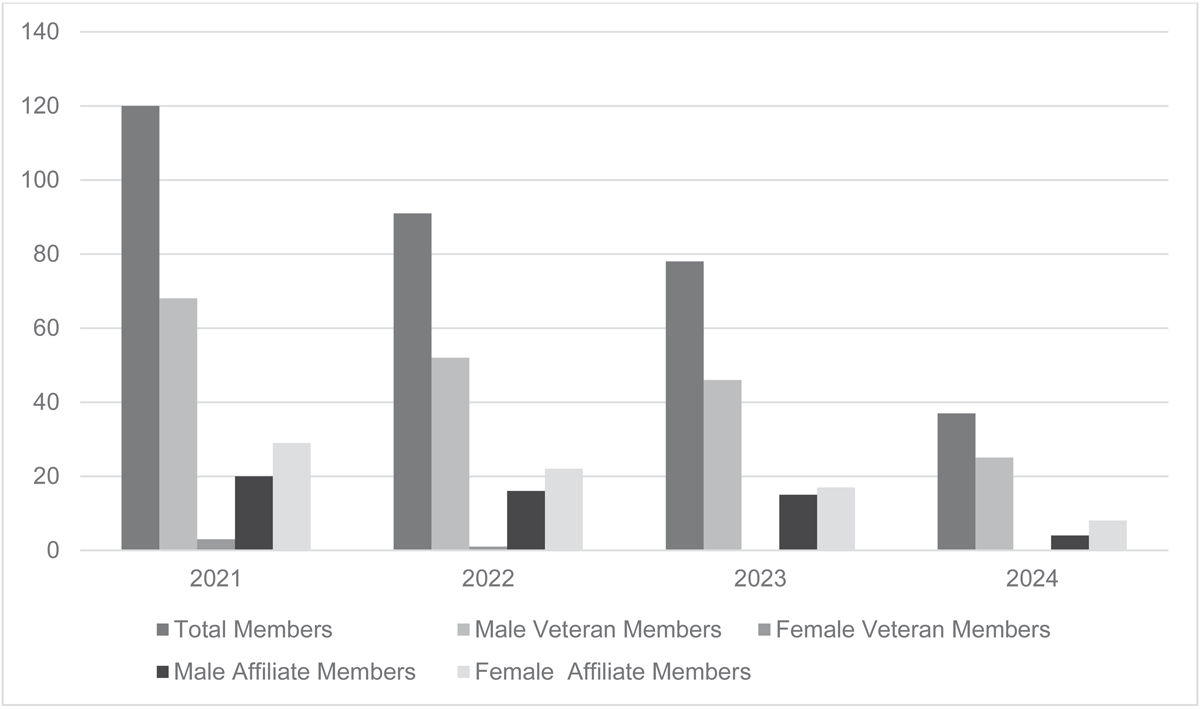
Figure 1
Veteran and Affiliate Sub-branch Membership Trends by Sex (2021–2024).
A subsequent meeting with the wider research team facilitated a comprehensive review of the consolidated codes, leading to the identification of core themes. A consensus was reached on three principal themes: Social group connectedness (camaraderie), concerns about declining membership and resistance to change, and inclusivity and unwelcoming atmosphere. To complete the analysis, the coding team systematically re-analysed participant comments based on the finalised core themes. This process confirmed the frequency and prevalence of each theme, identified participant excerpts associated with specific codes, and further validated the coding framework. These results provided the foundation for the study’s findings.
Findings
The findings are organised into themes identified through thematic analysis of qualitative data: (1) social group connection (camaraderie), (2) Concerns about declining membership and opposition to change, and (3) inclusivity and unwelcoming atmosphere.
Social Group Connectedness (camaraderie)
Social group connections, particularly camaraderie among veterans, play a critical role in their social health and well-being (Wakefield et al., 2024). Upon leaving the military, many veterans experience a profound sense of loss, particularly missing the close bonds shared with fellow service members. This emotional void is poignantly captured by a former 50-year-old veteran member from the sub-branch, who explained his decision to join the organisation, saying, “I missed being around other service members.”
RSL sub-branches play a vital role as community hubs, fostering bonds and providing veterans with a place to reconnect and support one another. Beyond serving as a gathering space, the RSL acts as an essential support network for aging veterans. As a current 73-year-old veteran member expressed, “I want things to continue to serve the Vietnam veterans and give them a place to socialise. We are all getting older, and these lunches are the only time we all get together.”
This sentiment resonates with other Vietnam War-era veterans who view the RSL as a crucial opportunity for social interaction. For instance, another current 73-year-old veteran member noted, “[it is] my only opportunity to connect with my fellow veterans,” while current 72-year-old veteran member added, “I still enjoy having a beer with the guys and having a yarn.” These comments highlight the importance of these social gatherings, which provide far more than just companionship —they serve as a lifeline for many aging veterans. For example, a current 82-year-old veteran member shared, “I really enjoy catching up with the guys for a chat,” while another current 70-year-old veteran member stated, “I look forward to Friday lunch as it’s one of my only chances to get out of the house with friends.”
In this context, the RSL not only promotes social interaction but also plays a central role in alleviating loneliness and maintaining a sense of community among aging veterans. The critical role of the RSL in sustaining camaraderie is highlighted by a current 82-year-old veteran member who remarked, “I like the RSL, and it’s been very important to stay connected with my fellow Vietnam veterans.” Many Vietnam War-era veterans attend the sub-branch weekly primarily for the camaraderie and to support the organisation. However, the decreasing number of attendees is a concern for current members. A current 70-year-old veteran member expressed this concern, stating, “The group is getting smaller and smaller, but it’s important to me that the RSL opens their doors to allow us to continue meeting up.”
These accounts underscore the essential role of social connections in enhancing veterans’ quality of life. RSL sub-branches not only offer a space for social interaction but also act as a support network that helps to alleviate feelings of isolation and loneliness. The frequent references of eagerly anticipated weekly meetings and concerns over declining attendance highlight the ongoing need for effective support and engagement strategies. While camaraderie and social connections are crucial for the well-being of veterans, the dominance of the Vietnam veteran cohort in contemporary RSLs raises important questions about how the experiences and needs of younger, female, and diverse veterans are being addressed.
Concerns about Declining Membership and Resistance to Change
As of 2024, the current veteran members of the examined RSL sub-branch are exclusively white (100%) and predominantly male (97%), with 82.3% having served in the Vietnam War. Given the aging profile of this group, it is likely that their active involvement in the veterans’ non-profit sector is nearing its end. Survey data supports this, showing that only 18.5% of current members plan to maintain their RSL membership for the next 5 years. The RSL is grappling with significant challenges, including a steady decline in membership and resistance to change from its existing members. Many current veteran members are becoming increasingly worried about the decreasing number of active participants, particularly in regions like South Australia.
This concern is reaffirmed in the words of a current 82-year-old veteran member, who stated, “I value the RSL and staying connected with my fellow Vietnam veterans, but it seems the group is getting smaller each year.” Another current 74-year-old veteran member shared his frustration, saying:
I enjoy the Friday lunches with the guys. It’s a great chance to socialise and have a beer and meal together. I don’t know why more people don’t join in. The number of us each Friday has been steadily going down, and last week, we only had eight of us.
However, a significant portion of the surveyed Vietnam veteran members oppose efforts to modernise the RSL to attract younger veterans and non-veteran members, preferring that the organisation’s focus remain on their own generation. As one current 73-year-old veteran member said, “If I am honest, I don’t want things to change. I won’t be a member in 5 years as I am getting older, and I really enjoy the Friday lunch and chatting with the guys.” This resistance often arises from a desire to preserve the traditions and social structures that have historically defined the RSL. Another current 74-year-old veteran member echoed this sentiment, saying:
Everyone talks about the need to get younger veterans into the RSL. I just think we should focus on the current members and providing a great service to them rather [than] trying to change everything to attract younger members and those that aren’t even veterans.
The RSL faces the challenge of balancing the preservation of its traditional practices with the need to evolve and remain relevant to a broader range of veterans and affiliates. Current members have been shown to value the traditional elements of the RSL and are concerned that changes could undermine the organisation’s original purpose. As one current 72-year-old veteran member stated, “The RSL is a veteran organisation and should be for veterans. The younger veterans are not interested in joining the RSL. More efforts should be made to support the current membership base rather than looking elsewhere for new members”. Similarly, a current 69-year-old veteran member added:
It should remain a solely military veteran club that is focused on veterans only. The younger veterans should want to join, but they are too busy. So, the RSL needs to focus on getting older veterans to join or provide more activities so they stay longer.
However, younger veterans and non-veteran affiliates have expressed dissatisfaction with the current state of the RSL. A former 40-year-old veteran member remarked, “It’s not for younger vets, especially those that still work or have a family. Best to go somewhere else, to be honest.” Some view the RSL as outdated, with a former 50-year-old veteran member commenting:
I joined the RSL during a period of leave from the ADF after an injury. I missed being around other service members. However, it’s not really suitable for me… If it moves into the 21st century and provides services to contemporary veterans, then I may actually engage more.
Such comments reflect a perception that the RSL is overly focused on the Vietnam veteran cohort. A former 41-year-old veteran member stated, “The RSL is in a position to do so much more for veterans, but now it’s just a retirement village with cheap beer for the older veterans, such a shame.” Many believe the RSL’s current model fails to attract a diverse range of veterans and is not competitive within the broader veterans’ non-profit sector. A former 43-year-old veteran member noted, “So many options in the veteran community. The RSL just doesn’t provide enough to be competitive in the market unless you are retired or a Vietnam veteran.” Another former 41-year-old veteran member remarked, “I would not recommend the RSL to any contemporary veteran or female veteran. It’s a Vietnam veteran club now.” Emphasising the need for change, a former 65-year-old veteran member stressed, “Engaging appropriately with contemporary veterans is essential for the long-term health of the RSL.”
Female non-veteran members also have voiced concerns. A former 61-year-old female affiliate member said, “I am no longer a member as it’s now just a clique of older veterans that make you feel like an outsider.” Similarly, a current 68-year-old female affiliate member noted the low engagement, saying, “Not many non-veterans attend, and the numbers are often low. It can get a bit boring too.” Another former 69-year-old affiliate member added, “It’s just for the Vietnam vets to get cheap alcohol and talk about their service. It’s not welcoming to non-veterans.”
The RSL’s challenge is compounded by the fact that over 80% of survey participants reported not recommending the RSL to others, indicating widespread dissatisfaction with the organisation’s current state. This finding underscores the urgency for the RSL to address the concerns of its traditional members and the needs of the broader veteran community. The organisation stands at a crossroads— to ensure its future viability, it must carefully balance preserving its cherished traditions while evolving to engage and attract a more diverse range of veterans and affiliates.
Inclusivity and Unwelcoming Atmosphere
While the RSL has historically played a crucial role in supporting Australia’s veterans, this research revealed significant challenges regarding inclusivity and creating a welcoming atmosphere, particularly for younger and female veterans, as well as non-veteran affiliates. The RSL’s membership remains predominantly male and white, with a significant aging cohort. In South Australia, 60% of members are over 70 years old, reflecting an era before females were fully integrated into the ADF in the 1980s (RSL, 2023). Although auxiliary organisations like the Women’s Royal Australian Army Corps existed prior to this integration, male dominance within the RSL persists, manifesting in both explicit and subtle ways that marginalise or exclude female members. Additionally, the predominately white Australian membership base may contribute to practices that inadvertently exclude individuals from diverse ethnic backgrounds.
The organisation appears to struggle with inclusivity, especially towards younger veterans and females. One former 60-year-old female affiliate member commented, “There are no younger veterans and minimal female affiliates—[I] didn’t feel comfortable.” Another former female affiliate raised similar concerns, saying, “The RSL is not doing enough to support younger and female veterans and affiliates… women like me feel unwelcome, and some of the older veterans make inappropriate comments about women and people of colour.”
Experiences of marginalisation extend beyond sex and age. A former 36-year-old female affiliate member, who joined to support the veteran community that her late father was part of, recounted feeling ostracised due to comments about her weight during pregnancy:
I just got tired of all the underhanded comments and whispers about me being overweight. They think I didn’t notice, but they didn’t make much of an effort to hide it. What made it worse was I was pregnant for many of these nasty comments.
A former 53-year-old male affiliate member also shared his dissatisfaction:
I was not made to feel welcome and found it difficult to make connections with the older members and veterans. I have now joined the local lawn bowling club and am thoroughly enjoying it…Maybe if I was a veteran, [it] would have ended differently.
Instances of inappropriate behaviour by older members, particularly Vietnam veterans, have been reported. One former 49-year-old male affiliate member described a troubling experience, stating, “The Vietnam veterans were very rude, and their comments [were] totally unacceptable. Sexist and racist comments. Two even greeted each other with [a racist hand gesture]. I could not believe it”. Similarly, a former 44-year-old female veteran member described a disturbing encounter:
I had a particularly confronting experience shortly after becoming an RSL member. I attended a Friday luncheon at the clubrooms…and one of the older men catcalled me. I was horrified and raised the issue with [a senior committee member] shortly afterward. His response was very dismissive with a ‘boys will be boys’ type of attitude.
Another former 41-year-old veteran member remarked, “They need to be more welcoming to contemporary veterans. The older cohort, mostly Vietnam veterans, are negative towards the younger veterans and discourage them from continuing being a member. I left [be]cause I felt unwelcome.” These accounts highlight a strong call for cultural change within the RSL to foster a more inclusive environment. One former 36-year-old female affiliate member asserted:
The RSL is not going to thrive if it continues to allow its backward culture and shocking attitudes of the older veterans to remain central to its brand. If it was any other business, it would have disappeared a long time ago.
Similarly, a former 60-year-old female affiliate member emphasised, “[There] needs to be fundamental change to [the] RSL to make it a more inclusive environment.” To address these challenges effectively, the RSL must undertake significant cultural and organisational reforms, despite potential resistance. Embracing these changes will enable the RSL to become a more inclusive and supportive organisation, ensuring its relevance and impact within the veteran community while improving its ability to attract and retain members.
Discussion
Research within military sociology has extensively explored various aspects of military culture, including the mechanisms by which civilians are integrated, the gendered ideologies that underpin it, and the influence this culture has on the identity formation of veterans. The literature details the significant transformation that civilians undergo upon joining the Armed Forces, a process known as militarisation (Wadham & Morris, 2019). This transformation begins with basic training, where new recruits experience a deliberate separation from civilian life to foster a strong identification with the military institution and culture (Cooper et al., 2018).
Within military culture, martial masculinity is hegemonic (Wadham & Connor, 2023). Masculinity is cultivated and sustained, emphasising qualities such as physical and emotional toughness, stoicism, self-reliance, aggressiveness, and a robust sense of heterosexual identity (Cooper et al., 2018; Lawn et al., 2024). Higate (2003) emphasised that the persistence of military masculinities significantly impacts the formation of a military identity, profoundly influencing individuals’ self-concept both during and after their transition into civilian life. For those transitioning from military service, this often results in the unconscious reproduction of military cultural attitudes and behaviours, which may remain oriented toward the military environment, leading to difficulties in making new connections and causing feelings of loneliness and social isolation (Grenawalt at al., 2023; Guthrie-Gower & Wilson-Menzfeld, 2022; Prevett et al., 2024). Service personnel who struggle to adapt to the different norms and values of civilian life experience what Bourdieu (1990) and Hardy (2012) describe as the hysteresis effect—a discrepancy between their ingrained habits and the new social setting they must now navigate. This ‘fish out of water’ phenomenon is evident among veterans whose entrenched attachment to their military service impedes their successful adaptation to civilian life, compelling them to seek out social connectedness that offers familiarity and similarity (Cooper et al., 2018).
This study’s findings provide valuable insights into how cultural dimensions shape veterans’ post-service experiences. Key themes such as social group connectedness, resistance to organisational change, and challenges with inclusivity underscore the intricate balance between preserving tradition and implementing necessary reforms. These dynamics reveal the complexities of ensuring the RSL remains relevant and effective in supporting a diverse and evolving veteran community.
Social Group Connectedness (Camaraderie)
This research has found that many current veteran members of the explored RSL sub-branch place significant importance on connecting with their fellow veterans, often citing the RSL as their primary means of doing so. Whether through communal meals, a few beers, or reunions on Anzac Day—a National Day of Remembrance in Australia—these activities facilitate positive social interactions. These gatherings enable the current sub-branch veteran membership, predominantly white males over 70 years old who served in the Vietnam War, to connect, share experiences, and cultivate a sense of belonging through their shared identity.
These connections are not merely social—they are protective. Studies indicate that social connectedness among veterans is linked to reductions in the severity of mental health symptoms, mitigations of moral injury, and lower suicidality rates (Flack & Kite, 2021; Kelley et al., 2019). The camaraderie fostered by these interactions supports improved social functioning, active participation in social networks, and overall enhanced well-being. Conversely, low social connectedness can lead to feelings of isolation despite access to social resources, underscoring its pivotal role in shaping the overall well-being of veterans (Cooper et al., 2018). For many of these veterans, their collective military history, particularly their experiences from the Vietnam War, coupled with shared military-based masculine ideals, fosters a strong sense of belonging within their social group and reinforces their veteran identity (Flack & Kite, 2021; Wadham, 2013). However, while this deep-rooted connection provides significant benefits for some members, it also contributes to the exclusion of others who do not share these characteristics.
Concerns about Declining Membership and Resistance to Change
Membership decline is a significant concern for the RSL, and this sub-branch is no exception. Leadership must address this issue while contending with a membership base deeply invested in maintaining the status quo. While most members acknowledge the declining numbers and recognise the potential risks to the organisation’s future, there remains significant resistance to changes that could reshape the traditional character of “their club.” This resistance is rooted in a profound attachment to established traditions and a perception that change might erode the group’s shared identity and sense of belonging.
The resistance to adapt is further compounded by the RSL’s longstanding reputation as an exclusionary space, historically dominated by older, white male veterans. This perception has discouraged participation from younger veterans, females, and individuals from diverse cultural backgrounds, creating barriers to broadening and revitalising the membership base. Such resistance not only limits efforts to revitalise the organisation but also accelerates the broader decline of the RSL nationwide. Combined with the ageing demographic of Vietnam veterans, this entrenched exclusivity highlights the urgent need for strategic reform to ensure the organisation’s long-term sustainability and relevance.
The aging Vietnam veteran population presents both a challenge and an opportunity for the RSL. On the one hand, their resistance to change complicates efforts to implement reforms aimed at broadening the organisation’s appeal. On the other hand, their eventual departure from the membership offers an opportunity to reimagine and reshape the RSL’s culture and reputation. This transition provides a chance to move beyond past patterns of exclusivity and create a more inclusive and welcoming environment for a diverse range of veterans. To succeed, leadership must strike a delicate balance by honouring the older members’ deep attachment to tradition, while steering the organisation toward a future that embraces diversity and inclusivity.
Inclusivity and Unwelcoming Atmosphere
This study identified exclusionary behaviours within the sub-branch, particularly towards individuals who do not align with the prevailing demographic and cultural characteristics of its membership. Females, younger veterans, and those from ethnically diverse backgrounds often face resistance, with members of the dominant group displaying discriminatory attitudes and language. These exclusionary behaviours are deeply embedded in the culture of certain sections of the RSL, shaped by military practices and forms of camaraderie that have nurtured a masculinist ethos. This culture prioritises uniformity at the expense of diversity and inclusivity (Wadham, 2013). A core element of martial masculinity is the creation of a sharp distinction between ‘self’ and ‘other’, a mindset that, while useful in combat, proves counterproductive in civilian social settings (Wadham & Connor, 2023). Veterans who do not conform to the traditional mould are often perceived as inferior, trespassing, or even a threat to the dominant group (Wadham & Connor, 2023).
The prevalence of sexist, racist, and discriminatory behaviour and language within the sub-branch highlights the depth of this exclusionary mindset. Females often bear the brunt of such discrimination. This reflects the enduring influence of hegemonic masculinity ingrained in military culture, which continues to shape attitudes long after service has ended. As a result, not all veterans benefit equally from the social opportunities offered by the RSL. Those perceived as the ‘other’ are frequently excluded from activities, leading many to abandon their membership. This exclusion not only robs these veterans of a sense of belonging and the protective benefits that come with social connectedness but also accelerates the decline of the organisation. Such a loss in membership threatens the survival of the sub-branch and, given the broader national decline of the RSL, poses a significant risk to the long-term sustainability of the entire network.
Exclusionary behaviours leave marginalised veterans feeling unwelcomed, prompting them to withdraw from the RSL altogether. This withdrawal deprives these veterans of the social and psychological benefits associated with group membership, such as reduced mental health challenges and increased well-being. Furthermore, the persistence of sexist and racist attitudes within the sub-branch deepens the sense of alienation. This exclusionary culture perpetuates the RSL’s reputation as an unwelcoming space. The broader consequences are far-reaching, and the decline in membership not only impacts individual veterans but also threatens the long-term viability of both the sub-branch and RSL network as a whole.
Strengths and Limitations
A key strength of this study is its high participation rate, with two-thirds of the sub-branch’s membership since 2021 taking part in the survey. This significant engagement suggests that the findings are likely representative of the broader membership experience, indicating that identified issues are more likely related to governance, operations, or inclusivity rather than the RSL’s mission itself. By including both current and former members, the study offers a well-rounded perspective on factors influencing membership dynamics, enhancing the analysis of retention and attrition. Additionally, the relevance of this study extends internationally, as it sheds light on common challenges faced by membership-based veterans’ organisations globally. The insights gained can inform best practices and strategies for similar organisations in different countries, enhancing their ability to support their veteran populations effectively.
However, the study is limited by its focus on a single sub-branch, which may not fully capture the diversity of experiences across the whole RSL network. While the sub-branch studied reflects the challenges faced by some branches, other areas within the RSL could be experiencing different trends and outcomes. Despite this limitation, the study provides a solid foundation for future research. It highlights key areas of concern and offers detailed insights into member perspectives, setting the stage for further investigation. Future research should aim to include a wider range of sub-branches and regions to validate and expand upon these findings. Such efforts will contribute to developing more comprehensive strategies for membership retention and engagement across the veterans’ non-profit sector.
Conclusion
The research underscores a critical and urgent issue facing the Returned and Services League—a persistent decline in its membership. This trend highlights a systemic failure to attract and retain newer generations of veterans, placing the viability of individual sub-branches and the overall sustainability of the RSL network at considerable risk. The findings reveal that a primary driver behind this decline is the insufficient integration and support for a diverse range of veteran groups. This lack of inclusivity threatens the structural integrity of the RSL and impedes its ability to meet the evolving needs of the veteran community. As the demographic of veterans becomes more diverse, the RSL’s existing strategies fall short, leading to disengagement and diminishing membership. To ensure the RSL’s continued relevance and effectiveness, it is crucial to address these shortcomings. The RSL must implement targeted strategies to improve the integration of diverse veteran groups and cultivate a more inclusive environment. By taking these steps, the organisation can revitalise its appeal, strengthen its support network, and secure its future as a vital institution serving Australia’s veterans.
Data Accessibility Statement
The authors confirm that the survey instrument used in this exploratory study is provided in the article’s supplementary material. De-identified membership data (2021–2024), which supports the findings of this study, are openly accessible via the Flinders University Repository of Open Access Data Sets at https://doi.org/10.25451/flinders.27099862.v1. However, due to the potential risk of identifying research participants, the raw survey data are available only upon reasonable request from the corresponding author, Andrew Prevett.
Ethics and Consent
Ethics approval to conduct the study was granted by the Charles Sturt University Human Research Ethics Committee: H23815.
Acknowledgements
The views are those of the authors and do not necessarily reflect the position or policy of the Returned & Services League of Australia. Drs Donna Bridges and Emma Rush of Charles Sturt University provided guidance with the development of the survey.
Funding Information
This research did not receive funding from any public, commercial, or non-profit organisation.
Competing Interests
The authors have no competing interests to declare.
Author Contributions
All authors contributed to the study’s conception and design. Material preparation, data collection, and analysis were performed by Andrew Prevett and Jade Lâm. The first draft of the manuscript was written by Andrew Prevett, and all authors commented on previous versions of the manuscript. All authors read and approved the final manuscript.