
Underemployment is a multidimensional construct that reflects inadequate work situations compared to an ideal standard, measured subjectively or objectively against full employment (Feldman, 1996). Underemployment has become a significant reality due to what is often termed “the changing nature of work,” influenced by factors such as economic recessions, globalization, automation, technological disruption, depressed wages, and weakened labor protections (Allan et al., 2022; International Labour Organization, 2020). The evolution of work since the 1980s has seen a rise in precarious employment, marked by the decline in full-time jobs and an increase in non-standard work arrangements, such as temporary and part-time positions (Maynard et al., 2006). Consequently, a pervasive underemployment trend has emerged where workers are trapped in inadequate jobs due to skill mismatches, low wages, or limited hours (Bell & Blanchflower, 2021; Pratap et al., 2021).
The impact of underemployment was further intensified by the COVID-19 pandemic, which disrupted traditional employment structures and accelerated existing trends in automation, remote work, reliance on online business models, and organizational downsizing (Kaur et al., 2020). These shifts have disproportionately affected workers due to systemic inequities and unequal investment in workforce training and public resources. As a result, the most disadvantaged populations are at a higher risk of facing the potentially adverse consequences of underemployment (Li & Wu, 2022; Pratap et al., 2021).
While the contextual factors surrounding the modern workforce underscore the growing reality of underemployment, challenges arise in conceptualizing and measuring this phenomenon, making it difficult to determine its prevalence and consequences. The US Bureau of Labor Statistics (BLS) provides a widely cited statistic of underemployment, which captures only time-based underemployment or the number of workers holding part-time jobs but desiring full-time employment. As of the data collection period for the current study in May 2019, the BLS reported an underemployment rate of 2.5% (US BLS, 2020). However, other studies consistently have noted much higher rates or as much as a third of the workforce (Green & McIntosh, 2007; Green & Zhu, 2010; McGuinness et al., 2017).
While the prevalence and consequences of various underemployment types are burgeoning areas of research in the general population, less is known about its occurrence and impact among military veterans, particularly among those transitioning to civilian life. Most of the research on veterans related to underemployment has been conducted outside of peer review by entities such as LinkedIn and ZipRecruiter. The samples from these studies have very limited generalizability due to inherent selection biases in platform use. However, these studies suggest that veterans transitioning from military service face dire challenges in navigating the civilian job market, and they are disproportionally affected by underemployment compared to their civilian counterparts (LinkedIn, 2019; 2023).
The Department of Defense (DoD) is the world’s largest employer, playing a pivotal role in workforce development, and provides a robust talent pipeline each year, with approximately 200,000 service members transitioning to civilian life (Ainspan et al., 2019). Addressing underemployment and other transition challenges within the veteran community is critical to maintaining this talent pipeline and imperative for our national security through the sustainment of an effective and motivated military force.
Furthermore, veterans represent a microcosm of society, reflecting a diversity comparable to, if not greater, than the general population (Ainspan et al., 2019). Their transition from military to civilian life marks a significant career shift, compounded by unique risk (e.g., combat propensity and trauma) and protective factors (e.g., education benefits and employment transition training), rendering them a pivotal demographic for understanding underemployment. While research on veteran underemployment has predominantly centered on objective metrics to ascertain its prevalence, indicating a significantly higher rate compared to the general populace, there exists a noticeable void in understanding veterans’ subjective perceptions of underemployment and their associated ramifications. These perceptions can detrimentally impact the psychological well-being of veterans and their families, which harms not only individuals and their families but also impacts our local communities and our national economy and security, underscoring the importance of delving deeper into this aspect of their post-service experience.
Underemployment Conceptualizations and Theory
A comprehensive understanding of underemployment requires clear conceptualization, precise measurement, and thorough analysis of the linkages between these interconnected relationships. While a singular definition of underemployment does not exist, there is a consensus that underemployment generally manifests in three primary forms: pay-based, qualification-based, or time-based. Employees, by virtue of their work situation, are involuntarily underutilized, underpaid, overqualified due to their education levels or skills, or working fewer hours than they would prefer.
The absence of a unified theoretical foundation hinders underemployment research, resulting in inconsistent measurement and limited investigative rigor. No single theory provides a comprehensive explanation for underemployment. However, the field is dominated by three predominant theories for examining underemployment, its moderators, and its outcomes, including person-job misfit, relative deprivation, and human capital theories. The current study focuses on perceived overqualification due to education, dissatisfaction with pay and benefits, and job turnover. Hence, we delve into human capital or return-on-investment theory as it is the predominant framework for understanding overqualification-based underemployment and the outcomes of interest as it emphasizes the role of education, training, and skills in an individual’s economic value (Erdogan & Bauer, 2011; Rehman et al., 2021). Human capital theory is also beneficial for understanding the relationship between education, underemployment, and job turnover, as it aligns with veterans’ expectations of military service.
Human capital theory posits that individuals invest in knowledge, skills, and experience to secure better employment outcomes, such as higher-paying jobs and career advancement (Barnichon & Zylberberg, 2019; Ng et al., 2005). Underemployment occurs when there is an incongruence in an individual’s education, experience, or skills with the job demands. Individuals may find themselves in jobs that do not fully utilize their skills or education, resulting in a mismatch. Lack of investment in human capital in the form of continuous learning and skill development can also contribute to underemployment if individuals do not possess the necessary skills to adapt to the changing demands of the job role.
Furthermore, as previously stated, human capital theory also considers compensation as a reward for the investment in education. Thus, previous research has demonstrated that overqualified individuals, especially ones who are not adequately rewarded, are more likely to have intentions to leave jobs and seek a job that fits within their education level and skill set, which is a better utilization of their human capital, thus protecting their investment (Johnson & Johnson, 1999; Johnson et al., 2002; Rubb, 2006). Some studies have also examined moderators of the relationship between being overqualified and turnover, most notably, satisfaction with compensation and rewards keeping overqualified individuals from leaving their jobs (Johnson & Johnson, 1999; Johnson et al., 2002; Rubb, 2006).
Overqualification-based underemployment is not always inherently adverse. Research has also demonstrated that underemployed individuals who are overqualified may advance within an organization and may do so more rapidly; thus, underemployment can be a gateway to higher-level positions (Hung, 2008; McMillen et al., 2007; Rubb, 2006). There is evidence, albeit limited, that this is true for veterans (LinkedIn 2019, 2023).
Underemployment Risk Factors
Each form of underemployment may have distinct antecedents and outcomes (Allan et al., 2022). Several general risk factors that contribute to underemployment include being female, younger or older, being from underrepresented racial and ethnic groups, and having physical disabilities (Allan et al., 2016; Konrad et al., 2013; Maynard et al., 2006; Mousteri et al., 2020; Slack & Jensen, 2011). When examining these risk factors in relationship to the three forms of underemployment, time-based underemployment is often associated with gender and caregiving responsibilities, which can lead to outcomes such as heightened stress and poverty. Qualification-based and pay-based underemployment, resulting from perceived inadequate compensation (e.g., salary and benefits), limited opportunities to utilize skills and training, and job dissatisfaction are all established antecedents of job turnover intentions (Maynard et al., 2006; Ongori, 2007). Among these antecedents, inadequate compensation has been found to have the highest impact on job turnover, particularly among overqualified individuals (Griffeth et al., 2000).
Underemployment measurement includes both objective factors and subjective experiences related to employment. Many studies focus on only one factor and usually rely on objective measures of underemployment (McKee-Ryan & Harvey, 2011); however, subjective measures are more closely linked to experiencing adverse outcomes, such as stress, depression, job dissatisfaction, and turnover (Jones-Johnson & Johnson, 1992; Khan & Morrow, 1991; Watt & Hargis, 2010).
The Consequences of Underemployment
Underemployment has significant economic and public health consequences. Job turnover incurs a substantial cost for organizations, not just financially but through the loss of human and relational capital. Hiring and training a new employee after a job turnover costs organizations up to half a year’s salary per departing employee (Johnson et al., 2000). Beyond the economic cost to organizations, underemployment can significantly negatively impact workers’ physical and psychological well-being (Allan et al., 2022; Pratap et al., 2021). Underemployment has been linked to reduced job satisfaction and self-esteem and increased stress, symptoms of depression, and alcohol abuse (Dooley et al., 2000; Li & Wu, 2022; Pratap et al., 2021). These outcomes are particularly concerning in the face of the changing nature of work, which increases the likelihood that workers will experience stressful employment-related events like unemployment, job insecurity, and changes in their work status or structure (Pratap et al., 2021). When the result of these experiences leads to underemployment, this can create a cycle of churn and instability, leading to deterioration in mental health (Pratap et al., 2021). Lack of adequate employment opportunities has been linked to ongoing crises in the US, including increased suicide rates and the opioid epidemic (Pratap et al., 2021). Meaningful work, often absent in underemployment, provides economic security, self-esteem, and social connection, all crucial buffers against adverse health consequences (Allan et al., 2020; Kim & Allan, 2020).
Veteran Underemployment in the United States
The Military as a Source of Human and Social Capital
The DoD’s ability to maintain the all-volunteer force hinges on prospective enlistees perceiving the benefits of military service. Among the factors motivating individuals to serve is the expectation that the military will equip them with education, experience, and career-related skills both during their service and post-transition (Ainspan et al., 2019). However, the research findings regarding the impact of military service on productivity, human capital, and wages vary, and it is evident that veterans are not a homogenous group. Disparities in veteran employment and wage outcomes exist across race/ethnicity and gender lines (Kleykamp, 2013; Schulker, 2017).
Consequently, military service may offer benefits to disadvantaged groups by enhancing their human and social capital, particularly regarding wage returns, which tend to be higher for individuals with lower levels of education (Brown & Routon, 2016; Clever & Segal, 2013; Gonzalez & Simpson, 2021; Kleykamp, 2013; MacLean & Kleykamp, 2016; Schulker, 2017). However, military service alone may not suffice as a substitute for post-service education that leads to a degree or a credential. Education remains a significant predictor of employment, as it is widely perceived to be directly correlated with qualifications (Juhdi et al., 2010). Therefore, post-military educational attainment may serve as the primary determinant of labor market outcomes for veterans (Routon, 2014).
Veterans pursuing professions similar to their military roles tend to experience better employment prospects (Routon, 2014). The military serves as a rich source of talent for the civilian workforce, with many veterans possessing skills crucial for economic competitiveness, particularly in technical sectors. Remarkably, approximately 86% of the over 8,000 occupations in the military have a moderate to strong overlap with civilian occupations (Ainspan et al., 2019).
Veterans’ Pre-Transition Employment Supports
The DoD is unique in that it extensively trains individuals who will eventually leave the service and seek additional employment (Ainspan et al., 2019). As such, veterans have unparalleled resources available to help with the transition. In 2011, the White House launched the Joining Forces initiative, placing veteran employment at the forefront of national priorities. Concurrently, Congress enacted the Veterans Opportunity to Work to Hire Heroes (VOW) Act, which not only offered tax incentives to employers for hiring veterans but also bolstered veteran preference in federal government positions and established various federal employment initiatives tailored to veterans’ needs.
The VOW Act also revamped programs to prepare veterans for a successful transition to civilian life, such as the mandatory Transition Assistance Program (TAP), which provides service members planning to separate, retire, or be released after 180 days on Title 10 Active Duty Status mandatory informational trainings and resources to help them in their civilian lives. Much of TAP is focused on career readiness and includes a Department of Labor Employment Workshop and other counseling and curriculum pathways (Ainspan et al., 2019). Numerous other governmental supports are also available, including the DoD SkillBridge initiative, which allows servicemembers to complete an apprenticeship with a civilian employer six months before their separation. Furthermore, the Post-9/11 GI Bill stands as a significant support mechanism, covering the full cost of tuition, providing stipends for books and supplies, and offering a monthly housing allowance for veterans wishing to return to school.
In addition to all the federal benefits and supports afforded to veterans, there are also numerous state-level benefits and supports and a whole host of public and private sector programs offering job training and certification services and job skills such as resume writing, interview assistance, and career coaching to name a few.
Veteran Underemployment
Helping veterans find meaningful employment is crucial for successful transitions from military to civilian life (Ainspan et al., 2019). Despite overall low unemployment rates, veterans consistently cite challenges securing employment as one of the most significant barriers to their transition (Perkins et al., 2017; Prudential Financial, Inc., 2012; Stone & Stone, 2015). Moreover, veterans are perhaps disproportionately affected by high underemployment rates after transitioning from military service (Barrera & Carter, 2017; LinkedIn 2019, 2023). Historically, individuals undergoing transitions, such as those who have been laid off or are starting new jobs, often face elevated levels of underemployment (Feldman, 1996). This tendency is exacerbated when individuals face specific financial responsibilities that compel them to accept jobs that result in underemployment (Feldman, 1996).
As highlighted, the transition of nearly a quarter of a million service members each year underscores the importance of reemployment in the civilian labor force. A significant majority of transitioning veterans depart from military service without a job lined up (Castro et al., 2015; Keeling et al., 2018). However, approximately 30% of veterans secure employment either before or within one month of leaving service (US Chamber of Commerce, 2016). Nevertheless, a considerable portion of recently reemployed veterans–-almost half, according to one study–opt to leave their initial civilian job within the first year, citing various reasons such as taking the job to fulfill immediate needs, finding a better opportunity, or a discrepancy between job expectations and the reality (Maury et al., 2014; US Chamber of Commerce, 2016).
This notable turnover rate may signify veterans’ challenges adjusting to civilian employment. These challenges may include finding meaning or purpose in their work after military service or facing a potential mismatch between their educational background, military occupational training, and their expectations for their post-service careers (Barrera & Carter, 2017; Maury et al., 2014). Moreover, it suggests that these positions might not effectively leverage veterans’ education and military training or meet their career expectations, potentially leaving them with a sense of underemployment.
Moreover, research has underscored the importance of job satisfaction, which reflects individuals’ contentment with their roles and is vital for overall well-being. Job satisfaction is also closely linked with employee performance and retention rates (Hirschfeld, 2000; Spector, 1997). Despite this, a notable research gap exists in veteran satisfaction with post-military employment–a subject warranting further investigation.
Transitioning veterans also encounter the unique challenge of translating their military employment, skills, and experiences into terms readily discernable to civilian employers (Barrera & Carter, 2017). Despite veterans’ translation efforts, misconceptions persist among employers, who may view veterans solely as possessing combat-related skills or even as having mental health issues (Davis & Minnis, 2017; Prudential Financial, Inc., 2012). In addition, veterans’ “soft skills,” including leadership and decision-making, may go unnoticed by employers (Davis & Minnis, 2017; Krueger et al., 2017). Lastly, policy barriers may hinder veterans from securing employment in professions that require state-level licensure and certification. Even when comparable jobs exist between military and civilian sectors (e.g., commercial drivers, medics, and nurses), the licensure and certification obtained in the military do not always transfer, necessitating additional coursework and examinations despite military training and experience (Barrera & Carter, 2017).
Veterans’ Risk Factors for Perceptions of Underemployment
Previous research has identified several factors associated with an increased likelihood of underemployment among veterans, including being Black Non-Hispanic, holding lower pay grades, serving in combat arms occupations, being 18 to 24 years old, holding less than a bachelor’s degree, and exhibiting symptoms of posttraumatic stress disorder. However, subgroups of veterans report varying perceptions of underemployment based on factors such as education, skills, or leadership experiences. For instance, veterans with combat arms occupational backgrounds often perceived underemployment solely in terms of their leadership experience. Similarly, younger veterans, aged 18 to 24, typically viewed their underemployment through the lens of their skills. At the same time, those with less than a bachelor’s degree reported feelings of underemployment related to their skills and leadership experiences (Davenport et al., 2022).
The link between these perceptions and actual employment outcomes remains to be seen despite the diverse perceptions among veteran subgroups related to feelings of underemployment. Moreover, research has highlighted the critical importance of job satisfaction, which reflects individuals’ contentment with their roles, including satisfaction with their compensation, and significantly impacts overall well-being. Job satisfaction is also closely linked with employee performance and retention rates (Hirschfeld, 2000; Spector, 1997). Despite this, there exists a notable research gap in understanding veteran satisfaction with their post-military employment and its influence on job outcomes, including turnover–a gap that warrants further investigation.
The Current Study
The present study addresses these gaps by investigating whether veterans who perceive themselves as underemployed are more prone to job turnover. In addition, this study explores how veterans’ satisfaction with compensation influences turnover and whether transitioning veterans who secure new positions experience improved compensation.
This study bridges critical gaps in the existing literature by examining underemployment in transitioning veterans. Generally, employment outcome research with veterans has focused almost entirely on unemployment. However, this demographic not only faces a heightened risk of underemployment but also benefits from extensive workforce training and support opportunities compared to the general population. Furthermore, this study distinguishes itself by analyzing actual job turnover rather than individuals’ intentions, thereby providing a more nuanced understanding of the employment landscape for transitioning veterans and contributing to both veteran transition and employment research fields.
This quantitative study draws upon longitudinal data from a cohort of post-9/11 veterans to investigate the relationship between perceived underemployment, compensation dissatisfaction, and job turnover. Note that the term “underemployment” in this context refers explicitly to veterans’ perceptions of underemployment due to their education level.
The study’s research questions are: Is voluntary job turnover related to veterans’ perceptions of underemployment, both, or neither? How does veterans’ salary change over time, and how is this change associated with veterans’ perceptions of underemployment and/or compensation dissatisfaction? Is there a significant interaction between perceived underemployment, compensation dissatisfaction, and job turnover with changes in salary?
Guided by a theoretical framework centered on protecting human capital investments and its emphasis on the relationship between education, skills, and earnings, our hypotheses posit that individuals who perceive themselves as underemployed, are dissatisfied with their compensation, or both underemployed and dissatisfied with compensation are more likely to experience job turnover and changes in salary compared to those without such perceptions or job changes. By addressing these specific questions, the study endeavors to unravel the complexities surrounding underemployment, compensation, and job turnover within the transitioning veteran population and inform the system of support to improve their transition to civilian employment.
Methods
Participants
Institutional Review Board approval was obtained from VA Boston Healthcare System, the Pennsylvania State University, and ICF International, Inc. Additional details on the sampling, recruitment, and data collection strategy are provided in Vogt et al. (2018). The joint Department of Veterans Affairs/Department of Defense Identity Repository (VADIR) database was used to identify a sample of transitioning post-9/11 veterans who served in the active component (i.e., Air Force, Army, Marine Corps, or Navy) or who were activated National Guard and Reserve service members in the prior three months before June 2016 to September 2016 (n = 48,965). The survey was administered every six months, from September 2016 to June 2019. Almost 20% of the population (n = 9,566) provided complete data at Wave 1. The majority of original respondents were male (82%; n = 7,823), White Non-Hispanic (65%; n = 6,185), and from enlisted ranks (77%; n = 7,365). In 2019, the survey administrators, ICF, communicated with the 7,404 participants to seek their permission to be contacted in future studies. A sample of 3,516 veterans voluntarily chose to participate in additional surveys. Eligible participants were invited by email to complete an additional online survey between November 2020 and January 2021. A total of 3,180 veterans completed the survey. Approximately one-third of the original sample was maintained for four years (M = 4.05, SD = .04) after the study’s first wave.
The Wave 7 respondents were 37.91 years old (SD = 9.41), predominantly male (81%; n = 2,575), and identified as White Non-Hispanic (70%; n = 2,234). Female veteran participation (19%) was greater in this survey than in the Wave 1 sample (16%). To qualify for the analytic sample, veterans must have completed Wave 6 of the survey, be currently employed (n = 4,057), and have reported information on underemployment and satisfaction with pay and benefits. Additionally, Wave 7 sample participants had to report any job changes since the last survey and their current salary (n = 1,972). For inclusion, participants also needed to be veterans or serving in the National Guard or Reserves but not on active-duty status during Waves 6 or 7.
The weighted analytic sample primarily was male (87%) and White Non-Hispanics (74%), with 33% belonging to the most junior enlisted pay grades (E1–E4). The majority of veterans (85%) had an honorable discharge. Approximately 16% of participants were currently serving in the National Guard or Reserves. Weighted descriptive statistics for gender, pay grade, race/ethnicity, and military occupation at discharge are displayed in Table 1. However, unweighted growth models are presented due to potential large standard errors that result from weighting.
Table 1
Descriptive Statistics for the Analytic Sample.
| VARIABLE | UNWEIGHTED %(n = 1,972) | WEIGHTED %(n = 30,280) | WEIGHTED STANDARD ERROR | DESIGN EFFECT |
|---|---|---|---|---|
| Gender | ||||
| Female | 15.1% | 12.7% | (0.01) | 1.09 |
| Male | 84.9% | 87.3% | (0.01) | 1.09 |
| Pay grade | ||||
| Enlisted E1 to E3 | 5.8% | 8.4% | (0.01) | 1.52 |
| Enlisted E4 | 22.4% | 32.5% | (0.01) | 1.37 |
| Enlisted E5 | 18.2% | 18.2% | (0.01) | 1.12 |
| Enlisted E6 | 9.7% | 9.6% | (0.01) | 1.10 |
| Enlisted E7 to E9 | 16.7% | 14.2% | (0.01) | 1.05 |
| Warrant officer W1 to W5 | 1.4% | 1.0% | (0.00) | 0.82 |
| Officer O1 to O3 | 10.0% | 7.1% | (0.01) | 0.86 |
| Officer O4 to O7 | 15.7% | 9.1% | (0.01) | 0.83 |
| Race/ethnicity | ||||
| White non-Hispanic | 74.3% | 74.2% | (0.01) | 1.20 |
| Black non-Hispanic | 7.6% | 6.8% | (0.01) | 1.06 |
| Hispanic | 10.5% | 11.5% | (0.01) | 0.96 |
| Asian, HPI/other | 7.6% | 7.5% | (0.01) | 1.21 |
| Wave 6 highest education completed | ||||
| Less than a bachelor’s degree | 50.7% | 57.7% | (0.01) | 1.17 |
| Bachelor’s degree | 23.4% | 22.3% | (0.01) | 1.16 |
| More than a bachelor’s degree | 27.2% | 20.0% | (0.01) | 1.04 |
| Left job between Waves 6 and 7 | 11.5% | 12.2% | (0.01) | 1.25 |
| Neither dissatisfied with compensation nor underemployed | 54.9% | 53.9% | (0.01) | 1.21 |
| Only dissatisfied with compensation | 4.3% | 4.6% | (0.01) | 1.26 |
| Only underemployed | 31.0% | 31.2% | (0.01) | 1.21 |
| Both underemployed and dissatisfied with compensation | 9.8% | 10.3% | (0.01) | 1.24 |
[i] Note. Inclusion criteria are as follows: not on active duty and working in Waves 6 and 7.
Measures
Demographic information, including gender, pay grade, race/ethnicity, and the highest level of education completed, was collected at Wave 1. At Wave 6, respondents again reported their highest level of education obtained and the following information: perceived underemployment based on education, dissatisfaction with compensation, voluntary job turnover between Waves 6 and 7, and salary information at Wave 6 and Wave 7.
Perceived Underemployment Based on Education
The survey first assessed employed veterans’ subjective underemployment experiences in Wave 6, approximately 2.5 years after separation from active duty. The survey adopted a previous measure of perceived underemployment (Crouter et al., 2006) and included three items about perceived underemployment due to education, skills, and leadership experiences. Due to the high correlation between the underemployment items (r = 0.79–0.81), this analysis used a single item: “Given my education, I should be in a better job than my current job.” Veterans indicated their agreement with the statement on a five-point scale from “strongly disagree” (1) to “strongly agree” (5). Responses were dichotomously coded based on whether they selected “somewhat” or “strongly agree” (1) or not (0).
Dissatisfaction with Compensation
Veterans also reported dissatisfaction with their compensation (pay and benefits) during the last six months at each wave. Responses were dichotomously reverse-coded. Responses of “very dissatisfied” or “somewhat dissatisfied” were coded as 1. Responses of “neither,” “somewhat satisfied,” and “very satisfied” were coded as 0. Compensation dissatisfaction data from Wave 6 were included in the current analysis.
Voluntary Job Turnover
Veterans were asked to report if they experienced work changes since the last survey with the following question: “In the past six months, have you left your job for a better opportunity?” This item is dichotomous: 1 = left your job, 0 = did not leave your job for a better opportunity. This item was used as a proxy for voluntary job turnover. Any reported job changes between Wave 6 and Wave 7 were included in the current analysis.
Salary
At Waves 6 and 7, a single item asked veterans to “please provide your expected annual salary before taxes are taken out. If you do not know the answer, please make your best guess.” Responses were recoded to reflect the lower end of the categorical range: No salary (0), Less than $15,000 per year (7.5), $15,000–$24,999 (15), $25,000–$34,999 (25), $35,000–$44,999 (35), $45,000–$54,999 (45), $55,000–$74,999 (55), $75,000–$99,999 (75), $100,000–$149,999 (100), and $150,000 or more per year (150).
Data Analytic Approach
Each research question led to the development of an analytical model, incorporating significant covariates identified in prior analyses, namely gender, pay grade, and educational attainment. The first two research questions employed logistic regression analysis to examine the likelihood of job turnover or increased salary with perceived underemployment based on education level. The third research question tested whether job turnover moderated salary changes from Wave 6 to Wave 7 between four groups of veterans: veterans who reported being neither underemployed nor dissatisfied with compensation, veterans who reported only being dissatisfied with their compensation, veterans who reported being only underemployed, and veterans who reported being both underemployed and dissatisfied with compensation. See Figure 1 for a visual representation of this conceptual model.
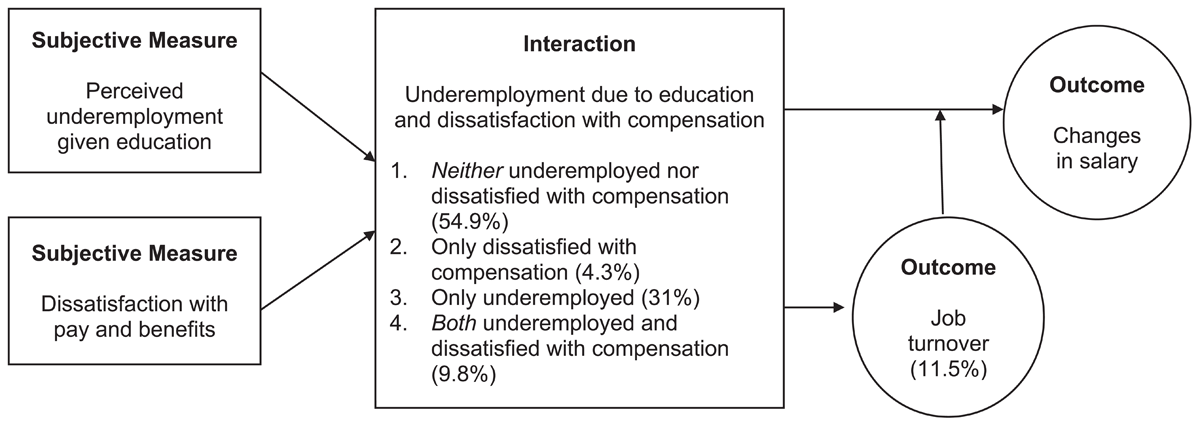
Figure 1
Conceptual Model.
Growth curve models (Singer & Willett, 2003) were used to examine the average salary at Wave 6 (intercept) and were used to determine if there were salary changes between Waves 6 and 7 (slope); time was nested within persons, which created a two-level model. All models were estimated using maximum likelihood and Satterthwaite denominator degrees of freedom with SAS Proc Mixed Version 9.4. An advantage of growth models is that they do not require complete data from all participants. Intercepts were allowed to be random or vary individually by participants. Given only two time points, slopes were fixed or averaged across participants. Model-fitting procedures were also conducted (Singer, 1998).
Results
Descriptive information for the combination of underemployment and dissatisfaction with pay and benefits groups (four in total) are as follows: more than half (54%) of veterans indicated neither underemployment nor dissatisfaction with their compensation. Approximately one-third of veterans (31%) reported experiencing unemployment without being dissatisfied with their compensation. A smaller segment (5%) expressed dissatisfaction solely with their compensation without reporting perceptions of underemployment. As illustrated in the lower section of Table 1, around 10% of veterans reported underemployment and dissatisfaction with their compensation. Approximately 12% of the sample opted to leave their jobs for a better opportunity between Waves 6 and 7.
Is Job Turnover Related to Underemployment and Compensation Dissatisfaction?
Table 2 presents the findings of veterans’ likelihood of leaving a job for a better opportunity between Wave 6 and Wave 7. Significant differences were found regarding pay grade among the covariates in the model. Compared to veterans with an E4 pay grade at discharge, those at enlisted pay grades E5, E6, and E7 to E9 were 30%, 50%, and 63% less likely to leave their jobs, respectively. Similarly, veteran respondents with officer pay grades O4 to O7 were 62% less likely to leave their jobs than veterans with E4 pay grade. Conversely, gender, race, and education were not significantly associated with leaving one’s job between Wave 6 and 7.
Table 2
Likelihood of Leaving a Job Between Wave 6 and Wave 7 as a Function of Turnover, Underemployment, and Compensation Dissatisfaction.
| VARIABLE | ODDS RATIO | CI LOWER | CI UPPER | DESIGN EFFECTS | p |
|---|---|---|---|---|---|
| Male | 0.83 | 0.61 | 1.14 | 1.03 | 0.25 |
| Pay grade (reference group: Enlisted E4) | |||||
| Enlisted E1 to E3 | 0.80 | 0.50 | 1.29 | 1.54 | 0.36 |
| Enlisted E5 | 0.70 | 0.51 | 0.97 | 1.20 | 0.03 |
| Enlisted E6 | 0.50 | 0.32 | 0.76 | 1.14 | <0.001 |
| Enlisted E7 to E9 | 0.37 | 0.25 | 0.54 | 1.05 | <0.001 |
| Warrant officer W1 to W5 | 1.25 | 0.52 | 2.98 | 0.78 | 0.62 |
| Officer O1 to O3 | 0.61 | 0.38 | 1 | 1.00 | 0.05 |
| Officer O4 to O7 | 0.38 | 0.23 | 0.65 | 0.95 | <0.001 |
| Highest education completed (reference group: bachelor’s degree) | |||||
| Less than a bachelor’s degree | 1.32 | 0.96 | 1.8 | 1.23 | 0.09 |
| More than a bachelor’s degree | 1.00 | 0.67 | 1.48 | 1.11 | 0.99 |
| Neither dissatisfied with pay nor underemployed (reference group) | |||||
| Only dissatisfied with pay | 1.32 | 0.75 | 2.33 | 1.20 | 0.33 |
| Only underemployed | 1.90 | 1.46 | 2.47 | 1.24 | <0.001 |
| Both underemployed and dissatisfied with pay | 3.86 | 2.70 | 5.53 | 1.23 | <0.001 |
Notable differences were identified concerning the likelihood of veterans leaving their jobs based on perceived underemployment and dissatisfaction with compensation. Compared to veterans reporting neither underemployment nor dissatisfaction with their compensation, those who reported being underemployed but not dissatisfied with their compensation were 90% more likely to leave their jobs. Moreover, veterans reporting both underemployment and dissatisfaction with their compensation were 3.86 times more likely to leave their current jobs for better employment opportunities.
Do Salary Changes Relate to Underemployment and Compensation Dissatisfaction?
To analyze veterans’ salaries over time, changes in salary between Wave 6 and 7, and the influence of underemployment perceptions and compensation dissatisfaction, an unconditional individual growth model with random intercept and fixed slope was used to calculate the average salary of veterans at Wave 6, approximately 33 months after leaving the military. At Wave 6, the average salary was $52,670 (β10 = 52.67, SE = 0.83). On average, the salary of respondents increased by $7,540 between Wave 6 and 7 (β10 = 7.54, SE = 0.59). Thus, the average salary for all respondents at Wave 7 was approximately $60,210.
In the conditional individual growth model, with a random intercept and fixed slope, covariates included gender, pay grade, educational attainment, the four groups of underemployment by employment dissatisfaction (main effects and interaction), and job turnover (see Table 3). The baseline, represented by the Wave 6 average salary when all the other variables are equal to zero, was 46.14 or approximately $46,000. At Wave 6, salaries varied based on gender, pay grade, and educational attainment (refer to the top of Table 3). The reference group, veterans discharged from the military at an E4 pay grade, had a salary of $46,140. Male veterans earned approximately $11,100 more than their female counterparts.
Table 3
Growth Curve Model Results: Salary Change Between Wave 6 and 7 among Demographics, Education, Underemployment, and Dissatisfaction with Pay.
| VARIABLE | EST. | SE | p |
|---|---|---|---|
| Intercept | 46.14 | 2.33 | <.0001 |
| Male | 11.10 | 1.65 | <.0001 |
| Pay grade (reference group: enlisted E4) | |||
| Enlisted E1 to E3 | –5.57 | 2.76 | 0.043 |
| Enlisted E5 | 6.50 | 1.86 | 0.001 |
| Enlisted E6 | 20.33 | 2.26 | <.0001 |
| Enlisted E7 to E9 | 31.60 | 1.95 | <.0001 |
| Warrant officer W1 to W5 | 44.94 | 5.13 | <.0001 |
| Officer O1 to O3 | 31.56 | 2.56 | <.0001 |
| Officer O4 to O7 | 58.55 | 2.53 | <.0001 |
| Wave 6 highest education completed (reference group: bachelor’s degree) | |||
| Less than a bachelor’s degree | –8.83 | 1.62 | <.0001 |
| More than a bachelor’s degree | 11.90 | 1.91 | <.0001 |
| Intercept Wave 6 (reference group: neither dissatisfied with pay nor underemployed) | |||
| Only dissatisfied with pay | –15.19 | 3.45 | <.0001 |
| Only underemployed | –10.96 | 1.53 | <.0001 |
| Both underemployed and dissatisfied with pay | –24.11 | 2.54 | <.0001 |
| Intercept: veterans with job turnover | –1.22 | 3.14 | 0.699 |
| Intercept: Wave 6 veterans with job turnover and neither dissatisfied with pay nor underemployed (reference group) | |||
| Veterans with job turnover and only dissatisfied with pay | 7.66 | 9.69 | 0.429 |
| Veterans with job turnover and only underemployed | –6.09 | 4.68 | 0.193 |
| Veterans with job turnover and both underemployed and dissatisfied with pay | 4.66 | 5.60 | 0.405 |
| Change in salary | 4.23 | 0.78 | <.0001 |
| Change in salary (reference group: neither dissatisfied with pay nor underemployed) | |||
| Only dissatisfied with pay | 9.46 | 3.19 | 0.003 |
| Only underemployed | 0.64 | 1.34 | 0.633 |
| Both underemployed and dissatisfied with pay | 6.03 | 2.33 | 0.010 |
| Change in salary for veterans with job turnover | 0.85 | 2.74 | 0.757 |
| Change in salary for veterans with job turnover (reference group: neither dissatisfied with pay nor underemployed) | |||
| Veterans with job turnover; only dissatisfied with pay | 6.29 | 9.21 | 0.495 |
| Veterans with job turnover; only underemployed | 10.81 | 4.15 | 0.009 |
| Veterans with job turnover; both underemployed and dissatisfied with pay | 7.84 | 5.02 | 0.119 |
[i] Note. Race/ethnicity was not a significant predictor of changes in salary and was removed from the current model.
Pay grade at discharge and education was significantly related to salary. Junior enlisted veterans (E1 to E3 pay grades) earned around $5,570 less than those with an E4 pay grade at discharge, a trend observed across all other enlisted pay grades. For instance, E5 pay grades made $6,500 more than E4 pay grades, while E6 pay grades made $20,330 more. Likewise, O1 to O2 pay grades earned $31,560 more, and O4 to O7 pay grades earned $58,550 more than veterans with an E4 pay grade at discharge. Regarding education and salary, veterans with a bachelor’s degree earned $8,830 more than those with less than a bachelor’s degree. In contrast, veterans with post-graduate education earned $11,900 more than those with bachelor’s degrees.
Significant findings emerged in examining the association between salary and veterans’ perceptions of underemployment and dissatisfaction with compensation. At Wave 6, veterans who solely reported dissatisfaction with compensation earned $15,190 less than those who reported neither underemployment nor compensation dissatisfaction. Similarly, veterans who reported only underemployment earned $10,960 less than veterans who reported neither underemployment nor compensation dissatisfaction. Veterans who reported both being underemployed and dissatisfied with their compensation experienced the largest gap, earning $24,110 less than those who reported neither underemployment nor compensation dissatisfaction. No significant differences in salary were found at Wave 6 (intercept) among veterans who left their jobs and those who remained in their current jobs. Between Wave 6 and Wave 7, all veterans, including those who did not leave their jobs and reported neither being underemployed nor dissatisfied with their compensation, had an average salary increase of $4,230.
The bottom half of Table 3 shows the salary changes from obtaining a new job between Wave 6 and 7 (the slope). Veterans who reported only dissatisfaction with their compensation had an increase of $9,460 in salary. For veterans experiencing both dissatisfaction with compensation and underemployment, there was an additional increase of $6,030 in salary. However, no significant differences were found among veterans who exclusively reported being underemployed.
Interaction between Underemployment and Compensation Dissatisfaction on Outcomes?
An analysis also assessed whether job turnover moderated perceived underemployment or dissatisfaction with compensation by examining the interaction between the four groups of underemployment and compensation and job turnover. The results, depicted in Table 4 and Figure 2, illustrated significant differences between the groups. Specifically, veterans who were solely underemployed and left their jobs experienced a salary increase of $10,810 compared to veterans who were not underemployed nor dissatisfied with compensation and left their jobs. However, no significant differences were found concerning job turnover and the subsequent impact on salary changes between veterans who were only dissatisfied with their compensation or among those veterans who were both underemployed and dissatisfied with their compensation and left their job compared to veterans who were neither underemployed nor dissatisfied with compensation and left their jobs.
Table 4
Salary Change as a Function of Turnover, Underemployment, and Compensation Dissatisfaction.
| VARIABLE | EST. | SE | p |
|---|---|---|---|
| Intercept Wave 6 (reference group: veterans with job turnover and neither*) | |||
| Job turnover and only dissatisfied with pay | 7.66 | 9.69 | 0.429 |
| Job turnover and only underemployed | –6.09 | 4.68 | 0.193 |
| Job turnover and both underemployed and dissatisfied with pay | 4.66 | 5.60 | 0.405 |
| Change in salary between Waves 6 and 7 (Question 2) Salary change (everyone goes up by $4,000) | 4.23 | 0.78 | <.0001 |
| Salary change (reference group: neither*) | |||
| Only dissatisfied with pay (make $13.69) | 9.46 | 3.19 | 0.003 |
| Only underemployed | 0.64 | 1.34 | 0.633 |
| Both underemployed and dissatisfied with pay | 6.03 | 2.33 | 0.010 |
| Salary change for veterans with job turnover | 0.85 | 2.74 | 0.757 |
| Salary change for veterans with job turnover (reference group: neither*) | |||
| Job turnover and only dissatisfied with pay | 6.29 | 9.21 | 0.495 |
| Job turnover and only underemployed | 10.81 | 4.15 | 0.009 |
| Job turnover and both underemployed and dissatisfied with pay | 7.84 | 5.02 | 0.119 |
[i] Note. Neither* in the table refers to neither dissatisfied with pay or underemployed. Race/ethnicity was not a significant predictor of changes in salary.
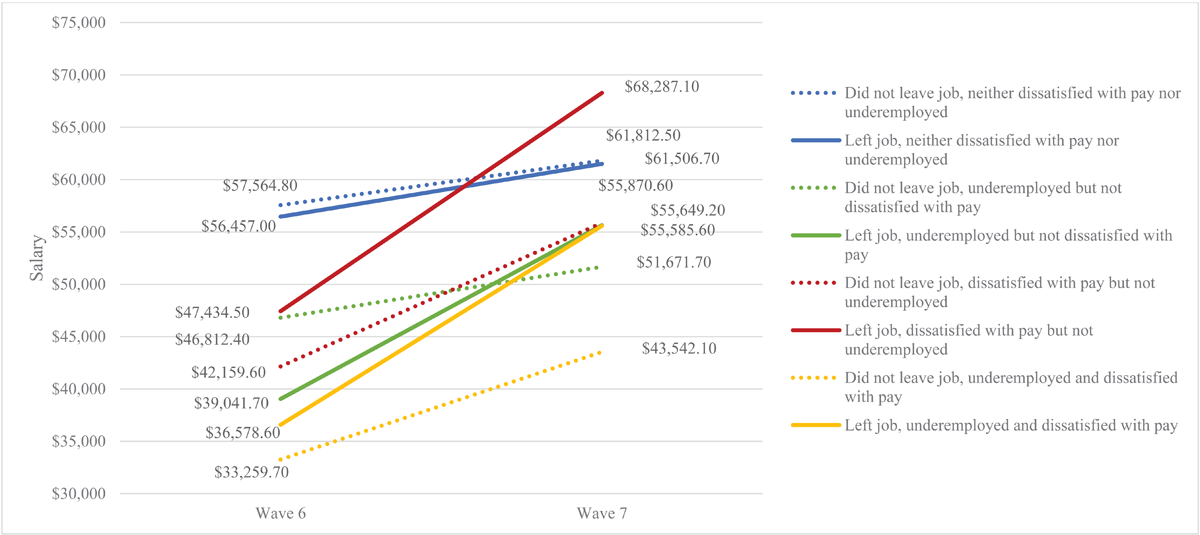
Figure 2
Interaction Between Underemployment, Dissatisfaction with Compensation, and Job Turnover on Salary Change.
Note. Estimates are for a male, E4 pay grade, with a bachelor’s degree.
Discussion
Nearly three years post-separation or deactivation, approximately one-third of veterans continued to report perceived underemployment. Furthermore, this study found that more than half of post-9/11 veterans (55%) did not perceive themselves as underemployed or dissatisfied with their compensation. This finding indicates that a significant proportion of employed post-9/11 veterans are satisfactorily employed, challenging the notion of a dire employment situation for this demographic. However, nearly 10% of post-9/11 veterans reported both underemployment and dissatisfaction with their compensation. Thus, there appears to be a substantial subset of post-9/11 veterans facing challenges in their transition to civilian employment, even three years after leaving the military.
Recognizing the association between underemployment and well-being (Friedland & Price, 2003; Wilkins, 2007), there are individual and policy-level recommendations to alleviate underemployment. First, veterans at risk for unfavorable employment transitions must be identified before their military separation and connected to appropriate employment programs (e.g., skills translation, resume writing, and veteran job fairs) to help prevent potential challenges (Collins et al., 2014). Employment interventions provided through mentors or coaches and other effective employment components (Morgan et al., 2022; Perkins et al., 2022) offer an opportunity to align veterans’ characteristics with their first civilian jobs, considering their education, skills, and leadership experiences upon military separation. For example, providing individualized transition employment support can help veterans find better fitting opportunities based on their interests and experiences, translate military skills for the civilian workforce, and leverage effective programs and resources both before and after separation that can match educational requirements with occupations can facilitate successful career exploration and bridge the gap between veterans and suitable employment opportunities, thereby reducing perceptions of underemployment or dissatisfaction with compensation and allow for successful post-service career advancement.
Among post-9/11 veterans, those with higher educational attainment demonstrated significantly higher earnings. This finding emphasizes the pivotal role education plays for veterans. US veterans can access programs that facilitate and support their pursuit of additional education, such as the Post-9/11 GI Bill. Prioritizing and endorsing initiatives that encourage veterans to pursue further education after military service as it relates to their career goals should be a central aspect of their transition.
Between Waves 6 and 7, 12% of veterans left their jobs for a new opportunity. As was hypothesized, veterans who perceived themselves as underemployed and dissatisfied with their compensation, constituting around 10% of the sample, were more inclined to change jobs than those who were not underemployed or dissatisfied with their compensation. This finding aligns with the premise of human capital theory, which suggests that individuals seek to optimize their skills and earning potential by moving to positions that better utilize their abilities and offer greater rewards. Thus, veterans’ self-perceptions of their employment situations were likely an impetus to seek a better job, reflecting their investment in enhancing their human capital.
Noteworthy, veterans who reported underemployment and compensation dissatisfaction but remained in their jobs between Waves 6 and 7 experienced a steeper salary increase than those who changed jobs. This finding underscores the nuanced interplay of factors influencing job turnover decisions, as posited by human capital theory. While immediate dissatisfaction may prompt individuals to consider changing jobs, other factors, such as workplace environment, social relationships, and, notably, individuals’ career advancement goals and opportunities for career advancement, may play a significant role in their decisions. Thus, underemployed veterans dissatisfied with their compensation may have chosen to stay in their jobs to capitalize on anticipated future growth opportunities, reflecting their strategic investment in long-term human capital development.
Moreover, these salary changes were not significant for job turnover, which may be influenced by other subgroups, given the presence of large standard errors. According to human capital theory, compensation rewards individuals’ investment in developing their skills and experiences. However, the lack of significant salary changes in relation to job turnover suggests that there are factors beyond immediate financial incentives that may play a role in veterans’ decisions to change jobs. Perhaps some veterans experienced lateral moves, resulting in salary changes not adequately captured by the broad measurement scales applied in this study. Thus, refining salary measurement precision or exploring additional covariates may be necessary to understand better the relationship between compensation and job turnover among veterans.
However, veterans’ underemployment perceptions were partially validated, particularly as veterans who perceived themselves as underemployed and left their jobs demonstrated significant salary growth nearly four years after separation or deactivation from military service. This finding supports the notion that individuals who perceive themselves as underutilized or undervalued in their current positions are more likely to seek alternative employment where they can better leverage their skills and experiences, which aligns with human capital theory’s emphasis on maximizing returns on investment.
Compensation is one of the most influential factors predicting an individual leaving their job (Griffeth et al., 2000). Surprisingly, in this sample, veterans who expressed dissatisfaction with their compensation but did not report underemployment were less inclined to leave their jobs. Notably, these veterans also saw a significant salary boost, indicating additional factors influencing their decisions. For example, veterans who are dissatisfied with their compensation but remain in their current jobs may have undergone other noteworthy job changes, such as receiving a promotion or gaining new responsibilities that contribute to their long-term career development.
Limitations and Future Research
The current study has limitations that warrant consideration. First, the sample is representative of transitioning veterans who were discharged in 2016. Second, there were several measurement constraints. Measures for underemployment, job turnover, and compensation dissatisfaction were all assessed using single items. The response options for salary were also too large, limiting the variability of the salary construct.
Furthermore, the absence of data on perceptions of underemployment until Wave 6 limited the ability to conduct thorough longitudinal examinations between underemployment perceptions and outcomes. Specifically, the study could not longitudinally explore the lasting effects for veterans who were initially underemployed in their first post-service civilian job, especially considering that a significant proportion of veterans leave their first job within the first year of separation and are still reporting perceived underemployment and voluntarily leaving their jobs two and a half to three years after separation. Thus, there may be long-term effects for veterans who were initially underemployed in their first post-service civilian job that the researchers could not detect. Job turnover, especially frequent turnover, may be an antecedent of underemployment that may be hard to overcome (Pratap et al., 2021). Yet, while this study was able to determine that those who were underemployed and dissatisfied were significantly more likely to change jobs, the linkage between job turnover and employment outcomes such as salary was unclear.
In addition, the study focused on only veterans’ perceived underemployment due to education because of its high correlation with the other perceived underemployment items in the survey and previous research and human capital theory indicating the relationship between overqualification, especially concerning employment and turnover. However, previous research has also demonstrated that educational attainment is an imperfect proxy for skills as education may overlook non-traditional skill acquisition, such as skills acquired on the job, and may not consider the fit of a degree or what skills are required for the job (Erdogan et al., 2011; Green & McIntosh, 2007; McGuinness & Wooden, 2009). However, subjective reports of overqualification, as examined in this study, such as underemployment due to education, are considered more robust predictors of individual well-being (Liu & Wang, 2012).
Several areas merit further exploration. First, a deeper dive into job promotions and their linkage to additional promotion or the receipt of increased pay could provide valuable insights. Although overall job turnover was not related to salary changes, promotions within their current job may contribute to career advancement, and this is an avenue that should be explored. Further, an earlier investigation did not find differences in perceived underemployment by gender (Davenport et al., 2022). However, gender differences in salary were evident, with female veterans earning, on average, $11,000 less than their male counterparts. This finding highlights the need for a more nuanced examination of job promotions and salary changes, particularly considering gender disparities.
Beyond gender, future analyses should explore specific career fields that inherently pose a higher risk of underemployment. Industry and occupation have been identified as critical factors influencing the risk of underemployment (Barrett & Doiron, 2001; Wilkins & Wooden, 2011), and further investigation could shed light on whether certain types of work or the number of hours worked contribute to underemployment perceptions.
Lastly, as noted in the limitation above, this study used a subjective report of underemployment due to education, which previous research demonstrates is a strong predictor of job-related outcomes. Future research using these data should explore the linkage between subjective and objective indicators of underemployment. While subjective reports provide robust and valuable insights, examining how well they align with objective indicators, such as occupational requirements for education, can enhance the accuracy of underemployment reflections reported by veterans.
Conclusion
While slightly more than half of post-9/11 veterans in the United States do not report underemployment nor dissatisfaction with compensation, approximately one-third report being underemployed more than three years after separating from the military. Notably, veterans’ perceptions of underemployment and compensation dissatisfaction were substantiated, as those reporting these challenges had significantly lower salaries than those without these concerns. Gender disparities were evident, with female veterans earning considerably less than male veterans, emphasizing the need for additional transition support. Enhancing pre-separation military transition programming with effective employment components (Perkins et al., 2022) could enhance veteran transitions by helping them identify vocational interests, manage employment expectations, and be better equipped to meet civilian employers’ expectations.
DoD policy and Congressional oversight should require evaluation of programs, directly linking them to veteran employment outcomes. Further, federal programs must consider establishing ongoing support as more than one-time point programming is needed for veterans’ effective employment transition. This finding is evident, given the fact that veterans continue to make heavy use of employment programs and services for years following the transition. Policy efforts need to require federal programs to be accountable and provide funds to programs with evidence of success through evaluation at fulfilling a critical role in the gap in transition support. Many of these programs can and do assist separating service members in exploring diverse careers and acquiring essential job-related or job-search skills.
Acknowledgements
The Veterans Metrics Initiative (TVMI) research was managed by the Henry M. Jackson Foundation for the Advancement of Military Medicine, Inc. (HJF), and it was collaboratively sponsored by the Bob Woodruff Foundation, Health Net Federal Services, HJF, Lockheed Martin Corporation, Marge and Phillip Odeen, May and Stanley Smith Charitable Trust, National Endowment for the Humanities, Northrop Grumman, Prudential, Robert R. McCormick Foundation, Rumsfeld Foundation, Schultz Family Foundation, The Heinz Endowments, U.S. Department of Veterans Affairs Health Services Research and Development Service, Walmart Foundation, and Wounded Warrior Project, Inc.
Funding Information
Support for the Veterans Engaging in Transition Studies (VETS) survey, a continuation of TVMI, was provided by The Pew Charitable Trusts. The views expressed are those of the author(s) and do not necessarily reflect the views of The Pew Charitable Trusts.
The Clearinghouse for Military Family Readiness at Penn State is the result of a partnership funded by the Department of Defense between the Office of the Deputy Assistant Secretary of Defense for Military Community and Family Policy and the USDA’s National Institute of Food and Agriculture through a cooperative agreement with the Pennsylvania State University. This work leverages funds by the USDA’s National Institute of Food and Agriculture and Hatch Appropriations.
Disclosures
The opinions and assertions contained herein are the private views of the authors. No endorsement by any sponsor listed above is intended nor should any such endorsement be inferred.
Competing Interests
The authors have no competing interests to declare.