

Figure 1
Alignment of the 5E Instructional Model with the Phases of Technology and Engineering (T/E) Design
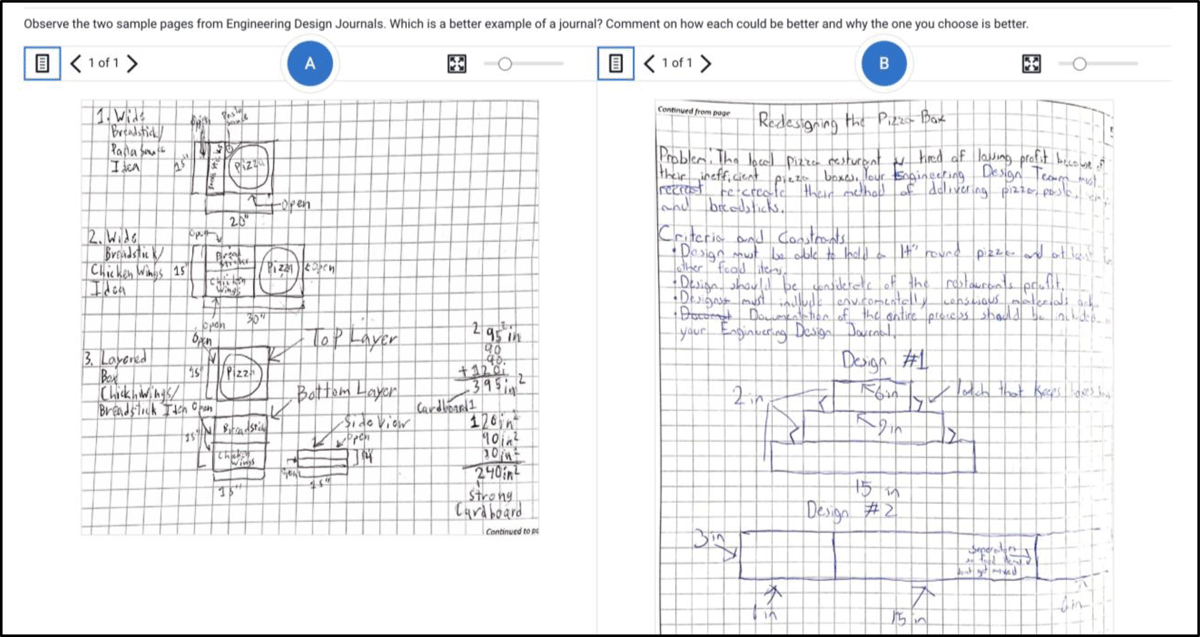
Figure 2
Example: Student LbE interface comparing engineering design journals of a pizza box redesign project
Table 1
Alignment between the 5E instructional model and LbE
| 5E Phase | Instructional Focus | LbE Contribution |
|---|---|---|
| Engage | Introduce real-world problems and activate prior knowledge | LbE prompts initial critical thinking by presenting past exemplars for analysis, stimulating curiosity and context awareness |
| Explore | Encourage hands-on ideation and investigation | LbE facilitates peer-to-peer comparison of emerging ideas, guiding students in identifying constraints and possibilities |
| Explain | Develop conceptual understanding and articulate learning | LbE scaffolds analytical reasoning as students justify their design decisions and identify quality indicators in peer work |
| Elaborate | Extend learning through application and iteration | LbE supports iterative design improvement through evaluative feedback loops, promoting deeper engagement with content |
| Evaluate | Reflect on learning and assess outcomes | LbE enables self- and peer-assessment with structured reflection, enhancing students’ ability to articulate, critique, and revise their work |
Table 2
5E Model in the design thinking context
| Phase | Details |
| Engage | This initial phase is pivotal for integrating real-world engineering challenges into the learning framework. It leverages industry-relevant scenarios to pique students’ interest, thereby establishing a direct connection between academic concepts and their practical applications. |
| Explore | During this stage, students engage in collaborative problem-solving and hands-on experimentation. Activities such as prototyping, coding, and model-building are central, facilitating the application of theoretical knowledge to practical tasks. |
| Explain | This phase involves a collaborative dialogue between students and educators, focusing on the analysis and discussion of the exploration outcomes. It serves as a conduit for introducing and assimilating technical terminology and formal concepts within the context of their empirical experiences. |
| Elaborate | Tailored to extend learning, this phase involves more intricate or extensive project work. Students are encouraged to refine their solutions, incorporate advanced technologies, and consider the broader societal and environmental implications of their work. |
| Evaluate | The evaluation phase transcends traditional assessment methods by incorporating peer reviews and reflective practices on the design process and final outcomes. This comprehensive assessment strategy focuses on both technical skills and the overall problem-solving methodology, highlighting the importance of continuous improvement and practical relevance. |
Table 3
Example coding prompt: “How does LbE affect your use of design thinking in teaching?”
| Engage | Contribution: Engages students by providing real-world contexts that pique their interest in design thinking, fostering curiosity. Hindrance: If not carefully framed, LbE can overwhelm students with complexity before they grasp the fundamentals of design thinking. |
| Explore | Contribution: Allows students to actively engage in problem-solving, promoting hands-on exploration of design concepts. Hindrance: Without structured guidance, students may focus on the experience rather than the exploration of design principles. |
| Explain | Contribution: Encourages students to reflect and articulate their design thinking processes, enhancing their understanding. Hindrance: Students may struggle to verbalize their thought process without a clear framework linking the experience to design thinking. |
| Elaborate | Contribution: Requires students to apply design concepts in new, complex situations, which deepens their design thinking skills. Hindrance: Students might face difficulty in abstracting and applying learned design thinking concepts to different contexts without explicit connections. |
| Evaluate | Contribution: Facilitates the evaluation of students’ understanding and application of design thinking through both process and product assessment. Hindrance: Measuring the impact of LbE on students’ design thinking can be challenging without clear evaluative criteria linked to design thinking objectives. |
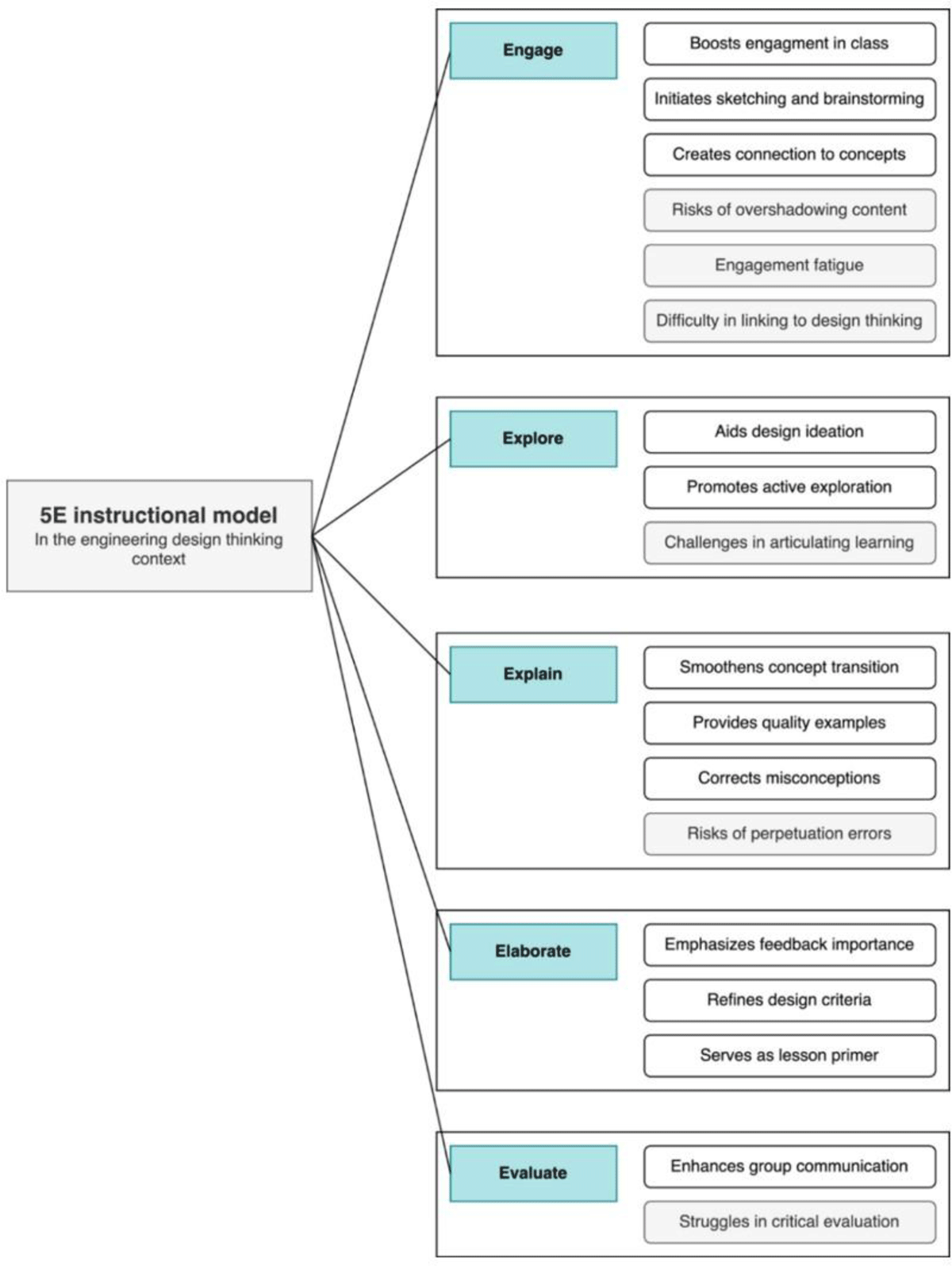
Figure 3
Visual Summary: LbE applied in 5E framework and design thinking context
Table 4
Synthesis of LbE implementation findings across 5E Phases in design thinking classrooms
| 5E Phase | Key Function | Design Thinking Parallel | How LbE Supports | Main Benefits | Instructional Challenges |
|---|---|---|---|---|---|
| Engage | Fuels interest, taps into prior knowledge | Empathize / Discover | Boosts engagement via comparing past work and real-world context | Boosts engagement Sparks brainstorming Builds concept links | Risk obscuring content Engagement fatigue Trouble connecting to broader design thinking |
| Explore | Encourage inquiry, hands-on exploration | Ideate / Research | Guides ideation and sketching with examples stimulating original thinking | Aids ideation Encourages active exploration | Students struggle to articulate insights from comparisons |
| Explain | Clarify concepts, introduce terminology | Define / Synthesize | Solidifies conceptual understanding via comparisons; resolves misconceptions | Smooth transition to new concepts Clarifies quality Corrects misconceptions | Misconceptions may persist if not explicitly addressed in discussion |
| Elaborate | Apply knowledge, extend thinking | Prototype / Iterate | Promotes iterative thinking and the value of feedback; sharpens criteria and constraints | Reinforces feedback loop Refines design criteria Acts as redesign primer | None explicit, but requires intentional facilitation to maintain rigor |
| Evaluate | Reflect, assess, and communicate learning | Test / Reflect | Supports group reflection/synthesis Requires scaffolding in evaluative language | Enhances group communication Synthesizes full design process | Difficulty verbalizing evaluative thinking Need scaffolding for critique and feedback |