
Introduction
The active engagement of the Elementary STEM Council (ESC) within the International Technology and Engineering Educators Association (ITEEA) gives evidence of the growth of engineering and technology education activities at elementary and early childhood levels in the USA. With elementary schools’ increased attention to engineering and technology education, much research has discussed the potential of incorporating robotics activities and coding within early childhood education to stimulate children’s interest in engineering and technology from a young age (e.g., Bers et al., 2014; Toh et al., 2016). Moreover, according to ITEEA’s Standards for Technological and Engineering Literacy (STEL), robotics has long been a core component of engineering and technology education and should be introduced to students in the earlier grades to engage them in engineering and technological practices (Bakala et al., 2021; Bers et al., 2014; Bloodworth et al., 2023; Çakir et al., 2021).
Early childhood education research has shown that coding provides fundamental skills necessary for participation in the digital society and significantly contributes to children’s developmental areas. For instance, Ceylan and Aslan (2024) implemented a learning trajectories-based coding education program, considerably enhancing preschool students’ mathematical measurement skills. Metin (2022) conducted an eight-day activity-based unplugged robotics and coding training program and found a significant improvement in preschool children’s basic coding and robotics skills. Turan and Aydğdu (2020) suggested that robotics and coding education bolsters children’s scientific process skills. In addition, coding was found to support the development of children’s skills such as computational thinking and competencies (Bakala et al., 2021; Bers et al., 2014; Gerosa et al., 2021), problem-solving, reasoning, acquisition of meta-cognitive skills (Çakir et al., 2021; Fessakis et al., 2013; Grover & Pea, 2013), and creative thinking skills (Berson et al., 2023; Gerosa et al., 2021). Moreover, coding was increasingly recognized to promote children’s social-emotional development (Fridberg et al., 2023; Hudson et al., 2020). Significantly, computational thinking and problem-solving skills developed through robotics activities at an early age are predictors of later academic and career success, particularly in engineering and technology fields (Flannery & Bers, 2013; Fridberg et al., 2023; Hudson et al., 2020).
Studies on coding in early childhood showed that increased efforts have been made to teach coding skills to children in their early years. Notable developments have been observed in instructional approaches and the assessment of coding skills (Başaran, Metin, & Vural, 2024; Metin, 2022). However, it is essential to explore how teachers conceptualize children’s understanding of coding concepts, the development of coding abilities, and their views on the strategies children employ to engage in coding activities. Teachers are pivotal stakeholders in robotics and coding education, and examining their perceptions is crucial to effectively integrate robotics activities into preschool classrooms (Manches & Plowman, 2017). Some research (Erdğmuş, 2020; Papadakis et al., 2021a, 2021b; Yang, Luo, & Su, 2022) has delved into teachers’ views toward implementing robotics activities within preschool curricula, particularly focusing on the opportunities and challenges. Further research is needed to investigate preschool teachers’ perceptions of children aged 3–5 learning to code based on their observations of children’s practices in robotics and coding activities.
To articulate children’s coding and computational thinking behaviors and processes, Brennan and Resnick (2012a) proposed a three-dimensional framework comprising practices, concepts, and perspectives. In this study, we explored preschool teachers’ perceptions of children’s capabilities and strategies in directing the robot’s movement (i.e., practices), their understanding of fundamental coding concepts (i.e., concepts), and children’s understanding and development of relationships with the socio-technical environment (i.e., perspectives). This study utilized a qualitative case study method to investigate teachers’ perceptions of young children’s coding capabilities when using an interactive robot to engage 3 to 5-year-old children in classroom robotics activities, with the aim of deepening our understanding of how robotics and coding education can be introduced into early childhood settings. This study answered the following research questions:
How do teachers perceive the development of skills and strategies for directing robot movements in preschool children aged 3 to 5?
How do teachers perceive preschool children’s understanding of fundamental coding concepts such as sequencing, selection, repetition, and debugging?
What are teachers’ perceptions of preschool children developing relationships with peers and the robot during coding activities?
Theoretical Framework
Robotics is one of many technologies that engineering and technology programs have embraced over recent decades (Bloodworth et al., 2023). The STEL linked robotics with computation and computational thinking and advocated the introduction of robotics into classrooms from pre-K through high school to develop children’s computational thinking (ITEEA, 2020). Brennan and Resnick’s (2012a) three-dimensional framework (i.e., practices, concepts, perspectives) has been acknowledged as an appropriate means of comprehensively understanding children’s coding abilities and behaviors (Brennan & Resnick, 2012b; Chen et al., 2017; Sáez-López et al., 2016). In the present study, we explored preschool teachers’ perceptions of 3–5-year-old children’s coding capabilities in practices, concepts understanding, and perspectives of relationship developments during coding activities based on the three dimensions outlined by Brennan and Resnick (2012a). More importantly, Brennan and Resnick (2012a) posited that practices and perspectives are not as assessment-friendly as concepts, necessitating a qualitative case study approach for this research. The three dimensions are interrelated so no single dimension should be assessed in isolation. Figure 1 depicts the three dimensions and their corresponding constructs.
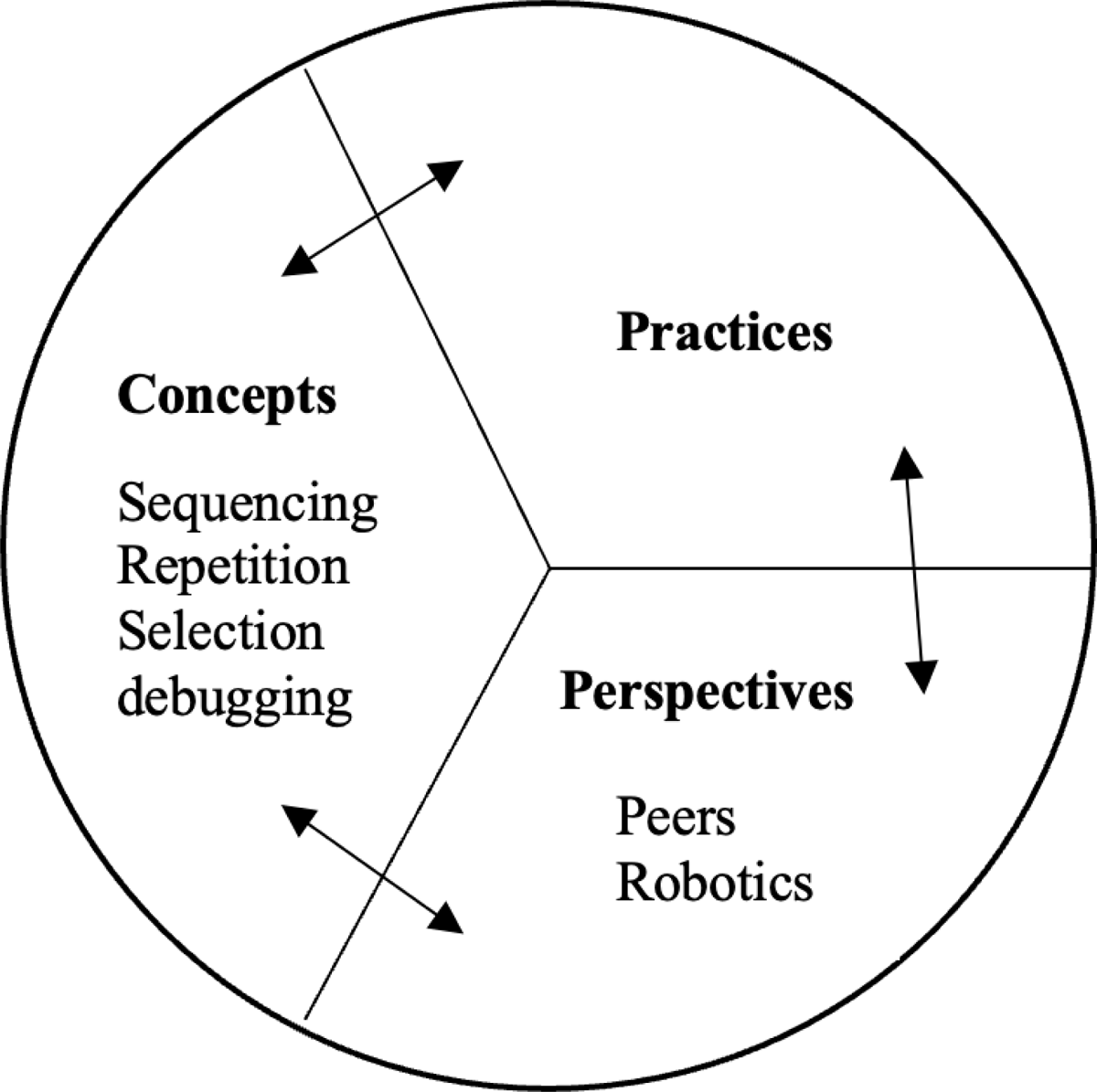
Figure 1
Three Dimensional Framework to Perceive Children’s Coding Abilities based on Brennan & Resnick, 2012a
Practices
According to Brennan and Resnick (2012a), when interacting with and navigating the physical robot movements, children engage in various coding practices, such as incremental and iterative testing and debugging (Brennan & Resnick, 2012a; Zhang & Nouri, 2019). This dimension focuses on what and how coding skills and strategies are used by children when they create codes to control the robot (Falloon, 2016). Designing and coding their own stories is similar to what a programmer does in moving an object through different obstacles and settings to reach the goal (McLennan, 2017) and requires the combination of various coding practices suggested by Brennan and Resnick (2012a). Debugging and testing are the most commonly observed coding practices (Falloon, 2016; Zhang & Nouri, 2019). Kafai and Vasudevan (2015) found that students iteratively perform these practices; for instance, debugging can occur before and after testing. Furthermore, children participated in an iterative programming process by repetitively incorporating peer feedback to move forward with their designs (Kafai & Vasudevan, 2015).
For engaged coding practices, teachers can allow children to use simple coding materials within familiar contexts, especially when interacting with physically embodied robots, making coding practices relevant and meaningful to children (Campbell & Walsh, 2017). In addition, playful coding is one of the essential practice considerations to attract children’s interest and stimulate motivation (Heikkilä & Mannila, 2018).
Concepts
Children engage with and grasp fundamental programming concepts while engaging in robotic practices. Brennan and Resnick (2012a, 2012b) suggested a set of programming concepts consisting of sequencing, repetition, selection, and debugging that are compatible with the developmental stage of children in preschool and kindergarten.
Through the synthesis of empirical studies, Zhang and Nouri (2019) found that repetition, selection, and sequencing are considered core programming concepts. Those concepts are the basic structures and components in any programming language (Funke & Geldreich, 2017; Grover & Cooper, 2015). Sequencing is the execution of a series of steps in the proper order. Several studies suggested that children could comprehend sequencing easily since they could use analogies in daily life to understand this concept (Wohl et al., 2015; Zhang & Nouri, 2019). Bakala et al. (2021) found that the concept of sequencing was one of the central components of programming identified in 87% of the studies they reviewed. Repetition is the mechanism to repeat a sequence of steps several times to achieve planned goals. Selection is children’s decision-making based on conditions or facts. Bakala et al. (2021) found that over one-third of the reviewed studies examined children’s comprehension of repetition and selection control structures.
Debugging is detecting and correcting error points in a code or series of codes (Brennan & Resnick, 2012b). It requires children to recognize problems or errors, check alternative hypotheses, and debug a program iteratively. Roussou and Rangoussi (2020) have broken down the debugging process by identifying cause-and-effect relations and solving the corresponding issues. Debugging is widely recognized as one of the critical concepts in children’s robotics and programming activities (Shute et al., 2017). Children’s comprehension of debugging is essential in coding; however, not much robotics research delves into young children’s conceptual understanding of debugging. Among the few studies, Bers et al. (2014) constructed a curriculum to develop students’ debugging skills. Muñoz-Repiso and Caballero-González (2019) also designed coding activities requiring children to detect and correct programming errors.
Perspectives
During programming, children can form distinct and evolving perspectives about the world, their relationship with peers, and themselves. Those perspectives result from children’s expressing, connecting, and questioning self and peers’ coding actions (Brennan & Resnick, 2012a). The expressing perspective focuses on how students communicate with peers and the coding world through language and codes. Researchers examine connecting through questions such as whether and how students collaborate and interact when participating in coding activities. Falloon (2016) emphasized that connecting is a common strategy employed at all stages of students’ programming work as they frequently receive feedback and give advice to others. Regarding questioning, researchers explore the questions and thoughts students have in terms of how they use coding to solve problems.
Teachers’ Perceptions of Early Childhood Robotics and Coding Education
The integration of robotics and coding into early childhood education is gaining traction as teachers recognize the potential of these technologies to enhance learning and development in areas such as critical thinking, problem-solving, and computational thinking (Khine, 2017; Rojewski & Hill, 2014; Sullivan & Bers, 2016; Zviel-Girshin et al., 2020). Teachers’ perceptions of early childhood robotics and coding education are pivotal, as they significantly influence the adoption and the quality of these educational interventions (Papadakis, 2022; Yadav et al., 2017).
Teachers generally recognize the potential for coding activities to enhance cognitive and problem-solving skills, even among younger learners (Erdğmuş, 2020; Papadakis et al., 2021a; Sullivan & Bers, 2016). They observe that preschoolers, despite their young age, are capable of understanding basic coding concepts – such as pattern recognition, sequence prediction, and simple logic – when these are integrated into developmentally appropriate, play-based activities (Elkin et al., 2016). Furthermore, the minds-on and hands-on nature of robotics is seen as a powerful tool for making abstract coding concepts accessible and understandable for young children (Garvis & Keane, 2023).
Teachers also recognize that coding activities in preschool settings can encourage social interaction as children collaborate to solve problems and share discoveries. Teachers view this collaborative aspect of coding positively, as it aligns well with the social learning environments typical of early childhood education (Kim et al., 2015). However, there is also an emerging concern among preschool teachers that coding activities, when not age-appropriate, potentially impede the development of both technical and cognitive skills development (Papadakis et al., 2021a, 2021b; Reich-Stiebert & Eyssel, 2016; Yang et al., 2022). Teachers’ concerns about age-inappropriate coding activities are multifaceted and include surpassing the children’s coding capabilities, misaligning their metacognitive development, and poorly integrating into existing curricula (Negrini, 2020; Reich-Stiebert & Eyssel, 2016). Thus, a deeper exploration of teachers’ perceptions of their students’ abilities in coding can inform decisions about developmentally appropriate robotics activities that optimize the benefits of robotics and coding education for young learners.
Method
Participants
This study employed a case study method. The participants were two preschool teachers based in the southeastern United States. They integrated a Blue-Bot® robot and various play-based robotics activities into their regular classroom routines for two months. Each teacher had a group of 15 to 16 children, ranging in age from 3 to 5.
One teacher (hereafter referred to as T1) had no previous experience with coding. The second teacher (T2) had some prior exposure to coding, primarily through informal play-based activities outside of school.
Material and context
A Blue-Bot® programmable floor robot, as depicted in Figure 2, was used in this research. The Blue-Bot® robot, a product of the TTS group, allows user interaction through four directional buttons (i.e., forward, backward, left turn, right turn).
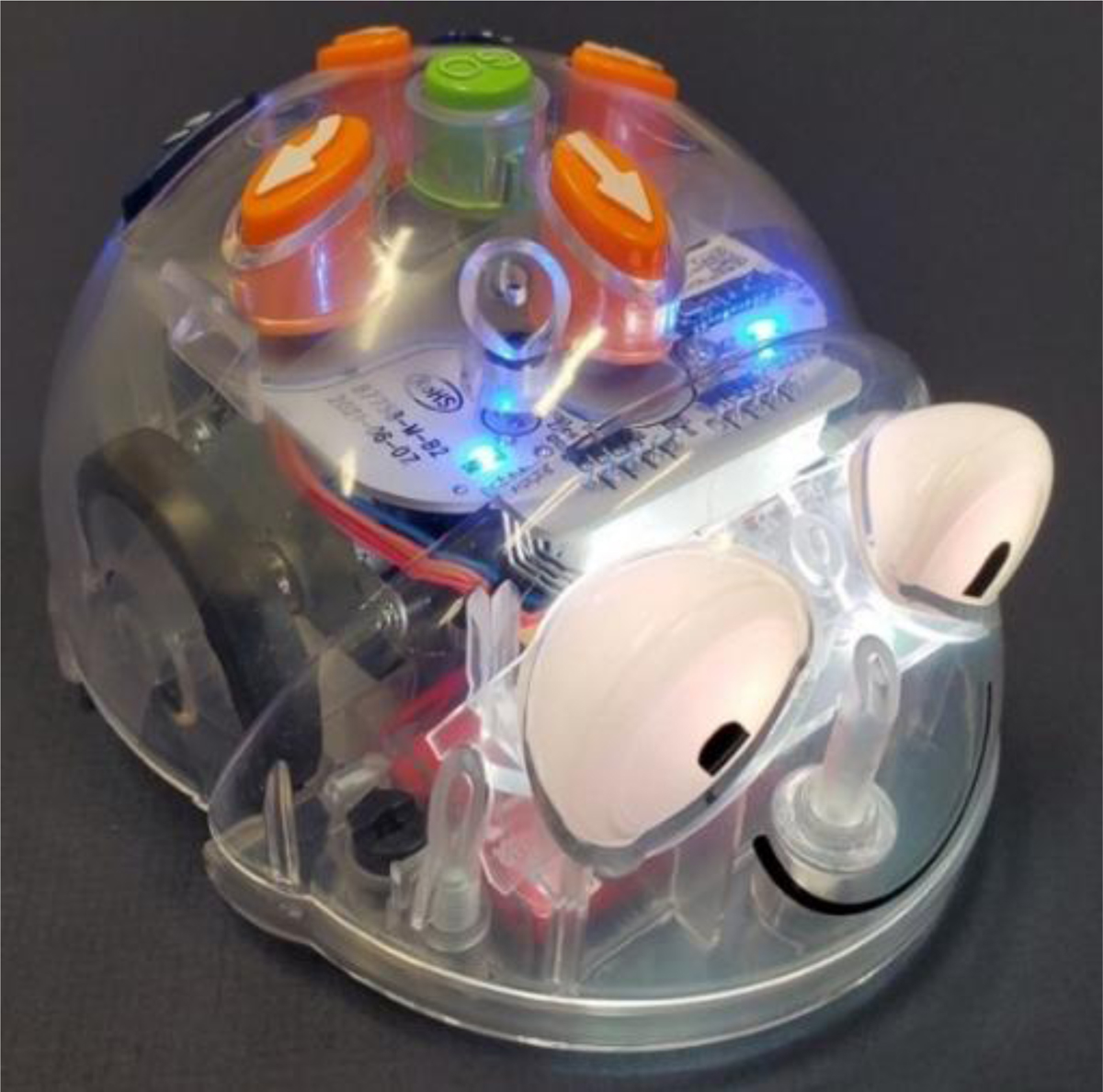
Figure 2
Blue-Dot® Programmable Floor Robot.
The Blue-Bot® robot can execute sequences of up to 40 commands within a single program, enabling children to explore both simple and complex coding concepts as they control the robot’s movement. Its transparent casing – a departure from its predecessor’s yellow – makes the mechanical components visible, promoting an understanding of the robot’s operation. Bluetooth technology enables remote programming from devices like iPads.
Each teacher participant received a Blue-Bot® robot and a 42-inch x 42-inch square grid with 6-inch spacing printed on a scrim for the robot’s navigational exercises. They were asked to engage children with play-based robotics activities using familiar classroom materials. Both teachers began by demonstrating to students how to operate the Blue-Bot® before moving on to exploratory activities, encouraging children to apply coding concepts creatively.
Data collection
We employed a semi-structured interview with each teacher after they conducted all Blue-Bot®-integrated coding activities with their children. The interview protocol, presented in Table 1, included 15 open-ended questions to probe teachers’ insights about using the Blue-Bot® to foster coding skills and competencies based on their observations of children’s coding practices, concepts, and perspectives. Observations revealed in the interviews became the data that revealed teacher perceptions for purposes of this study. These interviews were not confined to a rigid script but adapted to facilitate organic discussion and in-depth exploration of teachers’ experiences, observations, and perceptions. The interviews were conducted within a quiet after-school environment and lasted approximately 45 minutes each. We audio-recorded the teacher interviews and transcribed them verbatim for a robust thematic analysis.
Table 1
Semi-structured interview protocol.
| Areas | Questions |
| Please describe how the children participate in coding activities with Blue-Bot® in your classrooms |
|
| In your opinion, how does using Blue-Bot® help kids develop a better understanding of different coding concepts, such as sequential, selection, debugging, and repetition |
|
| How do children view their relationships with peers and Blue-Bot®? |
|
| Please share your additional experiences and perceptions of using Blue-Bot® in your classrooms. |
|
Data analysis
We analyzed the transcribed interview data using a deductive and inductive coding approach (Azungah, 2018). Before coding, we developed a coding protocol based on the theoretical framework, including (a) practices, pinpointing teachers’ perceptions of children’s behaviors, strategies, and cognitive skills for directing the robot movement; (b) concepts, capturing teachers’ perceptions of children’s understanding and employment of various coding concepts during coding practices; and (c) perspectives, exploring teachers’ perceptions of children’s relational perspectives to others and the technical world around them. The proposed coding protocol remained open to incorporate emerging codes and patterns that emerged throughout the coding process.
Based on the proposed coding protocol, two experts in robotics and education coded T1’s interview data. We then debriefed and compared the coding results to address any discrepancies and incorporate new codes. Any disagreement was negotiated, and a high level of inter-rater agreement was reached. We then proceeded to code T2’s interview data based on the refined coding protocol. The finalized coding protocol is shown in Table 2. This process allowed for integrating emerging codes and patterns with predetermined codes based on the theoretical framework, ensuring an in-depth explanation and a comprehensive understanding of the data.
Table 2
Coding protocol for analyzing teacher perceptions, based on three dimensions of children’s practices, concepts, and perspectives during coding activities
| Dimensions | Codes | Definitions |
| Practices | Skills and strategies | The strategies, behaviors, and skills children employed and displayed in controlling robot movement. |
| Difference | The difference among children when they code and control the robot movement. | |
| Challenges | The challenges children encountered when controlling robot movement. | |
| Concepts | Sequencing | How do children understand and apply the concept of sequencing to control robot movement? |
| Selection | How do children understand and apply the concepts of selection between different codes and strategies in controlling robot movement? | |
| Repetition | How children understand and apply the concept of repetition to make the robot repeat a specific pattern. | |
| Debugging | How children understand and apply the concept of debugging in debugging codes and problem-solving | |
| Perspectives | Peer interaction | How children interact with peers during coding activities. |
| Relationship with robot | How children understand and develop their relationships with the technological world |
Findings
Practices: children’s skills and strategies for directing robot movements
In addressing RQ1, which focused on how teachers perceived the development of skills and strategies in directing robot movements among children aged 3 to 5, we identified three salient themes from the analysis of teacher interview data, including (a) children deployed various strategies for directing the robot, (b) strategy differences by age and gender, and (c) challenges in directing robots.
Theme One: Children deployed various strategies for directing the robot
During the interviews, both teachers perceived that many children employed a strategy of physical visualization to direct the robot. Children frequently touched the grid squares with their fingers and used their bodies to physically map the robot’s movement trajectory before allowing the robot to move across the grid. For example, T2 stated, “They were touching the squares, they were visually looking, and some were lying on the mat because they could not reach where the bot was. You know, they wanted to physically touch and show it with their hands so that they could imagine its movement. they’re still in that stage of when they count, they touch right that one-to-one correspondence.” T1 noted that younger children, particularly those three-year-olds, employed physical visualization more frequently than their older peers.
Teachers also perceived that children employed the strategy of verbalization to articulate their thought processes and the robot movement pathways. For example, T1 shared: “I’d make children verbalize to me. How many squares is it going to move and then turn? And then they did it. I was really surprised. They did more than I expected.” T2 stated that children often counted the squares aloud as the robot navigated the grid.
Additionally, teachers stated that children exhibited strategic thinking by exploring multiple pathways to the robot’s destination. This revealed their understanding of varied solutions to a single problem. T1 expressed: “They could do it differently. Like it did not have to be the same path.” Likewise, T2 remarked, “They could understand that there is more than one way to get the robot to the final destination,…, it wasn’t all me saying that because some kids are very much like this. Kids were like, we could go this way, or we could go that way to there.” Furthermore, teachers perceived that children explored various robot movement trajectories by combining different pathways.
Theme Two: Strategy differences by age and gender
Teachers perceived that age influenced different strategies children employed to direct the robot. Older children (4–5 years) typically visualized the robot’s path mentally, looking at the grid squares without physical contact, whereas younger children (around three years old) frequently relied on direct physical interaction with the grid, using their fingers or bodies to facilitate their visualization. T2 shared one example related to this age difference:
I am thinking of two kids, one who could see it in his mind. And he was like, it is going to land right there. And he would just point where it was going to land. And then another one who was a younger one, like three, and she was like, laying on the grid, touching, moving, counting, …, so that was mostly my specific examples was that the older child was just looking at it with his eyes and he was like, 123, turn up to three, back to three, settling right here. Then, one younger child was lying on the graph because she could not reach where she needed to touch to count, but she still understood where it would go. Like she still got it. But she needed it right there in front of her face.
Additionally, teachers reported that gender differences did not correlate with children’s interest in coding. For example, T1 shared, “I thought that it would the boys will be more interested than the girls. But it wasn’t. They were equally as interested.” However, they perceived gender differences in how boys and girls engaged with the robot activities. Both teachers concurred that boys tended to experiment more with the robot’s movements, exploring creative ways to direct the bot, such as making it move circularly. However, girls favored linear, direct routes, aiming directly for the expected path without seeking alternative pathways.
Theme Three: The challenges in directing the robot
During coding activities, teachers perceived that making the robot turn was a significant challenge for many children. For instance, T2 pointed out, “Anytime children got messed up, it was because there was a turn.” This challenge is likely due to the abstract nature of the concept of direction and children’s developmental stage, resulting in frequent mistakes when directing the robot to turn; as T1 stated, “When they don’t know left and right super well, it is hard to keep the code in their working memory.” T2 said, “I think, I think just spatial ability at their, at their age and their development, and also wanting to know what it’s called, like, is it left? Is it right?” Furthermore, teachers shared that pressing the robot’s right or left turn button caused it to turn rather than turn and move simultaneously, a coding activity children found challenging to perform.
Teachers perceived another challenge: children sometimes forgot to reset the robot’s previous codes between activities, resulting in confusion when executing new coding. T1 remarked, “The thing they forgot to do the most was to clear and start new codes.” T2 echoed, “There were certain times that they didn’t clear it out, they didn’t clear out the code. And so they put in their new code. And then it didn’t do what they thought that it was going to do.”
Furthermore, teachers shared that dealing with long coding sequences was challenging for children. In particular, teachers found that many children had difficulty executing coding sequences with more than one turn within a single coding activity. They also had difficulty managing lengthy sequencing codes, leading to errors in the robot’s movements. T2 expressed that the children struggled with questions like, “Did I push too many? Which way is it going to go? Which didn’t push-that one or this one?”
Concepts: comprehension of coding concepts
In addressing RQ2, which examined teachers’ perceptions of preschool children’s understanding of fundamental coding concepts, the data anlysis revealed that teachers perceived that children quickly grasped basic coding terminologies, such as “code” and “coding”, once these terms were explained. For example, T2 introduced the concepts to children by saying, “We are giving it like a secret code like we are telling the robot exactly what we would like it to do. And it is going to decide, it is going just to do exactly what we asked it to do,” and shared that children understood when she used the word “code” and “coding” in this context.
Both teachers shared that the most frequently introduced coding concepts during students’ coding practices were sequencing, selection, and repetition, although these specific terminologies were not explicitly used. They perceived that children were capable of understanding and applying these coding concepts in their interactions with the robot. This observation suggested that young children can effectively engage with these fundamental concepts through practical application. For instance, regarding “sequencing,” teachers perceived that children understood the importance of order in robot movement and paid close attention to the sequence of their codes, making decisions such as “which code was first, which one next, and what was it going to do, where is it going to end last.” (T1). This indicated a grasp of the concept of sequencing among children. In addition, teachers stated that children could select the sequence of their codes and choose their preferred pathways among multiple alternatives. Teachers also noted that children consistently employed the concept of repetition, often repeating the same codes multiple times. For instance, T2 mentioned, “they wanted to go forward, forward, forward, they repeated the same code by pressing the same button many times. Sometimes one went off the mat completely. They knew they went too many, they repeated too many times.” T1 also shared, “They understand what it means to repeat and to do it again. And if it does not work, they try to repeat it again, again and again.”
Teachers reported that they did not use the word “debugging” during children’s coding practices, considering their cognitive developmental stage. However, they perceived that children could apply debugging to solve the errors they encountered. Teachers shared that children could identify errors with their codes when the robot didn’t perform as expected and then made multiple attempts to correct the codes. T2 stated, “They probably could have understood the debugging and they probably would have thought that was a super cool word. They would have thought that was cool. Because it, you know, has a bug in it.”
However, teachers perceived that children can not verbally articulate the abovementioned coding concepts, even though they can understand and apply those concepts through their practices. T2 mentioned, “Conceptually, for vocabulary, I don’t think that children would be able to say they are cool and big words, yes, but understand.”
Perspectives: the relationships with peers and the robot
To address RQ3 regarding teachers’ perceptions of children’s relationships development during robotic activities, we analyzed the interview data focusing on peer interactions and relationships with the robot.
Theme One: Peer interactions
During the interviews, teachers reported that children often assisted in visualizing and debugging their peers’ codes for directing the robot. This assistance demonstrated the children’s ability to work collaboratively in problem-solving. T2 shared, “What I am most surprised about is that when another child was coding, the other children could figure out where it would go. Prediction and paying close enough attention to what the child was doing.” For example, when one child encountered difficulties manipulating the robot’s turns, other children would offer physical support by touching the grid to help visualize the turning, such as, “They were able to watch it, then spatially do it in their minds or touching. They could figure out where it would turn,” T2 described. More importantly, teachers found that children could be patient and respectful when their peers mapped out and debugged their codes.
Theme Two: Relationship with the robot
When reflecting on their perceptions of children’s interactions with the robot, teachers expressed that children understood the cause-and-effect relationships between the Blue-Bot®’s buttons and their corresponding movements. T2 shared, “They understood the relationship between these. These are the buttons they were pushing; the bot responds exactly to those, you know, commands or codes.” For example, children gradually discerned the meanings of the turn buttons after initial failures, which posed a significant challenge for them at the outset. Furthermore, teachers observed that children demonstrated an understanding that making the robot turn in a specific direction, such as turning left, might vary based on their positions relative to the grid. This indicates a flexible and contextual understanding of the relationship between their positions and the robot. For example, T1 stated, “Children developed strategies for using terms, such as turning to the top/bottom, turning to your side, turning to my side when making the robot turn.”
Additionally, teachers perceived that during coding activities, children learned the necessity of following coding procedures to direct the robot. For example, they noted that children gradually remembered to clear previous codes before starting new coding sequences. Furthermore, they understood the importance of adhering to the sequential order of their codes to direct the robot’s movement. T1 shared, “I noted that sometimes children spend a lot of time figuring out the first code, the second code to make the robot reach the destination. They seldom randomly push the buttons.” This indicates that children developed an appropriate relationship with the robot to direct its movement effectively.
Discussion
In this qualitative case study, we examined observations made by two preschool teachers to understand their perceptions of the abilities of children aged 3 to 5 to develop coding strategies, understand coding concepts, and build social dynamics necessary for interacting with peers and a robot. Understanding teachers’ perceptions can guide infusion of robotics activities in early childhood instruction, fostering an early interest in engineering and technology among young learners. Grounded on Brennan and Resnick’s (2012a) three-dimensional theoretical framework for student coding and computational thinking, including practices, concepts, and perspectives, our analysis of teacher interview data revealed that teachers perceived children within this age group exhibited a variety of skills and strategies to direct robotic movements, understood basic coding concepts, and developed evolving relationships with peers and the robot.
Research has demonstrated that robotics and coding used in PreK-12 STEM and engineering and technology education can foster children’s cognitive and technological skills (Sapounidis et al., 2015; Toh et al., 2016), as well as their application of coding principles to solve problems (Kazakoff et al., 2013; Pila et al., 2019; Saxena et al., 2020; Strawhacker & Bers, 2015). However, those studies have primarily focused on measuring students’ learning outcomes in robotics-integrated tasks, such as achievement and engagement, while the question of coding capabilities in children aged 3–5 remained underexplored. More importantly, as primary stakeholders in the classroom, teachers’ perceptions of children’s coding abilities are crucial for understanding robotics education in early childhood settings. Addressing this research gap, in the present study we asked: Can children aged 3–5 years learn to code? Based on observations recorded in our interviews, the participating teachers perceived children, including three-year-olds, having the ability to employ various strategies and skills to complete coding tasks.
The findings suggested that teachers perceived three strategies that children used to interact with the robot: (a) physical visualization, (b) verbalization, and (c) the exploration of multiple pathways. Physical visualization, informed by theories of embodied cognition (Barsalou, 2008; Wilson & Foglia, 2011), facilitated children’s translation of complex coding procedures into concrete actions such as navigating grid squares and counting robot steps. However, verbalization allowed children to articulate their cognitive coding models, indicating the importance of speech in cognitive development and social behaviors (Vygotsky, 1962). The strategy of children pursuing various pathways to the same endpoint revealed their innate creativity in problem-solving. Experiences like this that enhance adaptability and inventiveness develop valuable skills in both programming and general problem-solving contexts. It is well-documented that early exposure to coding cultivates problem-solving aptitudes, cognitive development, and creative abilities (Bers et al., 2019; Çiftci & Bildiren, 2020; Hufad et al., 2021). The findings of this study suggest that children can engage effectively with robotics when developmentally appropriate strategies facilitate their engagement.
Our research revealed teachers’ perceptions of the age and gender-related variations in the strategies employed for directing the robot. Teachers perceived that younger children, such as three-year-olds, engaged more physically with coding activities. Surprisingly, despite needing more support, such as physical visualization, younger children also displayed competent coding abilities when they possessed more vital mathematical skills, such as pattern recognition and number sense. Additionally, gender-based differences in programming strategies were identified, with boys often adopting a more exploratory approach and girls opting for a direct method. This difference reflects established research on gender-specific play patterns (Angeli & Valanides, 2020; Papavlasopoulou et al., 2020; Su et al., 2023; Sullivan & Bers, 2013, 2016). These findings support the need for curricula accommodating varied strategy preferences, accounting for age and gender differences. Furthermore, teachers should provide age and gender-appropriate scaffolding to foster the completion of coding tasks when robots are used with early learners.
Teachers perceived that children faced challenges directing robots, including comprehending spatial concepts such as left and right, remembering to clear previous codes, and managing the cognitive demand of lengthy sequential codes. These challenges reinforce the necessity for effective teacher facilitation and targeted instruction – a strategy recognized for aiding children in solving complex tasks, such as sophisticated coding activities (Kirschner, Sweller, & Clark, 2006). Teachers can apply individualized instruction and scaffolding to address each child’s challenges. For instance, to assist in comprehending spatial concepts, teachers might employ alternative terms, such as ‘top’ and ‘bottom,’ ‘your side’ and ‘my side,’ that resonate better with young children’s levels of cognitive development.
In light of children’s understanding of coding concepts, our findings corroborate previous research, showing that young children, even as young as three, can understand and use fundamental coding concepts through interactive robotic activities. The findings challenge the notion that coding is exclusive to older children, bolstering the argument for introducing robotic activities and corresponding coding concepts to preschoolers. Our research also highlighted teachers’ perceptions that some children struggle to express their understanding of coding terms verbally. Instead, they rely on experiential learning (Kolb, 2014) by interacting with robotics and coding materials in ways that demonstrate comprehension. This indicates that teachers should provide diverse methods and avenues for gauging understanding of coding concepts during robotics and coding activities (Hmelo-Silver et al., 2007).
The children’s engagement in group-based robotic debugging activities, as shared by T2, promoted cognitive skills such as problem prediction and pattern recognition (Bers, 2018; Voogt & Knezek, 2018). Furthermore, consistent with Bers (2018), this study underscored the importance of such engagement for developing teamwork and patience, affirming that robotic activities benefit cognitive flexibility and social skills in a collaborative community (Ramani & Brownell, 2014).
Teachers perceived that children could understand the cause-and-effect relationship of the various buttons of Blue-Bot®, particularly the turning buttons, after several attempts. This underscores the effectiveness of tactile engagement for grasping complex robotic systems and abstract coding concepts (Silvis et al., 2022). Consequently, when crafting preschool coding curricula, preschool educators and curriculum designers need to incorporate tangible programming interfaces to establish a solid basis for computational thinking (Bers, 2010; Bers et al., 2014). In a broader sense, this also supports the minds-on and hands-on, problem-based approaches used in other engineering and technology education learning activities that do not involve robots.
These findings support the inclusion of robotics and coding activities as a component of early childhood education. When teachers introduce developmentally appropriate robotic activities, they simultaneously cultivate a range of skills in their students, including coding literacy, creativity, problem-solving abilities, and computational thinking and foster interest in engineering and technology (Macrides et al., 2022). Early engagement with these activities lays the groundwork for proficiency in computational thinking—a core component of engineering and technology education (ITEEA, 2020)—and fosters cognitive abilities and adaptive problem-solving skills. When considering young children’s cognitive capabilities to participate in robotics and coding activities, teachers need to think about the varied strategies children employ, their gender- and age-based differences, and potential challenges encountered to support personalized and interactive learning experiences, thus advancing children’s cognitive development and preparing them for a technologically literate future (Stamatios, 2022).
Conclusion and Limitations
To understand young children’s capabilities to code (Brennan & Resnick, 2012a), this study shed light on preschool teachers’ perceptions of 3–5-year-old children’s capabilities to develop skills and strategies in directing robot movements in coding practices, as well as children’s understanding of coding concepts, and perspectives of their relationships to peers and the technical world around them. Our findings revealed that teachers perceived young children to be capable of developing the ability to apply various coding strategies to direct the robot’s movement. This ability was seen as a critical indicator of children’s emerging problem-solving capacity and cognitive growth necessary for coding at a young age. Teachers further perceived that age and gender could play important roles in affecting children’s strategies to direct robot movements. Remarkably, teachers perceived that even children as young as three could comprehend and execute fundamental coding concepts and understand the socio-technical relationships with peers and the robot through engaging in collaborative coding tasks and following appropriate coding procedures. Based on teachers’ perceptions, we concluded that children aged 3–5 developed the cognitive, practical, and social abilities to engage in coding and robotics activities. This suggests the feasibility of introducing robotics into preschool curricula and classrooms.
This research acknowledges limitations, including relying only on qualitative data from teacher interviews, which may not be universally applicable. Future research could benefit from a mixed-methods approach for a broader perception on children’s coding capabilities. Moreover, extending the study over a longer period and involving a more comprehensive range of participants could provide valuable insights into the long-term impact of early coding education on child development.
Competing Interests
The author has no competing interests to declare.