
Introduction
The Commission des titres d’ingénieur (CTI) (Commission for Engineering Qualifications) is an institution regulating the training of engineers in France. It determines which engineering schools are entitled to confer the title of engineer to their graduates. The CTI employs a number of criteria to evaluate engineering training, including the institution’s identity, quality assurance, and training structure. Among the criteria considered by the CTI are those pertaining to skill-based teaching practices, such as project-based learning (PjBL) or problem-based learning (PBL). This commitment of the CTI establishes the management and project approach as a cornerstone of engineering training in France (Lemaître, 2017). Consequently, project management is integrated into all engineering training programs in France, which are aligned with scientific knowledge throughout the curriculum (Bouffartigue & Gadéa, 1997).
From a research perspective, project management in engineering education has been studied in different countries. These studies focused on the professionalization of engineers, or on the pedagogical approaches used to teach project management (Ballesteros-Sánchez et al., 2017; Chipulu et al., 2011; Guo et al., 2020; Marnewick, 2023; Ojiako et al., 2011, 2013). Among these studies, the uses and performances of artifacts were investigated without prior definition (Guo et al., 2020; Marnewick, 2023). This lack of definition underscores the need to explore the definitions of artifacts used in project management education. Moreover, most studies on artifact interactions or construction were conducted at the primary or secondary school levels (Collier-Reed et al., 2009; Impedovo et al., 2015; Rücker & Pinkwart, 2018; Svensson & Ingerman, 2010).
The objective of this study was to examine the gap in research on the concept of artifacts from a cultural perspective within the context of project management education at a post-secondary engineering school. The perspective of artifacts as explored in this study was based on the prior research of Vygotsky (1978, 1997). Vygotsky posited that artifacts facilitate mental processes in the context of problem-solving, as well as the mediation of the subject with the environment. Furthermore, as Cole (1996) posits, artifacts are said to condense “the signs of historical and cultural context in which they are created and are continuously recreated through their own use, making the culture as a system of accumulated artifacts of a community” (Impedovo et al., 2017, p.21).
Adhering to a case study approach (Yin, 2018), our theoretical framework for exploring artifact definitions within the context of project management was based on the work by Impedovo et al. (2017). Specifically, this study was focused on a project management learning sequence in a French engineering school, which is a fundamental curricular component of French engineering teaching used for introducing first-year students to project management.
Literature Review
Artifact
De Vries (2005) defined an artifact as: “any object that has been modified, whether or not it displays what it has been modified for” (de Vries, 2005, p.14). The term “modified” was directly linked to the definition given by Rabardel (1995), which specifies human interventions on artifacts and its use in an activity. As previously stated, our examination of the concept of artifact was based on a cultural perspective, and our theoretical framework was based on an article identifying artifacts from different epistemological and scientific perspectives (Impedovo et al., 2017). Specifically, the Impedovo article presented artifact as being polysemic and complex, and defined as a term dependent on the context and the pedagogical objectives.
Some studies questioned the categorizations of technical artifacts made by pupils. These studies demonstrated that the relationship between the subject and the technical object is complex (Impedovo et al., 2015). However, an educational-mediated intervention was shown to enable students with the ability to differentiate and categorize artifacts in advance, which assisted them in understanding complex technical artifacts (Rücker & Pinkwart, 2018).
Furthermore, Collier-Reed et al. (2009) identified four types of interactions with artifact: those directed by another individual; those facilitated by instruction; those self-initiating by tinkering ; and those created by self-engagement. In addition, Svensson and Ingerman (2010) demonstrated that pupils can discern systems in everyday objects in five ways:
By using objects,
By considering the function of objects,
By considering objects as part of a process,
By considering objects as components in one system,
By considering objects embedded in systems,
Outside of the learning context, Nia et al. (2019) questioned the normative practices associated with technology development as artifact in engineering practices. From two case studies, practices with non-normative rules were primarily driven by economic and political interests, despite people’s welfare and protection of the environment. These studies were useful for defining and categorizing the concept of artifact for pupils in technology education, but they did not demonstrate how audiences other than primary or secondary school students categorize artifacts within a learning context.
Projects and project management in engineering education
Heitmann (1996) showed that companies and engineering professions insisted on expanding skill and pedagogical approaches linked to the notion of project, which in part explains why project management was introduced into the engineering education curricula. Education from the project context was designed to prepare engineering students with technical skills (Sharma et al., 2021), technical knowledge (Rodríguez et al., 2015), and the ability to deal with technical complexity (Ballesteros-Sánchez et al., 2017). Recent literature reviews highlight the contributions of these pedagogical approaches on several aspects, such as skills contributions or engagement in learning (Guo et al., 2020; Helle et al., 2006).
Project management on the other hand is a mode of governance that allows the construction of an innovation (technological, accounting, social) in order to solve problems (Boutinet, 2012). From this pedagogical approach, project management is taught from several angles: work-based training (Sharma et al., 2021), instructional strategies for teaching project management to engineers (Ojiako et al., 2011, 2013), student experiences and learning within project management (Chipulu et al., 2011; Marnewick, 2023), and articulation between project management training and skills (Ballesteros-Sánchez et al., 2017).
Method
Research Question
As revealed through the previously discussed research, there are strong links between project management and pedagogical approaches such as PjBL, employed in higher education. In post-secondary engineering education specifically, project management is closely linked to the acquisition of professional engineering skills. However, research in project management education does not address the way in which students construct physical artifacts within this learning context, as is done in technology education research (Collier-Reed et al., 2009; Impedovo et al., 2015; Rücker & Pinkwart, 2018; Svensson & Ingerman, 2010). Furthermore, Guo et al. (2020) identified the need to explore the role of artifacts in the context of project training for engineers given that the inclusion of artifacts addressed through the project evaluation process is minimal. In light of these observations, it is pertinent to question artifacts from a cultural perspective in project management education, in order to account for the mediation and conceptualization of artifacts in this context. Consequently, this raised the following research question guiding this study:
RQ: What types of artifacts are used by first-year engineering students engaged in project management education?
Context and Participants
Presented is a case study focusing on a learning sequence as a curricular component in a French post-secondary engineering school. This engineering school was part of a group of engineering schools that have historically trained generalist engineers who would have management responsibilities within an organization. The goal of such training reflects the French vision of engineering education, which is to prepare them “not as simple technical implementers, but as industrial managers, able to direct major projects” (Lemaître, 2017, p.3).
Within the selected engineering school, we studied a learning (instructional) sequence designed for first-year engineering school students. The main objective was to introduce them to project management and teamwork. Prior to engaging in this learning sequence, students had completed a Massive Open Online Course (MOOC) on project management. The MOOC was comprised of four parts: part one on the theory of project management; part two was chosen by the learner (for example, creativity management or visual management); part three was an optional case study; and finally, part four was an examination.
The following instructional objectives, not made available to the students, guided the design of the learning sequence:
Solving a small engineering problem by adopting a simple project approach, with limited resources (identical equipment provided for each group).
Learning to work together: discovering each person’s abilities in the team, developing listening skills, group dynamics.
Developing a systemic vision and abilities in order to integrate various components of a project.
Developing strategies, decision-making, managing priorities, dealing with unexpected events.
Learning to react to the unexpected.
Learning to take care of deliverables qualities (presentation, video, report).
Establishing values in the workplace.
Working on sustainable development.
The engineering design challenge given to students was: “Build a prototype of a system which improves a workspace. This system must correspond to sustainable development requirements that you define”.
Given the design challenge, the learning sequence was organized according to a scope statement and a timeline (Table 1).
Table 1
Learning Sequence Structure and Deliverables
| Learning Sequence Structure | Deliverables |
| The subject was presented in an amphitheater. But there were no specific instructions about group organization. Students made their own groups of seven to eight people. Groups worked independently from Monday to Thursday. Teachers worked with groups once or twice during the week. In the middle of the week, a new deliverable is presented to the students. All deliverables had to be submitted by Thursday night. On Friday morning, students had an oral presentation. On Friday afternoon, there was a feedback session about the week. The subject is “teamwork”. | Project prototype must be built with ‘Meccano’ from ‘Meccano’ toy brand. A report explaining the project (six pages maximum). A report evaluating another group. A video showing project prototype in operation (three minutes maximum). An oral presentation of the project (five minutes maximum). |
Students were free to go and work wherever they wished, such as classrooms for meetings or a Fab-Lab in the engineering school. The Fab-Lab was a facility providing access to a wide range of tools. It contained five hubs: a 3D printing hub, an electrical hub for working on electrical systems, a laser cutting hub, a workshop hub for working on wood or metal, and a textile hub for working on textiles or flexible materials. The facility contained a wide range of tools, including soldering irons, a wood-cutting machine, saws, hammers, and screwdrivers.
The assessment was binary: ‘validated’ or ‘not validated’. Twelve teachers followed different student groups during the week. Teachers could help those student groups having difficulties achieving goals contained in the scope statement. Assessment of student groups was performed through the completion of three documents: a grid filled by juries, a group work assessment sheet and a group dynamics observation sheet.
Research Design
This research design followed a case study approach using an abductive approach. Several reasons explain why this approach was selected. The main objective of this research was to explore project management education in engineering education through the perspective of student conceptions of artifacts. The case study approach provided the best method for gaining a better understanding of how first-year engineering students categorize artifacts in the context of project management education. This approach enabled us to understand “how” and “why” (Yin, 2018) students constructed artifacts within the project management process. Analysis of data collected provided the means for answering the RQ: What types of artifacts are used by first-year engineering students engaged in project management education?
Data Collection
To identify the types of artifacts students used during the training week, we employed two methods. The first method involved observations of a group of eight students, selected at random, over a period of five days. The students consented to participate in the study. The author was not a member of the school or of the teaching staff involved in the project. The data were collected in the form of observation notes, which were then classified into four categories: cognitive, social, affective, time slot. For example, we noted: « 5.32pm: students finish working for the day »”. The categorization of observation notes was broad in order to facilitate exploration of various types of artifacts. Furthermore, the categorization permitted the examination of various interactions that students had with artifacts.
The second method utilized the explicitation interview method, developed by Vermersch (2014), to conduct follow-up interviews with the eight student members of the group. This type of directive interview enabled the tracing of an individual’s activity through verbalization. By posing precise questions about activities, the explicitation interview method allows for the identification of individual thoughts and practices during the performance of a task. As an example, the following types of questions were asked: “When the group started building the prototype, what did you do then?”; “How did the first brainstorming session go? What did you do at this moment?”.
The utilization of these two distinct qualitative data collection methods offered several advantages. The observations provided the means for documenting how students construct and interact with artifacts within the learning context and the instructional environment. The use of explicitation interviews served to supplement the observation notes, offering insights from the perspective of both the students and the researcher. This approach allowed for the study of artifact definitions in project management education from both the students’ point of view and the researcher observations. After collecting the data, the observations notes and interviews were transcribed.
Data Analysis
The first phase of data analysis was conducted using Nvivo 12 Plus software1 (2018) following the Nvivo procedure as defined by El Yahmady and Alabri (2013): starting a research project; preparing qualitative data files; defining categories; coding qualitative data into categories; starting analysis by going further into concepts/categories. Observation notes and interviews were prepared in the software. Initially the single category artifact was used, which corresponded to de Vries’ (2005) definition of artifact. All words meeting this definition were classified as artifact. As an example, the word wheelbarrow was classified in the artifact category because in a project learning context, it corresponds to de Vries’ definition of an artifact. To minimize bias in this analysis, coding of the qualitative data into categories was conducted twice. Recurrent results from the two independent codings were retained as the final coded results.
These categories were selected because they encompass a diverse range of artifacts and conceptual approaches. Moreover, they aligned with the exploratory nature of the study and provided an initial documentation of artifacts in the teaching of project management. To distinguish specific forms of artifact, the categories artifact, tool, and instrument were excluded. Artifacts were then categorized based on the following two criteria: the utilization of the artifacts by the students as evidenced in the observation notes, and the conceptualization of the artifacts as elucidated by students in the interviews. This coding phase was conducted twice and the recurrent results from the independent codings were retained as the final result. With the initial coding phases completed, the exploratory research shifted from inductive to deductive as a means of checking our results against established theoretical patterns (Strauss & Corbin, 2003). The deductive approach led to the analysis of coding results using the following artifact types as identified by Impedovo et al. (2017):
Epistemic artifact: “Epistemic objects can be used for both sharing knowledge and developing it collaboratively” (Knorr-Cetina, 1999; Paavola et al., 2004)
Knowledge artifact: “any object that conveys or holds usable representations of knowledge in some organizational context.” (Holsapple & Joshi, 2001)
Intermediate object: “Takes into account the materiality of things that are produced and mobilizing the actors’ situation: actors’ relationships between networks (textual documents and charts and physical objects).” (Vinck, 2009)
Instructional artifact: “Materials generated in classrooms, such as assignments, homework, quizzes, projects, or examinations. Systematically collected artifacts, assembled into portfolios or collected in other forms, can be used to measure various features of instructional practice.” (Martínez et al., 2012)
Technical artifact: “An object is technical from the moment it brings a technique with it.” (Séris, 1994)
Results
In the second phase of data analysis, artifact categorization (Figure 1) as identified by Impedovo et al. (2017) was used as a theorical lens for viewing student work. To contextualize the research findings, it is necessary to provide some background information on the group that was the subject of our study. This group decided to improve the work space of a gardener by constructing a wheelbarrow with a pulley system. The lever mechanism enabled the wheelbarrow to be emptied without the need for manual lifting. The objective was to reduce physical demands on the gardener. During the week, students constructed a full-scale prototype with the requisite mechanics, as specified in the instructions. A second prototype was constructed by the students themselves, utilizing a wheelbarrow and a variety of materials (cardboard, wood) sourced from the Fab-Lab.
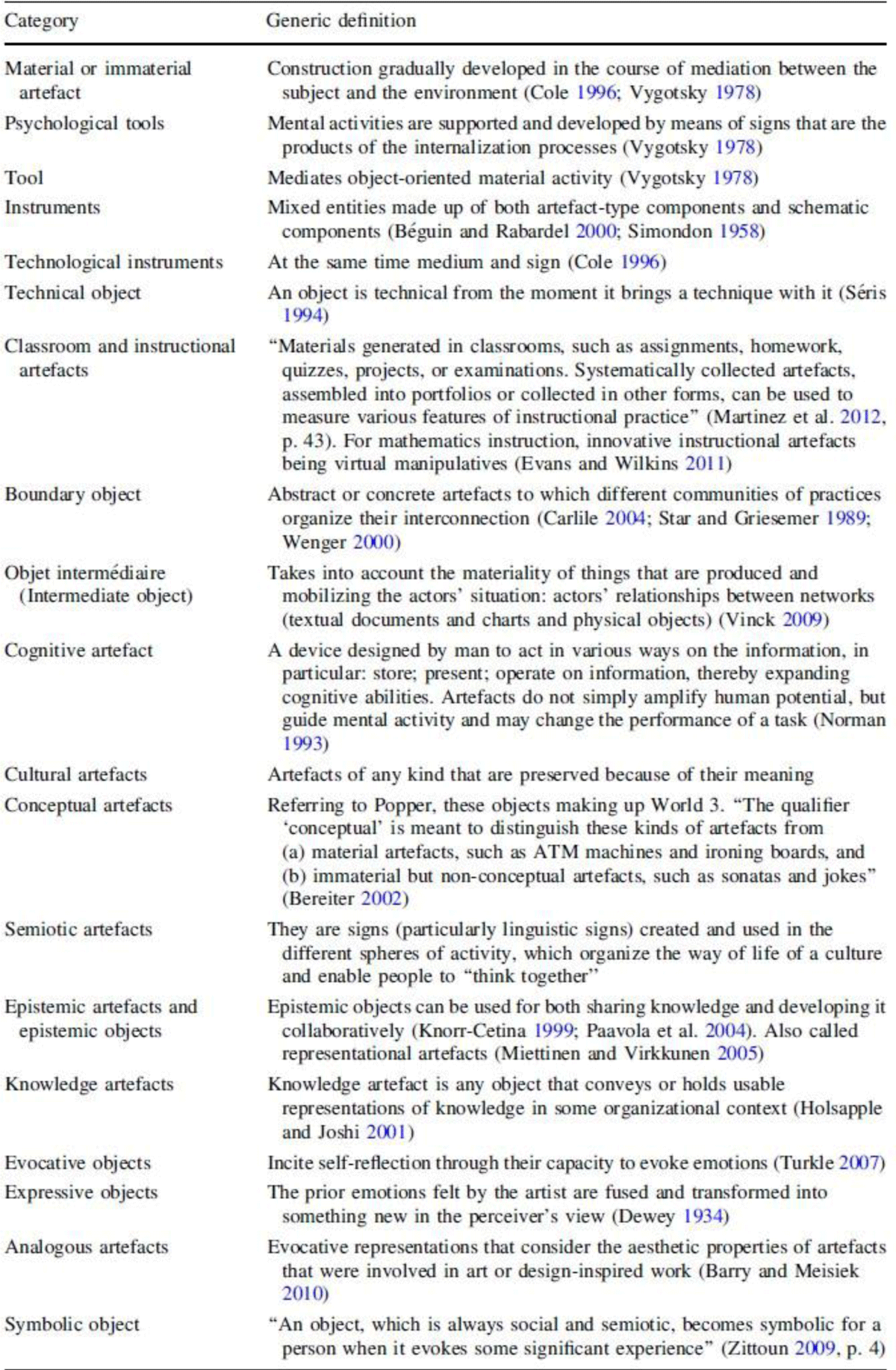
Figure 1
Examples: artifact types and related attributes (Impedovo et al., 2017, p. 22)
The first coding phase revealed 693 references within the artifact category. References from observation notes were under-represented (244) compared to references from interviews (449). Table 2 presents the most recurrent artifacts. The wheelbarrow was the most represented artifact (236). There were many references for this artifact, as it was the group’s prototype for improving a workspace (a garden). Apart from ‘Meccano’ (118), the other artifacts have fewer than 100 references; video (92), pulley (79) and model/prototype (50).
Table 2
Most frequent French words in the artifact category with at least five letters
| Artifact Referenced (n=693) | Letters in French Word | Frequency (f) | Percentage (%) |
| Wheelbarrow | 8 | 236 | 34 |
| ‘Meccano’ | 6 | 118 | 17 |
| Video | 5 | 92 | 13 |
| Pulley | 6 | 79 | 11 |
| Model/scale model/prototype | 6-8-9 | 65 | 9 |
| Report | 7 | 32 | 5 |
| Pulley system | 7 | 25 | 4 |
| Cardboard | 6 | 15 | 2 |
| File (contain all deliverables) | 7 | 7 | 1 |
The most recurrent artifacts were classified in relation to the definitions of artifacts (Table 3). The focus of this study was on categories with more than 50 occurrences, as identified through coding. The other categories, which have fewer than 50 occurrences, have been excluded from the analysis as they were considered to be of lesser significance. The wheelbarrow was found to be overrepresented in all artifact categories. For other artifacts, recurrences were identified. It is of note that the greatest difference in categories were observed for the notions of model/scale model/prototype, with 8 identifications. These notions were identified according to a plurality of approaches by the students.
Table 3
Most recurrent artifacts classified by artifact category (Impedovo et al., 2017)
| Artifact Category (# identified in coding) | Artifact (# identified in coding by artifact category) |
| Intermediate object (86) | Wheelbarrow (30), pulley (15), video (9), cardboard (9), model/scale model/prototype (7), ‘Meccano’ (7), pulley system (6), report (3) |
| Knowledge artifact (100) | Wheelbarrow (30), pulley (23), model/scale model/prototype (13), pulley system (11), video (11), ‘Meccano’ (7), report (3) |
| Instructional artifact (112) | wheelbarrow (31), pulley (21), model/scale model/prototype (15), ‘Meccano’ (12), video (12), pulley system (9), cardboard (9), report (3) |
| Epistemic artifact (98) | wheelbarrow (31), pulley (18), model/scale model/prototype (12), video (11), cardboard (9), ‘Meccano’ (7), pulley system (7), report (3) |
| Technical object (242) | wheelbarrow (122), pulley (72), ‘Meccano’ (48) |
We identified technical objects (Séris, 1994) as one of the most recurrent types of artifact. These artifacts provided evidence for the following technics: the wheelbarrow with the wheel and the ability to transport heavy objects; the ‘Meccano’ with the capacity to construct a multitude of objects with bolts and screws; and finally, the pulley which articulates the force, distance and load needed to lift objects. Regarding instructional artifact (Martínez et. al., 2012), all artifacts identified in coding have been considered to this definition. These artifacts were constructed and generated as part of the project, and they were evaluated at the end of the project. Some parts of the artifact were generated for fun (example: painting flames on the wheelbarrow) but the artifact in itself was constructed for the evaluation.
Based on data analysis, the following artifacts were identified as knowledge artifacts (Holsapple & Joshi, 2001): wheelbarrow, video, pulley, pulley system, model/scale model/prototype, report, file. Four of the artifacts (report, video, model/scale model/prototype, file) were of particular importance for generating project deliverables. These artifacts represent organizational and technical knowledge accumulated by the students on the project. Indeed, students constructed various forms of knowledge in these artifacts. For instance, the wheelbarrow and the pulley represent technical and scientific knowledge. Specifically, the pulley is a mechanical device based on force, distance and load.
To build the pulley, students watched YouTube videos several (4) times (observation note: Student 3 watched a video to see how to make a pulley, Student 6 joined him and a debate ensued between them on the construction of the pulley). Their objective was to comprehend the technical aspects of the pulley. Furthermore, all of the artifacts were considered to be epistemic artifacts (Knorr-Cetina, 1999; Miettinen & Virkkunen, 2005; Paavola and al., 2004) due to the following reasons. The construction of these artifacts occurred within the context of a project, which was situated in an organizational context. Consequently, the artifacts were shared and developed in a collaborative context. Moreover, the utilization of artifacts facilitated the development of reflexivity in relation to learner practice. This phenomenon, for example, was observed in the following abstract from an interview: “I think I was drawing some ideas about how to make the wheelbarrow. We had different ideas and then, we had to see which one was good, I think we had to choose the one that was going to be the easiest for us to make.” [Student 7]. All of the artifacts were interconnected (example: file with the report). Finally, all of the artifacts corresponded to an intermediate artifact (Vinck, 2009). And it is of significance that these elements facilitated the integration of students’ projections and expectations of their project’s outcome: “we had ‘Meccano’ and what we imagined about a wheelbarrow” [Student 8]. These artifacts illustrated the transition from intention to realization, as evidence within the reports and videos produced by students.
In addition, there were variations in student participation on artifact construction: file (all), cardboard (all), wheelbarrow (all), video (one student), ‘Meccano’ (all), pulley (five students), model/scale model/prototype (all), report (two students), pulley system (three students). The video was created by a single student due to his previous experience in video production and editing. The report was prepared by two students. As a result, the majority of artifacts were built through collective collaboration. Beyond categories of artifacts, interviews revealed that four students demonstrated a strong attachment to the wheelbarrow artifact. These students constructed the wheelbarrow using another wheelbarrow found in a waste center, despite the necessity of doing so with only ‘Meccano’. The interviews also revealed that students were proud of their construction of the wheelbarrow: “Making flames on the wheelbarrow might be seen as a waste of time, but it’s fun” [Student 7]; “It was Student 2 who came up with the idea of the wheelbarrow and we said to ourselves: ‘This could be a good idea, it could be fun to do this and this, this could be original! It could change things.” [Student 5]
Discussion
Our data permitted an analysis of the types of artifacts employed by students engaged in project management education. This study showed that epistemic and knowledge artifacts are not linked to a specific scientific field, such as chemistry, management, or physics. Even if they represent organizational or technical knowledge, they are not specifically linked to any field. Three factors explain this phenomenon:
It is not mandatory to use project management tools, because this sequence is an introduction to project management.
There is a lack of linkages between disciplinary teaching for technological tools and project management. Consequently, students may encounter difficulties in applying their knowledge of technology in the context of project management, which they encounter at the outset of their engineering course. Furthermore, the instructions and content in this learning context fail to provide students with knowledge related to technology or science. The activities they carry out require them to mobilize scientific and technical knowledge. As a result, artifacts are located in several disciplines and areas of knowledge. This is the case of the pulley, which can be considered as being located between physics and engineering sciences.
The pedagogical context of project management allows students to define their problem and to explore a wider range of solutions. Consequently, students have more possibilities to create various forms of artifacts.
Furthermore, epistemic artifacts reflect collective and organizational practice, such as the wheelbarrow or the report. The observations showed that students work collectively to construct artifacts. However, as previously stated, artifacts do not refer to project management practices or tools. There are explanations for this:
The exploratory dimension of the instructional sequence leads students to construct a wide variety of artifacts, none of which fit with project management.
The literature shows the development of skills in project management learning (Chipulu et al., 2011; Ojiako et al., 2011), which correspond to higher education objectives. However, this instructional sequence does not establish a link with the engineering skills specified by the CTI or project management skills.
The lack of student professional experience in project management leads to improved learnings in project management (Sharma et al., 2021).
In addition, these artifacts were constructed with the objective of corroboration to the scope statement. The scope statement document enabled students to have considerable autonomy, but while still adhering to the guidelines set out in the scope statement. This is why all artifacts correspond to instructional artifact (Martínez et al., 2012). Furthermore, it elucidates the rationale behind the interconnectivity of artifacts, as evidenced in Table 3, as well as their designation as intermediate artifacts (Vinck, 2009). These observations challenged the normativity of artifacts (Nia and al., 2019) according to the scope statement. It could be linked to pragmatism in the construction of artifacts, and also raise the question of how creativity is accepted by teachers in this pedagogical context. Finally, these remarks on artifacts highlight the training paths and requirements for French engineers, in order to articulate management and scientific knowledge (Bouffartigue & Gadéa, 1997; Lemaître, 2017). Indeed, this instructional sequence introduced students to project management, but required scientific and technical knowledge to construct deliverables.
It should be noted that this study contains some limitations. From a methodological standpoint, the data collection methods employed did not permit a comprehensive capture of students’ activities within the context of projects. In terms of research, the work of a single researcher can potentially introduce bias, particularly during data processing. The multiple phases of data processing were carried out in order to reduce this bias. Furthermore, as this research was focused on a single group, it would have been beneficial to study the artifacts constructed in other groups of students.
Conclusion & recommendations
This study claims that project management leads students to construct artifacts corresponding to the deliverables. The artifacts in question pertain to technical knowledge (such as the pulley) or to objectives defined by a specification. However, the artifacts constructed were not directly linked to management or engineering knowledge within scientific or technical disciplines. As such, this study demonstrates the value of questioning the meaning, interrelationships and complexity of artifacts among engineering students in a project context. Furthermore, this study opens the door to thinking about the integration of disciplinary teaching in project management. The input of teachers specializing in management or engineering sciences, as well as instruction referring to knowledge linked to specific disciplines, could contribute to the engagement of students in the subject matter.
In fine, this research provides a foundation for further investigation into artifacts within the context of project management education. Types of artifacts should be compared between different learning contexts, such as learning sequences introducing project management, or more advanced courses on project management. In addition, a quantitative study could be done, in order to compare artifacts constructed by several groups of students. Finally, exploratory studies could be carried out in other international higher education contexts with a similar audience (engineering students) or pedagogical objective (introducing project management).
Notes
Competing Interests
The author has no competing interests to declare.