
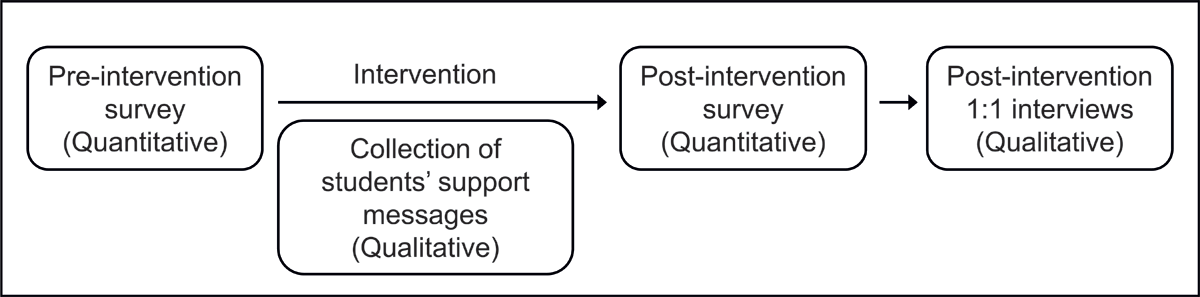
Figure 1
Overview of Mixed Methods Study Design.
Note. The pre- and post-intervention surveys were sent to students in both the intervention and comparison groups, while the collection of messages and interviews occurred with the intervention group only. Qualitative and quantitative data were analyzed independently and then compared to explore the study’s research questions.
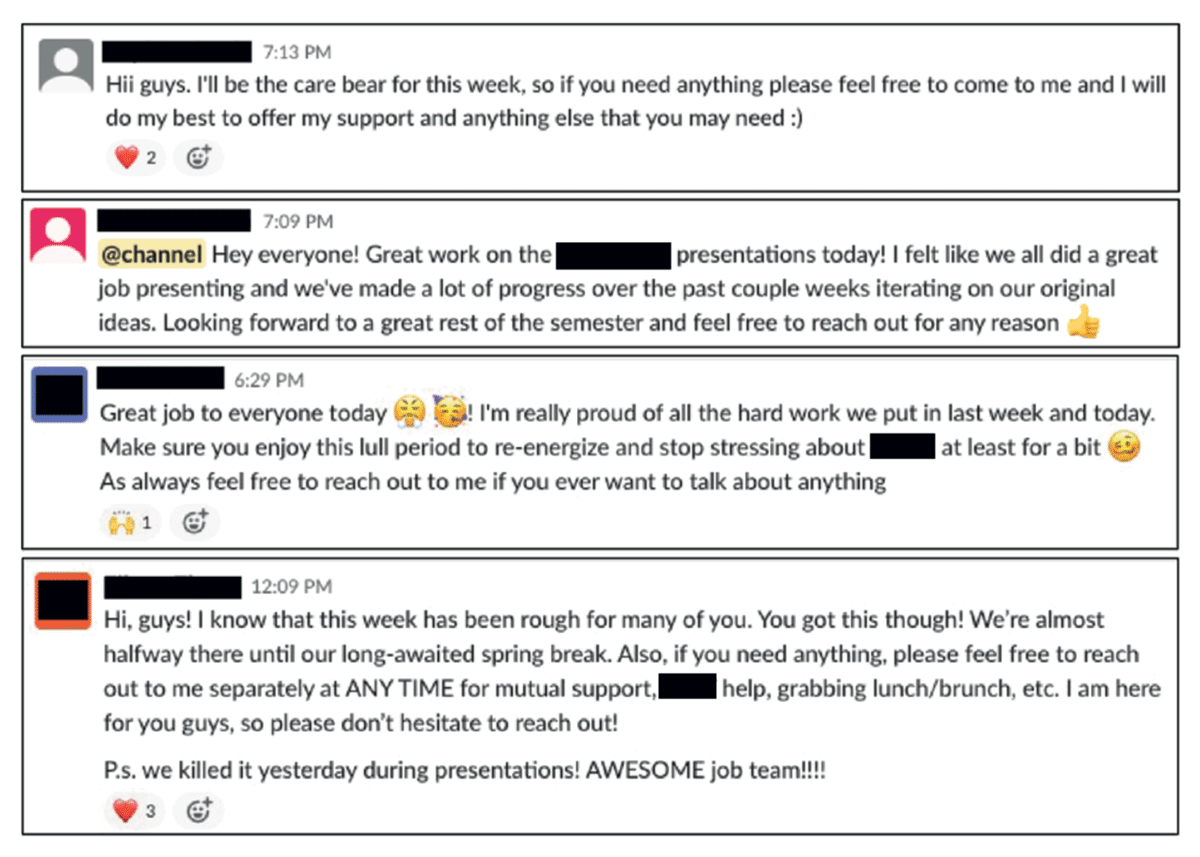
Figure 2
Examples of Students’ Slack Posts with Identifiers Redacted.
Table 1
Survey Variables and Corresponding Likert Items.
| SUBSCALE VARIABLE | ITEMS |
|---|---|
| Social connectedness among classmates | 1–6 |
| Compassion toward classmates | 7–11 |
| Compassion from classmates | 12–16 |
| Seeking support from classmates | 17–14 |
| Offering support to classmates | 25–31 |
| Classroom climate and compassion from instructor(s) | 32–35 |
| Future intentions to seek and offer support | 36–39 |
Table 2
Independent Samples t-Test of Pre Mean Scores.
| VARIABLE | SCALE | M | MD | t | p | Cohen’s d | |
|---|---|---|---|---|---|---|---|
| INTERVENTION | COMPARISON | ||||||
| Social connectedness | 6–30 | 19.83 | 18.67 | 1.16 | –0.79 | 0.44 | 4.20 |
| Compassion toward classmates | 5–25 | 20.67 | 20.83 | –0.16 | 0.16 | 0.88 | 2.99 |
| Compassion from classmates | 5–25 | 19.08 | 17.67 | 1.41 | –1.38 | 0.18 | 2.91 |
| Seeking support | 7–35 | 22 | 23.08 | –1.08 | 0.66 | 0.52 | 4.66 |
| Offering support | 6–30 | 20.71 | 20.92 | –0.21 | 0.15 | 0.88 | 3.90 |
| Classroom climate | 4–20 | 14.54 | 14.17 | 0.37 | –0.35 | 0.73 | 3.03 |
[i] Note. For all variables df = 34, n = 36 (Intervention, n = 24; Comparison, n = 12).
Table 3
Paired Samples t-Test of Pre and Post Mean Scores Within the Intervention Group.
| VARIABLE | SCALE | M | MD | t | p | Cohen’s d | |
|---|---|---|---|---|---|---|---|
| PRE | POST | ||||||
| Social connectedness | 6–30 | 19.83 | 22.67 | 2.84 | –3.46 | .002** | 4.02 |
| Seeking support | 8–40 | 22.00 | 24.33 | 2.33 | –2.59 | .017* | 4.42 |
| Offering support | 7–35 | 20.70 | 22.71 | 2.01 | –2.46 | .022* | 3.98 |
| Classroom climate | 4–20 | 14.54 | 15.92 | 1.38 | –2.47 | .022* | 2.73 |
| Compassion toward classmates | |||||||
| It’s not my place to try to support a classmate who is struggling, especially if I don’t know them well. | 1–5 | 2.13 | 3.88 | 1.75 | –6.16 | <.001** | 1.39 |
| It’s okay for friends to talk about their struggles, but classmates should avoid discussing personal issues. | 1–5 | 2.13 | 3.88 | 1.75 | –7.00 | <.001** | 1.23 |
| Compassion from classmates | |||||||
| I don’t care how my classmates treat me, as long we get the work done and get good grades. | 1–5 | 2.25 | 3.88 | 1.63 | –5.21 | <.001** | 1.53 |
| My classmates would think less of me if they were to find out that I was struggling. | 1–5 | 2.46 | 3.92 | 1.46 | –4.85 | <.001** | 1.48 |
[i] Note. For all variables, df = 23, n = 24.
* p < 0.05.
** p < 0.01.
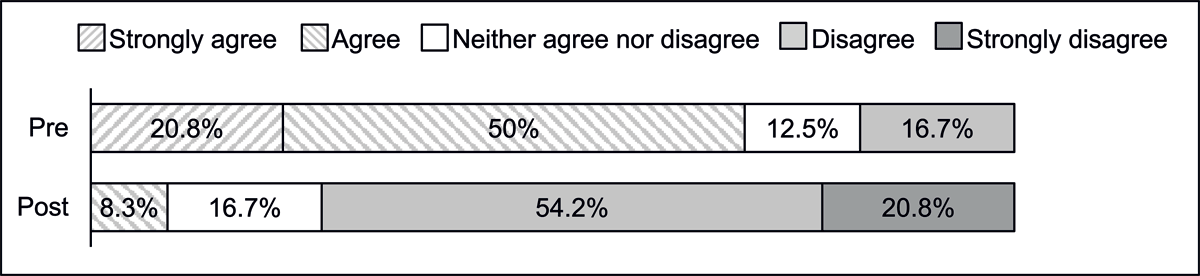
Figure 3
Intervention Group Pre and Post Responses for the Item “I don’t care how my classmates treat me, as long as we get the work done and get good grades.”
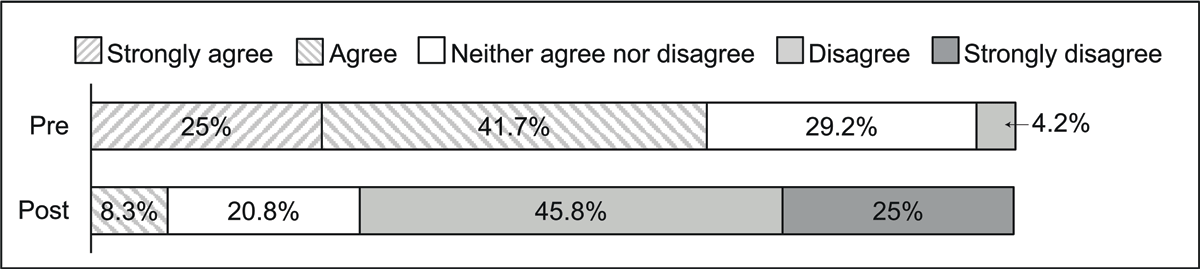
Figure 4
Intervention Group Pre and Post Responses for the Item “It’s not my place to try to support a classmate who is struggling, especially if I don’t know them well.”
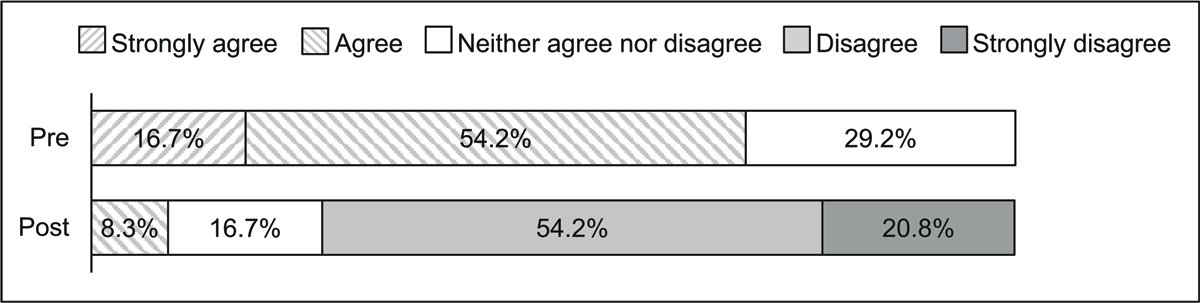
Figure 5
Intervention Group Pre and Post Responses for the Item “It’s okay for friends to talk about their struggles, but classmates should avoid discussing personal issues.”
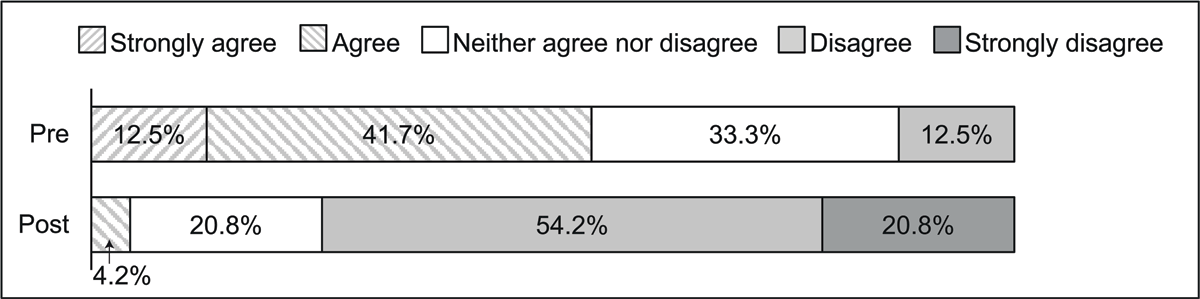
Figure 6
Intervention Group Pre and Post Responses for the Item “My classmates would think less of me if they were to find out that I was struggling.”