
Table 1.
Distribution of the population aged 30 to 60 years old by province
| Province | Population | Quota |
|---|---|---|
| San José | 715 834 | 121 |
| Alajuela | 427 568 | 72 |
| Cartago | 229 379 | 39 |
| Heredia | 227 188 | 38 |
| Total | 1 599 969 | 270 |
Table 2.
Sections used for contingent valuation (CV)
| Section | Description | Example questions |
|---|---|---|
| Dairy consumption | Consumption habits, preferences, and expenditures for fresh cheese and yogurt | How often do you consume yogurt? |
| What size do you prefer? | ||
| On a scale from 1 to 10, how much do you like fresh cheese/yogurt? (where: 1 means you like it a little or not at all; and 10 means you like it a lot) | ||
| What factors do you consider important when purchasing fresh cheese/yogurt? | ||
| Organic dairy products* | Awareness and perceptions of organic products, WTP for organic versions, and environmental concerns | Are you willing to pay more for organic cheese? |
| How much would you be willing to pay for 500 g of organic fresh cheese? | ||
| How much would you be willing to pay for a 1 000 ml organic yogurt? | ||
| Social and demographic characteristics | Age, gender, income, education, household composition, and location | What is your household income range? |
| How many people are part of your family unit? | ||
| How old are you in years? | ||
| What is your gender? |
Table 3.
Explanatory variables
| Variable | Abbreviation | Description |
|---|---|---|
| 1 | 2 | 3 |
| Age | EA | Age in years. |
| Level of education | NE | Ordinal variable, where: 1 = incomplete schooling; 2 = complete schooling; 3 = incomplete secondary education; 4 = complete secondary education; 5 = technical education; 6 = incomplete university education; 7 = complete university education; and 8 = postgraduate education. |
| Gender | GEN | Binary variable, where: female = 0 and male = 1. |
| Residence | RE | Province and canton of residence. |
| Family size | TF | Number of people living in the household. |
| Family income range in colones | IF | Categorical variable, where: 1 ≤ 250,000; 2 = 250,001–500,000; 3 = 501,000–1,000,000; 4 = 1,000,001–2,000,000; 5 = 2,000,001–3,000,000; and 6 ≥ 3,000,000. |
| Monthly household food expenditure | GMH | Monthly expenditure in colones for food at home. |
| Consumption of fresh cheese | CPCQS | Grams of fresh cheese consumed at home per week. |
| Yogurt consumption | CPCY | Milliliters of yogurt consumed at home per week. |
| Preferred size for fresh cheese consumption | GGF | Ordinal variable, where: 1 = likes it little or not at all and 10 = likes it very much. |
| Preferred size for yogurt consumption | GGY | |
| TPQF | Presentation in grams that you prefer for fresh cheese consumption at home. | |
| TPY | Preferred milliliter size for yogurt consumption at home. | |
| Skimmed | DESC | Ordinal variable, where: 0 = none; 1 = a little; 2 = moderate; 3 = a lot; and 4 = a great deal. |
| Lactose-free | DESL | |
| Creamy | CRE | |
| Artisanal | ART | |
| Locally sourced | OL | |
| Organic | ECO | |
| Odorless | AO | |
| Animal welfare | BA | |
| Intense flavor | SI | |
| Light flavor | SL | |
| Meltable | D | |
| Protein content | CP | |
| Variety of presentations | VP | |
| Product availability | DP | |
| Eye-catching packaging | EL | |
| Clear labeling | EC | |
| Process information | IPROC | |
| Producer information | IPROD | |
| Information on health benefits | IPBS | |
| Price | P | |
| Fruit flavor* | SF | |
| Fruit content in pieces | CFT | |
| Vitamin content and nutritional supplements | CVS | |
| Point of purchase for dairy products | PCL | Supermarkets, grocery stores, convenience stores, producer websites, or others. |
| Amount to pay for 500 g of fresh cheese | MPQ | Amount in colones to be paid for 500 grams of fresh cheese. |
| Amount to pay for 1000 ml of yogurt | MPY | Amount in colones to be paid for 1000 ml of yogurt. |
| Knowledge and consumption of different brands | CCL | Categorical variable, where: 0 = I don't know it; 1 = I don't consume it; 2 = I consume very little; 3 = I consume a little; 4 = I consume regularly; 5 = I consume a lot; and 6 = I consume a great deal. |
| Knowledge about fresh cheese and organic yogurt | CLE | Ordinal variable, where: 0 = none; 1 = a little; 2 = moderate; 3 = a lot; and 4 = a great deal. |
| Willingness to consume organic fresh cheese | DACQ | |
| Willingness to consume organic yogurt | DACY | |
| Amount to pay for 500 g and 1000 g of organic fresh cheese | DAPQ | Amount in colones to be paid for these deliveries of organic fresh cheese. |
| Amount to pay for 200 ml and 1000 ml of organic yogurt | DAPY | Amount in colones to be paid for these organic yogurt presentations. |
| Should you pay more for organic cheese? | PADIQ | Binary variable, where: 0 = No and 1 = Yes. |
| Should you pay more for organic yogurt? | PADIY | |
| Percentage you would be willing to pay extra for organic fresh cheese | PADIQP | Ordinal variable, where: 1 = 5%; 2 = 10%; 3 = 15%; 4 = 20%; 5 = 25%; 6 = 30%; 7 = 35%; 8 = 40%; and 9 = 45% or more. |
| Percentage you would be willing to pay extra for organic yogurt | PADIYP | |
| Importance of environmental strategies for dairy products | GEA | Ordinal variable, where: 0 = none; 1 = very little; 2 = little; 3 = moderate; 4 = a lot; and 5 = a great deal. |
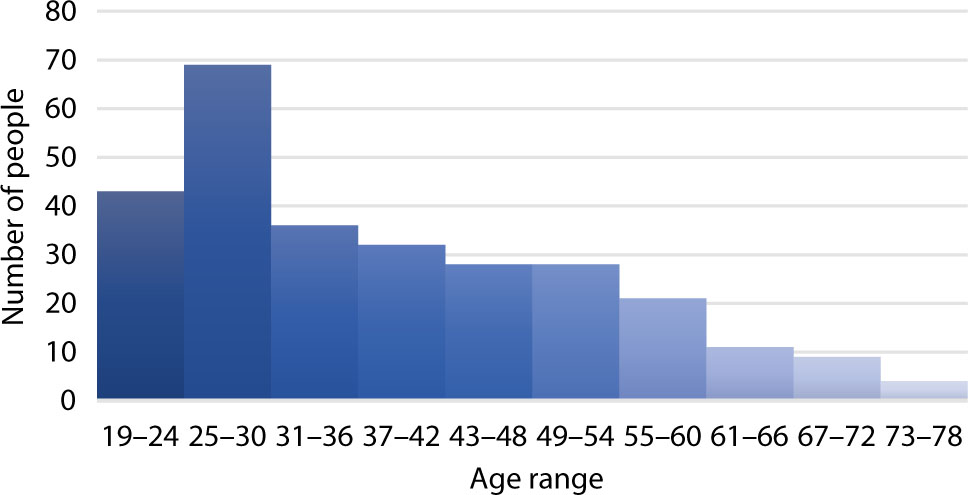
Fig. 1.
Distribution of survey participants by age
Source: Own elaboration.
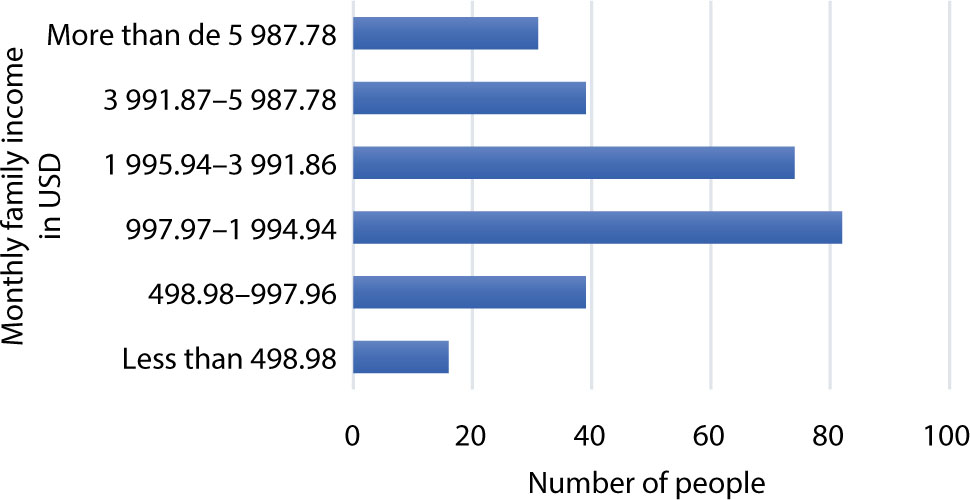
Fig. 2.
Distribution of responses related to household income in US dollars (USD)
Source: own elaboration based.
Table 4.
Dairy consumption and WTP additional payment for fresh cheese and organic yogurt
| Variable | Yes | No |
|---|---|---|
| Consume dairy products | 267 | 15 |
| Consume fresh cheese | 259 | 23 |
| Consume yogurt | 229 | 53 |
| WTP additional payment for organic fresh cheese | 167 | 92 |
| WTP additional payment for organic yogurt | 146 | 83 |
Table 5.
Descriptive statistics of quantitative variables
| Variable | n | Mean | Median | Min | Max | Std. dev. | Coef. var. (%) |
|---|---|---|---|---|---|---|---|
| Weekly fresh cheese consumption (g) | 259 | 533 | 500 | 10 | 3 500 | 416 | 78 |
| Weekly yogurt consumption (ml) | 229 | 733 | 750 | 50 | 5 000 | 702 | 96 |
| WTP additional for organic fresh cheese (%) | 143 | 13 | 10 | 5 | 45 | 7 | 57 |
| WTP additional for organic yogurt (%) | 141 | 13 | 10 | 5 | 45 | 8 | 59 |
| WTP for fresh cheese (500 g) | 259 | 6.08 | 5.99 | 1.40 | 19.96 | 2.69 | 44 |
| WTP for organic fresh cheese (500 g) | 259 | 6.42 | 5.99 | 1.60 | 23.95 | 2.59 | 40 |
| WTP for organic fresh cheese (1000 g) | 259 | 10.50 | 9.98 | 1.60 | 29.94 | 4.36 | 42 |
| WTP for yogurt (1000 ml) | 229 | 5.54 | 4.99 | 1.30 | 29.94 | 3.00 | 54 |
| WTP for organic yogurt (1000 ml) | 217 | 6.65 | 5.99 | 1.60 | 29.94 | 3.49 | 52 |
| WTP for organic yogurt (200 ml) | 229 | 2.38 | 1.10 | 0.60 | 19.96 | 1.99 | 83 |
| Monthly food spending (USD) | 282 | 516.22 | 498.98 | 598.88 | 1 596.74 | 303.49 | 59 |
| Preferred size for cheese (g) | 258 | 518 | 500 | 100 | 1 500 | 234 | 45 |
| Preferred size for yogurt (ml) | 229 | 741 | 1 000 | 100 | 1 800 | 390 | 53 |
Table 6.
Respondent responses associated with the term “ecological”
| Category | Answers |
|---|---|
| 1 | 2 |
| Environment | Water, air, environment, environmental protection, environmentally friendly, animals, trees, harmony with the environment, garbage in its place, forest, good practices, global warming, climate change, ozone layer, greenhouse gases, climate, certificate, composting, conservation, exosystems, saving resources, fauna, ecological treatments, flora, less pollution, mountain, land, rivers, rational use of water, green, without agrochemicals and pesticides, among others. |
| Other | Help, change, lie, care, they just want to sell, decrease, environment, effort, exclusive, easy use, fresh, farm, innovative, free, clean, more salty, less processed, I do not use genetically modified foods, non-toxic, unprocessed, pure, peace, world order, small quantities, respect, responsibility, rich, safe, toxic, deception, value, among others. |
| Health | Health, light, clean, healthier, diet, healthier, healthy, nutritious, healthy and vitamins. |
| Packing | Biodegradable, reusable, recyclable, returnable, degradable. |
| Sustainability | Self-sustaining, ecology, balance, future, less consumerism, responsibility, sustainability, equilibrium, food security, sustainable, sustainable, among others. |
| Price | Savings, expensive, costly, economic, price and wealth. |
| Without additives | No preservatives, no chemicals, no additives, no sugar, no coloring, no chemicals, no preservatives, no gluten, among others. |
| Welfare | General welfare, animal welfare and animal protection. |
| Artisanal | Artisanal and artisanal processes. |
| Quality | Quality and better |
| Commitment | Commitment and awareness. |
| Agricultural | Agriculture, agribusiness and countryside. |
Table 7.
Binary probit models of willingness to pay for cheese (WTPC)
| Parameter | Coefficients | Standard error | Z | p-value |
|---|---|---|---|---|
| Const | −1.9248 | 0.4590 | −4.1933 | 0.0000*** |
| DESL | −0.1890 | 0.0698 | −2.7081 | 0.0068*** |
| AO | 0.3048 | 0.0781 | 3.9008 | 0.0001*** |
| SL | 0.1908 | 0.0810 | 2.3563 | 0.0185** |
| SP | 0.3929 | 0.0892 | 4.4049 | 0.0000*** |
| P | −0.1462 | 0.1049 | −1.3938 | 0.1634 |
| AHPC000 | 0.0002 | 0.0001 | 1.8151 | 0.0695* |
| R2 McFadden | 0.181 | Akaike criterion | 289.001 | |
| Log likelihood | −137.505 | Hannan-Quinn | 299.011 | |
| Schwarz criterion | 313.880 | Correctly predicted cases | 74.81% | |
| Likelihood ratio | 0.000 | |||
| Normality test of residuals | 0.0004 |
Table 8.
Binary logit model of willingness to pay for yogurt (WTPY)
| Parameter | Coefficients | Standard error | Z | p-value |
|---|---|---|---|---|
| Const | −2.2569 | 0.7620 | −2.9617 | 0.0031*** |
| OLY | 0.4314 | 0.1377 | 3.1328 | 0.0017*** |
| SLY | 0.2960 | 0.1195 | 2.4762 | 0.0133** |
| IPRODY | −0.3167 | 0.1476 | −2.1458 | 0.0319** |
| SP | 0.5715 | 0.1608 | 3.5540 | 0.0004*** |
| PY | −0.1324 | 0.1636 | −0.8096 | 0.4182 |
| R2 McFadden | 0.1246 | Akaike criterion | 274.8549 | |
| Log likelihood | −131.4274 | Hannan-Quinn | 283.1372 | |
| Schwarz criterion | 295.3781 | Correctly predicted cases | 71.24% | |
| Likelihood ratio | 0.0000 |