
INTRODUCTION
According to the Executive Secretary for Agricultural Sectoral Planning (SEPSA, by its acronym in Spanish), cow cheese production during the period 2018–2021 has shown a growth of 3.52%, starting from 1,161,517 tons in 2018 to 1,202,446 tons in 2021 (Zeledón et al., 2024). The volume in metric tons of cheese exported by Costa Rica for 2023 was 3,158.9, which showed an increase of 12.09% compared to 2022; meanwhile, yogurt showed an increase of 3.63% for 2022, rising from 4,905.90 tons in 2022 to 55,083.90 tons in 2023 (PROCOMER, 2024).
Concern about environmental issues has increased the demand for eco-friendly products, leading industries to develop strategies to meet the demand for sustainable products. However, improper practices, such as green-washing, have also emerged (Martínez et al., 2018).
Green products can be defined as those whose life cycles demonstrate ecological characteristics and provide greater environmental benefits compared to conventional products, or that result in a reduced use of natural resources (Ritter et al., 2015). Liu (2024) mentions that investment in the adoption of green technology is necessary to improve the quality of products and satisfy the growing demand for environmentally friendly agricultural products. Liu also highlights the importance of raising consumer awareness about green products. Likewise, Malvestio et al. (2018) note that the concept of climate change has been widely accepted by consumers, which has increased interest in green agricultural products. A better understanding of consumer behavior toward these products could help producers, marketers, and policymakers make decisions that benefit the sector (Ritter et al., 2015).
The 2022 National Agricultural Survey 1 reports that 69.7% of farms with dairy cattle do not use any waste treatment system, while 16.24% implement systems that incorporate fertilizer or compost (INEC, 2022a). Therefore, managing waste and by-products generated on dairy farms remains a key challenge for organizations in the sector aiming for sustainable production.
One strategy adopted by the Ministry of Agriculture and Livestock (MAG) to address this issue is the Nationally Appropriate Mitigation Actions (NAMAs), which aim to enhance the resilience of agricultural systems to climate change and trade challenges, while also reducing dependence on external inputs and promoting environmental mitigation (Periódico Mensaje, 2022).
In this context, this research aims to contribute new information for policymakers, facilitating decision-making by identifying the willingness to pay (WTP) for dairy products with additional attributes derived from production systems that apply environmental mitigation measures.
THEORICAL FRAMEWORK
Organic, ecological or eco-food products are commonly associated by consumers with attributes such as health, freshness and safety. However, due to their ecological production process, these products generally have shorter shelf lives than conventional alternatives, making it necessary to verify their quality and ensure their safety for consumption (Arrieta and Montalvo, 2021). According to Oroian et al. (2017), analyses of consumption patterns for organic products using descriptive and inferential statistics indicate that consumers associate these products with health, lifestyle, social convenience, environmental protection, and sustainable development. In addition, flavor is regarded as a key organoleptic attribute in consumer decision-making.
Lazaroiu et al. (2019), through documentary research, identified a relationship between the purchase of organic products and factors such as health, nutrition, the absence of harmful substances, trust, environmental awareness and ecological responsibility. Similarly, McFadden and Huffman (2017) examined how price sensitivity and perceptions of environmental impact influence the purchase of organic products, using experimental sampling methods and linear regression analysis. However, they emphasize that the market for these products ultimately depends on consumers' willingness to pay.
Ajzen (1991) posits that willingness to pay is closely linked to consumer behavior, particularly through the lens of the theory of planned behavior. This theory considers factors such as attitudes toward the desirability of certain behaviors, subjective norms reflecting the opinions of influential individuals, and the perceived control a person has over their own actions. Conceptual studies, such as Li et al. (2020), note that willingness to pay a higher price decreases as the additional cost over the base price rises, in line with the law of demand. At the same time, consumer behavior involves balancing the utility and marginal price of a quality food product. In this context, willingness to pay can be effectively assessed by examining consumer behavior.
Green consumer purchasing behavior has been increasing in recent years. According to Kantar World Panel Mexico, in 2012, only 16% of Mexicans took any ecological action, whereas by 2019, 7 out of 10 Mexicans opted for ecological products. A study by Mü et al. (2021) aimed to identify which variables of the Theory of Planned Behavior truly affect young people's intention to purchase green products and to demonstrate that moral obligation should be included in the model. An online survey was conducted with 280 students from public schools in the Northeast region of Mexico. The data were analyzed using a structural equation model with partial least squares (PLS-SEM), revealing that only attitude and moral obligation have a positive and significant effect on the intention to purchase green products.
In relation to dairy products, their quality can be defined in four key dimensions: health, hedonic aspects, convenience and process, which influence consumer decisions. In a study on the willingness to pay for organic cheese with additional product information, no significant correlation was found between this willingness and perceived taste. This suggests that willingness to pay for cheese depends more on information about its organic production methods than on its sensory characteristics (Napolitano et al., 2010). Bernabéu et al. (2008) found, using logistic regression analysis, that the willingness to pay a premium for organic cheese over conventional cheese reaches 15.42%.
Van Loo et al. (2013), using a cross-sectional survey and statistical analysis, assessed the willingness to pay for organic yogurt relative to the price of conventional yogurt. They found that consumers were generally willing to pay more for organic yogurt, with willingness to pay highest among regular buyers, moderate among occasional buyers, and lowest among non-buyers.
In studies on willingness to pay using choice experiments, binary-choice options are often employed, generating binary response data. This allows prices and attribute levels to be varied to estimate valuation. Consequently, these models are analyzed using binary regression techniques, such as logit or probit models, to determine consumers' willingness to pay for specific products while evaluating multiple attributes (Beghin and Gustafson, 2021).
Lanfranchi et al. (2019) used a probit model to analyze the willingness to pay a premium for a wine produced using sustainable methods, finding that knowledge of these production methods is a significant factor in consumers' willingness to pay higher prices. Similarly, Edenbrandt (2018) evaluated the willingness to pay among conventional and organic consumers using a logit model with random parameters. Their analysis showed that frequent organic consumers have a greater willingness to pay, with paying a premium for organic milk being particularly prominent among their preferences.
NAMA in livestock farming seeks to reduce greenhouse gas (GHG) emissions and increase carbon capture on farms. To achieve this, it promotes the adoption of low-emission technologies and sustainable or organic production practices, which contribute to increased productivity and adaptation to climate change. The focus is on farms producing meat, milk and dual-purpose systems, striving for eco-competitive livestock farming through measures such as rational grazing, the use of live fences, and the improvement of pastures and fertilization plans (MAG, 2016).
Serna et al. (2017) relate the increase in environmental and social responsibility to consumption patterns. Therefore, environmentally responsible products incentivize producers to adapt to consumer demands. The implementation of livestock NAMA offers growth opportunities in countries such as Colombia and Costa Rica. Similarly, Duarte and Trujillo (2023), through a systematic review, highlight the need to pursue alternatives that increase productivity and efficiency while simultaneously promoting ecological and sustainable practices. This responds to cultural shifts among consumers, who increasingly demand organic foods due to their lower environmental impact.
MATERIAL AND METHODS
This research employed a mixed-methods approach, allowing for both social (subjective) and economic (objective) analyses (Hernández et al., 2014). For the social analysis, surveys were conducted to identify the characteristics influencing willingness to pay a premium (WTP) for organic fresh cheese and yogurt. These products originated from dairy production systems that implement NAMA-type measures.
Study population
By 2022, the population aged 30 to 60 years in the Greater Metropolitan Area (GAM 2, by its acronym in Spanish) was 1,599,969 (INEC, 2022b). This population was selected as the target since GAM has the highest population growth and concentrates the largest economic activity in the country (Arias and Sánchez, 2012). Based on the researchers' criteria, a quota sampling method was applied (Parra and Vázquez, 2017). Equation (1) was used to estimate the sample size from the total population, which exceeded 10,000 observations, and equation (2) was subsequently used to determine the representative quotas for the obtained sample.
Where: n – is the sample size to be determined; Z – is the confidence level coefficient; p, is the probability in favor; q – is the probability against (1 – p); and EE, is the estimated margin of error; ni – is the quota size proportional to the group; Ni – refers to the size of stratum i; and N – is the number of elements in the population.For this research, the proportion to be detected was unknown, so a value of 50% was used. A confidence level of 90% and an allowed error of 5% were also applied. By substituting these values into equation (1), a sample of 270 observations was obtained, distributed as shown in the following table.
Table 1.
Distribution of the population aged 30 to 60 years old by province
| Province | Population | Quota |
|---|---|---|
| San José | 715 834 | 121 |
| Alajuela | 427 568 | 72 |
| Cartago | 229 379 | 39 |
| Heredia | 227 188 | 38 |
| Total | 1 599 969 | 270 |
Data collection was conducted through visits to public parks and shopping centers within the study area, as well as by distributing online forms to individuals with heterogeneous characteristics residing in the study area.
Survey instrument design
A structured questionnaire comprising 39 items was developed and divided into three main sections (Table 2).
Table 2.
Sections used for contingent valuation (CV)
| Section | Description | Example questions |
|---|---|---|
| Dairy consumption | Consumption habits, preferences, and expenditures for fresh cheese and yogurt | How often do you consume yogurt? |
| What size do you prefer? | ||
| On a scale from 1 to 10, how much do you like fresh cheese/yogurt? (where: 1 means you like it a little or not at all; and 10 means you like it a lot) | ||
| What factors do you consider important when purchasing fresh cheese/yogurt? | ||
| Organic dairy products* | Awareness and perceptions of organic products, WTP for organic versions, and environmental concerns | Are you willing to pay more for organic cheese? |
| How much would you be willing to pay for 500 g of organic fresh cheese? | ||
| How much would you be willing to pay for a 1 000 ml organic yogurt? | ||
| Social and demographic characteristics | Age, gender, income, education, household composition, and location | What is your household income range? |
| How many people are part of your family unit? | ||
| How old are you in years? | ||
| What is your gender? |
Data collection was conducted in public spaces (parks and shopping centers), as well as online within the study area. The collected responses were subsequently tabulated to enable descriptive analysis and estimation of WTP.
Willingness to pay for organic fresh cheese and yogurts
To calculate the WTP for fresh cheese and yogurt with distinguishing attributes – such as originating from production systems that mitigate environmental impact – two methods were employed.
Contingent valuation
According to Hernandez et al. (2019), contingent valuation (CV) involves applying surveys to determine the value that individuals assign to a good or service and the factors influencing that value. In this study, CV was used to elicit the maximum WTP for organic dairy products. A two-stage question format was applied: an initial binary (yes/no) WTP question, followed by an open-ended question to capture the maximum amount respondents were willing to pay. Product quantities were standardized to 500 g of fresh cheese and 1000 ml of yogurt.
Econometric modeling of willingness to pay for fresh cheese and yogurt
Qualitative response models allow estimation of the probability of a specific event occurring (Hossain et al., 2022; Valencia et al., 2015). To assess the population's willingness to pay a premium for organic fresh cheese and yogurt, logit and probit models were applied.
Logit and probit models estimate the likelihood that respondents would pay a premium for organic dairy products. These binary choice models allow the probability of a positive WTP response to be modeled as a function of explanatory variables (Table 3).
Table 3.
Explanatory variables
| Variable | Abbreviation | Description |
|---|---|---|
| 1 | 2 | 3 |
| Age | EA | Age in years. |
| Level of education | NE | Ordinal variable, where: 1 = incomplete schooling; 2 = complete schooling; 3 = incomplete secondary education; 4 = complete secondary education; 5 = technical education; 6 = incomplete university education; 7 = complete university education; and 8 = postgraduate education. |
| Gender | GEN | Binary variable, where: female = 0 and male = 1. |
| Residence | RE | Province and canton of residence. |
| Family size | TF | Number of people living in the household. |
| Family income range in colones | IF | Categorical variable, where: 1 ≤ 250,000; 2 = 250,001–500,000; 3 = 501,000–1,000,000; 4 = 1,000,001–2,000,000; 5 = 2,000,001–3,000,000; and 6 ≥ 3,000,000. |
| Monthly household food expenditure | GMH | Monthly expenditure in colones for food at home. |
| Consumption of fresh cheese | CPCQS | Grams of fresh cheese consumed at home per week. |
| Yogurt consumption | CPCY | Milliliters of yogurt consumed at home per week. |
| Preferred size for fresh cheese consumption | GGF | Ordinal variable, where: 1 = likes it little or not at all and 10 = likes it very much. |
| Preferred size for yogurt consumption | GGY | |
| TPQF | Presentation in grams that you prefer for fresh cheese consumption at home. | |
| TPY | Preferred milliliter size for yogurt consumption at home. | |
| Skimmed | DESC | Ordinal variable, where: 0 = none; 1 = a little; 2 = moderate; 3 = a lot; and 4 = a great deal. |
| Lactose-free | DESL | |
| Creamy | CRE | |
| Artisanal | ART | |
| Locally sourced | OL | |
| Organic | ECO | |
| Odorless | AO | |
| Animal welfare | BA | |
| Intense flavor | SI | |
| Light flavor | SL | |
| Meltable | D | |
| Protein content | CP | |
| Variety of presentations | VP | |
| Product availability | DP | |
| Eye-catching packaging | EL | |
| Clear labeling | EC | |
| Process information | IPROC | |
| Producer information | IPROD | |
| Information on health benefits | IPBS | |
| Price | P | |
| Fruit flavor* | SF | |
| Fruit content in pieces | CFT | |
| Vitamin content and nutritional supplements | CVS | |
| Point of purchase for dairy products | PCL | Supermarkets, grocery stores, convenience stores, producer websites, or others. |
| Amount to pay for 500 g of fresh cheese | MPQ | Amount in colones to be paid for 500 grams of fresh cheese. |
| Amount to pay for 1000 ml of yogurt | MPY | Amount in colones to be paid for 1000 ml of yogurt. |
| Knowledge and consumption of different brands | CCL | Categorical variable, where: 0 = I don't know it; 1 = I don't consume it; 2 = I consume very little; 3 = I consume a little; 4 = I consume regularly; 5 = I consume a lot; and 6 = I consume a great deal. |
| Knowledge about fresh cheese and organic yogurt | CLE | Ordinal variable, where: 0 = none; 1 = a little; 2 = moderate; 3 = a lot; and 4 = a great deal. |
| Willingness to consume organic fresh cheese | DACQ | |
| Willingness to consume organic yogurt | DACY | |
| Amount to pay for 500 g and 1000 g of organic fresh cheese | DAPQ | Amount in colones to be paid for these deliveries of organic fresh cheese. |
| Amount to pay for 200 ml and 1000 ml of organic yogurt | DAPY | Amount in colones to be paid for these organic yogurt presentations. |
| Should you pay more for organic cheese? | PADIQ | Binary variable, where: 0 = No and 1 = Yes. |
| Should you pay more for organic yogurt? | PADIY | |
| Percentage you would be willing to pay extra for organic fresh cheese | PADIQP | Ordinal variable, where: 1 = 5%; 2 = 10%; 3 = 15%; 4 = 20%; 5 = 25%; 6 = 30%; 7 = 35%; 8 = 40%; and 9 = 45% or more. |
| Percentage you would be willing to pay extra for organic yogurt | PADIYP | |
| Importance of environmental strategies for dairy products | GEA | Ordinal variable, where: 0 = none; 1 = very little; 2 = little; 3 = moderate; 4 = a lot; and 5 = a great deal. |
According to (Gujarati and Porter, 2010), logit models are given by the logarithm of the ratio of the probabilities in favor of an event occurring (equation 4), based on a cumulative logistic distribution function (equation 3).
Where, the expected value 3 is given by E(y = 1) = p; Pi – is the probability that individual i is WTP; Zi – is the linear combination of explanatory variables that affect the WTP; Li – is the log-odds (logit) of the probability that individual i is WTP; β1 – is the intercept term in the model; β2 – is the coefficient of the explanatory variable Xi; Xi – is the value of the explanatory variable for individual i; and the variance is expressed as var(y) = p(1 – p) (Hill et al., 2011).The slope coefficient of a variable represents the change in the logarithm of the odds in favor of an event occurring associated with a one-unit change in that variable, while holding other variables constant. Therefore, equation 5 is used to calculate the rate of change in probability at a given point (Gujarati and Porter, 2010).
On the other hand, probit models follow a cumulative normal distribution (CND), represented by equation 6, while equation 7 represents the inverse of the CND (Glantz and Kissell, 2014).
Where: μ – is the mean and σ2 – the variance.The calculation of the rate of change of the probability in probit models requires the density function of the standardized normal variable (equation 8).
According to Orrego et al. (1997), the consumer can maximize utility by incorporating the demand for environmental services. Therefore, based on duality theory, the following equality can be proposed to define a relationship C between an individual's income and expenditure (Solórzano et al., 2020).
Where: C – maximum willingness to pay for the offered change (going from q0 to q1); y – represents income; p – is a price vector; s – is the socioeconomic characteristics vector.Finally, the linear equations (equations 10 and 11) and their transformation (equation 13) were derived. Equations 10 and 11 result from differentiating the utility function according to duality theory (Solórzano et al., 2020).
Where: v0, represents the initial utility of the consumer before paying for the improved product; ɛ0 – is the random error term; β – is the sensitivity to income; y, is the consumer income; v1 – is the utility after paying the cost of the improved product (C); C – is the average willingness to pay; α1 – is the new utility intercept; ɛ1 – is the error term in the new scenario; and η – is the combined error term after differentiation.Data analysis was carried out using specialized software such as Microsoft Excel from Office 365, and econometric estimates were performed with Gretl 2023a.
RESULTS
Descriptive analysis
A total of 282 observations were collected in the GAM: 43% in San José, 26% in Alajuela, 16% in Cartago and 15% in Heredia. Of these, 57% of respondents were women and 43% were men, and 169 respondents held a university degree.
Figure 1 shows a positive asymmetry for the age variable, ranging from 19 to 78 years. This is evident both in Figure 2 and by the fact that the mode for this variable does not coincide with the mean or the median (Díaz and Pita, 2001).
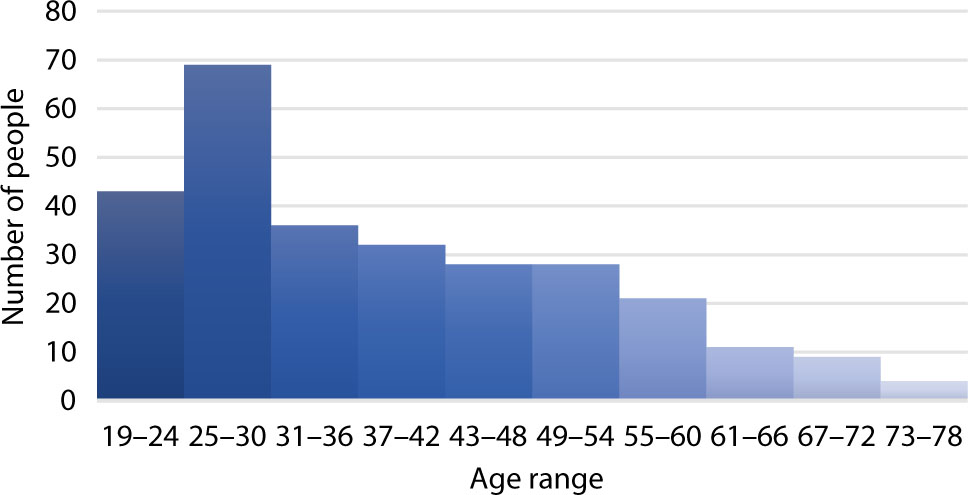
Fig. 1.
Distribution of survey participants by age
Source: Own elaboration.
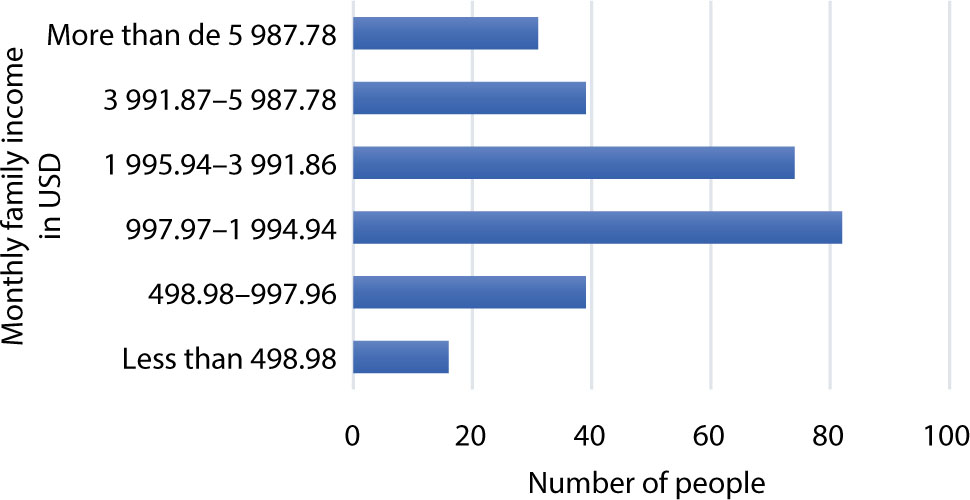
Fig. 2.
Distribution of responses related to household income in US dollars (USD)
Source: own elaboration based.
The average family size was three persons, and 29.08% of respondents reported a family income 4 ranging between USD 997.97 and USD 1995.93. 26.24% reported income between USD 1995.94 and USD 3991.86, while 13.38% reported income between USD 498.98–USD 997.96 and USD 3991.87–USD 5987.78 (Fig. 3). These values coincide with the III and IV quintiles of average household income reported by INEC (INEC, 2023). In addition, the average household food expenditure was USD 516.22, consistent with the aforementioned quintiles.
Table 4 shows that 95% of respondents consume dairy products, with 92% consuming fresh cheese and 81% yogurt. Likewise, 64% indicated willingness to pay (WTP) a premium for fresh cheese, and 63% for organic yogurt. Further details on WTP are discussed below.
Table 4.
Dairy consumption and WTP additional payment for fresh cheese and organic yogurt
| Variable | Yes | No |
|---|---|---|
| Consume dairy products | 267 | 15 |
| Consume fresh cheese | 259 | 23 |
| Consume yogurt | 229 | 53 |
| WTP additional payment for organic fresh cheese | 167 | 92 |
| WTP additional payment for organic yogurt | 146 | 83 |
Respondents who consume fresh cheese and yogurt reported weekly average intakes of 533.45 g and 732.88 ml, respectively. The preferred sizes were 500 g for fresh cheese and 750 ml for yogurt (Table 4). The initial WTP was USD 6.08 for 500 g of fresh cheese and USD 5.54 for 1,000 ml of yogurt. When asked about products from production systems implementing environmental mitigation strategies, respondents reported higher WTP values: USD 6.43 and USD 10.48 for 500 g and 1000 g of organic fresh cheese, respectively, and USD 6.65 and USD 2.40 for 1,000 ml and 200 ml of organic yogurt, respectively.
A total of 94% of respondents expressed a moderate to high preference for fresh cheese, while 86% reported a similar preference for yogurt. The characteristics of fresh cheese rated as “very” or “very important” by at least 55% of consumers were: absence of intense smell, light flavor, product availability, variety of presentations, clear labeling, information on health benefits, and price. For yogurt, characteristics that reached the 55% threshold included animal welfare, protein content, product availability, clear labeling, information on health benefits, and price.
It is also noteworthy that consumers place high importance on sustainability in dairy production. Specifically, between 73% and 81% of respondents rated the following attributes as “very” or “very important”: products from farms that implement efficient water use (73%), are carbon neutral (69%), are deforestation-free (79%), and guarantee animal welfare (81%).
46% of respondents associate the term “organic” with the category “environment,” which includes responses such as water, air, environmental protection, forests, green, global warming, and environmental mitigation strategies. The next most frequent categories are “other” and “health,” each with 11% of responses. The “other” category includes words such as help, change, lie, decrease, effort, exclusive, easy to use, fresh, free, clean, and saltier, while the “health” category includes words such as health, light, clean, healthier, diet, nutritious, and vitamins. Table 6 presents responses in the remaining categories: “packaging”, “sustainability”, “price”, without additives”, “wellness”, “artisanal”, “quality”, “commitment”, “agricultural” and “don't know.”
Table 5.
Descriptive statistics of quantitative variables
| Variable | n | Mean | Median | Min | Max | Std. dev. | Coef. var. (%) |
|---|---|---|---|---|---|---|---|
| Weekly fresh cheese consumption (g) | 259 | 533 | 500 | 10 | 3 500 | 416 | 78 |
| Weekly yogurt consumption (ml) | 229 | 733 | 750 | 50 | 5 000 | 702 | 96 |
| WTP additional for organic fresh cheese (%) | 143 | 13 | 10 | 5 | 45 | 7 | 57 |
| WTP additional for organic yogurt (%) | 141 | 13 | 10 | 5 | 45 | 8 | 59 |
| WTP for fresh cheese (500 g) | 259 | 6.08 | 5.99 | 1.40 | 19.96 | 2.69 | 44 |
| WTP for organic fresh cheese (500 g) | 259 | 6.42 | 5.99 | 1.60 | 23.95 | 2.59 | 40 |
| WTP for organic fresh cheese (1000 g) | 259 | 10.50 | 9.98 | 1.60 | 29.94 | 4.36 | 42 |
| WTP for yogurt (1000 ml) | 229 | 5.54 | 4.99 | 1.30 | 29.94 | 3.00 | 54 |
| WTP for organic yogurt (1000 ml) | 217 | 6.65 | 5.99 | 1.60 | 29.94 | 3.49 | 52 |
| WTP for organic yogurt (200 ml) | 229 | 2.38 | 1.10 | 0.60 | 19.96 | 1.99 | 83 |
| Monthly food spending (USD) | 282 | 516.22 | 498.98 | 598.88 | 1 596.74 | 303.49 | 59 |
| Preferred size for cheese (g) | 258 | 518 | 500 | 100 | 1 500 | 234 | 45 |
| Preferred size for yogurt (ml) | 229 | 741 | 1 000 | 100 | 1 800 | 390 | 53 |
Table 6.
Respondent responses associated with the term “ecological”
| Category | Answers |
|---|---|
| 1 | 2 |
| Environment | Water, air, environment, environmental protection, environmentally friendly, animals, trees, harmony with the environment, garbage in its place, forest, good practices, global warming, climate change, ozone layer, greenhouse gases, climate, certificate, composting, conservation, exosystems, saving resources, fauna, ecological treatments, flora, less pollution, mountain, land, rivers, rational use of water, green, without agrochemicals and pesticides, among others. |
| Other | Help, change, lie, care, they just want to sell, decrease, environment, effort, exclusive, easy use, fresh, farm, innovative, free, clean, more salty, less processed, I do not use genetically modified foods, non-toxic, unprocessed, pure, peace, world order, small quantities, respect, responsibility, rich, safe, toxic, deception, value, among others. |
| Health | Health, light, clean, healthier, diet, healthier, healthy, nutritious, healthy and vitamins. |
| Packing | Biodegradable, reusable, recyclable, returnable, degradable. |
| Sustainability | Self-sustaining, ecology, balance, future, less consumerism, responsibility, sustainability, equilibrium, food security, sustainable, sustainable, among others. |
| Price | Savings, expensive, costly, economic, price and wealth. |
| Without additives | No preservatives, no chemicals, no additives, no sugar, no coloring, no chemicals, no preservatives, no gluten, among others. |
| Welfare | General welfare, animal welfare and animal protection. |
| Artisanal | Artisanal and artisanal processes. |
| Quality | Quality and better |
| Commitment | Commitment and awareness. |
| Agricultural | Agriculture, agribusiness and countryside. |
Table 7.
Binary probit models of willingness to pay for cheese (WTPC)
| Parameter | Coefficients | Standard error | Z | p-value |
|---|---|---|---|---|
| Const | −1.9248 | 0.4590 | −4.1933 | 0.0000*** |
| DESL | −0.1890 | 0.0698 | −2.7081 | 0.0068*** |
| AO | 0.3048 | 0.0781 | 3.9008 | 0.0001*** |
| SL | 0.1908 | 0.0810 | 2.3563 | 0.0185** |
| SP | 0.3929 | 0.0892 | 4.4049 | 0.0000*** |
| P | −0.1462 | 0.1049 | −1.3938 | 0.1634 |
| AHPC000 | 0.0002 | 0.0001 | 1.8151 | 0.0695* |
| R2 McFadden | 0.181 | Akaike criterion | 289.001 | |
| Log likelihood | −137.505 | Hannan-Quinn | 299.011 | |
| Schwarz criterion | 313.880 | Correctly predicted cases | 74.81% | |
| Likelihood ratio | 0.000 | |||
| Normality test of residuals | 0.0004 |
Table 8.
Binary logit model of willingness to pay for yogurt (WTPY)
| Parameter | Coefficients | Standard error | Z | p-value |
|---|---|---|---|---|
| Const | −2.2569 | 0.7620 | −2.9617 | 0.0031*** |
| OLY | 0.4314 | 0.1377 | 3.1328 | 0.0017*** |
| SLY | 0.2960 | 0.1195 | 2.4762 | 0.0133** |
| IPRODY | −0.3167 | 0.1476 | −2.1458 | 0.0319** |
| SP | 0.5715 | 0.1608 | 3.5540 | 0.0004*** |
| PY | −0.1324 | 0.1636 | −0.8096 | 0.4182 |
| R2 McFadden | 0.1246 | Akaike criterion | 274.8549 | |
| Log likelihood | −131.4274 | Hannan-Quinn | 283.1372 | |
| Schwarz criterion | 295.3781 | Correctly predicted cases | 71.24% | |
| Likelihood ratio | 0.0000 |
To model the WTP for organic fresh cheese and yogurt, the binary qualitative response models – probit and logit – were used, with variables described in Appendix A. These models help control for potential response bias, as the predicted probabilities are always constrained between 0 and 1, with the partial effect varying depending on the parameters (Solórzano et al., 2020).
Willingness to pay a premium for organic fresh cheese
Table 4 shows that the willingness to pay a premium for organic fresh cheese is primarily influenced by the following variables: lactose-free, absence of odor, light flavor, household food expenses per capita, price, and the implementation of environmental impact mitigation strategies at the farm level.
Except for the price variable, all coefficients in both the logit and probit models are statistically significant and have the expected signs. Price was retained because it improves the goodness-of-fit measures. Both models achieve correct case prediction percentages above 70%; however, the probit model was selected as the preferred specification. Although the McFadden R2, which is intended to demonstrate that the independent variables have sufficient explanatory power given that the restricted model is not the same as the unrestricted model, is relatively low (0.1819), the likelihood ratio 5 has a p-value of 0.0000, indicating that the null hypothesis is rejected and the slope coefficients are simultaneously different from zero (Gujarati and Porter, 2010). The probit model also shows lower values for the Schwarz Criterion, and Akaike and Hannan Quinn criteria, and its predictive capacity (74.81%) is supported by an area under the curve of 0.762 for the binary probit, which ranges between 0 and 1 – the closer it is to the upper limit, the greater the model's ability to distinguish between the two classes (Fawcett, 2006; Martínez Pérez and Pérez Martin, 2023).
Based on the mean of the marginal changes for all observations, the probability that a consumer is willing to pay a premium for organic fresh cheese is 67%. This probability could decrease by 0.068 percentage points (pp) if the variable DESL increases by one category; increase by 0.110 pp if AO increases by one category; increase by 0.0690 pp if the variable SL increases by one category; increase by 0.1421 pp if the variable SP increases by one category; decrease by 0.0529 pp if P increases by one category; and finally, increase by 0.0001 pp if AHPC000 increases by one category. On the other hand, if interpreted in a generalized way from the odds ratio, the probit model presents an odds ratio of 2.04, indicating that the willingness to pay a premium for organic fresh cheese is 2.04 times more likely to be accepted by the consumer than not.
Willingness to pay a premium for organic yogurt
The significant coefficients with the expected signs for willingness to pay a premium for organic yogurt are light odor, light flavor, information on the production process, and the implementation of environmental impact mitigation strategies at the farm level. Both the logit and probit models achieved correct case prediction percentages above 70%; however, the logit model was selected as the one that best fits the data. Both models show a low McFadden R2 (0.1224), but the likelihood ratio has a p-value of 0.0000, rejecting the null hypothesis and indicating that the slope coefficients are simultaneously different from zero (Gujarati and Porter, 2010). The model's predictive capacity (71.24%) can be appreciated in Figure 6, which shows an area under the curve of 0.732 for the binary Logit.
Based on the mean of the marginal changes for all observations, the probability that a consumer is willing to pay a premium for organic yogurt is 63%. This probability could increase by 0.010 pp if OL increases by one category; increase by 0.066 pp if SLY increases by one category; decrease by 0.080 pp if IPRDY increases by one category; and increase by 0.131 pp if SP increases by one category. On the other hand, if interpreted in a generalized way from the probability ratio, the probit model shown above presents an odds ratio of 1.70, indicating that the willingness to pay a premium for organic yogurt is 1.70 times more likely to be accepted by the consumer than not.
Average willingness to pay
Based on the coefficients from the models presented in the previous sections and using equation 19, the average willingness to pay was estimated as USD 6.35 for 0.5 g organic fresh cheese and USD 7.51 for 1,000 ml organic yogurt.
DISCUSSION AND CONCLUSIONS
Positive willingness to pay (WTP) for organic fresh cheese and yogurt was found among people with high levels of education and medium-to-high incomes, corresponding to quintiles III and IV of average household income reported by INEC. Tapsoba et al. (2022) identified three groups willing to pay a premium for organic tomatoes: the first group had high income and education; the second group had low income and were women, and the third group were farmers. Similarly, Mamouni Limnios et al. (2016) found higher willingness to pay for the ecological footprint of different products in Australia among women, people with higher education, and individuals with incomes between $40,001 and $70,000.
For organic fresh cheese, the variables lactose-free, absence of intense odor, light flavor, the organic attribute, price, and household food expenditure per capita significantly influenced WTP (p < 0.05). For organic yogurt, significant 6 variables (p < 0.01) were light odor, light flavor, information about the producers, and price. Napolitano et al. (2010) reported that expectations generated by complete information (animal welfare, environmental contamination and product safety) on the organic production system were higher than those produced by information on animal welfare alone (p < 0.05) or environmental contamination alone (p < 0.01), while they also exceeded expectations from information on organic fresh cheese alone (p < 0.05).
Other studies indicate that age, male gender, known ecological attributes of the product (culinary, environmental, sanitary and physical), and price influence WTP for organic products (Geng et al., 2022; Tapsoba et al., 2022). In the present study, male gender and ecological attributes were significant in the WTP for organic fresh cheese and yogurt.
The research suggests that consumers are attracted to fresh cheese and yogurt from farms that implement strategies ensuring adequate water use, deforestation-free practices, animal welfare, and carbon neutrality. Consequently, people are willing to pay an additional 13% for organic fresh cheese and yogurt with these attributes. Tapsoba et al. (2022) found that respondents from Hauts-Bassins had a WTP 0.13 times higher than those from Atocara, which is linked to greater knowledge of organic attributes and higher income. Similarly, it was found that people are willing to pay an average additional premium of 13% for organic fresh cheese and yogurt.
Among the main conclusions, dairy consumption is widely accepted among the surveyed population, with a marked preference for fresh cheese and yogurt. Considerable willingness to pay for organic versions was observed, especially when the production systems incorporate environmental mitigation strategies. Sensory characteristics such as light flavor and the absence of strong odors, along with product availability, clear labeling, and information on health benefits, are key factors in purchasing decisions, reflecting consumers' valuation of both quality and sustainability attributes.
The applied econometric models indicate that the probability of accepting an additional payment for organic fresh cheese is 64% and 63% for organic yogurt. WTP estimates from both methods were consistent: USD 6.42 and USD 6.35 for 500 g of organic fresh cheese, and USD 6.65 and USD 7.51 for 1,000 ml of organic yogurt. These findings confirm that environmental awareness and the preference for products that ensure efficient water use, carbon neutrality, deforestation-free production, and animal welfare strongly influence consumers' WTP for organic dairy products.
The population is still not sufficiently familiar with products from systems that implement environmental mitigation strategies. Therefore, measures to encourage the consumption of organic dairy products are essential. These measures should focus on educating citizens about the health and environmental benefits of these products, implementing public policies that support the competitiveness of organic producers relative to conventional ones, and providing training and support to help organic producers optimize resource use and improve yields.