
Introduction
Work life is characterized by all kinds of changes. The pressure for efficiency and innovation to become more competitive and profitable forces organizations to adapt and restructure (e.g., reduce or expand workforce, install new technologies). In addition, socio-economic changes (e.g., economic crises, legislative changes, pandemics) may cause instability in organizations. In these changing work environments, it is not surprising that many workers feel uncertain about keeping their job in the future and not being fired, a subjective experience called job insecurity (Sverke et al. 2002). Over time employees develop expectations about their employment relationship, including job security. When job insecurity arises, it may violate these expectations. As such, job insecurity may invoke employees’ perceptions that the employer failed to fulfill adequately the promised obligations, including long-term job security, leading to a perceived breach of the psychological contract (Robinson 1996). Such a psychological contract breach might occur, even in situations over which the employer objectively has little control (e.g., in times of inflation, when stricter regulations by governments force costs on the organization). Given the harmful consequences for workers and organizations (e.g., negative emotional reactions, impaired well-being, lower organizational commitment, impaired performance) of both job insecurity (for meta-analyses, see Jiang & Lavaysse 2018; Sverke et al. 2019) and psychological contract breach (for meta-analyses, see Bal et al. 2008; Zhao et al. 2007), it is important to have a clear understanding of the dynamic and reciprocal processes between job insecurity and psychological contract breach. We also need to have a clear comprehension of the conditions affecting the relationship between job insecurity and psychological contract breach, such as perceptions of who is responsible for the job insecurity experienced.
In this regard, we see at least two important lacunae in prior research. First, scholars have focused primarily on the effect of job insecurity on psychological contract breach but have neglected the possibility of a reciprocal relationship between job insecurity and psychological contract breach. In the literature on job insecurity, the psychological contract framework has been used as a theoretical explanation of the detrimental outcomes of job insecurity (De Cuyper & De Witte 2006; Shoss 2017; Vander Elst et al. 2016). The experience of job insecurity was found to positively relate to psychological contract breach, which in turn related to outcomes such as need for recovery and low organizational commitment (Vander Elst et al. 2016). In addition, few cross-sectional studies presented psychological contract breach as the predictor and job insecurity as the dependent variable and established a positive relationship (Chih et al. 2017; Qadri et al. 2022; Xiao & Chen 2022). However, these notions neglect a dynamic process in which job insecurity and psychological contract breach can mutually influence each other over time. Both job insecurity and psychological contract breach may be conceived as cognitive appraisals of the work situation, mutually influencing each other (Lazarus & Folkman 1984; Vander Elst et al. 2016). In the research domains on both job insecurity (De Witte et al. 2016) and psychological contract breach (Conway & Coyle-Shapiro 2012; Griep & Bankins 2022; Griep & Vantilborgh 2018a, 2018b; e.g., Robinson 1996), such reciprocal mechanisms are generally recognized, yet it is unclear whether the same is true for the specific relationship between job insecurity and psychological contract breach.
Second, the question arises as to what conditions may affect the relationship between job insecurity and psychological contract breach. This is theoretically important but also practically relevant, because answering this question provides policymakers with guidance on how to avoid perceptions of psychological contract breach, and its associated negative reactions, during times of job insecurity. When feeling job-insecure, employees may desire to know the cause of this negative outcome (Weiner 2018) and evaluate to what extent the organization/employer (the actor in question) and/or external factors (the situation) are responsible for the possible threat of job loss. In this respect, Psychological Contract Theory (Rousseau 1989) and Attribution Theory (Weiner 1986, 2018) recognize the importance of causal attributions in predicting whether or not workers experience a psychological contract breach in reaction to negative outcomes. van Vuuren et al. (1991) demonstrated direct relationships between different types of causal attributions regarding the possibility of job loss and multiple negative outcomes (e.g., avoidance and job search behaviors). However, the extent to which causal attributions function as conditions under which job insecurity may lead to psychological contract breach is currently unknown.
In reply to these lacunae, we aim to increase our theoretical knowledge in multiple ways. First, we recognize that dynamic reciprocal processes between job insecurity and psychological contract breach may be present, as highlighted in research on job insecurity (De Witte et al. 2016) and psychological contract breach (e.g., Conway & Coyle-Shapiro 2012; Griep & Bankins 2022; Griep & Vantilborgh 2018a, 2018b; Robinson 1996), by examining their reciprocal relationship over time. Second, to get a more detailed understanding of the lagged relationship between job insecurity and psychological contract breach, we argue that this relationship is conditional upon employees’ causal attributions concerning the possibility of job loss. Specifically, building on van Vuuren et al. (1991) and Attribution Theory (Weiner 1986, 2018), we introduce blaming the organization for possible job loss in the future (i.e., causal attribution to the organization) and blaming external factors such as the economic situation (i.e., causal attribution to external factors) as potential moderators of the relationship between job insecurity and psychological contract breach. Finally, we use a multi-level approach with lagged within-person relationships. Testing relationships at the within-person level best reflects the processes described in Psychological Contract Theory (Rousseau 1989) and Attribution Theory (Weiner 1986, 2018). Hence, it contributes to previous research mainly using cross-sectional designs and longitudinal between-person designs, thereby tapping into rank-order relationships and differences between individuals instead of within-person dynamics (Hayes 2006; Voelkle et al. 2014).
The reciprocal relationship between job insecurity and psychological contract breach
Job insecurity has been defined as a subjective phenomenon that concerns uncertainty about an involuntary loss of the current job in the future (Sverke et al. 2002). Scholars conceive job insecurity as an important work stressor with aversive consequences, both for employees and the organization. Research has linked job insecurity to impaired mental and physical health (e.g., burnout, anxiety, physical health complaints), negative attitudes toward the job and the organization (e.g., lower job satisfaction and organizational commitment), and less favorable work behaviors (e.g., lower task performance, actual turnover) (for meta-analyses, see Jiang & Lavaysse 2018; Sverke et al. 2019).
To explain these outcomes theoretically, scholars have presented multiple explanatory mechanisms underlying the job insecurity–outcome relationship. These explanations can be clustered in three groups, based on the type of general psychological theories from which they derive: stress and coping-, social exchange-, and motivation-related mechanisms (Vander Elst & De Witte, 2024). In this study, we focus on psychological contract breach, a social exchange-related explanation of job insecurity outcomes that is well established, both in the domain of job insecurity (e.g., De Cuyper & De Witte 2007; Vander Elst et al. 2016) and in the domain of Psychological Contract Theory (Coyle-Shapiro et al. 2019; Rousseau et al. 2018). The psychological contract can be defined as ‘a cognitive schema, or system of beliefs, representing an individual’s perceptions of his or her own and another’s obligations, defined as the duties or responsibilities one feels bound to perform’ (Rousseau et al. 2018, p. 1081). These beliefs are shaped by internal (e.g., recalled experiences) and external sources (e.g., the employment contract), and may change over time. It is considered a critical construct in organizational behavior literature, because employees who perceive that their employer does not meet one or more obligations at a specific point in time (e.g., no longer delivering job security)—termed psychological contract breach—are likely to react emotionally and change their attitudes and behaviors toward the organization (Morrison & Robinson 1997).
Scholars have demonstrated that job security forms a central part of employees’ psychological contract. Kickul and Lester (2001) identified job security as one of the most perceived promises made by the organization among MBA students. Additionally, in a sample of Flemish workers, Claes et al. (2002) found that 81% of the respondents perceived job security as an obligation of the employer. More recent evidence shows that, even in times of economic crisis, both traditional (i.e., paid employees) and non-traditional (i.e., volunteers) workers expect job security from their employer (Griep et al. 2016). The experience of job insecurity may therefore reinforce employees’ perceptions that the employer has not fulfilled its obligations or promises, leading to an experienced unidirectional breach of the psychological contract. Multiple studies offer support for the positive relationship from job insecurity to psychological contract breach (e.g., Costa & Neves 2017; De Cuyper & De Witte 2006; Ma et al. 2019; Vander Elst et al. 2016).
Although previous research mainly focused on the effect of job insecurity on psychological contract breach, we may also argue for a reverse impact of psychological contract breach on job insecurity. First, when employees perceive psychological contract breach, they may be less inclined to trust their employer (Robinson 1996). According to Robinson (1996), psychological contract breach may specifically undermine judgments of integrity; employees likely perceive an inconsistency between the employer’s words and actions. As a result, employees lose confidence that the organization will reciprocate their contributions in the future (Griep & Bankins 2022; Robinson, 1996), for instance by providing job security. In addition, psychological contract breach may lower employees’ trust in the employer’s benevolence (Robinson 1996); employees likely question the assumption that the employer has respect and concerns for their welfare and interests, such as securing their job. Hence, employees may feel more job insecurity when they experience a psychological contract breach. Second, psychological contract breach may reduce employees’ sense of predictability and control over the work situation (Gakovic & Tetrick 2003; Shore & Tetrick 1994), which in turn make employees more likely to appraise the work situation as threatened or as job-insecure (Jiang et al. 2021). We believe that this argument may relate to the previous one, as trusting that the employer will fulfill its obligations makes the work situation more predictable and controllable (de Jong et al. 2021).
Only a handful of cross-sectional studies examined and showed a positive relationship between psychological contract breach and job insecurity (Chih et al. 2017; Qadri et al. 2022; Xiao & Chen 2022). As psychological contract breach can be conceived as a specific type of distributive or outcome injustice (Robinson & Rousseau 1994), we may also turn to previous findings relating (distributive) injustice to job insecurity. In their meta-analytical study, Jiang et al. (2021) found that organizational justice as a general construct (ρ = –.24, 95% CI = [–.36; –.12]), as well as distributive justice as a specific type of justice (ρ = –.30, 95% CI = [–.38; –.22]), were negatively related to job insecurity.
In sum, we hypothesize that perceptions of job insecurity are positively related to perceptions of psychological contract breach and that perceptions of psychological contract breach are positively related to perceptions of job insecurity over time.
Hypothesis 1: Job insecurity and psychological contract breach are reciprocally related over time, such that when employees experience higher levels of job insecurity, they are more likely to experience higher levels of psychological contract breach over time, and vice versa.
The moderating role of causal attributions
Beyond merely focusing on the reciprocal relationship between job insecurity and psychological contract breach, we also explore the role of causal attributions to better understand the conditions that may affect the relationship between job insecurity and future psychological contract breach. Based on the idea that job security is perceived as an obligation of the employer (see above; Claes et al. 2002; Griep et al. 2016; Kickul & Lester 2001), job-insecure employees may evaluate to which extent the organization can be blamed for the possible threat of job loss (i.e., ‘causal attribution to the organization’; Klandermans et al. 1991). Akin to causal attributions to the organization, potential dismissals in the future may also be attributed to external or situational factors that are beyond the control of the organization, such as an economic crisis or decisions by the government (i.e., ‘causal attribution to external factors’; Klandermans et al. 1991), consistent with previous research highlighting macroeconomic factors as causes of potential job losses and job insecurity (Klug et al. 2024; Shoss 2017). These two types of causal attributions correspond to the most salient distinction made in Attribution Theory (Weiner 2018)—‘locus’ (location)—namely between the actor in question (the employer/organization) as opposed to the situation (external factors) that is responsible for the negative outcome (job insecurity).
Unfulfilled commitments or discrepancies, such as job insecurity, will not always result in the perception that the organization breached the psychological contract. Generally, no blame or responsibility is inferred when the cause of the negative outcome (job insecurity) is conceived as not controllable by the actor (the employer/organization) (Weiner 2018). In this case, the failure to comply with the predefined promises is attributed to a disruption; the organization is willing but unable to fulfill its obligations (Eckerd et al. 2013; Robinson & Morrison 2000). In line with Attribution Theory (Weiner 2018) and theoretical work on psychological contract breach (e.g., Robinson & Morrison 2000; Turnley & Feldman 1999), it can be proposed that the perceived cause of the discrepancy between what was promised (i.e., job security) and delivered (i.e., perceived job insecurity) could moderate the relationship between perceptions of job insecurity and psychological contract breach. More precisely, we argue that when employees perceive that their organization is responsible for breaching the psychological contract and can thus be blamed for the possible threat of job loss (i.e., high levels of causal attribution to the organization), perceptions of job insecurity are more likely to result in psychological contract breach. In contrast, when employees perceive that the likelihood of potential dismissal can be attributed to external factors that are beyond the control of the organization (i.e., high levels of causal attribution to external factors), perceptions of job insecurity are less likely to result in psychological contract breach.
Although several scholars have emphasized the importance of defining causal attributions by job-insecure employees to determine potential negative work-related outcomes (Huang et al. 2017), little research (for some exceptions, see van Vuuren 1990; van Vuuren et al. 1991) has focused on the role of causal attributions to understand potential differential reactions of employees. van Vuuren et al. (1991) studied direct associations between causal attributions regarding job insecurity and various well-being and coping outcomes. They found that employees who attributed job insecurity to social and controllable causes (e.g., poor management) were more likely to express lower organizational commitment and to look for another job. In contrast, employees who attributed perceived job insecurity to uncontrollable social causes (e.g., general economic situation) were only more likely to avoid the situation. However, we are not aware of previous research examining the moderating role of causal attributions in the relationship between job insecurity and psychological contract breach.
In line with Attribution Theory (Weiner 2018), we propose that the relationship between job insecurity and future psychological contract breach will be stronger for high (as opposed to low) levels of causal attribution to the organization, and weaker for high (as opposed to low) levels of causal attribution to external factors.
Hypothesis 2: The positive lagged relationship between job insecurity and psychological contract breach is moderated by causal attribution to the organization, so that this relationship is stronger when employees experience higher (as opposed to lower) levels of causal attribution to the organization.
Hypothesis 3: The positive lagged relationship between job insecurity and psychological contract breach is moderated by causal attributions to external factors, so that this relationship is weaker when employees experience higher (as opposed to lower) levels of causal attribution to external factors.
We want to point out that we did not predict these types of causal attributions to moderate the effect of psychological contract breach on job insecurity over time. While psychological contract breach can be considered a stressful event that prompts workers to think about the possible causes of this breach (Conway & Briner 2005; Morrison & Robinson 1997), it does not necessarily concern a potential layoff or job insecurity. Rather, we ascribe the effect of psychological contract breach on job insecurity to the fact that workers lose trust in their employer in reciprocating their contributions and looking after their best interests in the future (Robinson 1996). Thus, while there is a clear match of job insecurity with the moderators under study (i.e., causal attributions to the organization and to external factors), this is not the case for psychological contract breach.
Temporal dynamics
In the current study, we focus on the relationship between job insecurity and psychological contract breach as conditional upon causal attributions. Because we aim to explore change relationships within individuals over time, we used a multilevel analytical approach to test these relationships. Specifically, we selected Random Intercept Cross-Lagged Panel Modeling (RI-CLPM) to analyze our data, which enables disentangling stable differences between individuals from intra-individual fluctuations and processes (Mulder & Hamaker 2021; Mulder & Hamaker 2023). Figure 1 displays the model to be tested, where the processes predicted in Hypotheses 1 to 3 are modeled at the within-person level of the RI-CLPM.
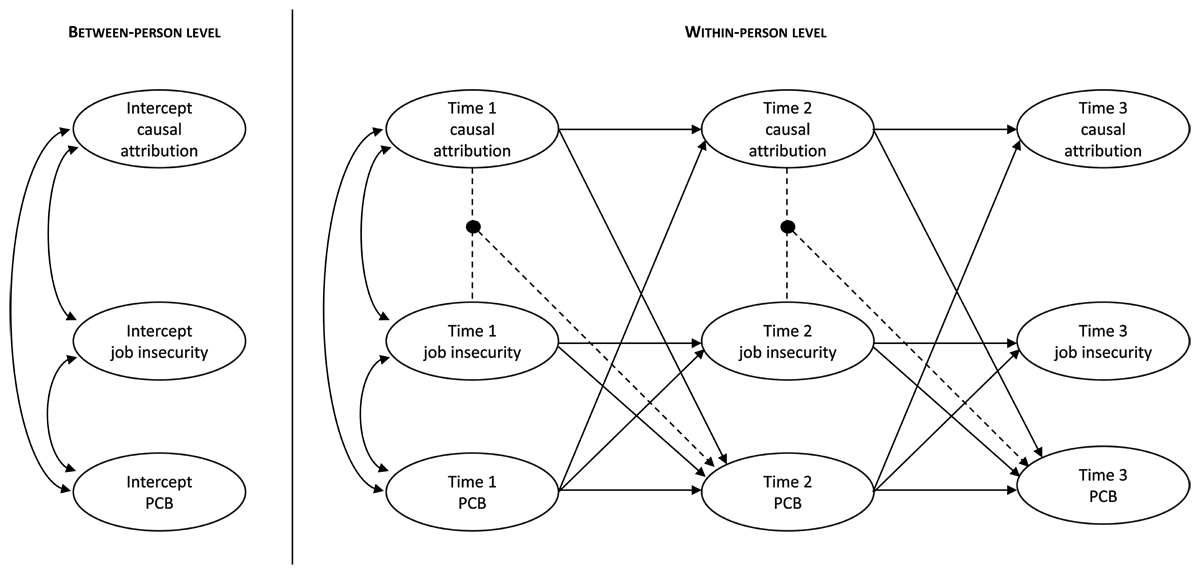
Figure 1
Random Intercept Cross-Lagged Panel Model with Latent Interactions between Job Insecurity and Causal Attribution in Relation to Future Psychological Contract Breach. PCB = Psychological Contract Breach.
Methods
Procedure and sample
We collected three-wave cross-lagged panel data in collaboration with a Belgian Human Resources magazine. We chose a time lag of six months between subsequent measurement points because the overarching research project generally aimed at investigating the lagged effects of job insecurity on employee well-being, attitudes, and behaviors (Time 1: April 2012; Time 2: November 2012; Time 3: April 2013). Such a time lag allowed changes in job insecurity and its outcomes to occur, while at the same time preventing large changes in respondents’ work and personal environment from confounding the results (Huang et al. 2015).
At Time 1, a heterogenous group of workers were invited through the newsletter and the website of the Human Resource magazine to participate in an online questionnaire. We collected the data independently from the organization the employees were working for. At the landing page of the questionnaire, respondents were informed about the purpose of the study, voluntary participation, and confidential treatment of the data. Continuing and answering the questions was therefore conceived as informed consent. In total, 4,878 individuals completed the questionnaire at Time 1. A strict data cleaning procedure was conducted, in which we omitted the following groups of people: respondents exceeding the 18–65 years age span (n = 14), respondents without paid employment (n = 930), self-employed respondents (n = 128), and respondents who filled out the questionnaire multiple times (detected based on recurrent email addresses and a combination of IP address and socio-demographic characteristics; n = 391).
Of the remaining 3,415 respondents, 2,223 respondents provided us with a valid email address and could be contacted for the follow-up questionnaires. While 957 respondents participated in the questionnaire at Time 2 (longitudinal response of 43.1%), 858 respondents initiated the questionnaire at Time 3 (longitudinal response of 38.6%). We removed all respondents who experienced an employment transition between the three measurements, either because of unemployment (n = 70) or job change (n = 159) because this may influence the lagged relationships under study. We arrived at a final sample of 1,994 respondents, who completed the questionnaire at least at Time 1. Approval of data management and GDPR procedures for using the anonymized datafile for this study was obtained in 2023 (ref no. TSB_RP1173).
In this sample, 35.7% of the respondents were male. The mean age of respondents was 38.03 years (SD = 11.50). Employees represented different socio-economic groups: 10.6% were blue-collar workers, 65.6% white-collar workers and 23.9% managers. Most respondents had a permanent contract (88.0%), worked on a full-time basis (77.0%), and worked in the private sector (63.5%).
Dropout analysis
We evaluated whether dropout at Time 2 and/or Time 3 could have influenced the results by conducting a dropout analysis on the data from the respondents who participated at Time 1 and could in principle also have taken part at Times 2 and 3 (N = 2,223). A multinomial logistic regression analysis was conducted in which the response pattern (i.e., (1) response at Time 1, Time 2 and Time 3, n = 582; (2) response at Time 1 and Time 2, n = 375; (3) response at Time 1 and Time 3, n = 276; and (4) response only at Time 1, n = 990) was regressed on a series of sociodemographic characteristics (i.e., age, gender, occupational position, contract, full-time employment and sector) and the four study variables at Time 1. The results showed that younger respondents dropped out more at Time 2 and/or Time 3 (response at Time 1 in comparison with response at Time 1, Time 2 and Time 3: B = –.04, SE = .01, p < .001; response at Time 1 and Time 2 in comparison with response at all times: B = –.02, SE = .01, p < .001; however, response at Time 1 and Time 3 in comparison with response at all times: B = .00, SE = .01, ns). None of the other variables significantly predicted response pattern.
Measurements
(Quantitative) Job insecurity was measured using the four-item Job Insecurity Scale, developed by De Witte (2000) and validated by Vander Elst et al. (2014). An example item is: ‘I think I will lose my job in the near future.’ The items were rated on a 5-point Likert-type scale ranging from 1 (totally disagree) to 5 (totally agree). This scale was reliable at the within- and between-person level, as estimated by the omega coefficient (ɷ) (within-person ɷ = .68, p < .001; between-person ɷ = .97, p < .001) (Geldhof et al., 2014).
Psychological contract breach was measured using four items by Robinson and Morrison (2000; e.g., ‘My employer has broken many of its promises to me even though I’ve upheld my side of the deal’). Respondents were asked to rate the items on a 5-point Likert scale ranging from 1 (totally agree) to 5 (totally disagree). The omega coefficients (ɷ) were .76 (p < .001) and .98 (p < .001) at the within- and between-person level, respectively.
Causal attribution to the organization was measured using an adapted item from van Vuuren (1990). The single item was as follows: ‘Below are several reasons why people in your organization might be laid off. To what extent do these reasons apply to the situation in your organization? The decisions of management increase the probability of dismissals.’ Respondents were requested to rate this item on a 5-point Likert-type scale ranging from 1 (totally not applicable) to 5 (totally applicable).
Causal attribution to external factors was measured using adapted items from van Vuuren (1990). Specifically, we used the following two items: ‘Government policies increase the likelihood of layoffs’ and ‘The economic situation in our country increases the likelihood of layoffs.’ Respondents were requested to rate these items on a 5-point Likert-type scale ranging from 1 (totally not applicable) to 5 (totally applicable). The scale tapping into causal attribution to external factors was reliable at the within-person and between-person level (within-person ritem1,item2 = .51, p < .001; between-person ritem1,item2 = .60, p < .001).
Analyses
Due to the interest in within-person processes over time, we used a multilevel approach. The ICC values of the study variables (ICCjob insecurity = .74; ICCpsychological contract breach = .67; ICCorganizational attribution = .51; ICCexternal attribution = .57) supported that a substantial amount of variance could be attributed to within-person differences. Next, prior to hypothesis testing, we ran multi-level confirmatory factor analysis (MCFA; using MPlus 8.7; Muthén & Muthén 2013) using the maximum likelihood estimator with robust standard errors (MLR) and full-information maximum likelihood (FIML) estimation to deal with missing data (Enders & Bandalos 2001). MCFAs were used to evaluate the fit of the hypothesized measurement model with four latent factors (job insecurity, psychological contract breach, attribution to the organization and attribution to external factors), both specified at the within- and between-person level. We then compared this model to four alternative measurement models. We used conventional standards by Hu and Bentler (1995) to assess model fit: the Comparative Fit Index (.90 ≤ CFI < .95: good fit; .95 ≤ CFI ≤ 1.00: excellent fit), the Tucker-Lewis Index (.90 ≤ TLI < .95: good fit; .95 ≤ TLI ≤ 1.00: excellent fit), Root Mean Square Error of Approximation (.05 < RMSEA ≤ .08: reasonable fit; 0 ≤ RMSEA ≤ .05: close fit), and Standardized Root Mean Square Residual (.05 < SRMR ≤ .08: reasonable fit; 0 ≤ SRMR ≤ .05: close fit). We compared nested models using the –2 log likelihood (–2 LL) difference test.
To test our hypotheses, we conducted Random Intercept Cross-Lagged Panel Modeling (RI-CLPM) in MPlus 8.7 (Mulder & Hamaker 2021; Mulder & Hamaker 2023; Muthén & Muthén 2013). In RI-CLPM, the variance of each study variable is split into a between-person part (the random intercept), reflecting stable or trait-like differences between individuals, and a within-person part, reflecting fluctuations from the expected score or the stable random intercept. Each between-person part (random intercept) is specified by a latent factor with the repeated measurements as indicators and the factor loadings fixed to 1, while the within-person part is specified by a latent factor for each measurement where the measurement error variance is restricted to 0. Covariances between the between-person parts and between the within-person parts of the study variables were added. To investigate the hypothesized cross-lagged relationships between the study variables at the within-person level, we added regression paths from the within-person part of a variable at a certain point in time (Time t) to the within-person part of a variable at a previous point in time (Time t-1).
Specifically, we conducted two sets of RI-CLPM analyses, following the recommendations of Speyer et al. (2023). First, we ran a baseline or direct effect RI-CLPM to test whether job insecurity and psychological contract breach were reciprocally related over time, while controlling for previous values of the endogenous variables and the moderators under study. At the within-person level, this model included the following regression paths: (1) autoregressive paths between subsequent time points for each study variable, representing carryover effects of a variable on itself over time, and (2) reciprocal cross-lagged relationships between job insecurity and causal attributions on the one hand and psychological contract breach on the other hand. We evaluated whether the autoregressive and cross-lagged regression coefficients were time invariant by imposing equality constraints on every unstandardized regression coefficient over multiple waves (Mulder & Hamaker 2021; Mulder & Hamaker 2023). When an equality constraint decreased model fit, we released this constraint and continued testing whether the next regression coefficient was time invariant.
In a second set of RI-CLPM analyses, we tested whether causal attributions moderated the lagged relationship from job insecurity to psychological contract breach. Because of the complexity of an overarching model including all latent interactions with job insecurity for both types of causal attributions, and the enormous time required to run this model, we decided to conduct separate analyses for the two types of causal attributions. Specifically, we tested a model with the following regression paths (at the within-person level): (1) autoregressive effects for job insecurity, psychological contract breach and the type of causal attribution concerned, (2) reciprocal lagged relationships between job insecurity and causal attribution on the one hand and psychological contract breach on the other hand, and (3) lagged effects from the latent interactions between job insecurity and the type of causal attribution concerned to psychological contract breach. We tested whether the latent interaction terms were time invariant by adding time constraints.
Given the high complexity of the interaction models, we used the Bayesian estimator with diffuse or non-informed priors for all RI-CLPM analyses (Muthén 2010; Speyer et al. 2023). The Bayesian estimator avoids convergence problems when running highly computationally demanding analyses, but unfortunately does not provide traditional fit indices to evaluate model fit. The Deviance Information Criterion (DIC) was used to compare nested models (a smaller value indicating a better fit). Regression paths were evaluated using the Bayesian 95% Credibility Intervals (CI), reflecting that the true parameter has a 95% probability of falling within this interval given the observed data. We checked for convergence setting the number of iterations to 50,000, and using the criterion that potential scale reduction (PSR) values were close to 1 (i.e., PSR < 1.1; Muthén 2010; Speyer et al. 2023). Significant latent interactions were displayed using the PLOT and LOOP options in MPlus 8.7, displaying the Bayesian 95% CIs around simple slopes of the relationship between job insecurity and psychological contract breach for all values of the centered moderator (Muthén & Muthén 2013; based on example 3.18).
Results
Descriptive results
Table 1 shows the means and standard deviations at the between-person level, as well as the intercorrelations both at the between- and within-person level.
Table 1
Means, Standard Deviations, and Correlation Matrix at the Between-Person Level (Below the Diagonal), as well as Correlation Matrix at the Within-Person Level (Above the Diagonal).
| VARIABLE | M | SD | 1 | 2 | 3 | 4 |
|---|---|---|---|---|---|---|
| 1. Job insecurity | 2.16 | 0.90 | – | .15*** | .16*** | .12*** |
| 2. Psychological contract breach | 2.60 | 0.82 | .28*** | – | .12*** | .04* |
| 3. Causal attribution to the organization | 2.79 | 1.21 | .39*** | .26*** | – | .25*** |
| 4. Causal attribution to external factors | 2.80 | 1.08 | .33*** | .15*** | .42*** | – |
[i] * p < .05; ** p < .01; *** p < .001.
Measurement model
MCFAs demonstrated the expected dimensionality, and thus construct validity, of the study variables at the within- and the between-person level. The hypothesized multi-level measurement model with four latent factors fit the data well (CFI = .99; TLI = .98; RMSEA = .03; SRMRwithin/between = .03/.03). In addition, this model showed a better fit in comparison with four alternative measurement models: (1) a three-factor model with a general causal attribution factor at both levels (Δ–2 LL(4) = 129.44; CFI = .98; TLI = .97; RMSEA = .03; SRMRwithin/between = .05/.06), (2) a three-factor multi-level model taking job insecurity and psychological contract breach as one latent factor (Δ–2 LL(6) = 2413.02; CFI = .85; TLI = .81; RMSEA = .08; SRMRwithin/between = .30/.29), (3) a two-factor multi-level model with a general causal attribution factor and a factor covering both job insecurity and psychological contract breach (no converge), and (4) a one-factor model in which the items of all scales loaded on the same factor at both levels (Δ–2 LL(10) = 3163.90; CFI = .75; TLI = .69; RMSEA = .11; SRMRwithin/between = .31/.30).
Hypothesis testing
Baseline RI-CLPM
The baseline RI-CLPM in which all regression paths were constrained to be invariant over time (DIC = 33544.38) showed a better fit to the data compared to the unconstrained baseline RI-CLPM (DIC = 33547.50), and therefore served as our final baseline model. This comparison showed that all lagged relationships tested were stable over time. Convergence of the final baseline model was reached with the number of iterations set at 50,000 (PSR value <1.1 for each parameter). Table 2 presents the constrained unstandardized regression coefficients of the final baseline RI-CLPM. Results indicate that, at the within-person level, only the autoregressive paths of psychological contract breach were positive and significant (B = .26, SE = .09, 95% CI = [.08; .43]). This illustrates a carryover effect of psychological contract breach on itself over time. In addition, psychological contract breach at one point in time was positively related to job insecurity at the next point in time (B = .16, SE = .07, 95% CI = [.01; .29]). This entails that an increase in psychological contract breach over time was related to a subsequent increase in job insecurity over time. None of the other autoregressive or cross-lagged relationships were found to be significant, however. A model with 100,000 iterations was tested for convergence check and yielded the same conclusions. Based on these findings, Hypothesis 1 on the reciprocal relationship between job insecurity and psychological contract breach was only partly supported; psychological contract breach at one point in time was positively related to job insecurity at the next point in time, whereas job insecurity at one point in time was not significantly related to psychological contract breach at the next point in time.
Table 2
Results of the Final Baseline Random Intercept Cross-Lagged Panel Model.
| PATHS | UNSTANDARDIZED COEFFICIENT (B) | SE | 95% CI |
|---|---|---|---|
| Within-person level | |||
| Autoregressive paths | |||
| Job insecurity | 0.06 | .10 | [–0.12; 0.25] |
| Psychological contract breach | 0.26 | .09 | [0.08; 0.43] |
| Causal attribution to the organization | 0.08 | .07 | [–0.05; 0.23] |
| Causal attribution to external factors | 0.10 | .07 | [–0.04; 0.23] |
| Cross-lagged paths | |||
| Job insecurity → Psychological contract breach | 0.14 | .08 | [–0.02; 0.28] |
| Causal attribution to the organization → Psychological contract breach | –0.04 | .04 | [–0.12; 0.03] |
| Causal attribution to external factors → Psychological contract breach | –0.02 | .04 | [–0.10; 0.06] |
| Psychological contract breach → Job insecurity | 0.16 | .07 | [0.01; 0.29] |
| Psychological contract breach → Causal attribution to the organization | 0.09 | .12 | [–0.15; 0.31] |
| Psychological contract breach → Causal attribution to external factors | 0.01 | .10 | [–0.18; 0.21] |
| Between-person level | |||
| Covariances | |||
| Job insecurity – Psychological contract breach | 0.15 | .02 | [0.11; 0.20] |
| Job Insecurity – Causal attribution to the organization | 0.38 | .03 | [0.32; 0.43] |
| Job Insecurity – Causal attribution to external factors | 0.29 | .02 | [0.25; 0.34] |
| Psychological contract breach – Causal attribution to the organization | 0.21 | .03 | [0.15; 0.27] |
| Psychological contract breach – Causal attribution to external factors | 0.14 | .03 | [0.09; 0.19] |
| Causal attribution to the organization – Causal attribution to external factors | 0.40 | .03 | [0.34; 0.46] |
[i] Note: SE = Standard error. 95% CI = Bayesian 95% Credibility Interval. Equality constraints were introduced on the unstandardized regression coefficients, and not on the standardized coefficients. The standardized coefficients can differ even if the unstandardized paths are constrained to be equal. Therefore, the standardized coefficients are not presented to present results unambiguously.
Interaction RI-CLPM
Next, testing separate interaction models for the two types of causal attributions showed that these models did not converge when using 50,000 iterations. Hence, we increased the number of iterations incrementally by 25,000 until we reached convergence for both interaction models. Table 3 presents the summary results of the sequential interaction RI-CLPMs for both types of causal attributions with increasing iterations. For the model with causal attribution to the organization as the moderator, convergence was first reached when using 75,000 iterations. However, 100,000 iterations were needed to arrive at convergence for the model with causal attribution to external factors as the moderator. When testing both interaction models with 100,000 iterations, we only found one significant interaction term, that is, from job insecurity*causal attribution to external factors at Time 1 in relation to psychological contract breach at Time 2. As the results for the interaction term job insecurity*causal attribution to the organization at Time 2 in relation to psychological contract breach at Time 3 changed from using 75,000 to 100,000 iterations, we additionally ran models with 125,000 iterations to see whether the results remained the same. This was the case; the interaction term job insecurity*causal attribution to the organization at Time 2 in relation to psychological contract breach at Time 3 did not change back to be significant when using 125,000 iterations. Hence, we selected the interaction models with 100,000 iterations to continue our analyses.
Table 3
Summary Results of the Sequential Interaction Random Intercept Cross-Lagged Panel Models with an Increasing Number of Iterations.
| NUMBER OF ITERATIONS | PATH | MODERATOR | |||||||
|---|---|---|---|---|---|---|---|---|---|
| CAUSAL ATTRIBUTION TO THE ORGANIZATION | CAUSAL ATTRIBUTION TO EXTERNAL FACTORS | ||||||||
| LARGEST PSR VALUE FOR FINAL 100 ITERATIONS | UNSTANDARDIZEDCOEFFICIENT (B) | SE | 95% CI | LARGEST PSR VALUE FOR FINAL 100 ITERATIONS | UNSTANDARDIZEDCOEFFICIENT (B) | SE | 95% CI | ||
| 50,000 | job insecurity*moderator at T1 → PCB at T2 | 1.19 | –0.05 | .07 | [–0.17; 0.09] | 1.80 | 0.18 | .09 | [0.01; 0.38] |
| job insecurity*moderator at T2 → PCB at T3 | 0.22 | .12 | [0.002; 0.48] | 0.14 | .13 | [–0.13; 0.43] | |||
| 75,000 | job insecurity*moderator at T1 → PCB at T2 | 1.07 | –0.05 | .07 | [–0.18; 0.09] | 1.10 | 0.16 | .09 | [–0.01; 0.35] |
| job insecurity*moderator at T2 → PCB at T3 | 0.24 | .13 | [0.01; 0.50] | 0.12 | .13 | [–0.12; 0.39] | |||
| 100,000 | job insecurity*moderator at T1 → PCB at T2 | 1.02 | –0.05 | .07 | [–0.19; 0.08] | 1.06 | 0.17 | .08 | [0.01; 0.33] |
| job insecurity*moderator at T2 → PCB at T3 | 0.23 | .14 | [–0.01; 0.52] | 0.13 | .13 | [–0.11; 0.39] | |||
| 125,000 | job insecurity*moderator at T1 → PCB at T2 | 1.03 | –0.05 | .07 | [–0.19; 0.08] | 1.04 | 0.17 | .08 | [0.02; 0.33] |
| job insecurity*moderator at T2 → PCB at T3 | 0.24 | .14 | [–0.02; 0.53] | 0.13 | .13 | [–0.13; 0.39] | |||
[i] Note: PCB = Psychological contract breach. PSR = potential scale reduction. SE = Standard error. 95% CI = Bayesian 95% Credibility Interval.
In these interaction models, the equality constraints for the direct cross-lagged relationships modeled in the final baseline RI-CLPM were retained, while the added latent interaction terms were initially allowed to vary across time. Therefore, in a next step, we constrained the interaction terms to be equal over time in each interaction RI-CLPM. However, these models stopped running, preventing them from converging and suggesting that the interaction/moderation effects were not stable over time. As a result, the RI-CLPMs with time invariant regression paths, with an exception for the interaction terms, and 100,000 iterations served as our final models. The results of these models are presented in Table 4.
Table 4
Results of the Final Interaction Random Intercept Cross-Lagged Panel Models with either Causal Attribution to the Organization or Causal Attribution to External Factors as the Moderator.
| PATH | MODERATOR | |||||
|---|---|---|---|---|---|---|
| CAUSAL ATTRIBUTION TO THE ORGANIZATION | CAUSAL ATTRIBUTION TO EXTERNAL FACTORS | |||||
| UNSTANDARDIZED COEFFICIENT (B) | SE | 95% CI | UNSTANDARDIZED COEFFICIENT (B) | SE | 95% CI | |
| Within-person level | ||||||
| Autoregressive paths | ||||||
| Job insecurity | 0.05 | .09 | [–0.11; 0.24] | 0.06 | .10 | [–0.11; 0.27] |
| Psychological contract breach | 0.26 | .09 | [0.07; 0.42] | 0.26 | .10 | [0.07; 0.44] |
| Moderator | 0.08 | .07 | [–0.06; 0.20] | 0.12 | .07 | [–0.03; 0.24] |
| Cross-lagged paths | ||||||
| Job insecurity → PCB | 0.10 | .07 | [–0.03; 0.23] | 0.14 | .08 | [–0.02; 0.28] |
| Moderator → PCB | –0.04 | .03 | [–0.10; 0.03] | 0.00 | .04 | [–0.08; 0.08] |
| Job insecurity * moderator at T1 → PCB at T2 | –0.05 | .07 | [–0.19; 0.08] | 0.17 | .08 | [0.01; 0.33] |
| Job insecurity * moderator at T2 → PCB at T3 | 0.23 | .14 | [–0.01; 0.52] | 0.13 | .13 | [–0.11; 0.39] |
| PCB → Job insecurity | 0.15 | .06 | [0.03; 0.26] | 0.18 | .07 | [0.05; 0.31] |
| PCB → Moderator | 0.12 | .11 | [–0.08; 0.38] | 0.09 | .09 | [–0.10; 0.25] |
| Between-person level | ||||||
| Covariances | ||||||
| Job insecurity – PCB | 0.15 | .02 | [0.11; 0.19] | 0.15 | .02 | [0.10; 0.19] |
| Job Insecurity – Moderator | 0.37 | .03 | [0.32; 0.42] | 0.29 | .03 | [0.24; 0.34] |
| PCB – Moderator | 0.20 | .03 | [0.14; 0.26] | 0.12 | .03 | [0.06; 0.17] |
[i] Note: PCB = Psychological contract breach. SE = Standard error. 95% CI = Bayesian 95% Credibility Interval. Equality constraints were introduced on the unstandardized coefficients of all cross-lagged paths (with an exception for the interaction terms), and not on the standardized coefficients. The standardized coefficients can differ even if the unstandardized paths are constrained to be equal. Therefore, the standardized coefficients are not presented to present results unambiguously.
The results of the final interaction RI-CLPM with causal attribution to the organization as the moderator showed that, similarly to the results of the final baseline model, psychological contract breach was positively associated with job insecurity over time (B = 0.15, SE = .06, 95% CI = [0.03; 0.26]). However, job insecurity was not significantly associated with psychological contract breach over time (B = 0.10, SE = .07, 95% CI = [–0.03; 0.23]). None of the interaction terms job insecurity*causal attribution to the organization predicted psychological contract breach over time (Time 1-Time 2: B = –.05, SE = .07, 95% CI = [–0.19; 0.08]; Time 2-Time 3: B = 0.23, SE = .14, 95% CI = [–.01; 0.52]). Nevertheless, the relationship between the interaction at Time 2 and psychological contract breach at Time 3 was marginally significant (two-sided p = .06). Figure 2 shows that the relationship between job insecurity at Time 2 and psychological contract breach at Time 3 was higher and significant for higher levels of causal attribution to the organization at Time 2. This trend provides some support for the idea that attributing one’s job insecurity to the organization strengthens the effect of job insecurity on psychological contract breach over time. In sum, although we did not find formal support for the moderating role of causal attribution to the organization on the relationship between job insecurity and psychological contract breach (Hypothesis 2), in one of the two occasions, we saw a trend in line with our expectations that the lagged relationship between job insecurity and psychological contract breach is stronger (and significant) when employees experience higher levels of causal attribution to the organization.
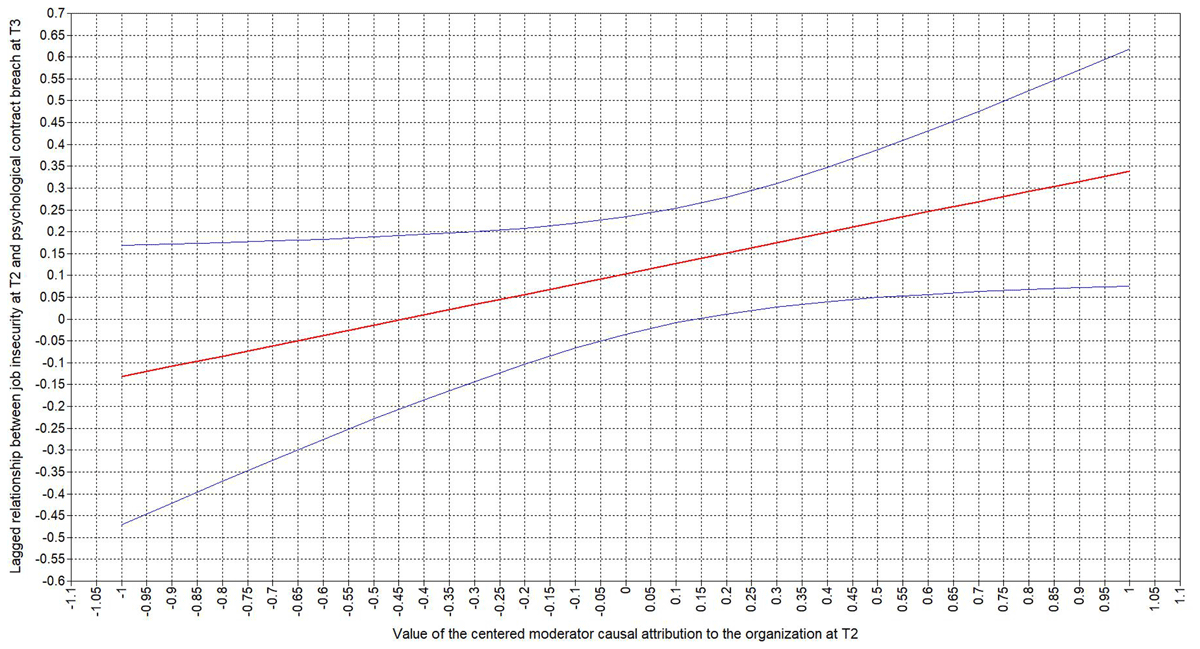
Figure 2
Loop Plot Displaying the Lagged Relationship between Job Insecurity at Time 2 and Psychological Contract Breach at Time 3 for Different Values of the Centered Moderator Causal Attribution to the Organization at Time 2, as well as the Credibility Bands of this Relationship.
In the final interaction RI-CLPM with causal attribution to external factors as the moderator we found that psychological contract breach was positively associated with job insecurity over time (B = 0.18, SE = .07, 95% CI = [0.05; 0.31]), yet we found no significant relationship between job insecurity and psychological contract breach over time (B = 0.14, SE = .08, 95% CI = [–0.02; 0.28]). Causal attribution to external factors at Time 1 amplified the relationship between job insecurity at Time 1 and psychological contract breach at Time 2 (B = 0.17, SE = .08, 95% CI = [0.01; 0.33]), but no moderation effect was found from Time 2 to Time 3 (B = 0.13, SE = .13, 95% CI = [–0.11; 0.39]). Figure 3 shows that the relationship between job insecurity at Time 1 and psychological contract breach at Time 2 became increasingly positive for higher levels of causal attribution to external factors at Time 1. In other words, attributing one’s job insecurity to external factors strengthens the positive effect of job insecurity on psychological contract breach over time. The nature of this interaction effect ran the opposite way than expected in Hypothesis 3.
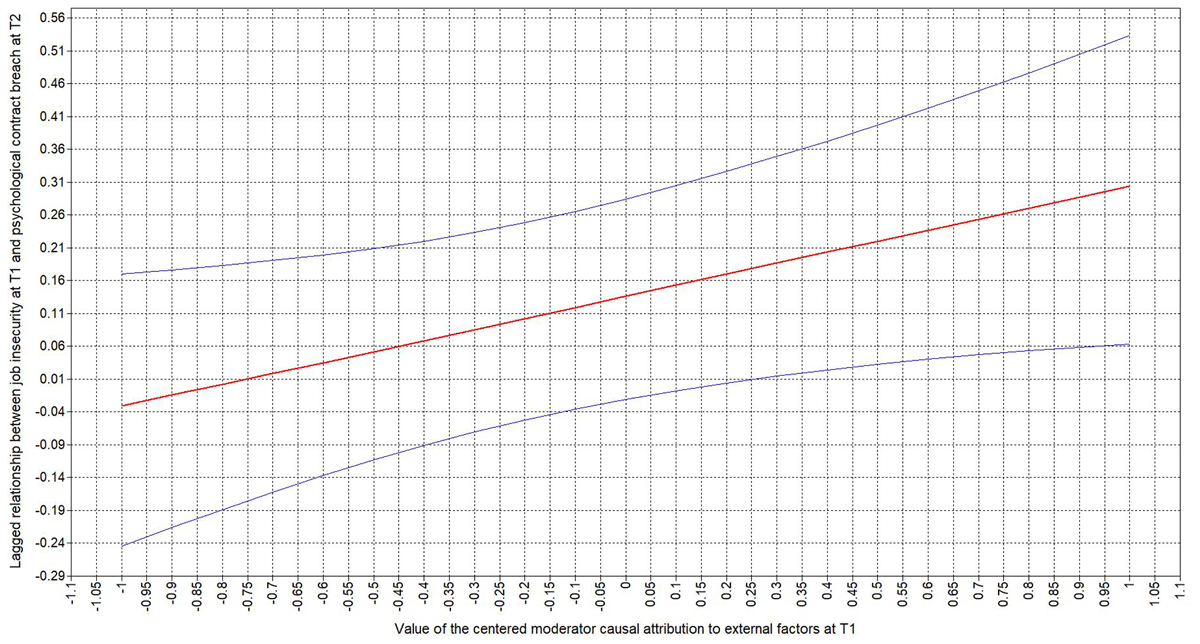
Figure 3
Loop Plot Displaying the Lagged Relationship between Job Insecurity at Time 1 and Psychological Contract Breach at Time 2 for Different Values of the Centered Moderator Causal Attribution to External Factors at Time 1, as well as the 95% Credibility Bands of this Relationship.
Discussion
In this study, we aimed to get a more detailed understanding of the lagged relationship between job insecurity and psychological contract breach. Using three-wave longitudinal data and RI-CLPM, we investigated whether there is a reciprocal relationship between job insecurity and psychological contract breach over time, and if so, to what extent the relationship from job insecurity to psychological contract breach is conditional upon causal attributions about the possibility of job loss. Overall, our results indicate that psychological contract breach was a consistent positive predictor of job insecurity over time, whereas job insecurity was not significantly related to psychological contract breach over time. As a corollary, we found no general support for a reciprocal relationship between job insecurity and psychological contract breach over time. However, this conclusion should be nuanced when taking causal attributions into account. In one of four moderation tests, causal attributions significantly moderated the relationship between job insecurity and psychological contract breach: higher attributions to external factors at Time 1 unexpectedly unveiled a positive lagged relationship from job insecurity to psychological contract breach, as supported by the interaction plot. For higher attributions to the organization at Time 2, the interaction plot also indicated a positive lagged relationship (despite the non-significant interaction term). Although these findings are inconsistent (e.g., variant regression coefficient over time) and thus far from conclusive, they imply that on few occasions, job insecurity and psychological contract breach were reciprocally related over time. Below we elaborate on our main theoretical questions and the implications of our study results.
Are job insecurity and psychological contract breach reciprocally related over time?
Psychological contract breach positively related to job insecurity over time, and this lagged relationship was found to be stable over time. To our knowledge, we were the first to investigate and substantiate the proposition that psychological contract breach predicts job insecurity over time (but see cross-sectional support in Chih et al. 2017; Qadri et al. 2022; Xiao & Chen 2022). Our finding corresponds with the theoretical argument that when employees experience psychological contract breach, they will be less likely to trust their employer in reciprocating their contributions and protecting their welfare and interests (Griep & Bankins 2022; Robinson 1996), resulting in higher job insecurity over time. In addition, psychological contract breach may reduce employees’ sense of predictability and control over the work situation (Gakovic & Tetrick 2003; Shore & Tetrick 1994), making them more insecure about their jobs (Jiang et al. 2021). As we did not examine these intermediating principles of trust, predictability, and control, testing these factors as explanatory mechanisms in the lagged relationship between psychological contract breach and job insecurity would be an interesting path for future research.
Next, job insecurity was generally not associated with psychological contract breach six months later. This result was unexpected, as scholars presented psychological contract breach as a theoretical explanation for the aversive outcomes of job insecurity (De Cuyper & De Witte 2006; Shoss 2017; Vander Elst et al. 2016), and thus seem to agree on the positive effect of job insecurity on psychological contract breach. In common with other researchers, we reasoned that job security is an important part of the psychological contract (Claes et al. 2002; Griep et al. 2016; Kickul & Lester 2001), and that the experience of job insecurity may strengthen employees’ perceptions that the employer has not fulfilled its obligations or promises, that is, psychological contract breach (e.g., De Cuyper & De Witte 2006; Vander Elst et al. 2016). A possible mismatch between theory and the applied time lag might explain why we could not establish a significant relationship between job insecurity and psychological contract breach over time.
It is possible that the time lag of six months was too long to observe the highest possible lagged relationship from job insecurity to psychological contract breach. Both variables can be conceived as cognitive appraisals by individuals going through a cognitive process after entering a new situation. While job insecurity concerns a threat appraisal, psychological contract breach can be considered as a type of distributive/outcome fairness (Lazarus & Folkman 1984; Robinson & Rousseau 1994; Vander Elst et al. 2016). Such cognitive appraisals may follow each other shortly in time, as demonstrated by research findings in the psychological contract field (e.g., Griep & Vantilborgh 2018a). Previous research supporting the relationship between job insecurity and psychological contract breach have mainly used cross-sectional designs (e.g., Costa & Neves 2017; De Cuyper & De Witte 2006; Ma et al. 2019; Vander Elst et al. 2016), testing rank-order relationships at one point in time rather than intra-individual processes. The appropriate time lag to measure changes in the study constructs and examine their relationships is not an issue in such between-person designs. To better align the test with the theory on situational appraisals that can affect each other relatively briefly in time, future research should use within-person designs with varying shorter time lags to explore which specific time lag works best (e.g., one day or one week, see e.g., Griep & Vantilborgh 2018a, 2018b).
Overall, we did not find support for a general reciprocal relationship between job insecurity and psychological contract breach over time, due to the finding that job insecurity was generally not associated with psychological contract breach over time. This contradicts a transactional notion where different perceptions of the work situation as well as aspects of employee functioning mutually influence each other over time (Lazarus & Folkman 1984). Yet in specific occasions, job insecurity positively related to psychological contract breach over time.
Is the lagged relationship from job insecurity to psychological contract breach conditional upon causal attributions?
This study shows that causal attributions to external factors at Time 1, but not at Time 2, moderated the relationship between job insecurity and subsequent psychological contract breach. The result for Time 1 aligns with the idea that outcomes of job insecurity depend on the macroeconomic context in which workers engage (Klug et al. 2024; Shoss 2017), and that appraisals concerning the impact of this context on potential job loss can affect how workers perceive the psychological contract with their employer. However, the amplifying effect of causal attribution to external factors at Time 1 was unexpected. After all, in line with Attribution Theory (Weiner 2018) and theoretical work on psychological contract breach (e.g., Robinson & Morrison 2000; Turnley & Feldman 1999), we predicted that perceptions of job insecurity are less likely to result in perceptions of psychological contract breach when employees attribute the possibility of dismissal to external factors beyond the control of the organization (e.g., an economic crisis, decisions by the government). Our unexpected finding can be explained by drawing from Conservation of Resources Theory (Hobfoll 2001, 2002).
Specifically, it could be argued that when employees experience more uncertainty about the extent to which the employer might meet its promises, as is the case when job insecurity is the result of external factors where the employer is seen as powerless, employees might wish to protect remaining resources or may even attempt to gain new resources. Individuals may invest personal and environmental resources, such as attention, cognitive processing, and sense-making, to protect remaining resources or enhance the chances of obtaining new ones (Gorgievski & Hobfoll 2008). In the context of one’s psychological contract, this implies that employees will attentively monitor the extent to which their organization fulfills its obligations. However, while designed to prevent further resource loss, the vigilant monitoring of the ongoing state of one’s psychological contract has been theoretically (Morrison & Robinson 1997) and empirically (Griep et al. 2016) linked to an increased probability of perceiving future psychological contract breaches. Indeed, vigilant monitoring raises the probability of detecting and interpreting a breach because attention is focused on negative environmental cues, prompting individuals to scrutinize, acknowledge, and make sense of minor discrepancies in line with prior experiences of the organization not fulfilling its promises (Fiske & Taylor 1984; Griep et al. 2016).
Next, we found no moderation by causal attribution to the organization in the lagged relationship between job insecurity and psychological contract breach. This finding is surprising because, based on Attribution Theory (Weiner 2018) and theoretical work on psychological contract breach (Robinson & Morrison 2000), we reasoned that job insecurity will more likely result in psychological contract breach over time when employees perceive that their organization is responsible for not fulfilling its obligation of job security and can thus be blamed for the possible threat of job loss. Nevertheless, although the interaction terms did not reach conventional levels of significance, the interaction plot in Figure 3 showed that the trend in the simple slope was in line with our predictions: the relationship between job insecurity and future psychological contract breach was stronger and significant for higher levels of causal attribution to the organization at Time 2. The inconsistency between the significance of the interaction terms and the interaction plot could be the result of a power issue, as the effect size (regression coefficient) of the interaction term at Time 2 in relation to psychological contract breach at Time 3 was substantial but nevertheless statistically non-significant (B = 0.23, SE = .14, 95% CI = [–.01; 0.52]; β = .17, 95% CI = [–.005; 0.37]). Indeed, we realize that RI-CLPM including latent interactions is statistically complex and that actions should be taken to increase power. Although our results are far from conclusive, this study thus offers some initial indications that job insecurity is related to more future psychological contract breach upon the condition that the organization is seen as responsible for the possibility of job loss. Future research should explore this further by using larger samples and/or more waves to increase power.
Limitations
First, as most of our study variables are idiosyncratic in nature, they were captured using self-reports and this might have increased the risk of common method bias. We reduced this risk by emphasizing the voluntary character of the survey, by stressing the anonymous treatment of the data, by using validated scales to measure the study variables, and by using longitudinal data in a lagged design (Conway & Lance 2010).
Second, the dropout analysis indicated that younger respondents dropped out more at Time 2 and/or Time 3, which can be explained by the fact that younger employees are less conscientious than older employees (Srivastava et al. 2003). The higher dropout among younger respondents could have influenced the results in opposite ways. On the one hand, it could have led to an underestimation of the relationship between job insecurity and psychological contract breach because younger employees have poorer emotion regulation skills (Carstensen et al. 2003). When encountering a negative event (e.g., job insecurity), they might not be able to handle their anger so well and thus experience greater psychological contract breach. On the other hand, it could have led to an overestimation of the job insecurity–psychological contract breach relationship because younger employees expect less job security from their employer than older employees (Rousseau 2001; Smithson & Lewis 2000).
Third, our sample was not representative of the labor force, and this could have influenced our results in various ways. For instance, experimental findings from Wei et al. (2015) showed that the positive effect of a labor costs reduction—reflecting a violation of job security—on psychological contract breach was higher among women with lower levels of managerial control over the decision, whereas the positive effect of a labor costs reduction on psychological contract breach was higher for men in the higher managerial control condition. As the majority of our sample was female, this could imply that the relationship between job insecurity and psychological contract breach for higher levels of causal attribution to external factors (reflecting low managerial control) could have been inflated, whereas this relationship could have been tempered for higher levels of causal attribution to the organization (reflecting high managerial control).
Finally, we used a single item measurement for causal attribution to the organization. Although using single items is not uncommon in cross-lagged panel studies and recommended by several authors as a best practice (e.g., Ohly et al. 2010), some scholars tend to criticize it because it does not allow for the calculation of reliability. However, it is important to bear in mind that reliability matters only in service of validity (e.g., Bergkvist & Rossiter 2009) and that when these single items have face- and content-validity they should be considered acceptable measurement tools (Bergkvist & Rossiter 2009; Fisher & To 2012).
Practical Implications
Given our finding that psychological contract breach consistently related to more job insecurity over time as well as previous research demonstrating the wide range of aversive outcomes of job insecurity for both employees and organizations (for meta-analyses, see Jiang & Lavaysse 2018; Sverke et al. 2019), employers and other policy makers within organizations should focus on reducing employees’ perceptions that the employer has not fulfilled its obligations or promises. However, in times of organizational and socio-economic change, it might be difficult if not impossible to completely avoid psychological contract breach (Robinson 1996). Nevertheless, as employees’ trust in the organization seems crucial in reducing their perceptions of psychological contract breach (Robinson 1996), employers and other policy makers need to reassure employees through open and honest communication, provide support, and offer remedies and alternatives when one is unable to fulfill one’s promises (Griep & Bankins 2022). By increasing the amount of contact and communication with employees while being careful about what is promised, organizations can also reduce incongruent perceptions and thus reduce the risk of psychological contract breach (Robinson & Morrison 2000).
In addition, this study offered some first indications that attributing one’s job insecurity to external factors (e.g., an economic crisis, decisions by the government) and to the organization might amplify the positive relationship between job insecurity and psychological contract breach. Although these findings are far from conclusive, they seem to imply that placing the cause of potential risks to employees’ jobs outside the organization is not a solution to prevent psychological contract breach. Instead, as we reasoned that attributions to external factors might lead the employer to be seen as powerless, we believe that organizations can best communicate about its responsibility and the measures taken to protect jobs. Nevertheless, future research should replicate and refine our study results before strong practical implications on causal attributions can be formulated.
Conclusion
To date, most research focusing on the relationship between job insecurity and psychological contract breach has approached psychological contract breach as a theoretical explanation for job insecurity outcomes, neglecting the possibility of a reciprocal relationship. In reply, this study delved into the nuanced interplay between job insecurity and psychological contract breach, shedding light on the significance of employees’ causal attributions about possible job loss. Unambiguous support was found for the positive lagged relationship from psychological contract breach to job insecurity. Yet, on few occasions, higher attributions to external factors and to the organization also revealed a positive relationship between job insecurity and psychological contract breach over time, suggesting reciprocity under specific circumstances. Our results underscore the complexity of the link between job insecurity and psychological contract breach and emphasize the need for future research to further investigate the moderating role of causal attributions in this relationship.
Data Availability Statement
The data used in this manuscript can be found on The Open Science Framework using the following link: https://osf.io/duxtn/?view_only=fca20382589c43aaa90a3c99483e84d4.
Competing Interests
The authors have no competing interests to declare.