
Introduction
Working life has changed tremendously during the past decades and these changes have effects on how employees experience job demands (see, e.g., Mauno & Kinnunen 2021; Menon et al. 2020; Rosa 2003). In this study, we focus on contemporary relevant job demands, that is, intensified job demands (IJDs), which describe the essence of the quantitative and qualitative intensification of working life (Kubicek et al. 2015; Mauno, Kubicek et al. 2019; Mauno et al. 2023). Generally, the former type of intensification refers to employees’ experiences of increased working pace or other increased effectivity demands, whereas the latter type of intensification characterizes employees’ experiences of increased cognitive or mental demands at work (a more detailed definition of IJDs appears later).
IJDs are not without costs, and there is evidence that they are job stressors associated with many negative strain-related outcomes (for a review, see Mauno et al. 2023). However, much less is known about their effects on employees’ job performance. This is indeed a paradoxical because, in its original conceptualization, the intensification of working life was expected to be one key route for higher organizational effectivity and performance (Boxall & Macky 2014; Mauno & Kinnunen 2021). Furthermore, if we focus on an individualistic stress management perspective, it is vital to seek different personal, job- and organization-related resources that would mitigate the stressfulness of IJDs, thus preventing them from detrimentally affecting individuals (e.g., Huo et al. 2022; Mauno & Kinnunen 2021; Minkkinen et al. 2021). In this study, we investigate whether approaching a job as a calling (henceforth calling) helps individuals tackle stressors more effectively by reducing the negative effects of hindrance stressors and enhancing the positive effects of challenge stressors on performance. To the best of our knowledge, calling has not been studied in association with IJDs, although there is evidence that calling has a positive role in individuals’ stress management, performance, and well-being (e.g., Creed et al. 2014; Dobrow et al. 2023; Duffy et al. 2014; Vianello et al. 2022).
Considering the gaps in research, our study has two objectives: (1) to explore the effects of IJDs on both in-role (task performance, TP) and extra-role (organizational citizenship behaviors, OCB) job performance, and (2) to investigate whether calling functions as a beneficial personal resource in the relationship between IJDs and performance. Empirically, our study is based on one-year follow-up data collected from Finnish teachers (n = 507). Teachers represent a useful sample, as their occupational role is likely to be both stressful and approached as a calling by individuals (Kyriacou 2001; Serow 1994; Virtanen 2021). The follow-up data would offer more reliable evidence compared to previous cross-sectional studies that have dominated the research regarding both IJDs (Mauno et al. 2023) and calling (Lysova et al. 2019; Thompson & Bunderson 2019).
Defining IJDs and their underpinnings in the context of social acceleration
In this study, we conceptualize and measure job demands by applying one recently developed model describing currently relevant job demands, that is, the intensified job demands model (IJDs model, see Kubicek et al. 2015; Mauno et al. 2023). More specifically, the IJDs model is rooted in social acceleration theory (Rosa 2003) and aims to describe and understand the characteristics of the quantitative and qualitative intensification of working life (see Herttalampi et al. 2023; Huhtala et al. 2021; Kubicek et al. 2015; Mauno & Kinnunen 2021; Mauno et al. 2023). In this context, we consider IJDs as sub-types of job demands that characterize post-modern societies and the current era via three processes of social acceleration concerning technology, social changes, and pace of living (Rosa 2003). These three forms of social acceleration affect working life by quantitatively and qualitatively intensifying job demands, and this phenomenon is conceptualized and operationalized in the IJDs model (see Korunka et al. 2015; Kubicek et al. 2015; Mauno et al. 2023; Mauno & Kinnunen 2021; Mauno, Kubicek et al. 2019). Among these forms of social acceleration, technological acceleration has been viewed as a key predictor of intensification of working life because its many forms, such as digitalization, robotization, machine learning, and artificial intelligence, are dramatically transforming the content of jobs, occupations, and ultimately entire industries (Mauno, Kubicek et al. 2019; Menon et al. 2020).
Indeed, pervasive technological acceleration in society is accelerating many work processes and information transfer (Rosa 2003), thus creating and maintaining the need for employees to work more effectively and intensively, which, in turn, is reflected in employees’ experiences of IJDs (Mauno, Kubiceket al. 2019). We perceive that social acceleration theory positions IJDs in a wider societal context, indicating that the megatrends of post-modern societies also affect working life. The idea of social acceleration is also present in the assessment of IJDs via a particular self-report inventory (i.e., IJDs-scale, Kubicek et al. 2015), which will be applied in our study. The main difference between traditional job demands/stressors (e.g., workload, other psychosocial job demands) and IJDs lies in the assumption that working life, including job demands, does not develop in a vacuum but in close interaction with more widespread societal phenomena, such as social acceleration.
According to the IJDs model (Kubicek et al. 2015; Mauno, Kubicek et al. 2019; Mauno et al. 2023), the intensification of working life concerns domains where job demands are becoming—or have already become—quantitatively or qualitatively more intensified and demanding. In this context, quantitative intensification entails that employees are supposed to work faster or otherwise more effectively in terms of time and/or the amount of work, whereas qualitative intensification means that employees are required to invest greater mental or cognitive effort at work, resulting in qualitatively more intensified work (Mauno et al. 2023). Specifically, the IJDs model, and the assessment scale based thereon, includes four dimensions that capture different facets of the intensification of work.
The first dimension of this model is work intensification (WI), and this dimension is consistent with the traditional sociological approach that has regarded work intensification as an accelerated pace of work (Green 2004). This dimension characterizes a need to work faster, reduce downtime and microbreaks, and perform work assignments by multitasking (Kubicek et al. 2015). This type of intensification has lately been referred to as quantitative work intensification (Mauno et al. 2023).
The second dimension in the IJDs model (Kubicek et al. 2015) is intensified job-related planning and decision-making demands (IJP), referring to increased decision-making pressures for an employee to sort out which work tasks (s)he has to perform (expected agency in planning) and how to perform them (expected agency in doing). In practice, this subtype of intensification would mean that ‘you should be your own boss’. The third dimension is career-related planning and decision-making demands (ICP). Specifically, this facet illustrates that employees are increasingly expected to maintain and improve their employability not only regarding their current employer but also considering external career opportunities and long-term career management plans (Kubicek et al. 2015; Mauno, Kubicek et al. 2019). This means that employees are expected to take the initiative and to be proactive in managing their careers (expected agency in career management) as employers may not be willing to make long-term investments in their personnel’s career prospects.
The fourth dimension of the IJDs model is intensified learning demands (ILD), which captures the intensification of demands in relation to work-related knowledge, skills, and competencies that employees are expected to constantly improve and update (Kubicek et al. 2015). In contemporary working life, employees are more and more expected to constantly update their job-relevant knowhow, skills, and competences to be able to perform their daily work and achieve work objectives (see Herttalampi et al. 2023; Kubicek et al. 2015; Mauno et al. 2023; Mauno & Kinnunen 2021). In recent formulations, these three last-mentioned dimensions of the IJDs model (i.e., IJP, ICP, and ILD) have described qualitative work intensification (Mauno et al. 2023).
IJDs in the context of work stress models
In the past, IJDs have often been studied within the theoretical framework of work stress (Herttalampi et al. 2023; Korunka et al. 2015; Kubicek et al. 2015; Mauno et al. 2023). This stress-focused perspective has been applied in exploring various negative effects of IJDs on employees (e.g., Herttalampi et al. 2023; Huhtala et al. 2021; Kubicek et al. 2015; Mauno et al. 2023; Mauno & Kinnunen 2021; Minkkinen et al. 2021). Many job stress models can be applied to explain the negative effects of IJDs. In this study, we focus on the challenge-hindrance model (e.g., Cavanaugh et al. 2000; LePine 2022; O’Brien & Beehr 2019), which was found to be a useful framework in explaining the different effects of IJDs on employees (e.g., Herttalampi et al. 2023; Huhtala et al. 2021; Korunka et al. 2015; Mauno et al. 2023).
The challenge-hindrance model (Cavanaugh et al. 2000; LePine 2022; O’Brien & Beehr 2019) suggests that job demands can be divided into hindering and challenging demands; the former results in negative outcomes (e.g., strain and lower well-being), whereas the latter might lead to positive outcomes (e.g., better motivation and performance). Hindrance demands are typically organizational or work-related constraints that drain employees’ resources and may also hinder performance and task accomplishment. Challenging demands are organizational or work-related characteristics that enable employees’ growth and personal development, although they simultaneously require often mental effort at work (Cavanaugh et al. 2000; LePine 2022). Among the subdimensions of IJDs, previous findings have indicated that quantitative work intensification (WI) is a hindrance demand, as it has typically been associated with negative employee outcomes (Herttalampi et al. 2023; Huhtala et al. 2021; Kubicek et al. 2015; Mauno et al. 2023). Although prior findings concerning other subdimensions of IJDs (i.e., intensified planning and decision-making demands related to job and career management, and intensified learning demands) are mixed, there is evidence showing that these demands can be positive challenges rather than hindrances, and that they relate to positive motivational outcomes, such as work engagement and job satisfaction (Herttalampi et al. 2023; Korunka et al. 2015; Mauno et al. 2023). Considering the challenge-hindrance model and previous empirical evidence, our first hypothesis states:
H1: The subdimension of work intensification (as a hindrance demand, H1a) is related to poorer performance, whereas other subdimensions of IJDs (as challenge demands; intensified job- and career-related planning- and decision-making demands, and intensified learning demands, H1b) are related to better performance.
Calling as a personal resource in a stress process
The concept of approaching work as a calling has a long history that traces back to the Protestant Reformation, which opened the chance of being called toward one’s work to non-religious workers (Bunderson & Thompson 2009). Work as a calling became a way to find purpose in life through pro-sociality and self-transcendence. The last twenty-five years have witnessed an increase in the scientific research on calling (for recent reviews, see Dobrow et al. 2023; Thompson & Bunderson 2019). However, no commonly agreed definition of calling exists even today (Thompson & Bunderson 2019). In this study, we rely on a definition proposed by Dik et al. (2009), of calling as transcendent summons, experienced as originating beyond the self, to approach a particular life role (here in relation to career/work) in a manner oriented toward demonstrating or deriving a sense of purpose or meaningfulness that includes other-oriented values and goals as primary sources of motivation.
Calling represents a personal resource that activates further individual resources and yield successful adjustment and action regulation, in the form of increased motivation, engagement, and commitment (e.g., Dobrow et al. 2023; Duffy et al. 2019; Duffy & Dik 2013), which, in turn, foster the positive experience of living one’s own calling. Indeed, it has been observed that employees with strong callings are more resilient to hindrance stressors (Dalla Rosa et al. 2020; Dalla Rosa & Vianello 2020) and may react more proactively to challenge stressors (Cai et al. 2022). More generally, approaching a job as a calling improves individual responses to environmental stimuli. As a result, individuals with high callings perform better at work (e.g., Duffy, Autin et al. 2018; Sharma et al. 2022). A recent meta-analytic summary of eleven studies (N = 2,286) found that the population estimate of the relationship between calling and task performance is r = .29, 95% CI [.18, .39], with no evidence of unknown moderators (Vianello et al. 2022). The positive link between calling and job performance is also one key element in the Work as a Calling Theory (Duffy, Dik et al. 2018, Duffy et al. 2019). Hence, our second hypothesis states:
H2: Calling is positively related to performance.
The role of calling as a personal resource is further supported by evidence showing that it prevents the development of workaholism when obsessive passion is high (Dalla Rosa & Vianello 2020) and that it protects against job burnout (Goštautaitė et al. 2020; Hagmaier et al. 2013). Considering the protective role of calling in stressful working conditions, we propose that calling may buffer against the detrimental effect of hindrance demands. Indeed, it has been observed that employees with higher calling reported lower job burnout in the presence of high role ambiguity compared to employees with lower calling (Wu et al. 2019). In this same study, higher calling and higher role conflict were associated with the highest job performance (an additive effect), suggesting that role conflict might be appraised as a challenge (rather than a hindrance) demand. Furthermore, it has recently been shown that calling buffered against specific job demands (e.g., fear of COVID-19) in relation to burnout and turnover intentions among health care workers (Dalla Rosa et al. 2023). However, as far as we know, no studies have been presented investigating the role of calling in the relationship between IJDs and performance. Consequently, we will seek new evidence of the beneficial role of calling between these particular job demands and job performance.
As previously mentioned (see H1a, H1b), the IJDs model distinguishes hindrance and challenge demands in terms of their different outcomes (see also Herttalampi et al. 2023; Huhtala et al. 2021; Mauno et al. 2023). For this reason, it is reasonable to expect that calling buffers the negative effects (in relation to hindrance demands) and strengthens the positive effects (in relation to challenge demands) of IJDs on performance indicators. The positive, buffering role of personal resources, including calling, in the presence of high job demands is comprehensible through the job demands-resources model (JD-R model, for reviews, see Bakker et al. 2014; Bakker et al. 2023), which argues that resources may have their most powerful effects on outcomes when job demands are high. Thus, resources are most needed and beneficial when working conditions are demanding. We argue that this prediction is valid for both hindrance and challenge demands here operationalized via IJDs. Hence, our third hypothesis states:
H3a: Calling buffers against the negative effects of hindrance demands (work intensification subdimension) on performance.
H3b: Calling strengthens the positive effects of challenge demands (intensified job- and career-related planning and decision-making demands, and intensified learning demands) on performance.
Methods
Participants and procedure
This study was implemented as part of a larger research project (IJDFIN-project), which examined contemporary job demands and their outcomes. Here, we focused on teachers as their working conditions have changed in Finland during recent years, for example, due to accelerated digitalization and renewals of the national study curriculum (Mäkikangas et al. 2023; Minkkinen et al. 2021; Virtanen 2021). Such changes have been reflected in teachers’ job demands, and Finnish teachers have reported relatively high IJDs in national comparative studies (e.g., Mauno, Minkkinen, & Auvinen 2019). More generally, teaching is considered a stressful calling occupation (Kyriacou 2001; Serow 1994; Virtanen 2021).
Specifically, we applied a two-wave lagged study design. The first wave data were collected in 2018 (Time 1, T1), and the second wave data were collected one year later in 2019 (Time 2, T2) from members on the register of the Trade Union of Education in Finland. Study participants were recruited via their trade union because union membership rates are high in Finland; 95% of Finnish teachers belonged to their trade union in 2015 (Trade Union of Education in Finland 2015). We used random sampling to collect the target group of teachers from the trade union’s registers. Data were collected using an online questionnaire that was sent to participants via representatives of the trade union. Individuals’ responses across the two waves were matched using codes for each participant to ensure data confidentiality. Participants were fully informed of the purpose of the study and its longitudinal nature, and their responses were matched longitudinally. Altogether, the whole study was implemented according to the ethical requirements of the Research Council of Finland (e.g., participation was voluntary, informed consent was obtained from each participant, and data were anonymized). Furthermore, we followed the European General Data Protection Regulation, and all descriptions of the procedures (e.g., data collection, data preservation, and data analysis) were reviewed and confirmed by our university administration.
At Time 1, the sampling included 5,076 teachers. The response rate at Time 1 was 48% (N = 2,434). Although more women participated at Time 1, the sample represented the membership of the trade union quite well. Gender difference was not significant compared to the trade union membership. At Time 1, over 50-year-olds were overrepresented compared to the trade union membership (57.3% vs. 43%, p < .001). At Time 2, a total of 507 individuals responded of those 895 who had given their consent to participate in the follow-up survey (response rate of 56.6%). Thus, 37% of the respondents at Time 1 gave their written consent to participate in the follow-up survey at Time 2. In the final sample of this particular study (n = 507 teachers participated at Time 1 and Time 2), the mean age was 47.1 years (SD = 10.8), and the respondents’ ages varied from 24 to 66 years. Of the participants, 81.7% were female, 77.8% had a permanent employment contract, and 14.1% worked in managerial positions. Concerning education, 2.9% had university postgraduate degrees (licentiate or doctorate), 68.1% had master’s degrees, and 22.9% had bachelor’s degrees. No systematic sample attrition between Time 1 and Time 2 measurements was observed in background factors in an earlier study based on the same dataset (Mäkikangas et al. 2023). In this follow-up data, there were no missing values as we included in the follow-up data only those respondents who had responded to all survey items.
Measures
Independent variables (at Time 1)
We assessed the intensification of job demands by applying the multi-dimensional intensified job demands model (IJDs) and survey (the Intensification of Job Demands Scale, IJDs scale) described in the introduction. This model and survey were developed, tested, and validated among Austrian employees by Kubicek et al. (2015). Before data collection, all items and response instructions were translated into Finnish using services of a translation agency. In collecting the data using a Finnish version of the IJDs scale, respondents were asked to evaluate changes in IJDs (in their organization/work) during the last five years or less if a participant had been working for less than five years. The IJDs model and survey are rooted in a societal process of acceleration (Rosa 2003), which has been emerging in recent years in the context of working life. Consequently, the time frame of the IJDs scale focused on perceived changes in IJDs that had occurred in the past (Huhtala et al. 2021; Kubicek et al. 2015; Mauno et al. 2019; Mauno et al. 2023; Mauno & Kinnunen 2021). Indeed, social acceleration, which underlies IJDs, is expected to be a rather slow process (Kubicek et al. 2015; Mauno et al. 2023; Mauno & Kinnunen 2021; Rosa 2003). For this particular reason, we used Time 1 IJDs scores in analyses.
More specifically, we applied the four sub-scales of IJDs: (1) work intensification (WI: α = 0.92, M = 3.84, SD = 1.02) consisting of five items (e.g., ‘ever more work has to be completed by fewer and fewer employees); (2) intensified job-related planning and decision-making demands (IJP: α = 0.87, M = 3.51, SD = 0.92) consisting of five items (e.g., ‘one increasingly has to check independently whether the work goals have been reached’); (3) intensified career-related planning and decision-making demands (ICP: α = 0.88, M = 3.42, SD = 0.96) consisting of three items (e.g., ‘one is increasingly required to maintain one’s attractiveness for the job market, e.g., through advanced education, networking’); and (4) intensified learning demands (ILDs: α = 0.94, M = 4.08, SD = 0.83) consisting of six items (e.g., ‘one has to update one’s knowledge level more frequently’ and ‘one increasingly has to familiarize oneself with new work processes’). We used the response scale with a five-point Likert rating scale (1 = not at all, 5 = completely). Higher scores indicated more frequent or higher IJDs. Previous multi-sample studies have shown that the IJDs scale has acceptable psychometrical properties and that its subscales are separate factors with sufficient factor loadings (e.g., Kubicek et al. 2015; Minkkinen et al. 2021).
Moderator variables (at Time 2)
Career calling (calling: α = 0.92, M = 5.72, SD = 1.30) was examined as both an independent variable and a moderator between IJDs and performance indicators. We measured calling using three items from the ‘living a calling’ scale (Duffy et al. 2012). Example items are: ‘I am currently working in a job that closely aligns with my calling’ and ‘I am living out my calling right now in my job.’ Items were evaluated using a seven-point Likert scale (1 = totally disagree, 7 = totally agree). The scale has demonstrated good psychometrical properties and criterion validity in prior studies (see Duffy et al. 2014; Duffy, Autin, et al. 2018; Duffy & Dik 2013; Duffy, Dik, et al. 2018; Mauno, Minkkinen, & Shimazu 2022).
Dependent variables (at Time 2)
Non-contextual job performance was evaluated via the concept of task performance (TP), referring to employees’ behaviors and actions related to the goals of their work organization and how well they achieved those goals (Campbell 1990; Koopmans et al. 2016). We assessed task performance (α = 0.92, M = 4.06, SD = 0.59 at Time 2) with four items from the Individual Work Performance Questionnaire (e.g., ‘I was able to plan my work so that I finished it on time’; see Koopmans et al., 2016). The items were rated on a frequency-based scale (1 = rarely, 5 = always), with higher scores reflecting better performance.
Contextual job performance describes extra-role performance, which refers to the social and motivational aspects of job performance, such as facilitating peer and team performance (e.g., by helping behaviors), going the ‘extra mile’ at work, and being industrious and persistent at work (Campbell 1990; Organ 1994). In this study, contextual performance was conceptualized via the construct of organizational citizenship behavior (OCB) referring to work-related behaviors that are not included in employees’ job descriptions or behaviors that are not formally rewarded in organizations but are nevertheless beneficial. We assessed OCB (α = 0.78, M = 3.42, SD = 0.69) via eight items based on the original study by Lee and Allen (2002) (e.g., ‘Willing to give your time to others who have work-related problems’ and ‘Offers ideas to improve the functioning of the organization’) using a frequency-based scale (1 = rarely, 5 = always), where higher scores reflect better performance.
These performance scales have been found to be psychometrically reliable in previous Finnish studies, which have also shown that both scales have sufficient criterion validity by associating it with relevant correlates (e.g., Mauno et al. 2017; Mauno, Minkkinen, & Auvinen 2019; Mauno, Minkkinen, & Shimazu 2022). Furthermore, earlier studies have indicated that TP and OCB are separate constructs, and they also have different antecedent factors (see Motowidlo & Van Scotter 1994; Williams & Anderson 1991). The inter-correlation between TP and OCB was not particularly high in this sample (r = 0.27, p < .001 at Time 2), indicating that the constructs did not overlap but described different facets of performance. Correlations between all studied variables are presented in Table 1.
Table 1
Correlations between the variables. P-values below the correlation coefficients.
| VARIABLE | 1 | 2 | 3 | 4 | 5 | 6 | 7 | 8 | 9 | 10 | 11 | 12 | 13 | 14 | 15 | 16 |
|---|---|---|---|---|---|---|---|---|---|---|---|---|---|---|---|---|
| Sex | – | |||||||||||||||
| Age | .001 .979 | – | ||||||||||||||
| Education | .046 .299 | –.070 .115 | – | |||||||||||||
| WIT1 | –.089 .045 | .076 .086 | .044 .324 | – | ||||||||||||
| IJPT1 | .025 .582 | .132 .003 | –.038 .397 | .542 .000 | – | |||||||||||
| ICPT1 | .067 .133 | .043 .339 | .089 .044 | .423 .000 | .650 .000 | – | ||||||||||
| ILDT1 | –.070 .116 | .288 .000 | .148 .001 | .380 .000 | .358 .000 | .426 .000 | – | |||||||||
| CCT2 | –.081 .100 | –.054 .277 | –.032 .520 | –.133 .007 | –.108 .027 | –.153 .002 | –.038 .437 | – | ||||||||
| WI × CC | –.059 .231 | .048 .327 | .031 .533 | .012 .815 | .034 .493 | –.010 .839 | –.075 .125 | .029 .562 | – | |||||||
| IJP × CC | –.086 .080 | .024 .631 | –.044 .369 | .035 .477 | .058 .241 | .052 .294 | –.023 .639 | .040 .417 | .366 .000 | – | ||||||
| ICP × CC | –.001 .981 | .050 .312 | –.034 .486 | –.015 .766 | .049 .316 | –.025 .606 | –.098 .047 | .218 .000 | .363 .000 | .517 .000 | – | |||||
| ILD × CC | .049 .320 | .037 .451 | .029 .558 | –.076 .120 | –.017 .730 | –.092 .062 | –.082 .094 | .082 .096 | .387 .000 | .380 .000 | .570 .000 | – | ||||
| TPT1 | .005 .919 | .028 .527 | .026 .565 | –.279 .000 | –.202 .000 | –.086 .052 | –.109 .014 | .276 .000 | –.027 .585 | .107 .029 | .138 .005 | .148 .002 | – | |||
| OCBT1 | –.017 .704 | .112 .012 | –.072 .104 | .100 .025 | .092 .039 | .111 .013 | .154 .000 | .201 .000 | –.073 .138 | –.032 .520 | .001 .977 | –.050 .307 | .172 .000 | – | ||
| TPT2 | –.012 .795 | .038 .410 | .072 .122 | –.190 .000 | –.121 .009 | –.054 .249 | –.061 .192 | .356 .000 | –.091 .064 | .109 .026 | .114 .020 | .088 .072 | .567 .000 | .188 .000 | – | |
| OCBT2 | –.054 .249 | .044 .342 | –.057 .223 | .122 .009 | .087 .061 | .089 .058 | .146 .002 | .303 .000 | –.153 .002 | .066 .176 | .067 .172 | .023 .642 | .167 .000 | .655 .000 | .269 .000 | – |
[i] Note for abbreviations: T1 = Time 1, T2 = Time 2, WI = work intensification, IJP = intensified job-related planning and decision-making demands, ICP = intensified career-related planning and decision-making demands, ILD = intensified learning demands, CC = career calling, TP = task performance, OCB = organizational citizenship behavior.
Statistical Analysis
Hypotheses (H1–H3) were tested using hierarchical moderated regression analyses, which is a standard method in examining moderator effects with continuous variables (see Aiken et al. 1991; Helm & Mark 2012). We estimated separate regression models for task performance (TP) and OBC as dependent variables measured at Time 2. At the first step, the baseline of dependent variables (TP, OCB) measured at Time 1 was controlled for as a standard procedure in longitudinal regression analysis. At the second step, four IJD variables, i.e., WI, IJP, ICP, and ILD (measured at Time 1), were entered into the model to estimate their direct effects on the performance indicators. At the third step, moderator variable, i.e., calling (measured at Time 2) was entered into the model. At the fourth step, four interaction terms (WI × calling, IJP × calling, ICP × calling, and ILD × calling) were entered into the model to analyze the moderator effects of calling between IJDs and performance indicators. All interaction variables were standardized before analyzing their direct and moderation effects (see Helm & Mark 2012). Background factors (gender, age, education) were controlled for (at the second step) only if they correlated significantly with the predicted variables. Significant interaction effects were graphically inspected and plotted into figures according to their beta-coefficients, confidence intervals, and standard deviations (see Aiken et al. 1991; Helm & Mark 2012).
Results
The results of the regression analyses are summarized in Table 2. All standardized coefficients were derived from the last step when all predicting variables were entered into the model. The first hypothesis (H1), which stated that IJDs would associate either negatively (H1a; the subdimension of WI) or positively (H1b; the subdimensions of IJP, ICP, and ILDs) with non-contextual (TP) and contextual (OCB) performance, was not supported (see Step 2, Table 2). Indeed, none of the four subdimensions of IJDs were related to either TP or OCB in the robust modeling when all predictors were entered into the model. Furthermore, the IJDs did not predict performance when they were entered into the equations for the first time. Thus, IJDs were not associated with the performance indicators, failing to support H1 (and thus H1a and H1b).
Table 2
Intensified job demands (IJDs) and career calling (CC) as predictors of task performance and organizational citizenship behavior.
| PREDICTORS AT T1 | TASK PERFORMANCE AT T2 | ORGANIZATIONAL CITIZENSHIP BEHAVIOR AT T2 | ||
|---|---|---|---|---|
| STANDARDIZED β-COEFFICIENTS, (p-VALUE) | CONFIDENCE INTERVALS 95% | STANDARDIZED β-COEFFICIENTS, (p-VALUE) | CONFIDENCE INTERVALS 95% | |
| Step 1 | ||||
| Dependent variable control | .484 (.000) | .401, .573 | .608 (.000) | .576, .729 |
| ΔR2, F-value (df), p-value | .316, 191.022(1) (.000) | .441, 325.591(1) (.000) | ||
| Step 2 Intensified job demands (IJDs) | ||||
| Work intensification (WI) | –.037 (.460) | –.091, .041 | .082 (.060) | –.002, .089 |
| Intensified job-related planning and decision-making demands (IJP) | .019 (.742) | –.062, .086 | .012 (.809) | –.046, .058 |
| Intensified career-related planning- and decision-making demands (ICP) | –.019 (.732) | –.090, .063 | –.027 (.590) | –.069, .039 |
| Intensified learning demands (ILD) | .041 (.368) | –.033, .088 | .047 (.246) | –.018, .068 |
| ΔR2, F-value (df), p-value | .004, .616(4) (.651) | .007, 1.381(4) (.240) | ||
| Step 3 Moderator at T2 | ||||
| Career calling (CC) | .219 (.000) | .095, .212 | .186 (.000) | .063, .145 |
| ΔR2, F-value (df), p-value | .042, 26.605(1), (.000) | .033, 25.789(4) (.000) | ||
| Step 4 Interaction terms | ||||
| WIT1 × CCT2 | –.117 (.009) | –.127, –.018 | –.182 (.000) | –.129, –.052 |
| IJPT1 × CCT2 | .095 (.048) | .001, .128 | .119 (.005) | .020, .110 |
| ICPT1 × CCT2 | –.013 (.806) | –.082, .064 | –.009 (.851) | –.056, .047 |
| ILDT1 × CCT2 | .015 (.769) | –.057, .064 | .076 (.084) | –.006, .089 |
| ΔR2, F-value (df), p-value | .014, 2.258(4) (.062) | .033, 6.815(4) (.000) | ||
[i] Note. Sex, education, and age were controlled for in the models only if they correlated significantly with the predicted variables.
N = 507 teachers; Time 1 (T1), Time 2 (T2). Coefficients derived from the last step after all variables have been entered into the model.
The second hypothesis (H2), which predicted that higher calling would relate positively to performance (TP, OCB), was fully supported (see Step 3, Table 2). Both TP (β = .219, p < .001) and OCB (β = .186, p < .001) were positively explained by calling; higher calling associated with higher performance, thus supporting H2.
The third hypothesis (H3), which stated that calling would buffer against hindrance demands (H3a; a subdimension of WI) and strengthen the positive effects of challenge demands (H3b; subdimensions of IJP, ICP, and ILDs) on the performance indicators, was only partially supported (see Step 4, Table 2). We observed that under a specific highly challenging demand (IJP), employees with high calling reported improved TP (β = .095, p < .05, see Figure 1) and OCB (β = .119, p < .01, see Figure 2) compared to employees with lower calling. Thus, a combination of high calling and high job-related self-directness (the subdimension of IJP) was found to be associated with the highest performance. This finding supports H3b regarding the additive positive effect of calling in the presence of a particular challenging demand (IJP).
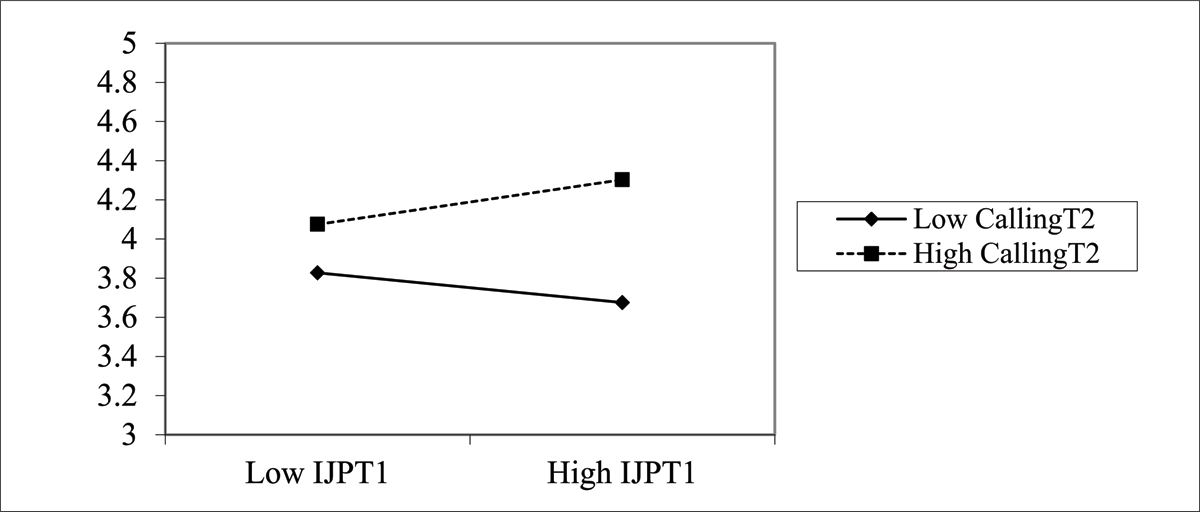
Figure 1
The interaction effect of intensified job-related planning and decision-making demands (IJP) and career calling (CC) on task performance (TP).
T1 = Time 1, T2 = Time 2 (low SD = –1, high SD = +1).
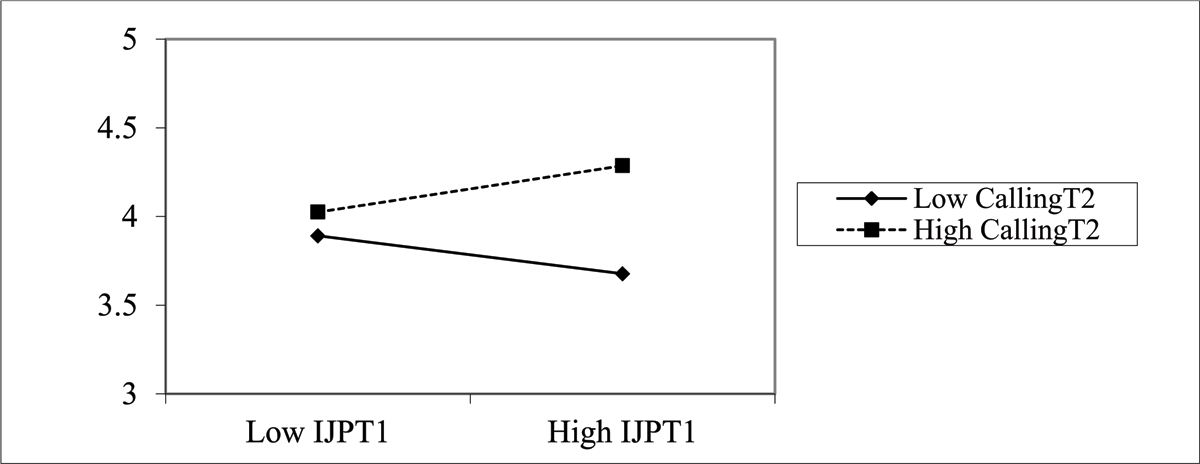
Figure 2
The interaction effect of intensified job-related planning and decision-making demands (IJP) and career calling (CC) on organizational citizenship behavior (OCB).
T1 = Time 1, T2 = Time 2 (low SD = –1, high SD = +1).
We also found a moderator effect of calling and WI on the performance indicators (Step 4, Table 2). However, this was not a buffering effect, as hypothesized in H3a, but rather an effect demonstrating the suppressive role of WI. In the presence of higher WI (a subdimension of IJDs illustrating a high hindrance demand), both TP (β = –.117, p < .01, see Figure 3) and OCB (β = –.182, p < .001, Figure 4) was lower among employees with higher calling than among those reporting lower calling. These results suggest that high WI might be appraised as a hindrance demand, which prevents employees from living out their calling at work, suppressing the positive effect of calling on performance. This interpretation is supported when considering the situation under a low WI (see Figures 3 and 4); in such a non-stressful situation, employees with high calling reported the highest TP and OCB, indicating the beneficial main effect of calling on performance when this hindrance demand is low.
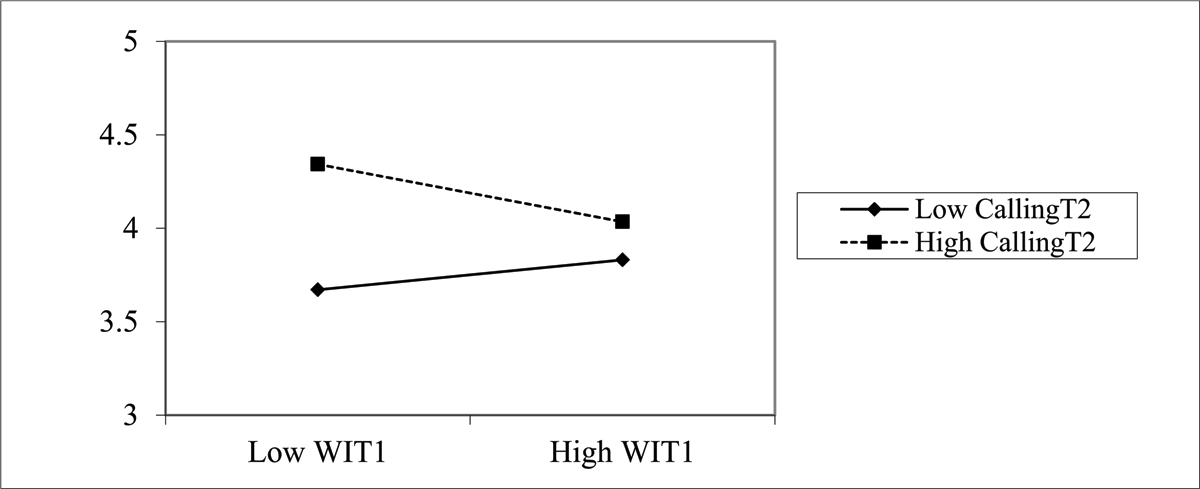
Figure 3
The interaction effect of work intensification (WI) and career calling (CC) on task performance (TP).
T1 = Time 1, T2 = Time 2 (low SD = –1, high SD = +1).
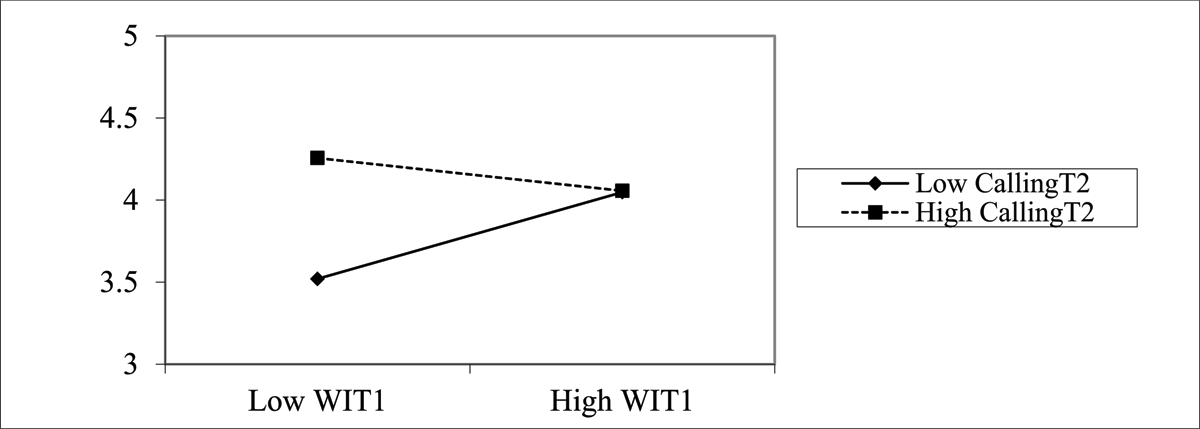
Figure 4
The interaction effect of work intensification (WI) and career calling (CC) on organizational citizenship behavior (OCB).
T1 = Time 1, T2 = Time 2 (low SD = –1, high SD = +1).
Discussion
This study explored the lagged effects of intensified job demands (IJDs) on performance (task performance; TP and organizational citizenship behavior, OCB) by investigating whether calling would moderate the relationship between IJDs and performance. In general, the results supported our hypotheses. However, neither the moderator nor the direct relationships were found for all subdimensions of IJDs, representing quantitative work intensification (WI), intensified job- (IJP) and career-related (ICP) planning and decision-making demands, and intensified learning demands (ILD). As far as we know, this is the first study to focus on the moderator role of calling in the relationships between these particular job demands and their outcomes.
Calling was associated with performance, whereas job demands were not
The results showed that IJDs were not associated with performance, thus failing to support H1, whereas calling was positively associated with both forms of performance, thus supporting H2. The latter finding is fully consistent with previous studies showing a small and positive relationship between calling and job performance (e.g., Duffy, Autin et al. 2018; Duffy, Dik et al. 2018; Sharma et al. 2022; Vianello et al. 2022). In this vein, it should be noted that our study – like the vast majority of earlier studies – only provides cross-sectional evidence of the relationship between calling and performance. Although the direction of causality is in line with the Work as a Calling Theory (Duffy, Dik et al. 2018, Duffy, Douglas et al. 2019), we still lack evidence about lagged associations because calling and performance were measured at the same wave (Time 2). Nevertheless, this finding suggests that organizations which want their personnel to perform well, both in-role (TP) and extra-role (OCB), could plan and implement measures and interventions that improve employees’ capabilities to live out their calling through their career/work. According to the Work as a Calling Theory (Duffy, Dik, et al. 2018; Duffy, Douglas et al. 2019), such interventions might include supporting individuals in their jobs, increasing their job crafting opportunities, creating conditions towards meaningful work, and increasing person–job fit (Harzer & Ruch 2016).
The second unexpected finding is that IJDs were not associated with performance. This observation is harder to explain, and is inconsistent with the challenge-hindrance model, which postulates that both challenge and hindrance demands result in consequences for well-being, motivation, or both (Cavanaugh et al. 2000; LePine 2022; O’Brien & Beehr 2019). It could be that IJDs are such hindrance and challenge demands, that would be associated with other types of outcomes than job performance, e.g., job burnout and work engagement (Huhtala et al. 2021; Kubicek et al. 2015; Mauno et al. 2023; Minkkinen et al. 2021). Overall, it has recently been indicated that IJDs are not always robust antecedents for employee outcomes (for a review, see Mauno et al. 2023), although they are often considered relevant job demands in contemporary, intensified working life (Herttalampi et al. 2023; Huhtala et al. 2021; Kubicek et al. 2015; Mauno & Kinnunen 2021; Minkkinen et al. 2021). It is also noteworthy that earlier studies on the effects of IJDs have been cross-sectional (easier to identify significant effects), whereas we analyzed lagged effects as IJDs were measured one year before the outcomes (harder to identify significant effects).
Furthermore, we also observed that this picture changed when IJDs combined with calling were analyzed via their moderator effects. In these moderator analyses (see Helm & Mark, 2012), some subdimensions of IJDs were associated with the performance indicators when accompanying calling. This, in turn, proposes that the effects of IJDs on job performance might be conditional on a ‘third factor,’ such as calling. Searching different moderators between challenge and hindrance demands and their outcomes have recently been called for (LePine 2022; O’Brien & Beehr 2019), and our results suggest that calling might be one of these moderators.
Calling operated as a moderator in combination with certain job demands
We found that the moderating role of calling on performance differed according to the subdimensions of IJDs. If a particular hindrance demand (WI) was high, employees with higher calling reported poorer performance (TP and OCB) compared to employees with lower calling. Thus, high WI (describing expectations to work harder and faster, and to multitask) suppressed the positive effect of calling on performance. This finding was unexpected (contrasting H3a), as we had hypothesized that high calling, as a notable personal resource, would mitigate the harmful effects of this hindrance demand on performance, thus acting as a buffer against stress. Such buffering effects in relation to other types of job demands have already been reported in earlier studies (see Creed et al. 2014; Dalla Rosa et al. 2023; Wu et al. 2019).
However, there is increasing evidence showing that job demands, particularly hindrance demands, might also suppress the positive effects of calling on different outcomes, including performance, mental health, burnout, and work–family balance (see Andel et al. 2022; Sharma et al. 2022; Vianello et al. 2022; Wilson & Britt 2021). For example, Andel et al. (2022) revealed that calling functioned as a vulnerability factor: on stressful working days, those who had higher calling reported more exhaustion and sleeping problems than those who had lower calling. Also, Wilson and Britt (2021) showed that calling functioned as a harmful moderator between hindrance demands and the outcomes (work motivation, health symptoms) by exacerbating the detrimental effects of hindrance demands. Altogether, this growing empirical evidence proposes that stressful working conditions, realized particularly via hindrance demands, might include a threat to an individual’s calling. Missed callings, that is, when individuals are unable to live out their callings at work, are known to associate with different detrimental consequences (Berg et al. 2010; Gazica & Spector 2015). In stressful working conditions, employees might benefit from stress management interventions aiming to create opportunities for employees to live out their calling, such as letting them craft their job, (re)focusing on the meanings they see in their work and fostering person–job fit (Harzer & Ruch 2016). More importantly, organizations should pursue less stressful working conditions, allowing employees to live out their callings (Ehrhardt & Ensher 2021) because living out a calling is linked to many positive outcomes (Dobrow et al. 2023; Duffy & Dik 2013; Thompson & Bunderson 2019).
However, not all job demands are equally harmful if combined with high calling (Wilson & Britt 2021; Wu et al. 2019). We indicated that if one specific challenge demand was high, i.e., IJP (intensified job-related planning and decision-making demands), employees with higher calling compared to those with lower calling reported better in-role (TP) and extra-role (OCB) performance. This finding supports our third (H3b) hypothesis, stating that high calling would amplify the positive effects of challenge demands on performance. However, it should be recalled that two other challenge-related subdimensions of IJDs (i.e., intensified career-related planning and decision-making demands, and intensified learning demands) were not moderated by calling, nor were they related directly to performance. Thus, the third hypothesis was only partially supported. Increases in job-related planning and decision-making demands may signal improved work-related autonomy or increased agency concerning one’s job, which has long been perceived as a notable job resource resulting in many positive outcomes (e.g., Aronsson et al. 2017; Karasek & Theorell 1990). This similarity may explain the positive interaction relationship found for this particular subdimension of IJDs. In calling occupations, e.g., teaching, organizations should support employees’ autonomous planning and decision-making regarding work tasks, as increasing such challenge demands may help them to live out their callings at work. Such a win–win situation, i.e., increased autonomy combined with strong calling, may eventually result in positive consequences, e.g., good performance. Nevertheless, it should be noted that calling may not function the same way in different occupational groups. We found these effects among teachers (traditional calling occupation) but there is a need to replicate our findings in other occupational groups.
Theoretical implications and directions for future research
Altogether, our findings support the idea that the effects of calling on in-role and extra-role job performance can be conditional upon environmental factors, e.g., different types and strengths of job demands. This observation underscores the role of job demands while clarifying the effects of calling on motivational and well-being outcomes (see also Andel et al. 2022; Creed et al. 2014; Dalla Rosa et al. 2023; Vianello et al. 2022; Wilson & Britt 2021; Wu et al. 2019). We encourage researchers to examine different job demands in this respect.
Viewed theoretically, our findings can be interpreted according to the challenge-hindrance model (e.g., Cavanaugh et al. 2000; LePine 2022; O’Brien & Beehr 2019), which argues that different job demands do exist, and they tend to result in different outcomes. Specifically, this model postulates that hindrance demands, such as organizational or work-related restrictions, are likely to result in negative outcomes (e.g., poor well-being), whereas challenge demands may boost personal growth, development, and high performance (positive motivational outcomes). Evaluating our findings more closely in the light of this latter challenge hypothesis does not yield any firm conclusion about the dual role of job demands. The job demands that we explored—IJDs categorized as hindrance and challenge demands (e.g., Herttalampi et al. 2023; Huhtala et al. 2021; Mauno et al. 2023)—were not directly associated with performance over time (while controlling for the baseline level of performance). This null finding particularly undermines the hypothesized positive effects of challenge demands on performance (Cavanaugh et al. 2000; LePine 2022) but is nevertheless consistent with a recent meta-analysis (Mazzola & Disselhorst 2019), which found only weak empirical support for the positive effects of challenge demands. Perhaps challenge demands result in positive consequences only in the presence of appropriate personal or work-related resources, e.g., if experiencing calling. Indeed, different personal and contextual factors may moderate the relationships between challenge (and hindrance) demands and their outcomes (LePine 2022; O’Brien & Beehr 2019), and such moderators should be clarified more in future research preferably via longitudinal designs. This suggestion is also in line with the JD-R model (Bakker et al. 2014; Bakker et al. 2023), which argues that job and personal resources are likely to affect (moderate) the relationships between job demands and their outcomes.
In our study, the picture was mixed when calling was studied in combination with IJDs and in relation to job performance. As mentioned previously, some of the studied job demands (i.e., WI, IJP) revealed relationships with performance only if combined with calling. These findings are overall consistent with the Work as a Calling Theory (Duffy, Dik et al. 2018; Duffy, Douglas et al. 2019), which presents that job characteristics, as environmental factors through a process of person–job (mis)fit, do affect how employees manage to live out their calling at work. Analyzing different environmental factors, e.g., job demands, in concert with calling may produce new, interesting knowledge about their combined effects on different outcomes (Creed et al. 2014; Vianello et al. 2022; Wilson & Britt 2021). Future studies in this field should broaden not only the scope of job demands but also the scope of the outcomes.
Limitations
There are several significant limitations in this study. First, even though we used a one-year lagged design, not all variables were measured repeatedly, and for this reason we were unable to reliably test longitudinal associations. We were not able to utilize a full-panel design (to measure all constructs in each wave), and consequently, we could not explore whether and how the indicators of job performance might have affected the experiences of IJDs or/and calling over time, or whether calling functioned as a mediator (rather than a moderator) between job demands and the outcomes. Yet the relationships between the phenomena studied were theoretically explicable according to the challenge-hindrance (Cavanaugh et al. 2000; LePine 2022; O’Brien & Beehr 2019) and JD-R (Bakker et al. 2014; Bakker et al. 2023) models, both of which argue that job demands affect well-being and motivation, not vice versa. Future studies should longitudinally test the direction of causality between calling and job performance, which is theorized in the Work as a Calling Theory (Duffy, Dik et al. 2018; Duffy, Douglas et al. 2019) but still lacking empirical evidence.
The second limitation is also methodological and concerns time-lag; we used a one-year time-lag and are not sure whether it is optimal for detecting significant associations between the phenomena studied. However, this time-lag was negotiated with the teachers’ trade union and was feasible considering the time frame of the research project. Third, we sampled only one occupational group (teachers), which may limit the generalizability of our findings. Relatedly, the response rate in the follow-up was less than we had hoped for, and it is possible that sample attrition affected the findings (e.g., through the healthy worker effect). Fourth, job performance had to be assessed via self-reports because we recruited the participants via the trade union, allowing us to gather no organization-specific information, e.g., objective or supervisor-evaluated performance ratings. Fifth, it should also be considered that we cannot rule out the explanation that some unknown “third factor” (e.g., personality, dispositional factor) may affect the relationships we found.
Furthermore, other notable limitations concern the assessment of job demands, i.e., IJDs scale. We did not assess a direct appraisal on whether an employee perceived IJDs as (personal) hindrances or challenges although such direct appraisal approach has recently been recommended (LePine 2022; O’Brien & Beehr 2019). Moreover, the rating scale of IJDs is problematic in longitudinal designs as a respondent evaluates retrospectively changes in job demands over the past five years (not appropriate for newcomers). It is also noteworthy that the IJDs scale was initially developed to assess the overall effects of social acceleration in working life (see Kubicek et al. 2015; Mauno, Kubicek et al. 2019), and for this reason the items of this self-report scale were formulated to avoid individualistic expressions (my/mine/me). This approach clearly differs from typical individualistic-based assessment scales of job demands. However, as far as we know, the IJDs scale is the first authentically multi-dimensional assessment tool applicable to assess how social acceleration is reflected in employees’ experiences of their job demands.
Conclusions
This is the first study on contemporarily relevant job demands (IJDs) focusing on calling as a moderating personal resource in the demands–performance relationship. Our results suggest that certain job demands, e.g., those perceived as hindrances, may suppress the positive effects of calling, deserving attention in stress management interventions. However, some challenging job demands, e.g., those improving an employee’s personal work-related agency, may enable people to live out their calling at work and be associated with enhanced motivation.
Funding information
The project was funded by Research Council of Finland (grant number 308 334).
Competing Interests
The authors have no competing interests to declare.