
Introduction
Against the backdrop of population aging, the eldercare sector in Sweden, as in many countries, faces a challenging future, with the simultaneous development of increased demand for care and a diminishing workforce (OECD, 2020). As a response to this, an increasing number of European countries have raised, or are expected to raise, the legal age for state retirement benefits (OECD, 2021). When the limit to receive an old-age pension is raised, the labor supply increases. While this might solve the issue of understaffing, it may also have consequences for intentions to change jobs instead of waiting for retirement among older employees (Kraak et al., 2017). With a longer working life in sight, older employees might feel more inclined to change jobs if they are unsatisfied with their present work. Therefore, there is a growing need to focus on the intention to change jobs in later working life (Garthe & Hasselhorn, 2022). The literature on older employees has mainly focused on transitions between work and retirement, and the end of working life (Taylor et al., 2016). While retirement signifies the end of job mobility (Ng & Feldman, 2009), turnover reinvokes employee mobility in finding new employment. It is therefore important to examine not only the intention to retire but also the intention to leave one’s job for another job among older employees.
Despite care workers having relatively high job satisfaction (Rose, 2003), they are likely to leave their work (OECD, 2020). Turnover is relatively high among both care workers (Elstad & Vabø, 2021; OECD, 2020) and managers (Stengård et al., 2013). For instance, in a study on Nordic eldercare workers, 40 percent had seriously considered quitting their jobs (Elstad & Vabø, 2021). Among employees with long work experience, one of the most prominent factors affecting the decision to retire or continue working are opportunities for development and autonomy (see e.g., Chen & Gardiner, 2019). Age-management strategies such as creating more individualized work conditions in the form of individual arrangements (sometimes referred to as idiosyncratic deals) is another solution advocated to attract and retain older employees (Bal et al., 2012; Bal & Jansen, 2015; Jonsson et al., 2021). With individual arrangements, we refer to individually negotiated agreements made between the employee and a supervisor or manager regarding specific aspects of the work situation (Rousseau et al., 2006). Both autonomy and individual arrangements can be described as a “win-win” for employees and employers, and both forms of influence on the work situation have also been found to result in similar outcomes. Autonomy is positively related to health and well-being, performance, job satisfaction and low turnover intentions (Avgar et al., 2012), while individual arrangements have been found to affect voice behavior, job satisfaction, commitment, motivation to continue work after retirement and turnover intentions (Liao et al., 2016). In the literature, measurements of autonomy most often focus on task autonomy, which does not account for structural work conditions. This article, however, focuses on procedural autonomy, which refers to the collective influence over the frames and structure of the workday. It regards possibilities to temporarily adjust when, where, and how work is done (Lopes et al., 2014), for example to work at a slower pace or in another place without preceding permission or individual negotiations with a supervisor or manager. Whereas autonomy is a form of general and collective influence, individual arrangements can be seen as part of an individualization process, where responsibility for the work situation is decentralized to the individual (Bal & Lub, 2016).
As the eldercare sector in Sweden are in dire need of staff (SALAR, 2018) and the levels of job autonomy among care workers have declined (Strandell, 2020; Szebehely et al., 2017) it is an interesting context for examining the prevalence of different kinds of influence on the work situation and their importance for turnover intentions among older employees. Whereas autonomy has been well studied, there are fewer empirical studies on individual arrangements (Conway & Coyle-Shapiro, 2016).
To our knowledge, collective and individual dimensions of influence on the work situation have not been studied together before. Furthermore, since employees might be affected differently as autonomy and possibilities for individual arrangements vary depending on occupational class (Goldthorpe, 2000; Hörnqvist, 2018; Vogt, 2018), it is also of interest to examine the relation between occupational class and intention to leave among older employees. Hence, the purpose of the study is to examine how the importance of different forms of influence on the work situation (procedural autonomy and individual arrangements), at different occupational class positions affects the intention to leave among older employees in the eldercare sector. The article contributes to the literature by analyzing and contrasting different forms of influence in relation to the intention to leave, under control for occupational class. It further contributes to an examination of the relevance of individual arrangements in a Swedish context, characterized by a labor market that, to a high extent, is collectively regulated.
The Swedish Context
The labor market in Sweden is characterized by collectively determined agreements between trade unions and employers/employer organizations at both national and local levels (Furåker & Larsson, 2020). This institutionalized model of collective regulations might limit the extent of individual arrangements and their importance in Sweden (Jonsson et al., 2021). However, processes of individualization are nonetheless present. Decades of decentralization of collective bargaining have institutionalized individualized wage setting, which has particularly affected the public sector (Kjellberg, 2019; Ulfsdotter Eriksson et al., 2021). Most collective agreements statue the right to yearly salary negotiation. However, the scope for the negotiation is limited by a normative use of wage raises in the industry (the “mark”) as the benchmark, and limited local pots for wages, creating a zero-sum game where giving a reward to one employee reduces the availability of raises for the others (Ulfsdotter Eriksson et al., 2021). Hence, as individualized wage setting co-exist with collective regulations, the prevalence and impact of individual arrangements might be less distinct than in other contexts.
Furthermore, Swedish working life is known for relatively high levels of job autonomy. However, there are gender differences (Corin et al., 2021), and decision authority is still limited in sectors where women predominate, specifically in care work (Aronsson et al., 2021; Cerdas et al., 2019; Nyberg et al., 2021). New Public Management, with its emphasis on efficiency and cost reduction through competition, has transformed public eldercare in the Nordic countries (Andersson & Kvist, 2015) and led to far-reaching organizational changes such as time pressure, strict governance control (Dellve & Kheddache Jendeby, 2022), standardization and decreased autonomy (Trydegard, 2012; Vabø, 2009).
The public eldercare sector in Sweden is regulated through a chain of hierarchical decisions where the care workers seldom make any formal decisions about care. However, since work in eldercare, even for unskilled workers, requires flexibility and adjustment of work tasks in relation to the elders’ needs and preferences, a certain amount of decision latitude and task autonomy characterizes all work in the sector (Kamp & Hvid, 2012). However, possibilities to adjust work, in accordance with the needs of others, reflect characteristics of the tasks and the organization of work rather than the individual’s autonomy over the conditions for her work situation. It is therefore important to redefine the view of autonomy and move away from the focus on task autonomy.
Procedural Autonomy
Autonomy is a classic cornerstone in the field of labor studies (Gallie et al., 2004; Väänänen et al., 2020). Studies on work autonomy in the public sector have shown a relationship between autonomy and health and well-being, early retirement thoughts (Elovainio et al., 2005), and lower turnover intentions (Avgar et al., 2012; Han et al., 2015; Thompson & Prottas, 2006). In line with this, earlier research on eldercare has found that care workers who experience low autonomy are more inclined to leave their work (Clausen et al., 2014; Trydegard, 2012).
Work autonomy is also a central concept in class analysis (Vogt, 2018). Depending on the skills required and possibilities to monitor work, there are different possibilities for employers to control employees (Edlund & Grönlund, 2010). In general, a higher occupational class implies more complex work tasks which are harder to monitor, whereas work in lower-class occupations is more often routine based and easier to monitor (Goldthorpe, 2000; Hörnqvist, 2018). However, work autonomy also depends on how work is organized, the extent of standardized work processes, rules and surveillance systems, and the prevalence of freedom from technical control (Kalleberg et al., 2009). As the employment contract does not regulate everything within employment, employees will always have some non-negligible amount of discretion (Goldthorpe, 2000).
The majority of studies on autonomy focus on task autonomy and decision latitude over work methods (De Spiegelaere et al., 2016). In care work, task autonomy and decision latitude refer to, e.g., which type of care is to be given (Weston, 2009). However, scholars have stressed the importance of also focusing on work time, pace and location when studying autonomy (de Jonge et al., 1999; De Spiegelaere et al., 2016). Väänänen and Toivanen (2018) argue that the lack of task autonomy is usually not the problem; rather, the limited time available to complete all required tasks undermines employees’ ability to choose how to carry out their work (Väänänen et al., 2020). Following this line of reasoning, this article focuses on procedural autonomy, which refers to influence over the frames and structure of the workday (Lopes et al., 2014), such as by being able to modify work effort for a short time.
Hypothesis 1. Procedural autonomy will have a negative association with intention to leave, also under control for occupational class, gender, self-rated health, age, place of birth and tenure.
Individual Arrangements
Individual arrangements refer to the possibility for employees to make individual agreements with their employers regarding their working conditions (Rousseau et al., 2006). A distinction can be made between formal and informal working arrangements. Formal arrangements are made with the employer, and informal arrangements are decided with one’s supervisor or manager. Both types of arrangements allow the individual some flexibility in terms of amount, time and location of work (De Menezes & Kelliher, 2017). The informal arrangements are not regulated in the employment contract, instead they are outcomes of individual negotiations between employees and their supervisors. Most existing studies on individual arrangements focus on one or more of the following four aspects; work hour flexibility, workload reductions, career development (Rousseau & Kim, 2006), work tasks/job content (Hornung et al., 2010; Rosen et al., 2013), and location flexibility (Rosen et al., 2013).
Furthermore, earlier studies have shown that individual arrangements are more common among those in higher-class positions (Jonsson et al., 2021). The possibility of making individualized work arrangements of increased responsibilities and resources has been found to be associated with job level (Hornung et al., 2010), job type (Damman & Henkens, 2020; Hornung et al., 2009) and gender (Damman & Henkens, 2020). Considering that flexibility in general is expected to be heavily dependent upon job type, it is reasonable to expect a similar relationship between occupational class and individual arrangements. Nevertheless, structural conditions for individual arrangements have received relatively little attention in the literature (Jonsson et al., 2021).
Hypothesis 2. Individual arrangements will be unevenly distributed between different occupational classes, also under control for procedural autonomy, gender, self-rated health, age, place of birth and tenure.
Individual arrangements are negotiated to regulate personal conditions (Hornung et al., 2009) in order, for example, to enhance motivation among older employees (Bal et al., 2012). This may explain why associations between individual arrangements and turnover have been stronger among older employees, where work-related preferences tend to be more heterogeneous (Bal & Jansen, 2015).
Hypothesis 3. Individual arrangements will have a negative association with intention to leave, also under control for occupational class, gender, self-rated health, age, place of birth and tenure.
Unlike autonomy, individual arrangements require an interest and some level of engagement from the employee. Since procedural autonomy does not imply individual negotiation, but is embedded in the job itself, it can be expected to benefit more people and thus have more importance for intention to leave than individual arrangements.
Hypothesis 4. Procedural autonomy is expected to have a greater influence on intention to leave than individual arrangements.
Data and Methods
Study Sample
Data were obtained from the HEARTS-LEXLIV study, a digital survey directed to all public-sector employees aged 55 years or older in the municipality of Gothenburg, Sweden (Seldén et al., 2020). The study sample consists of part- and full-time employees >55 years old in the eldercare sector (N = 769) in 2019. The response rate was 35.9 percent. Among the respondents, 58.5 percent were assistant nurses or caring assistants. Other occupational groups included are, for example, nurses, administrators, managers, and social workers. The mean age of respondents was 59.5 years, 90 percent were women (reflecting the gender distribution in the sector), 24.3 percent were born outside of Sweden, 64.9 percent had held their current job for 5 years or more, and 12.2 percent reported poor self-rated health. Finally, 65.5 percent of respondents were employed in blue-collar jobs (skilled or unskilled) (Table 1).
Table 1
Characteristics of the sample and group differences in autonomy, individual arrangements and intention to leave (total N = 769).
| N (%) | PROCEDURAL AUTONOMY M (SD) | INDIVIDUAL ARRANGEMENT: SCHEDULE FLEXIBILITY M (SD) | INDIVIDUAL ARRANGEMENT: TASK AND WORK RESPONSIBILITIES M (SD) | INDIVIDUAL ARRANGEMENT: FINANCIAL INCENTIVES M (SD) | INTENTION TO LEAVE M (SD) | |
|---|---|---|---|---|---|---|
| All | 769 (100) | 3.47 (2.55) | 3.11 (2.78) | 2.96 (3.09) | 3.32 (3.04) | 1.98 (2.52) |
| Age | ns. | ns. | ns. | ns. | *** | |
| 55–61 | 549 (70.4) | 3.46 (2.55) | 3.04 (2.75) | 2.91 (3.09) | 3.37 (3.06) | 2.20 (2.55) |
| 62–70 | 220 (28.6) | 3.50 (2.56) | 3.25 (2.84) | 3.07 (3.10) | 3.20 (3.01) | 1.45 (2.38) |
| Gender | ns. | ns. | ns. | ns. | ns. | |
| Female | 692 (90.0) | 3.41 (2.57) | 3.09 (2.79) | 2.92 (3.09) | 3.33 (3.07) | 1.95 (2.48) |
| Male | 77 (10.0) | 3.96 (2.28) | 3.23 (2.69) | 3.27 (3.05) | 3.19 (2.79) | 2.22 (2.91) |
| Occupational Class position | *** | *** | ** | ns. | ns. | |
| Unskilled workers (UW) | 207 (26.9) | 2.15 (2.09) | 2.70 (2.49) | 2.51 (2.58) | 3.13 (2.95) | 2.18 (2.73) |
| Skilled workers (SW) | 297 (38.6) | 2.36 (1.89) | 2.66 (2.54) | 3.18 (3.17) | 3.39 (3.15) | 2.09 (2.48) |
| Lower-grade service class (LSC) | 199 (25.9) | 4.91 (2.11) | 3.81 (2.94) | 3.37 (3.19) | 3.14 (2.88) | 1.64 (2.29) |
| Higher-grade service class (HSC) | 66 (8.6) | 6.87 (1.46) | 3.77 (3.35) | 2.14 (2.78) | 4.12 (3.28) | 2.0 (2.69) |
| Poor self-rated health | ns. | ns. | ns. | ns. | *** | |
| Yes | 71 (12.2) | 3.05 (2.52) | 2.87 (2.76) | 2.78 (2.84) | 2.66 (2.84) | 3.09 (2.86) |
| No | 511 (87.8) | 3.56 (2.56) | 3.14 (2.81) | 2.92 (3.11) | 3.38 (3.06) | 1.85 (2.45) |
| Organizational tenure | * | ns. | ns. | ns. | ns. | |
| < 5 years | 261 (35.1) | 3.81 (2.71) | 3.17 (2.75) | 2.90 (3.00) | 3.14 (2.89) | 2.09 (2.64) |
| ≥ 5 years | 483 (64.9) | 3.28 (2.43) | 3.08 (2.80) | 3.00 (3.15) | 3.41 (3.12) | 1.90 (2.45) |
| Foreign born | ns. | ns. | ns. | ns. | ns. | |
| Yes | 141 (24.3) | 3.22 (1.91) | 3.45 (2.90) | 3.46 (3.35) | 3.51 (3.33) | 2.11 (2.33) |
| No | 440 (75.7) | 3.57 (2.71) | 3.00 (2.77) | 2.76 (2.98) | 3.25 (2.96) | 1.96 (2.60) |
[i] Note: All indices are measured on a scale from 0 to 10. Significance of group differences was assessed using the Kruskal-Wallis H test (>2 groups) and the Wilcoxon rank-sum test (2 groups). *p < 0.05. **p < 0.01. *** p < 0.001.
Measures
All focal measures were indicated by latent variables, which comprise the covariance between a set of observed indicators (for internal correlations and Cronbach’s alpha see Appendix), estimated by confirmatory factor analysis (CFA). The estimation procedures are described in more detail under “Statistical analyses.” All manifest items used to construct latent variables can be found in Table 2.
Table 2
Measurement models.
| AUTONOMY AND INDIVIDUAL ARRANGEMENTS | INTENTION TO LEAVE | |||||
|---|---|---|---|---|---|---|
| COEF. a | CI | P | COEF. a, b | CI | P | |
| PROCEDURAL AUTONOMY | ||||||
| How can you adapt your work if you feel tired and fatigued, have aches and pains, a cold or similar? I can… | ||||||
| Performance | 0.912 | 0.863–0.962 | *** | – | – | – |
| Carry out necessary work and postpone the rest (PER1) | 0.919 | 0.888–0.949 | *** | – | – | – |
| Choose among work tasks (PER2) | 0.908 | 0.869–0.947 | *** | – | – | – |
| Work at a slower pace (PER3) | 0.714 | 0.668–0.760 | *** | – | – | – |
| Duration | 0.882 | 0.828–0.936 | *** | – | – | – |
| Take longer breaks (DUR1) | 0.850 | 0.804–0.896 | *** | – | – | – |
| Shorten the working day (DUR2) | 0.927 | 0.884–0.969 | *** | – | – | – |
| Place | 0.806 | 0.740–0.872 | *** | – | – | – |
| Work from home (PLA1) | 0.885 | 0.819–0.951 | *** | – | – | – |
| Work from a computer or other digital aid (PLA2) | 0.841 | 0.765–0.918 | *** | – | – | – |
| INDIVIDUAL ARRANGEMENT: SCHEDULE FLEXIBILITY | ||||||
| My employer (manager) has granted me a higher degree of flexibility concerning the execution of my work task (SF1) | 0.844 | 0.805–0.883 | *** | – | – | – |
| My employer is open to discussing my working conditions based on my individual needs and desires (SF2) | 0.891 | 0.859–0.923 | *** | – | – | – |
| My manager takes into account my personal requests for working hours (schedules) (SF3) | 0.694 | 0.630–0.758 | *** | – | – | – |
| Based on my wishes, my supervisor (manager) takes into account my private situation when determining my working hours (SF4) | 0.683 | 0.617–0.748 | *** | – | – | – |
| I have permission from my supervisor (manager) to take time off for non-work-related matters (SF5) | 0.630 | 0.544–0.716 | *** | – | – | – |
| INDIVIDUAL ARRANGEMENT: TASK AND WORK RESPONSIBILITIES | ||||||
| I have agreed with my employer (manager) to be assigned tasks that better match my competence and experiences (TWR1) | 0.940 | 0.925–0.956 | *** | – | – | – |
| I have agreed with my employer (manager) to be assigned tasks that better develop my knowledge (TWR2) | 0.954 | 0.938–0.969 | *** | – | – | – |
| I have discussed the possibility of being assigned tasks that better match my skills and abilities with my employer (manager) (TWR3) | 0.909 | 0.887–0.930 | *** | – | – | – |
| My employer has offered me the opportunity to work with tasks that are outside my usual area of responsibility (TWR4) | 0.738 | 0.690–0.786 | *** | |||
| INDIVIDUAL ARRANGEMENT: FINANCIAL INCENTIVES | ||||||
| Based on my special skills, my employer is open to discussing my salary and other benefits (FI1) | 0.884 | 0.824–0.944 | *** | |||
| My employer has increased my salary because of my good performance (FI2) | 0.727 | 0.647–0.807 | *** | |||
| INTENTION TO LEAVE | ||||||
| I feel like quitting my current job (ITL1) | – | – | – | 0.808 | 0.767–0.849 | *** |
| I am searching/will start searching for a new job (ITL2) | – | – | – | 0.930 | 0.888–0.972 | *** |
| If I find a new job, I would end my current employment (ITL3) | – | – | – | 0.902 | 0.870–0.935 | *** |
| RESIDUAL COVARIANCES | ||||||
| SF3 Û SF4 | 0.663 | 0.612–0.718 | *** | – | – | – |
| TWR4 Û SF1 | 0.570 | 0.445–0.696 | *** | – | – | – |
| PER3 Û DUR1 | 0.489 | 0.336–0.641 | *** | – | – | – |
| N | 769 | 769 | ||||
| Chi2 (df) | 483.356 (123) | – | ||||
| TLI | 0.980 | – | ||||
| RMSEA | 0.062 | – | ||||
| WRMR | 1.246 | – | ||||
[i] Notes: * p < 0.05. ** p < 0.01. *** p < 0.001.
(a) Standardized coefficients.
(b) Just identified model, no fit indices available.
Procedural autonomy were measured through questions regarding employees’ opportunities to independently reduce or otherwise modify their work effort for a short time, such as by working at a slower pace, or in another place when feeling ill or tired (Hultin et al., 2010; Johansson & Lundberg, 2004). Thus, they reflect opportunities to independently exert control over one’s current work situation. The manifest variables range from 1 “Never” to 4 “Often.” Since Place, Duration and Performance reflect three distinct, albeit related, aspects of autonomy, three different latent variables were estimated to reflect each aspect (Table 2). However, since these different forms of autonomy are also intrinsically linked, the three latent variables were used to create a “second-order,” latent variable to indicate the degree of procedural autonomy more generally in the analyses.
Individual arrangements were measured through questions from the ex post i-deals scale (Rosen et al., 2013), which contains questions about the extent to which employees have negotiated specific, individualized work arrangements with their supervisor or employer (Rousseau, 2001). Individual arrangements in three distinct domains were examined, each indicated by a latent variable: Schedule flexibility, Task and work responsibilities and Financial incentives. Responses were given on scales ranging from 1 “Not true at all” to 7 “Completely true.”
Intention to leave was measured through three questions regarding respondents’ willingness to leave their current position for another job (Sjöberg & Sverke, 2000). As such, the conceptualization is distinct from, for example, retirement preferences and individuals’ desire to permanently exit the labor market. One latent variable was constructed. Responses were given on scales ranging from 1 “Not true at all” to 5 “Completely true.”
Covariates
The following variables were included to examine the prevalence of autonomy and/or individual arrangements across different groups of employees as well as to control for potentially confounding effects: Age, gender (male/female), foreign born (yes/no), tenure ≥5 years (yes/no), poor self-rated health (yes/no) and occupational class (Table 1). To indicate occupational class, the OESCH five-class scheme was used (Oesch, 2003, Oesch, 2006). Unlike class schemes that rest primarily on hierarchical division, this scheme also emphasizes differences in “work logics” (i.e., technical or interpersonal). Accordingly, it is assumed to better capture horizontal and gendered class cleavages. In the context of the present study, it differentiates between, for example, care work performed in nursing facilities and in recipients’ private homes. For employees,1 the OESCH five-class scheme distinguishes between the following four occupational class positions: (1) unskilled workers, (2) skilled workers (e.g., craft workers, clerks, and skilled service workers), (3) lower-grade service class (e.g., semi-professionals and associate managers) and (4) higher-grade service class (e.g., professionals and managers). Information on respondents’ occupations was obtained from the staff register of the municipality of Gothenburg. These were coded in accordance with the Swedish Standard Classification of Occupations 2012 (Statistics Sweden, 2012). These codes were later transformed into ISCO08 codes (ILO, 2012), which were used to create the class scheme.
Statistical Analyses
For descriptive purposes, mean differences in autonomy and individual arrangements in different groups of employees were assessed using the Kruskal-Wallis H test (>2 groups) and the Wilcoxon rank-sum test (2 groups). Data management and descriptive statistics were carried out in Stata 15.1.
To test the hypothesized relationships between i) autonomy and intention to leave, and ii) individual arrangements and intention to leave in municipal eldercare, CFA and structural equation modelling (SEM) were employed. These methodological approaches are essentially hypothesis-driven and enable the incorporation of both observed and unobserved variables. They are particularly adequate for studies aimed at examining more abstract theoretical constructs that are difficult to capture using just one single survey question. When using CFA, the covariance between a set of observed variables is used to indicate such more abstract phenomena. Because a latent variable, unlike the commonly used additive index, comprises only the covariance between the manifest indicators, measurement error is reduced. Further, compared to ordinary regression techniques, residual covariances are estimated separately throughout the modelling procedure in CFA/SEM, which means that the analysis can explicitly estimate and model measurement error. Finally, the use of SEM is advantageous as it enables concurrent tests of multiple hypotheses, that is, it is possible to include multiple outcomes and to specify regression paths also between predictors in the same model (Brown, 2015; Byrne, 2013). Considering that a number of the observed dependent variables are categorical, skewed and have fewer than five categories, the weighted least squares means and variance adjusted (WLSMV) estimator (Rhemtulla et al., 2012) were used. Accordingly, standardized probit regression coefficients are reported. Coefficients for latent and continuous predictors should be interpreted as “the change in y (in y standard deviation units) for a standard deviation change in x.” The coefficients for binary covariates should be interpreted as “the change in y (in y standard deviation units) when x changes from zero to one” (Muthén & Muthén, 1998–2017, p. 799f). Since the WLSMV estimator is computationally limited in handling missingness that has not occurred completely at random (Asparouhov & Muthén, 2010a), missing values were imputed using Bayesian estimation. Five data sets were generated and analyzed simultaneously, which means that all parameter estimates and standard errors represent averages over the five analyses (Asparouhov & Muthén, 2010b). The analyses were estimated in MPlus version 8.8.
To evaluate model fit, the following fit indices and cut-off criteria were used: a root mean square error of approximation (RMSEA) of close to 0.06 or below, a Tucker–Lewis index (TLI) of close to 0.95 or greater, and a standardized root mean square residual (SRMR) of less than 0.08 (DiStefano et al., 2018; Hu & Bentler, 1999; Yu, 2002). Model Chi2 is also reported, but because it is known to be inflated when n is large (Browne & Cudeck, 1993; Byrne, 2013), significant values were not considered to be of any major concern. All measures were evaluated concurrently as well as in relation to the theoretical plausibility of the models (Brown, 2015; Byrne, 2013).
Results
The analyses were performed in three steps, which will be presented below. First, the initial descriptive analyses are presented (Table 1). This is followed by a description of the CFA, which was used to estimate the latent variables (Table 2). Finally, the full and controlled structural model in which all four hypotheses were tested simultaneously is presented (Figure 1).
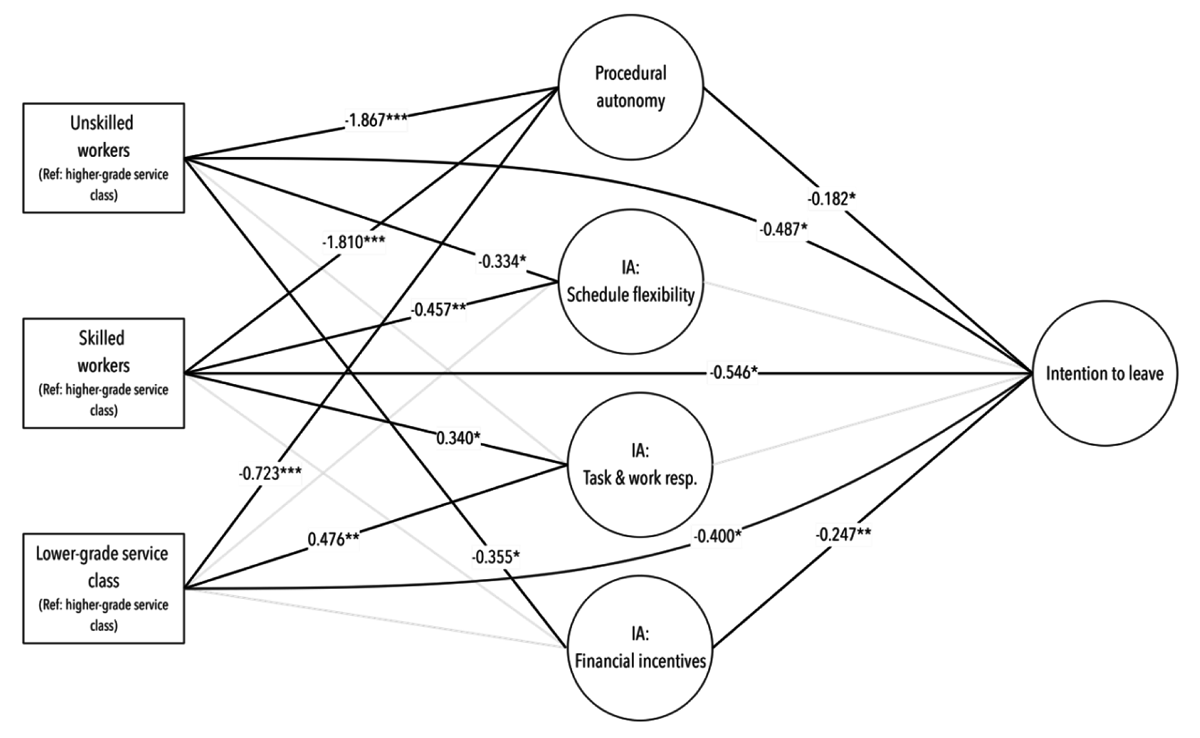
Figure 1
Full structural model (N = 769).
Notes:
(a) White circles represent latent variables; white rectangles represent observed variables. Bold lines represent significant associations; grey lines indicate non-significant associations. Abbreviation: IA = individual arrangement.
(b) Fully standardized coefficients reported, * p < 0.05, ** p < 0.01, *** p < 0.001.
(c) Model adjusted for: Gender, age, place of birth, self-rated health, and tenure (estimates excluded for clarity reasons but are available upon request).
(d) Model fit indices: Chi2 (df) = 891.007(302); TLI = 0.971; RMSEA = 0.050; SRMR: 0.088.
Descriptive Analyses
Overall, the mean value for intention to leave was low (1.98 on a 10-point scale). Likewise, the prevalence of individual arrangements was relatively low. On scales ranging from 0–10, the mean values varied between 2.96 (Task and work responsibilities) and 3.32 (Financial incentives). The experienced level of autonomy was slightly higher (3.47). Younger individuals and individuals reporting poor health were more inclined to leave their current job. Finally, the bivariate analyses confirmed a relationship between occupational class and procedural autonomy and suggested that occupational class might be related to some, but not all, types of individual arrangements (Table 1).
Confirmatory Factor Analyses
In a first step, a measurement model including all latent factors pertaining to autonomy and individual arrangements was estimated. Altogether, 11 manifest variables were used to construct three first-order factors indicating the different types of individual arrangements. Likewise, seven manifest variables were used to estimate three first-order factors corresponding to different aspects of the second-order factor autonomy. When the hypothesized model was fitted to the data, all manifest indicators were significantly related to the latent factors as posited, and factor loadings were generally high (>0.6). However, the fit indices suggested a relatively poor overall model fit (results not shown here but are available upon request). By running the model without the imputed data, localized areas of misfit were identified. The modification indices obtained from this analysis suggested three additional paths (representing residual covariances) to be added (SF3 with SF4, TWR4 with SF1 and PER3 with DUR1) (see Table 2). These changes amended overall fit to acceptable levels, as indicated by the fit indices obtained for the final model: Chi2 (df) = 483.365 (123), TLI (0.980), RMSEA (0.062) and SRMR (0.046). Again, all factor loadings were high, ranging from 0.630 to 0.954, and significant (Table 2). In a second step, a measurement model was estimated to construct the latent factor Intention to leave. Three manifest indicators were used for this purpose, all of which demonstrated high factor loadings (0.808–0.930) and a significant relationship to the latent factor. Because this model is just identified (i.e., has zero degrees of freedom), no fit indices are available to report.
The Structural Model
The full structural model included all four latent variables and the outcome, intention to leave. To control for potentially confounding effects, direct paths between all control variables and intention to leave were also specified, as were paths between the controls and the influence variables.2 As indicated by the following fit indices, the model demonstrated a good fit to the data and no further adjustments were made: Chi2 (df) = 891.007 (302), TLI (0.971), RMSEA (0.050) and SRMR (0.08).
In accordance with H1 and H3, both procedural autonomy and individual arrangements were expected to be negatively associated with intentions to leave. H1 was supported by the data, as procedural autonomy was significantly associated with intention to leave (β = –0.182; p < .05). H3 was only partially supported by the data, as it was only one of the domains of individual arrangements studied, financial incentives (β = –0.247; p < .01), that was significantly associated with intention to leave. The analysis also demonstrated that, compared to higher-grade service workers, intentions to leave were lower among both skilled (β = –0.546; p < .05) and unskilled workers (β = –0.487; p < .05) as well as among employees in lower-grade service positions (β = –0.400; p < .05).
As to H2, the model posited that individual arrangements would be unevenly distributed between different occupational classes, also under control for procedural autonomy, gender, self-rated health, age and tenure. In support of H2, both skilled (β = –0.457; p < .01) and un-skilled (β = –0.334; p < .05) workers experienced less schedule flexibility. Somewhat surprisingly, however, skilled (β = 0.340; p < .05) and lower-grade service workers (β = 0.476; p < .01) reported significantly higher levels of influence in relation to task and work responsibilities than their higher-grade counterparts did. As to financial incentives, the only significant difference between different occupational classes was observed between unskilled workers, who experienced fewer individual arrangements in this respect, and higher-grade service workers (β = –0.355; p < .05).
Finally, H4 posited that procedural autonomy would have a greater influence on intentions to leave compared to individual arrangements. This hypothesis was supported in the sense that procedural autonomy was significantly associated with intentions to leave, while this was the case for only one of the estimates for individual arrangements, financial incentives. There was a minor difference between the standardized estimate for procedural autonomy (β = –0.182; p < .05) and financial incentives (β = –0.247; p < .01). Wald chi-square test was used to assess the equality of these parameters to test whether there was a significant difference in the effect of procedural autonomy and financial incentives on intention to leave, (Muthén & Muthén, 1998–2017). The difference was not found to be significant (Wald Chi-square (1) = 0.458, p = .499.
Discussion
In this study we have examined the importance of different kinds of influence on the work situation among older employees in the public eldercare sector in Sweden, a labor market characterized by collectively determined agreements at both national and local levels. Our findings show that procedural autonomy and individual arrangements regarding financial incentives are of importance for intentions to leave. The study contributes theoretically to the literature on individual arrangements by indicating that their relevance might depend on class, sector, and labor market, factors which are absent in much of the previous research. Furthermore, the study contributes to the literature on work autonomy by shifting focus from task autonomy towards the importance of employee control over structural dimensions of work, as time and place of work. This is an important shift of focus in research of work autonomy. The study further contributes to studies on ageing and employment by focusing on intention to leave one’s job for another job instead of focusing solely on intention to retire among older employees which is significant as more and more employees are expected to work longer. The results suggest that investments in wage development and increased procedural autonomy among employees at all levels within the sector could contribute to lower intentions to leave work among older employees in the eldercare sector.
Intentions to leave were generally low in the study, but similar to earlier findings, demonstrated a negative association with age (Ng & Feldman, 2009). There are several possible explanations for lower intentions to leave among older employees. In many cases, the likelihood of getting a new job reduces when getting older. As the eldercare sector has problems with staffing, this might relate more to general perceptions of changing job at an older age. Older employees have also been found to voice dissatisfaction more easily (Cooper, 2018), which might have a buffering effect on intention to leave (Astvik et al., 2021).
In line with Hypothesis 1 the findings show a negative association between procedural autonomy and intention to leave. This finding confirms previous studies on autonomy (Avgar et al., 2012; Han et al., 2015; Thompson & Prottas, 2006), while also expanding the concept of autonomy, showing how control over the workday itself is of importance for intentions to leave. Regarding Hypothesis 2 and the assumed relation between occupational class and individual arrangements, the findings show that it was dependent on the specific arrangement. The possibility to make an individual arrangement regarding the work schedule was experienced to a lesser extent among skilled and unskilled workers than among higher-grade service workers. This can partially be explained by the organization of work (Damman & Henkens, 2020; Hornung et al., 2009), where care assistants and nurse assistants who work in direct contact with the care recipients often need to perform certain tasks at specific times. For many unskilled workers in home-based care, work is further characterized by an increasing time management. The daily schedule is often regulated on the minute (Wånell et al., 2015), creating a constant struggle to keep up with the schedule (Strandell, 2023). It also relates to the organization of work time, where care workers often work rotating shifts on 4- to 6-week schedules, an irregularity which can create discontent (Szebehely et al., 2017) and affect considerations to change job (Drange & Vabø, 2021). The finding that unskilled workers experienced less possibilities for financial incentives than higher-grade service workers might not stand out as surprising. However, less expected was that those in higher-grade service class position did not report the highest value on opportunities for task and work arrangements. This might be due to the low number of posts at higher organizational levels. With few other colleagues with similar assignments, it might be harder to change duties. It could also be due to the specific characteristics of the public sector, where the top executives are working to achieve government-mandated goals that are beyond their control to change, and a slimmed organizational structure where it is hard to delegate tasks. The care sector is female-dominated and compared to male-dominated sectors, associated with fewer managers, more subordinates per manager, sparse contact with politicians and tighter budgets (Forsberg Kankkunen, 2009; Regnö, 2021). Hence, the possibility for individual adjustments among the higher-grade service class within the eldercare sector might also be affected by sector-specific characteristics to a greater extent than occupational position.
Hypothesis 3 was partially supported. The only individual arrangement with an association to intention to leave was financial incentives. Following this, the result regarding hypothesis 4 also differed from our expectations. We expected procedural autonomy to be of greater importance for intention to leave than individual arrangements. As only one of the three domains of individual arrangements affected intention to leave, the hypothesis is partially supported. However, as there was no significant difference between procedural autonomy and financial incentive, the hypothesis is not confirmed regarding financial incentives.
Earlier studies on individual arrangements and intention to leave have shown an association regarding arrangements concerning development, flexibility and tasks rather than financial incentives (Brzykcy et al., 2019; Ho & Tekleab, 2016). Hence, this might be a sector-specific result, indicating that the description of care workers as “underpaid and overworked” (Razavi & Staab, 2011) can be expanded to the whole sector. Among care workers, which is the largest occupational group in our sample, better wages have been found to be one of the most prominent factors affecting decisions both to leave (Clausen et al., 2014) and stay (Dill et al., 2012; Morgan et al., 2013) as financial distress increases considerations to quit (Drange & Vabø, 2021). Whereas individual arrangements might be more related to facilitating for those with lower ability to meet performance expectations (see e.g., Jonsson et al., 2021), procedural autonomy might be more closely connected to intrinsic motivation through both having responsibility and master one’s work.
However, individual arrangements have migrated from an American context, where the labor market is less regulated than in Sweden. In the Swedish context it can be discussed whether financial incentives should be considered a pure individual arrangement, since most employees have the right to a yearly salary negotiation inscribed in the collective agreements. The result that unskilled workers to a lower extent experienced possibilities for financial incentives might reflect a class difference in possibilities to influence the yearly salary negotiation rather than fewer opportunities to talk about it. It could also emanate from slight differences in the collective agreements for different occupations regarding salary negotiations. However, as most of the unskilled and skilled workers in the study share the same collective agreement, and there are multiple collective agreements among both lower- and higher-grade service class occupations in the study, it would require more research to draw a conclusion about the influence of collective agreements on the matter. But as the most prominent individual arrangement in the study is closely connected to collective agreements, the relevance of individual arrangements in more regulated labor market contexts could be further analyzed.
It is likely that individual financial deals, and especially wage development, can make a great difference for employees at the end phase of their working lives, and thus, contribute to retaining them in the organization. Procedural autonomy is about trusting that employees will not misuse the ability of adjusting their workday if wanted or needed, which seems highly appreciated among older employees at all levels within the studied eldercare sector. As it is closely related to contemporary organizational trends of flexible working conditions and trust-based governing (Bentzen, 2019; Smite et al., 2023), its significance for employees may further increase.
Strengths and Limitations
The conclusions in this article must be considered in relation to the methodological strengths and limitations. The theoretical approach, use of validated survey questions and the statistical analysis add to the strength of the study. However, the design and data collection entail some limitations affecting the result’s transferability. The present study tests a hypothesized causal chain in which individual arrangements are conceptualized as preceding employees’ intentions to leave. In practice, it is of course possible that individuals who consider leaving their current job are more inclined towards negotiating such arrangements and/or that managers are more likely to agree with them if they are keen to retain the employee in question. Unfortunately, the cross-sectional design of the present study implies that no conclusions concerning causality, or its potential direction, can be drawn. We thus encourage future studies using longitudinal data to further explore the extent to which employees’ intentions to leave precedes, or are preceded by, managers willingness and ability to grant them individual arrangements. As we observed some high factor loadings (>8), and rather high internal correlation between some of the items in the latent variables (see Appendix A), it could be of relevance to revise the constructs in future studies. Furthermore, the study is based on survey data collected from employees in a specific age group in one municipality in Sweden. The response rate was moderate (40%), in line with other surveys conducted in Sweden. The non-responding group did not differ statistically significantly from responders with regards to mean age or proportion of sex and employment status (Seldén et al., 2020).
Conclusion
The study shows that turnover intentions among employees aged 55–70 years within the Swedish eldercare sector were associated with procedural autonomy and possibilities for making individual arrangements regarding financial incentives. Furthermore, the associations of different forms of influence and autonomy were unevenly distributed among occupational class positions. This shows the importance of acknowledging different contexts and occupational class when researching outcomes related to influence. In this context of older employees in the Swedish public service eldercare sector, individual arrangements were not as relevant as in other, earlier studied contexts. Regarding autonomy, our findings indicate that procedural autonomy and control over place and time during the workday is an important factor to consider in future research.
Data Accessibility Statements
Relevant data will be available from the authors upon reasonable request.
Additional File
The additional file for this article can be found as follows:
Notes
Ethics and Consent
The study was approved by the Ethics Committee in the Gothenburg Region (EPN; Dnr: 2019–02934).
Acknowledgements
We would like to thank Erica Nordlander for insightful comments on an early draft and Mattias Bengtsson for constructive comments during the development of the final manuscript.
Funding information
We are grateful to the Swedish Research Council for Health, Working Life and Welfare (Forte) (ref: 2013-2300) and AFA insurance (ref: 190280, 190281) for financial support.
Competing Interests
The authors have no competing interests to declare.
Author contributions
All authors contributed to the design of the study and the interpretation of the results. LD have done the data collection. CH was responsible for the SEM-analysis and HH for the descriptive analysis. HH was responsible for drafting the manuscript. All authors contributed to the manuscript and read and approved the final manuscript.